Options
1797 Bust dime- genuine or counterfeit? Opinions needed on this bust time. Please comment. Thanks!
 rec78
Posts: 5,965 ✭✭✭✭✭
rec78
Posts: 5,965 ✭✭✭✭✭
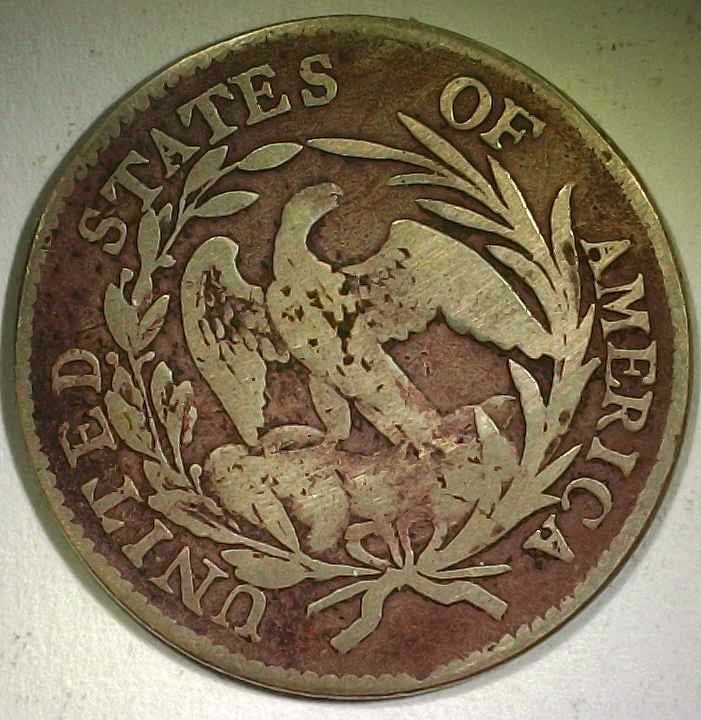
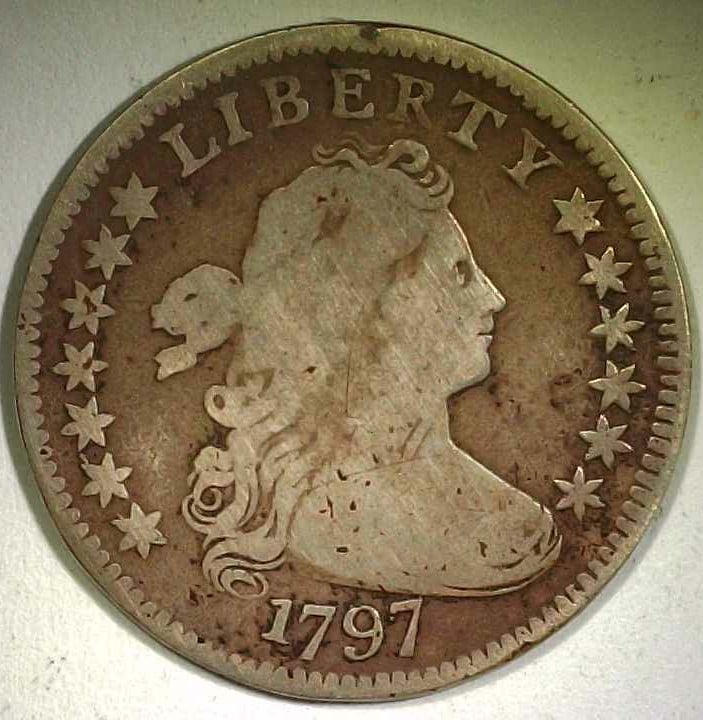
Weight is 2.32g.

1797 Bust dime- genuine or counterfeit? Opinions needed on this bust time. Please comment. Thanks!
This is a public poll: others will see what you voted for.





resized.jpg)



1
Comments
Nothing jumps out as an obvious fake. I’ll let the die marriage guys confirm though.
Same hence why I voted genuine. But I’m not an expert in this series by any means.
Successful transactions with: wondercoin, Tetromibi, PerryHall, PlatinumDuck, JohnMaben/Pegasus Coin & Jewelry, CoinFlip, coinlieutenant, bigjpst, and joebb21.
I voted real, figuring that with that honest-looking wear it would have to be a contemporary counterfeit if fake, and I wouldn't expect that early counterfeiters in the fledgling US were that skilled.
It looks real to me
Mr_Spud
Looks good to me but experience is hindering it here
wow... that's a tough one to call for me... Nothing is screaming fake, but I'll sit back and wait for the die variety experts to weigh in...
Successful BST transactions with: SilverEagles92; Ahrensdad; Smitty; GregHansen; Lablade; Mercury10c; copperflopper; whatsup; KISHU1; scrapman1077, crispy, canadanz, smallchange, robkool, Mission16, ranshdow, ibzman350, Fallguy, Collectorcoins, SurfinxHI, jwitten, Walkerguy21D, dsessom.
Has the appearance of being real, but some fakes can be that deceptive.
One concern I have, if the color is actually accurate, would be if the reddish pink color could be from artificial aging.
"To Be Esteemed Be Useful" - 1792 Birch Cent --- "I personally think we developed language because of our deep need to complain." - Lily Tomlin
Edited, in light of some of the additional posts to this thread.
Mark Feld* of Heritage Auctions*Unless otherwise noted, my posts here represent my personal opinions.
All the diagnostics look right for the 13* variety. Wear looks even & natural. Owner has weight @ 2.32; original was 2.7 - likely wear causes the difference. A member commented on the color; I can’t attest to that as “normal” or due to something else.
“The thrill of the hunt never gets old”
PCGS Registry: Screaming Eagles
Copperindian
Copperindian II
Indy Eagles
Gold Rush
Bust Caps
Retired sets: Soaring Eagles
Copperindian
Nickelodeon
Early Walkers
Successful transactions: Eagle Eye, redraider, winesteven, renomedphys, splitaces, oreville, ajaan, Cent1225, onlyroosies, justindan, blitzdude, DesertMoon, johnnyb, Heubschgold, SunshineRareCoins, ParadimeCoins, ndeagles, Southern_Knights, pcgsregistrycollector, BruceS
Possibly repaired
Real but cleaned/damaged/messed with. Won't straight grade.
Worry is the interest you pay on a debt you may not owe.
"Paper money eventually returns to its intrinsic value---zero."----Voltaire
"Everything you say should be true, but not everything true should be said."----Voltaire
With its smooth even flat appearance I just can’t see it as genuine. Pass
My suggestion get TPG material, especially if expensive coins. The fact it’s not in a TPG holder another red flag. Don’t like it. Suspicious of the color too.
It’s definitely something I would pass on.
Shop it around the bourse see what they would say or offer. That it’s a big ticket coin non TPG certified - a red flag.
Nastily beautiful on my budget.
Paper money eventually returns to its intrinsic value. Zero. Voltaire. Ebay coinbowlllc
It is difficult to fathom how any professional dealer could look at the OP's dime and come to a conclusion it is counterfeit, yet here we are.
Interesting. Check the diameter. Count the edge reeds. At first glance it looks genuine, then I compared with my PCGS VG10 of the 1797 JR2. Compare the 2 small diagonal scratches on the neck on each coin, along with the longer diagonal scratch starting at the bottom of the two scratches to hair. Also, the width of the rims appears wider on the OP coin.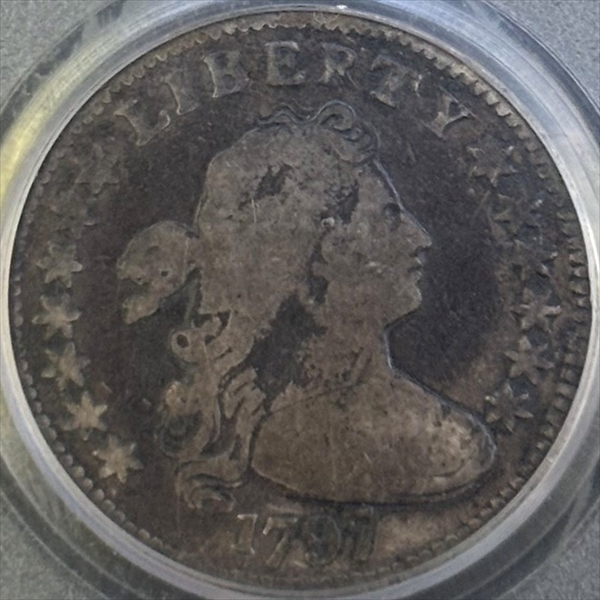
There are 2 known die pairs for dimes dated 1797, and I agree, this is JR-2 (13 stars, knobbed 9 obv.).
Compare with JR-1 (16 stars, pointed 9).
Both die pairs use the same reverse die.
This coin is a die match to JR-2 for all the obverse and reverse positional attributes listed in the Davis, et al book.
So the die markers do not indicate a counterfeit.
It could still be a counterfeit if struck from transfer dies which were made from a genuine JR-2.
In my opinion, it is genuine.
[Edit: but see below and above - identical circulation marks like the parallel scratches on neck indicate this is one of several transfer die counterfeits.]
How much less difficult would it be if you were to omit the word “professional”?
I do think the conclusion would be less difficult to fathom if it had been predicated upon something other than
“With its smooth even flat appearance I just can’t see it as genuine.”> @RedRocket said:
How much less difficult would it be to fathom if you omitted “professional” from your sentence?😈
Mark Feld* of Heritage Auctions*Unless otherwise noted, my posts here represent my personal opinions.
It looks off, even though the die markers match up. Just a gut feeling.
But it has been "boinked" quite a bit (my term for excessive abusive fore collectors and general life on planet Earth) and so, even though I THINK it is probably genuine, I really don't know.
“We are only their care-takers,” he posed, “if we take good care of them, then centuries from now they may still be here … ”
Todd - BHNC #242
@burfle23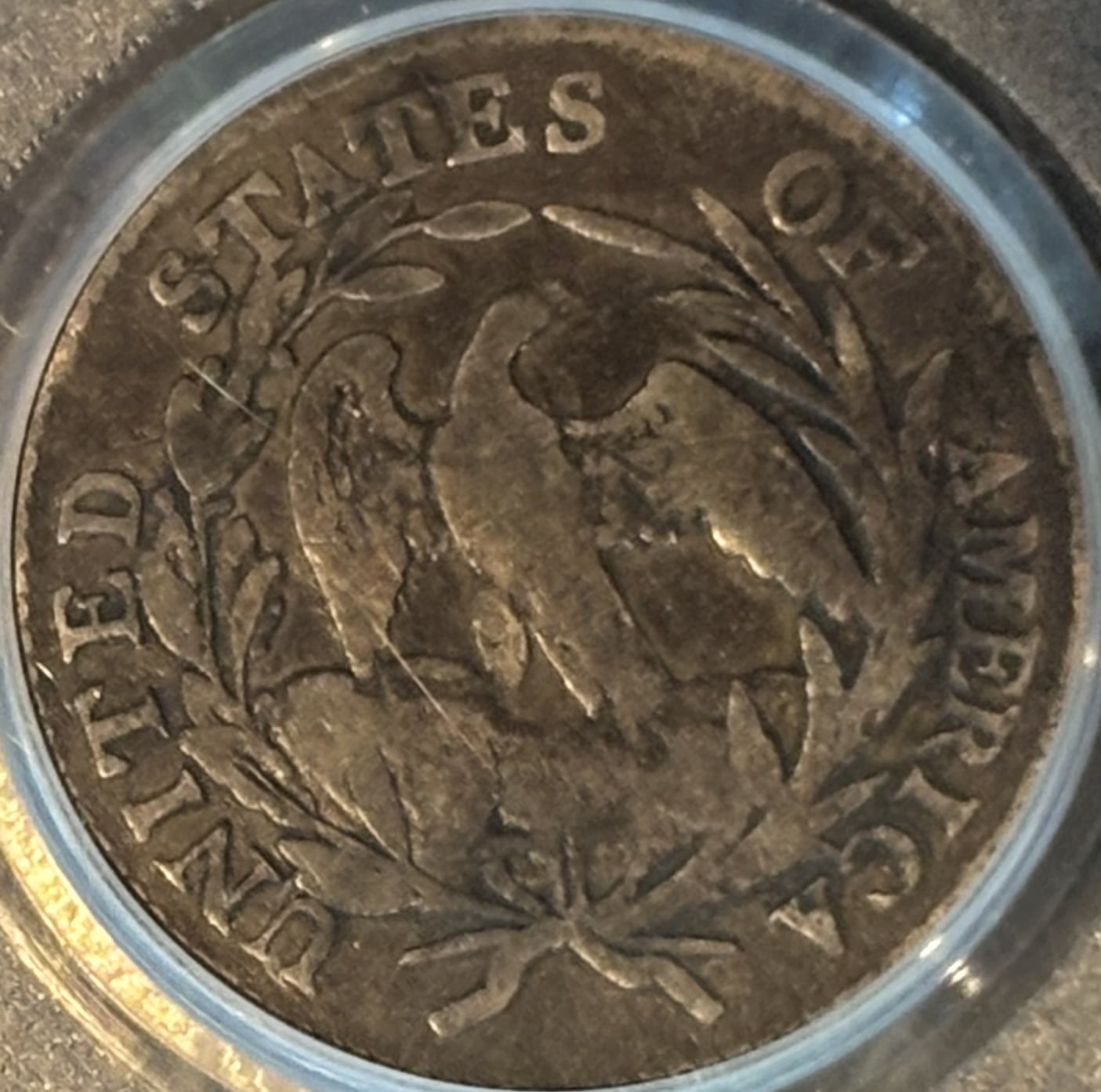
The reverse has post-mint marks that are similar to OP coin, small dig with cratering between S and T, dig on leaf below R, scratch just of end of D to leaf, others. Sorry about the pic, best I could quickly do with an iPhone.
I would say genuine, but cleaned with some crude attempts to replace some feathers on the eagle. That made me think counterfeit at first glance. It won’t get a straight grade.
But, hey, it’s a 1797 dime which is legitimately scarce.
I received a warning last week from PCGS Social to play nice.
That was me playing nice.
.
.
Not looking good for the coin in the OP.
Circulation marks cannot appear on other coins in the same identical place. That seems to be how some of the more deceptive counterfeits of various series have been confirmed that burfle23 has written about before.
"To Be Esteemed Be Useful" - 1792 Birch Cent --- "I personally think we developed language because of our deep need to complain." - Lily Tomlin
Don’t like it’s flat look and lack of detail.
Seems counterfeit.
She looks Genny.
Nothing jumps out at me that would lead me to believe otherwise.
Sometimes, it’s better to be LUCKY than good. 🍀 🍺👍
My Full Walker Registry Set (1916-1947):
https://www.ngccoin.com/registry/competitive-sets/16292/
Some of the marks do appear similar, but I do not see any that are identical. At least none that I can say for sure based on both photos.
Edit: Ok I found this one sold in 2021 that has all of the same indicators. NGC - Good Cleaned. This would indeed appear to be a transfer die counterfeit.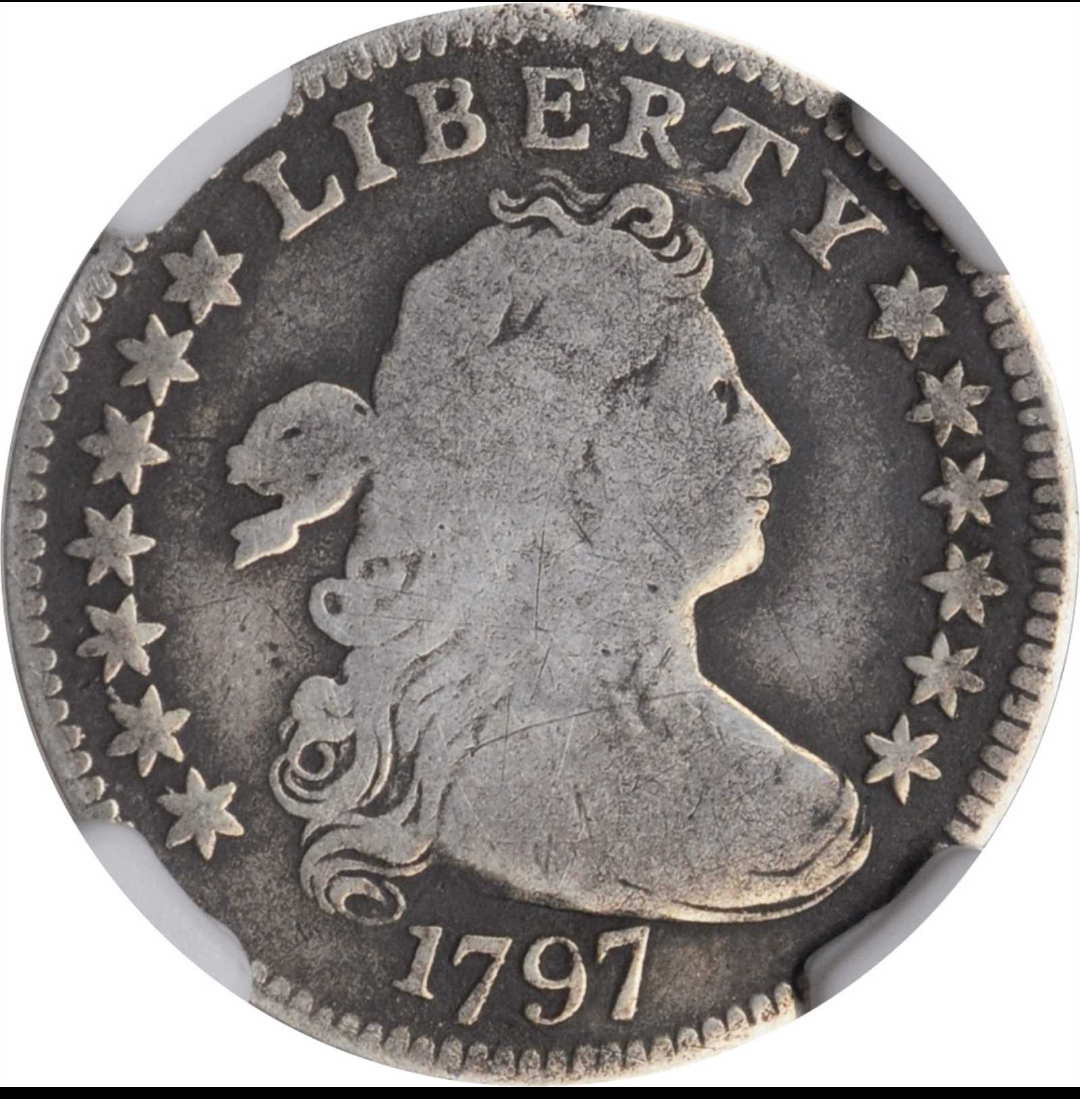
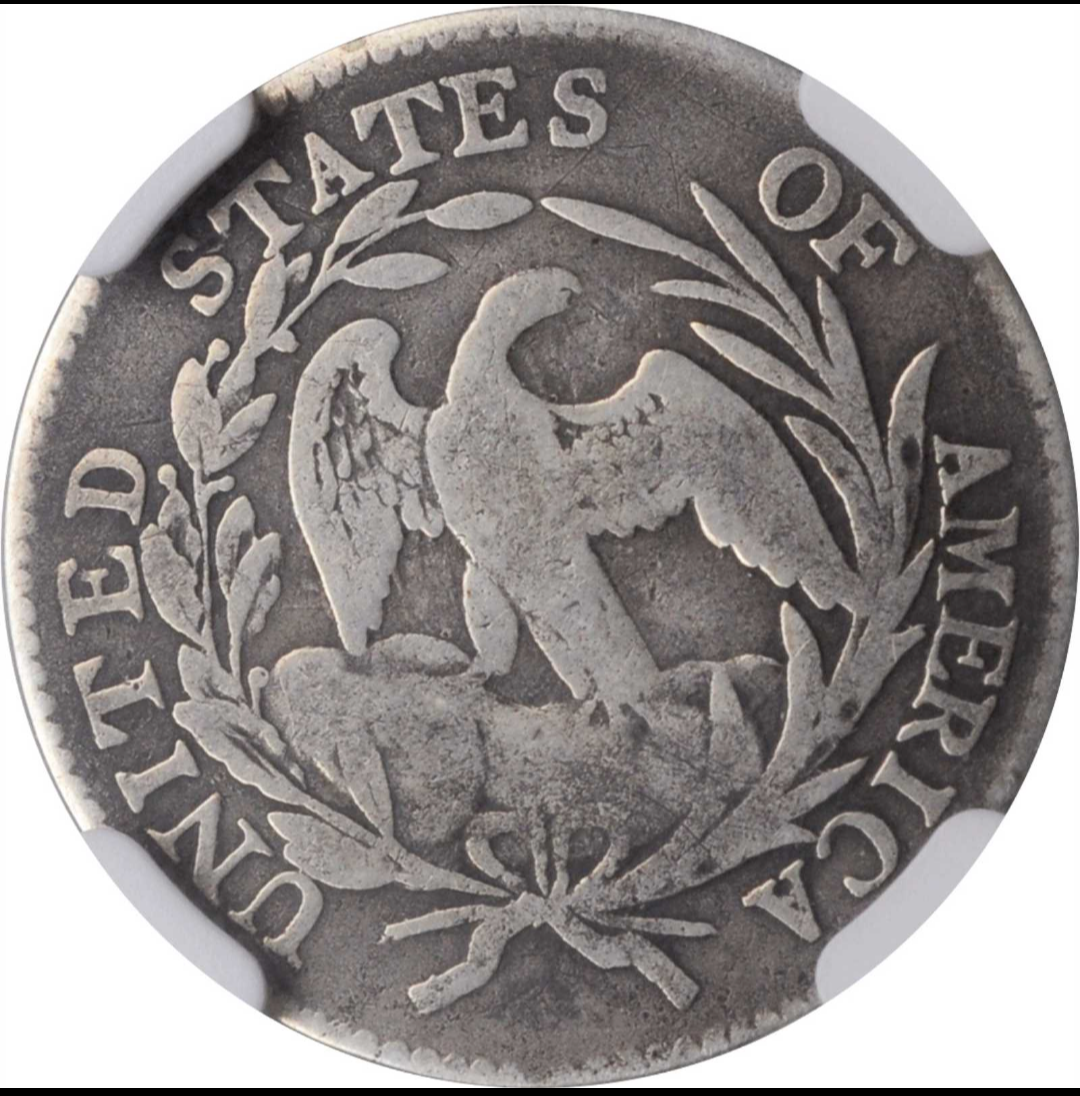
Authentic. Not for me but authentic nonetheless.
Also a VG-8 from a 2018 sale.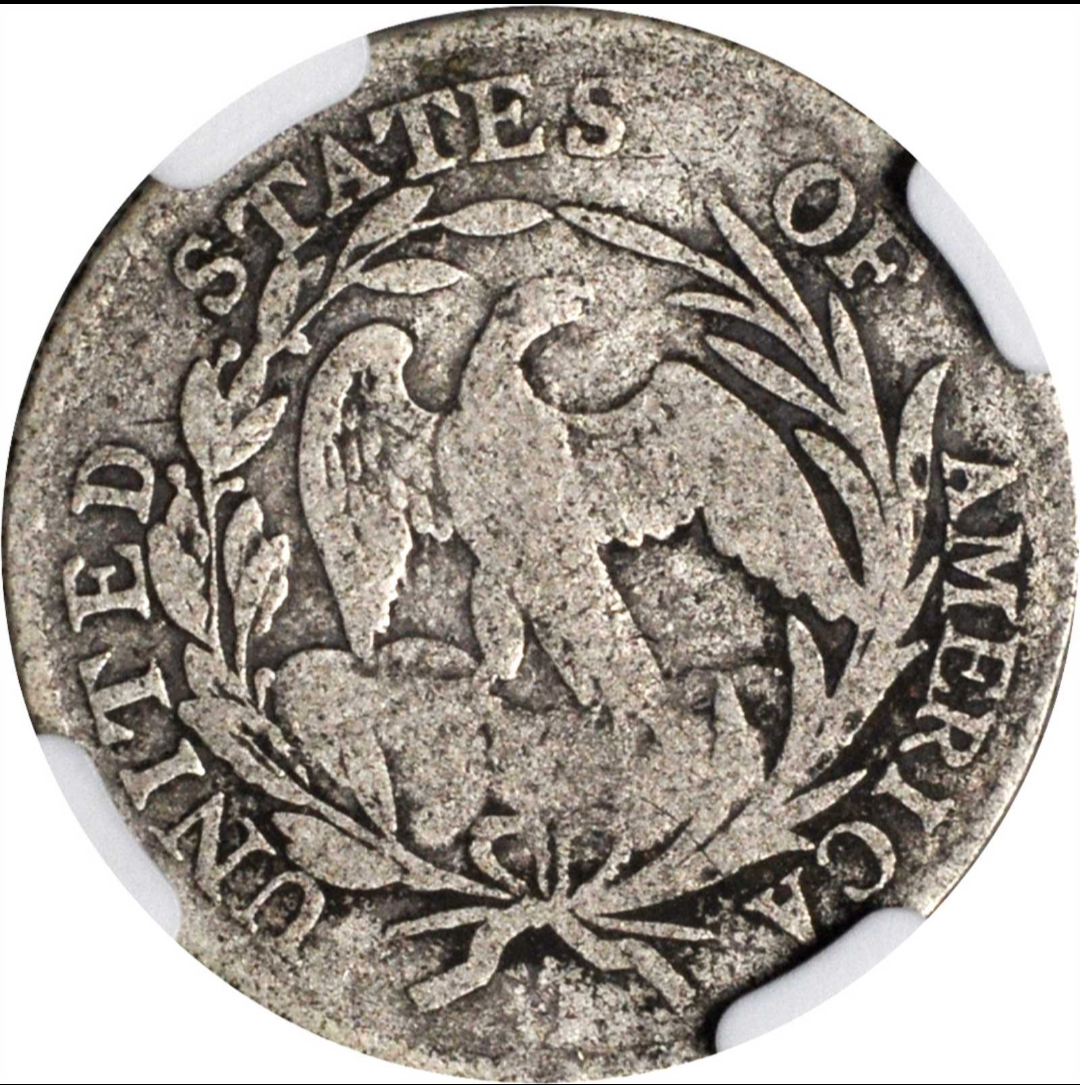
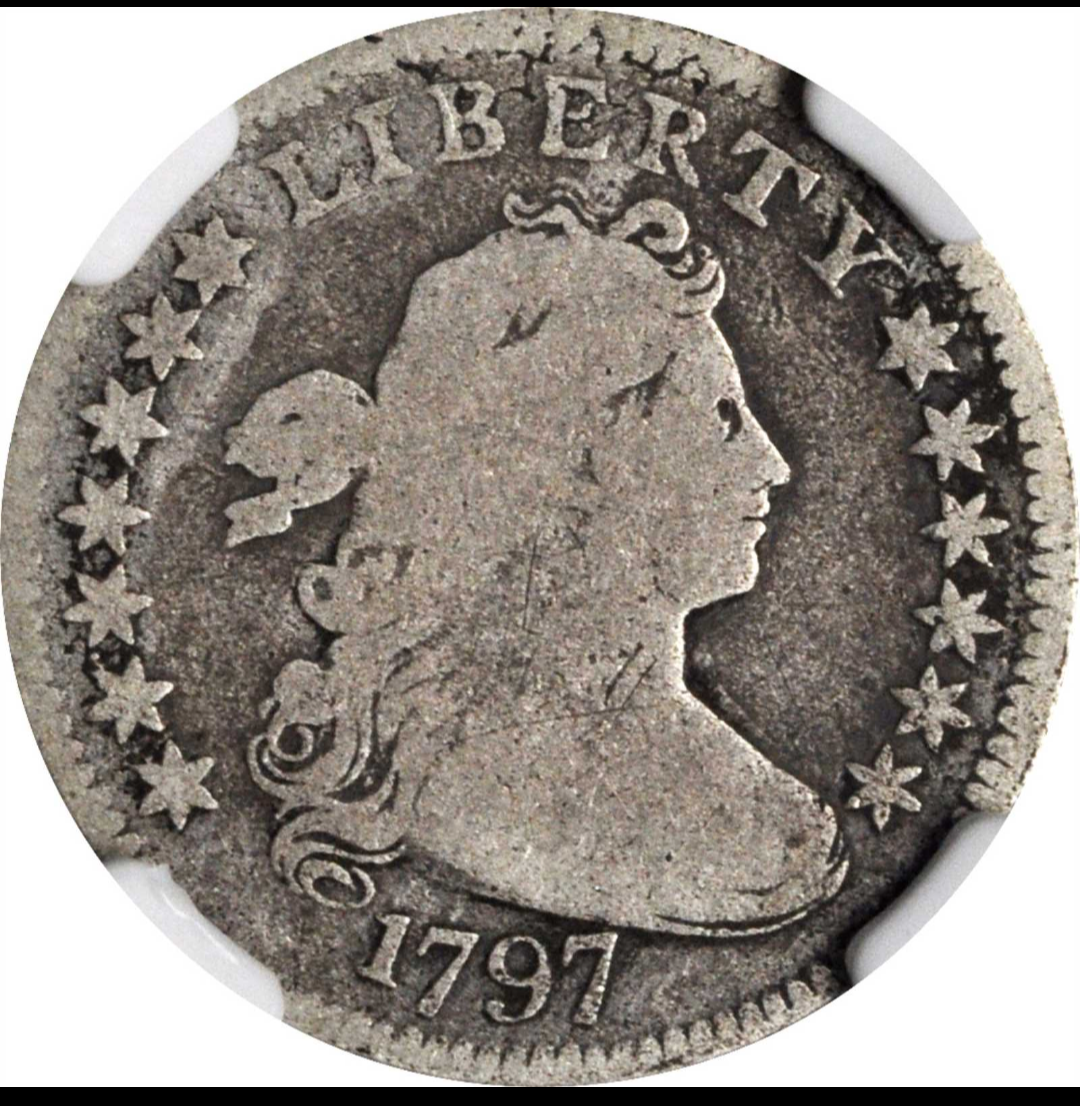
The OP coin is a transfer die counterfeit. My pictured coin is most likely counterfeit, or it could be the host coin as it has the most detail of those found. Several have appeared since 2018.
Edit: the graders/authenticators at PCGS @pcgs_education @PCGS_Moderator and other TPG's need to know, as the discovery was made on this thread and was previously unknown. Several have been submitted and authenticated by TPG's from 2018 to current, both graded and details/genuine. My coin came to market in late 2023, by an eBay high-volume seller.
Second Edit: @yosclimber thanks for your compilation, the counterfeit was made by 2007 or earlier. Genuine 1797 JR-2 13 Star dimes are becoming rarer in low grades!
@rec78, can you give more information on the background of the coin? Also, does the item have edge reeding? I suspect a plain edge or something that does not match genuine, that would be useful information for the TPG's.
Nice work on showing showing the multiple examples of this counterfeit!
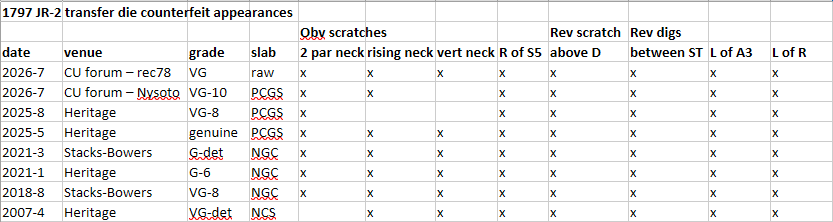
I looked through the PCGS Auction Prices table and made this list:
Here is the 2007-4, since it had not been mentioned in prior posts:
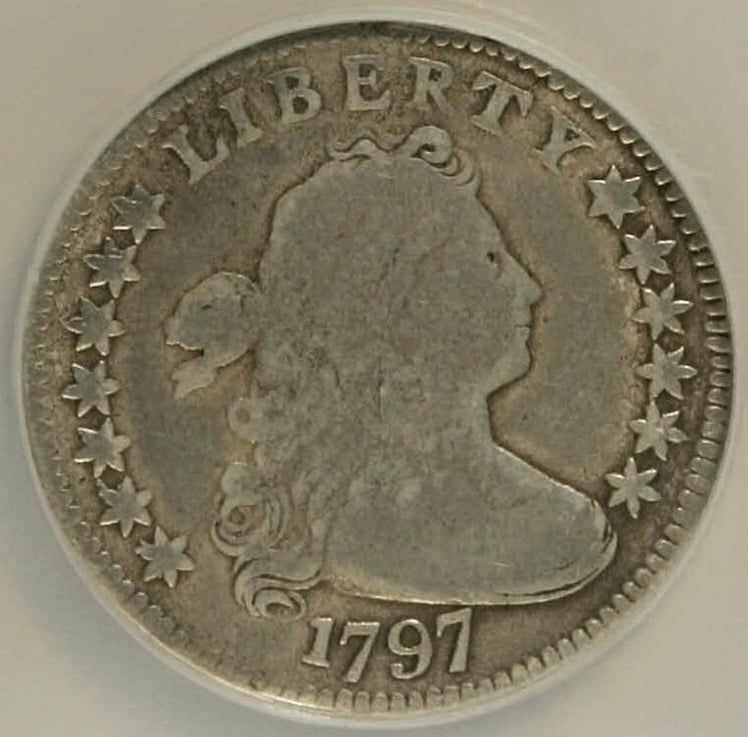
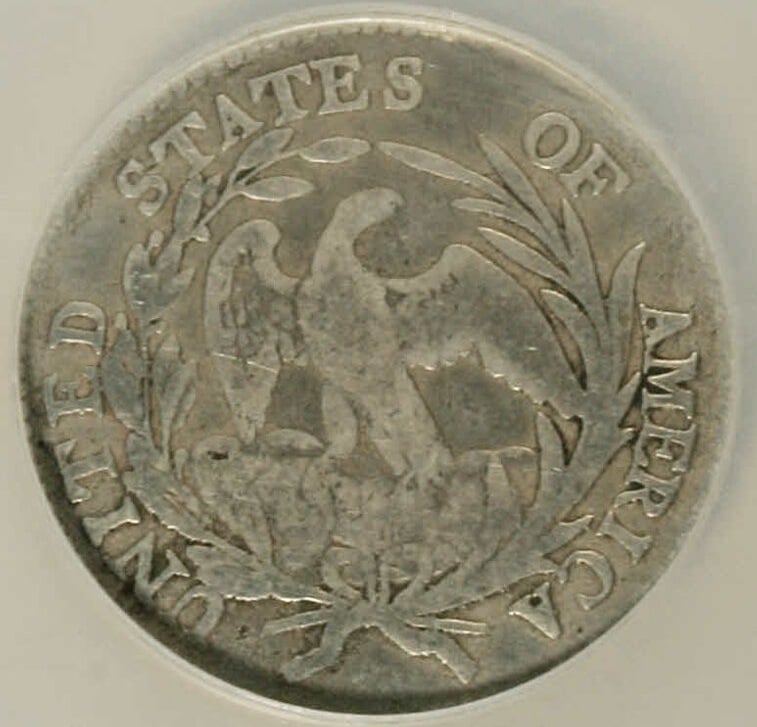
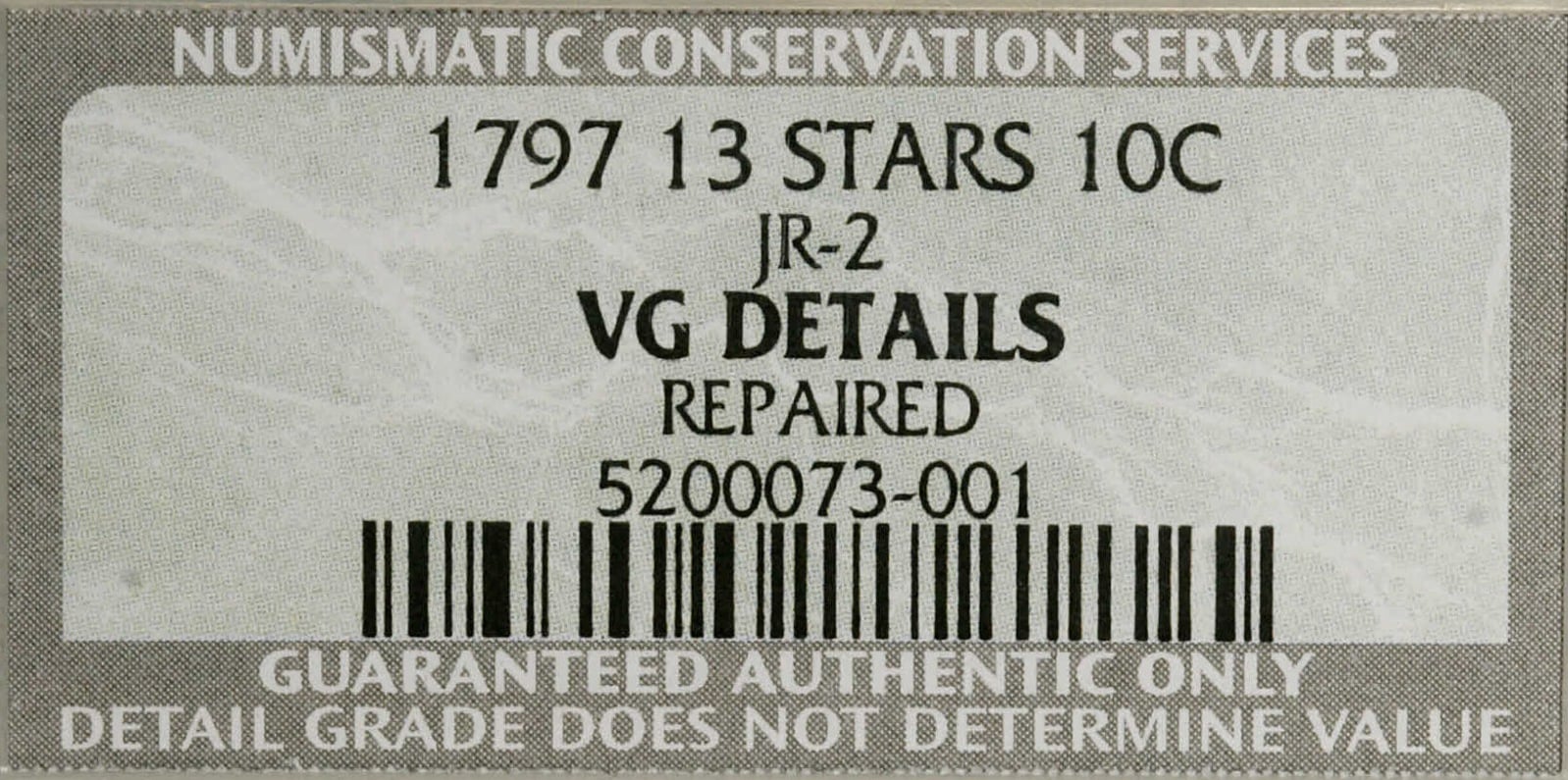
Sounds like the only solution here is to submit to PCGS and see what the paid professionals come back as Genuine or Counterfeit!
Successful transactions with: wondercoin, Tetromibi, PerryHall, PlatinumDuck, JohnMaben/Pegasus Coin & Jewelry, CoinFlip, coinlieutenant, bigjpst, and joebb21.
Wow!
A momentous ‘catch and kill’ by a fine group of numismatic mavens!
30+ years coin shop experience (ret.) Coins, bullion, currency, scrap & interesting folks. Loved every minute!
+1. I poo-poohed this in my head as I was reading through the thread, but the last series of pictures are pretty definitive. Nicely done, and very impressive. This thread should be framed!
https://www.worthpoint.com/worthopedia/1797-draped-bust-dime-10c-jr-13-stars-4676121214
https://www.worthpoint.com/worthopedia/1797-draped-bust-dime-10c-coin-13-4928562712
https://www.worthpoint.com/worthopedia/1797-jr2-r4-draped-bust-dime-13-stars-1954556703
Hats off to @Nysoto for comparing it to his coin and pointing out the issues. I wasn't sold at first, but it was motivation to look for other examples.
I don't know much background-only that I purchased it about 20 years ago at a coin show.
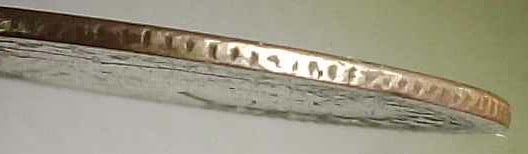
Thanks @TrickleCharge and @rec78 for posting the images. An unfortunate result, but the original post helped to uncover many (at least 9) deceptive counterfeits of a rare major variety Draped Bust dime that had been graded/authenticated by TPG's. This indicates the importance of examining the edge for authentication. Thanks also to the rest of the Heritage cataloging team for research on additional examples and diagnostics of the counterfeit 1797 JR-2 dimes.
Edit: This is important for @rec78, the host coin has not been positively identified. The counterfeits have been artificially worn, cleaned, AT, repaired, tooled - but one of them is the genuine host coin.
Nice, I dug those up as well- good sleuthing!
Interesting!
And the more you look, the more you see:
Considering the range of grades and the range of surface conditions -- the left image in the last post looks nice and crusty -- I wonder if these were contemporary.
There probably isn't a way to prove that. The best approach I can think of is if some museum has an example in their collection, with a very early accession date.
Most contemporary silver counterfeits through the Bust era were crude. From the 1984 Early United States Dimes 1796-1837, "The 1800 Var. 2 dime had the dubious distinction of being the only variety of Heraldic Eagle dime seen by the authors that had been counterfeited. A number of cast impressions have been circulated..." I have not read the 2022 Winston Zack book Bad Metal: Silver 3 to 25 Cents, there may be more.
However, the 1797 16 Stars and 1797 13 Stars dimes were the first major varieties identified for the series, listed in my 1925 Max Mehl The Star Rare Coin Encyclopedia and Premium Catalog. No other major varieties of Draped or Capped Bust dimes were included. Mehl paid $2.50 to $5.00 for the 1797 13 Star dime, while he only paid $1.00 to $3.00 for a 1796 dime. So, there was financial incentive to counterfeit the 1797 13 Star dime more than 100 years ago. Yes, it would be difficult to prove a time period. Either deceptive AT, or they were faked around 100 years ago.
The micro O Morgan counterfeits are good examples of contemporary transfer die counterfeits that were artificially worn and made to circulate at face value. The dimes in this thread were more likely stuck to fool the numismatic community. We know they were made at least 20 years ago, maybe much longer. The choice of a lower grade coin would probably fetch less, but be more likely to be accepted as real. Just as we saw by how many called it genuine in the poll here. I'm thinking they were probably messed with to look more crusty and appear circulated as opposed to actually being used in commerce.
I voted "authentic" after matching it up to JR-2.
Then I found two examples in "details" holders that appear to be the exact same coin -- or duplicates!
So now I am not so sure.
Edited to add: I went back and read the rest of the thread and see that others came to the same conclusion of "not genuine". Thanks for the excellent information!
Official PCGS account of:
www.TallahasseeCoinClub.com
Great work everyone! This is the type of thread I love to see on the forum.
I would need to see it in hand to make my judgement
How would you go about authenticating this coin if no other matching pieces could be found?
Doggedly collecting coins of the Central American Republic.
Visit the Society of US Pattern Collectors at USPatterns.com.
I don't know about the following as I thought I remembered write ups denoting finding the orignal coin. But this pcgs article, which is basically the same as that in my book pcgs counterfeit detection, mentions the original coin being sacrificed to make the dies. Indicating being damaged by the hubbing.
https://www.pcgs.com/news/the-fundamentals-of-counterfeit-detection--part-1
"Transfer Dies
Transfer dies are the most common devices used by the modern counterfeiter whose sole intent is to defraud. In the transfer method, the counterfeiter actually creates a working die. In the crudest form, called an impact die, a genuine coin will be sacrificed in making this fake working die by impressing it into die steel, as if the coin were a working hub. Once a pair of dies has been created, the counterfeiter then produces fake coins."
If the obverse is being hubbed will it damage the obverse of the coin?
If the obverse is being hubbed will it damage the reverse of the coin due to pressing on the reverse to hub the obverse?
Could the answer depend on how technically qualified the counterfeiter is/was?
@MrEureka
"How would you go about authenticating this coin if no other matching pieces could be found?"
From various readings it is stated that the transfer die counterfeit can be very deceptive. But they are not all equal. Some items, and these are not necessarily things one would routinely check, would be reeding consistency (spacing, count, geometry...) with know originals, material content and weight/size. But again it will depend on how good the transfer die counterfeit is as some have more obvious markers. Some almost none.
Interesting that this article showed up yesterday (dated July 29, 2026) indirectly referencing this forum thread. It mentions some items for detection.
https://coinagerings.org/buyers-guide-1797-draped-bust-dime-how-to-spot-the-transfer-die-counterfeit-and-protect-your-investment/#google_vignette
Buyer’s Guide: 1797 Draped Bust Dime – How to Spot the Transfer Die Counterfeit and Protect Your Investment
https://youtube.com/watch?v=OwZlYz2V4AM Sophie Lloyd, guitar shred cover Paranoid (Black Sabbath)
https://youtube.com/watch?v=fbEW8BrNctI Haley Reinhart, Don't Know How To Love You Live (direct to record)
RLJ 1958 - 2023
Current computer aided technology does NOT damage the source coin. We have been chasing the really deceptive counterfeits since 2015, and these fit the MO. I have written numerous articles on these and continue to document sightings.
The attached is a previous summary of ones documented to date and the number certified genuine by each of the 4 top TPGs. This 1797 apparently flew under the radar...
I am not making any comment on any coin illustrated in this thread. I am merely making a comment, based upon personal experience, on repeating marks and how they can appear on both counterfeit coins AND one genuine coin.
In my time at ANACS (early 1980's) we got in a 1796 Quarter that was basically a textbook Good-4 for the type, except that it had a "scratch" in the right obverse field. I kicked it out of the normal flow for additional study, and after looking at it a few times over several days could not find any reason to condemn it. We issued a photo certificate and returned it to the submitter.
About a year later I was at a show and Lee Minshull came up to me and handed me that coin and that certificate and another 1796 Quarter in Good-4 with the exact same scratch. I said "oops" and asked if we could borrow both coins, which Lee graciously agreed to. I took them back to Headquarters, did some research in auction catalogues in the ANA Library, and found several more that had been auctioned over the years. I photographed both pieces and wrote an article about them for the ANACS page in The Numismatist.
Over the next several months we got in 3 or 4 more from people who had seen the article, and wanted us to confirm that it was bad so that they could ask the sellers for refunds. Then a piece came in with a letter from a collector saying that his dealer had seen the article and, remembering the piece, contacted the collector telling him to send it in, and if we said it was bad he would refund the collector the price of the coin and the fees. Absolutely doing the right thing.
Well, I studied the piece and saw that the "scratch" was actually a small lamination in the surface, that you could see under if you tilted the coin up. After studying that and other features I determined that this was the genuine coin that the counterfeiter made his dies from. We certified the piece, and I wrote a long letter to the collector on ANA letterhead explaining that this coin shown on certificate number xxxxxx was the genuine coin that the counterfeit coin shown on page yyyyyy of the zzzzzz issue of The Numismatist was copied from, to help his sell it some day.
So, repeating marks ARE a very strong indicator that a coin with them MIGHT be a counterfeit, but always remember that the genuine coin with those marks might turn up someday.
TD
P.S.: I tried to trace the genuine coin's history back to find the counterfeiter, but the dealer said that he had bought it from some guy at a coin show for cash and there were no records of the guy's name.
With the number of matches posted to this thread, why do you think the subject coin is the one that’s genuine (and thus, that the others are the copies)?
Mark Feld* of Heritage Auctions*Unless otherwise noted, my posts here represent my personal opinions.