@CaptHenway said:
I am not making any comment on any coin illustrated in this thread. I am merely making a comment, based upon personal experience, on repeating marks and how they can appear on both counterfeit coins AND one genuine coin.
In my time at ANACS (early 1980's) we got in a 1796 Quarter that was basically a textbook Good-4 for the type, except that it had a "scratch" in the right obverse field. I kicked it out of the normal flow for additional study, and after looking at it a few times over several days could not find any reason to condemn it. We issued a photo certificate and returned it to the submitter.
About a year later I was at a show and Lee Minshull came up to me and handed me that coin and that certificate and another 1796 Quarter in Good-4 with the exact same scratch. I said "oops" and asked if we could borrow both coins, which Lee graciously agreed to. I took them back to Headquarters, did some research in auction catalogues in the ANA Library, and found several more that had been auctioned over the years. I photographed both pieces and wrote an article about them for the ANACS page in The Numismatist.
Over the next several months we got in 3 or 4 more from people who had seen the article, and wanted us to confirm that it was bad so that they could ask the sellers for refunds. Then a piece came in with a letter from a collector saying that his dealer had seen the article and, remembering the piece, contacted the collector telling him to send it in, and if we said it was bad he would refund the collector the price of the coin and the fees. Absolutely doing the right thing.
Well, I studied the piece and saw that the "scratch" was actually a small lamination in the surface, that you could see under if you tilted the coin up. After studying that and other features I determined that this was the genuine coin that the counterfeiter made his dies from. We certified the piece, and I wrote a long letter to the collector on ANA letterhead explaining that this coin shown on certificate number xxxxxx was the genuine coin that the counterfeit coin shown on page yyyyyy of the zzzzzz issue of The Numismatist was copied from, to help his sell it some day.
So, repeating marks ARE a very strong indicator that a coin with them MIGHT be a counterfeit, but always remember that the genuine coin with those marks might turn up someday.
TD
P.S.: I tried to trace the genuine coin's history back to find the counterfeiter, but the dealer said that he had bought it from some guy at a coin show for cash and there were no records of the guy's name.
With the number of matches posted to this thread, why do you think the subject coin is the one that’s genuine (and thus, that the others are the copies)?
I did not get that from the CaptHenway post especially in light of this point - "I am not making any comment on any coin illustrated in this thread."
Somewhere there is still a genuine one. I do wonder if it could be the @Nysoto example as it appears to have the most detail, but it could be another still unnoted coin or maybe a listed one could be the original. Still work to be done.
"To Be Esteemed Be Useful" - 1792 Birch Cent --- "I personally think we developed language because of our deep need to complain." - Lily Tomlin
@CaptHenway said:
I am not making any comment on any coin illustrated in this thread. I am merely making a comment, based upon personal experience, on repeating marks and how they can appear on both counterfeit coins AND one genuine coin.
In my time at ANACS (early 1980's) we got in a 1796 Quarter that was basically a textbook Good-4 for the type, except that it had a "scratch" in the right obverse field. I kicked it out of the normal flow for additional study, and after looking at it a few times over several days could not find any reason to condemn it. We issued a photo certificate and returned it to the submitter.
About a year later I was at a show and Lee Minshull came up to me and handed me that coin and that certificate and another 1796 Quarter in Good-4 with the exact same scratch. I said "oops" and asked if we could borrow both coins, which Lee graciously agreed to. I took them back to Headquarters, did some research in auction catalogues in the ANA Library, and found several more that had been auctioned over the years. I photographed both pieces and wrote an article about them for the ANACS page in The Numismatist.
Over the next several months we got in 3 or 4 more from people who had seen the article, and wanted us to confirm that it was bad so that they could ask the sellers for refunds. Then a piece came in with a letter from a collector saying that his dealer had seen the article and, remembering the piece, contacted the collector telling him to send it in, and if we said it was bad he would refund the collector the price of the coin and the fees. Absolutely doing the right thing.
Well, I studied the piece and saw that the "scratch" was actually a small lamination in the surface, that you could see under if you tilted the coin up. After studying that and other features I determined that this was the genuine coin that the counterfeiter made his dies from. We certified the piece, and I wrote a long letter to the collector on ANA letterhead explaining that this coin shown on certificate number xxxxxx was the genuine coin that the counterfeit coin shown on page yyyyyy of the zzzzzz issue of The Numismatist was copied from, to help his sell it some day.
So, repeating marks ARE a very strong indicator that a coin with them MIGHT be a counterfeit, but always remember that the genuine coin with those marks might turn up someday.
TD
P.S.: I tried to trace the genuine coin's history back to find the counterfeiter, but the dealer said that he had bought it from some guy at a coin show for cash and there were no records of the guy's name.
With the number of matches posted to this thread, why do you think the subject coin is the one that’s genuine (and thus, that the others are the copies)?
I did not get that from the CaptHenway post especially in light of this point - "I am not making any comment on any coin illustrated in this thread."
Somewhere there is still a genuine one. I do wonder if it could be the @Nysoto example as it appears to have the most detail, but it could be another still unnoted coin or maybe a listed one could be the original. Still work to be done.
Thank you. I was confused by the “Genuine” at the top of his post.
Mark Feld* of Heritage Auctions*Unless otherwise noted, my posts here represent my personal opinions.
@MFeld said:
...
Thank you. I was confused by the “Genuine” at the top of his post.
An out of date vote before more info came in I assume.
Exactly. That was my vote in the original poll. It will no doubt reappear with this comment.
Numismatist. 54 year member ANA. Former ANA Senior Authenticator. Winner of four ANA Heath Literary Awards; three Wayte and Olga Raymond Literary Awards; Numismatist of the Year Award 2009, and ANA Lifetime Achievement Award 2020. Also won the PNG's Robert Friedberg Award for "The Enigmatic Lincoln Cents of 1922," Available now from Whitman or Amazon.
Thanks for all the replies! I have learned a lot and I hope others have also. These are quite deceiving. And yes I paid a lot for it many year ago!
Unforunately (for me) here is PCGS reply:.
@rec78 I believe you mentioned you have had it for around 20 years- do you remember the date you purchased it? The NCS example appears to have many of the matching marks (poor resolution images) but not the 2 prominent scratches on the neck and was in the 2007 HA auction.
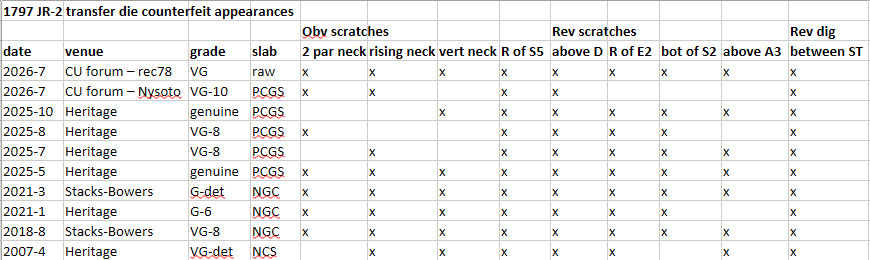
Current count is 13 review examples, 10 certified and 3 raw including the OP's coin. Of these there appears to be two examples without the pair of prominent scratches on the throat:
@JDark said:
Current count is 13 review examples, 10 certified and 3 raw including the OP's coin. Of these there appears to be two examples without the pair of prominent scratches on the throat:
I listed 8 examples in my post of 7/26,
[Edit: late on Aug 4:] but I checked the Heritage archive directly tonight (instead of using the PCGS Auction Prices as an index, which has problems), and found 2 more (2025-10 and 2025-7), so my total is 10 now.
Tonight I also checked Stacks-Bowers, GreatCollections and ebay directly and did not find any additional examples.
And I only saw 1 raw on this thread.
I agree the 2 parallel scratches on the throat are not visible on the 2007 NCS example (left in your photo array above).
But it's an older, lower res photo, so they may be there on the coin but the photo is not good enough to show them.
Lighter scratches could also be polished down at some point and become less visible.
I was happy to see that PCGS recently determined @rec78's coin to be counterfeit, so they are already using this discovery.
Although it's of course bad news for the market value of @rec78's coin; that's how things go sometimes.
@yosclimber , thanks for the response. There are now 6 PCGS, and 4 NGC/NCS examples and 3 raw ones. I am working on timing for when the TPG coins were certified to try to develop a relevant timeline.
You didn't comment on the example on the right which also doesn't show the "2 parallel scratches". Do you think they were erased on the coin as well?
Here are better definitions for the 4 Obverse scratch markers that I used in my table.
The coin on the right (Heritage 2025-10) has 2 of the 4 visible.
Maybe the other 2 markers (2 par neck, rising neck) were polished out, but that is just a theory.
Here are all 5 Obverse scratch markers on another coin that shows all of them.
[Edit Aug 8: added 5th marker "under TY", pointed out by @JDark]
Here are the definitions for the 4 Reverse markers for the updated table.
I dropped the "digs" in the leaves, as they are part of the design and show up on genuine coins in this grade range.
They are replaced with scratches at E2, S2 and A3, which are visible in almost all photos.
@JDark said: @yosclimber , thanks for the response. There are now 6 PCGS, and 4 NGC/NCS examples and 3 raw ones. I am working on timing for when the TPG coins were certified to try to develop a relevant timeline.
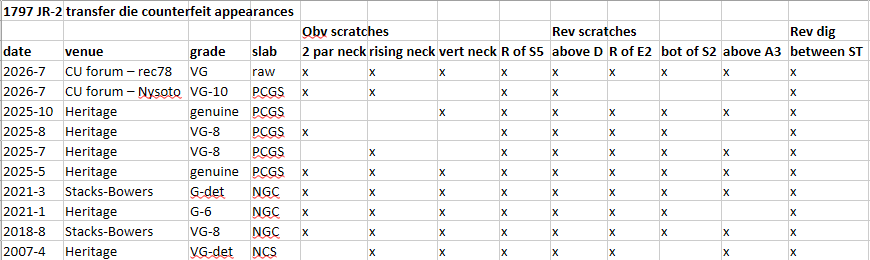
Inspired by your superior results, I tried harder tonight and used the Heritage Archive instead of the PCGS Auction Prices, and found 2 more PCGS at Heritage (2025-10 and 2025-7).
So my counts are now 5 PCGS, 4 NGC/NCS and 1 raw. I'm still short by 3, but improved.
Thanks for the reminder! Somehow those had slipped my mind.
[Edit: 8:15pm] - there was one duplicate, on both Heritage and ebay/Worthpoint - the PCGS VG-det.
This bumps the total in my table up to 12 coins, 13 appearances. @JDark found one additional raw coin (not in my table at present).
Thanks to @JDark for noticing this discrepancy.
After this correction, we have the same set of coins and appearances.
This is a fascinating thread and I have learned a lot. Thanks to everyone who participated and contributed research. Now I've been thinking about the implications of all this.
The 1797 13-stars dime is considered more common in lower grades, but scarcer in higher grades relative to the 1797 16-stars. For example, PCGS has certified 29 13-stars in VG or lower; 22 16-stars in VG or lower. Given that many/most of the VG or lower 13-stars are actually counterfeit, can we say that the 13-stars is probably scarcer than the 16-stars in all grades?
And given the high number of counterfeits, that all genuine 1797 dimes are actually scarcer than originally thought?
Not being a dime expert, I would be interested in the early dime experts' (or anyone else's) opinions on this.
"Can we say that the 13-stars is probably scarcer than the 16-stars in all grades?"
I would say that it is. As my time, mostly as a type collector, I have owned two 1797, 16 Star dimes. I have seen a couple 13 star coins at the shows, but I have never owned one.
All 1797 dimes are scarce. The 16 star is rated as an R-4, 76 to 200 known, but if it's an R-4, it's a "tough R-4." I have not seen nearly as many of them as I have other coins which are also rated R-4.
Here is my current piece. I bid on it in a Herirage auction and lost. Later I bought it from the dealer who won it. I probably paid too much, but given the rarity and the interesting die break about the date, which virtually always there, it's an unusual early coin. This is PCGS graded VF-25.
Retired dealer and avid collector of U.S. type coins, 19th century presidential campaign medalets and selected medals. In recent years I have been working on a set of British coins - at least one coin from each king or queen who issued pieces that are collectible. I am also collecting at least one coin for each Roman emperor from Julius Caesar to ... ?
Comments
I did not get that from the CaptHenway post especially in light of this point - "I am not making any comment on any coin illustrated in this thread."
Somewhere there is still a genuine one. I do wonder if it could be the @Nysoto example as it appears to have the most detail, but it could be another still unnoted coin or maybe a listed one could be the original. Still work to be done.
"To Be Esteemed Be Useful" - 1792 Birch Cent --- "I personally think we developed language because of our deep need to complain." - Lily Tomlin
Thank you. I was confused by the “Genuine” at the top of his post.
Mark Feld* of Heritage Auctions*Unless otherwise noted, my posts here represent my personal opinions.
An out of date vote before more info came in I assume.
"To Be Esteemed Be Useful" - 1792 Birch Cent --- "I personally think we developed language because of our deep need to complain." - Lily Tomlin
Exactly. That was my vote in the original poll. It will no doubt reappear with this comment.
Thank you, gentlemen.
Mark Feld* of Heritage Auctions*Unless otherwise noted, my posts here represent my personal opinions.
Thanks for all the replies! I have learned a lot and I hope others have also. These are quite deceiving. And yes I paid a lot for it many year ago!
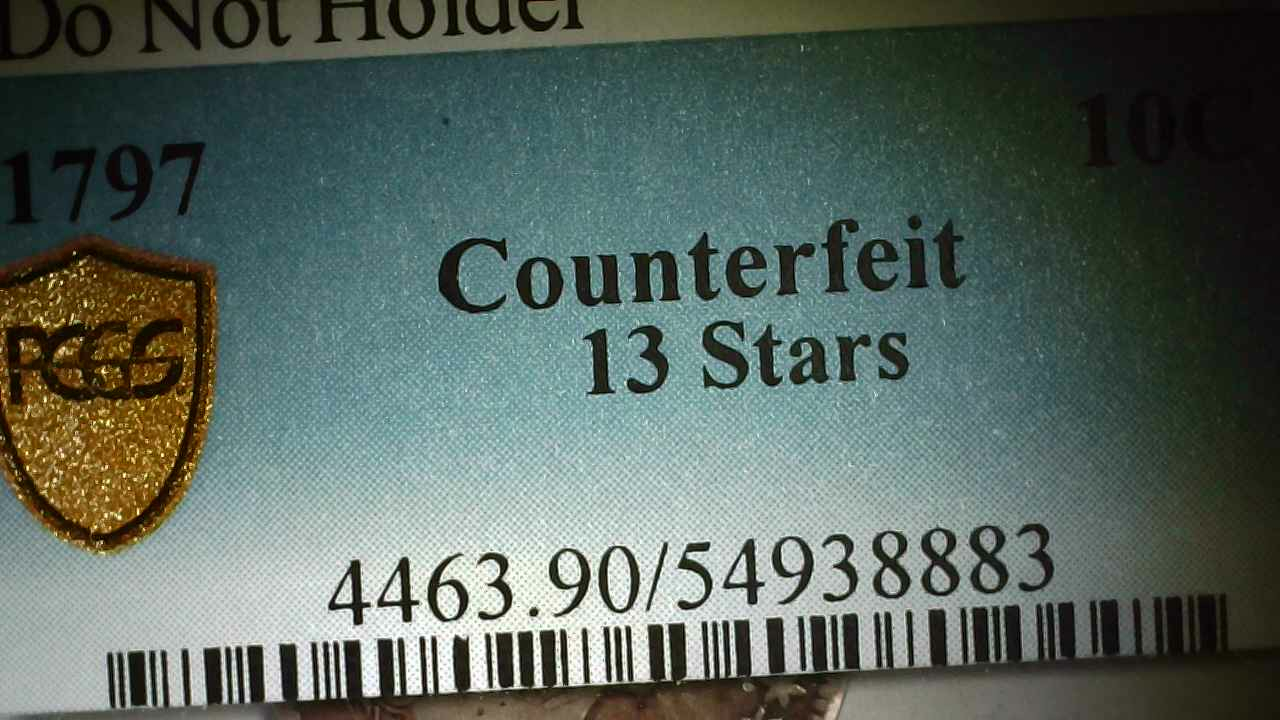
Unforunately (for me) here is PCGS reply:.
@rec78 I believe you mentioned you have had it for around 20 years- do you remember the date you purchased it? The NCS example appears to have many of the matching marks (poor resolution images) but not the 2 prominent scratches on the neck and was in the 2007 HA auction.
I'm no expert but it looks genuine to me.
Current count is 13 review examples, 10 certified and 3 raw including the OP's coin. Of these there appears to be two examples without the pair of prominent scratches on the throat:
I listed 8 examples in my post of 7/26,
[Edit: late on Aug 4:] but I checked the Heritage archive directly tonight (instead of using the PCGS Auction Prices as an index, which has problems), and found 2 more (2025-10 and 2025-7), so my total is 10 now.
Tonight I also checked Stacks-Bowers, GreatCollections and ebay directly and did not find any additional examples.
And I only saw 1 raw on this thread.
I agree the 2 parallel scratches on the throat are not visible on the 2007 NCS example (left in your photo array above).
But it's an older, lower res photo, so they may be there on the coin but the photo is not good enough to show them.
Lighter scratches could also be polished down at some point and become less visible.
I was happy to see that PCGS recently determined @rec78's coin to be counterfeit, so they are already using this discovery.
Although it's of course bad news for the market value of @rec78's coin; that's how things go sometimes.
@yosclimber , thanks for the response. There are now 6 PCGS, and 4 NGC/NCS examples and 3 raw ones. I am working on timing for when the TPG coins were certified to try to develop a relevant timeline.
You didn't comment on the example on the right which also doesn't show the "2 parallel scratches". Do you think they were erased on the coin as well?
Thanks, Jack.
Here are better definitions for the 4 Obverse scratch markers that I used in my table.
The coin on the right (Heritage 2025-10) has 2 of the 4 visible.
Maybe the other 2 markers (2 par neck, rising neck) were polished out, but that is just a theory.
Here are all 5 Obverse scratch markers on another coin that shows all of them.
[Edit Aug 8: added 5th marker "under TY", pointed out by @JDark]
Here are the definitions for the 4 Reverse markers for the updated table.
I dropped the "digs" in the leaves, as they are part of the design and show up on genuine coins in this grade range.
They are replaced with scratches at E2, S2 and A3, which are visible in almost all photos.
Inspired by your superior results, I tried harder tonight and used the Heritage Archive instead of the PCGS Auction Prices, and found 2 more PCGS at Heritage (2025-10 and 2025-7).
So my counts are now 5 PCGS, 4 NGC/NCS and 1 raw. I'm still short by 3, but improved.
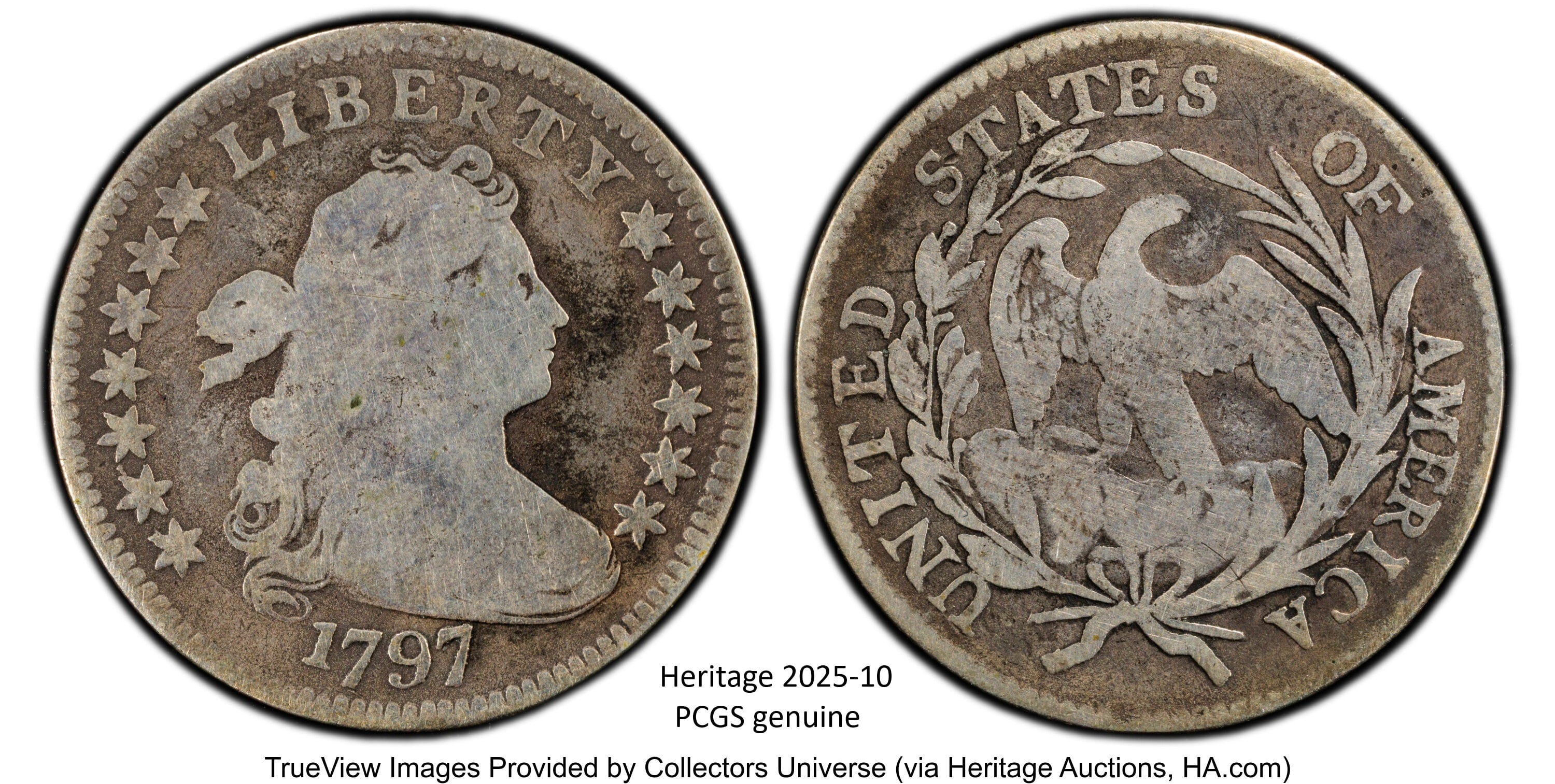
Here are the 2 I added:
Did you include the ones I found on worthpoint? (They might be duplicates of ones on heritage -- I didn't check)
Thanks for the reminder! Somehow those had slipped my mind.
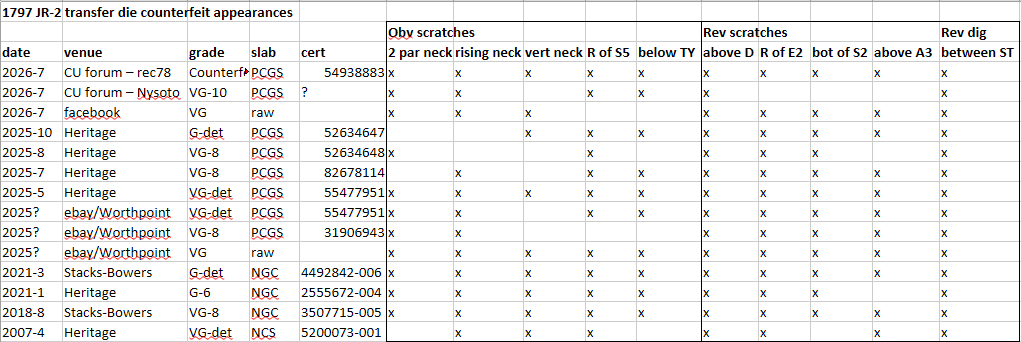
[Edit: 8:15pm] - there was one duplicate, on both Heritage and ebay/Worthpoint - the PCGS VG-det.
This bumps the total in my table up to 12 coins, 13 appearances.
@JDark found one additional raw coin (not in my table at present).
Thanks to @JDark for noticing this discrepancy.
After this correction, we have the same set of coins and appearances.
One more raw example on my list and now in-hand; found off my FB group:
@JDark found a 5th obverse marker which is present in almost all the photos - scratch under TY,
so I added this and the facebook coin to the table.
This is a fascinating thread and I have learned a lot. Thanks to everyone who participated and contributed research. Now I've been thinking about the implications of all this.
The 1797 13-stars dime is considered more common in lower grades, but scarcer in higher grades relative to the 1797 16-stars. For example, PCGS has certified 29 13-stars in VG or lower; 22 16-stars in VG or lower. Given that many/most of the VG or lower 13-stars are actually counterfeit, can we say that the 13-stars is probably scarcer than the 16-stars in all grades?
And given the high number of counterfeits, that all genuine 1797 dimes are actually scarcer than originally thought?
Not being a dime expert, I would be interested in the early dime experts' (or anyone else's) opinions on this.
Complete Set of Chopmarked Trade Dollars
Carson City Silver Dollars Complete 1870-1893http://www.pcgs.com/setregistry/showcase.aspx?sc=2722"
"Can we say that the 13-stars is probably scarcer than the 16-stars in all grades?"
I would say that it is. As my time, mostly as a type collector, I have owned two 1797, 16 Star dimes. I have seen a couple 13 star coins at the shows, but I have never owned one.
All 1797 dimes are scarce. The 16 star is rated as an R-4, 76 to 200 known, but if it's an R-4, it's a "tough R-4." I have not seen nearly as many of them as I have other coins which are also rated R-4.
Here is my current piece. I bid on it in a Herirage auction and lost. Later I bought it from the dealer who won it. I probably paid too much, but given the rarity and the interesting die break about the date, which virtually always there, it's an unusual early coin. This is PCGS graded VF-25.
Counterfeit
Looked good to me, with the obvious caveat that my personal experience with this type is... umm... nil, zilcho, nada.
Collector since 1976. On the CU forums here since 2001.