I have finally finished one Classic Head gold set!
 BillJones
Posts: 35,989 ✭✭✭✭✭
BillJones
Posts: 35,989 ✭✭✭✭✭
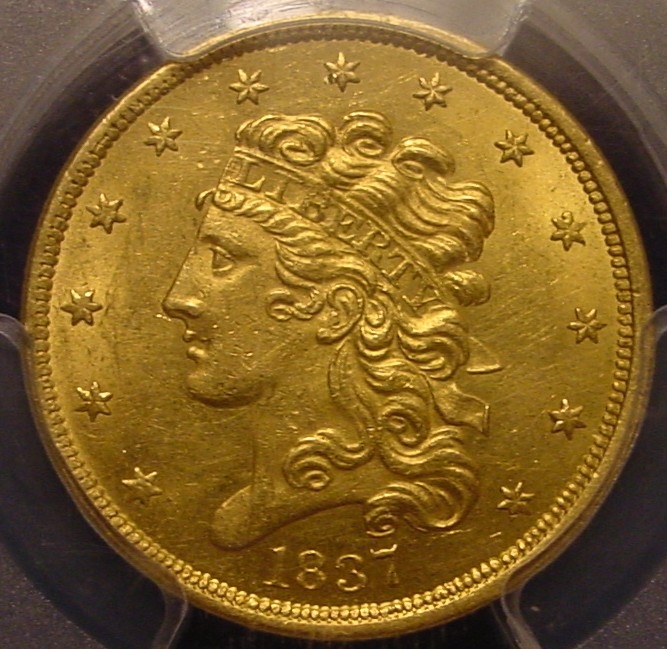
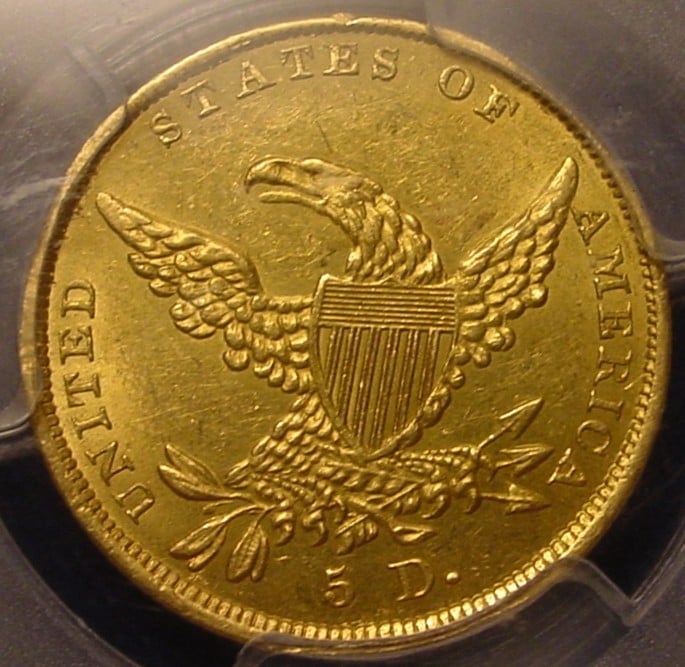
I was able to pick up this 1837 half eagle at auction. It's graded MS-61, and it actually makes the grade IMO. As usual my photos make it look worse than it is.
The 1837 half eagle is a "sleeper" in the set. David Akers compared the number of auction appearances for it with the 1838-D although he said that the Dahlonega coin was scarcer.
This was the last piece I needed to finish this eight piece set. I'll never be complete on any registry, however, because my set is a "crossbreed" with NGC and PCGS coins.
Oddly enough my "GPA" numbers are comparable to Harry Bass who had the #1 set of all time. Believe me, that's where the comparisons end. My 1834 Crosslet 4 (a tough coin) is graded MS-61, but my grade would be in the AU-55 to 58 range. Bass also had the finest know 1838-C at MS-63, and I'm quite a bit below that with an AU.
Would my three NGC coins cross in the same grades? Maybe. Perhaps I should put their pictures up here and let you guys speculate on them. I think one might. The other two could lose a point or two.
Comments
Congratualtions! A worthy accomplishment, especially given your demand for originality for the coins.
Your Crosslet 4 and 38-C aren't that far away from the top, probably both condition census. Certainly your 38-C is, as there is only one true uncirculated 38-C known.
Please post pictures of your other coins, would be fun to speculate. Again, congrats!
Okay, here is the 1883-C. For a fleeting moment I thought about getting involved with the Pogue coin, but knew I was out of my league. From what I heard one well known dealer thought that he had a chance it for a $100,000 bid because there was "a breather" in the proceedings. Then it took off to over $200,000 as expected.
At any rate here is my coin. This has to be pretty close to the terminal die state for the reverrse.
Nice coins, Bill.
That's quite an achievement.
Congrats!
Sometimes, it’s better to be LUCKY than good. 🍀 🍺👍
My Full Walker Registry Set (1916-1947):
https://www.ngccoin.com/registry/competitive-sets/16292/
congrats bill! that is a tough set to complete with quality pieces!
Nice. Tough project!
mark
Fellas, leave the tight pants to the ladies. If I can count the coins in your pockets you better use them to call a tailor. Stay thirsty my friends......
i like the 38-C.
the small date 37 is one that i would like to own. i missed a chance to buy a really nice one in ms63...i thought it went too high at 13K, but now i wish i had bid it up more.
ALL of the Classic Head coins are rare in true Unc. They were issued when there were very few coin collectors in America, and $5 was a lot of money to set asside doing nothing. The 1837 $5 is rarer than any of the other "common" Philadelphia Mint dates. So if the MS-63 really made the grade, $13k sounds reasonable, if you wanted it.
I love the 38-C. Mine is a modest EF45
Latin American Collection
Congratulations!
Nice coins!
Congrats on the completion.
at the time, i thought i would be overpaying, so i backed out. now, i cannot find the coin on stacks. it was auctioned before they redesigned the web site. maybe it went higher and my memory is fading. in hindsight, it was a good deal and i should have paid up for it.
I remember the ads back in the 90s for various classic gold, raw coins in the gold type sets run by people like the late JJ Van Grover, not sure how many of those were gradable. Very interesting designs and gold is a lot easier to sell than silver and copper.
Congrats Bill and you deserve a YOU SUCK for completing that at those grades!
bob:)
Congratulations. That is quite the accomplishment!
Really nice and super cool accomplishment
siliconvalleycoins.com
Now I remember your 38-C. It was once known as from the Elrod Collection and last sold at auction back in 2008 FUN. I think it is condition census and the 5th finest known for the date. Definitely a very late die state.
On your 1837, there were three obverses and three reverses for 1837 Half Eagles. Yours has a couple of interesting die markers. On the reverse, if you look for the middle arrow between the talon and the eagle's leg, the arrow disappears. It was lapped off. Also, can't see it on your picture, but there should be a floating serif to the left of T in UNITED.
Congratulations Bill. Great accomplishment!
Yes, the 1838-C is the Elrod coin.
Congratulations Bill.... I am envious of any old gold set..... Cheers, RickO
Congrats
Steve
Well done!
Congrats, very nice coins
Successful transactions with : MICHAELDIXON, Manorcourtman, Bochiman, bolivarshagnasty, AUandAG, onlyroosies, chumley, Weiss, jdimmick, BAJJERFAN, gene1978, TJM965, Smittys, GRANDAM, JTHawaii, mainejoe, softparade, derryb, Ricko
Bad transactions with : nobody to date
Very cool! Nice job, Bill!
I knew it would happen.
Congrats on a tough set.
Joseph J. Singleton - First Superintendent of the U.S. Branch Mint in Dahlonega Georgia
Findley Ridge Collection
About Findley Ridge
I've always thought this was a sleeper series In general. An obverse mm gold piece is high on my want list
An ambitious undertaking well executed.
Beautiful coins!
Here are the other two NGC coins that are in the set. The first one is the 1834 Plain 4 variety. This is by far the most common date and variety in the $5 Classic Head set. This was my type coin for quite a few years.
And here my 1838-P. This is a surprising hard coin to find without the usual problems (cleaning). The 1837 is scarcer, probably because a fair number of the pieces that were reported in the 1837 mintage were made from one or more left over 1836 dies.
I'll come back with the NGC grades in a couple of days.
Congrats on finishing the set...beauties. You mention not being able to see it on a registry because it's a "crossbreed"...true, but you could add it on collectivecoin.
What a finish.
Congrats Bill and thanks for sharing
A big congrats!
Waiting on the grades!
It may be time to call B/S on this. The idea that the 1837 mintage contained coins dated 1836 comes from the Breen Encyclopedia. Before that, Breen said in his 1966 monograph that it is "most probably" so. It looks as if he erroneously concluded that a reverse die was carried over from 1836 to 1837, and through die emission sequencing thought that the 1836s were struck last. Problem is there was no carry over die from 1836 to 1837. He was comparing two similar, but different reverse dies used in 1836 and 1837. And if Breen had any specific archival evidence proving his point, which isn't typical that a fact of this nature in question can be proven from Mint records, I haven't found it yet.
Surprisingly, what I did find, and which has not been published yet, is that one of the three die marriages of 1837 was entirely minted in 1838.
This is an excellent set. Congratulations on completion. Current TPG's list five 1838-C MS coins: one PCGS; four NGC. However, I can only account for three: the Pogue specimen and two of the four NGC specimens currently in private collections. What I did not realize as a beginning collector back in the day was the lack of consistency in what is now called raw grading. I viewed the Elrod collection at Stack's in 1976 and I believe that the 1838-C, a quality, original coin, received a lower grade from Stack's at that time. To be correct I would have to check the catalog.
My opinion is that, despite better images today, you have to see the coin to grade it. ...But the 34 and 38 look good!
Okay, if that is B/S, then why is the 1837 so scarce with a mintage of 207,121 with a "Coin Facts" estimated survival of 350 pieces? The runner-up is the 1838-P with a mintage of 286,588 and an estimated survival of 700 pieces. The 1837 is disproportionately rare given the number made.
These numbers are supported by the PCGS population reports. PCGS has graded only 269, 1837 half eagles. The runner-up is the 1838-P with 479.
Either there has been a disproportionate number of meltings of the 1837 half eagle, or there were fewer pieces made that year than was reported. What is your theory as to why the 1837 is scarcer than it should be?
Okay, then the 1837 should be more common, but it isn't.
Here are the grades of the two coins.
NGC graded the 1834 Plain 4 MS-61, and by today's standards, that is accurate. When I bought this piece 20 years ago I compared it to the PCGS MS-61 coins, they were quite similar.
The 1838 is an NCG AU-58, CAC. Once more I think that the grade is correct, but a veterian dealer didn't agree with me.
Beautiful coins, Bill!
My YouTube Channel
Hard to tell from the pics, but I had your 1834 at MS62, luster looks nice, and the 1838 at AU58.
Guess I should've been a little more careful in what I wrote.
I wasn't calling BS on your conclusion, but on Breen's writing. I agree with you, that the 1837 is disproportionally scarcer. When I did the research, I found out that Breen's explanation did not hold.
Again, should've written that one of the three die marriages of 1837 was entirely minted after 1838 coins were minted. I have made an assumption in my first statement, therefore, that some of the 1837 coins were minted in 1838, because I have never heard of coins minted prior to the start of their year. If that happened, that would help explain why 1837s are more scarce (1838s were minted in 1837), but don't think that would have happened.
So I am just following what the research tells me, but so far have no theory why 1837s are disproportionally scarcer.
Today it has become common practice. In recent years, the current year's Silver Eagles are available for sale at the Winter FUN show that is held early in January. There is simply no way that all of those coins could have been struck and delivered to dealers upon and after January 1 of the current year.
Back in the 19th century I doubt that any coins were made with the next year's date on them. I am quite sure that many coins were made with the prior year's date on them. You didn't discard good dies just because the year had flipped.