Options
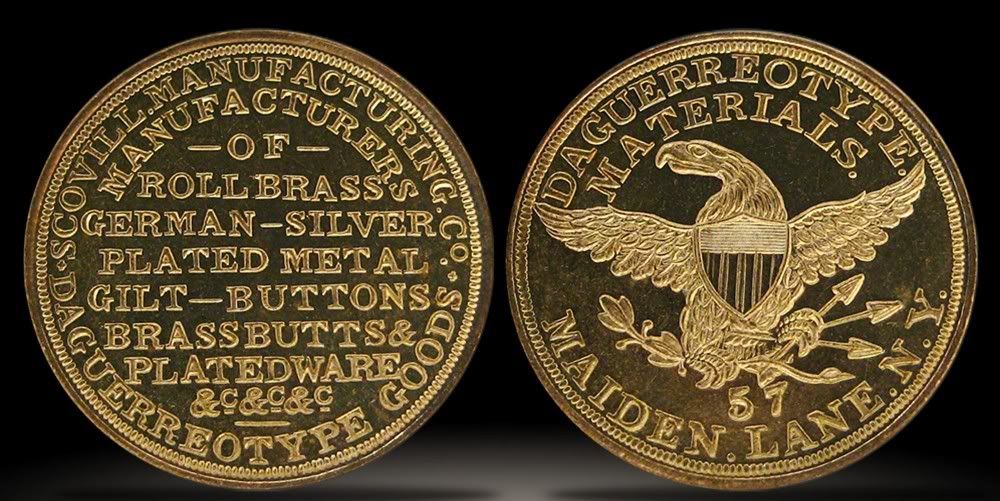
Daguerreotypes........the image, Merchant token now we need ambro1 for a pic of his camera
 coinsarefun
Posts: 21,781 ✭✭✭✭✭
coinsarefun
Posts: 21,781 ✭✭✭✭✭
The daguerreotype image.............and its TONED too


Anyone know the guy.......distant relative perhaps?

The Merchant Card that sold the supplies..................
NGC MS66
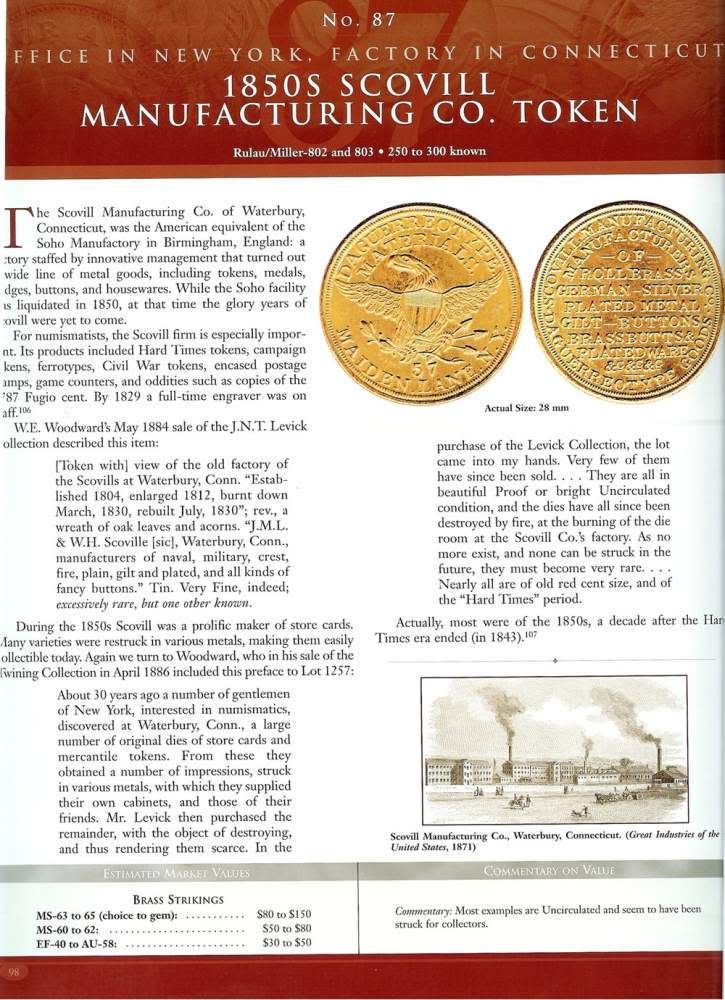
Background info on Scovill
Ok, ambro........post your camera that takes the daguerreotypes
CoinsAreFun Pictorials Album FOR SALE SOME will mark final ones before auction
.
CoinsAreFun Toned Silver Eagle Proof Album
.
Gallery Mint Museum, Ron Landis& Joe Rust, The beginnings of the Golden Dollar
.
More CoinsAreFun Pictorials NGC FOR SALE
.
CoinsAreFun Toned Silver Eagle Proof Album
.
Gallery Mint Museum, Ron Landis& Joe Rust, The beginnings of the Golden Dollar
.
More CoinsAreFun Pictorials NGC FOR SALE
0
Comments
Of every head he's had the pleasure to have known
And all the people that come and go
Stop and say hello
www.brunkauctions.com
The token in the OP looks- dare I say it- gold. I guess it's gilt? Fantastic piece.
I have a thing for old dags and tintypes, too, but I couldn't afford to collect 'em, probably. Not the really interesting ones, anyway.
Oh- gotta LOL @ the "BRASS BUTTS" on that token, too.
Collector since 1976. On the CU forums here since 2001.
He gave the process freely to the World, rather than patenting it. BUT, he did have a resentment toward the English and DID patent the process there, which partially fostered the continuation of Fox Talbots paper negative process and Frederick Scott Archers invention and popularity of the wet plate collodion process.
Dags continue to be made today, in fact there are more active Daguerreotypists in New York City today, than there were in 1870, when only two photographers continued to use the obsolete process.
Any camera that can do Dags can to tintypes, ambrotypes, glass negatives....
The Camera pictured is one of mine, this is a Lewis Daguerreotype Camera, which was patented in 1856 and introduced a bellows to extend the plate far enough from the lens to do 1 to 1 reproductions of plates. That was the only way to get 'another copy' of an image previously done, as there is no negative with these processes.
Dags today are done as they were in the past, but a different style of development, and much safer, is usually done. Back in the day, and still done by some today...the image plate fresh from exposure in the camera is placed on a slight angle in a cast iron inverted pyramid device, with a small amount of mercury in the base. A small flame under this heats the mercury to 147 degrees F. when it begins to vaporize. Small metallic globules, 1/200 of a mm in diameter, rise and adhere themselves to the silver compounds on the plate, in varying degrees according to the exposure. Where there is no image, the plate remains mirrorlike. A bright part of the image attacts the most mercury, becoming the lights of the image. Dags can only really be seen under certain lighting, like an overhead lamp and then reflecting against a dark color. The mirror (darks) of the plate picks up the dark reflections...and the image is 'seen'. Oddly enough, they scan very well.
Many photographers today doing dags develop using the Becquerrel process, which was invented back in the day but not very popular. For still unknown reasons, a dag plate that is slow (sensitized using only iodine rather than iodine, chlorine and bromine) can be developed by simply putting it under a sheet of red glass and placing this in a printing frame in direct sunlight for up to six hours. The results are close to the mercury development...but not quite as dense and vivid. Experts can easily tell the difference. The old plates are wholly superior to anything done today by this process.
The True Masters of the process were Southworth and Hawes. Their images, still, are knockouts. Revival attempts by them for this process lasted until 1908.
fficial&prmd=imvns&tbm=isch&tbo=u&source=univ&sa=X&ei=h-h1Tu-8H-L10gHFssjJDQ&ved=0CFQQsAQ&biw=960&bih=649">Southworth and Hawes Images
On these images, look seven rows down, fourth in. THAT was the most Famous picture of the day, a shot of the Chief Justice and it was taken NOT in the studio, but in the foyer. Hawes noticed the light streaming down, instructed him to "STAY THERE", went and got the camera equipment and made the image. In its day, it was insured for 10 thousand dollars!!!!
Plates frequently tarnished, as the one posted here has done. Photographers made quite a bit of 'side money' by brightening tarnished plates. They simply took it in the back, uncased the image, and gave it a quick rinse with potassium cyanide solution. Then, a rinse and a dry..and it was as good as new ~~ twenty five cents please~
Still, today, there is NO hard images made by any process that has the technical qualities and precision of a properly made daguerreotype.
<< <i>I have an ambrotype, a picture printed on glass, of a Civil War soldier. It is in a composition case like the one that came with the 1996 Civil War commemorative coins, but it does not have the $10 gold piece on the lid. I wish I had access the picture now, but I don't. I'll post it next week if anyone is interesting. >>
hey!...i'm interesting....and would like to see it!
My favorite was one a friend showed me 10 years ago - it was a civil war soldier that was his grandfather! Turns out he didn't have kids until he was 60 and niether had his son - a very long time between generations.
<< <i>hey!...i'm interesting....and would like to see it! >>
Okay, here is my ambrotype of a Civil War soldier. I understand that he was an officer and was from Massachusetts. Unfortunately I don't know his name.
A word of care on old ambrotypes. NOTHING can be done on the image surface itself to improve it. Just like a coin.....best left untouched. However, to enhance visibility, there is nothing at all wrong with removing the image pack (by tapping it upside down against the palm of your hand...NOT prying it out)....the cover glass is usually dirty, clean this well. You can always replace this, but be warned the glass is thinner than what you find commercially available. Picture framing glass is closest to the thickness (or thinness), better than ordinary window glass. Behind the ambro, you will find either an applied asphalt black varnish, or black paper, or black tin, or black velvet. The best enhancement here is to get a fresh piece of black velvet, cut this to size, inset in into the case, and reseat the image pack. IF the black coating on the reverse is coming off in flakes, or crazed and in really bad shape...determing what side the image itself is on. 99 percent of the time they are on the front, the asphalt on the back. If this is so, you can scrape off the old flaked coating and then reset the image pack over the new black velvet. BUT, make sure where the image is...sometimes the asphalt was applied directly on top of the image. If the area where the black is missing, if you can see what looks like a thin negative through that...thats the image itself. That always goes to the top.
Scovill was a HUGE manufacturer of the brass mats and preservers (the thing that goes around the mat and fold behind the image).
If you look close on the image Bill posted you will see the cheek tint. Many photogs done this as a usual practice if the subject was facing right into the camera. Done with a small brush and ground up red pigment, it was dusted onto the cheekbone and then the excess blown off. Then the plate was varnished...dried, and sealed up. Some very artistic photographers back then, and also now, can totally colorize an ambrotype or tintype to give a very beautiful image.
The finest expression of the Ambrotype was a variant called the "Alabasterine" . No one is doing these today, since the technique called for the application of Mercuric Chloride to the surface of the image, before it was varnished. This is a horrid poison and is avoided at all costs today. BUT...back then...after the surface was bleached white by this chemical, and rendered somewhat porous, four colors were used in combinations to lay in color. Then, the image was flowed with canada balsam, and a cover glass clamped onto the plate and the image allowed to set, and cure. Done right, these look like a reverse painting on glass... but far more perfect. Ive seen a few at the Eastman House and they are amazing, a true representation of what early color photography was.