Options
A Demented Grandpa's Classic Ignorance of the 2008 Silver Eagle With Reverse of 2007
 Moki
Posts: 259
Moki
Posts: 259
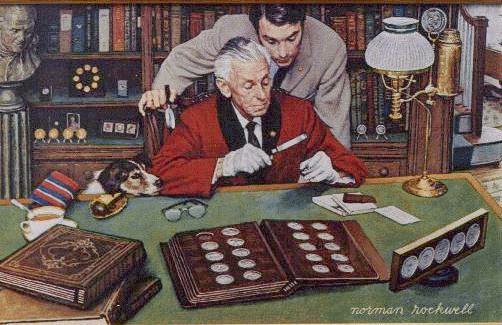
“Hey Grandpa, check out my new coin collection.”
The grandfather thoughtfully scans the collection for a few moments.
“Hmmm. I thought you said these were coins, Jimmy? I don’t know if you are aware of this—but these aren’t coins Jimmy—they’re bullion. There’s quite a difference between collecting coins and collecting bullion. Where did you come up with the idea of collecting these?”
“Golly, some guys on the PCGS website say these are the really hot thing to collect and they have been going up in price every week. They’re a unique error and going to be worth a fortune someday.”
“Bullion errors, eh? Who would imagine? Never heard of such a thing. How many have been minted, Jimmy?”
“Well, the Mint says there are 47,000 of them.”
“47,000? Well, that doesn’t make them rare—not even kind of scarce. I’m sorry, Jimmy, but given those numbers I don’t see how they’re ever going to be worth a fortune.”
“Well, some guys on the PCGS website say that the Mint’s number is way too high and there’s probably not even going to be half that and . . . ”
“And what makes them so certain about that when the people who actually minted them say otherwise?”
“Well . . . it just seems to be the feeling there . . . ”
“Do you mind if I ask what you paid for them?”
“Well, I was able to buy 25 of these for an average price of about $300—except for my MS70—which was more, of course. Soon they’ll be worth twice that.”
“Worth twice that? And what do you base that on?”
“Well, some guys on the PCGS website . . . ”
Suddenly realizing he did not have an adequate explanation to his grandfather’s question and not wishing to sound foolish, the grandson stopped mid-sentence to shift the focus of discussion by handing his grandfather a slabbed coin.
“. . . here, check out my MS70. It’s a perfect coin! You can’t get any better than that.”
“Perfect coin, eh?”
“Yeah, and here’s an MS69 for comparison.”
The grandfather carefully scrutinizes the two coins with the magnifier; first one then the other, back and forth quietly for some time.
“Well, I’ll be damned if I can tell the difference. What did you say you paid for this MS70?”
“I got a really good deal—paid just over a $1000 for it.”
Grandpa capitulates forward wheezing a faint groan as if suddenly stabbed in the stomach by an invisible fist. He then gets very quiet and somber while collecting his thoughts.
“Jimmy, I’m going to tell you something. You’re not collecting coins son—you’re speculating. Speculating is for gamblers and the salesmen who hawk it; while coin collecting is for individuals who love and appreciate fine coins—their history, their uniqueness, their personality, the time period they represent, and their beauty. Yes, the folks who are talking up these errors and promoting to sell them and who get in at the beginning will probably make some money—just like the relatively few people do with many pyramid and MLM schemes. Sure, the people in the beginning make some money—sometimes a nice stash. The people that get in too late—well, to phrase it in the vernacular of you young folks—they get screwed.”
Long pause while Jimmy stares at the floor.
“I tell you what Jimmy, I’ve never told you about my Classic coin collection before. Would you like to see it? I think maybe then you will begin to get an understanding of what I’m trying to explain.”
“You bet! That would be swell! But Grandpa?”
“Yes, Jimmy?”
“You’re not mad at me are you?”
“Mad is not the word, Jimmy. Let’s just say I’m thanking my lucky stars that your grandmother and I haven’t yet finalized our will.”
Jimmy with a puzzled look on his face. (fade to black)
0
Comments
Federal officials faced a dilemma in the years after the Civil War. The Comstock Lode and other Western mines were producing large quantities of silver, but the government could use only limited amounts of it in coinage. This seems puzzling in retrospect, for silver coins were few and far between in circulation (a lingering legacy of wartime hoarding), and Americans presumably would have welcomed major infusions of silver coins. But Mint officials feared that new silver coins would be subject to hoarding as well, since the marketplace was awash with paper money, including fractional currency born of wartime need. People would have been only too happy to exchange these notes, which brought less than full face value, for precious-metal coinage.
For a time, the miners found outlets for their silver, often in coinage form, in foreign markets. Canada, Latin America and Europe all absorbed significant quantities during the 1860s. But then, for various reasons these markets became glutted. In Europe, for example, Prussian Chancellor Otto von Bismarck established a gold standard for Germany after unifying the country in 1871 and promptly dumped huge amounts of silver on the international market.
For the miners and their powerful allies in Washington these developments were doubly disturbing: Not only was it hard to sell their silver, but the market price was steadily declining. Initially, coinage did offer one escape valve: Under a long- standing law, silver could be deposited with the Mint for conversion into silver coins, for which it could then be exchanged. Having no other ready outlet, miners took advantage of this one. Invariably, they chose silver dollars, the one denomination that hadn't been changed when silver coins were reduced in weight (and precious-metal content) in 1853. As a direct result, silver dollar mintages soared above one million in both 1871 and 1872.
But with the Coinage Act of 1873, Congress closed this loophole by suspending further production of silver dollars. And that's where the trade dollar came in: Flexing their muscle, the mining interests won approval for this new silver coin-one that would, in theory at least, not only provide an outlet for the metal, but also open a whole new market for it in an area that was already receiving Congressional attention.
The market in question was Asia, particularly China. Some U.S. silver had found its way to that region previously, but now a full-fledged offensive was planned. The Chinese had shown a decided preference for silver coins, and up to then the bulk of American trade with China had been carried out with Spanish and Mexican dollars. The trade dollar's architects set out to supplant those rivals by giving the new coin a higher silver content. They even had it inscribed on the coin: "420 GRAINS, 900 FINE."
At first glance, the trade dollar looks much like a regular silver dollar. It's the same diameter and about the same weight as its predecessor, the Seated Liberty dollar, and its portraiture is similar: a seated female figure representing Liberty on the obverse and a naturalistic eagle on the reverse-designs prepared by Mint Chief Engraver William Barber.
In contrast to the new trade dollar, the regular U.S. silver dollar weighed just 412.5 grains, and the Mexican dollar weighed only 416. But the architects had miscalculated; though it weighed slightly less, the Mexican coin had a higher fineness and therefore contained slightly more pure silver. The astute Chinese recognized this and, in many provinces, gave the U.S. coin short shrift, favoring the Mexican coin.
That's not to say the trade dollar wasn't used. On the contrary, over 27 million went overseas and found their way into Asian commerce, many later being sent on to India in trade for opium. Numerous pieces show chop marks-distinctive Chinese symbols-placed on them by merchants to attest to their authenticity. But usage of the coins never approached Americans' expectations.
The trade dollar's biggest problems occurred not in China but at home. In a last-minute deal, Congress had made the coin a legal tender for domestic payments up to five dollars. In 1876, millions were dumped into circulation in the United States when silver prices plummeted, making them worth substantially more as money than as metal.
Congress quickly revoked their legal-tender status (the only time this has been done with any U.S. coin), but the seeds of serious trouble had been sown. In the late 1870s, employers bought up huge numbers of the coins at slightly more than bullion value (80 to 83 cents apiece) and then put them in pay envelopes at face value. Merchants and banks accepted them only at bullion value or rejected them altogether, so the workers effectively lost one-sixth to one-fifth of their pay at a time when that pay often amounted to less than $10 a week.
Spurned abroad and despised by many at home, the trade dollar soon faded into oblivion. After 1878, production was suspended except for proofs-and even those dwindled to just ten in 1884 and five in 1885.
Like many other "fantasy" coins before them, the 1884 and 1885 pieces were clandestinely struck for Mint crony William Idler and were unknown to the numismatic community until six pieces from Idler's estate were sold by dealer John Haseltine in 1908. Notwithstanding their questionable origin, these two dates are viewed as great rarities today.
In all, fewer than 36 million trade dollars were struck during the coin's 13-year lifespan, including about 11,000 proofs. Production took place at Philadelphia, Carson City and San Francisco. The rarest business strike is the 1878-CC with a mintage of 97,000, many of which appear to have been melted. All high-grade business strikes of the trade dollar are rare to non-existent, leaving proofs to fill most of the demand from type collectors.
The extraordinary beauty of originally-toned proofs entices many collectors to attempt complete proof runs (excluding the virtually unavailable 1884 and 1885, of course). Indeed, any trade dollar is highly prized and sought in pristine condition. Points to check for wear include Liberty's ear, left knee and breast and the eagle's head and left wing.
<B>SPECIFICATIONS:</B>
<B>Designer:</B> William Barber
<B>Weight: </B>27.22 grams
<B>Net weight: </B>0.7874 oz pure silver
<B>Composition:</B> 0 .900 silver, 0.100 copper
<B>Diameter:</B> 38.1 mm
<B>Edge:</B> reeded
<B>Minted at: </B> Philadelphia, Carson City, San Francisco
<B>Years Minted:</B> 1873 to 1885
<B>Mint mark: </B>On reverse below eagle and above the 'D' in the word 'dollar.'
<B>Notes: </B>Key date 1878CC due to numerous coins being melted and low mintage. Proofs are rare too. Many trade dollars have been counterstamped with Chinese 'chop marks'. These marks typically devalue the coin.
<FONT size=1>BIBLIOGRAPHY: Bowers, Q. David, Silver Dollars & Trade Dollars of the United States, A Complete Encyclopedia, Bowers and Merena, Wolfeboro, NH, 1993. Breen, Walter, Walter Breen's Complete Encyclopedia of U.S. and Colonial Coins, F.C.I. Press/Doubleday, New York, 1988. Willem, John M., The United States Trade Dollar, Whitman Publishing Co., Racine, WI, 1965. Yeoman, R.S., A Guide Book of United States Coins, 48th Edition, Western Publishing Co., Racine, WI, 1994.</FONT>
<I>Coin Information Provided Courtesy NGC</I>
<< <i>
So grandfather can't grade, either? Lots of collectors can't grade coins but if I was writing this story the wise old gradfather character would have been able to grade coins. --Jerry
So after stopping the stray dog from pee'n on the coins, the two left the walnut-lined, public library and headed home.
As he drove, Junior silently was thinking how the old guy had wasted his life, collecting crap.
He then dropped Gramps off back at the Trailer Park so the old coot could continue his mushroom-induced fantasy
“I tell you what Jimmy, I’ve never told you about my Classic coin collection before. Would you like to see it?"
“It is full of gem key dates I bought in the 1960's. Added mintmarks, omega signs and some coin from the Bay Area?”
"And I bought them all at great prices on ebay from Chinese sellers whom didn't know what they really had!"
1947-P & D; 1948-D; 1949-P & S; 1950-D & S; and 1952-S.
Any help locating any of these OBW rolls would be gratefully appreciated!
I 'tapped' one of the kids bike on Friday backing out after my BIN went off at $1,999.99.
Nothing a new bike rim couldn't fix ;>
<< <i>
“47,000? Well, that doesn’t make them rare—not even kind of scarce. >>
"But Gramps, it just might be rare if there are kazillion SAE collectors out there. Supply may not keep up with demand for something like this."
Gramps with a rolaids look on his face replies, "darn bullion collectors any how.
Hey grandpa, check out my collection of Morgan Dollars, Jimmy said proudly. Gramps grabbed his trusty glass and took a look at the coins with a quiet chuckle. Morgan's eh. Jimmy, don't you know that no one wants those bulky old coins. My gosh son, they can't even get rid of them so they had to store them in great piles at the MInt. What is this one- an 1889 Carson City. Can't you even get one of those pretty San Francisco coins? But Grampa, the guys at the collector club said that coin could be one of the real keen coins of the future because they didn't make many. Jimmy, you got a long way to go as a collector son. You know they made 350,000 of those coins? My gosh child, you call that scarce? Guess you got your brains from your grandmother. Yes, said Jimmy sheepishly.
Moral: Gramps is a pompous idiot who cannot see the future with his trusty glass to save his soul and really could use a laxative.
Fact is, the ordinary and even Professional TPGer cannot tell the difference between one grade-point to another. Why is it that NGC 70s are PCGS 69s? Why does NGC tend to assign more 70 grades than PCGS? Is it because the professionals at NGC are more far-sighted? I doubt it. IMO its more competitor-based and the fact that there is no Industry standard grading guideline. Each TPG has their own.
Sir, if you can differentiate between a 69 and 70, congratulations. But instead of conjecturing that it is a matter of clarity to those "that care to learn it", howzabout sharing that knowledge? I happen to "care to learn it", but I don't see anyone on these boards sharing that knowledge!
IMO the difference between a 69 and 70 is a matter of opinion. Subjective and susceptible to the mood/attitude of the grader(s) state of mind at the time he sees the coin cross his desk in a matter of 16 seconds.
I don't believe that anyone can distinguish a 69 from a 70 any more than I think anyone on these boards can accurately grade a coin from a two-dimensional digital photograph!
No, offense Buff hunter, that's just my honest opinion.
Edited: for spelling once again
<< <i>The difference between a 69 or 70 is clear enough for those that care to learn it. >>
---------------------------------------------------------------------------------------------------------------------------------------
BONGO HURTLES ALONG THE RAIN SODDEN HIGHWAY OF LIFE ON UNDERINFLATED BALD RETREAD TIRES
<< <i>I can not distinguish between a 69 and 70 even with close examination. I use a 10X loupe (perhaps more magnification makes a difference?), good lighting, etc, but I just don't see the difference. Usually, both exampleslook equally flawless to me. Perhaps some people are blessed with sharper vision through superior physiology: optometrists correct me if I'm wrong, but some folks are born with a higher density of photoreceptors on their eyeballs which makes for crisper, more detailed visual images. >>
I think I can tell. If nothing else, I think too many 69s get graded a 70. Usually the strikes are about the same but there are tiny nicks or breaks in the luster on 69s or possibly even an irregular luster. I am still learning though.
<< <i>Compared the the success of other ASE years and vaireties with similar mintages, these pieces actually have a chance at becoming fairly valuable. >>
250,000 2006 Reverse Proofs... 69s worth about $150 or so?
30,000 1995-W Proof Silver Eagles... $4k-$4.5k
42/92
(Edited to tone it down a bit...we're only talking about coins here...
<<Fact is, the ordinary and even Professional TPGer cannot tell the difference between one grade-point to another. Why is it that NGC 70s are PCGS 69s? Why does NGC tend to assign more 70 grades than PCGS? Is it because the professionals at NGC are more far-sighted? I doubt it. IMO its more competitor-based and the fact that there is no Industry standard grading guideline. Each TPG has their own.
Sir, if you can differentiate between a 69 and 70, congratulations. But instead of conjecturing that it is a matter of clarity to those "that care to learn it", howzabout sharing that knowledge? I happen to "care to learn it", but I don't see anyone on these boards sharing that knowledge!
IMO the difference between a 69 and 70 is a matter of opinion. Subjective and susceptible to the mood/attitude of the grader(s) state of mind at the time he sees the coin cross his desk in a matter of 16 seconds.
I don't believe that anyone can distinguish a 69 from a 70 any more than I think anyone on these boards can accurately grade a coin from a two-dimensional digital photograph!
No, offense Buff hunter, that's just my honest opinion.
Well said, DieClash. My 45+ years of collecting and grading can't readily distinguish a 69 from a 70 - and I too await the lesson from a Master!
Cheers!
<< <i>Just because someone can't tell or hasn't bothered to learn the difference dosen't mean there isn't one. As far as PCGS 70's go, quality of strike & centering compared to other similar coins is a factor as well as not having any contact marks visible under 5x magification. NGC definition of 70's is 'as struck' with no flaws caused after the minting process visible under 5x magnification. which is different and more lenient than the PCGS standard since it will allow for some minor Mint flaws that would cause it to drop to 69 at PCGS. As they say, it's all in the details
---------------------------------------------------------------------------------------------------------------------------------------
BONGO HURTLES ALONG THE RAIN SODDEN HIGHWAY OF LIFE ON UNDERINFLATED BALD RETREAD TIRES
<< <i>So its all about 5x magnification and whehter or not the strike is full and centered, eh? I can live with that Buff Hunter.
Cheers!
<< <i>Just because someone can't tell or hasn't bothered to learn the difference dosen't mean there isn't one. As far as PCGS 70's go, quality of strike & centering compared to other similar coins is a factor as well as not having any contact marks visible under 5x magification. NGC definition of 70's is 'as struck' with no flaws caused after the minting process visible under 5x magnification. which is different and more lenient than the PCGS standard since it will allow for some minor Mint flaws that would cause it to drop to 69 at PCGS. As they say, it's all in the details
>>
It really is not rocket science and actually fairly easy to learn what a company calls a '70'. The marketplace is very efficient in determining value based on a TPG standards and quick to adjust for discrepancies that come along (as in the case of a coin having a higher 70 ratio than previous similar coins). Reason why PCGS 70's are more coveted than NGC's 70's due to the different standards used and the prices reflect that. Collectors buy with their money what suits them not what you, I or anybody else likes.
<< <i>
<< <i>So its all about 5x magnification and whehter or not the strike is full and centered, eh? I can live with that Buff Hunter.
Cheers!
<< <i>Just because someone can't tell or hasn't bothered to learn the difference dosen't mean there isn't one. As far as PCGS 70's go, quality of strike & centering compared to other similar coins is a factor as well as not having any contact marks visible under 5x magification. NGC definition of 70's is 'as struck' with no flaws caused after the minting process visible under 5x magnification. which is different and more lenient than the PCGS standard since it will allow for some minor Mint flaws that would cause it to drop to 69 at PCGS. As they say, it's all in the details
>>
It really is not rocket science and actually fairly easy to learn what a company calls a '70'. The marketplace is very efficient in determining value based on a TPG standards and quick to adjust for discrepancies that come along (as in the case of a coin having a higher 70 ratio than previous similar coins). Reason why PCGS 70's are more coveted than NGC's 70's due to the different standards used and the prices reflect that. Collectors buy with their money what suits them not what you, I or anybody else likes. >>
---------------------------------------------------------------------------------------------------------------------------------------
BONGO HURTLES ALONG THE RAIN SODDEN HIGHWAY OF LIFE ON UNDERINFLATED BALD RETREAD TIRES
Well, just Love coins, period.
<< <i>I concur, but what makes PCGS 70s more maket valuable is the Condition Rarity vis-a-vis NGC MS70s. I assert that Condition Rarity is relative. Consider the raririty of all 1804 Silver dollars across all grades compared to the scarcity of a pop 1/1 2007-D Pres. Dollar where there were millions of Satin-finished dollars produced but only a fraction having seen a plastic slab? PCGS MS70 raririty is a false indicator of relative rarity because it is speculative. For sure the "market" pays more because there are fewer PCGS 70s than NGC 70s and thus there is a false perception of "rarity" in general. Look, I'm not one to question the market. I don't purchase plastic. But how the market interprets 70 vs. 69 is totally speculative based on loosely applied subjective TPG standards. Hence, my cry for an industry standard implemented by a hobby-wide acceptable ANA-enforced definition. Only when all TPGs grade on the same standard can one say that they can differentiate between one-point differences on the scale of 1-to-70. >>
To me at least, PCGS's and NGC's standard for a 69 or 70 (although different) is as defined as all other grades lower. It's a matter of learning what the company's standard is that makes the determination to be able to recognize the difference. And that only comes from looking at coins and sending them in to be graded in order to have a basis of what to recognize. If there is a general standard implemented, IMO PCGS's is closer to a perfect 70 than any other as reflected by the ratio of 70's compared to NGC's and that is what I feel the marketplace basis value on, not neccesarily rarity.
Then so be it! We need one standard for all TPGs, IMHO. And not subjective standards defined by individual TPGs as we have today. And BTW while PCGS may have the conservative MS70 industry defined grade, they have been susceptible to grade-flation as ohter TPGs have succumbed. The marketplace may recognize PCGS grades with a nominal premium over other TPGs, but the market and industry is still severly lacking of a standard that would make this thread moot!
<< <i>
<< <i>I concur, but what makes PCGS 70s more maket valuable is the Condition Rarity vis-a-vis NGC MS70s. I assert that Condition Rarity is relative. Consider the raririty of all 1804 Silver dollars across all grades compared to the scarcity of a pop 1/1 2007-D Pres. Dollar where there were millions of Satin-finished dollars produced but only a fraction having seen a plastic slab? PCGS MS70 raririty is a false indicator of relative rarity because it is speculative. For sure the "market" pays more because there are fewer PCGS 70s than NGC 70s and thus there is a false perception of "rarity" in general. Look, I'm not one to question the market. I don't purchase plastic. But how the market interprets 70 vs. 69 is totally speculative based on loosely applied subjective TPG standards. Hence, my cry for an industry standard implemented by a hobby-wide acceptable ANA-enforced definition. Only when all TPGs grade on the same standard can one say that they can differentiate between one-point differences on the scale of 1-to-70. >>
To me at least, PCGS's and NGC's standard for a 69 or 70 is as defined as all other grades lower. It's a matter of learning what the company's standard is that makes the determination to be able to recognize the difference. And that only comes from looking at coins and sending them in to be graded in order to have a basis of what to recognize. If there is a general standard implemented, IMO PCGS's is closer to a perfect 70 than any other as reflected by the ratio of 70's compared to NGC's and that is what I feel the marketplace basis value on, not neccesarily rarity. >>
---------------------------------------------------------------------------------------------------------------------------------------
BONGO HURTLES ALONG THE RAIN SODDEN HIGHWAY OF LIFE ON UNDERINFLATED BALD RETREAD TIRES
<< <i>The PCGS 70 grade is no imperfections at 5X magnification. Isn't that like saying a girl is a 10 after you drink about 8 beers?
>>
---------------------------------------------------------------------------------------------------------------------------------------
BONGO HURTLES ALONG THE RAIN SODDEN HIGHWAY OF LIFE ON UNDERINFLATED BALD RETREAD TIRES
Now just do me one favor old man. Tell me that paying $7,000,000.00 for 1933 gold bullion is a rational thing to do.
I'm waiting.
Stupid old fart.
Only time will tell if the ASE's or ASE's "errors" is held in as high esteem as true coins that survive in much less quantity. But I would not argue with Grandpa. Remember the Golden Rule.
Practice makes perfect & nobody is perfect. So, practice being nobody and be perfect !
<< <i>Bullion Coin:
A bullion coin is a coin that is valued by its weight in a specific precious metal. >>
<< <i>Collector or Rare Coin:
The value of a collector or rare coin is based upon the coin’s rarity, demand, condition and mintage. A collector or rare coin may be worth more than its bullion value. >>
Why not just rat him out to Grandma and be done with it................
Dan
<< <i>I think it's funny that people will brag that they can't tell the difference between a 69 and a 70 but won't admit they can't tell the difference between a 64 and a 65. >>
Jerry, There are PQ 64s and low-end 65s that could go either way subjectively. And they can price in the middle too. Have you ever heard of any (non-newbie) collector or dealer paying a premium for a PQ 69?
NSDR - Life Member
SSDC - Life Member
ANA - Pay As I Go Member
First, you should listen to grandpa........he's right.
Second, the 1933 gold is a COIN not bullion!!!!!!!!!!!
Third, I would sure hate to be holding these "RARE" (laugh) moderns when the music stops! AND IT WILL !!!!!!!!!!!!!!!
<< <i>
<< <i>I think it's funny that people will brag that they can't tell the difference between a 69 and a 70 but won't admit they can't tell the difference between a 64 and a 65. >>
Jerry, There are PQ 64s and low-end 65s that could go either way subjectively. And they can price in the middle too. Have you ever heard of any (non-newbie) collector or dealer paying a premium for a PQ 69? >>
Coxe,
I'm sure you can grade 64 thru 65, expecially in Morgans, dividing the grade up into tenths (64.1 thru 64.9). But those who can't grade don't brag about it unless they are talking the 69/70 line.
Yes, as a seller of 69s I frequently have buyers message me asking for a PQ 69--in fact just last week one buyer returned an NGC 69 2008/7 silver eagle and I gave him a better one. Now if someone says that there is little or no differnce between a PQ 69 and a low end 70 then I will agree. --Jerry
<< <i>Two words..... Computer Grading. That will provide uniformity, take any guesswork out of the equation, eliminate a lot of grader jobs, and increase TPG profitablility - until someone bootlegs the program and sells it to collectors...
There are only two absolute's! Everything else is simply an acceptable compromise!
Computer grading, IMO, will never replace human grading because computers do not buy coins.
Remember, the whole premise behind Sheldon's scale was not based upon technical accuracy but on what people would pay for a specific piece compared to a basal state coin. Therefore a coin that had a hit in an area that was not attracted by the eye yet had excellent luster could get a grade a point higher than the same coin which had the same hit with only ok luster. Its not so much what is wrong with the coin as much as it is what the buyer's are willing to accept. Trade off's play an important role in coin collecting yet trade off's are difficult to program.
Just some thoughts.
The name is LEE!
<< <i>First, you should listen to grandpa........he's right.
Second, the 1933 gold is a COIN not bullion!!!!!!!!!!!
Third, I would sure hate to be holding these "RARE" (laugh) moderns when the music stops! AND IT WILL !!!!!!!!!!!!!!! >>
What makes one round disk a coin and another round disk bullion? Were trade dollars bullion or a coin? Lastly, who cares anyway because even if something is not technically a "coin" they still have collector value and that value can last just like any circulated coin-maybe better.
<< <i>Just wait until gramps is incointinent
"Incointinent" - a great word for these boards.
<< <i>
<< <i>
<< <i>I think it's funny that people will brag that they can't tell the difference between a 69 and a 70 but won't admit they can't tell the difference between a 64 and a 65. >>
Jerry, There are PQ 64s and low-end 65s that could go either way subjectively. And they can price in the middle too. Have you ever heard of any (non-newbie) collector or dealer paying a premium for a PQ 69? >>
Coxe,
I'm sure you can grade 64 thru 65, expecially in Morgans, dividing the grade up into tenths (64.1 thru 64.9). But those who can't grade don't brag about it unless they are talking the 69/70 line.
Yes, as a seller of 69s I frequently have buyers message me asking for a PQ 69--in fact just last week one buyer returned an NGC 69 2008/7 silver eagle and I gave him a better one. Now if someone says that there is little or no differnce between a PQ 69 and a low end 70 then I will agree. --Jerry >>
"low end 70" that is funny
<< <i> "low end 70" that is funny >>
If you think that's funny then you don't understand that 70 is a grade just like 45. --Jerry