Reason for small seated dollar mintages
 RogerB
Posts: 8,911 ✭✭✭✭✭
This letter expresses director J. R. Snowden's objections to minting silver dollars. At this time the standard silver dollar contained about $1.04 in silver. Other documents and research by Dan Owens notes that many of these coins were used in Asian trade, which helps explain their domestic scarcity.
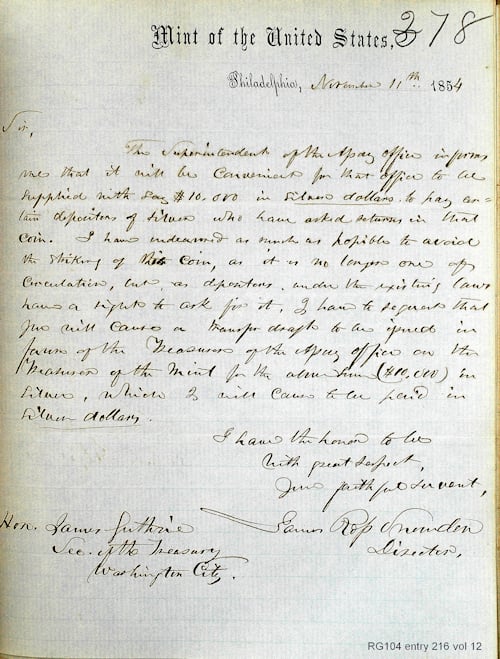
[RG104 entry 216 vol 12]
Philadelphia
November 11, 1854
Hon. James Guthrie,
Secretary of the Treasury
Sir:
The superintendent of the Assay Office informs me that it will be convenient for that office to be supplied with say $10,000 in silver dollars to pay certain depositors of silver who have asked [for their] returns in that coin. I have endeavored as much as possible to avoid the striking of this coins, as it is no longer one of circulation; but as depositors, under the existing laws, have a right to ask for it, I have to request that you will cause a transfer draft to be issued in favor of the Treasurer of the Assay Office on
the Treasurer of the Mint for the above sum ($10,000) in silver, which I will cause to be paid in silver dollars.
James Ross Snowden
Director
Comments
I once saw a list of "how" coins were suppose to be valued on the Newman Portal. I really wish I had copied it. To the best of my memory it was from around the mid 1870's and there were specific amounts listed; not just for certain denominations but also different versions of coins, such as Seated Halves with and without arrows. I can't imagine a modern retailer doing something like this. I also think the modern consumer would be horrified to find out they have to know like a dozen different coins and their values. Different times; different ways of life, james
Is this close to what you saw?
Memorandum of Silver standard of Spain.
From the reign of Philip II of Spain, until 1728, the standard fineness of silver was 11-1/6
dineros fine, at which rate the marc of Castile, 3.557 grains, yielded 8-1/2 dollars of 389-4/10
grains each. The remedy of the Mint was 2 grains fine to each piece.
Assays of these pieces at the British Mint, in 1717, gave 386-3/4 grains fine silver.
The above coins ceased to circulate in 1728, in which year the standard purity of the Spanish
Dollar was reduced to 11 dineros, equal to 383-2/10 grains.
In 1772 a Royal Edict established the regulation of 10-3/4 dineros fine, equivalent to 374-7/8
grains to each dollar, with Mint remedy of one grain. With such reduction in content of fine
silver, the previous issue became simply bullion when measured by the reduced coin, and ceased
to circulate by tale.
chopmarkedtradedollars.com
@lermish --might be of interest:
Alejandra Irigoin, Atsushi Kobayashi & David Chilosi, China Inside Out: Explaining Silver Flows in the Triangular Trade, c.1820s-1870s (London Sch. of Econ. & Pol. Sci., Working Paper No. 357, 2023), https://www.lse.ac.uk/asset-library/information/wp357.pdf
Alejandra Irigoin, The End of a Silver Era: The Consequences of the Breakdown of the Spanish Peso Standard in China and the United States, 1780s–1850s, 20 J. World Hist. 207 (2009). https://www.researchgate.net/publication/236757054_The_End_of_a_Silver_Era_The_Consequences_of_the_Breakdown_of_the_Spanish_Peso_Standard_in_China_and_the_United_States_1780s-1850s
@RogerB. No, the list I saw was a typewritten list of American coins, (and paper money) and had a heading something like; "A Merchants Guide to Coins & Currency). It was also dated but I can't remember the date. James
I'm surprised that with those objections there was no proposal enacted to reduce the silver content of the silver dollar.
Custom album maker and numismatic photographer.
Need a personalized album made? Design it on the website below and I'll build it for you.
https://www.donahuenumismatics.com/.
When Congress lowered the silver of all other coins, except the Silver Three Cent Piece, which as already a token coin, the silver dollar, it condemned that already unpopular coin to domestic disuse. It is interesting to note that they were still used for the China trade. Perhaps that’s why Congress left it alone.
For those who might not realize it, the Silver Three Cent Piece was a token coin from the beginning. It was freely admitted that the piece did not contain 3 cents worth of silver. The other coins carried the illustration that they did although that was for public consumption. Once a coin melts from more than its face value, people withdraw it from circulation. As in 1853 and 1964-5.
The silver content of the three cent silver actually increased with the Coinage Act of 1853, even as the weight went down because of the increase in fineness, making it proportional to the other fractional silver coins. I suspect that the Mints found it inconvenient to keep track of silver stock and scrap that was both .900 fine and .750 fine.
Discussion in 1852-53 included reduction in the silver dollar's weight as with the other coins. But considerable objections were raised thereby debasing the "Standard Silver Dollar" and thus throwing the "Standard Gold Dollar" out as the sole "metallic currency standard."
Know this was a short hand response, but actually was a compromise between the monometallists (led by Senator Robert M. T. Hunter of Virginia, Chairman of the Senate Finance Committee) and bimetallists ( led in the House by Cyrus L. Dunham from Indiana ). By debasing subsidiary coinage but preserving a non debased Silver dollar, the veneer of bimetallism was maintained . It pushed the debate down the road, rather than being a definitive determination....
"We propose, so far as these coins are concerned, to make the silver subservient to the gold coin of the country, so far as regards the medium of exchange—to make them tokens, if you please, of less value than the gold, but of a specific value, strictly regulated by law, for necessary change, and to be used only for such necessary change. We do not, however, propose to change the dollar."
Cong. Globe, 32d Cong., 2d Sess. App. 190 (1853) (statement of Rep. Cyrus L. Dunham).
California, and Australian gold rushes were having significant global effects at this time....
Thanks for the additional info ! Very welcome.
The Type I Three Cent Piece was 75% silver and 25% copper, the only U.S. coin in that alloy. The Types II and III coins were 90% silver like the rest of silver coins of the period.
Very informative thread. Thank you all.
If they weren't being used in commerce, are they the equivalent of modern day half dollars?
We need to realize gold coins circulated. Would you rather have five clunky silver dollars in your pocket or a nice tidy little $5 Liberty? …….or to the extreme, a double eagle or Twenty (clunky) silver dollars in your pocket(s).
According to ChatGPT, a common laborer in 1859 earned about $6 a week so a double eagle was the equivalent of two and a half week's wages. How many people would be likely to be carrying around that sort of value in one coin? Even a $5 coin was nearly a week's wages.
Oh, yeah... here's where that number comes from: The historical data come from Robert A. Margo's Wages and Labor Markets in the United States, 1820–1860 and the U.S. Bureau of Labor Statistics' History of Wages in the United States.
Followup ChatGPT inquiry response:
A bricklayer in 1859 earning $6 for a six-day workweek was a skilled manual laborer. The closest modern comparison would be a journeyman bricklayer or mason.
According to the latest available Bureau of Labor Statistics figures (May 2025):
So 2 1/2 week's wages for a comparable worker's labor would be nearly $3000 today.
How useful to the average person would a $3000 coin be?
welcome to left field
Thanks, but I usually play third base.
I find it to be an interesting parallel, per my comments and the responses to which above, that the 1 dollar coin has been a historically unwanted coin both back in the mid-nineteenth century and in the current era.
Custom album maker and numismatic photographer.
Need a personalized album made? Design it on the website below and I'll build it for you.
https://www.donahuenumismatics.com/.
Consider -- There were practical reasons for European gold being mostly $5 size; and crowns being smaller than US silver dollars in the 19th and 20th centuries. Those were convenient sizes for pockets/pocketbooks and use by middle class families. People of means used bank drafts and credit notes/letters of credit. Lower class families used copper and small silver - rarely seeing gold in any form.
Might be of interest --provides a good general overview of the nation's transition from bimetallism to the gold standard, alongside the circulation of bank notes, government bills, and bills of exchange
Craig K. Elwell, Cong. Research Serv., R41887, Brief History of the Gold Standard in the United States (2011), available at https://www.congress.gov/crs_external_products/R/PDF/R41887/R41887.2.pdf
Why weren't US silver dollars cut into pieces of eight to make them smaller?
Most Seated Liberty silver dollars have significant circulation wear.
Although the mintages were relatively low, the coins that were produced did tend to get used extensively in commerce.
I have read claims that "nobody wanted silver dollars".
I find that claim preposterous. Of course people wanted them - they were money.
But a large segment of the population could not afford them.
The 1870CC Seated dollars traded at a premium in California. They were symbols of the West and became pocket pieces..
Some of the 1870CC Seated Dollars must have made it to China because there are currently two known pieces with chopmarks
Good observations @dcarr .
Here are some of mine:
Wesley C. Mitchell, A History of the Greenbacks: With Special Reference to the Economic Consequences of Their Issue: 1862–65 (1903); Charles W. Calomiris & Christopher Hanes, Consistent Systems of Exchange Rates and Specie Prices in Gold and Silver Markets, 1862–1879 (Nat’l Bureau of Econ. Rsch., Working Paper No. 5381, 1995).
Part of the story missing here is the silver price kept falling off a clif after 1872 which is what led to the Trade dollars being demonitized to stem the flow back into the states that didn't work
11.5$ Southern Dollars, The little “Big Easy” set
......
Agree, Perhaps-- and as a matter of pure speculation---, that would then provide the incentive for any hoarded dollars to then circulate.
There was sufficient small denomination coinage to cover demand; thus, no general necessity.
I'm not sure if I follow you. Do you mean if silver prices hadn't kept falling it would have led to more circulation of hoarded dollars?
Apologies for derailing this seated dollar thread with more trade dollar talk but the continued drop in silver prices along with legislative changes led to the melting pot for T$, not more circulation.
chopmarkedtradedollars.com
Gold coins circulated to a limited extent even with efforts in the 1830s to reduce the Standard Gold Dollar and discourage coin export. When considered from our perspective in coin collecting - by the piece, not dollar - the quantity of pieces in active circulation was small compared to other currency. Post Civil War recoinage of low weight/damaged gold coins combined with introduction of gold notes eventually returned a large proportion of extant coins to Treasury vaults. Mint and NYAO sale of $5,000 fine bars beginning in the late 1850s further limited industrial conversion and use.
Gold coins we collect are remnants - leftovers - and cannot be used to "prove" extensive economic impact or circulation. Further, the anecdotal base on which numismatic lore has been built accepts almost exclusively upper-middle and upper class family economics added to national and international business use.
Bottom line: Extensive gold coin circulation among the US population is, with few exceptions, a self-proved fallacy.
Here's some info from our AI friends:
Silver dollars were highly unpopular and practically nonexistent in daily American commerce from the 1830s to the 1870s.
While physical bulk and the logistical issue of carrying heavy, dollar-sized coins in trouser pockets did play a minor role, the primary reasons for their unpopularity were entirely macroeconomic.
1. The Global Arbitrage Threat: They Were Worth More Melted Down
The single biggest reason silver dollars didn't circulate was Gresham’s Law—the economic principle that "bad money drives out good". 1, 2
• The Gold Rush Disruption: Following the 1848 California Gold Rush, an immense flood of new gold hit the global market. This sudden massive supply caused the value of gold to drop relative to silver. 1, 2, 3
• The Valuation Gap: The U.S. government legally mandated that a silver dollar coin was worth exactly $1.00 in commerce. However, because silver had become scarcer and more valuable than gold, the raw silver metal inside a single Seated Liberty dollar coin was worth roughly $1.03 to $1.05 on the open bullion market. 1, 2
• The Result: If you had a silver dollar, spending it at a local store meant losing money. Instead, merchants, citizens, and bullion brokers hoarded the coins, melted them down into silver bars, or exported them overseas to Europe and China where silver fetched a premium. The "good" money vanished from pockets completely. 1, 2
2. The 1853 Fractional Overhaul (Leaving the Dollar Isolated)
By 1853, the silver melting crisis was so severe that the U.S. faced a catastrophic shortage of small change. To fix this, Congress passed the Coinage Act of 1853. 1, 2
This law intentionally reduced the weight and silver content of half-dollars, quarters, and dimes by about 7%, making the metal inside those smaller coins worth less than their face value. This successfully stopped people from melting them down, allowing small change to return to circulation. 1, 2
However, Congress purposefully exempted the full-sized silver dollar from this weight reduction to preserve it as a "flagship" standard. Because it remained heavy and full-purity, it remained highly profitable to melt down. The public happily carried the newly modified, lighter fractional silver coins in their pockets, leaving the heavy silver dollar ignored and out of use. 1
3. The Practical Pocket Burden & Financial Alternatives
On the practical side, carrying dollar-sized silver coins was legitimately inconvenient, and society adapted around it:
• The Gold Dollar Alternative: In 1849, the U.S. Mint began producing the gold dollar coin—a tiny coin roughly the size of a modern dime. Because gold was highly valued and lightweight, people vastly preferred carrying a few tiny gold coins in their vest pockets to dragging around a stack of large, heavy, 38.1mm silver dollars. 1
• The Rise of Paper & Minor Currency: In the lower classes, daily wages in the 1850s were often less than $1.00 a day. Everyday transactions relied on copper cents, half-dimes, and quarters. For larger transactions, merchants and the middle class heavily utilized banknotes and paper currency, which easily folded into wallets without wearing out clothing fabrics. 1
4. The Direct Ban and the "Crime of '73"
Because silver dollars did not actively circulate, the U.S. government officially pulled the plug on them. The Coinage Act of 1873 entirely discontinued the production of the standard silver dollar, officially placing the United States on a de facto gold standard. 1
Mining interests later dubbed this the "Crime of '73" because it legally demonetized silver. It wasn't until the late 1870s (with the passage of the Bland-Allison Act and the introduction of the famous Morgan Silver Dollar) that the government was forced by political lobbying to start pumping mass-produced silver dollars back into the economy—though even then, the public mostly kept them stored in Treasury vaults rather than carrying them in their pockets. 1
Would you like to explore how Western miners and cowboys actually carried their gold and wealth if they weren't using pockets, or should we look at the specific foreign coins (like Spanish pieces of eight) that people used in America during this era instead?
RE:
"Most Seated Liberty silver dollars have significant circulation wear.
Although the mintages were relatively low, the coins that were produced did tend to get used extensively in commerce.
I have read claims that "nobody wanted silver dollars".
I find that claim preposterous. Of course people wanted them - they were money.
But a large segment of the population could not afford them."
1) "Most Seated Liberty silver dollars have significant circulation wear."
Absolutely. It's all we have left.
2) "Although the mintages were relatively low, the coins that were produced did tend to get used extensively in commerce."
Silver dollars were only produced through 1872 on demand by silver bullion owners. These owners already had commercial uses for the coins, or they would not have invested a bullion premium, or would have requested smaller denominations. Overvaluation greatly restricted any ordinary circulation use until after silver bullion began its sharp decline.
3) "I have read claims that 'nobody wanted silver dollars.' "
As others have noted, dollars were bulky and paper was preferred. That there was only business demand due to overvaluation through 1872 likely contributed to the "unwanted" title. Silver dollars were not available from banks - they had to be ordered from the Mints.
4) "I find that claim preposterous. Of course people wanted them - they were money."
Ludicrous circular reasoning and contradiction logic. Wanting money is not the same as wanting to use a specific form of money.
5) "But a large segment of the population could not afford them."
This confuses "affordability" with "convenience and financial benefit." A workman paid $2 a day could afford to own pre-1873 silver dollars even when they were overvalued as bullion, but doing so was neither convenient nor financially beneficial within the economy in which he and his family lived. Further, no business employer could be expected to pay $2 per day in coins that cost him $2.10 in silver.
,,,,
Never mind going full Casey Jones where Trade Dollars are raised 😊
Was just a speculative point. Arbitrage-given premium over melt-- incentivized hoarding pre 1870 Are well worn seated coins –so was just speculating drop in silver in the 1870s might have flushed them out, and explain prevalence of circulated examples. Think Trades are relevant, in that it does show an off-load of silver.
All just a guess on my part.
Redemption of trades is a great topic in itself!
@RogerB
might be of general nterest:
Jesse C. Kraft, The Circulation of Foreign Coinage: An American Response, ca. 1750–1857 (2019) (Ph.D. dissertation, University of Delaware), https://udspace.udel.edu/items/a1551ee6-50ba-4d8f-88c2-8bc5c0afb46e.
RE: "@RogerB might be of general interest: 'Jesse C. Kraft, The Circulation of Foreign Coinage....' "
Thanks! Read it with high hopes just after first posting on Univ Del.