Reason for small seated dollar mintages
 RogerB
Posts: 8,901 ✭✭✭✭✭
This letter expresses director J. R. Snowden's objections to minting silver dollars. At this time the standard silver dollar contained about $1.04 in silver. Other documents and research by Dan Owens notes that many of these coins were used in Asian trade, which helps explain their domestic scarcity.
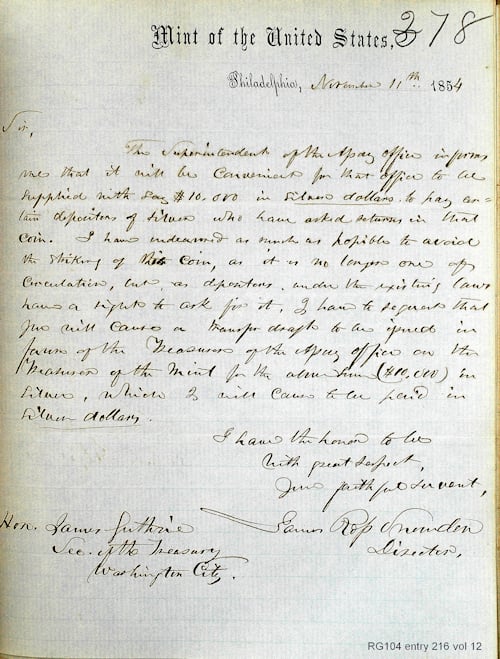
[RG104 entry 216 vol 12]
Philadelphia
November 11, 1854
Hon. James Guthrie,
Secretary of the Treasury
Sir:
The superintendent of the Assay Office informs me that it will be convenient for that office to be supplied with say $10,000 in silver dollars to pay certain depositors of silver who have asked [for their] returns in that coin. I have endeavored as much as possible to avoid the striking of this coins, as it is no longer one of circulation; but as depositors, under the existing laws, have a right to ask for it, I have to request that you will cause a transfer draft to be issued in favor of the Treasurer of the Assay Office on
the Treasurer of the Mint for the above sum ($10,000) in silver, which I will cause to be paid in silver dollars.
James Ross Snowden
Director
Comments
I once saw a list of "how" coins were suppose to be valued on the Newman Portal. I really wish I had copied it. To the best of my memory it was from around the mid 1870's and there were specific amounts listed; not just for certain denominations but also different versions of coins, such as Seated Halves with and without arrows. I can't imagine a modern retailer doing something like this. I also think the modern consumer would be horrified to find out they have to know like a dozen different coins and their values. Different times; different ways of life, james
Is this close to what you saw?
Memorandum of Silver standard of Spain.
From the reign of Philip II of Spain, until 1728, the standard fineness of silver was 11-1/6
dineros fine, at which rate the marc of Castile, 3.557 grains, yielded 8-1/2 dollars of 389-4/10
grains each. The remedy of the Mint was 2 grains fine to each piece.
Assays of these pieces at the British Mint, in 1717, gave 386-3/4 grains fine silver.
The above coins ceased to circulate in 1728, in which year the standard purity of the Spanish
Dollar was reduced to 11 dineros, equal to 383-2/10 grains.
In 1772 a Royal Edict established the regulation of 10-3/4 dineros fine, equivalent to 374-7/8
grains to each dollar, with Mint remedy of one grain. With such reduction in content of fine
silver, the previous issue became simply bullion when measured by the reduced coin, and ceased
to circulate by tale.
chopmarkedtradedollars.com
@lermish --might be of interest:
Alejandra Irigoin, Atsushi Kobayashi & David Chilosi, China Inside Out: Explaining Silver Flows in the Triangular Trade, c.1820s-1870s (London Sch. of Econ. & Pol. Sci., Working Paper No. 357, 2023), https://www.lse.ac.uk/asset-library/information/wp357.pdf
Alejandra Irigoin, The End of a Silver Era: The Consequences of the Breakdown of the Spanish Peso Standard in China and the United States, 1780s–1850s, 20 J. World Hist. 207 (2009). https://www.researchgate.net/publication/236757054_The_End_of_a_Silver_Era_The_Consequences_of_the_Breakdown_of_the_Spanish_Peso_Standard_in_China_and_the_United_States_1780s-1850s
@RogerB. No, the list I saw was a typewritten list of American coins, (and paper money) and had a heading something like; "A Merchants Guide to Coins & Currency). It was also dated but I can't remember the date. James
I'm surprised that with those objections there was no proposal enacted to reduce the silver content of the silver dollar.
Custom album maker and numismatic photographer.
Need a personalized album made? Design it on the website below and I'll build it for you.
https://www.donahuenumismatics.com/.
When Congress lowered the silver of all other coins, except the Silver Three Cent Piece, which as already a token coin, the silver dollar, it condemned that already unpopular coin to domestic disuse. It is interesting to note that they were still used for the China trade. Perhaps that’s why Congress left it alone.
For those who might not realize it, the Silver Three Cent Piece was a token coin from the beginning. It was freely admitted that the piece did not contain 3 cents worth of silver. The other coins carried the illustration that they did although that was for public consumption. Once a coin melts from more than its face value, people withdraw it from circulation. As in 1853 and 1964-5.
The silver content of the three cent silver actually increased with the Coinage Act of 1853, even as the weight went down because of the increase in fineness, making it proportional to the other fractional silver coins. I suspect that the Mints found it inconvenient to keep track of silver stock and scrap that was both .900 fine and .750 fine.
Discussion in 1852-53 included reduction in the silver dollar's weight as with the other coins. But considerable objections were raised thereby debasing the "Standard Silver Dollar" and thus throwing the "Standard Gold Dollar" out as the sole "metallic currency standard."
Know this was a short hand response, but actually was a compromise between the monometallists (led by Senator Robert M. T. Hunter of Virginia, Chairman of the Senate Finance Committee) and bimetallists ( led in the House by Cyrus L. Dunham from Indiana ). By debasing subsidiary coinage but preserving a non debased Silver dollar, the veneer of bimetallism was maintained . It pushed the debate down the road, rather than being a definitive determination....
"We propose, so far as these coins are concerned, to make the silver subservient to the gold coin of the country, so far as regards the medium of exchange—to make them tokens, if you please, of less value than the gold, but of a specific value, strictly regulated by law, for necessary change, and to be used only for such necessary change. We do not, however, propose to change the dollar."
Cong. Globe, 32d Cong., 2d Sess. App. 190 (1853) (statement of Rep. Cyrus L. Dunham).
California, and Australian gold rushes were having significant global effects at this time....
Thanks for the additional info ! Very welcome.
The Type I Three Cent Piece was 75% silver and 25% copper, the only U.S. coin in that alloy. The Types II and III coins were 90% silver like the rest of silver coins of the period.
Very informative thread. Thank you all.
If they weren't being used in commerce, are they the equivalent of modern day half dollars?
We need to realize gold coins circulated. Would you rather have five clunky silver dollars in your pocket or a nice tidy little $5 Liberty? …….or to the extreme, a double eagle or Twenty (clunky) silver dollars in your pocket(s).
According to ChatGPT, a common laborer in 1859 earned about $6 a week so a double eagle was the equivalent of two and a half week's wages. How many people would be likely to be carrying around that sort of value in one coin? Even a $5 coin was nearly a week's wages.
Oh, yeah... here's where that number comes from: The historical data come from Robert A. Margo's Wages and Labor Markets in the United States, 1820–1860 and the U.S. Bureau of Labor Statistics' History of Wages in the United States.