@PerryHall said:
I can see PCGS taking legal action in concert with the FBI against a specific eBay seller who is selling dozens of fake coins in the same fake PCGS slab thus establishing an obvious pattern of fraud.
So what are they waiting for? There has been known frauds on ebay for what, decades? Why now all of a sudden?
I don't know. It's a good question but you'll have to ask PCGS. Perhaps the cost of legal action exceeds the cost of the damage to their brand. I remember in their early years, PCGS and the FBI went after a coin dealer who was counterfeiting their then current rattler slab and this dealer was convicted and sent to prison. PCGS then changed the design of their slab and made it more difficult to counterfeit.
Worry is the interest you pay on a debt you may not owe.
"Paper money eventually returns to its intrinsic value---zero."----Voltaire
"Everything you say should be true, but not everything true should be said."----Voltaire
How will that work with registered mail? Coins valued over $5000.00 should be sent by registered mail insured and need to be signed for. Ebay is going to pay for registered insured mail for high value coins?
@rec78 said:
How will that work with registered mail? Coins valued over $5000.00 should be sent by registered mail insured and need to be signed for. Ebay is going to pay for registered insured mail for high value coins?
ebay does not "have to" use registered mail. Undoubtedly they have shipping and insurance arrangements to use whatever shipping method they find to be the most practical.
I have not read through this thread entirely, but wonder if PCGS has added a new office for the authentication process. It would take seemingly forever to receive the coins if they had to wait in the grading line.
oih82w8 = Oh I Hate To Wait _defectus patientia_aka...Dr. Defecto - Curator of RMO's
May have been discussed previously, however recently saw sealed boxes on Ebay which claimed to be "authenticity guarantee" coins. Strange how these ads appear. Guaranteed in an unopened box.
The authentication process has added 9 days to the turnaround on my purchase. The approval just came this morning, so September 9 to September 18. Given the time of day of the purchase you might quibble that it was only 8 days.
This was purchased as a raw coin, so it has to actually be authenticated and not just given a quick glance at the slab registry.
As to why I would even buy a key date that was not authenticated, I am building a small set of Indians in a Capital Plastics holder. Even if it were slabbed I would have to crack it out anyway. I don’t plan to resell the coin; I don’t need to convince a downstream buyer of authenticity or grade.
@Ronsanderson said:
The authentication process has added 9 days to the turnaround on my purchase. The approval just came this morning, so September 9 to September 18. Given the time of day of the purchase you might quibble that it was only 8 days.
This was purchased as a raw coin, so it has to actually be authenticated and not just given a quick glance at the slab registry.
As to why I would even buy a key date that was not authenticated, I am building a small set of Indians in a Capital Plastics holder. Even if it were slabbed I would have to crack it out anyway. I don’t plan to resell the coin; I don’t need to convince a downstream buyer of authenticity or grade.
When did the seller ship the coin, and when was it actually marked Delivered?
btw, if they do a thorough job with coins as they do with cards, then they don't just do a slab-registry lookup. They will inspect the slab to make sure it was not tampered with. And also try to determine if the card inside the slab matches what the slab says.
It looks like the seller did their part. They had the item in the mail by 11 AM after a late-evening sale.
Although this is a bit lengthy, I am providing you the entire shipping history. I hope you can tease out the parts of the delay that interest you. If you draw a conclusion, I am interested to hear it too.
There may be some overlap in the history, since I had to take screenshots instead of just copying the text. I think if I used the website instead of the eBay app I would have been able to do a better job of it.
Looks like PCGS received the coin on 9/15, and Authenticated it and is sending it Fedex to you on 9/18. They said Authentication to be within 1 or 2 business days -- but it looks like it took 3 business days this time. It's not really an extra 9 days yet if you would have gotten the coin on 9/15, then it's 9/15 plus whenever Fedex delivers the coin is the extra days (which could be more than 9 days, but hopefully less than 9 days). In the end, you got a coin that was Authenticated by PCGS to match the description of the eBay listing.
I suspect they may have to open a regional grading center or two. Saugerties, NY, is only 2 1/2 hours from me. Yet the coin traveled for six days across country to get graded. If it takes that long to travel back here, the overall experience will have taken half a month. (Still beats the ten months my 1910 Lincoln proof took via registered mail to travel 25 miles to me. Covid shutdown trapped it.)
PCGS may be able to meet their turnaround guarantees, but the average purchaser will blame them anyway.
By the way, I was planning to buy the coin without the authentication guarantee. I do like the assurance, over and above dealing with a store I already trust.
Apparently you cannot combine shipping with coins selling over $500 each now?? I just sold one coin for $545 and the other for $321 to the same person. I have to send one to the authenticator and the other to the buyer? What if I sell the same buyer multiple coins that sell for more then $500.00 each-Do I send them all seperetly?
I recently had one buyer buy 8 coins at once and I shipped them in one box. Now I have to ship them in 8 different boxes? Sorry, but this is confusing.
Combining sales used to be automatic.
@rec78 said:
Apparently you cannot combine shipping with coins selling over $500 each now?? I just sold one coin for $545 and the other for $321 to the same person. I have to send one to the authenticator and the other to the buyer? What if I sell the same buyer multiple coins that sell for more then $500.00 each-Do I send them all seperetly?
I recently had one buyer buy 8 coins at once and I shipped them in one box. Now I have to ship them in 8 different boxes? Sorry, but this is confusing.
Combining sales used to be automatic.
Each coin that goes through Authenticity Guarantee needs to be shipped by itself (no combined shipping of coins going through the Authenticity process).
Well I stand mute on the topic as I no longer sell ANY coins on eBay nor do I purchase any coins over $500 there! Overall tho I think it's ok since eBay definitely has a fake coin problem and this may help to curtail some of the nonsense! 😎
🇺🇸 Harlequin
harlequinnumismatic@gmail.com Home of the Americana Collection of USA silver coins
Still building some general understand here. Let's suppose I go to eBay and purchase what appears to be a PCGS-slabbed coin. eBay then sends the slab to PCGS for authentication of the holder. The various possibilities of whether the holder and the coin are authentic appear to boil down to the four scenarios shown below.
But in this example, PCGS (the company) is only going to authenticate the holder. If they deem it to be fake, then we find ourselves in scenario #3 or #4. But is scenario #3 a plausible outcome? Do individuals or organizations acquire real coins, then put them into fake holders? I certainly understand it's a possibility, as they might be inserting a real MS61 coin into fake holder labelled MS64. But does this really happen?
@cinque1543 said:
Still building some general understand here. Let's suppose I go to eBay and purchase what appears to be a PCGS-slabbed coin. eBay then sends the slab to PCGS for authentication of the holder. The various possibilities of whether the holder and the coin are authentic appear to boil down to the four scenarios shown below.
But in this example, PCGS (the company) is only going to authenticate the holder. If they deem it to be fake, then we find ourselves in scenario #3 or #4. But is scenario #3 a plausible outcome? Do individuals or organizations acquire real coins, then put them into fake holders? I certainly understand it's a possibility, as they might be inserting a real MS61 coin into fake holder labelled MS64. But does this really happen?
It has happened before. A fake holder with a genuine lower graded coin.
@cinque1543 said:
Still building some general understand here. Let's suppose I go to eBay and purchase what appears to be a PCGS-slabbed coin. eBay then sends the slab to PCGS for authentication of the holder. The various possibilities of whether the holder and the coin are authentic appear to boil down to the four scenarios shown below.
But in this example, PCGS (the company) is only going to authenticate the holder. If they deem it to be fake, then we find ourselves in scenario #3 or #4. But is scenario #3 a plausible outcome? Do individuals or organizations acquire real coins, then put them into fake holders? I certainly understand it's a possibility, as they might be inserting a real MS61 coin into fake holder labelled MS64. But does this really happen?
It has happened before. A fake holder with a genuine lower graded coin.
Doesn't matter. If the holder is fake, end of story. They also check that out matches the description. A 63 coin in a fake 66 holder is no better than a counterfeit coin.
Has anybody checked the trading card forum here to see how flawed eBay's authentication program is? There should be plenty of comments explaining how it doesn't work by now.
Bought a lot of two raw coins over the weekend which will go through the authentication process. Once I get them they will then be sent right back to PCGS.
@clarkbar04 said:
Bought a lot of two raw coins over the weekend which will go through the authentication process. Once I get them they will then be sent right back to PCGS.
Is each coin worth more than $500? I would have the Seller call eBay support to see if the 2-coin lot should follow the Authenticity Guarantee process...
@DotStore (or anyone), do you know when eBay began Authenticity Guarantee for cards?> @rec78 said:
Apparently you cannot combine shipping with coins selling over $500 each now?? I just sold one coin for $545 and the other for $321 to the same person. I have to send one to the authenticator and the other to the buyer? What if I sell the same buyer multiple coins that sell for more then $500.00 each-Do I send them all seperetly?
I recently had one buyer buy 8 coins at once and I shipped them in one box. Now I have to ship them in 8 different boxes? Sorry, but this is confusing.
Combining sales used to be automatic.
That's been my main problem with this program so far. We've had customers purchase multiple $500+ coins on eBay, but we had to ship them separately. I see no reason why we can't ship them together to PCGS, and then PCGS ship them together to the customer. Seems like that should be a win-win-win.
Also, there may be days where we have several $500+ coins sell on eBay. Why can't we just ship them together in one large box to PCGS (with each coin clearly and properly labeled, of course)?
It would be like if submissions to PCGS were all required to be shipped separately. Seems like a big waste.
@MasonG said:
Has anybody checked the trading card forum here to see how flawed eBay's authentication program is? There should be plenty of comments explaining how it doesn't work by now.
@MsMorrisine created a post on the card forum looking for feedback. It didn't get a lot of action, but the couple responders liked the program. No dissenters chimed in.
I'd imagine there might be a similar trajectory with coins. Complaints at first, but then people get used to the program and it's not as awful as they first thought.
@slimbert said: @DotStore (or anyone), do you know when eBay began Authenticity Guarantee for cards?> @rec78 said:
Apparently you cannot combine shipping with coins selling over $500 each now?? I just sold one coin for $545 and the other for $321 to the same person. I have to send one to the authenticator and the other to the buyer? What if I sell the same buyer multiple coins that sell for more then $500.00 each-Do I send them all seperetly?
I recently had one buyer buy 8 coins at once and I shipped them in one box. Now I have to ship them in 8 different boxes? Sorry, but this is confusing.
Combining sales used to be automatic.
That's been my main problem with this program so far. We've had customers purchase multiple $500+ coins on eBay, but we had to ship them separately. I see no reason why we can't ship them together to PCGS, and then PCGS ship them together to the customer. Seems like that should be a win-win-win.
Also, there may be days where we have several $500+ coins sell on eBay. Why can't we just ship them together in one large box to PCGS (with each coin clearly and properly labeled, of course)?
It would be like if submissions to PCGS were all required to be shipped separately. Seems like a big waste.
I had to look it up, and looks like they started Authenticating RAW cards $750+ late January, 2022. They later added graded cards as well as autographed cards. And then they eventually added other features such as submitting the raw card for PSA Grading (for a grading fee in line with their fee schedule), and also storing graded cards in what they call the PSA Vault -- they catalog the card under your personal Vault Address, and keep track of all your cards within their PSA Vault.
For the inability to combine shipping, I can only imagine they are trying to avoid figuring out which in this LOT passes inspection, and which ones do not pass inspection. For them it's straight forward -- single card at a time, it either passes or fails. Nothing to worry about partial verification, and partial rejects. There might be some other accounting type reasons too...
@DotStore said:
For the inability to combine shipping, I can only imagine they are trying to avoid figuring out which in this LOT passes inspection, and which ones do not pass inspection. For them it's straight forward -- single card at a time, it either passes or fails. Nothing to worry about partial verification, and partial rejects. There might be some other accounting type reasons too...
I asked ChatGPT if there was anything publicly published that explained eBay's reasoning for their one-at-a-time policy. The result of that inquiry was that no, there's nothing. I then asked for possible reasons why they might have chosen to run the program as they have and this:
"I can only imagine they are trying to avoid figuring out which in this LOT passes inspection, and which ones do not pass inspection. For them it's straight forward -- single card at a time, it either passes or fails. Nothing to worry about partial verification, and partial rejects."
@DotStore said:
For the inability to combine shipping, I can only imagine they are trying to avoid figuring out which in this LOT passes inspection, and which ones do not pass inspection. For them it's straight forward -- single card at a time, it either passes or fails. Nothing to worry about partial verification, and partial rejects. There might be some other accounting type reasons too...
I asked ChatGPT if there was anything publicly published that explained eBay's reasoning for their one-at-a-time policy. The result of that inquiry was that no, there's nothing. I then asked for possible reasons why they might have chosen to run the program as they have and this:
"I can only imagine they are trying to avoid figuring out which in this LOT passes inspection, and which ones do not pass inspection. For them it's straight forward -- single card at a time, it either passes or fails. Nothing to worry about partial verification, and partial rejects."
was one of the reasons suggested.
That’s crazy that ChatGPT just quoted me word for word. I seriously just wrote that off the top of my head because that’s what I would be thinking if trying to verify hundreds or thousands of orders per day.,,
@DotStore said:
That’s crazy that ChatGPT just quoted me word for word. I seriously just wrote that off the top of my head because that’s what I would be thinking if trying to verify hundreds or thousands of orders per day.,,
That wasn't ChatGPT's exact quote. It was, however, the thought.
Sorry for not making it clear that ChatGPT didn't actually say the same thing you did. My fault.
@clarkbar04 said:
Bought a lot of two raw coins over the weekend which will go through the authentication process. Once I get them they will then be sent right back to PCGS.
Is each coin worth more than $500? I would have the Seller call eBay support to see if the 2-coin lot should follow the Authenticity Guarantee process...
Yes, the aggregate selling price for the lot exceeded the threshhold.
That’s crazy that ChatGPT just quoted me word for word. I seriously just wrote that off the top of my head because that’s what I would be thinking if trying to verify hundreds or thousands of orders per day.,,
This part of AI is just an advanced search engine, and this website is part of the known universe it uses for answers.
@clarkbar04 said:
Bought a lot of two raw coins over the weekend which will go through the authentication process. Once I get them they will then be sent right back to PCGS.
Is each coin worth more than $500? I would have the Seller call eBay support to see if the 2-coin lot should follow the Authenticity Guarantee process...
Yes, the aggregate selling price for the lot exceeded the threshhold.
For the inability to combine shipping, I can only imagine they are trying to avoid figuring out which in this LOT passes inspection, and which ones do not pass inspection. For them it's straight forward -- single card at a time, it either passes or fails. Nothing to worry about partial verification, and partial rejects. There might be some other accounting type reasons too...
It's always easier (though not necessarily more efficient) to reconcile "one in, one out" models. Imagine an individual who buys 50 coins on eBay. eBay puts them in a single box with an inventory list showing 50 items, but then mistakenly puts only 49 coins in the box. Now, upon opening the box, PCGS has a reconciliation item to contend with (ie, figuring out which item is missing). I know it sounds trivial, but my guess is they just chose a simpler model to start with from an audit and reconciliation perspective, then will improve upon it at later date if they so choose.
Yes, the aggregate selling price for the lot exceeded the threshhold.
Is each coin worth more than $500?
They are raw so the value is subjective, but in my opinion, yes they are.
The program is supposed to be single coin at a time (not lots). I recommend you ask the seller to find out from eBay what to do before packaging both coins and shipping as 1 lot to PCGS.
@MasonG said:
Has anybody checked the trading card forum here to see how flawed eBay's authentication program is? There should be plenty of comments explaining how it doesn't work by now.
@MsMorrisine created a post on the card forum looking for feedback. It didn't get a lot of action, but the couple responders liked the program. No dissenters chimed in.
I'd imagine there might be a similar trajectory with coins. Complaints at first, but then people get used to the program and it's not as awful as they first thought.
It's actually that post from @MsMorrisine in the card forum that got my attention so I followed the link and posted here in the Coin forum.
The coin I bought Sept 9 arrived today, so about 12 1/2 days altogether from purchase to arrival.
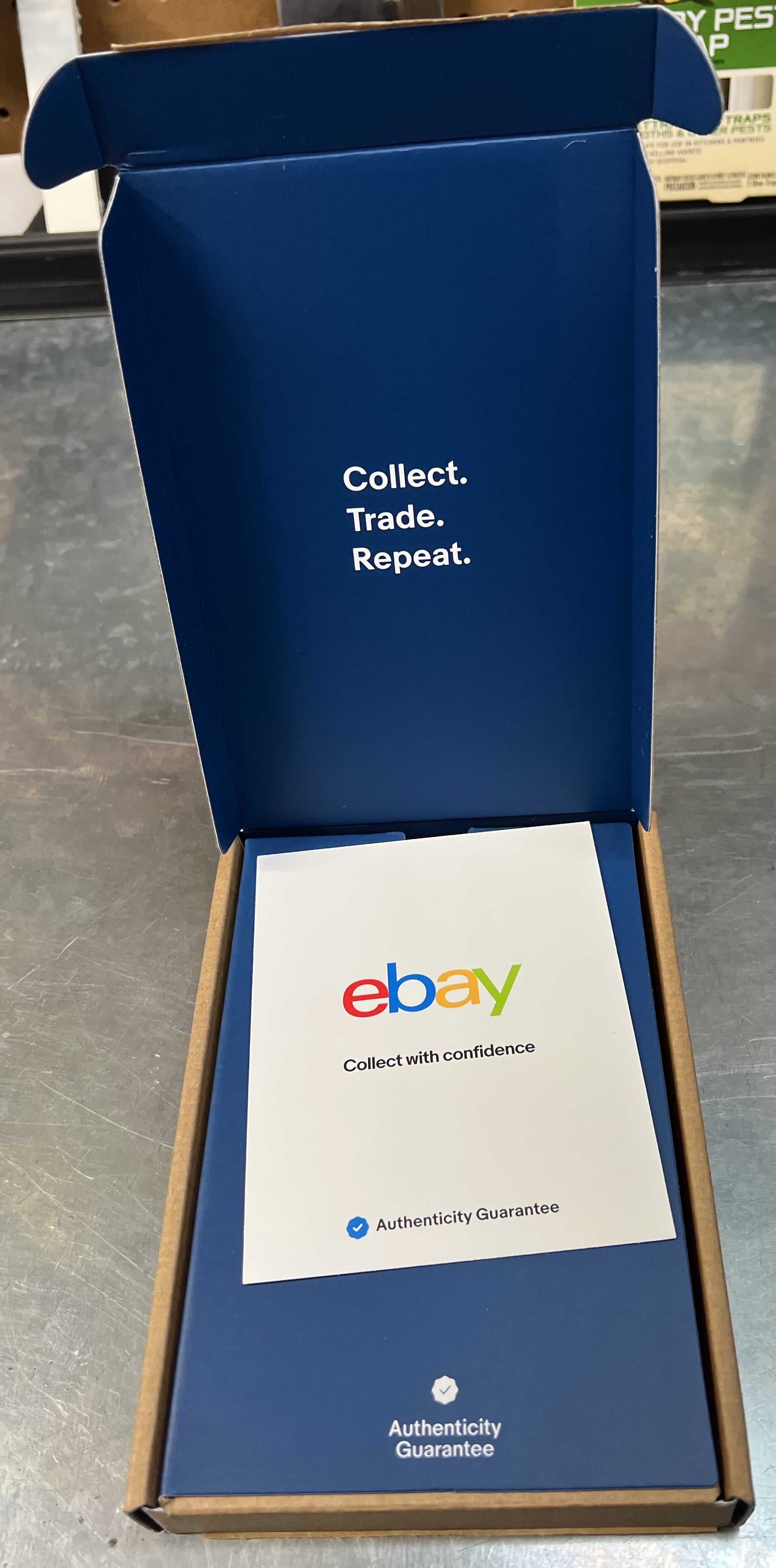
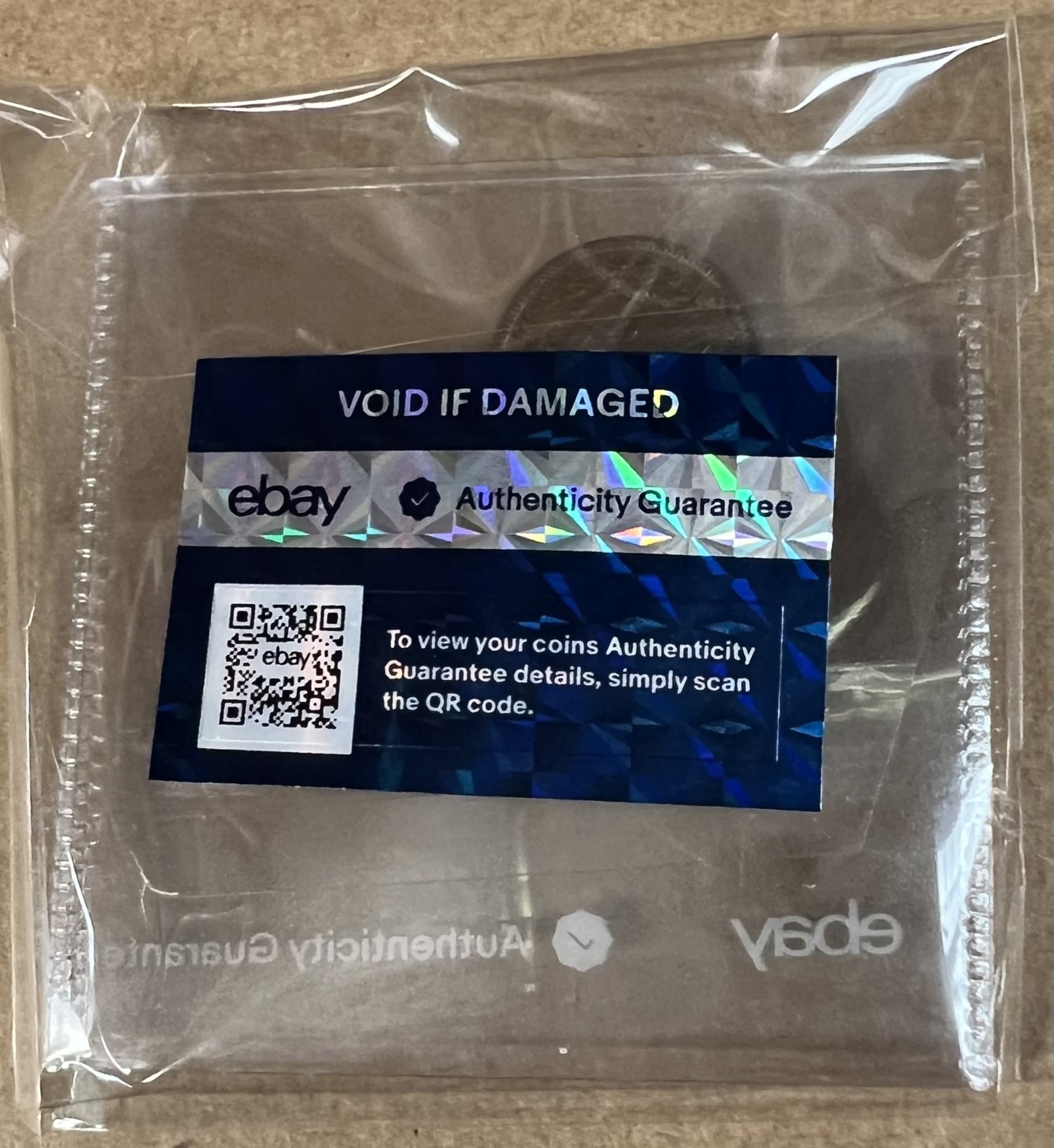
The eBay/PCGS packaging was quite elegant. I show it here in case anyone is curious.
The package from eBay Authentication arrived in a shipping envelope.
The package upon breaking the tape and opening.
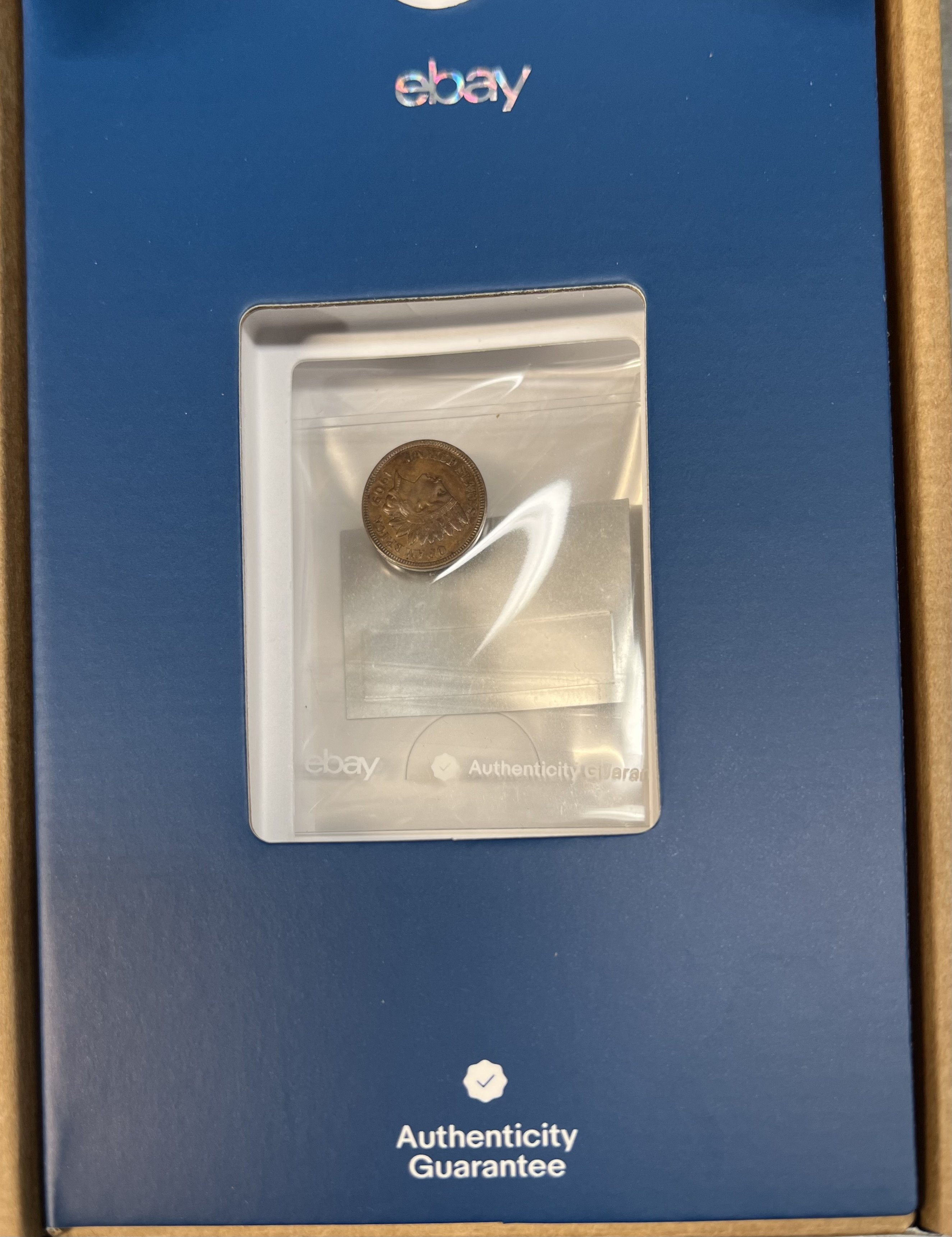
The package with the informational card removed, showing how a raw coin is shipped. Notice the opening is the size of a slab, so it works for both raw and graded coins.
The cardboard insert has been lifted to gain access to the coin.
The raw coin is placed into a flip, and the flip is in a plastic bag.
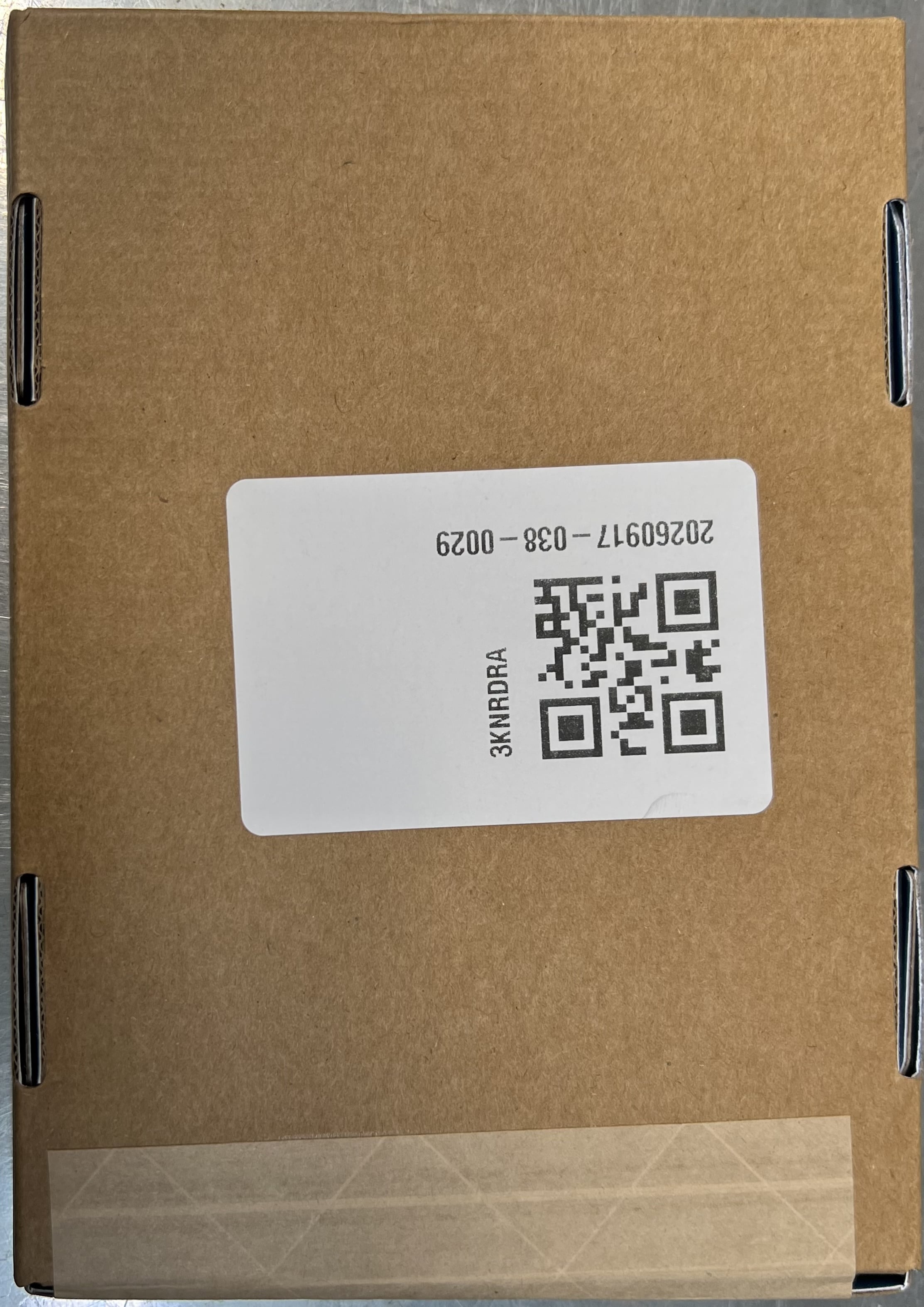
The plastic bag is sealed with a unique sticker, which has a QR code that links back to the authentication and eBay auction page. I did not obscure the QR code in case anyone wants to see how this information is presented.
ebay does not "have to" use registered mail. Undoubtedly they have shipping and insurance arrangements to use whatever shipping method they find to be the most practical.
If too many of their coins go missing, insurance goes up, or insurance stops insuring. And that of course, raises the cost of the Authenticity Guarantee Program. And that of course, will, ultimately have to be passed on to the buyers and the sellers if it affects ebay margins, they have shareholders to answer to...........................
@Ronsanderson said:
The coin I bought Sept 9 arrived today, so about 12 1/2 days altogether from purchase to arrival.
The eBay/PCGS packaging was quite elegant. I show it here in case anyone is curious.
The package from eBay Authentication arrived in a shipping envelope.
The package upon breaking the tape and opening.
The package with the informational card removed, showing how a raw coin is shipped. Notice the opening is the size of a slab, so it works for both raw and graded coins.
The cardboard insert has been lifted to gain access to the coin.
The raw coin is placed into a flip, and the flip is in a plastic bag.
The plastic bag is sealed with a unique sticker, which has a QR code that links back to the authentication and eBay auction page. I did not obscure the QR code in case anyone wants to see how this information is presented.
And what is the additional cost to ebay for all of this packaging, review and extra shipping?
eBay has been running their Authenticity Guarantee Program for trading cards for nearly five years, they probably have a pretty good handle on program expenses.
The program is supposed to be single coin at a time (not lots). I recommend you ask the seller to find out from eBay what to do before packaging both coins and shipping as 1 lot to PCGS.
Just an update. This is what PCGS and ebay had to say about the matter:
Your item is headed your way, but we couldn’t provide the Authenticity Guarantee you may have been expecting because, upon inspection, we found it to be miscategorized.
Unfortunately, miscategorized items aren’t eligible for Authenticity Guarantee.
We know this may be disappointing, and we've asked the seller to review and update their listings to prevent this from happening again.
The program is supposed to be single coin at a time (not lots). I recommend you ask the seller to find out from eBay what to do before packaging both coins and shipping as 1 lot to PCGS.
Just an update. This is what PCGS and ebay had to say about the matter:
Your item is headed your way, but we couldn’t provide the Authenticity Guarantee you may have been expecting because, upon inspection, we found it to be miscategorized.
Unfortunately, miscategorized items aren’t eligible for Authenticity Guarantee.
We know this may be disappointing, and we've asked the seller to review and update their listings to prevent this from happening again.
I personally have no problem with eBays effort. For crying out loud at least they are doing something. But I do worry that these fancy shipping boxes will end up at shows with counterfeit slabs ready to STILL sucker people.
WS
Proud recipient of the coveted PCGS Forum "You Suck" Award Thursday July 19, 2007 11:33 PM and December 30th, 2011 at 8:50 PM.
It was for a lot of two as opposed to a single coin.
Well that's interesting. So right now I have a listing for a 2026 P & D Dime Set in PCGS MS68 for well over $500. I guess that will be rejected too? Mine is not miscategorized, it's in the proper category for 2026 dimes. Unless they are suggesting the the "appropriate" category is the "sets and lots" category.
Comments
I don't know. It's a good question but you'll have to ask PCGS. Perhaps the cost of legal action exceeds the cost of the damage to their brand. I remember in their early years, PCGS and the FBI went after a coin dealer who was counterfeiting their then current rattler slab and this dealer was convicted and sent to prison. PCGS then changed the design of their slab and made it more difficult to counterfeit.
Worry is the interest you pay on a debt you may not owe.
"Paper money eventually returns to its intrinsic value---zero."----Voltaire
"Everything you say should be true, but not everything true should be said."----Voltaire
One I was watching may not have gone well for the seller...
Authenticity Guarantee may have caught as eBay has now removed the listing:
How will that work with registered mail? Coins valued over $5000.00 should be sent by registered mail insured and need to be signed for. Ebay is going to pay for registered insured mail for high value coins?
ebay does not "have to" use registered mail. Undoubtedly they have shipping and insurance arrangements to use whatever shipping method they find to be the most practical.
I have not read through this thread entirely, but wonder if PCGS has added a new office for the authentication process. It would take seemingly forever to receive the coins if they had to wait in the grading line.
BST transactions: dbldie55, jayPem, 78saen, UltraHighRelief, nibanny, liefgold, FallGuy, lkeigwin, mbogoman, Sandman70gt, keets, joeykoins, ianrussell (@GC), EagleEye, ThePennyLady, GRANDAM, Ilikecolor, Gluggo, okiedude, Voyageur, LJenkins11, fastfreddie, ms70, pursuitofliberty, ZoidMeister,Coin Finder, GotTheBug, edwardjulio, Coinnmore, Nickpatton, Namvet69,...
May have been discussed previously, however recently saw sealed boxes on Ebay which claimed to be "authenticity guarantee" coins. Strange how these ads appear. Guaranteed in an unopened box.
Here is a fake coin in a fake slab. Anyone want to play the game and report back?
[https://ebay.com/itm/407225163552?
Hmm... while I was typing this, the listing was cancelled by the seller "because there was an error in the listing".
It will probably be back, I have seen this fake date/slab combo sell a few times this year.
The authentication process has added 9 days to the turnaround on my purchase. The approval just came this morning, so September 9 to September 18. Given the time of day of the purchase you might quibble that it was only 8 days.
This was purchased as a raw coin, so it has to actually be authenticated and not just given a quick glance at the slab registry.
As to why I would even buy a key date that was not authenticated, I am building a small set of Indians in a Capital Plastics holder. Even if it were slabbed I would have to crack it out anyway. I don’t plan to resell the coin; I don’t need to convince a downstream buyer of authenticity or grade.
When did the seller ship the coin, and when was it actually marked Delivered?
btw, if they do a thorough job with coins as they do with cards, then they don't just do a slab-registry lookup. They will inspect the slab to make sure it was not tampered with. And also try to determine if the card inside the slab matches what the slab says.
It looks like the seller did their part. They had the item in the mail by 11 AM after a late-evening sale.
Although this is a bit lengthy, I am providing you the entire shipping history. I hope you can tease out the parts of the delay that interest you. If you draw a conclusion, I am interested to hear it too.
There may be some overlap in the history, since I had to take screenshots instead of just copying the text. I think if I used the website instead of the eBay app I would have been able to do a better job of it.
Looks like PCGS received the coin on 9/15, and Authenticated it and is sending it Fedex to you on 9/18. They said Authentication to be within 1 or 2 business days -- but it looks like it took 3 business days this time. It's not really an extra 9 days yet if you would have gotten the coin on 9/15, then it's 9/15 plus whenever Fedex delivers the coin is the extra days (which could be more than 9 days, but hopefully less than 9 days). In the end, you got a coin that was Authenticated by PCGS to match the description of the eBay listing.
I suspect they may have to open a regional grading center or two. Saugerties, NY, is only 2 1/2 hours from me. Yet the coin traveled for six days across country to get graded. If it takes that long to travel back here, the overall experience will have taken half a month. (Still beats the ten months my 1910 Lincoln proof took via registered mail to travel 25 miles to me. Covid shutdown trapped it.)
PCGS may be able to meet their turnaround guarantees, but the average purchaser will blame them anyway.
By the way, I was planning to buy the coin without the authentication guarantee. I do like the assurance, over and above dealing with a store I already trust.
For a coin I've lived my whole life without, I'm okay with a two week wait to receive it.
JMO, YMMV.
Apparently you cannot combine shipping with coins selling over $500 each now?? I just sold one coin for $545 and the other for $321 to the same person. I have to send one to the authenticator and the other to the buyer? What if I sell the same buyer multiple coins that sell for more then $500.00 each-Do I send them all seperetly?
I recently had one buyer buy 8 coins at once and I shipped them in one box. Now I have to ship them in 8 different boxes? Sorry, but this is confusing.
Combining sales used to be automatic.
Each coin that goes through Authenticity Guarantee needs to be shipped by itself (no combined shipping of coins going through the Authenticity process).
@Ronsanderson — thank you for the post.
Well I stand mute on the topic as I no longer sell ANY coins on eBay nor do I purchase any coins over $500 there! Overall tho I think it's ok since eBay definitely has a fake coin problem and this may help to curtail some of the nonsense! 😎
🇺🇸 Harlequin
harlequinnumismatic@gmail.com
Home of the Americana Collection of USA silver coins
Still building some general understand here. Let's suppose I go to eBay and purchase what appears to be a PCGS-slabbed coin. eBay then sends the slab to PCGS for authentication of the holder. The various possibilities of whether the holder and the coin are authentic appear to boil down to the four scenarios shown below.
But in this example, PCGS (the company) is only going to authenticate the holder. If they deem it to be fake, then we find ourselves in scenario #3 or #4. But is scenario #3 a plausible outcome? Do individuals or organizations acquire real coins, then put them into fake holders? I certainly understand it's a possibility, as they might be inserting a real MS61 coin into fake holder labelled MS64. But does this really happen?
It has happened before. A fake holder with a genuine lower graded coin.
The program is designed to catch all of that.
Has anybody checked the trading card forum here to see how flawed eBay's authentication program is? There should be plenty of comments explaining how it doesn't work by now.
Bought a lot of two raw coins over the weekend which will go through the authentication process. Once I get them they will then be sent right back to PCGS.
Is each coin worth more than $500? I would have the Seller call eBay support to see if the 2-coin lot should follow the Authenticity Guarantee process...
@DotStore (or anyone), do you know when eBay began Authenticity Guarantee for cards?> @rec78 said:
That's been my main problem with this program so far. We've had customers purchase multiple $500+ coins on eBay, but we had to ship them separately. I see no reason why we can't ship them together to PCGS, and then PCGS ship them together to the customer. Seems like that should be a win-win-win.
Also, there may be days where we have several $500+ coins sell on eBay. Why can't we just ship them together in one large box to PCGS (with each coin clearly and properly labeled, of course)?
It would be like if submissions to PCGS were all required to be shipped separately. Seems like a big waste.
@MsMorrisine created a post on the card forum looking for feedback. It didn't get a lot of action, but the couple responders liked the program. No dissenters chimed in.
If you compare that with a post over there from when the program was fresh, it looked a lot like some of the posts here on the coin forum - some posters thought it was a bad change.
I'd imagine there might be a similar trajectory with coins. Complaints at first, but then people get used to the program and it's not as awful as they first thought.
I had to look it up, and looks like they started Authenticating RAW cards $750+ late January, 2022. They later added graded cards as well as autographed cards. And then they eventually added other features such as submitting the raw card for PSA Grading (for a grading fee in line with their fee schedule), and also storing graded cards in what they call the PSA Vault -- they catalog the card under your personal Vault Address, and keep track of all your cards within their PSA Vault.
For the inability to combine shipping, I can only imagine they are trying to avoid figuring out which in this LOT passes inspection, and which ones do not pass inspection. For them it's straight forward -- single card at a time, it either passes or fails. Nothing to worry about partial verification, and partial rejects. There might be some other accounting type reasons too...
I asked ChatGPT if there was anything publicly published that explained eBay's reasoning for their one-at-a-time policy. The result of that inquiry was that no, there's nothing. I then asked for possible reasons why they might have chosen to run the program as they have and this:
"I can only imagine they are trying to avoid figuring out which in this LOT passes inspection, and which ones do not pass inspection. For them it's straight forward -- single card at a time, it either passes or fails. Nothing to worry about partial verification, and partial rejects."
was one of the reasons suggested.
That’s crazy that ChatGPT just quoted me word for word. I seriously just wrote that off the top of my head because that’s what I would be thinking if trying to verify hundreds or thousands of orders per day.,,
That wasn't ChatGPT's exact quote. It was, however, the thought.
Sorry for not making it clear that ChatGPT didn't actually say the same thing you did. My fault.
Yes, the aggregate selling price for the lot exceeded the threshhold.
This part of AI is just an advanced search engine, and this website is part of the known universe it uses for answers.
Is each coin worth more than $500?
They are raw so the value is subjective, but in my opinion, yes they are.
It's always easier (though not necessarily more efficient) to reconcile "one in, one out" models. Imagine an individual who buys 50 coins on eBay. eBay puts them in a single box with an inventory list showing 50 items, but then mistakenly puts only 49 coins in the box. Now, upon opening the box, PCGS has a reconciliation item to contend with (ie, figuring out which item is missing). I know it sounds trivial, but my guess is they just chose a simpler model to start with from an audit and reconciliation perspective, then will improve upon it at later date if they so choose.
The program is supposed to be single coin at a time (not lots). I recommend you ask the seller to find out from eBay what to do before packaging both coins and shipping as 1 lot to PCGS.
It's actually that post from @MsMorrisine in the card forum that got my attention so I followed the link and posted here in the Coin forum.
The coin I bought Sept 9 arrived today, so about 12 1/2 days altogether from purchase to arrival.
The eBay/PCGS packaging was quite elegant. I show it here in case anyone is curious.
The package from eBay Authentication arrived in a shipping envelope.
The package upon breaking the tape and opening.
The package with the informational card removed, showing how a raw coin is shipped. Notice the opening is the size of a slab, so it works for both raw and graded coins.
The cardboard insert has been lifted to gain access to the coin.
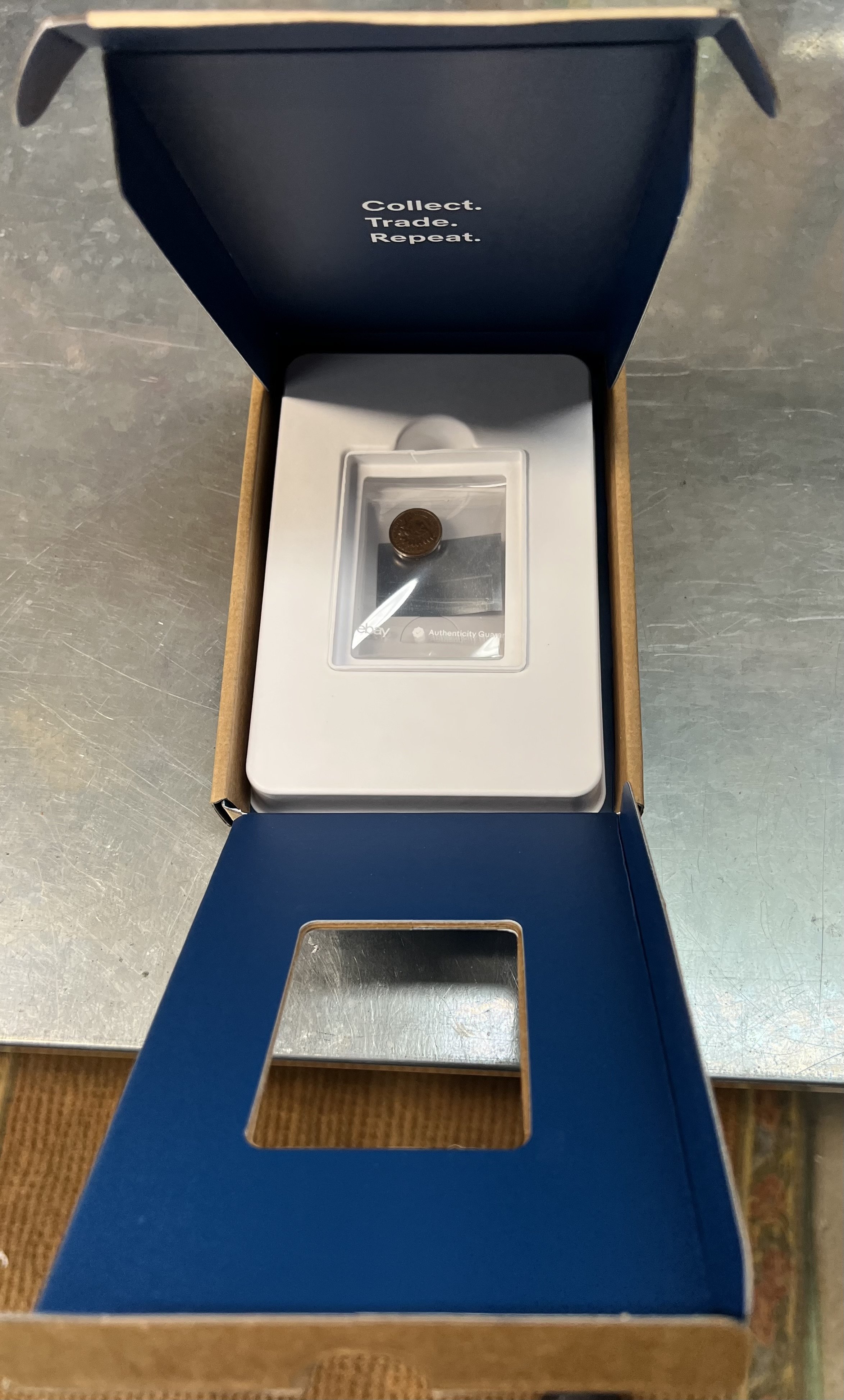
The raw coin is placed into a flip, and the flip is in a plastic bag.
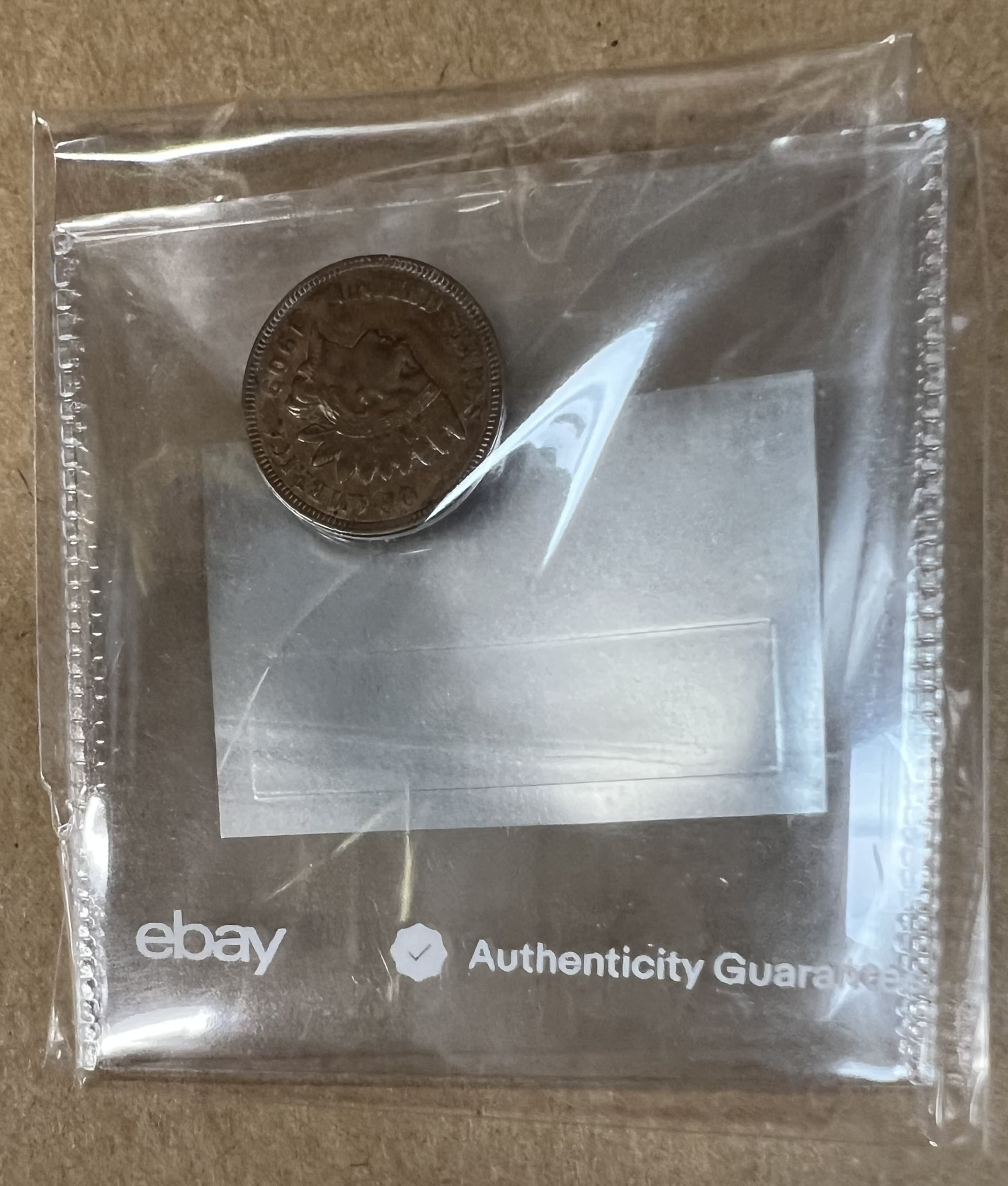
The plastic bag is sealed with a unique sticker, which has a QR code that links back to the authentication and eBay auction page. I did not obscure the QR code in case anyone wants to see how this information is presented.
If too many of their coins go missing, insurance goes up, or insurance stops insuring. And that of course, raises the cost of the Authenticity Guarantee Program. And that of course, will, ultimately have to be passed on to the buyers and the sellers if it affects ebay margins, they have shareholders to answer to...........................
And what is the additional cost to ebay for all of this packaging, review and extra shipping?
eBay has been running their Authenticity Guarantee Program for trading cards for nearly five years, they probably have a pretty good handle on program expenses.
Just an update. This is what PCGS and ebay had to say about the matter:
Your item is headed your way, but we couldn’t provide the Authenticity Guarantee you may have been expecting because, upon inspection, we found it to be miscategorized.
Unfortunately, miscategorized items aren’t eligible for Authenticity Guarantee.
We know this may be disappointing, and we've asked the seller to review and update their listings to prevent this from happening again.
What was the miscategorization?
I personally have no problem with eBays effort. For crying out loud at least they are doing something. But I do worry that these fancy shipping boxes will end up at shows with counterfeit slabs ready to STILL sucker people.
WS
It was for a lot of two as opposed to a single coin.
Well that's interesting. So right now I have a listing for a 2026 P & D Dime Set in PCGS MS68 for well over $500. I guess that will be rejected too? Mine is not miscategorized, it's in the proper category for 2026 dimes. Unless they are suggesting the the "appropriate" category is the "sets and lots" category.