After a years of building the 50-piece classic commemorative type set, I decided to write the guide I wished I'd had when I started.
"Half a Dollar of History" covers all 50 types — Columbian through Carver-Washington — with a chapter per coin: historical background, design analysis, grading guide (strike quality, toning, weak points), and set-building strategy across three budget tiers (MS-63 / MS-65 / MS-65+CAC).
Auction values are based on MS-65 medians from April 2026. Coin photography courtesy of PCGS.
One note from a top-10 PCGS Registry collector who reviewed the manuscript: "Well researched... I do like the commentary and guidance on what to look for on the 50 commems. I will buy this book for my library as soon as it is available."
Available on Amazon in both Kindle ($9.99) and Paperback ($51.99): https://www.amazon.com/dp/B0H6BZMQ6X
Happy to answer any questions about the content.
Author of "Half a Dollar of History" — A collector's guide to the classic U.S. commemorative type set (1892–1954) | 50 chapters, PCGS photography, grading guides & auction values | amazon.com/dp/B0H6BZMQ6X
Nice. Is your price limiting sales? With a BSR over 200,000 - My experience is that this range equates to less than 10 books per month - just trying to help.
Thank you — really appreciate the insight. BSR is something I'm still learning to read. The paperback is a full-color 272-page collector's guide so printing costs are significant, but I hear you on the price point.
Amazon actually just applied an automatic discount bringing it under $43 — which is what prompted this update. I'll keep an eye on the BSR and see if it moves. Any other advice from your experience welcome!
Edit:
Just checked — BSR is currently #85,177 in Books overall, #72 in Antiques & Collectibles Encyclopedias, and #92 in Antique & Collectible Coins & Medals. Seems the Amazon discount helped move things along. Thank you for the nudge to check!
Author of "Half a Dollar of History" — A collector's guide to the classic U.S. commemorative type set (1892–1954) | 50 chapters, PCGS photography, grading guides & auction values | amazon.com/dp/B0H6BZMQ6X
As of July 14, 2026 - Best Sellers Rank: #753,589 in Books. A price of $44.01 is too high and there are too many coin guides on Amazon ~200.
Other issues:
You are not from the USA, likely Poland
You are not a coin expert but spent a lot of time on the internet copying photos and information.
Wide spacing in the paragraphs indicates AI
Book cover does not state - color
Book cover does not stand out.
The BSR of ~750K is not recoverable and it will only get worse
You have a non-traditional pricing scheme
Yes, I'm from Poland - but I don't see that as a flaw. Building a collection of U.S. coins from Europe is a completely different experience than doing it stateside. We decide from the photographs in a listing, and we don't hold the coin until weeks after buying it. I'd argue that perspective enriches the book rather than detracting from it.
You're right that I'm not a coin expert, and I've never claimed to be. I'm a collector, and the book is written from a collector's perspective. My intention was to create a resource that anyone - especially beginners - could learn from.
And yes, I'm not reinventing the wheel. If you're determined, you can find the history of every one of these coins online. Even the prices I cite are publicly available - with enough time you could gather them yourself and work out the three-year auction medians.
In your review (and I assume the one star was yours), you suggest the book was made for profit. Every numismatic author knows numismatic books aren't a source of income. What drove me was passion for this series - one I fell for at first sight.
Which is why the BSR honestly doesn't matter much to me. What matters is that someone wanting to start this series now has a book to introduce them to it.
Giving one star to a book you haven't read - without naming a single factual error, based only on the fact that I'm Polish and not a native speaker - strikes me as unfair. The book is available worldwide and gets very good feedback from people who've actually read it. That's the real reward: when someone writes to say it helped them.
Author of "Half a Dollar of History" — A collector's guide to the classic U.S. commemorative type set (1892–1954) | 50 chapters, PCGS photography, grading guides & auction values | amazon.com/dp/B0H6BZMQ6X
Mr. Rotocki's book about classic commemorative halves is a meaningful example of learning from available on-line materials. That is a significant advantage for individuals although it comes with certain inherent difficulties. Commemorative halves are a good initial subject because there are many older publications covering the same subject, and the series ended 70+ years ago. That is, it's a static subject where repeated publications have largely worked through common errors and misinterpretations. All this is to Mr. Rotocki's advantage and he has produced a direct, clear and helpful book aimed at interesting new collectors. (This should not be compared to Lee Gast's detailed, comprehensive exposition covering the same time period. Mr. Gast's work is clearly near the top of scholarship on this subject.)
As an internet researched book, "Half a Dollar of History" bumps squarely into a core problem of anything based on this muddle of information: What is truth and what is not. As noted, most of "Half a Dollar of History's" information comes from pre-assimilated material, but by depending on that alone, the book does not include anything new. It presents no revelations, cites no new sources, presents no updates, and largely falls flat beyond the newest numismatic ingénue's infatuation. To a certain extent, the author can be forgiven, however. His location in Europe precludes direct access to United States archives, and very little numismatic information is available on-line beyond the Newman Numismatic Portal (NNP).
As an author, I appreciate Mr. Rotocki's energy and dedication in producing "Half a Dollar of History." I hope he will continue to pursue knowledge and publication of results for all to enjoy.
RWB
@CaptHenway said:
Anybody remember the thread here in the forums a couple of years ago about a brass piece that looked like an undated Seated Liberty Quarter but with strangely concave fields? It is in Judd and has traditionally dated to about 1840? I know one of the previous owners, and tried to buy it from him without luck. It fascinated me.
Well, I was amazed to see it in Roger Burdette's new book "Fads, Fakes & Foibles," where Roger convincingly attributed it to 1857 and the pre-Civil War experiments with very thin and/or concave coinage to discourage crooks from hollowing out gold and silver coins. The book covers a wide range of 19th Century experimental pieces. I highly recommend the book. Here is a press release on it:
PRESS/MEDIA RELEASE
For Release June 15, 2021
Contact: Roger W. Burdette, accurateye@aol.com
Seneca Mill Press LLC proudly announces release of the latest numismatic book by Roger W. Burdette:
Fads, Fakes & Foibles.
Most nineteenth century Americans thought of coins and currency in two practical ways: a concern that their pieces of coin or paper currency would be accepted by merchants for purchases and a desire to have more.
For those few involved in economic policy and politics, other, more esoteric aspects of coinage were of concern. Their three principal subjects were prevention of adulteration or counterfeiting, direct equivalence of international gold coins, and use of metric weights for coins. Underlying each of these were certain economic assumptions and profit opportunities that pushed governments toward decisions.
Adulteration and counterfeiting were of concern to all because bad coins meant that merchants and banks would reject the money a person offered in payment. In this regard, it must be remembered that gold coins were simply convenient tokens containing a certain weight of pure gold. Banks and merchants could, and occasionally did, reject legitimate gold coins because they appeared heavily worn or were lighter than official standards. This was the focus of James T. Barclay and his obsession with preventing degradation of the national coinage.
Nickel mining maven Joseph Wharton went to great lengths to promote alloys of nickel and copper for minor coins valued up to ten cents. Here, he cracked skulls with persistent mint officers who thought of base metal coins only as temporary Civil War substitutes for silver dimes and half dimes.
Businessman Dana Bickford, alternatively, was concerned with the ability of travelers to easily know the value of their American money in certain European currencies. His idea for a gold international coin was not intended as a standard of value, but as an equivalency calculator. His changes were of design, not content although much of the work was facilitated by George Dunning, former Superintendent of the New York Assay Office.
Silver producers of the 1870s wanted to stop the decline in silver value compared to gold. Others wanted a bimetallic standard so that gold and silver would circulate equally. Backers of standard international coinage wanted to follow principles of the Latin Monetary Union and have the gold coins of all major nations exactly equal one another. Further, many idealists across the world wanted all coin weights expressed in grams of pure gold or silver and coin diameters and weights to be whole numbers. Here we find Wheeler Hubbell proposing a bimetallic coinage alloy and U.S. coins of metric weight. He was neither first not last to advocate these measures, but was certainly the one most favored by a Congressional committee. Nicholas Veeder, on the other hand, wanted not an alloy but a mechanical union of the two metals much like modern bimetallic coins.
Others proposed to protect coins by adding an iron ring, or striking pieces with one or more holes to permit a convenient diameter while aiding the blind in identifying a coin’s value.
Fads, Fakes & Foibles brings together a strange crew of idealists and opportunists – creators of the best known, but little understood coinage proposals. The author, building on original archival sources separates fact from fancy while providing today’s collectors with a delightful journey through some of the oddest coinage proposals ever made.
Fads, Fakes & Foibles is available from Wizard Coin Supply (www.wizardcoinsupply.com). Cover price for the 8½x11-inch book containing 273 full color pages is $29.95. Purchasers may also request a complete digital index edition at no cost. This will facilitate subject searches and provides a convenient copy for use on smart phones, tablets, and similar portable devices.
Fads, Fakes & Foibles includes a lot of new information about the coins in question along with Barclay's imagination and Hubbell's presbyopia.
Here's the Table of Contents:
PAGE 11 - Introductory Remarks
PAGE 13 - Dr. Barclay’s Experimental Coinage ~ 1832-1876
James T. Barclay’s experiments at the Philadelphia Mint are mentioned in many coin collectors’ books but rarely explained. Who was this enigmatic experimenter and what did he accomplish?
PAGE 57 - Donuts to Dollars ~ 1849-1854
An excess of California gold and a shortage of silver encouraged experiments with America’s annular gold dollar and half-dollar patterns.
PAGE 91 - Examination of Counterfeit or Debased Coins ~ 1860
by Jacob R. Eckfeldt, William E. Dubois and James B. Longacre
During and after Dr. Barclay’s experiments at the Philadelphia Mint, it was claimed his ideas were not original and had no influence on Mint experiments. Yet his exposition of problems with adulterated coinage evidently inspired internal examination.
PAGE 101 - Ring Around the Dollar – A Device to Reduce Abrasion ~ 1867
Ignatius Sargent and J. S. Getchell assured the mint director that a metal ring would protect gold and silver coins from abrasion. After all, it worked for wood buttons.
PAGE 105 - Wharton’s Folly ~ 1864-1870
The Civil War era economy required an unusual decision for United States coinage: should small change be made of high value precious metal, or nearly worthless base
alloy? Nickel mine owner Joseph Wharton eagerly promoted his opinion to the Mint
Bureau.
PAGE 133 - Prevention of A Fraud Upon Our Gold Coins ~ 1873
by William E. Dubois
Mint Assayer William Dubois examined adulteration of gold coins by filling with platinum. His report discussed detection methods and suggested that thinner coins could reduce the frequency of this fraud.
PAGE 139 - International Coinage ~ 1865-1868
From the 1860s through the 1880s, multiple international conferences were held with the goal of rationalizing financial exchanges. This chapter introduces coin collectors to the purposes for and outcomes of the discussions.
PAGE 151 - The Holey Money of Hall and Johnson ~ 1866-1885
Could cutting holes in small denomination coins help alleviate financial inconvenience and loss for much of the working population? Edwin Hall and Eastman Johnson thought they had the answer.
PAGE 175 - Bickford-Dunning Gold Exchange Coin ~ 1874-1877
Recent research proves that most of the design and promotion of Dana Bickford’s
International $10 pattern coin was performed by former New York Assay Office
Superintendent George F. Dunning.
PAGE 191 - Louis Garnett, Wheeler Hubbell, and the Goloid Fiasco ~ 1878-1882
Goloid and metric coinage alloy patterns are among the most popular and common of all pieces struck as proposed coinage. The entire episode was expensive, disruptive, wasteful and useless.
PAGE 269 - The Cometallic Money Plan ~ 1885-1886
Nicholas Veeder was convinced his cometallic money plan would make the word a
financial utopia. Few others were similarly persuaded.
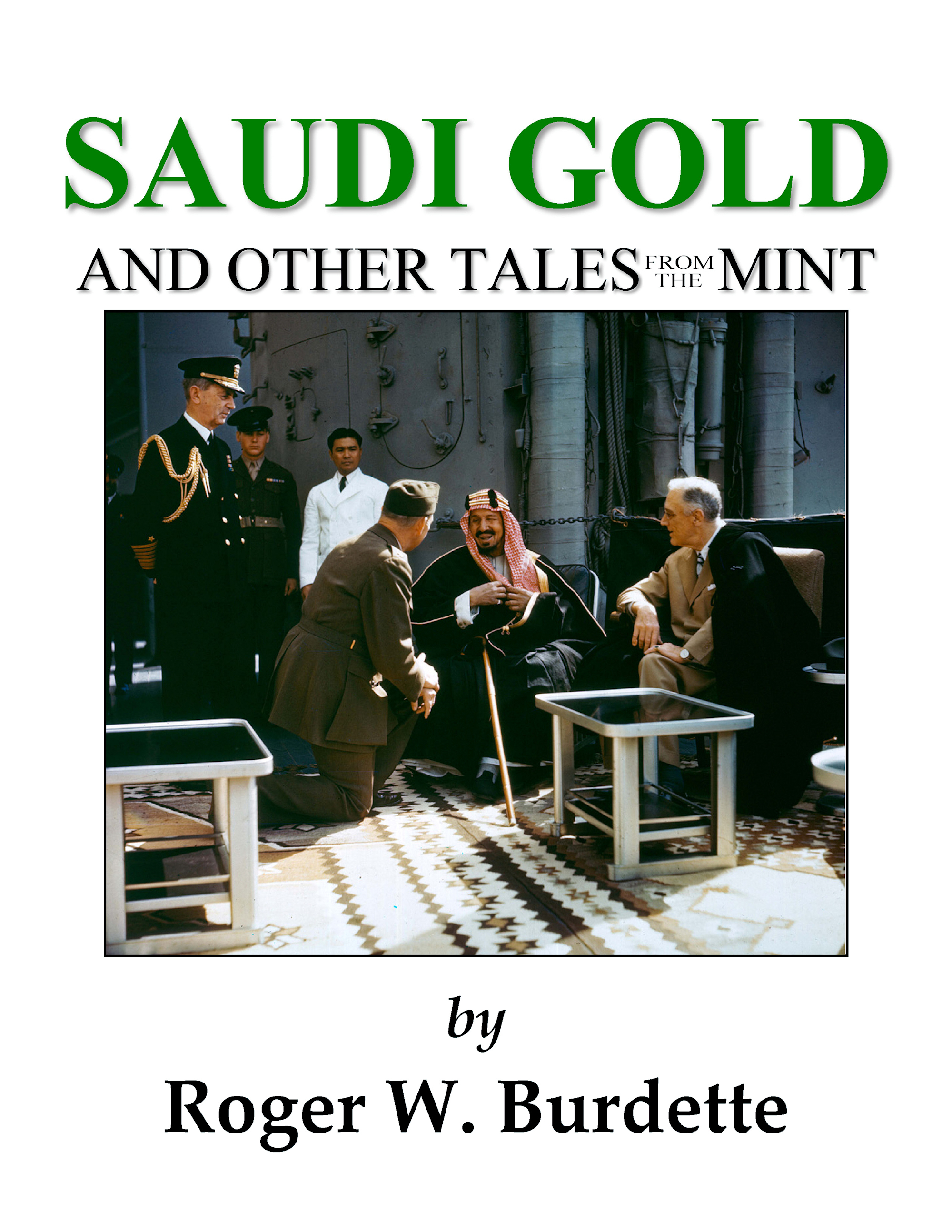
I don't know if this has been discussed before, so here the Table of Contents for Saudi Gold and other Tales from the Mint
PAGE 9
INTRODUCTORY REMARKS
PAGE 11
CHAPTER 1 – CROWNS OF GOLD, FEET OF CLAY
America was officially on a “gold standard” from 1900 to 1974 although its practical beginning was in 1834. Through political, economic and social changes gold seemed to be the basis of financial stability –– until one day the luster peeled off.
PAGE 29
CHAPTER 2 –WHEN A DOLLAR IS A DOLLAR
During World War I, the United States learned that its economy could function very well without gold coins in circulation. Gradually gold was consolidated into national vaults. With nationalization of gold and silver every dollar became identical with every other dollar.
PAGE 59
CHAPTER 3 – BETWEEN THE WARS TO END ALL WARS
While America stood aside in world events during the “Roaring Twenties,” Presidents Harding, Coolidge and Hoover cut domestic budgets and discouraged capital investment in minting technology. The three great U.S. Mints stagnated in neglect and ineptitude until appointment of Nellie Ross as Director of the Mint in 1933.
PAGE 97
CHAPTER 4 – MISSING 1928 DOUBLE EAGLES
A bag of 1928 double eagles was missing from the Philadelphia Mint. The Secret Service investigated down to the dust on remaining coin bags but came up empty handed.
PAGE 119
CHAPTER 5 – AMERICAN GOLD AFTER NATIONALIZATION
Hoarding of money by frightened citizens contributed to the Great Depression, but others sought to gain advantage from the situation, and some fortunate few found themselves owners of newfound treasures.
PAGE 151
CHAPTER 6 – COIN COLLECTING DURING THE DEPRESSION
Shortage of cash did not deter people from engaging in hobbies and other inexpensive diversions. Coin collecting experienced a resurgence fueled by commemorative half dollars, inexpensive coin folders, and the prospect of finding a valuable coin in pocket change.
PAGE 161
CHAPTER 7 – TREASURY’S WARTIME SECRETS
World War II was waged on many fronts and by every part of the United States government and people. Some of the war made headlines, some was out of public attention, and some was known only to a few.
PAGE 185
CHAPTER 8 – GOLD DISCS FOR THE KINGDOM OF SAUDI ARABIA
The Kingdom of Saudi Arabia controlled vast petroleum reserves, but the United States was more interested in access to a strategic staging point to support a potential invasion of Japan. Gold bullion discs were part of the American plan.
PAGE 211
CHAPTER 9 – FRANKLIN D. ROOSEVELT DIME
FDR was the only President many Americans had known. He was also the most dynamic since his cousin Theodore held the same office. FDR’s sudden death only a month before victory in Europe shocked the nation and world.
PAGE 229
CHAPTER 10 – AN AMERICAN ORIGINAL
America has long had a fascination for the quirky yet practical genius of Benjamin Franklin. He was never elected to office but remains better known than most of the prominent men who became political leaders.
Comments
After a years of building the 50-piece classic commemorative type set, I decided to write the guide I wished I'd had when I started.
"Half a Dollar of History" covers all 50 types — Columbian through Carver-Washington — with a chapter per coin: historical background, design analysis, grading guide (strike quality, toning, weak points), and set-building strategy across three budget tiers (MS-63 / MS-65 / MS-65+CAC).
Auction values are based on MS-65 medians from April 2026. Coin photography courtesy of PCGS.
One note from a top-10 PCGS Registry collector who reviewed the manuscript: "Well researched... I do like the commentary and guidance on what to look for on the 50 commems. I will buy this book for my library as soon as it is available."
Available on Amazon in both Kindle ($9.99) and Paperback ($51.99):
https://www.amazon.com/dp/B0H6BZMQ6X
Happy to answer any questions about the content.
Author of "Half a Dollar of History" — A collector's guide to the classic U.S. commemorative type set (1892–1954) | 50 chapters, PCGS photography, grading guides & auction values | amazon.com/dp/B0H6BZMQ6X
Nice. Is your price limiting sales? With a BSR over 200,000 - My experience is that this range equates to less than 10 books per month - just trying to help.
Thank you — really appreciate the insight. BSR is something I'm still learning to read. The paperback is a full-color 272-page collector's guide so printing costs are significant, but I hear you on the price point.
Amazon actually just applied an automatic discount bringing it under $43 — which is what prompted this update. I'll keep an eye on the BSR and see if it moves. Any other advice from your experience welcome!
Edit:
Just checked — BSR is currently #85,177 in Books overall, #72 in Antiques & Collectibles Encyclopedias, and #92 in Antique & Collectible Coins & Medals. Seems the Amazon discount helped move things along. Thank you for the nudge to check!
Author of "Half a Dollar of History" — A collector's guide to the classic U.S. commemorative type set (1892–1954) | 50 chapters, PCGS photography, grading guides & auction values | amazon.com/dp/B0H6BZMQ6X
As of July 14, 2026 - Best Sellers Rank: #753,589 in Books. A price of $44.01 is too high and there are too many coin guides on Amazon ~200.
Other issues:
You are not from the USA, likely Poland
You are not a coin expert but spent a lot of time on the internet copying photos and information.
Wide spacing in the paragraphs indicates AI
Book cover does not state - color
Book cover does not stand out.
The BSR of ~750K is not recoverable and it will only get worse
You have a non-traditional pricing scheme
Hi,
Let me clear up a few things.
Yes, I'm from Poland - but I don't see that as a flaw. Building a collection of U.S. coins from Europe is a completely different experience than doing it stateside. We decide from the photographs in a listing, and we don't hold the coin until weeks after buying it. I'd argue that perspective enriches the book rather than detracting from it.
You're right that I'm not a coin expert, and I've never claimed to be. I'm a collector, and the book is written from a collector's perspective. My intention was to create a resource that anyone - especially beginners - could learn from.
And yes, I'm not reinventing the wheel. If you're determined, you can find the history of every one of these coins online. Even the prices I cite are publicly available - with enough time you could gather them yourself and work out the three-year auction medians.
In your review (and I assume the one star was yours), you suggest the book was made for profit. Every numismatic author knows numismatic books aren't a source of income. What drove me was passion for this series - one I fell for at first sight.
Which is why the BSR honestly doesn't matter much to me. What matters is that someone wanting to start this series now has a book to introduce them to it.
Giving one star to a book you haven't read - without naming a single factual error, based only on the fact that I'm Polish and not a native speaker - strikes me as unfair. The book is available worldwide and gets very good feedback from people who've actually read it. That's the real reward: when someone writes to say it helped them.
Author of "Half a Dollar of History" — A collector's guide to the classic U.S. commemorative type set (1892–1954) | 50 chapters, PCGS photography, grading guides & auction values | amazon.com/dp/B0H6BZMQ6X
Mr. Rotocki's book about classic commemorative halves is a meaningful example of learning from available on-line materials. That is a significant advantage for individuals although it comes with certain inherent difficulties. Commemorative halves are a good initial subject because there are many older publications covering the same subject, and the series ended 70+ years ago. That is, it's a static subject where repeated publications have largely worked through common errors and misinterpretations. All this is to Mr. Rotocki's advantage and he has produced a direct, clear and helpful book aimed at interesting new collectors. (This should not be compared to Lee Gast's detailed, comprehensive exposition covering the same time period. Mr. Gast's work is clearly near the top of scholarship on this subject.)
As an internet researched book, "Half a Dollar of History" bumps squarely into a core problem of anything based on this muddle of information: What is truth and what is not. As noted, most of "Half a Dollar of History's" information comes from pre-assimilated material, but by depending on that alone, the book does not include anything new. It presents no revelations, cites no new sources, presents no updates, and largely falls flat beyond the newest numismatic ingénue's infatuation. To a certain extent, the author can be forgiven, however. His location in Europe precludes direct access to United States archives, and very little numismatic information is available on-line beyond the Newman Numismatic Portal (NNP).
As an author, I appreciate Mr. Rotocki's energy and dedication in producing "Half a Dollar of History." I hope he will continue to pursue knowledge and publication of results for all to enjoy.
RWB
Fads, Fakes & Foibles includes a lot of new information about the coins in question along with Barclay's imagination and Hubbell's presbyopia.
Here's the Table of Contents:
PAGE 11 - Introductory Remarks
PAGE 13 - Dr. Barclay’s Experimental Coinage ~ 1832-1876
James T. Barclay’s experiments at the Philadelphia Mint are mentioned in many coin collectors’ books but rarely explained. Who was this enigmatic experimenter and what did he accomplish?
PAGE 57 - Donuts to Dollars ~ 1849-1854
An excess of California gold and a shortage of silver encouraged experiments with America’s annular gold dollar and half-dollar patterns.
PAGE 91 - Examination of Counterfeit or Debased Coins ~ 1860
by Jacob R. Eckfeldt, William E. Dubois and James B. Longacre
During and after Dr. Barclay’s experiments at the Philadelphia Mint, it was claimed his ideas were not original and had no influence on Mint experiments. Yet his exposition of problems with adulterated coinage evidently inspired internal examination.
PAGE 101 - Ring Around the Dollar – A Device to Reduce Abrasion ~ 1867
Ignatius Sargent and J. S. Getchell assured the mint director that a metal ring would protect gold and silver coins from abrasion. After all, it worked for wood buttons.
PAGE 105 - Wharton’s Folly ~ 1864-1870
The Civil War era economy required an unusual decision for United States coinage: should small change be made of high value precious metal, or nearly worthless base
alloy? Nickel mine owner Joseph Wharton eagerly promoted his opinion to the Mint
Bureau.
PAGE 133 - Prevention of A Fraud Upon Our Gold Coins ~ 1873
by William E. Dubois
Mint Assayer William Dubois examined adulteration of gold coins by filling with platinum. His report discussed detection methods and suggested that thinner coins could reduce the frequency of this fraud.
PAGE 139 - International Coinage ~ 1865-1868
From the 1860s through the 1880s, multiple international conferences were held with the goal of rationalizing financial exchanges. This chapter introduces coin collectors to the purposes for and outcomes of the discussions.
PAGE 151 - The Holey Money of Hall and Johnson ~ 1866-1885
Could cutting holes in small denomination coins help alleviate financial inconvenience and loss for much of the working population? Edwin Hall and Eastman Johnson thought they had the answer.
PAGE 175 - Bickford-Dunning Gold Exchange Coin ~ 1874-1877
Recent research proves that most of the design and promotion of Dana Bickford’s
International $10 pattern coin was performed by former New York Assay Office
Superintendent George F. Dunning.
PAGE 191 - Louis Garnett, Wheeler Hubbell, and the Goloid Fiasco ~ 1878-1882
Goloid and metric coinage alloy patterns are among the most popular and common of all pieces struck as proposed coinage. The entire episode was expensive, disruptive, wasteful and useless.
PAGE 269 - The Cometallic Money Plan ~ 1885-1886
Nicholas Veeder was convinced his cometallic money plan would make the word a
financial utopia. Few others were similarly persuaded.
I don't know if this has been discussed before, so here the Table of Contents for Saudi Gold and other Tales from the Mint
PAGE 9
INTRODUCTORY REMARKS
PAGE 11
CHAPTER 1 – CROWNS OF GOLD, FEET OF CLAY
America was officially on a “gold standard” from 1900 to 1974 although its practical beginning was in 1834. Through political, economic and social changes gold seemed to be the basis of financial stability –– until one day the luster peeled off.
PAGE 29
CHAPTER 2 –WHEN A DOLLAR IS A DOLLAR
During World War I, the United States learned that its economy could function very well without gold coins in circulation. Gradually gold was consolidated into national vaults. With nationalization of gold and silver every dollar became identical with every other dollar.
PAGE 59
CHAPTER 3 – BETWEEN THE WARS TO END ALL WARS
While America stood aside in world events during the “Roaring Twenties,” Presidents Harding, Coolidge and Hoover cut domestic budgets and discouraged capital investment in minting technology. The three great U.S. Mints stagnated in neglect and ineptitude until appointment of Nellie Ross as Director of the Mint in 1933.
PAGE 97
CHAPTER 4 – MISSING 1928 DOUBLE EAGLES
A bag of 1928 double eagles was missing from the Philadelphia Mint. The Secret Service investigated down to the dust on remaining coin bags but came up empty handed.
PAGE 119
CHAPTER 5 – AMERICAN GOLD AFTER NATIONALIZATION
Hoarding of money by frightened citizens contributed to the Great Depression, but others sought to gain advantage from the situation, and some fortunate few found themselves owners of newfound treasures.
PAGE 151
CHAPTER 6 – COIN COLLECTING DURING THE DEPRESSION
Shortage of cash did not deter people from engaging in hobbies and other inexpensive diversions. Coin collecting experienced a resurgence fueled by commemorative half dollars, inexpensive coin folders, and the prospect of finding a valuable coin in pocket change.
PAGE 161
CHAPTER 7 – TREASURY’S WARTIME SECRETS
World War II was waged on many fronts and by every part of the United States government and people. Some of the war made headlines, some was out of public attention, and some was known only to a few.
PAGE 185
CHAPTER 8 – GOLD DISCS FOR THE KINGDOM OF SAUDI ARABIA
The Kingdom of Saudi Arabia controlled vast petroleum reserves, but the United States was more interested in access to a strategic staging point to support a potential invasion of Japan. Gold bullion discs were part of the American plan.
PAGE 211
CHAPTER 9 – FRANKLIN D. ROOSEVELT DIME
FDR was the only President many Americans had known. He was also the most dynamic since his cousin Theodore held the same office. FDR’s sudden death only a month before victory in Europe shocked the nation and world.
PAGE 229
CHAPTER 10 – AN AMERICAN ORIGINAL
America has long had a fascination for the quirky yet practical genius of Benjamin Franklin. He was never elected to office but remains better known than most of the prominent men who became political leaders.
PAGE 241
BIBLIOGRAPHY