@pruebas said:
I just bought this today. It is apparently a new discovery. Still in its original cellophane from the Mexican Mint.
The obverse is the 1978 onza pattern using the design of the 1949 onza (see KM-Pn211).
This design was ultimately rejected for the inferior (IMHO) design ultimately selected.
The reverse design is a Mayan ballplayer similar to what was used on the 20 Pesos starting 1980.
(This design may have also been used on a medal, but I can't seem to find it.)
It has a plain edge, so perhaps it's a restrike, made after 1978 using muled dies.
Finding the medal with this reverse design might lend a clue.
So there are now two newly-discovered, related Mexican pieces and after further research, I believe they both may be patterns for the 1982 silver Libertad onza. I have no doubt they are absolutely genuine Mexican Mint products.
The evidence:
-The obverse of the first piece ties it to the 1978 Onza pattern (see KM-Pn211).
-The reverse of the first piece ties it to the second piece.
-The obverse of the second piece is a bizarre subject. It appears to be a crouching man holding a sword in his right hand and blowing a conch shell with his left hand. But why? And no legend?
-Both mintmarks "Mo" are absolutely legit (in font & style).
-Both pieces came in original Mexican Mint cellophane. Were they meant to be sold? Or is that how they delivered them to the officials for examination?
-The edge of both pieces are plain (which probably means restrike, sometime after 1978). KM-Pn211 has a reeded edge.
-The weight of both pieces is 31.1g, which implies 0.999 fineness.
But the 1978-80 onzas were of 0.925 fineness (33.62g and a carryover from 1949). 0.999 didn't start being used for bullion until the silver Libertad series in 1982 (even the early gold onzas in 1981 were 0.900 fine).
My current thinking is that these were the first ideas for the new onza series starting 1982. They had the 1978 pattern die lying around, and maybe they thought it was nicer than the final selected design from the 78-80 onza, so they were trying it again in 1981 after the discontinuance of the 78-80 onza. Or maybe they were just planchet patterns for the new 0.999 fine silver planchets to be used starting 1982.
Anyway, these are headed off for a long vacation at Newport Beach and I need to think of the best way to attribute them.
Edited to add: I own 3 different varieties of KM-Pn211. Maybe I should crack them all out and weigh them? KM-Pn211 is one of the pattern designs for the 1978 silver onza.
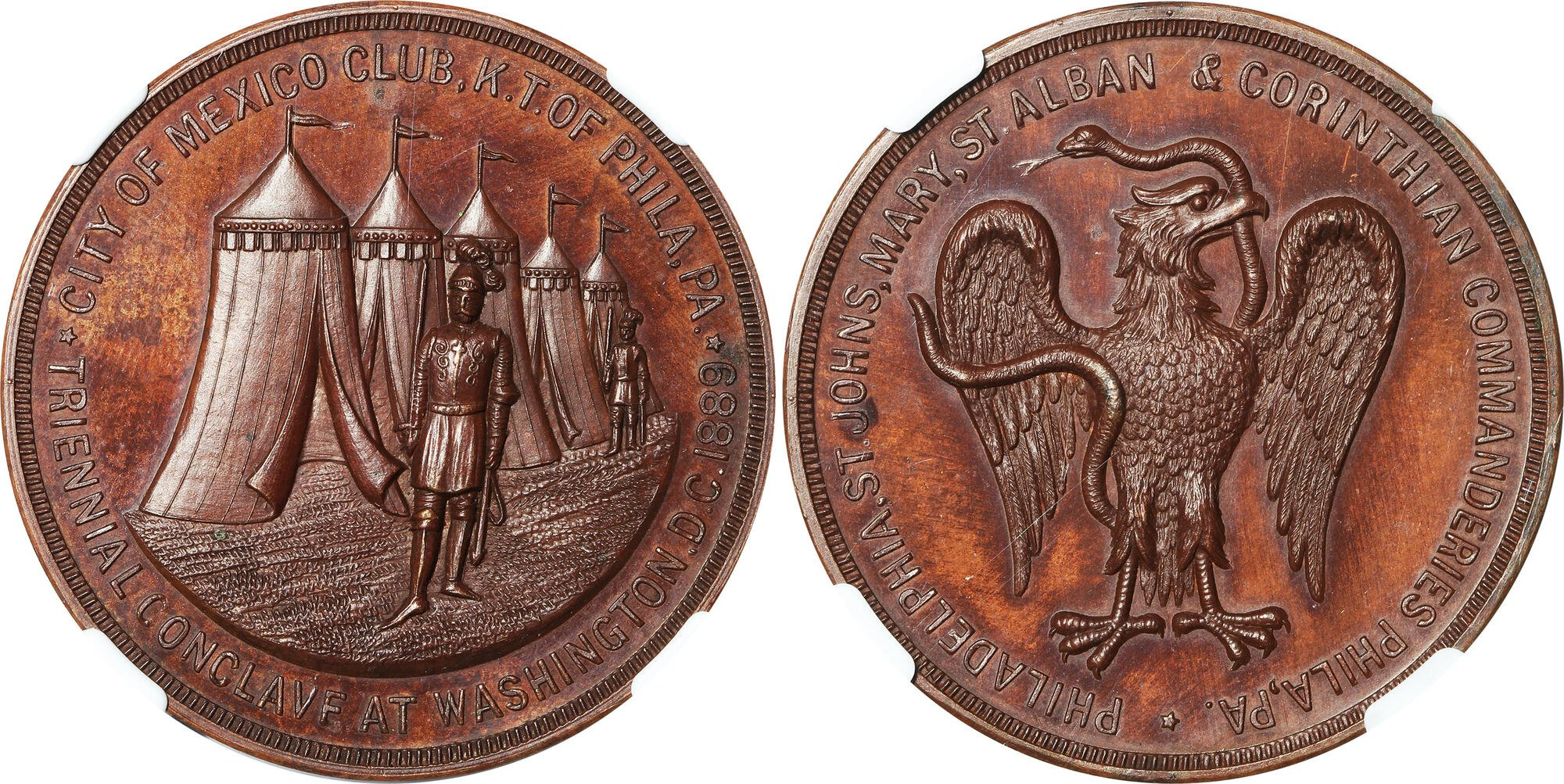
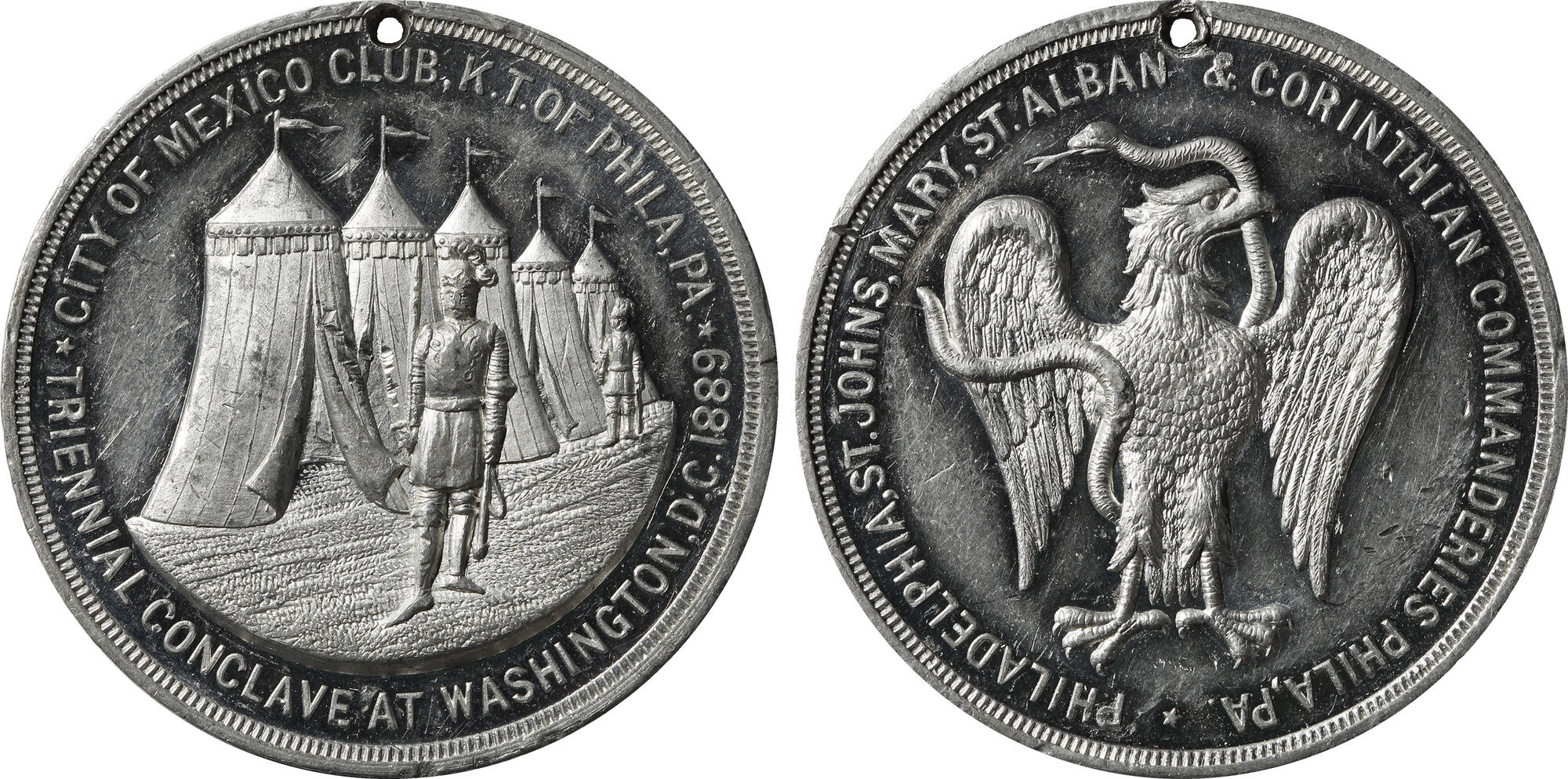
I bought these a year ago, but never showed them here. They are US pieces made by the Knights Templar of Philadelphia. There is some relation to Mexico and I bought them for the beautiful rendition of the Mexican eagle on the reverse. They seem scarce as I’ve not seen them before.
Anybody notice this sale? 1858 Canada specimen cent in PCGS SP-65 Brown, with a small obverse scratch. Went for $11,590, about 4 times what I thought was the going rate. Shows what I know.
Numismatic author & owner of the Uncommon Cents collections. 2011 and 2025 Fred Bowman Literary Award, 2025 Guy Potter Literary Award, 2022 Paul Fiocca Award, & 2020 J. Douglas Ferguson Award.
@bosox said:
Anybody notice this sale? 1858 Canada specimen cent in PCGS SP-65 Brown, with a small obverse scratch. Went for $11,590, about 4 times what I thought was the going rate. Shows what I know.
I don't see how that could be a 65 with that scratch plus the ones on the cheek and behind the neck.
But not knowing pricing on these, the price doesn't seem outrageous to me.
There are about 40 specimen 1858 cents around. It's the most common large cent specimen date outside of 1908 and 1911. The Charlton standard catalog lists a SP-65RB for $3,500 CAD. A few years ago, I bought a really nice SP-65 RB for $4,000 USD from Heritage's Beckman sale (a well-known Canada specimen collection). $11,590 is a quantum leap, likely caused by two very stubborn bidders.
Numismatic author & owner of the Uncommon Cents collections. 2011 and 2025 Fred Bowman Literary Award, 2025 Guy Potter Literary Award, 2022 Paul Fiocca Award, & 2020 J. Douglas Ferguson Award.
Proof like off metal pattern (Pn47 in Krause) in CuNi, originally misattributed as a business strike at NGC, being corrected now as a mechanical error.
Now with an update, NGC’s XRF confirmed off-metal with a combined 75% CuNi but the incompetent NGC put the coin right back in the same MS65 holder. Just spoke with customer service. Amazing.
@bosox said:
There are about 40 specimen 1858 cents around. It's the most common large cent specimen date outside of 1908 and 1911. The Charlton standard catalog lists a SP-65RB for $3,500 CAD. A few years ago, I bought a really nice SP-65 RB for $4,000 USD from Heritage's Beckman sale (a well-known Canada specimen collection). $11,590 is a quantum leap, likely caused by two very stubborn bidders.
Very true. But if Canadian is anything like Mexican, prices have increased dramatically in the last 2 years. Largely due to the drastic decline of the USD.
Really good Canadian is going higher, but I suspect not as much or as quickly as Latin American coinages. I did not consider this 1858 specimen cent as really good Canadian, mostly because I agree it was over-graded.
Numismatic author & owner of the Uncommon Cents collections. 2011 and 2025 Fred Bowman Literary Award, 2025 Guy Potter Literary Award, 2022 Paul Fiocca Award, & 2020 J. Douglas Ferguson Award.
I just picked this one up. It’s a coin-like medal, perhaps using a 8R die for the obverse (substituting a sun face for 8R).
Funny story. I tried to buy a NGC example many years ago at Heritage. I bid last minute in a weekly (?) sale just before bidding ended and thought I had won it. What I didn’t realize at the time was that it was only pre-bidding and there was a live component to the sale afterwards. I was outbid during that session.
Thankfully, this is a nicer example. But unfortunately I paid a lot more than that other example sold for (due to Galactus).
This will likely be a catch and release but I thought it was a neat find.
See the date for what makes it special.
The first two pics were the sellers, so a little tough to spot.
Unique in private hands - Record Proof 1955 Bahamas Five Dollar coin; interesting in that the currency versions are readily available and even packaged as "specimen sets" when put in with the other denominations. They however are neither specimen nor proof as opposed to this one, bought as part of a set..
1891 Dominican Republic 5 Francos. Much nicer in hand and will send to TPG for grading. I do not think this will come back with environmental damage or cleaning, if seen in hand, even though it looks similar to some that have:
Love that Milled British (1830-1960) Well, just Love coins, period.
I can’t recall if I have seen one in hand before. Excellent addition
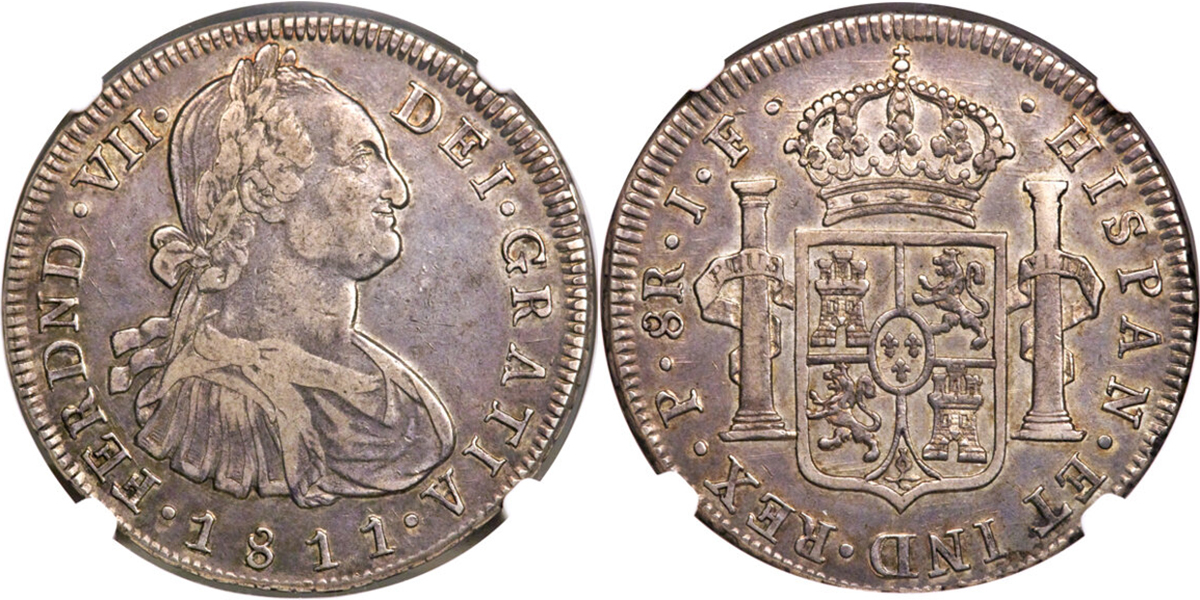
There are 7 dates, 1811,1812,1813,1814,1814/3,1816,1820. The bulk of the series is in the 1814. If done the census for the 1811,1812,1813’s with about 5-10 coins for each date and 75% being problem coins or higher if you include graded coins that shouldn’t be in holders.
There are too many 1814 and 1814/3’s to bother with a census (maybe 20 coins) but will do the others in time.
The series is about as rare as the Colombian or Santiago pillars.
I went on a small research project on the 1813 Popayán 8R somewhat recently as a modern forgery of that date popped up on Ebay and sold for a couple thousand. Although I believe 1813 is listed in Krause and Elizondo I could not find any non-overdate 1813s... which kind of made me wonder if the 1814/3 is really an 1814/3/2.
I went on a small research project on the 1813 Popayán 8R somewhat recently as a modern forgery of that date popped up on Ebay and sold for a couple thousand. Although I believe 1813 is listed in Krause and Elizondo I could not find any non-overdate 1813s... which kind of made me wonder if the 1814/3 is really an 1814/3/2.
I’ll publish my census of all the dates in a little while. At present I have no non-over date 1813’s documented
Here's one in NGC AU55 from the Kirk Menczer sale with an interesting planchet depression on the eagle that closely matches the cap from the other side. It is quite pronounced, and in hand, it reminds me of the shield on the eagle of a US Capped Bust quarter dollar.
United Provinces of the Rio de la Plata (Argentina) 8 Reales 1813, Potosi Mint
Silver, 38 mm, 26.80 gm
Obverse: Sun face and rays / PROVINCIAS DEL LA RIO DELA PLATA
Reverse: Wreath, two hands holding Liberty Cap / EN UNION Y LIBERTAD / 1813
Two copper-nickel minor Mexican patterns from 1972.
The new CuNi 10c took over from the bronze Juarez 10c and was issued from 1974 to 1980. This was the last 10c coin under the "old Pesos" monetary system. A 10c in the New Pesos system started in 1992.
The new CuNi 20c took over from the beloved bronze Pyramid 20c and was issued from 1974 to 1983. There was a short-lived Olmec 20c that took over in 1983 and lasted 1.5 years before it too was discontinued in 1984. More on that coin next week. The Olmec was the last 20c under the "old Pesos" system. A new 20c in the New Pesos system was started in 1992.
Very scarce 1/5 de sol minted in Arequipa, Peru in 1885
Some background to this coin:
The bloody War Of The Pacific (1879-1883) had ended two years before with Peru's and Bolivia's defeat against Chile.
Chilean troops evacuated Lima shortly thereafter, and left president General Andres Avelino Caceres, who had led Peru to the few victories Peruvians could achieve against Chile, with the painful task of re-building the country.
Peru had been economically decimated during the war. Public coffers were almost empty before the war, and in dire condition after the war with the rich province of Tarapaca lost to Chile. The scarcity of coinage outside of Lima, the capital was great, and this led President Caceres to mandate the striking of coinage at the southern provincial city of Arequipa. 1/5 Sol (quintos), and probably also some 1/10 Sol (dineros o decimos) were minted.
This coinage was struck under very rudimentary conditions. The coins did not comply with the specification of the mint in Lima which ordered the fledgling mint closed and the dies confiscated.
Today, about 8 examples of the 1/5 Sol 1885 from Arequipa are now known, and only one example of the 1/10 dinero.
Further background to this coinage (in Spanish) from an issue of OMNI No 6 - 04/2013:
"El primer día de enero de 1885 el presidente Andrés A. Cáceres dio un decreto estableciendo una ceca en Arequipa para acuñar quintos y décimos de Sol. La ceca debía estar en manos de particulares y la autorización era por cinco años. La licitación la ganó Enrique Gamboa, autor de la única propuesta y el 26 de enero siguiente se firmó el contrato con gran expectativa de los comerciantes, las autoridades y el público en general, y poco después se estableció la fábrica en la calle Santa Teresa, posteriormente llamada Pichincha sin haberse podido ubicar la numeración27.
El 17 de abril, La Bolsa, periódico de Arequipa anuncia que al día siguiente se iniciaría la producción y que las pruebas que se han visto son de “buena factura28”.
Como en el caso del Cusco, el grabador de las monedas fue el artista italiano Félix Bragagnini, que para entonces vivía en Arequipa. El ensayador, según indica Yabar, debió ser el aprendiz de ensayador de la ceca limeña Alejandro A. Caballero porque las iniciales A.C. aparecen el los quintos y A.A.C. en la única pieza de Dinero que se conoce. Al lado del escudo que acompaña a la Libertad sentada, se lee el apellido “Gamboa”, práctica reñida con la ley como se vio en el caso de los primeros soles de 1864 con el apellido de Derteano, pero que al parecer no fue notada en su momento.
Los esfuerzos de Gamboa por continuar la amonedación se encontraron enfrentados a la decisión de Director de Hacienda quien el 18 de abril nombró una comisión para examinar la maquinaria, el volumen de producción, la ley, calidad de grabado y peso de cada moneda29.
La comisión detectó que las monedas no se ajustaban ni al diseño, ni a la ley metálica ni a las dimensiones especificadas, por lo que el Consejo de Ministros inmediatamente procedió a la clausura de la ceca y la confiscación de los cuños poniendo así fin a esta efímera Casa de moneda."
I’ve always been very curious to see this in hand, seen it listed on eBay for a while, I have a very hard time believing it’s an AU, cleaned or otherwise. Can you provide any other shots by chance? I’m not trying to give you a hard time, I just see abundant wear, like VF level.
I’ve always been very curious to see this in hand, seen it listed on eBay for a while, I have a very hard time believing it’s an AU, cleaned or otherwise. Can you provide any other shots by chance? I’m not trying to give you a hard time, I just see abundant wear, like VF level.
Look at how sharp the edge/rim is to the SW of the date... you could shank someone with that. As with any poorly-struck piece (which, obviously, runs amok in Spanish Colonial/post-Colonial), sharp rim is the litmus test.
It's just a blunt strike, as most Guatemalan "cobs" are. Look through all the Reijgersdaal pieces...
This year has been a bit of an oddity for my. After seven and a half months, I just bought my first coin. And this one comes from a fellow member of the board! Thank you very much @FistFullOfDollars for this magnificent coin! This is a really rare issue.
Comments
Peru (1872). Bronze medal by Tiffany & Co. Engraved by JS & AB Wyon.
So there are now two newly-discovered, related Mexican pieces and after further research, I believe they both may be patterns for the 1982 silver Libertad onza. I have no doubt they are absolutely genuine Mexican Mint products.
The evidence:
-The obverse of the first piece ties it to the 1978 Onza pattern (see KM-Pn211).
-The reverse of the first piece ties it to the second piece.
-The obverse of the second piece is a bizarre subject. It appears to be a crouching man holding a sword in his right hand and blowing a conch shell with his left hand. But why? And no legend?
-Both mintmarks "Mo" are absolutely legit (in font & style).
-Both pieces came in original Mexican Mint cellophane. Were they meant to be sold? Or is that how they delivered them to the officials for examination?
-The edge of both pieces are plain (which probably means restrike, sometime after 1978). KM-Pn211 has a reeded edge.
-The weight of both pieces is 31.1g, which implies 0.999 fineness.
But the 1978-80 onzas were of 0.925 fineness (33.62g and a carryover from 1949). 0.999 didn't start being used for bullion until the silver Libertad series in 1982 (even the early gold onzas in 1981 were 0.900 fine).
My current thinking is that these were the first ideas for the new onza series starting 1982. They had the 1978 pattern die lying around, and maybe they thought it was nicer than the final selected design from the 78-80 onza, so they were trying it again in 1981 after the discontinuance of the 78-80 onza. Or maybe they were just planchet patterns for the new 0.999 fine silver planchets to be used starting 1982.
Anyway, these are headed off for a long vacation at Newport Beach and I need to think of the best way to attribute them.
Edited to add: I own 3 different varieties of KM-Pn211. Maybe I should crack them all out and weigh them? KM-Pn211 is one of the pattern designs for the 1978 silver onza.
Please keep us posted how this unfolds… should be interesting
Experience the World through Numismatics...it's more than you can imagine.
Rare Chilean gold medal, perhaps 5 exist from 10 made.
Latin American Collection
I bought these a year ago, but never showed them here. They are US pieces made by the Knights Templar of Philadelphia. There is some relation to Mexico and I bought them for the beautiful rendition of the Mexican eagle on the reverse. They seem scarce as I’ve not seen them before.
Bronze NGC MS64:
White metal (raw):
Anybody notice this sale? 1858 Canada specimen cent in PCGS SP-65 Brown, with a small obverse scratch. Went for $11,590, about 4 times what I thought was the going rate. Shows what I know.
https://coins.ha.com/itm/canada/canada-victoria-specimen-cent-1858-sp65-brown-pcgs-/a/3132-32173.s?ic2=mybidspage-lotlinks-12202013&tab=MyBids-101116
http://www.victoriancent.com
I don't see how that could be a 65 with that scratch plus the ones on the cheek and behind the neck.
But not knowing pricing on these, the price doesn't seem outrageous to me.
There are about 40 specimen 1858 cents around. It's the most common large cent specimen date outside of 1908 and 1911. The Charlton standard catalog lists a SP-65RB for $3,500 CAD. A few years ago, I bought a really nice SP-65 RB for $4,000 USD from Heritage's Beckman sale (a well-known Canada specimen collection). $11,590 is a quantum leap, likely caused by two very stubborn bidders.
http://www.victoriancent.com
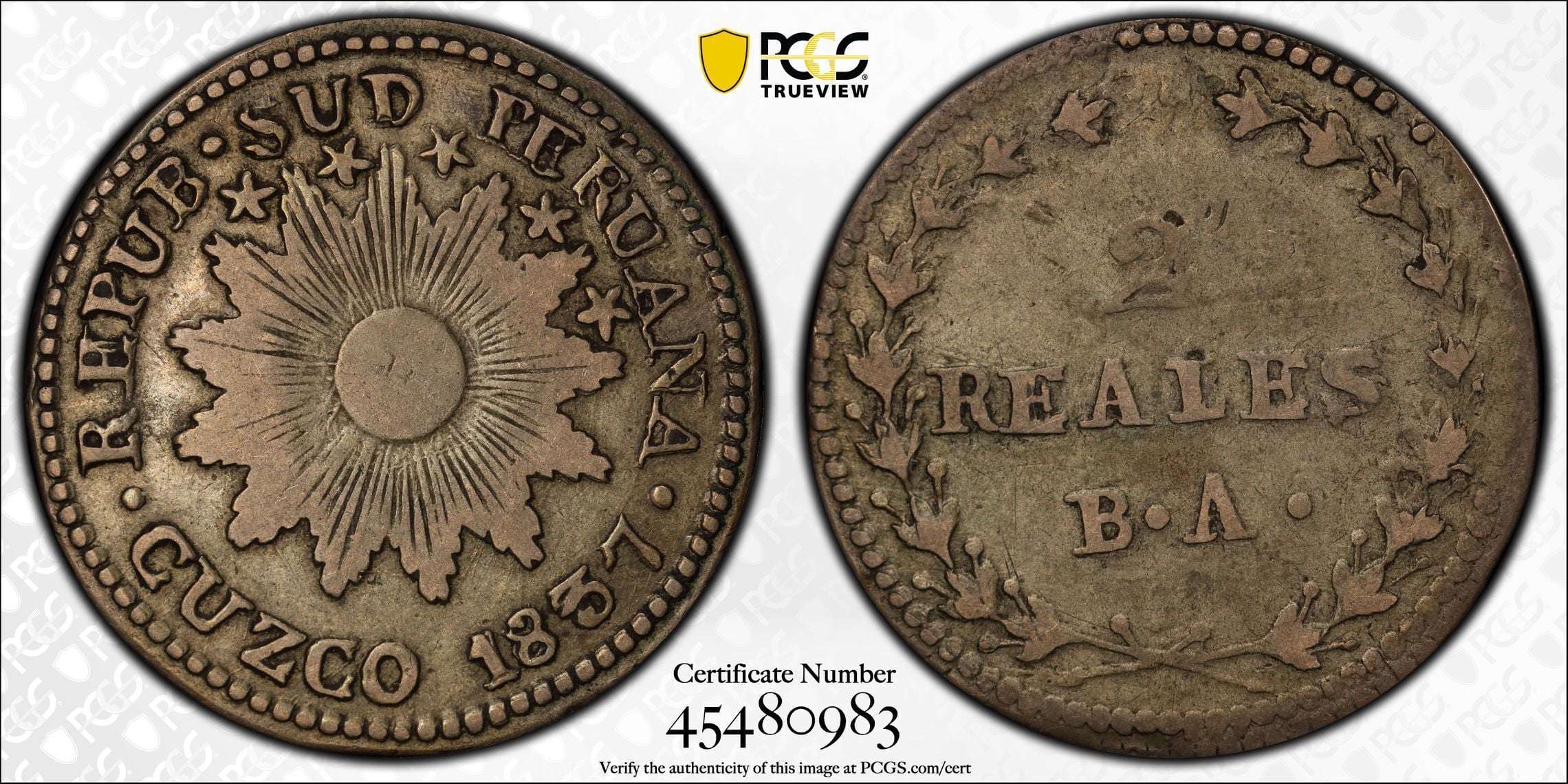
New pickup. South Peru “sun face” 2R. The sun is there, the face not so much. Looks to be a nice wholesome original with honest wear.
F15
Proof like off metal pattern (Pn47 in Krause) in CuNi, originally misattributed as a business strike at NGC, being corrected now as a mechanical error.
Now with an update, NGC’s XRF confirmed off-metal with a combined 75% CuNi but the incompetent NGC put the coin right back in the same MS65 holder. Just spoke with customer service. Amazing.
Latin American Collection
Very true. But if Canadian is anything like Mexican, prices have increased dramatically in the last 2 years. Largely due to the drastic decline of the USD.
Really good Canadian is going higher, but I suspect not as much or as quickly as Latin American coinages. I did not consider this 1858 specimen cent as really good Canadian, mostly because I agree it was over-graded.
http://www.victoriancent.com
I just picked this one up. It’s a coin-like medal, perhaps using a 8R die for the obverse (substituting a sun face for 8R).
Funny story. I tried to buy a NGC example many years ago at Heritage. I bid last minute in a weekly (?) sale just before bidding ended and thought I had won it. What I didn’t realize at the time was that it was only pre-bidding and there was a live component to the sale afterwards. I was outbid during that session.
Thankfully, this is a nicer example. But unfortunately I paid a lot more than that other example sold for (due to Galactus).
Rare proof striking of the Haiti gourde made at the Paris mint.
Latin American Collection
This will likely be a catch and release but I thought it was a neat find.
See the date for what makes it special.
The first two pics were the sellers, so a little tough to spot.
Great catch! I'd keep it
Unique in private hands - Record Proof 1955 Bahamas Five Dollar coin; interesting in that the currency versions are readily available and even packaged as "specimen sets" when put in with the other denominations. They however are neither specimen nor proof as opposed to this one, bought as part of a set..
1891 Dominican Republic 5 Francos. Much nicer in hand and will send to TPG for grading. I do not think this will come back with environmental damage or cleaning, if seen in hand, even though it looks similar to some that have:
Well, just Love coins, period.
A couple Guatemala newbies
1748 and 1761
I'm BACK!!! Used to be Billet7 on the old forum.
That's a nice 1761 2R.
Thanks! I was happy to get it.
I'm BACK!!! Used to be Billet7 on the old forum.
Solar eclipse silver medal: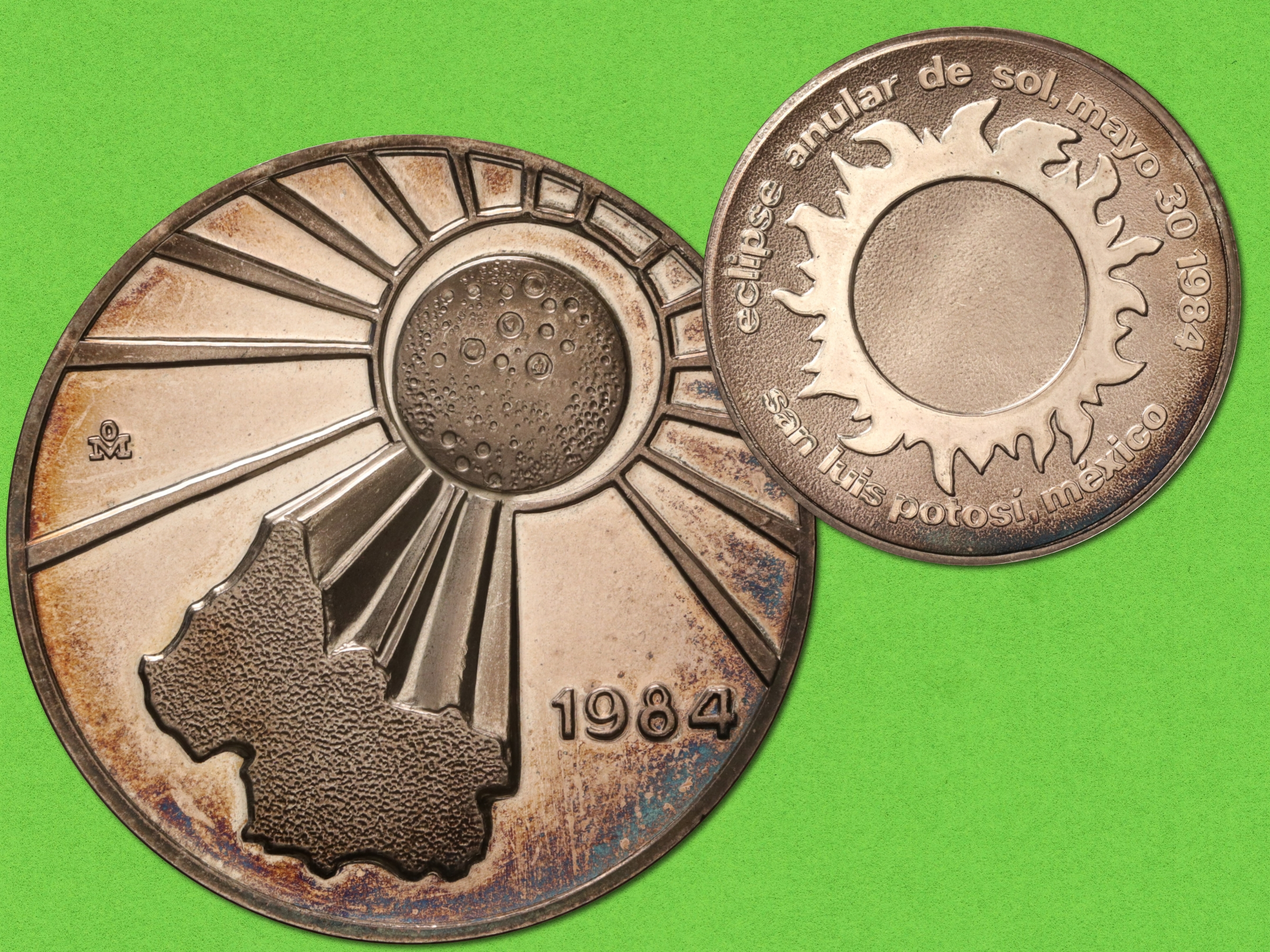
added this rare 1811 Popayan 8 Reales from MrEureka
Latin American Collection
@Boosibri
I can’t recall if I have seen one in hand before. Excellent addition
Experience the World through Numismatics...it's more than you can imagine.
Scarcity aside, I really the look on this one. Total package. What a terrific coin.
There are 7 dates, 1811,1812,1813,1814,1814/3,1816,1820. The bulk of the series is in the 1814. If done the census for the 1811,1812,1813’s with about 5-10 coins for each date and 75% being problem coins or higher if you include graded coins that shouldn’t be in holders.
There are too many 1814 and 1814/3’s to bother with a census (maybe 20 coins) but will do the others in time.
The series is about as rare as the Colombian or Santiago pillars.
Latin American Collection
Outstanding coin Boosibri!
I went on a small research project on the 1813 Popayán 8R somewhat recently as a modern forgery of that date popped up on Ebay and sold for a couple thousand. Although I believe 1813 is listed in Krause and Elizondo I could not find any non-overdate 1813s... which kind of made me wonder if the 1814/3 is really an 1814/3/2.
I’ll publish my census of all the dates in a little while. At present I have no non-over date 1813’s documented
Latin American Collection
From the latest sale of Kirk Menczer's Republican Reales Minors. NGC MS64 and the only one at either TPG.
Edited to add that this appears to be an overdate of 1832/52 .
I have shown this before but am trying to show better pictures of this coin which has original prooflike presentation in hand;
Well, just Love coins, period.
Here's one in NGC AU55 from the Kirk Menczer sale with an interesting planchet depression on the eagle that closely matches the cap from the other side. It is quite pronounced, and in hand, it reminds me of the shield on the eagle of a US Capped Bust quarter dollar.
Don't cry for me, Argentina...
United Provinces of the Rio de la Plata (Argentina) 8 Reales 1813, Potosi Mint
Silver, 38 mm, 26.80 gm
Obverse: Sun face and rays / PROVINCIAS DEL LA RIO DELA PLATA
Reverse: Wreath, two hands holding Liberty Cap / EN UNION Y LIBERTAD / 1813
For more about this coin please visit:
https://forums.collectors.com/discussion/1009175/pirates-from-argentina-attack-monterey-california-november-20-1818
The Mysterious Egyptian Magic Coin
Coins in Movies
Coins on Television
Two copper-nickel minor Mexican patterns from 1972.
The new CuNi 10c took over from the bronze Juarez 10c and was issued from 1974 to 1980. This was the last 10c coin under the "old Pesos" monetary system. A 10c in the New Pesos system started in 1992.
The new CuNi 20c took over from the beloved bronze Pyramid 20c and was issued from 1974 to 1983. There was a short-lived Olmec 20c that took over in 1983 and lasted 1.5 years before it too was discontinued in 1984. More on that coin next week. The Olmec was the last 20c under the "old Pesos" system. A new 20c in the New Pesos system was started in 1992.
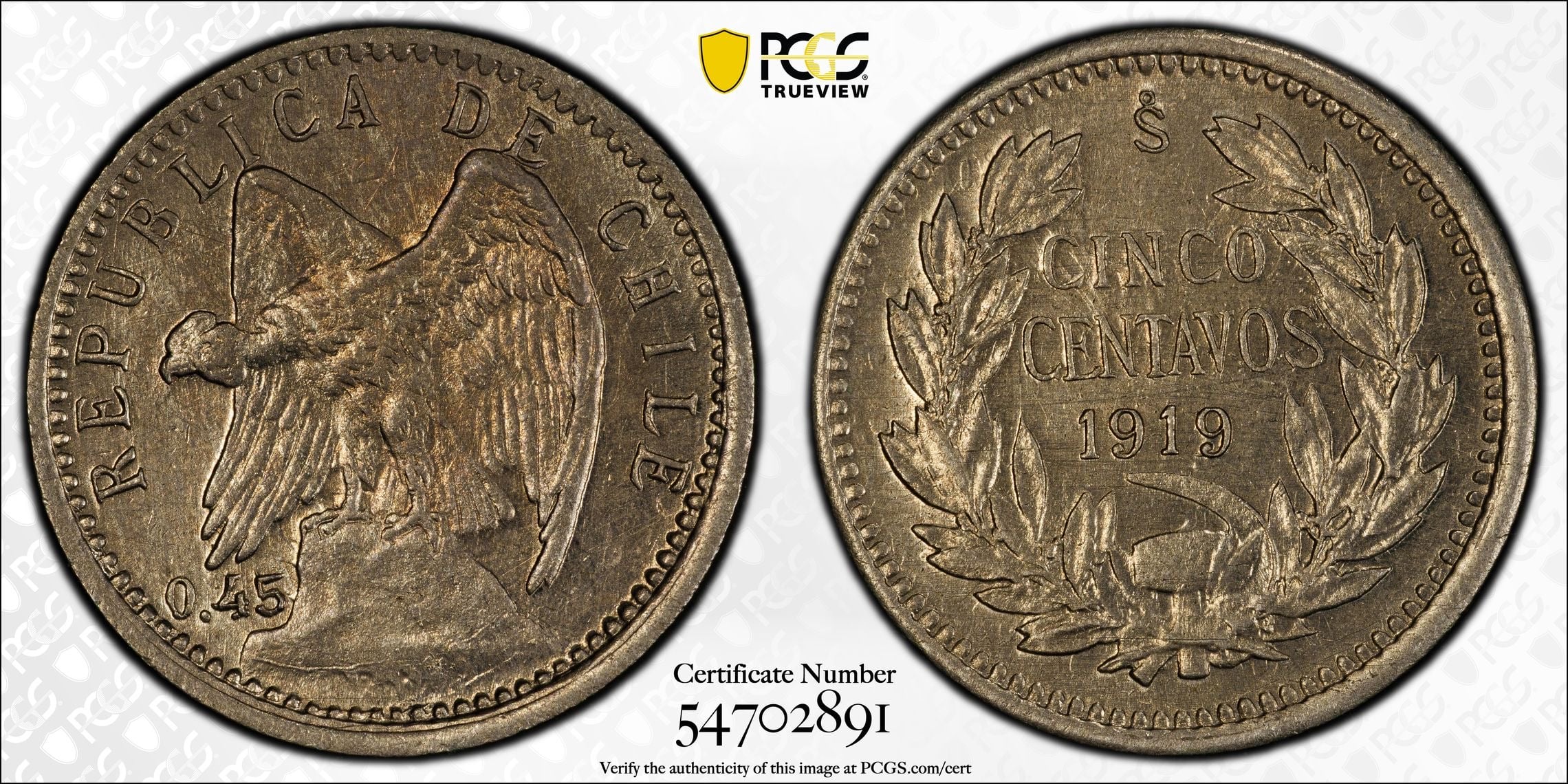
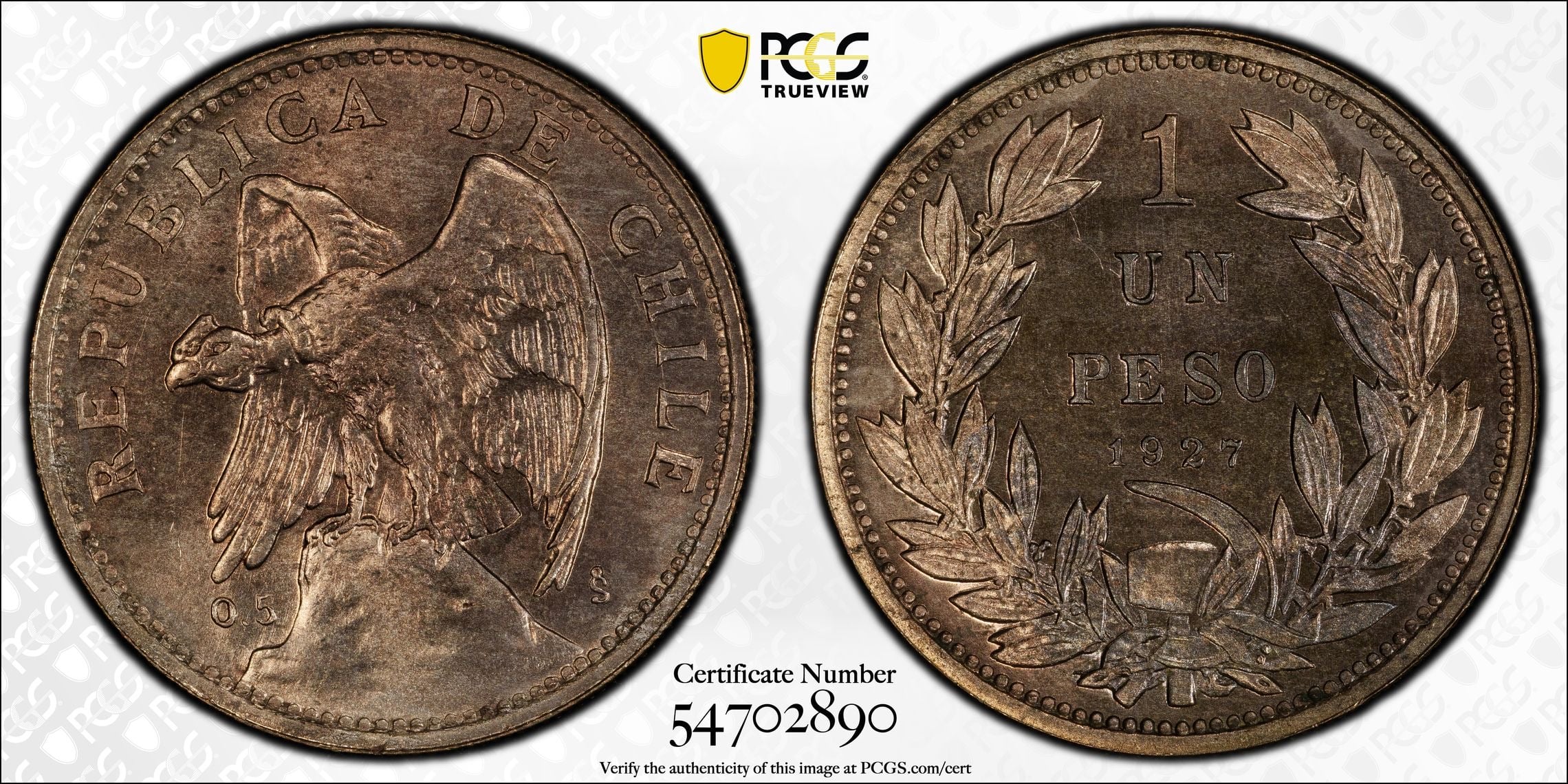
Two patterns which pcgs S got right after NGC flubbed it. Pictures are still meh
Latin American Collection
Is it eventing you were hoping for?
I'm BACK!!! Used to be Billet7 on the old forum.
Very scarce 1/5 de sol minted in Arequipa, Peru in 1885
Some background to this coin:
The bloody War Of The Pacific (1879-1883) had ended two years before with Peru's and Bolivia's defeat against Chile.
Chilean troops evacuated Lima shortly thereafter, and left president General Andres Avelino Caceres, who had led Peru to the few victories Peruvians could achieve against Chile, with the painful task of re-building the country.
Peru had been economically decimated during the war. Public coffers were almost empty before the war, and in dire condition after the war with the rich province of Tarapaca lost to Chile. The scarcity of coinage outside of Lima, the capital was great, and this led President Caceres to mandate the striking of coinage at the southern provincial city of Arequipa. 1/5 Sol (quintos), and probably also some 1/10 Sol (dineros o decimos) were minted.
This coinage was struck under very rudimentary conditions. The coins did not comply with the specification of the mint in Lima which ordered the fledgling mint closed and the dies confiscated.
Today, about 8 examples of the 1/5 Sol 1885 from Arequipa are now known, and only one example of the 1/10 dinero.
Further background to this coinage (in Spanish) from an issue of OMNI No 6 - 04/2013:
"El primer día de enero de 1885 el presidente Andrés A. Cáceres dio un decreto estableciendo una ceca en Arequipa para acuñar quintos y décimos de Sol. La ceca debía estar en manos de particulares y la autorización era por cinco años. La licitación la ganó Enrique Gamboa, autor de la única propuesta y el 26 de enero siguiente se firmó el contrato con gran expectativa de los comerciantes, las autoridades y el público en general, y poco después se estableció la fábrica en la calle Santa Teresa, posteriormente llamada Pichincha sin haberse podido ubicar la numeración27.
El 17 de abril, La Bolsa, periódico de Arequipa anuncia que al día siguiente se iniciaría la producción y que las pruebas que se han visto son de “buena factura28”.
Como en el caso del Cusco, el grabador de las monedas fue el artista italiano Félix Bragagnini, que para entonces vivía en Arequipa. El ensayador, según indica Yabar, debió ser el aprendiz de ensayador de la ceca limeña Alejandro A. Caballero porque las iniciales A.C. aparecen el los quintos y A.A.C. en la única pieza de Dinero que se conoce. Al lado del escudo que acompaña a la Libertad sentada, se lee el apellido “Gamboa”, práctica reñida con la ley como se vio en el caso de los primeros soles de 1864 con el apellido de Derteano, pero que al parecer no fue notada en su momento.
Los esfuerzos de Gamboa por continuar la amonedación se encontraron enfrentados a la decisión de Director de Hacienda quien el 18 de abril nombró una comisión para examinar la maquinaria, el volumen de producción, la ley, calidad de grabado y peso de cada moneda29.
La comisión detectó que las monedas no se ajustaban ni al diseño, ni a la ley metálica ni a las dimensiones especificadas, por lo que el Consejo de Ministros inmediatamente procedió a la clausura de la ceca y la confiscación de los cuños poniendo así fin a esta efímera Casa de moneda."
1765 2R Guatemala, a nice little win for the pillar collection, F15
I'm BACK!!! Used to be Billet7 on the old forum.
I'm happy with it. Thanks for sending a video prior to the auction.
The credit really goes to @Plus00Vltra he shot and sent it to me originally.
I'm BACK!!! Used to be Billet7 on the old forum.
That's a gorgeous Ecuadorian War of Independence issue.
I’ve always been very curious to see this in hand, seen it listed on eBay for a while, I have a very hard time believing it’s an AU, cleaned or otherwise. Can you provide any other shots by chance? I’m not trying to give you a hard time, I just see abundant wear, like VF level.
I'm BACK!!! Used to be Billet7 on the old forum.
>
Look at how sharp the edge/rim is to the SW of the date... you could shank someone with that. As with any poorly-struck piece (which, obviously, runs amok in Spanish Colonial/post-Colonial), sharp rim is the litmus test.
It's just a blunt strike, as most Guatemalan "cobs" are. Look through all the Reijgersdaal pieces...
This year has been a bit of an oddity for my. After seven and a half months, I just bought my first coin. And this one comes from a fellow member of the board! Thank you very much @FistFullOfDollars for this magnificent coin! This is a really rare issue.