An AI Experiment: Selecting a Buffalo Nickel Type Coin
 P0CKETCHANGE
Posts: 3,867 ✭✭✭✭✭
Most of the AI-related discussion here has focused on AI grading, but I wondered how AI would synthesize more general numismatic knowledge and whether it could aid a collector in building a collection. So, I asked an AI model if it could help me select a type coin example for the Buffalo Nickel series.
The entirety of the response is below. I’m curious what folks here think of the quality of the advice. What’s accurate, what isn’t? What’s missing? Was the guidance generally on track? Is that the “right” coin in the series to target for a type set? What follow up questions should I ask?
Here is the response:
Buffalo Nickel Type Set Recommendation
The Selection: 1937 Philadelphia, PCGS/NGC MS-66, Target Price $150–$225
Here’s my reasoning and the full framework for selecting the ideal Buffalo Nickel type coin.
Why 1937 Philadelphia?
The 1937-P is the optimal type candidate for several reasons. It’s the final year of the series, meaning the Philadelphia Mint had fully refined its production techniques after 25 years of striking this design. Die preparation, metal flow, and strike quality reached their peak. The mintage of roughly 79 million ensures a deep survivor population in high grades, which keeps prices rational and gives you the luxury of being highly selective — exactly what you want in a type set.
Some collectors instinctively reach for a 1913 Type I or Type II as the “classic” choice. The problem is that early-date Buffalos in true gem grades command steep premiums driven by date-rarity, not type quality. You’d be paying for scarcity rather than for the best-struck, most visually appealing representative of James Earle Fraser’s design. That’s a date collection mentality, not a type collection mentality.
The 1936-P is also a strong candidate with similar characteristics, and I wouldn’t object to one if the coin itself is superior. But 1937 edges it out slightly on consistency of strike quality in my experience handling both.
Why MS-66?
At MS-66, you’re solidly in gem territory where the coin will have strong luster, a sharp strike, and only minor, non-distracting contact marks. The population at MS-66 is healthy enough — typically several thousand combined across PCGS and NGC — that you can afford to be choosy and wait for the right coin. MS-67 examples exist but jump to $400–$800+, and the population thins dramatically, which limits your ability to cherry-pick for the specific visual qualities that matter. MS-65 saves money but sacrifices the eye appeal threshold that makes a type set sing.
At $150–$225 for a PCGS or NGC MS-66, you’re well under budget. That’s intentional. The remaining budget is better deployed elsewhere in the type set, and there’s no reason to overpay for a common type coin. If you find a truly extraordinary example with a CAC sticker (which I’ll discuss below), $250–$300 would still be very reasonable.
How to Cherry-Pick the Best MS-66
This is where the real expertise matters. Not all MS-66 Buffalo Nickels are created equal, and the difference between a pedestrian MS-66 and an exceptional one is dramatic. Here’s how I’d rank the selection criteria:
1. Strike Sharpness — The Single Most Important Factor
Fraser’s design is notoriously difficult to strike fully. The highest point on the obverse is the braid and hair detail above the Native American’s forehead and along the braid ribbon. On the reverse, the key area is the fur detail on the bison’s head, shoulder, and along the spine/hip. A fully struck coin will show crisp, individually separated hair strands in the braid and distinct fur texture on the bison’s shoulder. Many Buffalo Nickels, even at MS-66, show weakness in these areas because the design’s relief demanded enormous striking pressure. Reject any coin where the bison’s shoulder fur blends into a flat, mushy mass — that’s a weakly struck coin that happened to survive without bag marks.
2. Luster Quality and Cartwheel
The ideal coin will display full, unbroken cartwheel luster when rotated under a single point light source. You want thick, “creamy” luster rather than thin or grainy texture. Buffalo Nickels were struck in 75% copper / 25% nickel, and the best examples have a satiny, almost liquid appearance. Be wary of coins with dull, lifeless surfaces even if technically graded MS-66 — luster is the life of an uncirculated coin.
3. Surface Quality and Mark Placement
At MS-66, minor contact marks are permissible, but their location matters enormously. The obverse field in front of the face is the “prime real estate” — any noticeable tick or mark here is distracting and should be a disqualifier when you have the population depth to be choosy. Similarly, the bison’s flank on the reverse is a large, open field where marks are conspicuous. The best coins will have their few allowable marks hidden in the hair detail or along the rim where they’re visually absorbed.
4. Eye Appeal and Toning
Buffalo Nickels can develop attractive light golden or lavender toning that enhances their visual appeal. An original, untampered coin with subtle peripheral toning is desirable. Avoid coins that appear artificially bright or “white” in a way that looks chemically stripped — the surfaces should look natural and undisturbed. Conversely, dark or splotchy toning is a negative.
5. CAC Verification
A green CAC (Certified Acceptance Corporation) sticker is a meaningful positive signal on this coin. It confirms that an independent expert evaluated the coin as solid or better for the grade. Within the MS-66 population, a CAC-approved coin has been vetted for above-average eye appeal and surfaces. I’d pay a 15–25% premium for a CAC sticker on this coin — it simplifies the cherry-picking process and adds liquidity if you ever sell.
6. Die State
Early die state coins will have the sharpest details and strongest luster. Later die state examples may show die polish lines, slight mushiness from die wear, or minor flow lines. This is subtle but visible under magnification and contributes to overall visual crispness.
Summary
My recommendation is a 1937 Philadelphia Buffalo Nickel, graded MS-66 by PCGS or NGC, ideally with a CAC sticker, in the $150–$250 range. This gives you a coin from the strongest production year of the series, at a grade level high enough to showcase Fraser’s iconic design at its best, with enough population depth to be ruthlessly selective on strike, luster, and surface quality. The coin will be a fully struck, satiny gem with undisturbed original surfaces — exactly the kind of piece that anchors a serious type collection.
Superb collections are built more by omission than by addition.
Comments
An ultra-common Buffalo Nickel that comes nice and is in a price range that makes slabbing and stickering a waste of money.
So AI is saying things like "in my experience handling both" and "I’d pay...". Does it think it's human?
Collector of Liberty Seated Half Dimes, including die pairs and die states
‘37 is obviously wrong as the “final year”. Finding a gorgeous ‘38D is fairly easy and probably a better choice. A ‘13 May be more expensive, but can also be found with beautiful toning and has the pizzaz of the first year of issue as well as age.
AI has a ways to go, but the selection criteria are impressive.
Yeah, I just recently paid $118 for a really nice, ms66 38d w/cac for my type set.
Newbie collector of type and circulated Peace dollars, photographer of places and animals, player of instruments and builder of amplifiers, espresso industry professional, and a person distracted by shiny objects.
CACG Registry
MyCollect Registry
A load of crock from some dealer have a s**t load of BU '37 dated rolls for sale is what I'm seeing.
The "original" design is type 1. An AI who tells you otherwise is, well, just full of it.
Finding a gorgeous ‘38D is fairly easy and probably a better choice. A ‘13 May be more expensive
I concur. My type set of Indian Head Nickels is comprised of two coins, a 1913 type 1 and a 1938-D, which is, of course, type 2. They are both nice uncs, the pair worth about $200, maybe a little north of. At least two coins are needed for an Indian head nickel type set.
Examples of IHN varieties and errors grouped together makes for an interesting collection. Types of errors and varieties, how's that? How useful is AI going to be to the collector of IHN varieties and errors?
Going back to the 2-coin idea for IHN type collection: If I couldn't afford to buy uncirculated, I would seek out well-struck with full horn pieces that may have circulated for a short time but have lots of luster. Spend $20 for a sharp AU 1913 type 1? $30 for an AU 1913 type 2?
Impressive for a machine with no real world experience.
“Land of the free because of the brave”
“Saved by grace alone, through faith alone, in Christ alone”
In Deo solo confidimus
ΙΧΘΥΣ
ΙϹ ΧϹ ΝΙΚΑ (ΙΗΣΟΥΣ ΧΡΙΣΤΟΣ ΝΙΚΑ)
Member since 2026
Successful BST transactions with: Ted 1, JWP, bigjpst, Vetter, nickelsciolist, ajaan, USMarine6, ad4400, grote15, coinbuf, Gothat3rs, No Headlights, PROMETHIUS88, Harlequin, Coin Finder, Coins3675, CKcollectibles2
Fascinating
Micah Langford - https://www.oldglorycoinsandcurrency.com/
I see that AI mentioned PCGS and NGC but failed to mention CACG or CAC stickers.
Worry is the interest you pay on a debt you may not owe.
"Paper money eventually returns to its intrinsic value---zero."----Voltaire
"Everything you say should be true, but not everything true should be said."----Voltaire
Pretty amazing and exciting. And scary at the same time. The implications of AI are belatedly dawning on me.
I’ll admit I hadn’t considered a 1937-P as a type coin candidate, so it was an interesting recommendation over the ubiquitous 1938-D. The Philly issue has a fraction of the certified population at both PCGS and CAC. There’s a slight premium for the 37-P in 67 CAC, which may be worth the trade-off for the increase in (relative) rarity.
Superb collections are built more by omission than by addition.
The movie, The Wizard of Oz (1939), is proving itself to be prophetic. We're off to see the wizard, the wonderful wizard of OzAI.
Go for a circulated key or semi key.
Proud follower of Christ! I love the USA! Land of the Bright and Beautiful! 🇺🇸🇺🇸🇺🇸🇺🇸🇺🇸
I like the idea, but I have a classic approach to my type set (generally maximizing the grade for the expenditure). A circulated coin would look very out of place, and a key or semi-key would pull too much budget away from other coins.
Superb collections are built more by omission than by addition.
The take-away for Red on this in debt (post edit: depth) conversation is everyone who self-labels themselves a collector really isn't much of one without owning a sparkling, well-struck 1938 Indian head (not Buffalo head) nickel.
Red isn't sure that is accurate or not yet does appreciate the conversation leading up to that conclusion.
As a human with a non AI brain, I'd say a 1938-D in MS-66 would be a better, cheaper answer. I bought this one for $50 for a few years ago.
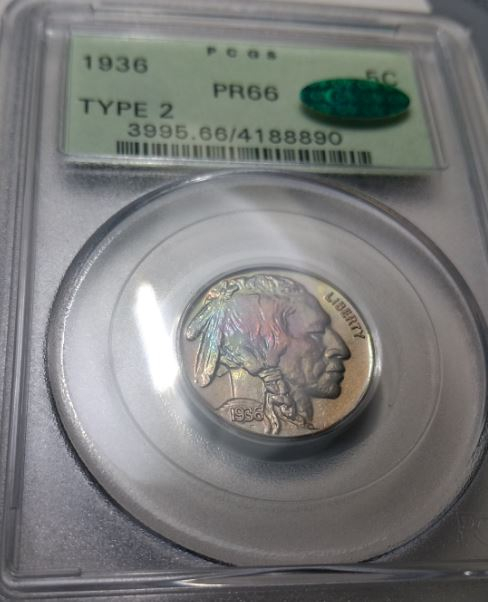
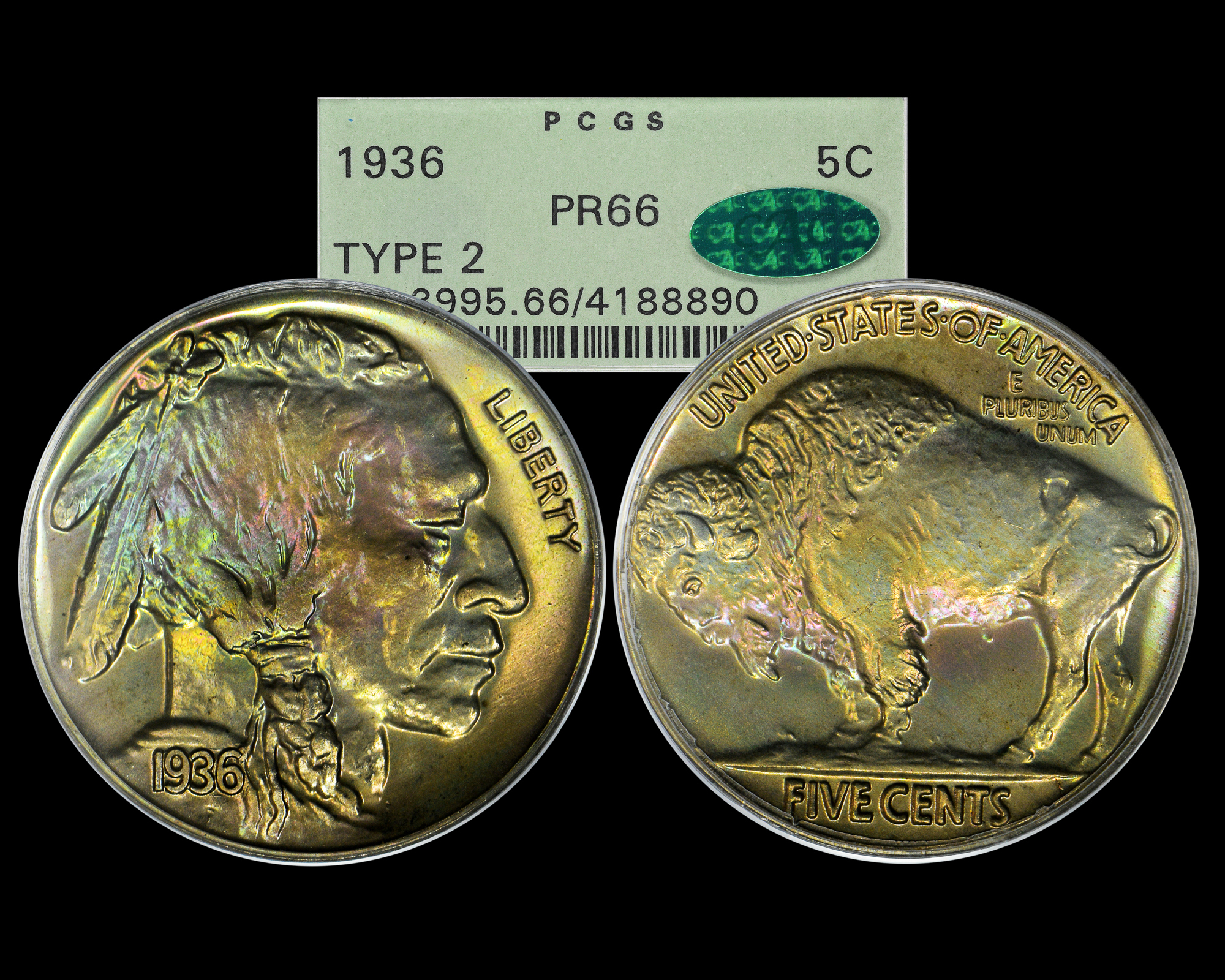
As for showing off the design, I would go with the 1936 Satin Proof. This one is a PR-66, CAC.
If you want is shiny, the 1937 Brilliant Proof is the way to go.
And if you want a IHN OMM that is especially interesting to talk about beyond simply being the last year of issue...
My '38-D is a D/S FS-513 NGC graded MS 65+. They undergraded it. It is absolutely a superb gem,imo.
Years ago, David Hall, founder of PCGS, was saying that every collector of US coins should acquire at least one uncirculated 1938-D nickel.
I replied to the AI and attached the TrueView below, with the simple question "what do you think of this one?". The AI's reply follows the photo. It's graded MS65, but I did not include that information.
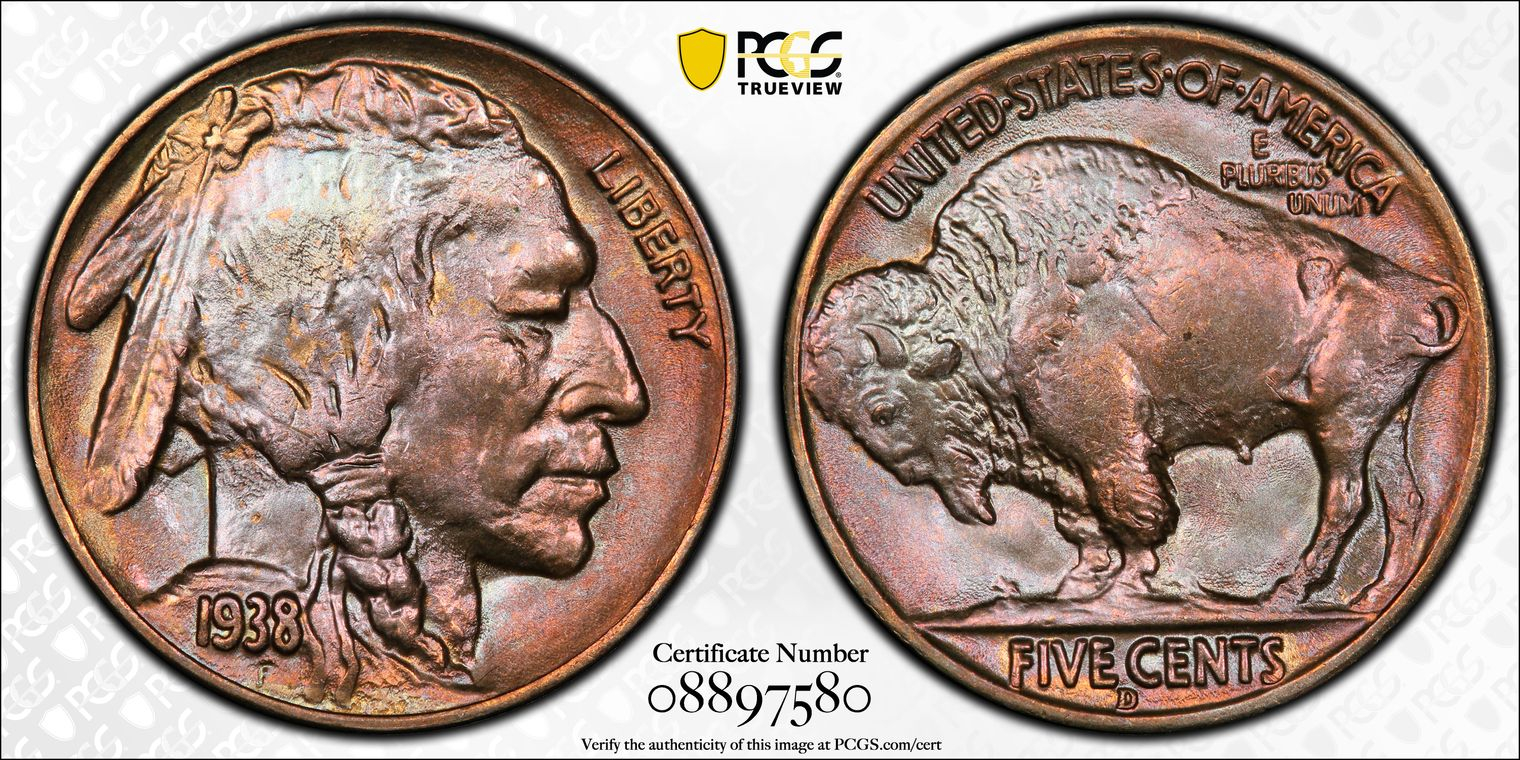
This is a really interesting coin to evaluate. Let me break down what I'm seeing.
The Basics
This is a 1938-D Buffalo Nickel, graded by PCGS (certificate 08897580), with TrueView imaging. The 1938-D is the final issue of the entire Buffalo Nickel series — the last year and the last mint. It has a relatively low mintage of about 7.02 million, which makes it the scarcest regular-issue Buffalo Nickel of the late 1930s, though far from a true rarity in absolute terms.
What I Like
The toning is spectacular. This coin has deep, multicolored toning — rose, violet, blue, and golden hues across both sides. On a nickel composition coin, this kind of rich, layered color is unusual and eye-catching. It appears natural and stable, likely the result of long-term storage in a particular environment (possibly a paper roll or album). This is the kind of toning that divides collectors — some will pay a significant premium for it, while others prefer brilliant, untoned surfaces. For a type set focused on visual impact, though, this coin has tremendous shelf appeal.
The strike looks solid. From the TrueView image, the braid detail on the obverse appears well-defined, and the bison's shoulder and head fur on the reverse show good separation. It's not the absolute sharpest strike I've ever seen on a late-date Buffalo, but it's well above average.
Surface quality appears strong. I don't see any immediately obvious distracting contact marks in the prime areas — the field in front of the face or the bison's flank. The toning may be masking some minor marks, which is worth noting.
My Concerns
The toning is doing a lot of work here. Heavy toning like this can obscure surface issues — hairlines, minor marks, or even signs of past cleaning that have since retoned. I'd want to know the grade on this coin before rendering a final opinion. If this is graded MS-65 or MS-66, the toning may be elevating a coin that would otherwise be visually ordinary in brilliant condition. If it's MS-67, that's a different story.
1938-D vs. 1937-P for the type set. The 1938-D is a perfectly legitimate type coin, but the lower mintage means you're paying a modest date premium over a 1937-P at equivalent grades. The population in upper gem grades is also thinner, which limits your cherry-picking ability. For a pure type set, that's a slight disadvantage — you're paying more and choosing from fewer options. That said, there's something appealing about owning the very last Buffalo Nickel ever struck for circulation.
I can't determine the grade from the image alone. The PCGS cert number is right there — 08897580 — and I'd strongly recommend verifying it on PCGS's website to confirm the grade, population data, and whether any details like a plus (+) grade or CAC sticker are associated with it. Do you have the grade?
Superb collections are built more by omission than by addition.
I can buy off on the idea of the 37-P being an affordable, technically sound and readily available option.
One observation is how 66 was selected as a target grade in OP (which I again can buy into), but other responses came up with grades of 63-64 when the criteria of "high grade" was added.
For me personally, I wouldn't be dissuaded by statement "that early-date Buffalos in true gem grades command steep premiums driven by date-rarity", You're not going to get a 66, but I find that the 1915, 1916 and 1919 can be really sharp looking in 64.
Granted, the OP's question was not 'what should I **buy for **my set' but rather give an ideal hypothetical. The answer to 'what coin is right for my set' I is still a very human decision:
Does this specific coin match well with the other specific coins in my set.
Do I have some sort of theme of the set and does it fit.
Do I simply prefer coin A over coin B
What is my threshold of "I can pay X$ more for a different grade or date".
Buffalo Nickel Digital Album
Toned Buffalo Date SetDigital Album
https://pcgs.com/setregistry/mysetregistry/album/411385 7070 Registry<
1938-D vs. 1937-P for the type set. The 1938-D is a perfectly legitimate type coin, but the lower mintage means you're paying a modest date premium over a 1937-P at equivalent grades. The population in upper gem grades is also thinner, which limits your cherry-picking ability. For a pure type set, that's a slight disadvantage — you're paying more and choosing from fewer options. That said, there's something appealing about owning the very last Buffalo Nickel ever struck for circulation.
Oh yeah. That modest premium is a deal killer for sure says the wizard of AI with a ****load of '37s that haven't been moving.
"I asked her about a CAC or CACG coin. She doesn't want to pay the premium."
Well, it looks like @jmlanzaf has nailed it...AI is actually our own @Cougar1978.
In honor of the memory of Cpl. Michael E. Thompson
Word on the street is that Cougs is addicted to CACG now.

Superb collections are built more by omission than by addition.
If I am only going to own one example of a type, I always try to find a nice one in a higher grade, better date, and eye appeal. I don't really care what AI says (seems like "group think" to me.
I own two Buffalo Nickels - both proof. Here is the one I will keep. Imaging is tough on this example, it is not as yellow as the photo shows, more purple and green is seen. I hope to get a video of the coin rotated under light. I can look at this coin for a long time before I put it down.
“In matters of style, swim with the current; in matters of principle, stand like a rock." - Thomas Jefferson
My digital cameo album 1950-64 Cameos - take a look!
@Cameonut that is a superb coin...wow
Superb collections are built more by omission than by addition.
1937 wouldn't be anywhere near my first recommendation for a type coin. Ignoring the 1913 Type I as a single year type, I'd recommend a 1914, 15, or 16 in 64-66, whichever made the most sense financially. These always have sharper detail than the later dates, as the hubs were fresh.
Keeper of the VAM Catalog • Professional Coin Imaging • Prime Number Set • World Coins in Early America • British Trade Dollars • Variety Attribution
It'll take more than that gentle throw-down to take down a world renown dealer and market-maker.
I agree with this, 1915 in particular.
For the most detailed and aesthetically impressive Buffalo nickel, pursue a 1913 Type 1 Philadelphia piece in superb Gem Mint State with a full horn and razor-sharp strike.
My '13 type 1 is an NGC MS 62. It's a great looking piece that cost me less than $50.