Home U.S. Coin Forum

NGC VS PCGS

I know these are the two massive grading companies, but whats the deal with them? Do they grade in different ways, why is PCGS like the top dog in grading, is it better to buy graded coins from one versus the other? Somebody explain 🙏

«1

Comments

  • MsMorrisineMsMorrisine Posts: 38,455 ✭✭✭✭✭

    it is perceived that pcgs is a more conservative grader - ymmv

    the is also the newcomer cacg - also said to be a conservative grader

    Current maintainer of Stone's Master List of Favorite Websites // My BST transactions
  • WQuarterFreddieWQuarterFreddie Posts: 3,081 ✭✭✭✭✭

    In my experience, a PCGS graded W quarter sells at a significant premium to an NGC graded quarter. Exact same grade.

    Check out completed Ebay auctions which documents this fact.

    Don't know why.....

  • interpolsinterpols Posts: 51 ✭✭✭

    @MsMorrisine said:
    it is perceived that pcgs is a more conservative grader - ymmv

    the is also the newcomer cacg - also said to be a conservative grader

    cac is just the sticker right

  • skier07skier07 Posts: 4,665 ✭✭✭✭✭

    @MsMorrisine said:
    it is perceived that pcgs is a more conservative grader - ymmv

    the is also the newcomer cacg - also said to be a conservative grader

    +1

    But keep in mind this is a PCGS forum.

  • interpolsinterpols Posts: 51 ✭✭✭

    @skier07 said:

    @MsMorrisine said:
    it is perceived that pcgs is a more conservative grader - ymmv

    the is also the newcomer cacg - also said to be a conservative grader

    +1

    But keep in mind this is a PCGS forum.

    just wanted to know what all the hubub was about

  • GoobGoob Posts: 266 ✭✭✭✭

    @interpols said:

    @MsMorrisine said:
    it is perceived that pcgs is a more conservative grader - ymmv

    the is also the newcomer cacg - also said to be a conservative grader

    cac is just the sticker right

    They started slabbing coins in 2023

    "Another day, another Collectors Universe forum scrolling session."
    - Someone, probably

  • interpolsinterpols Posts: 51 ✭✭✭

    @Goob said:

    @interpols said:

    @MsMorrisine said:
    it is perceived that pcgs is a more conservative grader - ymmv

    the is also the newcomer cacg - also said to be a conservative grader

    cac is just the sticker right

    They started slabbing coins in 2023

    pcgs slab + cac sticker tuff

  • GoobGoob Posts: 266 ✭✭✭✭

    @interpols said:

    @Goob said:

    @interpols said:

    @MsMorrisine said:
    it is perceived that pcgs is a more conservative grader - ymmv

    the is also the newcomer cacg - also said to be a conservative grader

    cac is just the sticker right

    They started slabbing coins in 2023

    pcgs slab + cac sticker tuff

    frfr
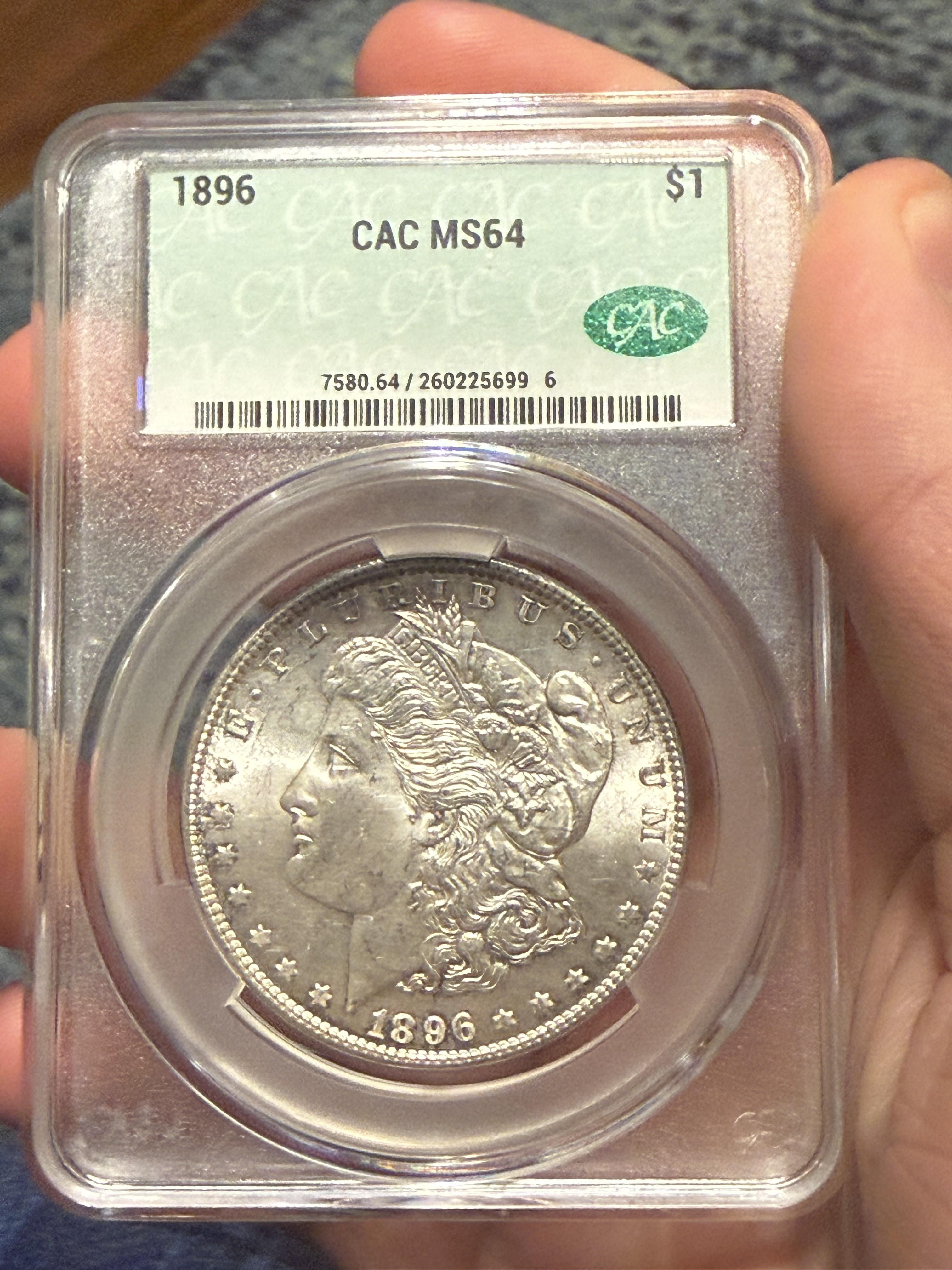
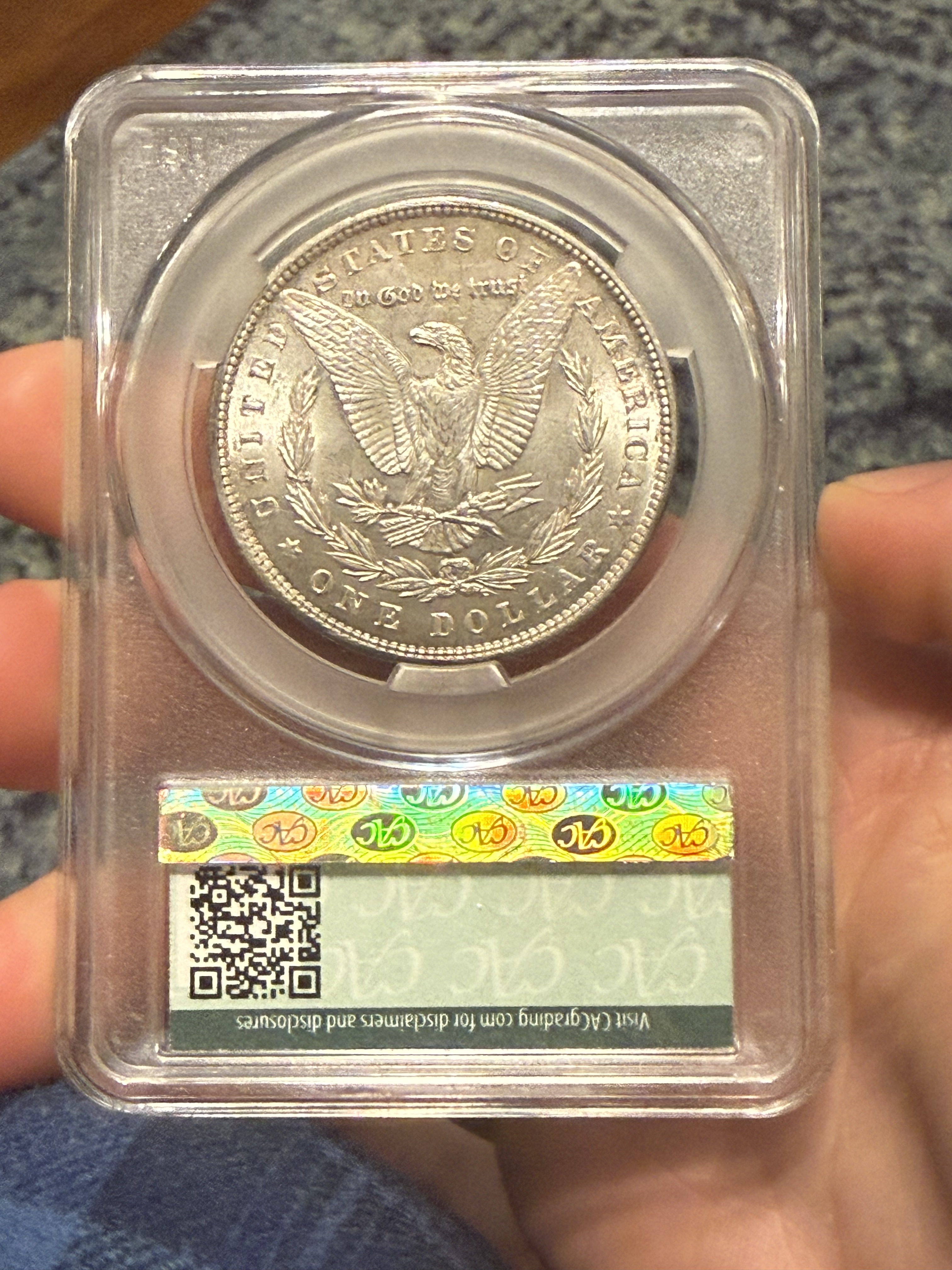
    also this is what a CAC slab looks like

    "Another day, another Collectors Universe forum scrolling session."
    - Someone, probably

  • CryptoCrypto Posts: 4,088 ✭✭✭✭✭

    Coin grading is subjective and the plus and minus are weighted slightly differently between the two with the biggest differences being mint surfaces preservation “luster” mandate between xf45 and AU58. There is also difference between the weighting of detriments.

    CACG (and the market standard) is closer aligned to PCGS’s although they add more gravity to detriments as a rule of thumb.

  • Cougar1978Cougar1978 Posts: 9,504 ✭✭✭✭✭
    edited January 27, 2026 9:17PM

    TPG politics can be very opinionated. Am a PCGS submitter but have Anacs, ICG, NGC too as different deals walkup to my table. And have many CACG pick up here and there.

    Investor
  • InlanderInlander Posts: 142 ✭✭✭✭

    And keep in mind that in some cases, coins have been graded differently over time. It's good to know different TPG slab versions and when they were used.

    CAC | PCGS | NGC

  • NJCoinNJCoin Posts: 3,763 ✭✭✭✭✭

    @interpols said:

    @skier07 said:

    @MsMorrisine said:
    it is perceived that pcgs is a more conservative grader - ymmv

    the is also the newcomer cacg - also said to be a conservative grader

    +1

    But keep in mind this is a PCGS forum.

    just wanted to know what all the hubub was about

    Nothing. Other than market perception.

  • ProofCollectionProofCollection Posts: 7,587 ✭✭✭✭✭

    Pretty much everyone here has it wrong.
    Every company has their own standard thus making statements like one company being looser or more conservative meaningless. That is because these statements are never made with respect to a different grading standard such as ANA. Which, you could compare which company is closer to ANA standards, but that's generally not what the expressed opinions are saying. I think what some commenters end up meaning to say is that some companies tend to give out lower numbers than other companies, but then to translate that to one being better or more desirable is opinion based on a preference than adherence to a particular standard.

    After looking at 1000's of coins you will learn how to translate one company's grades to another company and what conditions one company will tolerate and another company will reject.

  • BUFFNIXXBUFFNIXX Posts: 2,747 ✭✭✭✭✭

    As far as buffalo nickels I have seen coins graded as VF20 or higher that were no better than a fine 12.

    Collector of Buffalo Nickels and other 20th century United States Coinage
    a.k.a "The BUFFINATOR"
  • BillJonesBillJones Posts: 35,556 ✭✭✭✭✭

    @WQuarterFreddie said:
    In my experience, a PCGS graded W quarter sells at a significant premium to an NGC graded quarter. Exact same grade.

    Check out completed Ebay auctions which documents this fact.

    Don't know why.....

    PCGS has long been the leader in the modern coin grading market. The perception is that their grading is more conservative, and therefore PCGS products sell for higher prices.

    Retired dealer and avid collector of U.S. type coins, 19th century presidential campaign medalets and selected medals. In recent years I have been working on a set of British coins - at least one coin from each king or queen who issued pieces that are collectible. I am also collecting at least one coin for each Roman emperor from Julius Caesar to ... ?
  • BillJonesBillJones Posts: 35,556 ✭✭✭✭✭

    @ProofCollection said:
    Pretty much everyone here has it wrong.
    Every company has their own standard thus making statements like one company being looser or more conservative meaningless. That is because these statements are never made with respect to a different grading standard such as ANA. Which, you could compare which company is closer to ANA standards, but that's generally not what the expressed opinions are saying. I think what some commenters end up meaning to say is that some companies tend to give out lower numbers than other companies, but then to translate that to one being better or more desirable is opinion based on a preference than adherence to a particular standard.

    After looking at 1000's of coins you will learn how to translate one company's grades to another company and what conditions one company will tolerate and another company will reject.

    And then you get into the issue of inconsistency in applying those standards. That’s why the so-called “Blue Sheet prices” which are sight unseen bids are lower than Grey Sheet prices, which are sight seen bids.

    Retired dealer and avid collector of U.S. type coins, 19th century presidential campaign medalets and selected medals. In recent years I have been working on a set of British coins - at least one coin from each king or queen who issued pieces that are collectible. I am also collecting at least one coin for each Roman emperor from Julius Caesar to ... ?
  • CryptoCrypto Posts: 4,088 ✭✭✭✭✭

    @NJCoin said:

    @interpols said:

    @skier07 said:

    @MsMorrisine said:
    it is perceived that pcgs is a more conservative grader - ymmv

    the is also the newcomer cacg - also said to be a conservative grader

    +1

    But keep in mind this is a PCGS forum.

    just wanted to know what all the hubub was about

    Nothing. Other than market perception.

    That’s not true, they have different standards. There is nuance to why the market values them differently. I’d agree they’re more similar than different but pick a series esp 19th cen ones and buy a treasure trove of AU coins in NGC at market rates and then report back. Sure you can find nice ones at any grade but the number of market XF coins in NGC AU holders is startling (or low AU in high AU).

    IMO NGC clearly employee more of a traditional details Sheldon scale with detail preservation where PCGS factor in or weight mint surfaces heavier into their point totaling. Sure there is overlap at the same grade for millions of grading events and somethings get graded tougher at NGC but to say their standards are a figment of the market is disingenuous

  • CatbertCatbert Posts: 8,115 ✭✭✭✭✭

    Thanks, Mark. I got that inverted, didn't I? :D

    Seated Half Society member #38

    "She comes out of the sun in a silk dress,
    running like a water color in the rain...."
  • MFeldMFeld Posts: 16,160 ✭✭✭✭✭

    @Catbert said:
    Thanks, Mark. I got that inverted, didn't I? :D

    Not according to many collectors, these days.😀

    Mark Feld* of Heritage Auctions*Unless otherwise noted, my posts here represent my personal opinions.

  • BoosibriBoosibri Posts: 12,613 ✭✭✭✭✭

    @MsMorrisine said:
    it is perceived that pcgs is a more conservative grader - ymmv

    the is also the newcomer cacg - also said to be a conservative grader

    Waldo?

  • BoosibriBoosibri Posts: 12,613 ✭✭✭✭✭

    @PerryHall said:
    NGC also has a coin forum. Now that you know what the PCGS Kool-Aid drinkers think, I suggest that you ask the same question over there and see what kind of responses that you get. ;)

    You just may need to wait 3 weeks for someone to respond.

  • JJMJJM Posts: 8,112 ✭✭✭✭✭

    Both are safe bets IMO

    👍BST's erickso1,cone10,MICHAELDIXON,TennesseeDave,p8nt,jmdm1194,RWW,robkool,Ahrensdad,Timbuk3,Downtown1974,bigjpst,mustanggt,Yorkshireman,idratherbgardening,SurfinxHI,derryb,masscrew,Walkerguy21D,MJ1927,sniocsu,Coll3tor,doubleeagle07,luciobar1980,PerryHall,SNMAM,mbcoin,liefgold,keyman64,maprince230,TorinoCobra71,RB1026,Weiss,LukeMarshall,Wingsrule,Silveryfire, pointfivezero,IKE1964,AL410, Tdec1000, AnkurJ,guitarwes,Type2,Bp777,jfoot113,JWP,mattniss,dantheman984,jclovescoins,Collectorcoins,Weather11am,Namvet69,kansasman,Bruce7789,ADG,Larrob37,Waverly, justindan
  • ProofCollectionProofCollection Posts: 7,587 ✭✭✭✭✭

    @jmlanzaf said:

    @ProofCollection said:
    Pretty much everyone here has it wrong.
    Every company has their own standard thus making statements like one company being looser or more conservative meaningless. That is because these statements are never made with respect to a different grading standard such as ANA. Which, you could compare which company is closer to ANA standards, but that's generally not what the expressed opinions are saying. I think what some commenters end up meaning to say is that some companies tend to give out lower numbers than other companies, but then to translate that to one being better or more desirable is opinion based on a preference than adherence to a particular standard.

    After looking at 1000's of coins you will learn how to translate one company's grades to another company and what conditions one company will tolerate and another company will reject.

    There's a logical fallacy floating through there. I don't need a 3rd set of standards to know who is looser. I need only compare Company A to Company B. If Company A calls it XF details and Company B calls it XF, Company B is looser than Company A. If A calls it XF40 and B calls it XF45, B is looser. This is true regardless of what the ANA would call it.

    I'm taller than you, even if there is no official standard of "tall". You're confusing the comparative with an absolute. Both A and B might both be "tight" relative to ANA, but that doesn't mean B isn't "looser" than A.

    No, there is no fallacy.
    I agree that when it comes to one company designating details and another not, that is a clear example of looser vs tighter standards.
    You are on the right track but where you go wrong is that to be comparative you have to define a standard to compare to, such as the ANA standard. It's like asking which car is faster, a Dodge Demon 170 or a Porsche 911 GT3 RS? It depends on what standard you define. Are you talking 1/4 mile or a race course? You have to define what you are measuring to. In coin grading, handing out lower numbers does not make one company tighter than another.

    So when it comes to one company (A) issuing a 40 and another (B) a 45, all you can say is that one company issued a lower number. That doesn't make the XF40 grade tighter. For example, if the grading scale had all 70 grades and the coin per the ANA standard was an XF44, then the company calling it an XF45 is tighter. If all you compare is A vs B then all you know is that one was 40 and the other was 45. When you compare A & B to the ANA standard, now you can actually say which one was closest to the ANA standard. You have to say what True North is.

  • jmlanzafjmlanzaf Posts: 40,047 ✭✭✭✭✭
    edited January 28, 2026 11:13PM

    @ProofCollection said:

    @jmlanzaf said:

    @ProofCollection said:
    Pretty much everyone here has it wrong.
    Every company has their own standard thus making statements like one company being looser or more conservative meaningless. That is because these statements are never made with respect to a different grading standard such as ANA. Which, you could compare which company is closer to ANA standards, but that's generally not what the expressed opinions are saying. I think what some commenters end up meaning to say is that some companies tend to give out lower numbers than other companies, but then to translate that to one being better or more desirable is opinion based on a preference than adherence to a particular standard.

    After looking at 1000's of coins you will learn how to translate one company's grades to another company and what conditions one company will tolerate and another company will reject.

    There's a logical fallacy floating through there. I don't need a 3rd set of standards to know who is looser. I need only compare Company A to Company B. If Company A calls it XF details and Company B calls it XF, Company B is looser than Company A. If A calls it XF40 and B calls it XF45, B is looser. This is true regardless of what the ANA would call it.

    I'm taller than you, even if there is no official standard of "tall". You're confusing the comparative with an absolute. Both A and B might both be "tight" relative to ANA, but that doesn't mean B isn't "looser" than A.

    No, there is no fallacy.
    I agree that when it comes to one company designating details and another not, that is a clear example of looser vs tighter standards.
    You are on the right track but where you go wrong is that to be comparative you have to define a standard to compare to, such as the ANA standard. It's like asking which car is faster, a Dodge Demon 170 or a Porsche 911 GT3 RS? It depends on what standard you define. Are you talking 1/4 mile or a race course? You have to define what you are measuring to. In coin grading, handing out lower numbers does not make one company tighter than another.

    So when it comes to one company (A) issuing a 40 and another (B) a 45, all you can say is that one company issued a lower number. That doesn't make the XF40 grade tighter. For example, if the grading scale had all 70 grades and the coin per the ANA standard was an XF44, then the company calling it an XF45 is tighter. If all you compare is A vs B then all you know is that one was 40 and the other was 45. When you compare A & B to the ANA standard, now you can actually say which one was closest to the ANA standard. You have to say what True North is.

    No, you do not need a 3rd standard to compare to. That is your logical fallacy. If A says 30 and B says 50, A is looser than B. Period. That is true even if the ANA says 25 or the ANA says 55. "Looser" is a comparison not an absolute. A is looser than B without any need to have a standard C. Period. I can't state it any more clearly.

    Your car example is just creating a different confusion. A and B are not two different races, they are BOTH the same race (scale). It is quite simple to say that the demon is faster on 1/4 mile than the Porshe. You don't need a standard 1/4 mile car to compare to. NGC and PCGS are not running two different races. Their numbers directly compare, regardless of whether the ANA exists or not and no matter where they stand relative to the ANA.

    All comments reflect the opinion of the author, even when irrefutably accurate.

  • ProofCollectionProofCollection Posts: 7,587 ✭✭✭✭✭

    @jmlanzaf said:

    @ProofCollection said:

    @jmlanzaf said:

    @ProofCollection said:
    Pretty much everyone here has it wrong.
    Every company has their own standard thus making statements like one company being looser or more conservative meaningless. That is because these statements are never made with respect to a different grading standard such as ANA. Which, you could compare which company is closer to ANA standards, but that's generally not what the expressed opinions are saying. I think what some commenters end up meaning to say is that some companies tend to give out lower numbers than other companies, but then to translate that to one being better or more desirable is opinion based on a preference than adherence to a particular standard.

    After looking at 1000's of coins you will learn how to translate one company's grades to another company and what conditions one company will tolerate and another company will reject.

    There's a logical fallacy floating through there. I don't need a 3rd set of standards to know who is looser. I need only compare Company A to Company B. If Company A calls it XF details and Company B calls it XF, Company B is looser than Company A. If A calls it XF40 and B calls it XF45, B is looser. This is true regardless of what the ANA would call it.

    I'm taller than you, even if there is no official standard of "tall". You're confusing the comparative with an absolute. Both A and B might both be "tight" relative to ANA, but that doesn't mean B isn't "looser" than A.

    No, there is no fallacy.
    I agree that when it comes to one company designating details and another not, that is a clear example of looser vs tighter standards.
    You are on the right track but where you go wrong is that to be comparative you have to define a standard to compare to, such as the ANA standard. It's like asking which car is faster, a Dodge Demon 170 or a Porsche 911 GT3 RS? It depends on what standard you define. Are you talking 1/4 mile or a race course? You have to define what you are measuring to. In coin grading, handing out lower numbers does not make one company tighter than another.

    So when it comes to one company (A) issuing a 40 and another (B) a 45, all you can say is that one company issued a lower number. That doesn't make the XF40 grade tighter. For example, if the grading scale had all 70 grades and the coin per the ANA standard was an XF44, then the company calling it an XF45 is tighter. If all you compare is A vs B then all you know is that one was 40 and the other was 45. When you compare A & B to the ANA standard, now you can actually say which one was closest to the ANA standard. You have to say what True North is.

    No, you do not need a 3rd standard to compare to. That is your logical fallacy. If A says 30 and B says 50, A is looser than B. Period. That is true even if the ANA says 25 or the ANA says 55. "Looser" is a comparison not an absolute. A is looser than B without any need to have a standard C. Period. I can't state it any more clearly.

    This is your fallacy. Looser is a relative term. You have to define the standard.

    Otherwise you're just announcing that the lower number

    Your car example is just creating a different confusion. A and B are not two different races, they are BOTH the same race (scale). It is quite simple to say that the demon is faster on 1/4 mile than the Porshe. You don't need a standard 1/4 mile car to compare to. NGC and PCGS are not running two different races. Their numbers directly compare, regardless of whether the ANA exists or not and no matter where they stand relative to the ANA.

    This is where you fallacy is. PCGS and NGC and all of the numbers do NOT directly compare. Each company has their own standard. PCGS has their standard for what a MS65 is and so does NGC. They are not the same. One is not better than the other although one may align with your standard better than the other but that's a personal subjective assessment. If you are to say that one is looser than the other then you are comparing to YOUR standard of what you think it should be rather than an objective standard like ANA.

    Part of the problem is that you're thinking of the term "looser" like two pair of pants, one of which has more room around the waist. The "least loose" pants are the ones with no extra room and the loosest pants are the ones that almost fall off. The thing is in grading, the grade can by looser and be either higher than it should be or lower than it should be, so you can't just say that the lowest number is the tightest.

  • jmlanzafjmlanzaf Posts: 40,047 ✭✭✭✭✭
    edited January 29, 2026 2:57AM

    @ProofCollection said:

    @jmlanzaf said:

    @ProofCollection said:

    @jmlanzaf said:

    @ProofCollection said:
    Pretty much everyone here has it wrong.
    Every company has their own standard thus making statements like one company being looser or more conservative meaningless. That is because these statements are never made with respect to a different grading standard such as ANA. Which, you could compare which company is closer to ANA standards, but that's generally not what the expressed opinions are saying. I think what some commenters end up meaning to say is that some companies tend to give out lower numbers than other companies, but then to translate that to one being better or more desirable is opinion based on a preference than adherence to a particular standard.

    After looking at 1000's of coins you will learn how to translate one company's grades to another company and what conditions one company will tolerate and another company will reject.

    There's a logical fallacy floating through there. I don't need a 3rd set of standards to know who is looser. I need only compare Company A to Company B. If Company A calls it XF details and Company B calls it XF, Company B is looser than Company A. If A calls it XF40 and B calls it XF45, B is looser. This is true regardless of what the ANA would call it.

    I'm taller than you, even if there is no official standard of "tall". You're confusing the comparative with an absolute. Both A and B might both be "tight" relative to ANA, but that doesn't mean B isn't "looser" than A.

    No, there is no fallacy.
    I agree that when it comes to one company designating details and another not, that is a clear example of looser vs tighter standards.
    You are on the right track but where you go wrong is that to be comparative you have to define a standard to compare to, such as the ANA standard. It's like asking which car is faster, a Dodge Demon 170 or a Porsche 911 GT3 RS? It depends on what standard you define. Are you talking 1/4 mile or a race course? You have to define what you are measuring to. In coin grading, handing out lower numbers does not make one company tighter than another.

    So when it comes to one company (A) issuing a 40 and another (B) a 45, all you can say is that one company issued a lower number. That doesn't make the XF40 grade tighter. For example, if the grading scale had all 70 grades and the coin per the ANA standard was an XF44, then the company calling it an XF45 is tighter. If all you compare is A vs B then all you know is that one was 40 and the other was 45. When you compare A & B to the ANA standard, now you can actually say which one was closest to the ANA standard. You have to say what True North is.

    No, you do not need a 3rd standard to compare to. That is your logical fallacy. If A says 30 and B says 50, A is looser than B. Period. That is true even if the ANA says 25 or the ANA says 55. "Looser" is a comparison not an absolute. A is looser than B without any need to have a standard C. Period. I can't state it any more clearly.

    This is your fallacy. Looser is a relative term. You have to define the standard.

    Otherwise you're just announcing that the lower number

    Your car example is just creating a different confusion. A and B are not two different races, they are BOTH the same race (scale). It is quite simple to say that the demon is faster on 1/4 mile than the Porshe. You don't need a standard 1/4 mile car to compare to. NGC and PCGS are not running two different races. Their numbers directly compare, regardless of whether the ANA exists or not and no matter where they stand relative to the ANA.

    This is where you fallacy is. PCGS and NGC and all of the numbers do NOT directly compare. Each company has their own standard. PCGS has their standard for what a MS65 is and so does NGC. They are not the same. One is not better than the other although one may align with your standard better than the other but that's a personal subjective assessment. If you are to say that one is looser than the other then you are comparing to YOUR standard of what you think it should be rather than an objective standard like ANA.

    Part of the problem is that you're thinking of the term "looser" like two pair of pants, one of which has more room around the waist. The "least loose" pants are the ones with no extra room and the loosest pants are the ones that almost fall off. The thing is in grading, the grade can by looser and be either higher than it should be or lower than it should be, so you can't just say that the lowest number is the tightest.

    Lmfao

    I'm taller than you. So is the standard for tall?

    When you think everyone else is wrong, you might examine why you are swimming upstream

    So Sheldon 45 is NOT greater than Sheldon 40. Got it. 🤣🤣🤣🤣🤣

    Let's say I have a ruler and it is exactly 15 inches long. Let's say you have a ruler and it is 10 inches long. We them both measure the SAME board and I say 4 feet and you say 6 feet. We can directly compare those measurements even if we both think our rulers are 12 inches. There is no need to compare the rulers to a standard foot. Everyone knows your ruler is shorter than mine just from the 2 measurements. We even know quantitatively how much shorter, even though we don't know which one is now accurate.

    That is EXACTLY the situation

    All comments reflect the opinion of the author, even when irrefutably accurate.

  • CatbertCatbert Posts: 8,115 ✭✭✭✭✭

    @jmlanzaf we are missing your tagline about being “irrefutably accurate”. I notice it comes and goes on your posts! :D 😉

    Seated Half Society member #38

    "She comes out of the sun in a silk dress,
    running like a water color in the rain...."
  • jmlanzafjmlanzaf Posts: 40,047 ✭✭✭✭✭

    @Catbert said:
    @jmlanzaf we are missing your tagline about being “irrefutably accurate”. I notice it comes and goes on your posts! :D 😉

    Lol. Hmmm...I see it.

    All comments reflect the opinion of the author, even when irrefutably accurate.

  • cheezhedcheezhed Posts: 6,289 ✭✭✭✭✭

    For me it's just personal preference. Also I have no preference, I look at coin.

    Many happy BST transactions
  • interpolsinterpols Posts: 51 ✭✭✭

    @cheezhed said:
    For me it's just personal preference. Also I have no preference, I look at coin.

    does the coin look back at you

  • lermishlermish Posts: 4,529 ✭✭✭✭✭
    edited January 29, 2026 8:28AM

    .> @MFeld said:

    @ProofCollection said:

    @jmlanzaf said:

    @ProofCollection said:

    @jmlanzaf said:

    @ProofCollection said:
    Pretty much everyone here has it wrong.
    Every company has their own standard thus making statements like one company being looser or more conservative meaningless. That is because these statements are never made with respect to a different grading standard such as ANA. Which, you could compare which company is closer to ANA standards, but that's generally not what the expressed opinions are saying. I think what some commenters end up meaning to say is that some companies tend to give out lower numbers than other companies, but then to translate that to one being better or more desirable is opinion based on a preference than adherence to a particular standard.

    After looking at 1000's of coins you will learn how to translate one company's grades to another company and what conditions one company will tolerate and another company will reject.

    There's a logical fallacy floating through there. I don't need a 3rd set of standards to know who is looser. I need only compare Company A to Company B. If Company A calls it XF details and Company B calls it XF, Company B is looser than Company A. If A calls it XF40 and B calls it XF45, B is looser. This is true regardless of what the ANA would call it.

    I'm taller than you, even if there is no official standard of "tall". You're confusing the comparative with an absolute. Both A and B might both be "tight" relative to ANA, but that doesn't mean B isn't "looser" than A.

    No, there is no fallacy.
    I agree that when it comes to one company designating details and another not, that is a clear example of looser vs tighter standards.
    You are on the right track but where you go wrong is that to be comparative you have to define a standard to compare to, such as the ANA standard. It's like asking which car is faster, a Dodge Demon 170 or a Porsche 911 GT3 RS? It depends on what standard you define. Are you talking 1/4 mile or a race course? You have to define what you are measuring to. In coin grading, handing out lower numbers does not make one company tighter than another.

    So when it comes to one company (A) issuing a 40 and another (B) a 45, all you can say is that one company issued a lower number. That doesn't make the XF40 grade tighter. For example, if the grading scale had all 70 grades and the coin per the ANA standard was an XF44, then the company calling it an XF45 is tighter. If all you compare is A vs B then all you know is that one was 40 and the other was 45. When you compare A & B to the ANA standard, now you can actually say which one was closest to the ANA standard. You have to say what True North is.

    No, you do not need a 3rd standard to compare to. That is your logical fallacy. If A says 30 and B says 50, A is looser than B. Period. That is true even if the ANA says 25 or the ANA says 55. "Looser" is a comparison not an absolute. A is looser than B without any need to have a standard C. Period. I can't state it any more clearly.

    This is your fallacy. Looser is a relative term. You have to define the standard.

    Otherwise you're just announcing that the lower number

    Your car example is just creating a different confusion. A and B are not two different races, they are BOTH the same race (scale). It is quite simple to say that the demon is faster on 1/4 mile than the Porshe. You don't need a standard 1/4 mile car to compare to. NGC and PCGS are not running two different races. Their numbers directly compare, regardless of whether the ANA exists or not and no matter where they stand relative to the ANA.

    This is where you fallacy is. PCGS and NGC and all of the numbers do NOT directly compare. Each company has their own standard. PCGS has their standard for what a MS65 is and so does NGC. They are not the same. One is not better than the other although one may align with your standard better than the other but that's a personal subjective assessment. If you are to say that one is looser than the other then you are comparing to YOUR standard of what you think it should be rather than an objective standard like ANA.

    Part of the problem is that you're thinking of the term "looser" like two pair of pants, one of which has more room around the waist. The "least loose" pants are the ones with no extra room and the loosest pants are the ones that almost fall off. The thing is in grading, the grade can by looser and be either higher than it should be or lower than it should be, so you can't just say that the lowest number is the tightest.

    I’m having a hard time fathoming that you could make some of your above statements.

    I'm not.

    https://forum.cacgrading.com/discussion/1527/theoretically-should-all-cacg-coins-that-straight-crossed-to-pcgs-qualify-for-a-sticker/p1

    This argument is a fool's errand and once was enough for me.

    chopmarkedtradedollars.com

  • LeeBoneLeeBone Posts: 4,756 ✭✭✭✭✭

    @MFeld said:

    @Catbert said:
    Thanks, Mark. I got that inverted, didn't I? :D

    Not according to many collectors, these days.😀

  • m4832m4832 Posts: 109 ✭✭✭

    @cheezhed said:
    For me it's just personal preference. Also I have no preference, I look at coin.

    Me to.

  • Eldorado9Eldorado9 Posts: 2,707 ✭✭✭✭✭

    One thing is certain, you will get endless debate on this topic. Back in the 90's I was pretty active buying high end coins, and I remember having zero concerns about PCGS or NGC, and they seemed to be interchangeable. Most of those coins I bought back then now reside in holders that are an entire point or even 1.5 points higher. Today, the gold standard is PCGS with a CAC sticker.

  • ProofCollectionProofCollection Posts: 7,587 ✭✭✭✭✭
    edited January 29, 2026 9:31AM

    @jmlanzaf said:

    @ProofCollection said:

    @jmlanzaf said:

    @ProofCollection said:

    @jmlanzaf said:

    @ProofCollection said:
    Pretty much everyone here has it wrong.
    Every company has their own standard thus making statements like one company being looser or more conservative meaningless. That is because these statements are never made with respect to a different grading standard such as ANA. Which, you could compare which company is closer to ANA standards, but that's generally not what the expressed opinions are saying. I think what some commenters end up meaning to say is that some companies tend to give out lower numbers than other companies, but then to translate that to one being better or more desirable is opinion based on a preference than adherence to a particular standard.

    After looking at 1000's of coins you will learn how to translate one company's grades to another company and what conditions one company will tolerate and another company will reject.

    There's a logical fallacy floating through there. I don't need a 3rd set of standards to know who is looser. I need only compare Company A to Company B. If Company A calls it XF details and Company B calls it XF, Company B is looser than Company A. If A calls it XF40 and B calls it XF45, B is looser. This is true regardless of what the ANA would call it.

    I'm taller than you, even if there is no official standard of "tall". You're confusing the comparative with an absolute. Both A and B might both be "tight" relative to ANA, but that doesn't mean B isn't "looser" than A.

    No, there is no fallacy.
    I agree that when it comes to one company designating details and another not, that is a clear example of looser vs tighter standards.
    You are on the right track but where you go wrong is that to be comparative you have to define a standard to compare to, such as the ANA standard. It's like asking which car is faster, a Dodge Demon 170 or a Porsche 911 GT3 RS? It depends on what standard you define. Are you talking 1/4 mile or a race course? You have to define what you are measuring to. In coin grading, handing out lower numbers does not make one company tighter than another.

    So when it comes to one company (A) issuing a 40 and another (B) a 45, all you can say is that one company issued a lower number. That doesn't make the XF40 grade tighter. For example, if the grading scale had all 70 grades and the coin per the ANA standard was an XF44, then the company calling it an XF45 is tighter. If all you compare is A vs B then all you know is that one was 40 and the other was 45. When you compare A & B to the ANA standard, now you can actually say which one was closest to the ANA standard. You have to say what True North is.

    No, you do not need a 3rd standard to compare to. That is your logical fallacy. If A says 30 and B says 50, A is looser than B. Period. That is true even if the ANA says 25 or the ANA says 55. "Looser" is a comparison not an absolute. A is looser than B without any need to have a standard C. Period. I can't state it any more clearly.

    This is your fallacy. Looser is a relative term. You have to define the standard.

    Otherwise you're just announcing that the lower number

    Your car example is just creating a different confusion. A and B are not two different races, they are BOTH the same race (scale). It is quite simple to say that the demon is faster on 1/4 mile than the Porshe. You don't need a standard 1/4 mile car to compare to. NGC and PCGS are not running two different races. Their numbers directly compare, regardless of whether the ANA exists or not and no matter where they stand relative to the ANA.

    This is where you fallacy is. PCGS and NGC and all of the numbers do NOT directly compare. Each company has their own standard. PCGS has their standard for what a MS65 is and so does NGC. They are not the same. One is not better than the other although one may align with your standard better than the other but that's a personal subjective assessment. If you are to say that one is looser than the other then you are comparing to YOUR standard of what you think it should be rather than an objective standard like ANA.

    Part of the problem is that you're thinking of the term "looser" like two pair of pants, one of which has more room around the waist. The "least loose" pants are the ones with no extra room and the loosest pants are the ones that almost fall off. The thing is in grading, the grade can by looser and be either higher than it should be or lower than it should be, so you can't just say that the lowest number is the tightest.

    Lmfao

    I'm taller than you. So is the standard for tall?

    Using a comparative that only goes one direction is different than a comparative that can go both directions. In length/height, clearly one measurement is greater than another. Looser and stricter refer to a tolerance that can go both ways because the measurement can be higher or lower. There is overgrading and undergrading. Both are an issue. I believe you are arguing that undergrading is being a stricter adherence to a standard when it is not. It is just as problematic to undergrade as it is to overgrade.

    When you think everyone else is wrong, you might examine why you are swimming upstream

    No, I realize that I struggle to convey myself clearly. You'll come around.

    So Sheldon 45 is NOT greater than Sheldon 40. Got it. 🤣🤣🤣🤣🤣

    Well yes, a grade of 45 is better than a grade of 40 but if you're assigning a 40 to a coin that is a 45 that is grading loosely to the standard. Grading tightly would give a 45 to a 45.

    Let's say I have a ruler and it is exactly 15 inches long. Let's say you have a ruler and it is 10 inches long. We them both measure the SAME board and I say 4 feet and you say 6 feet. We can directly compare those measurements even if we both think our rulers are 12 inches. There is no need to compare the rulers to a standard foot. Everyone knows your ruler is shorter than mine just from the 2 measurements. We even know quantitatively how much shorter, even though we don't know which one is now accurate.

    That is EXACTLY the situation

    Your example makes no sense.

    @MFeld said:

    @ProofCollection said:

    @jmlanzaf said:

    @ProofCollection said:

    @jmlanzaf said:

    @ProofCollection said:
    Pretty much everyone here has it wrong.
    Every company has their own standard thus making statements like one company being looser or more conservative meaningless. That is because these statements are never made with respect to a different grading standard such as ANA. Which, you could compare which company is closer to ANA standards, but that's generally not what the expressed opinions are saying. I think what some commenters end up meaning to say is that some companies tend to give out lower numbers than other companies, but then to translate that to one being better or more desirable is opinion based on a preference than adherence to a particular standard.

    After looking at 1000's of coins you will learn how to translate one company's grades to another company and what conditions one company will tolerate and another company will reject.

    There's a logical fallacy floating through there. I don't need a 3rd set of standards to know who is looser. I need only compare Company A to Company B. If Company A calls it XF details and Company B calls it XF, Company B is looser than Company A. If A calls it XF40 and B calls it XF45, B is looser. This is true regardless of what the ANA would call it.

    I'm taller than you, even if there is no official standard of "tall". You're confusing the comparative with an absolute. Both A and B might both be "tight" relative to ANA, but that doesn't mean B isn't "looser" than A.

    No, there is no fallacy.
    I agree that when it comes to one company designating details and another not, that is a clear example of looser vs tighter standards.
    You are on the right track but where you go wrong is that to be comparative you have to define a standard to compare to, such as the ANA standard. It's like asking which car is faster, a Dodge Demon 170 or a Porsche 911 GT3 RS? It depends on what standard you define. Are you talking 1/4 mile or a race course? You have to define what you are measuring to. In coin grading, handing out lower numbers does not make one company tighter than another.

    So when it comes to one company (A) issuing a 40 and another (B) a 45, all you can say is that one company issued a lower number. That doesn't make the XF40 grade tighter. For example, if the grading scale had all 70 grades and the coin per the ANA standard was an XF44, then the company calling it an XF45 is tighter. If all you compare is A vs B then all you know is that one was 40 and the other was 45. When you compare A & B to the ANA standard, now you can actually say which one was closest to the ANA standard. You have to say what True North is.

    No, you do not need a 3rd standard to compare to. That is your logical fallacy. If A says 30 and B says 50, A is looser than B. Period. That is true even if the ANA says 25 or the ANA says 55. "Looser" is a comparison not an absolute. A is looser than B without any need to have a standard C. Period. I can't state it any more clearly.

    This is your fallacy. Looser is a relative term. You have to define the standard.

    Otherwise you're just announcing that the lower number

    Your car example is just creating a different confusion. A and B are not two different races, they are BOTH the same race (scale). It is quite simple to say that the demon is faster on 1/4 mile than the Porshe. You don't need a standard 1/4 mile car to compare to. NGC and PCGS are not running two different races. Their numbers directly compare, regardless of whether the ANA exists or not and no matter where they stand relative to the ANA.

    This is where you fallacy is. PCGS and NGC and all of the numbers do NOT directly compare. Each company has their own standard. PCGS has their standard for what a MS65 is and so does NGC. They are not the same. One is not better than the other although one may align with your standard better than the other but that's a personal subjective assessment. If you are to say that one is looser than the other then you are comparing to YOUR standard of what you think it should be rather than an objective standard like ANA.

    Part of the problem is that you're thinking of the term "looser" like two pair of pants, one of which has more room around the waist. The "least loose" pants are the ones with no extra room and the loosest pants are the ones that almost fall off. The thing is in grading, the grade can by looser and be either higher than it should be or lower than it should be, so you can't just say that the lowest number is the tightest.

    I’m having a hard time fathoming that you could make some of your above statements.
    If you take a thousand coins, have two different companies grade all of them and one company grades 900 of the coins a point or more higher, 50 of them the same and the other 50 a point or more lower, one company clearly graded more loosely (or if you prefer, liberally) than the other.

    The conclusion we could draw is that one company's standards are different than the other. Which one has a "tighter" tolerance? We have to define that - it depends what standard you use. If you use Company A's standards then Company A is tighter to Company A's standard. Same with B. Comparing A to B is meaningless. Now if you compare A & B to the ANA standard you can actually render a judgement which company has the lowest tolerances to the ANA standard. If the company with greater quantity of lower grades has undergraded the majority of their coins per the ANA standard, then they are grading looser to the ANA standard than the other company even if the numbers are lower.

    And that has nothing to do with which company is more accurate, what my personal standards are or what anyone else’s standards are.

    Yes, as you wrote “looser is a relative term”. But no, you don’t “have to define the standard”. When comparing how two companies grade the same coins, the one which grades them higher is grading more loosely/liberally than/relative to the other.

    Now you are conflating "loose" and "liberal" which may be the root of this misunderstanding. Liberal in this case would mean assigning extra or higher grading points than deserved or warranted. While again "loose" refers to a tolerance and is a measurement of how close an assigned grade is to where it should be (higher or lower). When you are discussing a tolerance you have to have an objective definition of "where it should be" in order to evaluate the adherence to (or deviation from) the standard.

    @lermish said:
    .> @MFeld said:

    @ProofCollection said:

    @jmlanzaf said:

    @ProofCollection said:

    @jmlanzaf said:

    @ProofCollection said:
    Pretty much everyone here has it wrong.
    Every company has their own standard thus making statements like one company being looser or more conservative meaningless. That is because these statements are never made with respect to a different grading standard such as ANA. Which, you could compare which company is closer to ANA standards, but that's generally not what the expressed opinions are saying. I think what some commenters end up meaning to say is that some companies tend to give out lower numbers than other companies, but then to translate that to one being better or more desirable is opinion based on a preference than adherence to or deviation from a particular standard.

    After looking at 1000's of coins you will learn how to translate one company's grades to another company and what conditions one company will tolerate and another company will reject.

    There's a logical fallacy floating through there. I don't need a 3rd set of standards to know who is looser. I need only compare Company A to Company B. If Company A calls it XF details and Company B calls it XF, Company B is looser than Company A. If A calls it XF40 and B calls it XF45, B is looser. This is true regardless of what the ANA would call it.

    I'm taller than you, even if there is no official standard of "tall". You're confusing the comparative with an absolute. Both A and B might both be "tight" relative to ANA, but that doesn't mean B isn't "looser" than A.

    No, there is no fallacy.
    I agree that when it comes to one company designating details and another not, that is a clear example of looser vs tighter standards.
    You are on the right track but where you go wrong is that to be comparative you have to define a standard to compare to, such as the ANA standard. It's like asking which car is faster, a Dodge Demon 170 or a Porsche 911 GT3 RS? It depends on what standard you define. Are you talking 1/4 mile or a race course? You have to define what you are measuring to. In coin grading, handing out lower numbers does not make one company tighter than another.

    So when it comes to one company (A) issuing a 40 and another (B) a 45, all you can say is that one company issued a lower number. That doesn't make the XF40 grade tighter. For example, if the grading scale had all 70 grades and the coin per the ANA standard was an XF44, then the company calling it an XF45 is tighter. If all you compare is A vs B then all you know is that one was 40 and the other was 45. When you compare A & B to the ANA standard, now you can actually say which one was closest to the ANA standard. You have to say what True North is.

    No, you do not need a 3rd standard to compare to. That is your logical fallacy. If A says 30 and B says 50, A is looser than B. Period. That is true even if the ANA says 25 or the ANA says 55. "Looser" is a comparison not an absolute. A is looser than B without any need to have a standard C. Period. I can't state it any more clearly.

    This is your fallacy. Looser is a relative term. You have to define the standard.

    Otherwise you're just announcing that the lower number

    Your car example is just creating a different confusion. A and B are not two different races, they are BOTH the same race (scale). It is quite simple to say that the demon is faster on 1/4 mile than the Porshe. You don't need a standard 1/4 mile car to compare to. NGC and PCGS are not running two different races. Their numbers directly compare, regardless of whether the ANA exists or not and no matter where they stand relative to the ANA.

    This is where you fallacy is. PCGS and NGC and all of the numbers do NOT directly compare. Each company has their own standard. PCGS has their standard for what a MS65 is and so does NGC. They are not the same. One is not better than the other although one may align with your standard better than the other but that's a personal subjective assessment. If you are to say that one is looser than the other then you are comparing to YOUR standard of what you think it should be rather than an objective standard like ANA.

    Part of the problem is that you're thinking of the term "looser" like two pair of pants, one of which has more room around the waist. The "least loose" pants are the ones with no extra room and the loosest pants are the ones that almost fall off. The thing is in grading, the grade can by looser and be either higher than it should be or lower than it should be, so you can't just say that the lowest number is the tightest.

    I’m having a hard time fathoming that you could make some of your above statements.

    I'm not.

    https://forum.cacgrading.com/discussion/1527/theoretically-should-all-cacg-coins-that-straight-crossed-to-pcgs-qualify-for-a-sticker/p1

    This argument is a fool's errand and once was enough for me.

    And I do recall that in the end I was proven right.

  • coinbufcoinbuf Posts: 12,265 ✭✭✭✭✭
    edited January 29, 2026 9:48AM

    @interpols said:
    why is PCGS like the top dog in grading, is it better to buy graded coins from one versus the other? Somebody explain 🙏

    This part of your question is incorrect, for many coins PCGS can/does sell for more. But that does not prove or mean that PCGS is the top dog, only that currently there is a market preference. That preference is not because PCGS is the better grader, there are multiple factors that influence market preference and prices. Registry demand, holder preference, value preservation, are just some of the personal biases that determine prices. It really has very little to do with who is the best at grading coins and more to do with bias and perception.

    Back in the early days NGC and PCGS graded coins sold for roughly equal amounts. However, NGC began market grading coins sooner than PCGS (PCGS now market grades) this led to the perception that NGC was looser and that is one of the factors that drives market preference. Those collectors and dealers who have primarily PCGS graded coins have a vested interest in seeing that price divide remain. Afterall if PCGS lost its price advantage in the market those individuals stand to lose a considerable amount of money. Many of those people are members of this forum and will defend PCGS to their last breath.

    I buy the coin, and I actually enjoy the market bias as it means I can buy really nice coins in NGC holders at a discount to PCGS graded coins. But the holder brand is not all that important to me, the coin is.

    My Lincoln Registry
    My Collection of Old Holders

    Never a slave to one plastic brand will I ever be.
  • lermishlermish Posts: 4,529 ✭✭✭✭✭

    @ProofCollection said:

    @jmlanzaf said:

    @ProofCollection said:

    @jmlanzaf said:

    @ProofCollection said:

    @jmlanzaf said:

    @ProofCollection said:
    Pretty much everyone here has it wrong.
    Every company has their own standard thus making statements like one company being looser or more conservative meaningless. That is because these statements are never made with respect to a different grading standard such as ANA. Which, you could compare which company is closer to ANA standards, but that's generally not what the expressed opinions are saying. I think what some commenters end up meaning to say is that some companies tend to give out lower numbers than other companies, but then to translate that to one being better or more desirable is opinion based on a preference than adherence to a particular standard.

    After looking at 1000's of coins you will learn how to translate one company's grades to another company and what conditions one company will tolerate and another company will reject.

    There's a logical fallacy floating through there. I don't need a 3rd set of standards to know who is looser. I need only compare Company A to Company B. If Company A calls it XF details and Company B calls it XF, Company B is looser than Company A. If A calls it XF40 and B calls it XF45, B is looser. This is true regardless of what the ANA would call it.

    I'm taller than you, even if there is no official standard of "tall". You're confusing the comparative with an absolute. Both A and B might both be "tight" relative to ANA, but that doesn't mean B isn't "looser" than A.

    No, there is no fallacy.
    I agree that when it comes to one company designating details and another not, that is a clear example of looser vs tighter standards.
    You are on the right track but where you go wrong is that to be comparative you have to define a standard to compare to, such as the ANA standard. It's like asking which car is faster, a Dodge Demon 170 or a Porsche 911 GT3 RS? It depends on what standard you define. Are you talking 1/4 mile or a race course? You have to define what you are measuring to. In coin grading, handing out lower numbers does not make one company tighter than another.

    So when it comes to one company (A) issuing a 40 and another (B) a 45, all you can say is that one company issued a lower number. That doesn't make the XF40 grade tighter. For example, if the grading scale had all 70 grades and the coin per the ANA standard was an XF44, then the company calling it an XF45 is tighter. If all you compare is A vs B then all you know is that one was 40 and the other was 45. When you compare A & B to the ANA standard, now you can actually say which one was closest to the ANA standard. You have to say what True North is.

    No, you do not need a 3rd standard to compare to. That is your logical fallacy. If A says 30 and B says 50, A is looser than B. Period. That is true even if the ANA says 25 or the ANA says 55. "Looser" is a comparison not an absolute. A is looser than B without any need to have a standard C. Period. I can't state it any more clearly.

    This is your fallacy. Looser is a relative term. You have to define the standard.

    Otherwise you're just announcing that the lower number

    Your car example is just creating a different confusion. A and B are not two different races, they are BOTH the same race (scale). It is quite simple to say that the demon is faster on 1/4 mile than the Porshe. You don't need a standard 1/4 mile car to compare to. NGC and PCGS are not running two different races. Their numbers directly compare, regardless of whether the ANA exists or not and no matter where they stand relative to the ANA.

    This is where you fallacy is. PCGS and NGC and all of the numbers do NOT directly compare. Each company has their own standard. PCGS has their standard for what a MS65 is and so does NGC. They are not the same. One is not better than the other although one may align with your standard better than the other but that's a personal subjective assessment. If you are to say that one is looser than the other then you are comparing to YOUR standard of what you think it should be rather than an objective standard like ANA.

    Part of the problem is that you're thinking of the term "looser" like two pair of pants, one of which has more room around the waist. The "least loose" pants are the ones with no extra room and the loosest pants are the ones that almost fall off. The thing is in grading, the grade can by looser and be either higher than it should be or lower than it should be, so you can't just say that the lowest number is the tightest.

    Lmfao

    I'm taller than you. So is the standard for tall?

    Using a comparative that only goes one direction is different than a comparative that can go both directions. In length/height, clearly one measurement is greater than another. Looser and stricter refer to a tolerance that can go both ways because the measurement can be higher or lower. There is overgrading and undergrading. Both are an issue. I believe you are arguing that undergrading is being a stricter adherence to a standard when it is not. It is just as problematic to undergrade as it is to overgrade.

    When you think everyone else is wrong, you might examine why you are swimming upstream

    No, I realize that I struggle to convey myself clearly. You'll come around.

    So Sheldon 45 is NOT greater than Sheldon 40. Got it. 🤣🤣🤣🤣🤣

    Well yes, a grade of 45 is better than a grade of 40 but if you're assigning a 40 to a coin that is a 45 that is grading loosely to the standard. Grading tightly would give a 45 to a 45.

    Let's say I have a ruler and it is exactly 15 inches long. Let's say you have a ruler and it is 10 inches long. We them both measure the SAME board and I say 4 feet and you say 6 feet. We can directly compare those measurements even if we both think our rulers are 12 inches. There is no need to compare the rulers to a standard foot. Everyone knows your ruler is shorter than mine just from the 2 measurements. We even know quantitatively how much shorter, even though we don't know which one is now accurate.

    That is EXACTLY the situation

    Your example makes no sense.

    @MFeld said:

    @ProofCollection said:

    @jmlanzaf said:

    @ProofCollection said:

    @jmlanzaf said:

    @ProofCollection said:
    Pretty much everyone here has it wrong.
    Every company has their own standard thus making statements like one company being looser or more conservative meaningless. That is because these statements are never made with respect to a different grading standard such as ANA. Which, you could compare which company is closer to ANA standards, but that's generally not what the expressed opinions are saying. I think what some commenters end up meaning to say is that some companies tend to give out lower numbers than other companies, but then to translate that to one being better or more desirable is opinion based on a preference than adherence to a particular standard.

    After looking at 1000's of coins you will learn how to translate one company's grades to another company and what conditions one company will tolerate and another company will reject.

    There's a logical fallacy floating through there. I don't need a 3rd set of standards to know who is looser. I need only compare Company A to Company B. If Company A calls it XF details and Company B calls it XF, Company B is looser than Company A. If A calls it XF40 and B calls it XF45, B is looser. This is true regardless of what the ANA would call it.

    I'm taller than you, even if there is no official standard of "tall". You're confusing the comparative with an absolute. Both A and B might both be "tight" relative to ANA, but that doesn't mean B isn't "looser" than A.

    No, there is no fallacy.
    I agree that when it comes to one company designating details and another not, that is a clear example of looser vs tighter standards.
    You are on the right track but where you go wrong is that to be comparative you have to define a standard to compare to, such as the ANA standard. It's like asking which car is faster, a Dodge Demon 170 or a Porsche 911 GT3 RS? It depends on what standard you define. Are you talking 1/4 mile or a race course? You have to define what you are measuring to. In coin grading, handing out lower numbers does not make one company tighter than another.

    So when it comes to one company (A) issuing a 40 and another (B) a 45, all you can say is that one company issued a lower number. That doesn't make the XF40 grade tighter. For example, if the grading scale had all 70 grades and the coin per the ANA standard was an XF44, then the company calling it an XF45 is tighter. If all you compare is A vs B then all you know is that one was 40 and the other was 45. When you compare A & B to the ANA standard, now you can actually say which one was closest to the ANA standard. You have to say what True North is.

    No, you do not need a 3rd standard to compare to. That is your logical fallacy. If A says 30 and B says 50, A is looser than B. Period. That is true even if the ANA says 25 or the ANA says 55. "Looser" is a comparison not an absolute. A is looser than B without any need to have a standard C. Period. I can't state it any more clearly.

    This is your fallacy. Looser is a relative term. You have to define the standard.

    Otherwise you're just announcing that the lower number

    Your car example is just creating a different confusion. A and B are not two different races, they are BOTH the same race (scale). It is quite simple to say that the demon is faster on 1/4 mile than the Porshe. You don't need a standard 1/4 mile car to compare to. NGC and PCGS are not running two different races. Their numbers directly compare, regardless of whether the ANA exists or not and no matter where they stand relative to the ANA.

    This is where you fallacy is. PCGS and NGC and all of the numbers do NOT directly compare. Each company has their own standard. PCGS has their standard for what a MS65 is and so does NGC. They are not the same. One is not better than the other although one may align with your standard better than the other but that's a personal subjective assessment. If you are to say that one is looser than the other then you are comparing to YOUR standard of what you think it should be rather than an objective standard like ANA.

    Part of the problem is that you're thinking of the term "looser" like two pair of pants, one of which has more room around the waist. The "least loose" pants are the ones with no extra room and the loosest pants are the ones that almost fall off. The thing is in grading, the grade can by looser and be either higher than it should be or lower than it should be, so you can't just say that the lowest number is the tightest.

    I’m having a hard time fathoming that you could make some of your above statements.
    If you take a thousand coins, have two different companies grade all of them and one company grades 900 of the coins a point or more higher, 50 of them the same and the other 50 a point or more lower, one company clearly graded more loosely (or if you prefer, liberally) than the other.

    The conclusion we could draw is that one company's standards are different than the other. Which one has a "tighter" tolerance? We have to define that - it depends what standard you use. If you use Company A's standards then Company A is tighter to Company A's standard. Same with B. Comparing A to B is meaningless. Now if you compare A & B to the ANA standard you can actually render a judgement which company has the lowest tolerances to the ANA standard. If the company with greater quantity of lower grades has undergraded the majority of their coins per the ANA standard, then they are grading looser to the ANA standard than the other company even if the numbers are lower.

    And that has nothing to do with which company is more accurate, what my personal standards are or what anyone else’s standards are.

    Yes, as you wrote “looser is a relative term”. But no, you don’t “have to define the standard”. When comparing how two companies grade the same coins, the one which grades them higher is grading more loosely/liberally than/relative to the other.

    Now you are conflating "loose" and "liberal" which may be the root of this misunderstanding. Liberal in this case would mean assigning extra or higher grading points than deserved or warranted. While again "loose" refers to a tolerance and is a measurement of how close an assigned grade is to where it should be (higher or lower). When you are discussing a tolerance you have to have an objective definition of "where it should be" in order to evaluate the adherence to (or deviation from) the standard.

    @lermish said:
    .> @MFeld said:

    @ProofCollection said:

    @jmlanzaf said:

    @ProofCollection said:

    @jmlanzaf said:

    @ProofCollection said:
    Pretty much everyone here has it wrong.
    Every company has their own standard thus making statements like one company being looser or more conservative meaningless. That is because these statements are never made with respect to a different grading standard such as ANA. Which, you could compare which company is closer to ANA standards, but that's generally not what the expressed opinions are saying. I think what some commenters end up meaning to say is that some companies tend to give out lower numbers than other companies, but then to translate that to one being better or more desirable is opinion based on a preference than adherence to or deviation from a particular standard.

    After looking at 1000's of coins you will learn how to translate one company's grades to another company and what conditions one company will tolerate and another company will reject.

    There's a logical fallacy floating through there. I don't need a 3rd set of standards to know who is looser. I need only compare Company A to Company B. If Company A calls it XF details and Company B calls it XF, Company B is looser than Company A. If A calls it XF40 and B calls it XF45, B is looser. This is true regardless of what the ANA would call it.

    I'm taller than you, even if there is no official standard of "tall". You're confusing the comparative with an absolute. Both A and B might both be "tight" relative to ANA, but that doesn't mean B isn't "looser" than A.

    No, there is no fallacy.
    I agree that when it comes to one company designating details and another not, that is a clear example of looser vs tighter standards.
    You are on the right track but where you go wrong is that to be comparative you have to define a standard to compare to, such as the ANA standard. It's like asking which car is faster, a Dodge Demon 170 or a Porsche 911 GT3 RS? It depends on what standard you define. Are you talking 1/4 mile or a race course? You have to define what you are measuring to. In coin grading, handing out lower numbers does not make one company tighter than another.

    So when it comes to one company (A) issuing a 40 and another (B) a 45, all you can say is that one company issued a lower number. That doesn't make the XF40 grade tighter. For example, if the grading scale had all 70 grades and the coin per the ANA standard was an XF44, then the company calling it an XF45 is tighter. If all you compare is A vs B then all you know is that one was 40 and the other was 45. When you compare A & B to the ANA standard, now you can actually say which one was closest to the ANA standard. You have to say what True North is.

    No, you do not need a 3rd standard to compare to. That is your logical fallacy. If A says 30 and B says 50, A is looser than B. Period. That is true even if the ANA says 25 or the ANA says 55. "Looser" is a comparison not an absolute. A is looser than B without any need to have a standard C. Period. I can't state it any more clearly.

    This is your fallacy. Looser is a relative term. You have to define the standard.

    Otherwise you're just announcing that the lower number

    Your car example is just creating a different confusion. A and B are not two different races, they are BOTH the same race (scale). It is quite simple to say that the demon is faster on 1/4 mile than the Porshe. You don't need a standard 1/4 mile car to compare to. NGC and PCGS are not running two different races. Their numbers directly compare, regardless of whether the ANA exists or not and no matter where they stand relative to the ANA.

    This is where you fallacy is. PCGS and NGC and all of the numbers do NOT directly compare. Each company has their own standard. PCGS has their standard for what a MS65 is and so does NGC. They are not the same. One is not better than the other although one may align with your standard better than the other but that's a personal subjective assessment. If you are to say that one is looser than the other then you are comparing to YOUR standard of what you think it should be rather than an objective standard like ANA.

    Part of the problem is that you're thinking of the term "looser" like two pair of pants, one of which has more room around the waist. The "least loose" pants are the ones with no extra room and the loosest pants are the ones that almost fall off. The thing is in grading, the grade can by looser and be either higher than it should be or lower than it should be, so you can't just say that the lowest number is the tightest.

    I’m having a hard time fathoming that you could make some of your above statements.

    I'm not.

    https://forum.cacgrading.com/discussion/1527/theoretically-should-all-cacg-coins-that-straight-crossed-to-pcgs-qualify-for-a-sticker/p1

    This argument is a fool's errand and once was enough for me.

    And I do recall that in the end I was proven right.

    That is not the conclusion at all. The conclusion is that I gave up because of a neverending series of misguided and pedantic posts just like this one. I could only bang my head against the wall for so long. Or maybe not, because here I am again.

    You were just as wrong there as you are here. The difference is, I'm getting out of this one after two posts and not even trying. It's pointless and a lost cause.

    chopmarkedtradedollars.com

  • MFeldMFeld Posts: 16,160 ✭✭✭✭✭
    edited January 29, 2026 10:02AM

    @ProofCollection said:

    @jmlanzaf said:

    @ProofCollection said:

    @jmlanzaf said:

    @ProofCollection said:

    @jmlanzaf said:

    @ProofCollection said:
    Pretty much everyone here has it wrong.
    Every company has their own standard thus making statements like one company being looser or more conservative meaningless. That is because these statements are never made with respect to a different grading standard such as ANA. Which, you could compare which company is closer to ANA standards, but that's generally not what the expressed opinions are saying. I think what some commenters end up meaning to say is that some companies tend to give out lower numbers than other companies, but then to translate that to one being better or more desirable is opinion based on a preference than adherence to a particular standard.

    After looking at 1000's of coins you will learn how to translate one company's grades to another company and what conditions one company will tolerate and another company will reject.

    There's a logical fallacy floating through there. I don't need a 3rd set of standards to know who is looser. I need only compare Company A to Company B. If Company A calls it XF details and Company B calls it XF, Company B is looser than Company A. If A calls it XF40 and B calls it XF45, B is looser. This is true regardless of what the ANA would call it.

    I'm taller than you, even if there is no official standard of "tall". You're confusing the comparative with an absolute. Both A and B might both be "tight" relative to ANA, but that doesn't mean B isn't "looser" than A.

    No, there is no fallacy.
    I agree that when it comes to one company designating details and another not, that is a clear example of looser vs tighter standards.
    You are on the right track but where you go wrong is that to be comparative you have to define a standard to compare to, such as the ANA standard. It's like asking which car is faster, a Dodge Demon 170 or a Porsche 911 GT3 RS? It depends on what standard you define. Are you talking 1/4 mile or a race course? You have to define what you are measuring to. In coin grading, handing out lower numbers does not make one company tighter than another.

    So when it comes to one company (A) issuing a 40 and another (B) a 45, all you can say is that one company issued a lower number. That doesn't make the XF40 grade tighter. For example, if the grading scale had all 70 grades and the coin per the ANA standard was an XF44, then the company calling it an XF45 is tighter. If all you compare is A vs B then all you know is that one was 40 and the other was 45. When you compare A & B to the ANA standard, now you can actually say which one was closest to the ANA standard. You have to say what True North is.

    No, you do not need a 3rd standard to compare to. That is your logical fallacy. If A says 30 and B says 50, A is looser than B. Period. That is true even if the ANA says 25 or the ANA says 55. "Looser" is a comparison not an absolute. A is looser than B without any need to have a standard C. Period. I can't state it any more clearly.

    This is your fallacy. Looser is a relative term. You have to define the standard.

    Otherwise you're just announcing that the lower number

    Your car example is just creating a different confusion. A and B are not two different races, they are BOTH the same race (scale). It is quite simple to say that the demon is faster on 1/4 mile than the Porshe. You don't need a standard 1/4 mile car to compare to. NGC and PCGS are not running two different races. Their numbers directly compare, regardless of whether the ANA exists or not and no matter where they stand relative to the ANA.

    This is where you fallacy is. PCGS and NGC and all of the numbers do NOT directly compare. Each company has their own standard. PCGS has their standard for what a MS65 is and so does NGC. They are not the same. One is not better than the other although one may align with your standard better than the other but that's a personal subjective assessment. If you are to say that one is looser than the other then you are comparing to YOUR standard of what you think it should be rather than an objective standard like ANA.

    Part of the problem is that you're thinking of the term "looser" like two pair of pants, one of which has more room around the waist. The "least loose" pants are the ones with no extra room and the loosest pants are the ones that almost fall off. The thing is in grading, the grade can by looser and be either higher than it should be or lower than it should be, so you can't just say that the lowest number is the tightest.

    Lmfao

    I'm taller than you. So is the standard for tall?

    Using a comparative that only goes one direction is different than a comparative that can go both directions. In length/height, clearly one measurement is greater than another. Looser and stricter refer to a tolerance that can go both ways because the measurement can be higher or lower. There is overgrading and undergrading. Both are an issue. I believe you are arguing that undergrading is being a stricter adherence to a standard when it is not. It is just as problematic to undergrade as it is to overgrade.

    When you think everyone else is wrong, you might examine why you are swimming upstream

    No, I realize that I struggle to convey myself clearly. You'll come around.

    So Sheldon 45 is NOT greater than Sheldon 40. Got it. 🤣🤣🤣🤣🤣

    Well yes, a grade of 45 is better than a grade of 40 but if you're assigning a 40 to a coin that is a 45 that is grading loosely to the standard. Grading tightly would give a 45 to a 45.

    Let's say I have a ruler and it is exactly 15 inches long. Let's say you have a ruler and it is 10 inches long. We them both measure the SAME board and I say 4 feet and you say 6 feet. We can directly compare those measurements even if we both think our rulers are 12 inches. There is no need to compare the rulers to a standard foot. Everyone knows your ruler is shorter than mine just from the 2 measurements. We even know quantitatively how much shorter, even though we don't know which one is now accurate.

    That is EXACTLY the situation

    Your example makes no sense.

    @MFeld said:

    @ProofCollection said:

    @jmlanzaf said:

    @ProofCollection said:

    @jmlanzaf said:

    @ProofCollection said:
    Pretty much everyone here has it wrong.
    Every company has their own standard thus making statements like one company being looser or more conservative meaningless. That is because these statements are never made with respect to a different grading standard such as ANA. Which, you could compare which company is closer to ANA standards, but that's generally not what the expressed opinions are saying. I think what some commenters end up meaning to say is that some companies tend to give out lower numbers than other companies, but then to translate that to one being better or more desirable is opinion based on a preference than adherence to a particular standard.

    After looking at 1000's of coins you will learn how to translate one company's grades to another company and what conditions one company will tolerate and another company will reject.

    There's a logical fallacy floating through there. I don't need a 3rd set of standards to know who is looser. I need only compare Company A to Company B. If Company A calls it XF details and Company B calls it XF, Company B is looser than Company A. If A calls it XF40 and B calls it XF45, B is looser. This is true regardless of what the ANA would call it.

    I'm taller than you, even if there is no official standard of "tall". You're confusing the comparative with an absolute. Both A and B might both be "tight" relative to ANA, but that doesn't mean B isn't "looser" than A.

    No, there is no fallacy.
    I agree that when it comes to one company designating details and another not, that is a clear example of looser vs tighter standards.
    You are on the right track but where you go wrong is that to be comparative you have to define a standard to compare to, such as the ANA standard. It's like asking which car is faster, a Dodge Demon 170 or a Porsche 911 GT3 RS? It depends on what standard you define. Are you talking 1/4 mile or a race course? You have to define what you are measuring to. In coin grading, handing out lower numbers does not make one company tighter than another.

    So when it comes to one company (A) issuing a 40 and another (B) a 45, all you can say is that one company issued a lower number. That doesn't make the XF40 grade tighter. For example, if the grading scale had all 70 grades and the coin per the ANA standard was an XF44, then the company calling it an XF45 is tighter. If all you compare is A vs B then all you know is that one was 40 and the other was 45. When you compare A & B to the ANA standard, now you can actually say which one was closest to the ANA standard. You have to say what True North is.

    No, you do not need a 3rd standard to compare to. That is your logical fallacy. If A says 30 and B says 50, A is looser than B. Period. That is true even if the ANA says 25 or the ANA says 55. "Looser" is a comparison not an absolute. A is looser than B without any need to have a standard C. Period. I can't state it any more clearly.

    This is your fallacy. Looser is a relative term. You have to define the standard.

    Otherwise you're just announcing that the lower number

    Your car example is just creating a different confusion. A and B are not two different races, they are BOTH the same race (scale). It is quite simple to say that the demon is faster on 1/4 mile than the Porshe. You don't need a standard 1/4 mile car to compare to. NGC and PCGS are not running two different races. Their numbers directly compare, regardless of whether the ANA exists or not and no matter where they stand relative to the ANA.

    This is where you fallacy is. PCGS and NGC and all of the numbers do NOT directly compare. Each company has their own standard. PCGS has their standard for what a MS65 is and so does NGC. They are not the same. One is not better than the other although one may align with your standard better than the other but that's a personal subjective assessment. If you are to say that one is looser than the other then you are comparing to YOUR standard of what you think it should be rather than an objective standard like ANA.

    Part of the problem is that you're thinking of the term "looser" like two pair of pants, one of which has more room around the waist. The "least loose" pants are the ones with no extra room and the loosest pants are the ones that almost fall off. The thing is in grading, the grade can by looser and be either higher than it should be or lower than it should be, so you can't just say that the lowest number is the tightest.

    I’m having a hard time fathoming that you could make some of your above statements.
    If you take a thousand coins, have two different companies grade all of them and one company grades 900 of the coins a point or more higher, 50 of them the same and the other 50 a point or more lower, one company clearly graded more loosely (or if you prefer, liberally) than the other.

    The conclusion we could draw is that one company's standards are different than the other. Which one has a "tighter" tolerance? We have to define that - it depends what standard you use. If you use Company A's standards then Company A is tighter to Company A's standard. Same with B. Comparing A to B is meaningless. Now if you compare A & B to the ANA standard you can actually render a judgement which company has the lowest tolerances to the ANA standard. If the company with greater quantity of lower grades has undergraded the majority of their coins per the ANA standard, then they are grading looser to the ANA standard than the other company even if the numbers are lower.

    And that has nothing to do with which company is more accurate, what my personal standards are or what anyone else’s standards are.

    Yes, as you wrote “looser is a relative term”. But no, you don’t “have to define the standard”. When comparing how two companies grade the same coins, the one which grades them higher is grading more loosely/liberally than/relative to the other.

    Now you are conflating "loose" and "liberal" which may be the root of this misunderstanding. Liberal in this case would mean assigning extra or higher grading points than deserved or warranted. While again "loose" refers to a tolerance and is a measurement of how close an assigned grade is to where it should be (higher or lower). When you are discussing a tolerance you have to have an objective definition of "where it should be" in order to evaluate the adherence to the standard.

    @lermish said:
    .> @MFeld said:

    @ProofCollection said:

    @jmlanzaf said:

    @ProofCollection said:

    @jmlanzaf said:

    @ProofCollection said:
    Pretty much everyone here has it wrong.
    Every company has their own standard thus making statements like one company being looser or more conservative meaningless. That is because these statements are never made with respect to a different grading standard such as ANA. Which, you could compare which company is closer to ANA standards, but that's generally not what the expressed opinions are saying. I think what some commenters end up meaning to say is that some companies tend to give out lower numbers than other companies, but then to translate that to one being better or more desirable is opinion based on a preference than adherence to or deviation from a particular standard.

    After looking at 1000's of coins you will learn how to translate one company's grades to another company and what conditions one company will tolerate and another company will reject.

    There's a logical fallacy floating through there. I don't need a 3rd set of standards to know who is looser. I need only compare Company A to Company B. If Company A calls it XF details and Company B calls it XF, Company B is looser than Company A. If A calls it XF40 and B calls it XF45, B is looser. This is true regardless of what the ANA would call it.

    I'm taller than you, even if there is no official standard of "tall". You're confusing the comparative with an absolute. Both A and B might both be "tight" relative to ANA, but that doesn't mean B isn't "looser" than A.

    No, there is no fallacy.
    I agree that when it comes to one company designating details and another not, that is a clear example of looser vs tighter standards.
    You are on the right track but where you go wrong is that to be comparative you have to define a standard to compare to, such as the ANA standard. It's like asking which car is faster, a Dodge Demon 170 or a Porsche 911 GT3 RS? It depends on what standard you define. Are you talking 1/4 mile or a race course? You have to define what you are measuring to. In coin grading, handing out lower numbers does not make one company tighter than another.

    So when it comes to one company (A) issuing a 40 and another (B) a 45, all you can say is that one company issued a lower number. That doesn't make the XF40 grade tighter. For example, if the grading scale had all 70 grades and the coin per the ANA standard was an XF44, then the company calling it an XF45 is tighter. If all you compare is A vs B then all you know is that one was 40 and the other was 45. When you compare A & B to the ANA standard, now you can actually say which one was closest to the ANA standard. You have to say what True North is.

    No, you do not need a 3rd standard to compare to. That is your logical fallacy. If A says 30 and B says 50, A is looser than B. Period. That is true even if the ANA says 25 or the ANA says 55. "Looser" is a comparison not an absolute. A is looser than B without any need to have a standard C. Period. I can't state it any more clearly.

    This is your fallacy. Looser is a relative term. You have to define the standard.

    Otherwise you're just announcing that the lower number

    Your car example is just creating a different

    confusion. A and B are not two different races, they are BOTH the same race (scale). It is quite simple to say that the demon is faster on 1/4 mile than the Porshe. You don't need a standard 1/4 mile car to compare to. NGC and PCGS are not running two different races. Their numbers directly compare, regardless of whether the ANA exists or not and no matter where they stand relative to the ANA.

    This is where you fallacy is. PCGS and NGC and all of the numbers do NOT directly compare. Each company has their own standard. PCGS has their standard for what a MS65 is and so does NGC. They are not the same. One is not better than the other although one may align with your standard better than the other but that's a personal subjective assessment. If you are to say that one is looser than the other then you are comparing to YOUR standard of what you think it should be rather than an objective standard like ANA.

    Part of the problem is that you're thinking of the term "looser" like two pair of pants, one of which has more room around the waist. The "least loose" pants are the ones with no extra room and the loosest pants are the ones that almost fall off. The thing is in grading, the grade can by looser and be either higher than it should be or lower than it should be, so you can't just say that the lowest number is the tightest.

    I’m having a hard time fathoming that you could make some of your above statements.

    I'm not.

    https://forum.cacgrading.com/discussion/1527/theoretically-should-all-cacg-coins-that-straight-crossed-to-pcgs-qualify-for-a-sticker/p1

    This argument is a fool's errand and once was enough for me.

    And I do recall that in the end I was proven right.

    If/when company A’s “standards” are different from those of company B and that difference results in grading the identical coins higher than company B does, company A is grading more loosely than company B (while company B is grading tighter than company A). No one else’s opinions or standards have any relevance or bearing, whatsoever, on that reality.

    If you disagree or don’t understand that, I have nothing else to say that will make a difference, so I’ll stop beating my head against the wall.

    Mark Feld* of Heritage Auctions*Unless otherwise noted, my posts here represent my personal opinions.

  • fiftysevenerfiftysevener Posts: 939 ✭✭✭✭

    The CAC sticker makes either NGC or PCGS stickered coins solid or better for the grade and price guides for stickered coins are only that, just a guide. Interesting to note that while tracking a few recent purchases I found CAC price guides to be lower than either NGC or PCGS price guides yet CAC stickered coins usually sell higher then their own price guide indicates.

  • coinbufcoinbuf Posts: 12,265 ✭✭✭✭✭

    You are correct, the problem you have is the people who are arguing with you have already made up their mind that PCGS is the standard and thus no actual standard is needed. From that point of view then everything else can be called loose or tight as needed to fit the narrative.

    Most people know that there is 5280 feet in a mile. But if you don't know that you can say you ran a mile after only 5279 feet because you don't know the standard which allows you to make any number the standard. This is very prevalent in today's society, if I say something enough times it becomes fact even if it is not. These people have it ingrained into their brain that PCGS is always right, that it is the standard; you just cannot defeat years of indoctrination with facts.

    My Lincoln Registry
    My Collection of Old Holders

    Never a slave to one plastic brand will I ever be.
  • johnny9434johnny9434 Posts: 31,099 ✭✭✭✭✭

    @interpols said:

    @cheezhed said:
    For me it's just personal preference. Also I have no preference, I look at coin.

    does the coin look back at you

    Yes and smiles to 😵‍💫

  • jmlanzafjmlanzaf Posts: 40,047 ✭✭✭✭✭
    edited January 29, 2026 11:33AM

    @coinbuf said:

    You are correct, the problem you have is the people who are arguing with you have already made up their mind that PCGS is the standard and thus no actual standard is needed. From that point of view then everything else can be called loose or tight as needed to fit the narrative.

    Most people know that there is 5280 feet in a mile. But if you don't know that you can say you ran a mile after only 5279 feet because you don't know the standard which allows you to make any number the standard. This is very prevalent in today's society, if I say something enough times it becomes fact even if it is not. These people have it ingrained into their brain that PCGS is always right, that it is the standard; you just cannot defeat years of indoctrination with facts.

    No one said PCGS was more or less accurate. No one even said PCGS was more strict. What we said is that any company that consistently gives a 58 to the same coin that another company gives a 62 is looser. That is true even if both of them are stricter or looser than a 3rd standard. Do you disagree? Would you not say that a company that gives a 63 to THE SAME COIN that another gave a 58 is "looser "?

    I really don't even see how it is arguable.

    All comments reflect the opinion of the author, even when irrefutably accurate.

  • MFeldMFeld Posts: 16,160 ✭✭✭✭✭
    edited January 29, 2026 11:35AM

    @coinbuf said:

    You are correct, the problem you have is the people who are arguing with you have already made up their mind that PCGS is the standard and thus no actual standard is needed. From that point of view then everything else can be called loose or tight as needed to fit the narrative.

    Most people know that there is 5280 feet in a mile. But if you don't know that you can say you ran a mile after only 5279 feet because you don't know the standard which allows you to make any number the standard. This is very prevalent in today's society, if I say something enough times it becomes fact even if it is not. These people have it ingrained into their brain that PCGS is always right, that it is the standard; you just cannot defeat years of indoctrination with facts.

    I won’t speak for others who have been debating this issue. However, in my replies, I’ve made it clear that no-one’s opinions or perceived “standards” have any bearing on their views regarding one company’s grading the identical coins more strictly or loosely than another company does.

    If you submitted 1000 different type and grades of the identical coins to PCGS and.NGC, if PCGS graded 70% of them higher, 20% the same and 10% lower, wouldn’t it be fair to say that based on your submissions, it appeared that PCGS was looser in its grading than NGC was?

    Mark Feld* of Heritage Auctions*Unless otherwise noted, my posts here represent my personal opinions.

Leave a Comment

BoldItalicStrikethroughOrdered listUnordered list
Emoji
Image
Align leftAlign centerAlign rightToggle HTML viewToggle full pageToggle lights
Drop image/file