Home U.S. Coin Forum
Options

Some comments on planchet metal movement during a coin strike, vis-a-vis die erosion

CaptHenwayCaptHenway Posts: 33,886 ✭✭✭✭✭
edited January 12, 2026 10:30AM in U.S. Coin Forum

In a thread on why 1943-dated cents sometimes have a weak or missing 4, I made the following comments about how planchet metal moves both outwards and inwards during a strike, and how this affects different areas of the die face differently. I thought it might deserve a separate thread for future research purposes.
..

I confess to being somewhat baffled as to why there are so many 1943-dated steel cents with the 4 partially filled in on the dies, and maybe the mint mark, though I never really studied them. The theory that some of the zinc plating was eroding off of the planchets and accumulating in the 4 is quite plausible, though one must wonder why it would accumulate only there and not in the 9 and/or the 3.

FWIW, die erosion across the face of the obverse die is definitely not uniform. In my book on the cents of 1922 I discuss metal flow within a planchet during striking, and how this affected die erosion, at least within the 1922-D cent universe I was studying.

Short summary: During a strike SOME of the metal in the planchet, that which is closest to the collar, flows OUTWARDS to fill in the tiny gap between the edge of the planchet and the collar, as well as moving both up and down and forming the rims on the coin. The upsetting of the rims of the planchet helps facilitate the metal flow into the rims in the dies, though it probably work hardens the edge of the planchet a bit.

SOME of the metal, closest to the center of the dies, flows INWARDS to build up the mound of metal that is Lincoln's head. That metal has to come from somewhere, so the obverse die sucks it in from the fields.

In between is a no-mans-land where it is possible that the metal flows BOTH WAYS, starting outwards towards the collar during the microsecond when the highest parts of the obverse die (those which form the "bay" under Lincoln's chin and the angle at the back of his neck) first touch the planchet, and then reversing back inwards towards the recess that forms the head as that part of the design strikes up.

On the 1922-D and/or "No D" cents, this no-mans-land tended to fall under the 9 in the date and the R of LIBERTY. Multiple dies show these two characters eroded in all directions, while the nearby 1 (one) and Y are basically normal. On the dies used the longest this erosion sometimes spreads to the first 2 in the date and the E of LIBERTY, and maybe the left side of the T.

IF (and this is a mighty big IF) the 1943-dated cents experienced a similar back and forth die erosion at the 4, then the dislodged zinc MIGHT have tended to accumulate there instead of being swept away towards the edge. I offer this as a theory only, and would appreciate any comments. I would also like to know if any of the weak 4 coins also show any weakness near the center of LIBERTY.

TD

P.S.: As for why the 9 was affected on the 1922-D coins and the 4 on the 1943 coins, this might be because of differences in the upsetting of the planchets, differences in the relief of Lincoln's head, the hardness of the steel or the shape of the 4, or any combination of these factors.

Numismatist. 54 year member ANA. Former ANA Senior Authenticator. Winner of four ANA Heath Literary Awards; three Wayte and Olga Raymond Literary Awards; Numismatist of the Year Award 2009, and ANA Lifetime Achievement Award 2020. Also won the PNG's Robert Friedberg Award for "The Enigmatic Lincoln Cents of 1922," Available now from Whitman or Amazon.
Tagged:

Comments

  • Options
    CaptHenwayCaptHenway Posts: 33,886 ✭✭✭✭✭

    An excerpt from a picture of a Die Pair #3 coin provided to me for the book by @MarkSokoloff on here.

    Note the selective die erosion on the 9, compared to the normal 2 right next to it. This "feathering," as I call it, appears on many Cents of 1922.

    Numismatist. 54 year member ANA. Former ANA Senior Authenticator. Winner of four ANA Heath Literary Awards; three Wayte and Olga Raymond Literary Awards; Numismatist of the Year Award 2009, and ANA Lifetime Achievement Award 2020. Also won the PNG's Robert Friedberg Award for "The Enigmatic Lincoln Cents of 1922," Available now from Whitman or Amazon.
  • Options
    MsMorrisineMsMorrisine Posts: 39,484 ✭✭✭✭✭

    this post is worthless without pictures, but i discarded worn die coins instead of shooting them

    but the reverse on the presidential dollar coins have flow lines that are not radially outward. next the the handle and between the crown flow lines develop linearly with a readily apparent angle to an imaginary radial line.

    question: does the 4 get filled on the -d and -s relatively equally? what about the (p)?

    Current maintainer of Stone's Master List of Favorite Websites // My BST transactions
  • Options
    RittenhouseRittenhouse Posts: 677 ✭✭✭✭

    Tom,

    I worked as a manufacturing engineer in the stamping industry, mostly making electrical contacts. Every stamping die erodes from the friction of stamping and, as you point out, there are several flow directions during stamping. Some time ago I found ref to a US Mint contract proposal to develop software that predicted metal flow during striking based on the design, size, metal, etc. While somewhat interesting, since it was in the 2000s (if I recall), it was well beyond my area of interest. However, it might be worth looking into if you're interested in if the prop was ever successful and what it might reveal about metal flow on the Lincoln cents you mention.

  • Options
    Pete2226Pete2226 Posts: 83 ✭✭✭

    @CaptHenway said:

    ..... I would also like to know if any of the weak 4 coins also show any weakness near the center of LIBERTY.

    TD

    I have not found any weak R in LIBERTY

    Have you done any work with 1922 on examining variations in die curvature?

  • Options
    cladkingcladking Posts: 29,974 ✭✭✭✭✭

    You might be able to falsify your theory with enough examples to show off-center strikes fit this pattern or, perhaps, merely show off-center strike are much less likely to display the effect.

    tempus fugit extra philosophiam.
  • Options
    MsMorrisineMsMorrisine Posts: 39,484 ✭✭✭✭✭

    problem is the scarcity of o/c and maybe clips(affect flow)

    Current maintainer of Stone's Master List of Favorite Websites // My BST transactions
  • Options
    Pete2226Pete2226 Posts: 83 ✭✭✭

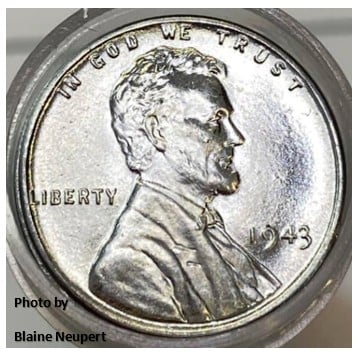
    On occasion, 3 can show weakness in addition to the 4 and/or mintmark
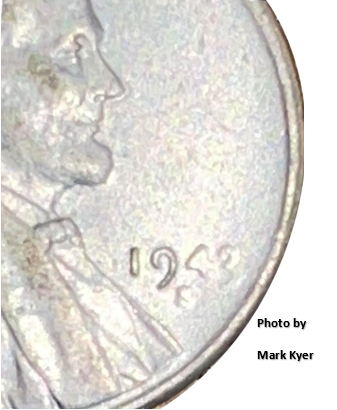
    On some 43 cents, shadowing helps highlight basining at various distances from the rim
  • Options
    MsMorrisineMsMorrisine Posts: 39,484 ✭✭✭✭✭

    any basining on the reverse?

    Current maintainer of Stone's Master List of Favorite Websites // My BST transactions
  • Options
    Pete2226Pete2226 Posts: 83 ✭✭✭

    @MsMorrisine said:
    any basining on the reverse?

    Have not seen any and that may be due to the Wheat ears being where basining would be expected.

    One other type to point out is the build-up around 4 and mint mark
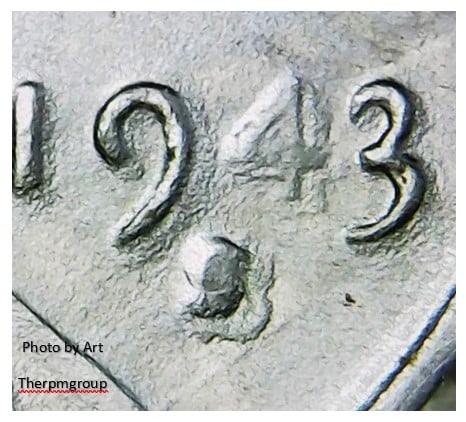
  • Options
    lilolmelilolme Posts: 2,962 ✭✭✭✭✭

    I looked into this back when the half dime struck through / into the half dollar was being discussed. I found a good article on the 'mechanical analysis of coin striking' but it has since been locked and need to request access. A search of 'mechanical analysis of coin striking' will bring it up and a couple of similar but needing access request it looks like.

    I will try to describe what it had for the simplified version. The central devices were simplified as two center discs on the obverse and reverse dies. The outer lettering was simplified as two channels on the obverse and reverse dies. The obverse and reverse dies were the same. I don't fully recall but I don't think it had a collar but expansion outside the dies would be limited but not forced by the collar.

    The analysis was iterative or small steps. Initially as the dies strike the planchet in the field areas, it determines the flow required to fill the recessed die device areas. So initially the flow could be inward to fill the inner die cavities. As die cavities get filled that flow stops and then the flow changes and is directed towards any areas to fill any other unfilled die cavities. On an actual coin die the dies are not symmetric and have varying die cavities which would require a more refined model but the principle would be the same for the analysis model. One article mentioned the flow lines on a coin adjacent to the outer lettering and being inward and due to the outer volume being filled and then flowing inwards. The all happens very quickly.

    One thing that I found inconsistencies in was where through the thickness of the planchet that the flow is happening. Some indicating at the surface (only) but others indicating through the total thickness which made more sense to me. It is known that dies erode so there is some flow at the surface. Also planchet lines, adjustment marks, surface marks can still exist after striking mostly in device areas but sometimes (particularly adjustment marks or roller lines) in a field area. Indicating some flow outside the surface. One other thing to note is that clad coins maintain that clad structure after striking - not sure how the flow might be impacted by clad layers.

    https://youtube.com/watch?v=hYCRaWPlTIE Sophie Lloyd, guitar shred cover of Panama (Van Halen)

    https://youtube.com/watch?v=dOV1VrDuUm4 Ted Nugent, Hibernation, Live 1976

    RLJ 1958 - 2023

  • Options
    jonathanbjonathanb Posts: 4,062 ✭✭✭✭✭

    This should be testable, although I'm not exactly sure what it would take to get useful results. I was thinking that someone could (mark?) (engrave?) a blank planchet with a very fine series of dots or lines in regular grid, then see what happens to the grid after striking.

    My biggest concern is finding the balance where you need the dots/grid to remain visible after striking, without actually interfering with the metal flow that you want to measure.

    I'd love if this could work with ink, since ink clearly would sit on top of the metal and not affect the flow. My guess is that the energy / heat of the strike would burn off any ink and the result wouldn't be helpful at all. I wouldn't mind being wrong, and it would certainly be easy enough to test if the ink survives. I don't think it will, though.

    Assuming that ink doesn't work, I think the only option would be to physically engrave the dots / lines into the planchet before the strike, and see if there's some happy medium where the dots / lines remain visible enough afterwards.

  • Options
    Pete2226Pete2226 Posts: 83 ✭✭✭

    I have a paper in my files that includes a discussion of Flow if that would be helpful.

    I am attaching it here

  • Options
    Pete2226Pete2226 Posts: 83 ✭✭✭

    One other paper in my files that some here may find useful.

  • Options
    CaptHenwayCaptHenway Posts: 33,886 ✭✭✭✭✭
    edited January 12, 2026 12:57PM

    @MsMorrisine said:
    this post is worthless without pictures, but i discarded worn die coins instead of shooting them

    but the reverse on the presidential dollar coins have flow lines that are not radially outward. next the the handle and between the crown flow lines develop linearly with a readily apparent angle to an imaginary radial line.

    question: does the 4 get filled on the -d and -s relatively equally? what about the (p)?

    I think this question might be more appropriate on the thread about 1943-dated coins.

    Numismatist. 54 year member ANA. Former ANA Senior Authenticator. Winner of four ANA Heath Literary Awards; three Wayte and Olga Raymond Literary Awards; Numismatist of the Year Award 2009, and ANA Lifetime Achievement Award 2020. Also won the PNG's Robert Friedberg Award for "The Enigmatic Lincoln Cents of 1922," Available now from Whitman or Amazon.
  • Options
    CaptHenwayCaptHenway Posts: 33,886 ✭✭✭✭✭

    @Rittenhouse said:
    Tom,

    I worked as a manufacturing engineer in the stamping industry, mostly making electrical contacts. Every stamping die erodes from the friction of stamping and, as you point out, there are several flow directions during stamping. Some time ago I found ref to a US Mint contract proposal to develop software that predicted metal flow during striking based on the design, size, metal, etc. While somewhat interesting, since it was in the 2000s (if I recall), it was well beyond my area of interest. However, it might be worth looking into if you're interested in if the prop was ever successful and what it might reveal about metal flow on the Lincoln cents you mention.

    If somebody can dig this out of the Mint I would love to see it. Unfortunately, the Mint refuses to talk to me, so I can't ask to see it.

    Numismatist. 54 year member ANA. Former ANA Senior Authenticator. Winner of four ANA Heath Literary Awards; three Wayte and Olga Raymond Literary Awards; Numismatist of the Year Award 2009, and ANA Lifetime Achievement Award 2020. Also won the PNG's Robert Friedberg Award for "The Enigmatic Lincoln Cents of 1922," Available now from Whitman or Amazon.
  • Options
    CaptHenwayCaptHenway Posts: 33,886 ✭✭✭✭✭

    @lilolme said:
    I looked into this back when the half dime struck through / into the half dollar was being discussed. I found a good article on the 'mechanical analysis of coin striking' but it has since been locked and need to request access. A search of 'mechanical analysis of coin striking' will bring it up and a couple of similar but needing access request it looks like.

    I will try to describe what it had for the simplified version. The central devices were simplified as two center discs on the obverse and reverse dies. The outer lettering was simplified as two channels on the obverse and reverse dies. The obverse and reverse dies were the same. I don't fully recall but I don't think it had a collar but expansion outside the dies would be limited but not forced by the collar.

    The analysis was iterative or small steps. Initially as the dies strike the planchet in the field areas, it determines the flow required to fill the recessed die device areas. So initially the flow could be inward to fill the inner die cavities. As die cavities get filled that flow stops and then the flow changes and is directed towards any areas to fill any other unfilled die cavities. On an actual coin die the dies are not symmetric and have varying die cavities which would require a more refined model but the principle would be the same for the analysis model. One article mentioned the flow lines on a coin adjacent to the outer lettering and being inward and due to the outer volume being filled and then flowing inwards. The all happens very quickly.

    One thing that I found inconsistencies in was where through the thickness of the planchet that the flow is happening. Some indicating at the surface (only) but others indicating through the total thickness which made more sense to me. It is known that dies erode so there is some flow at the surface. Also planchet lines, adjustment marks, surface marks can still exist after striking mostly in device areas but sometimes (particularly adjustment marks or roller lines) in a field area. Indicating some flow outside the surface. One other thing to note is that clad coins maintain that clad structure after striking - not sure how the flow might be impacted by clad layers.

    ..
    There are so many variables involved in the striking of coins it is hard to make any "rules" at all. You know how many an old-time dealer can look at the obverse of a BU Morgan Dollar and tell you which Mint it was struck at? Part of that is the strike, but part of the strike is the radius of the die (the flatness or the curvature of the fields) when new, and another part of the strike is how and where the upset rims were formed on the planchets.

    When I was at ANACS we got in a 12-piece "clock" of off-center silver dollars, mostly Morgans, though some of the clock positions were represented by Peace Dollars. Many of them were identifiable by date and/or Mint. Looking at the upset rims in the unstruck areas, you could see that the raised bulges of the upset planchets were very close to the edges of the planchets on the O-Mint coins, while on the CC coin in the clock the raised bulges were pushed in at least another millimeter. The P and S-mint coins had the raised bulges more or less centered between these two extremes.

    The rim on a Morgan dollar is in two parts, a solid raised line around a slightly lower row of individual denticles. If you look at normally struck O-mint dollars from, say, 1885, you will see that the outer raised lines tend to be very strong, because that is where the bulge was on the planchets, while the inner ends of the denticles sometimes fade away because the bulges were further out. If you look at the edges of these coins, you will see that the reeding lines are relatively long, because the solid line of the rim adjacent to the edge is fully struck up, and that brought up more of the reeding. (Oh, for the days where there were millions of BU Morgans in clear plastic coin tubes you could study!)

    However, these same O-Mint Dollars tend to be weakly struck in their centers, with weak ears and/or eagles' breasts, because the dies were basined rather flatly before being put into use. This meant that the fields of the dies on either side of the head or the eagles did not push as deeply into the planchets during the strikes, displacing metal that would help fill up that head or that eagle.

    Now look at, say, a normal BU 1884-CC dollar. The solid line of the rim is weak and falls off towards the edge, causing the edge to have shorter reeding lines than the O-Mint coin. Conversely, the denticles on the CC coin are stronger, because that is where the bulge on the planchets hit the dies. Glancing at the field, you can see with your naked eye that it is more curved than the O-mint coin. On a few CC dies you can even see small rough patches in the fields next to the head and/or the eagle, where the original hubbed surface of the die was not basined away because of the greater curvature of the basining wheel. Because there is more die metal there to push deeper into the planchet, the heads and eagles on CC-Mint dollars tend to be well struck up, even if the edges and the outer bands of the rims are not.

    Obviously these factors can change over the lifetime of a series as basing wheels and upsetting mill "shoes" wear out and are replaced.

    TD

    Numismatist. 54 year member ANA. Former ANA Senior Authenticator. Winner of four ANA Heath Literary Awards; three Wayte and Olga Raymond Literary Awards; Numismatist of the Year Award 2009, and ANA Lifetime Achievement Award 2020. Also won the PNG's Robert Friedberg Award for "The Enigmatic Lincoln Cents of 1922," Available now from Whitman or Amazon.
  • Options
    PeasantryPeasantry Posts: 299 ✭✭✭

    H> @Rittenhouse said:

    Tom,

    I worked as a manufacturing engineer in the stamping industry, mostly making electrical contacts. Every stamping die erodes from the friction of stamping and, as you point out, there are several flow directions during stamping. Some time ago I found ref to a US Mint contract proposal to develop software that predicted metal flow during striking based on the design, size, metal, etc. While somewhat interesting, since it was in the 2000s (if I recall), it was well beyond my area of interest. However, it might be worth looking into if you're interested in if the prop was ever successful and what it might reveal about metal flow on the Lincoln cents you mention.

    Was this the reference?

    Source: U.S. Mint (.gov) https://share.google/XsCYMNZTmumg9P6EO

    "Additional research to better understand the relationship between the fine details of a coin’s artwork and its impact on material flow stress and die life during striking would be valuable. Improved understanding could be reflected in the “Engraver’s Handbook.” pg. 367 para. 7.7.3.

  • Options
    CaptHenwayCaptHenway Posts: 33,886 ✭✭✭✭✭

    @jonathanb said:
    This should be testable, although I'm not exactly sure what it would take to get useful results. I was thinking that someone could (mark?) (engrave?) a blank planchet with a very fine series of dots or lines in regular grid, then see what happens to the grid after striking.

    My biggest concern is finding the balance where you need the dots/grid to remain visible after striking, without actually interfering with the metal flow that you want to measure.

    I'd love if this could work with ink, since ink clearly would sit on top of the metal and not affect the flow. My guess is that the energy / heat of the strike would burn off any ink and the result wouldn't be helpful at all. I wouldn't mind being wrong, and it would certainly be easy enough to test if the ink survives. I don't think it will, though.

    Assuming that ink doesn't work, I think the only option would be to physically engrave the dots / lines into the planchet before the strike, and see if there's some happy medium where the dots / lines remain visible enough afterwards.

    I am sure that Dan Carr could do something along these lines.

    By the way, there are many BU Morgans that show "shadow doubling" outside the outer edges of the date, stars and lettering that give a precise measurement how much that metal moved outwards from the start of the strike to the end of the strike.

    TD

    Numismatist. 54 year member ANA. Former ANA Senior Authenticator. Winner of four ANA Heath Literary Awards; three Wayte and Olga Raymond Literary Awards; Numismatist of the Year Award 2009, and ANA Lifetime Achievement Award 2020. Also won the PNG's Robert Friedberg Award for "The Enigmatic Lincoln Cents of 1922," Available now from Whitman or Amazon.
  • Options
    CaptHenwayCaptHenway Posts: 33,886 ✭✭✭✭✭

    @Peasantry said:
    H> @Rittenhouse said:

    Tom,

    I worked as a manufacturing engineer in the stamping industry, mostly making electrical contacts. Every stamping die erodes from the friction of stamping and, as you point out, there are several flow directions during stamping. Some time ago I found ref to a US Mint contract proposal to develop software that predicted metal flow during striking based on the design, size, metal, etc. While somewhat interesting, since it was in the 2000s (if I recall), it was well beyond my area of interest. However, it might be worth looking into if you're interested in if the prop was ever successful and what it might reveal about metal flow on the Lincoln cents you mention.

    Was this the reference?

    Source: U.S. Mint (.gov) https://share.google/XsCYMNZTmumg9P6EO

    "Additional research to better understand the relationship between the fine details of a coin’s artwork and its impact on material flow stress and die life during striking would be valuable. Improved understanding could be reflected in the “Engraver’s Handbook.” pg. 367 para. 7.7.3.

    That looks both amazing and quite formidable. THank you for posting it.

    Numismatist. 54 year member ANA. Former ANA Senior Authenticator. Winner of four ANA Heath Literary Awards; three Wayte and Olga Raymond Literary Awards; Numismatist of the Year Award 2009, and ANA Lifetime Achievement Award 2020. Also won the PNG's Robert Friedberg Award for "The Enigmatic Lincoln Cents of 1922," Available now from Whitman or Amazon.
  • Options

    Some of the "coins" struck on washers are interesting if you assume the hole in the center was perfectly round before being struck. The metal flow is so much more toward the center of the coin as there is not enough metal to force an outward spread towards the rim. A lot that I have seen end up with an egg shaped hole in the center depending upon the coins design. Just food for thought.

  • Options
    lilolmelilolme Posts: 2,962 ✭✭✭✭✭

    @CaptHenway said:

    @lilolme said:
    I looked into this back when the half dime struck through / into the half dollar was being discussed. I found a good article on the 'mechanical analysis of coin striking' but it has since been locked and need to request access. A search of 'mechanical analysis of coin striking' will bring it up and a couple of similar but needing access request it looks like.

    I will try to describe what it had for the simplified version. The central devices were simplified as two center discs on the obverse and reverse dies. The outer lettering was simplified as two channels on the obverse and reverse dies. The obverse and reverse dies were the same. I don't fully recall but I don't think it had a collar but expansion outside the dies would be limited but not forced by the collar.

    The analysis was iterative or small steps. Initially as the dies strike the planchet in the field areas, it determines the flow required to fill the recessed die device areas. So initially the flow could be inward to fill the inner die cavities. As die cavities get filled that flow stops and then the flow changes and is directed towards any areas to fill any other unfilled die cavities. On an actual coin die the dies are not symmetric and have varying die cavities which would require a more refined model but the principle would be the same for the analysis model. One article mentioned the flow lines on a coin adjacent to the outer lettering and being inward and due to the outer volume being filled and then flowing inwards. The all happens very quickly.

    One thing that I found inconsistencies in was where through the thickness of the planchet that the flow is happening. Some indicating at the surface (only) but others indicating through the total thickness which made more sense to me. It is known that dies erode so there is some flow at the surface. Also planchet lines, adjustment marks, surface marks can still exist after striking mostly in device areas but sometimes (particularly adjustment marks or roller lines) in a field area. Indicating some flow outside the surface. One other thing to note is that clad coins maintain that clad structure after striking - not sure how the flow might be impacted by clad layers.

    ..
    There are so many variables involved in the striking of coins it is hard to make any "rules" at all. You know how many an old-time dealer can look at the obverse of a BU Morgan Dollar and tell you which Mint it was struck at? Part of that is the strike, but part of the strike is the radius of the die (the flatness or the curvature of the fields) when new, and another part of the strike is how and where the upset rims were formed on the planchets.

    When I was at ANACS we got in a 12-piece "clock" of off-center silver dollars, mostly Morgans, though some of the clock positions were represented by Peace Dollars. Many of them were identifiable by date and/or Mint. Looking at the upset rims in the unstruck areas, you could see that the raised bulges of the upset planchets were very close to the edges of the planchets on the O-Mint coins, while on the CC coin in the clock the raised bulges were pushed in at least another millimeter. The P and S-mint coins had the raised bulges more or less centered between these two extremes.

    The rim on a Morgan dollar is in two parts, a solid raised line around a slightly lower row of individual denticles. If you look at normally struck O-mint dollars from, say, 1885, you will see that the outer raised lines tend to be very strong, because that is where the bulge was on the planchets, while the inner ends of the denticles sometimes fade away because the bulges were further out. If you look at the edges of these coins, you will see that the reeding lines are relatively long, because the solid line of the rim adjacent to the edge is fully struck up, and that brought up more of the reeding. (Oh, for the days where there were millions of BU Morgans in clear plastic coin tubes you could study!)

    However, these same O-Mint Dollars tend to be weakly struck in their centers, with weak ears and/or eagles' breasts, because the dies were basined rather flatly before being put into use. This meant that the fields of the dies on either side of the head or the eagles did not push as deeply into the planchets during the strikes, displacing metal that would help fill up that head or that eagle.

    Now look at, say, a normal BU 1884-CC dollar. The solid line of the rim is weak and falls off towards the edge, causing the edge to have shorter reeding lines than the O-Mint coin. Conversely, the denticles on the CC coin are stronger, because that is where the bulge on the planchets hit the dies. Glancing at the field, you can see with your naked eye that it is more curved than the O-mint coin. On a few CC dies you can even see small rough patches in the fields next to the head and/or the eagle, where the original hubbed surface of the die was not basined away because of the greater curvature of the basining wheel. Because there is more die metal there to push deeper into the planchet, the heads and eagles on CC-Mint dollars tend to be well struck up, even if the edges and the outer bands of the rims are not.

    Obviously these factors can change over the lifetime of a series as basing wheels and upsetting mill "shoes" wear out and are replaced.

    TD

    I can agree that there are many variables even before injecting die and planchet irregularities as mentioned. However, my post was meant to address the theoretical metal flow. That is, in the past I have read when a coin is struct the metal flows outwards. This modeling and energy theory is indicating that the metal flows to fill the die cavities and mostly in nearby or adjacent areas.

    As I noted a real coin die is more complex and not the simplified example. But the theory should still apply. When there are irregularities in the die or planchet then this will of course impact the final result. I recall in another thread asking about why on some CBH the banner with e pluribus unum would be very soft in the center on a well struck coin. As I recall it was the die was not hard enough and "spreads" leaving a weak strike (forget the term/name used). Similarly a planchet that is not annealed properly could impact the strike. If one could input these inconsistencies into the model it would be interesting to see what it would predict.

    I quickly looked at Pete2226 documents and it appears to be the same or very similar modeling theory I recall and being used to optimize production.

    As you noted the Morgan dollars have such a wide variance in their striking results. There is one I called a 'dished' luster. I recall it on some of the early S mints (83S). I think I still have an 82S with the look. The luster (cartwheel) does not go across the coin in a linear manner (like most) but the luster will curve (away from the light source) as it is seen towards the outer rim. I believe the surface is 'dished' but never looked into it.

    https://youtube.com/watch?v=hYCRaWPlTIE Sophie Lloyd, guitar shred cover of Panama (Van Halen)

    https://youtube.com/watch?v=dOV1VrDuUm4 Ted Nugent, Hibernation, Live 1976

    RLJ 1958 - 2023

  • Options
    jonathanbjonathanb Posts: 4,062 ✭✭✭✭✭

    Thinking about this some more... I wonder what would happen if you took some fine mesh and plopped it on top of a planchet before striking? It's basically "struck through cloth", but possibly more reproducible results.

    I'm not sure what would happen during striking. It doesn't make sense to me that the planchet would flow "underneath" the mesh. I think that means that the mesh would have to deform to match the metal flow. One concern would be if the presence of the mesh changed the metal flow. I'm not sure what to do about that.

    Amazon has lots of options for meshes of various sizes. You'd have to buy them, so not quite as easy to try out as using ink, but many of the options are less than $10, so not a big investment either.

  • Options
    CaptHenwayCaptHenway Posts: 33,886 ✭✭✭✭✭

    @Tahquamenon said:
    Some of the "coins" struck on washers are interesting if you assume the hole in the center was perfectly round before being struck. The metal flow is so much more toward the center of the coin as there is not enough metal to force an outward spread towards the rim. A lot that I have seen end up with an egg shaped hole in the center depending upon the coins design. Just food for thought.

    Yes, and sometimes the inner curve of a "clip" will be distorted when part of the clip falls under the field of the die and another part falls under the design.

    Numismatist. 54 year member ANA. Former ANA Senior Authenticator. Winner of four ANA Heath Literary Awards; three Wayte and Olga Raymond Literary Awards; Numismatist of the Year Award 2009, and ANA Lifetime Achievement Award 2020. Also won the PNG's Robert Friedberg Award for "The Enigmatic Lincoln Cents of 1922," Available now from Whitman or Amazon.
  • Options
    CaptHenwayCaptHenway Posts: 33,886 ✭✭✭✭✭

    @jonathanb said:
    Thinking about this some more... I wonder what would happen if you took some fine mesh and plopped it on top of a planchet before striking? It's basically "struck through cloth", but possibly more reproducible results.

    I'm not sure what would happen during striking. It doesn't make sense to me that the planchet would flow "underneath" the mesh. I think that means that the mesh would have to deform to match the metal flow. One concern would be if the presence of the mesh changed the metal flow. I'm not sure what to do about that.

    Amazon has lots of options for meshes of various sizes. You'd have to buy them, so not quite as easy to try out as using ink, but many of the options are less than $10, so not a big investment either.

    Don’t know.

    Got any pictures of naturally occurring “struck through cloth” errors that might provide an answer?

    Numismatist. 54 year member ANA. Former ANA Senior Authenticator. Winner of four ANA Heath Literary Awards; three Wayte and Olga Raymond Literary Awards; Numismatist of the Year Award 2009, and ANA Lifetime Achievement Award 2020. Also won the PNG's Robert Friedberg Award for "The Enigmatic Lincoln Cents of 1922," Available now from Whitman or Amazon.
  • Options
    jonathanbjonathanb Posts: 4,062 ✭✭✭✭✭

    @CaptHenway said:

    @jonathanb said:
    Thinking about this some more... I wonder what would happen if you took some fine mesh and plopped it on top of a planchet before striking? It's basically "struck through cloth", but possibly more reproducible results.

    I'm not sure what would happen during striking. It doesn't make sense to me that the planchet would flow "underneath" the mesh. I think that means that the mesh would have to deform to match the metal flow. One concern would be if the presence of the mesh changed the metal flow. I'm not sure what to do about that.

    Amazon has lots of options for meshes of various sizes. You'd have to buy them, so not quite as easy to try out as using ink, but many of the options are less than $10, so not a big investment either.

    Don’t know.

    Got any pictures of naturally occurring “struck through cloth” errors that might provide an answer?

    This is good enough if you want something to look at. I don't think I good enough to give any useful answers for metal movement: https://forums.collectors.com/discussion/911362/major-error-eye-candy-2-125-struck-through-cloth

  • Options
    CaptHenwayCaptHenway Posts: 33,886 ✭✭✭✭✭

    Neat coin, but as you say it doesn’t address the question.

    Numismatist. 54 year member ANA. Former ANA Senior Authenticator. Winner of four ANA Heath Literary Awards; three Wayte and Olga Raymond Literary Awards; Numismatist of the Year Award 2009, and ANA Lifetime Achievement Award 2020. Also won the PNG's Robert Friedberg Award for "The Enigmatic Lincoln Cents of 1922," Available now from Whitman or Amazon.
  • Options
    Pete2226Pete2226 Posts: 83 ✭✭✭

    Another resource with information about metal flow is the ASM Metals handbook. Discussion in the handbook includes coinage and metal flow, but extracting meaningful information from the text is difficult and time consuming. The book is over 2500 pages in length. If anyone is interested, I can post a .pdf copy (if the system will take that size file!). {ASM = American Society for Metals}

  • Options
    RittenhouseRittenhouse Posts: 677 ✭✭✭✭

    @Peasantry said:
    Was this the reference?

    Source: U.S. Mint (.gov) https://share.google/XsCYMNZTmumg9P6EO

    No, that's interesting but the RFP I saw was specifically for development of software to model metal flow during striking.

  • Options
    RittenhouseRittenhouse Posts: 677 ✭✭✭✭

    @CaptHenway said:
    If somebody can dig this out of the Mint I would love to see it. Unfortunately, the Mint refuses to talk to me, so I can't ask to see it.

    You don't need to "dig this out of the mint." All non-national security gov't RFPs (Requests For Proposal) and contracts are public. If I recall, I had googled "metal flow during stamping" or some such thing and one of the results was the RFP for metal flow modelling software.

    Googled again and came up with this article. An email to the author might get you headed in the right direction.

    https://www.thefabricator.com/thefabricator/article/bending/die-science-forming-simulation-software

Leave a Comment

BoldItalicStrikethroughOrdered listUnordered list
Emoji
Image
Align leftAlign centerAlign rightToggle HTML viewToggle full pageToggle lights
Drop image/file