Options
Grade-flation.
 keets
Posts: 25,351 ✭✭✭✭✭
Do the major TPG's, PCGS and NGC, grade on a "curve" which results in our perception of grade-flation??
Al H.
0
Comments
Please define "grade-on-the-curve" and give a fanciful example we can discuss. Otherwise, some (including me - sorry) may have no idea what you are asking.
what, didn't you go to school?
It seems like to me, there might be "a curve" in some of the huge bulk graded lots I've seen.
Many years ago I knew a dealer who had huge group of Sacagawea Dollars bulk graded when they were introduced (NOT PCGS!). The grades ranged from MS-64 to 67. I went through a number of them and it almost seemed like the graders felt a need to assign grades to a bell curve. There were lots of MS-65s and 66s, and not so many MS-64s and 67s. The trouble was when I really looked at the coins, some of the pieces in the lower grade holders were better than the pieces in the higher grade holders. It was like they were just randomly graded and put into holders with grade quotas, not the coins, in mind.
@Insider2 ....Here is a definition......Cheers, RickO
Grading on the “Curve” is a method of grading that is based on the belief that letter grades in any given class should be distributed along a bell curve. Typically, an assignment or test is scored, and the average score automatically becomes an average grade (typically a B- or C+).
RickO went to school and I think BillJones did, too!
Quite the opposite for my set.
They establish a top pop and work backwards.
Sometimes there are 5 grades between #1 & dreck (1908 NM WF)
Sometimes there are 2 (1920)
Then there are times when they throw darts (1907 HR)
And times where every participant gets a prize (1907 low relief)
I think grade-flation is sort of a myth.
It's just the "market grading system" recognizing toning/eye appeal after a lot of years of not doing it.
Also a bunch of c coins that are for sale for YEARS that make everyone want to do this....
My Saint Set
I don’t know what grading on a curve would have to do with it unless you are comparing key dates to commons.
The primary cause (IMO) of gradeflation is that coins are selectively tried multiple times for upgrades. This has a secondary effect that isn’t often mentioned - the training set of coins from which people learn how to grade (by viewing thousands of coins) is therefore also continuously increasing.
@keets asked: "w [W] hat, didn't you go to school?"
You should take a time out. IMHO, you have posted what could have been a very interesting discussion. Unfortunately, you have decided to poke fun at someone with more "school education" than you'll ever have if you started remedial night courses tonight!

I know exactly what "grading-on-the-curve is WHEN APPLIED TO TESTS IN A CLASSROOM. In fact, in one of my genetics classes one girl (who actually studied) ruined things for the guys because it was obvious to the professor that his test questions were appropriate and for that reason HE COULD NOT GRADE-ON-A-CURVE!
I have found that unless all the folks in a discussion do not agree on EXACTLY WHAT THEY ARE DISCUSSING at the very beginning, a lot of nonsense, misinformation, etc clutters up the discussion until pretty soon the entire discussion is about correcting misunderstandings about what is being discussed.
There may be something to what you asked. Perhaps now, you can swallow the petty rankness and post an example and how in your mind grading-on-a-curve is applied to numismatics.
So...Please define "grade-on-the-curve" (EDIT: Thanks @ricko) and give a fanciful example we can discuss. Otherwise, some (including me - sorry) may have no idea what you are asking.
I really don't see how this could apply in grading, yes in a class it works because all the conditions are the same, same questions, same number of questions, one correct answer, etc. The only place that applies is perhaps for bulk modern issues but even then not all the conditions are exact because the coin may have been produced on different days, different machines, different operators, etc.
My Collection of Old Holders
Never a slave to one plastic brand will I ever be.
Grading on the curve should be banned in the educational system. It does more to discourage kids from trying. The kid works hard studies and gets 89% on his test. Unfortunately 89 is a D on the test.
MS60 --- 216.
MS61 --- 1,942.
MS62 --- 13,174.
MS63 --- 70,628.
MS64 --- 106,163.
MS65 --- 55,515.
MS66 --- 14,561.
MS67 --- 2,395.
MS68 --- 176.
I took the grades/numbers above from the PCGS pop report for MS 1881-S Morgan Dollars. Without plotting the numbers on a graph I think it is clear what it will look like. Unlike a "school test" scenario where all the events happen at the same time, this group of events has taken place over the course of 33+ years and yielded a similar result. My thinking has always been that as a group of graders at a specific TPG sees an increasing number of same date/mm coins that the knowledge of what that coin's grade characteristics are evolves. That means that what was an MS64 in 1986 would probably be viewed differently today and has been over the years as the group of coins graded has increased. Thus, we arrive at the Bell although in a different manner.
Now I suppose it could be that when the Mint made all those 1881-S's back in the day that they were all of a correspondingly similar quality, that's why we get the grade dispersal we have. The thing is that I doubt collectors submit a coin that is an MS62 thinking that's what it is. Most collectors submit nice coins so maybe they just don't know how to grade.
So much to think about without trying to look like I'm picking on insider.
Interesting, though I doubt that is common for all series.
And boy is that a lot of widgets
it's interesting to me that I have thought about this for a long time off-and-on but never really looked at any pop numbers to see if I was crazy or not. I decided to look this afternoon and chose 1881-S because I know there are a lot of them. it's ridiculous how it actually is very close to a nice, uniform bell.
@keets posted: "Now I suppose it could be that when the Mint made all those 1881-S's back in the day that they were all of a correspondingly similar quality, that's why we get the grade dispersal we have."
If by similar quality you mean as they left the press, I'll agree. Otherwise, I disagree. The principal way we get the dispersal (bell shaped curve using a TPGS example) is because 68-70 hardly exist and 60-62 (as you posted) are not usually not sent in.
If we leave out the strike, the majority of large coins (1881-S in your example) would grade MS-66 and higher when they were made. Rarely would anything below MS-65 leave the press. Thus no bell curve. What happened after the coins left the Mint is the reason they now are found in various grades. Additionally, the grading standards have loosened during the time period which further screws a valid result.
What?
@Insider said: I think Raybo did also.
I think ultra rarities are currently graded on a curve in the sense that the grades seem more like a relative ranking rather than a meaningful grade. Then again, the grade on the plastic probably doesn't really matter that much for those. I don't think this is the case for 99% of U.S. issues.
MS60 --- 216.
MS61 --- 1,942.
MS62 --- 13,174.
MS63 --- 70,628.
MS64 --- 106,163.
MS65 --- 55,515.
MS66 --- 14,561.
MS67 --- 2,395.
MS68 --- 176.
This isn't a bell curve at all. These were all graded at different times and the medium grade is 64 and it falls off on both sides.
The 1881-S is a decent candidate for a statistical analysis since there are so many of them, but there are a TON of variables that make a meaningful analysis difficult. Pretty much others have said the same thing, but here's how I see it:
Even so, someone good at maths could ferret out some information that would be interesting and possibly surprising to most collectors. I'm guessing that those with sharp minds and decades of experience have informally developed an intuitive sense of this on their own, and in many cases they're probably pretty close to dead-on. For instance, think about the "feel" that Rick Snow has for the distribution of FE cents or what Doug Winter knows about classic US gold. The validity and accuracy of pop reports, mintage figures, and survival rarity estimates are not always so good.
But, to get to the OP's actual question, no, I think they grade the coins in front of them. While doing this, of course, they're subject to the whims and biases that we all are prone to, both consciously and unconsciously.
Agree. Also the lower mint state grades are far more numerous. They just are not worth submitting to the grading services.
Worry is the interest you pay on a debt you may not owe.
"Paper money eventually returns to its intrinsic value---zero."----Voltaire
"Everything you say should be true, but not everything true should be said."----Voltaire
I agree, but no one said it had to be a perfect bell curve.
I totally agree with @BryceM with respect to the issues related to a meaningful statistical analysis. My biggest issue is that the total population of coins is not sampled (graded) in a random manner. We all know that nicer coins are selected preferentially over lower grades. This would naturally skew the distribution to favor higher grades.
FWIW, here is what the data looks like when plotted. I didn't spend the time to overlay a normal curve, but I think it is intuitive that this distribution is normal.
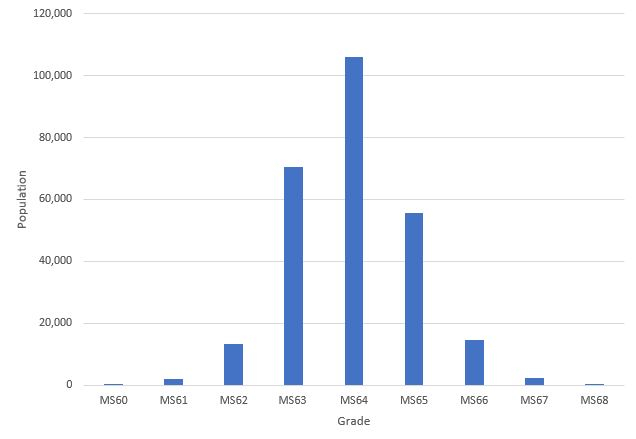
Having said all that, nobody has mentioned that PCGS maintains grading sets. Presumably this is done to insure that grades don't vary over time. It would seem to me that if they are not tweaking the grading sets, the standards have remained the same over the years.
“In matters of style, swim with the current; in matters of principle, stand like a rock." - Thomas Jefferson
My digital cameo album 1950-64 Cameos - take a look!
It is approximately a bell curve. It may represent a distribution conflating the submitters eye with the coins themselves and the price guide. The 60/62 are probably a little low because not worth submitting. The 67/68 a little low because they don't exist in large numbers. The middle part probably represents the distribution of submitter opinions as they tried to submit 65s because anything less than 65 was not worth submitting.
It is an interesting bar graph
Lighten up Francis! Somebody is a little touchy...
This isn't a bell curve at all.
not to argue the point, but as Cameonut has showed, yes, it is indeed a "Bell Curve" when graphed.
drei3ree, he is always like that, it's his personality. he believes he is some sort of moderator and can control what goes on here. I have learned to poke the bear and move on.
I love the banter, puts some excitement in my boring old life!
it is interesting that there has consistently been talk at this forum, since I joined in 2002, by a wide range of members that PCGS "changes their grading standard" and is either loose or tight at a specific time. in the past there has been speculation by members that PCGS had "put the brakes" on the MS/PR 70 grade. I used to have a complete collection of the hard-cover census report from around 1997-2006 or whenever they stopped sending them out: it was a useful reference for seeing what was taking place in the present day vs. what had taken place in the past.
is this sort of anecdotal evidence and reference reporting accurate?? it is hard to say, but what is accurate is that members believe it to be true. members tend to believe that PCGS, at certain times, has graded either conservatively, accurately or liberally.
maybe my initial post was poorly worded. I just think it is an interesting fact that for some coins, maybe many coins, the grade dispersal resembles the Bell Curve that many, though not all of us, are familiar with and grew up knowing. was that intentional?? who knows. is it an odd coincidence?? perhaps, but the older I get the less I believe that the World functions accidentally, it tends to be purpose driven. also, I really do believe that the way coins have been graded by PCGS has changed over the years. how could it not change?? to use the subject 1881-S Morgan Dollar as an example, it seems natural that after having seen 50,000 of them that an individual or entity wouldn't assess them the same as when they had only seen 500 coins.
hopefully, this explains my original point a little better and meets or exceeds the "Insider2 Threshhold" for meaningful discussion.
I don't claim to be a statistician but I think that's what gives the figures a bell shape curve. Starts small, increases, and then goes back down.
My point was they didn't grade these coins to make that shape. That is probably indicitive(sp) of a lot of dates. And this is not at all what grading on a curve is as in school. Grading on a curve you take the highest grade and it becomes a 100 and everybody is adjusted to that. So if the top was 90 it becomes a 100 and your 70 becomes a 80....that is grading on a curve.
So to compare this to coins.......those 68's would become 70's....the 67's become 69's...etc....
And that's why they are not calculated in the number. They are not part of the curve yet they do influence the results because they cause the low end of the curve to start low.
Coins are graded one by one.
Grading standards have changed (Gradeflation) which has altered the distribution of grades; however, they are still graded one by one.
Sure looks like a bell curve to me.
@drei3ree said: "Lighten up Francis! Somebody is a little touchy..."
NOTE to all members: You might be very surprised if you knew the true identity of some of the anonymous posters on CU.
That is NOT grading on a curve, although it is mistakenly referred to that way. That is SCALING the grades.
If you truly graded on a curve, some people's hearts are adjusted up some down to get a Gaussian distribution.
@keets
All I asked for was a definition and an example of what you believed to be the case. @riko supplied the definition. Using the definition of a bell curve, it has been proven that VINTAGE COINS tend to follow the curve and the reasons are obvious! Low end and high end with most forming a bulge in the middle.
This has NOTHING to do with the coins being ranked at the same time as in "grading-by-the-curve!"
A chart of "moderns" would not yield this result. In my limited experience, most would fall above 65 with the vast majority higher.
I also asked for an example. We did not get one but it is not needed now. Additionally, while gradeflation affects the individual grades assigned to the coins, in the long run. the "bell shape" should remain. Is this intentional. Absolutely not! Coins at the low end will continue to be ignored and coins at the high end will continue to be scarce. Therefore, I expect the curve will continue to exist long after I'm too tired to banter.
NISM
That is a standard deviation, which is very different than grading on a curve.
Here is something that would make grading more consistent and precise but it will not happen:
In class, I give students several types of coins one type at a time and tell them to rank them by grade. Take the Buffalo nickels. Examples range from G to AU with some "liners" in the VF - XF grades. Given a dozen coins, most students can place them in a straight line, low to high, and be in 98% agreement. Depending on the actual coins, it could reach 100%.
Think if a TPGS could take every Buffalo nickel they received in a day (mark them in some way so their owner can be identified) and place them on a felt table for the graders to rank by condition according to their grading set. One table for MS and one for circulated coins.
This is a great exercise for a coin club. Try it.
What this does illustrate may be to the point. I've always understood MS63 to be "average uncirculated". If (I say IF) this was once the case then it's obvious that the "average" is now MS64 for many common classic coins. This is true for many fairly common and abundant classic series and dates as I'm sure most of you have observed. Is this evidence of gradeflation? No way to know from published pop reports as there is a strong bias towards coins in better condition, the effect of resubmissions, and the lack of a time line - but it is suggestive. Useless for modern coins and probably many other examples.