Options
First coin made at San Francisco Mint - Should now be in Smithsonian
 RogerB
Posts: 8,967 ✭✭✭✭✭
Members, especially those who collect early double eagles by die variety - might want to examine the 1854-S double eagle in the Smithsonian NNC.
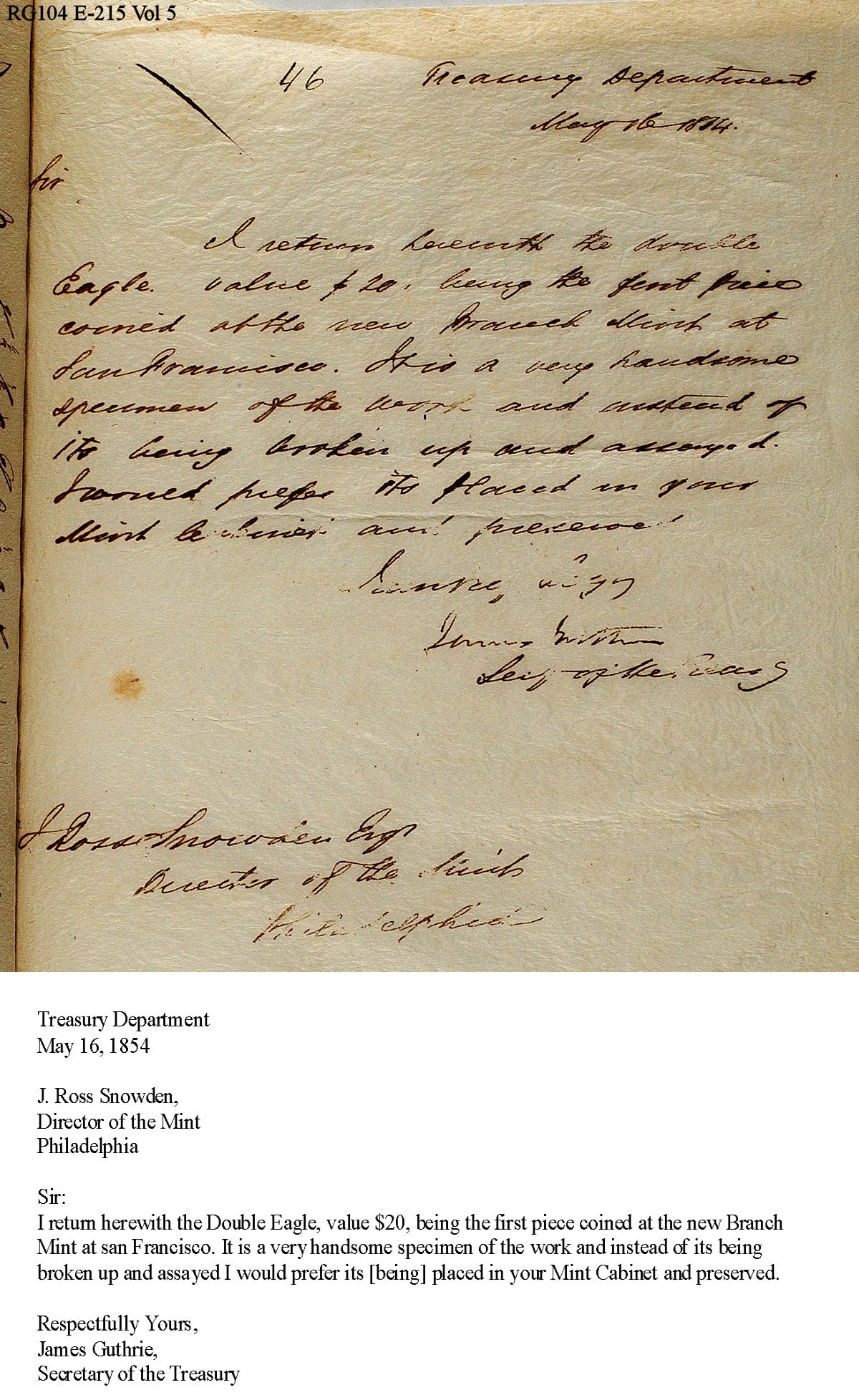
24
Comments
WOW!
That is a great knowledge addition to the historical record of the mint cabinet
Latin American Collection
I will send a high resolution copy to the NNC curator Monday. She might enjoy it.
{BTW - This is just one of many potentially interesting and historically valuable documents "hidden" in letter books and manuscripts. The Newman Numismatic Portal (NNP) is supporting a digitization program which will bring more images within free access by collectors, researchers and others. However, the content of these images remains "locked up" in handwritten materials. The wonderful people who have been working on transcriptions are doing a great job - all be it, slow.)
Updooted for your tagline.
It's a well known coin. It's fully prooflike, perfectly struck, and has been described as specially made. I have a photo somewhere.
What is now proved was once only imagined. - William Blake
Didn't need to find mine - Tom Mulvaney's photo is in Coinfacts:

It's fully prooflike in hand - the photo's lighting doesn't show that feature off...
What is now proved was once only imagined. - William Blake
Where is the “LOVE!” Button?
It's a really impressive coin in hand.
What is now proved was once only imagined. - William Blake
There is your die characteristic, the repunched lower left serif of the 1.
She is a looker. Good post, thanks.
On the reverse, the U in United is also repunched.
What is now proved was once only imagined. - William Blake
Thank you Roger for this fine numismatical presentation. Thank goodness you may continue. Thank you also to CaptHenway and Regulated for your additional info.
Jim
When a man who is honestly mistaken hears the truth, he will either quit being mistaken or cease to be honest....Abraham Lincoln
Patriotism is supporting your country all the time, and your government when it deserves it.....Mark Twain
Wow, impressive !!!
Are you sure that is not “Longacre Doubling?”
Does that beauty have a grade?
Later, Paul.
He's back!!!!! do-do do-do do-do-do... (Twilight Zone theme music beginning).
If it is in the Smithsonian, it does not need one.
I see...
Later, Paul.
Guthrie called it a "specimen," not a "proof"
JD cites this letter in his proof gold book, where he describes the coin as "specially struck from regular production dies."
would that coin have been struck using a medal press?
Kaz, Only the Philadelphia Mint had a medal press, so no.
The letter clearly indicates the coin was carefully made, probably intentionally polishing the dies and hand operating the large toggle press. The original letter could be used in Coin Facts or other illustrated databases to support descriptions of this coin.
I am glad that the Secretary of the Treasury had a sense of history.
What a beautiful gold coin.... I remember going to the Smithsonian and seeing some gold coins on display (this was over fifty years ago).... I do not recall if this was one of them...They were amazing to me...Untouchable beauties...They were the first gold coins I had ever seen, and started my lifelong love affair with gold...Cheers, RickO
I don't think this was out when we put the old display away in 2005 - it was sitting in the 1854 drawer.
What is now proved was once only imagined. - William Blake
I sent the original (photo) document to the NNC curator.
This is one of those coins that I feel the designation "Specimen" is truly appropriate. We have the coin and the document, and even its present location.
Indeed!
I feel that similar documentary support is necessary for any coin that is called a "specimen."
I respectfully disagree. I have spoken before of the 1799 Dollar I once handled that I could arguably call a Proof. At the minimum it is a Specimen striking.
Then how does one define usage of "specimen" in relation to modern identification of coins? Do we follow the example of so many "proof" bust halves that have now become proof-like or some other thing? What about those other coins declared by "experts" to be something special that turned out to be nothing special?
I expect most would agree that with documentation such as for the subject 1854-S DE, the term is entirely appropriate. What about others that presently don't have contemporary support? How can they be confidently and objectively assessed, and by whom? That is: what constitutes a "specimen" coin when there is no supporting documentation?
Anybody have a picture of "The Coin?"
(It's posted near the top.)
Part of the issue is that there has been little to no archival research on many of these SP pieces. At the moment, I have substantial, previously unknown documentation on one such piece that conflicts with the current explanations about why it exists, but unquestionably confirms its status (this will become an article soon).
I would say that a coin like the 76-CC dime - where we have what are essentially progress proofs in three metals (nickel, copper and silver) - are unquestionably special, despite the fact that I haven't seen documentation (which could very well exist - I haven't looked). I can't imagine a sensible explanation as to why someone would take a used Carson City die, strike off-metal examples, lap it, pickle it in acid to frost the devices, re-lap, then polish it, unless the intent was to make something out of the ordinary. The piece that I handled had been struck under so much pressure that its rim was nearly three times the thickness of a normal dime. Calling it a prooflike business strike would have been numismatic malpractice.
That being said, I've also seen things in SP holders that were obvious coin dealer hokum. I don't think that you can apply a single rule to these things, and if you're not 100% sure about the status of the piece, no grading service opinion should matter.
What is now proved was once only imagined. - William Blake
For an 1876-CC dime the obvious questions are "Why" and "Where?"
Those are questions that I've asked myself, although I'm not in the "it must have been made in Philly" camp.
What is now proved was once only imagined. - William Blake
The rim is the final part of a die pair to be formed during striking. It's height cannot exceed the depth of cut in the dies which is also influenced by planchet upset and metal available to fill the dies. Pressing dies harder will not make the rim higher, only broader toward the center. Even at the extreme pressure sufficient to perforate the planchet, the rim cannot exceed the machined cut depth. If a coin has a measurable high rim, then we have to look to the dies defect.