Options
NEWP from SS Central America #2
 jonruns
Posts: 1,202 ✭✭✭✭✭
jonruns
Posts: 1,202 ✭✭✭✭✭
I love the shipwreck story but my original plan was to hold off on the purchase of an SSCA2 coin until they hit the secondary market...and the dealers got hold of some of the better dates and submitted them to CAC. Maybe a year or so...
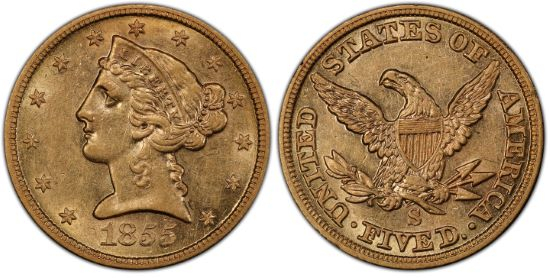
However my friends know that patience is not my strong suit, so I jumped on this coin when it was recently posted for sale at Legend.
Checks all the boxes:
- Desirable date: first obtainable half eagle from the S- mint
- Great eye appeal
- Relatively scarce; approximately 30 new ones found in addition to the estimated existing population of 135
- Top pop CAC: 4 in 58, 1 higher; 19 total
- Shipwreck and cool accompanying PCGS holder (my high school son likes the pinch better than the coin!)
- Modest premium vs Price Guide
It looks like most or all of the new ones for this date are graded, 4 at 58 none higher. Based upon the images it looks like Laura may have picked out the best one. I had heard that the marketing for round one was so great, not sure what's changed but I'm having real difficulty understanding who is selling what...glad I saw this one though...
15
Comments
Yikes!!!
CC
That’s a beautiful coin. I love the history. Congratulations.
Love it, congratulations!
Sweet !!!
Nice snatch and great write up
Congrats
mark
Fellas, leave the tight pants to the ladies. If I can count the coins in your pockets you better use them to call a tailor. Stay thirsty my friends......
Congrats
Latin American Collection
Edited. Too early.
Great coin! Congratulations.
Kind regards,
George
Very nice gold.... You seem quite pleased and that is important.... Cheers, RickO
Beautiful 5 Lib.......
The packaging is really well done..I think you can buy the pinch separately for less than $200...would be a nice graduation gift for someone...the back story on the pinch is kind of cool...
"Gold dust was a major medium of exchange during the California Gold Rush. A “pinch” of gold was a unit of exchange in commerce. When properly measured, a gold pinch equaled the gold value of a privately minted 50-cent California fractional gold coin. In California in 1857, two pinches of gold could buy a bag of flour, but most miners went to a saloon before they went to the general store. In a saloon, one pinch would buy a shot of whiskey, so the saloon owners would hire bartenders with large thumbs to hold a bigger “pinch” of gold dust. That may sound like cheating, but the cheating went both ways. Some of the miners might mix a little yellow dust with their gold to make their initial drinking spree last longer!
Genuine California Gold Rush gold dust is rare, as it was typically melted into an ingot or used for coin production. Much of the gold dust on sale now was not lying free on the floor of the ocean. It was discovered in hand-sewn sacks, known as “pokes”, much of it locked away in a safe aboard the SS Central America."
Very nice coin. Of course you had to buy it.
By any chance is the reverse die the same one that struck the 1854-S coins? That die should have had a lot of life left in it after the tiny 1854 press run.
a very nice pick up.
Congrats on your pickup. Gold is always great to look at.
Donato
Donato's Complete US Type Set ---- Donato's Dansco 7070 Modified Type Set ---- Donato's Basic U.S. Coin Design Set
Successful transactions: Shrub68 (Jim), MWallace (Mike)
The S-mint coins could definitely benefit from a DW book....as you know SF only minted 250 or so quarter and half eagles in 1854...but 100,000+ eagles and double eagles...presumably to meet demand...
Awesome piece.
I suspect that the short press runs of the 1854-S half and quarter eagles were just so that they could have a few on hand to pay off depositors who got significant quantities of $20's and $10's but would almost always have an odd amount to pay out between $0.01 and $9.99. This a depositor who was due, say, $20,278.63 would get 1,013 $20's plus a $10, a $5, a $2-1/2 plus some odd change. Once the initial backlog was caught up by making mostly $10's and $20's they could make more of the small stuff for the local demand.