Options
Think of the effort it took to obtain the gold for Double Eagles during the California gold rush ...
 291fifth
Posts: 25,252 ✭✭✭✭✭
For example, just counting the production of the San Francisco mint in 1856, 1,189,750 Double Eagles were coined. 1,151,083 ounces of gold were required for that mintage.
Now think of the Discovery Channel program "Gold Rush" in the present day. Using huge machines that move and process massive amounts of material the present day miners consider 5000 ounces of gold to be a successful amount for the year.
I wonder just how much gold was just laying in and near the streams of California in the 1850s and how much came from actual mining. The effort to extract enough gold to produce the Double Eagles along must have been exceptional.
I think I would have preferred to be the person who sold the miners their pans and shovels.
All glory is fleeting.
3
Comments
My great grandfather hit it big during the rush of '49. Unfortunately he did not write it down. His claims are under Lake McCloud up in Shasta county. Sure would have loved to see them but will never get the chance. I would sure like to know. When he moved to Genoa in 1859 and then Carson immediately after he built a beautiful 5 bedroom home and had no mortgage. Great story, but so much is unknown. Lost to time.
You can google The Rinckel Mansion or Matt Rinckel. I cannot imagine the amount he amassed in order to do what he did. Gold must have been rampant on the stream beds for sure.
bob
I love where your thoughts are taking you. It must have been quite pleantiful and likely not every grain made it to the mint.
I think they were really getting after it by 1850.
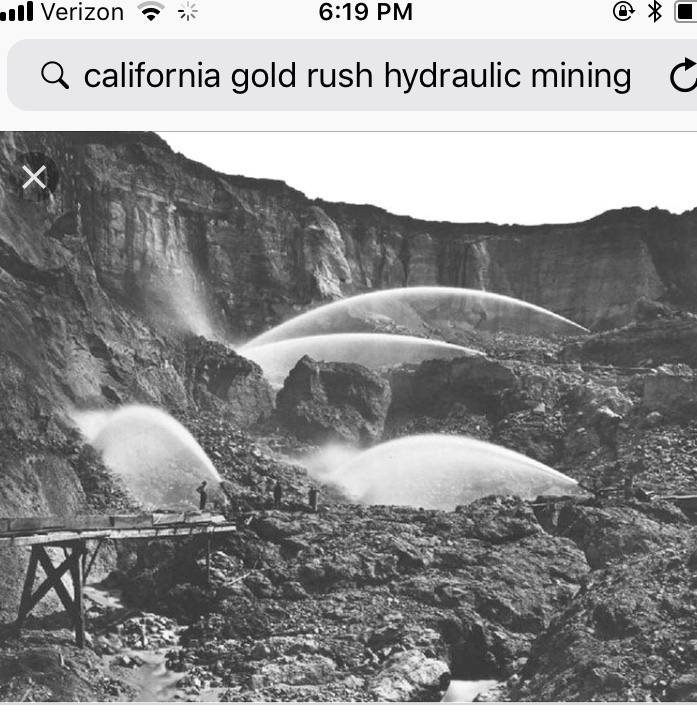
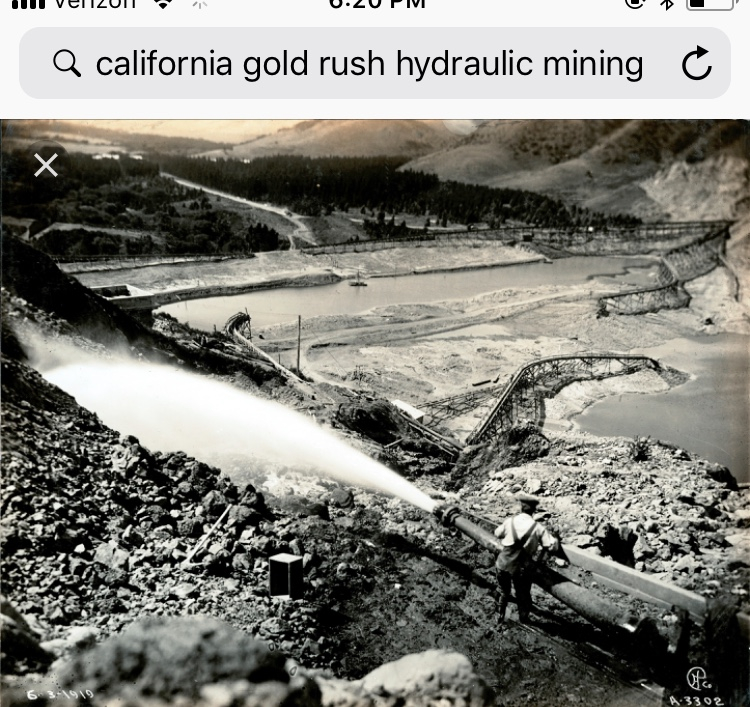
By damning water upstream and slowly necking down a pipeline downstream would create pressure for a Monitor. Blasting down everything it could reach and washing it to a plant.
Surly CA still has the kind of gold present like in the Yukon on the discovery show, but civilization covers it and built on these old tailings piles in places.
My understanding was that the people who were already in California and the very youngest people (the most mobile, fastest travelers) who made it in during the first wave did the best.
By the time they were hydraulic mining (less than a decade later), many people were just working for wages and had no real stake in the outcome. Big Money had already taken over the field.
Same thing happened in the Klondike, 1898. The people who were already there before the discovery did well, and after some strong recoveries, they sold out to big money and went back to Seattle and California. Many of the rushers never went out from Dawson City - the productive ground was already staked out and claimed that early. The geology of the Klondike was complicated too, and practically nobody understood it. Pierre Berton has written all about it. He figures that maybe 400 people did well out of the 80,000 to 100,000 persons who really headed off for Dawson City.
Not the only coins made from gold rush gold, it went to the other mints as well and they created whole new denominations to use it up

11.5$ Southern Dollars, The little “Big Easy” set
My understanding is that the placer gold was pretty much gone by 1852.
I suspect the 1st to discover could walk along and pick up hundreds of ounces per day if they were go getters like I would be!
My uncle's gramps (dammit not on my side) made his by sitting in a bar in Jenny Lind and providing the money for claims (reportedly five bucks) for gold seekers with the proviso that they repay his loan with the LAND in the claim after they were through.
He got 3300 acres of prime grazing land for the new, hungry state.
The ranch is still in that family.
Countless lifetimes of labor have been expended collecting the yellow stuff. During the various gold rushes those who did the best were often those who “mined the miners.” Shopkeepers, outfitters, ladies of the evening..... they generally did quite well.
The energy consumed, wasted and converted to heat would make global warming look like child's play if an equivalent amount of BitCoin was mined today.
If you take the tour at the Reed family mine near Charlotte, North Carolina, you will hear the same story. After 12 year old Conrad Reed for the nugget that was worth over $3,000 in the river bed near family home, and the content of the rock was confirmed, they started digging along the shore of the river. One of the slaves found on piece of gold bearing ore that weighed over 13 pounds. This was only one of many such finds.
After the river was played out, the family tried mining. Legal issues got involved, but the truth was the big money had been made off the claim early on. What was left was not worth the effort.
Actually my great great grandfather went to California ca. 1880 and hit it big building homes, churches and businesses out of brick. Many of the buildings are still very much there.
Read this
https://books.google.com/books/about/The_World_Rushed_in.html?id=JnvuCGyPj7sC&printsec=frontcover&source=kp_read_button
Best gold rush contemporary account out there.
Marvelous book.
Read this:
https://books.google.com/books/about/The_World_Rushed_in.html?id=JnvuCGyPj7sC&printsec=frontcover&source=kp_read_button
Best contemporary account of the gold rush out there.
That reminds me of the Clint Eastwood movie "Pale Rider."
Cheers
Bob
"I think I would have preferred to be the person who sold the miners their pans and shovels."
I understand that these people did quite well. Margin of profit for support items was astronomical.
There is still a surprising amount of alluvial gold to be found in California. I did some panning when I lived there, found mostly dust and tiny nuggets. However, a friend who lived in Grass Valley had a small pump and suction dredge and he had a couple of huge nuggets (small hen's egg size) and large jars of gold nuggets and dust. We lost touch when I left CA for Texas....I have no idea if he ever cashed it in.... Cheers, RickO
Great thread here,
My YouTube Channel
One day I am going to plan a trip to one of those gem parks and just spend my time looking for treasure. Nothing like the idea of making a big find. Would pack up today and move if I thought I could spend my day searching for goodies and still pay the bills.
Best place to buy !
Bronze Associate member
Nice thread 291. This era and location has really peaked my interest and has lead to beginning work on a set of type 1 S-mint double eagles. Goal is to get them in well circulated condition while still having plenty of detail and as unmessed with as possible. The idea of them being used for their intended purpose is appealing. All coins keep cools stories but these seem to speak to me a bit louder than others.
Just took these quick pics today of what's in the collection so far. Good timing.
The pale rider scenes at the mine were great.
There was not some quota of double eagle production that required effort to "extract enough gold." The number of coins made depended on how much gold was brought in to the mint.
http://www.foundsf.org/index.php?title=The_Gold_Rush:_Behind_the_Hype
You wouldn't get very far these days if you found a gold deposit and would need to get many permits and do it right.
Back in the "raw" days of the 1970's, you could barely find anyone who would buy those type1 twenties.
If only we knew. :'(
I still have 2.1 ounces of raw gold flecks that I panned in Alaska over a 2 day period. I was in the Army, I was laying over for 3 days, heading off for 365 days of glorious fun in the rice paddy wonderlands of Asia.
An Army friend had an uncle, IIRC, that had a machine dredge, and he let me pan the tailings after it had gone through the sluices boxes (believe that was the correct term) so it was just ground up crud laying down behind this machine as it chugged along.
I put it in a a big envelope and mailed it home, and retrieved it a year later. Gold was not worth that much, so it was no big financial deal. It sits in a couple old 35mm film containers in a safety deposit box in the town where my mom lives.
NARA archives include many reports to the mint regarding mining conditions, technologies and larger claims. These include most of the western states, and the early reports discuss eastern mining prospects.
Also, most of the annual mint reports have tables showing the quantity of gold mined in each state for the fiscal year. Your can access the annual reports on the NNP - free.
Those are awesome!
My YouTube Channel
I started reading the recommended book The World Rushed In by J. S. Holliday today.
It's slightly possible that some California gold ended up here:
United States $10 1850
The Mysterious Egyptian Magic Coin
Coins in Movies
Coins on Television
There was an episode of The American Experience a few years ago that looked really good. Ive still only seen the first few minutes of it. Here's a little bit from the transcript and a link to video.
By the summer of 1848, the news of gold had reached the pueblo of Los Angeles, some 350 miles south of San Francisco.
Antonio Franco Coronel, a 30-year-old Californio, was among the first to pull up stakes and head for the hills. A former officer in the Mexican army and a respected civic leader, Coronel had been lured north by reports of immense fortunes dug out of the ground with nothing more than a spoon.
Years later, he would recall his first attempt at mining...
"Everyone began to work at daybreak. Soon after a little digging we came to the gold deposits, and everyone who was working was happy with the results. I recovered about forty-five ounces of coarse gold. All the others, about one hundred and some odd persons, had brilliant results..."
In his first three days, Coronel pocketed more than eight pounds of gold, roughly 2,000 dollars' worth -- enough to buy at least one hundred horses...
North of where Coronel was digging, a fellow Californio recovered enough gold to pay off the ten workers he'd brought with him and return home with 14,000 dollars. Later, Coronel watched one man dig up an amazing 52 pounds of gold in just eight days. Another extracted enough in a matter of hours to fill his straw hat to the brim.
The early days must have been a blast.
American Experience Transcript.
YouTube Video.