Gold Dollars from the 1880s ... Proof vs. Unc.?
 BillJones
Posts: 36,020 ✭✭✭✭✭
I have been reading about gold dollars since the early 1970s when I purchased Walter Breen's pioneering work on gold dollar die varieties. One of the debates that often came up in the old days was how one could tell the difference between Proof and Mint State pieces. Both finishes looked very similar on some coins, and distinguishing the Proofs was difficult, especially when one didn't have a bonafide Proof to use for reference. The advice at that time was "to sell the coin as an Unc. if you weren't sure it's a Proof."
The gold dollars from the 1880s are interesting group. All of the mintages were low, usually less than 10,000 coins per year. Given the low mintages, the dies were seldom pushed to their limits, and the initial die polishing often lasted for most if not all of the production run. Therefore a lot of pieces had strong luster, and prooflike coins were sometimes more common than pieces with conventional mint bloom or satin finish.
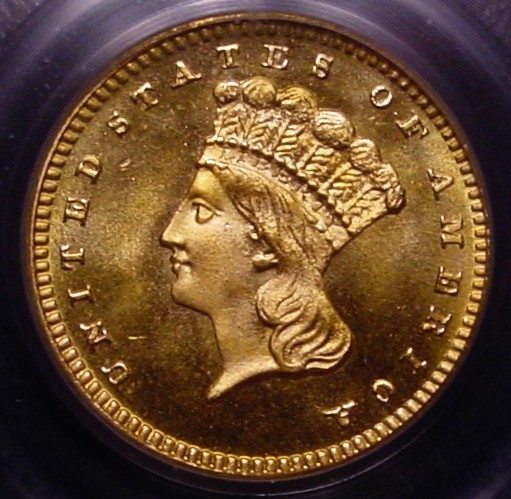
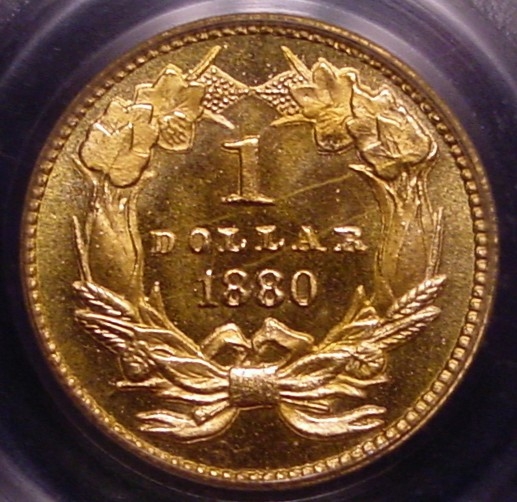
Although none of them are marked as such here some very lustrous gold dollars. This 1880 is the closest thing I have to a deceptive business strike that could be taken as a Proof. The business strike mintage was only 1,600 pieces.
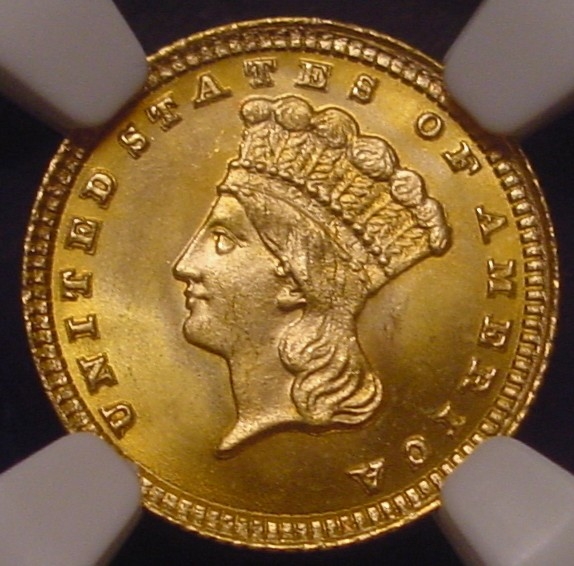
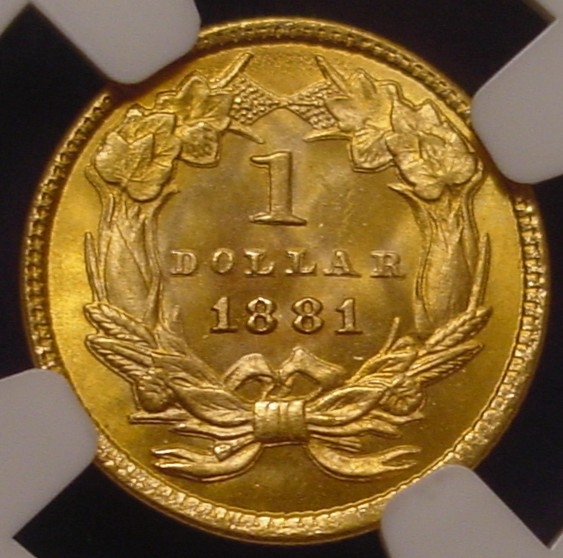
This 1881 is more convincing in person as a possible Proof.
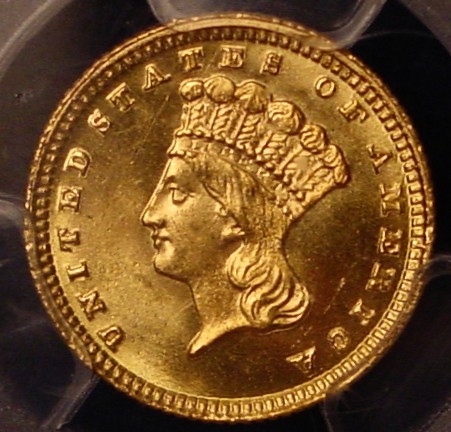
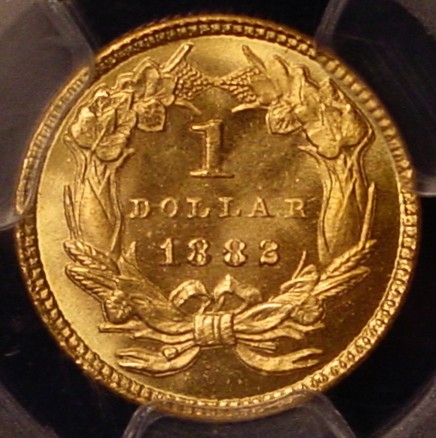
And here is an 1882 that has vibtant luster in person that might lead one to say "Proof."
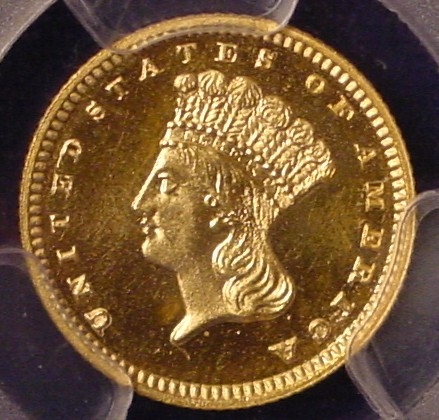
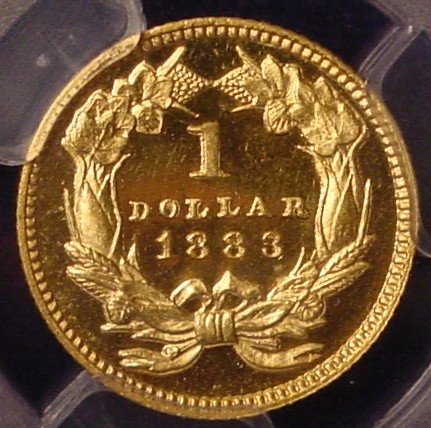
And here is the real thing ... an 1883 in Proof-65, Cameo. Note the even more lustrous fields and the well squared off, more nicely finished rims.
Comments
Bill, I'm guessing you look first at the rims to make a determination of proof versus mint state. Is that correct?
The reeded edge might also be very telling.
RMR: 'Wer, wenn ich schriee, hörte mich denn aus der Engel Ordnungen?'
CJ: 'No one!' [Ain't no angels in the coin biz]
Yes, the rims are good place to start, as well has the mirrors. Just how deep are they? On the Proof they are stronger, at least on the pieces I have owned.
No proof Liberty gold expert here. But, of the few hundred or so pieces I've seen over the years, they always seem to have obvious, rough orange-peel surfaces. So in my mind PL, fully PL flat mirrors and deep strike aren't enough. If there are exceptions, I've yet to personally hold one.
I'm certainly no expert, but I could tell the proofs from the photos.
See the Coin World article about production of gold dollars, and a longer version in the Journal of Numismatic Research (JNR).
I generally did not have any problem telling the Proofs from the Uncs on the gold dollars of the 1880's. The denticles, rims and edges were the telling points.
Now, the copper-nickel three cent pieces of the 1880's are an entirely different kettle of fish!
All nice thanks for sharing. I was at a show once where a guy came up wanting to sell an Indian quarter eagle he said was a proof. I wouldn't touch one that is uncertified.
Given the number of "mechanical errors" that are not covered under TPG guarantees, certification wouldn't be enough for me unless I could tell the difference.
Good thread Bill...thanks for the pictures.. a good lesson in this subject. Cheers, RickO
Those are some truly awesome gold dollars
Steve