Options
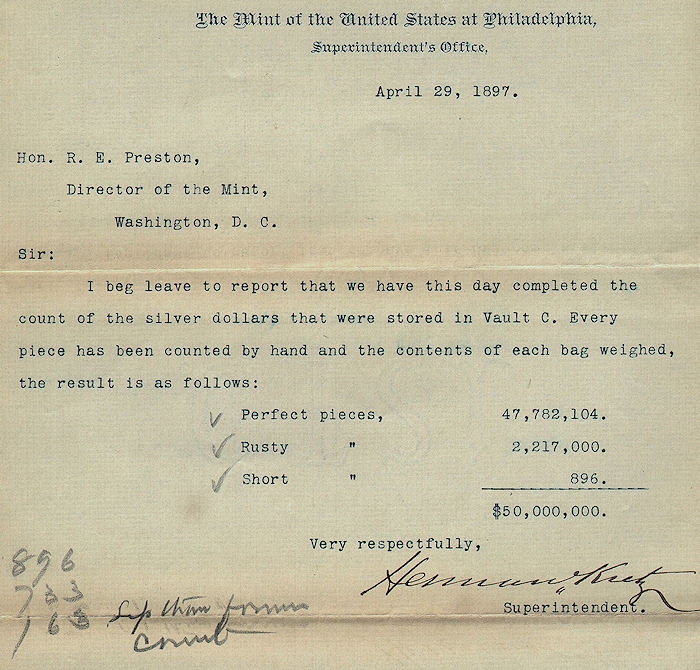
Sore fingers at the Philadelphia Mint....? 50,000,000 silver dollars counted by hand.
 RogerB
Posts: 8,852 ✭✭✭✭✭
RogerB
Posts: 8,852 ✭✭✭✭✭
Some of us think our jobs are boring, but what about the work done by a bunch of Philadelphia Mint workers in 1897.
6
Comments
That's a LOT of fingerprints.
I hope they didn't have to count them all on that single day!!!! WOW!!!! Probably took awhile, even with a bunch of workers.
Michael Kittle Rare Coins --- 1908-S Indian Head Cent Grading Set --- No. 1 1909 Mint Set --- Kittlecoins on Facebook --- Long Beach Table 700
Wonder what they meant by "Rusty." Surely 2 million + dollars did not have actual rust on them. Would be interesting if that meant they were tarnished... what we call toning???
Michael Kittle Rare Coins --- 1908-S Indian Head Cent Grading Set --- No. 1 1909 Mint Set --- Kittlecoins on Facebook --- Long Beach Table 700
If memory serves me correctly I believe they used counting boards. There were roll shaped receptacles I a box that would hold a known number of coins in each receptacle. They would pour loose coins into the tray and shake them into the holes then sweep off the excess allowing a known number to remain.
I don't think they were sliding two off the countertop into their hand counting to ten or twenty at a time.
Still a lot if work, but not nearly as much as "hand counting" would indicate.
A: The year they spend more on their library than their coin collection.
A numismatist is judged more on the content of their library than the content of their cabinet.
"Rusty" refers to coins that were discolored from water and minerals in the vault after many of the bags rotted. This is the likely source of many coins with attractive original toning. (The workers did not have blow torches or ovens handy.) Some were cleaned by the mint with soap and acid, others were considered unfit to distribute and melted. Exact numbers are among other papers in the archives. There is also a set of journals tracking the distribution of silver dollars from 1878 through 1890
Out of all those coins only 900 short. Amazing.
Successful BST:here and ATS, bumanchu, wdrob, hashtag, KeeNoooo, mikej61, Yonico, Meltdown, BAJJERFAN, Excaliber, lordmarcovan, cucamongacoin, robkool, bradyc, tonedcointrader, mumu, Windycity, astrotrain, tizofthe, overdate, rwyarmch, mkman123, Timbuk3,GBurger717, airplanenut, coinkid855 ,illini420, michaeldixon, Weiss, Morpheus, Deepcoin, Collectorcoins, AUandAG, D.Schwager, blu62vette, morgan13, torinoCobra71, JWP, promethius88,
As workers weren't (likely) examining each individual coin and setting aside rusty ones, then entire bags (or piles?) of rusty coins must have been condemned in one fell swoop.
I imagine workers used shovels to scoop up loose coins from rotted sacks. Makes you cringe.
Lance.
"Rusty" ... perhaps it was a 19th century "alternative fact".
Possibly. They did something similar with the Redfield hoard. Some of the bags were ripped or rotted from peach juice or opened and scattered across the floor from the coal chute drop. Those were scooped up with shovels and dust pans.
And we thought graders for statehood quarters were bored...
Here's a warning parable for coin collectors...
"Rusty" was explained in another document as discolored. It appears that workers gave a cursory check to each coin. And, yes, they probably used wooden shovels to clean up the mess in the vault. (The also had dollars in a large Post Office vault, plus the Sub-treasuries in Philadelphia, New York and New Orleans.)
I'm curious now Roger about the cause of loss, and the math along with footnote at lower left of document. Was the loss simply theft, culmination of slightly overweight coins when bagged- if they were weighed and not counted, or, just counted in error when initially stored in bags? Very interesting!
The procedure was to separate intact bags from loose coins and broken bags. The complete bags were first weighed, then counted. According to other documents, there were occasional shortages and inclusion of planchets or defective coins accounted for most of the loss. After individual counting, the coins were put into boxes and sealed. Bags were discarded with other fabrics and eventually burned. Ashes were reduced to recover silver and gold. Loose coins were counted, put into 1,000-coin boxes and sealed. Defective and damaged pieces were designated for recoinage. The pencil notations refer to shortages in bags, short count of loose coins and damaged/defective coins. All of these were supposed to be deducted from the final vault inventory. (I don't recall the proportion of good bags vs loose coins but it is in the documentation.) There is a complete list of box numbers available -- but it tells us nothing about the dates/mints of coins. (No notes about "Dear diary...counted 12,000 1895 dollars today; ate lunch; salami was rancid; threw-up on the vault floor; shoveled silver dollars.")
Mint officers also attempted to recover the shortages from the surety bonds of previous Superintendents. Incoming Superintendents normally accepted the vault seals from his predecessor without demanding a physical count of contents. But, that made the new Superintendent responsible for any shortage. All of the bond recoveries failed. I don't know how the matter was resolved -- maybe in a later box or volume that info will appear. Resolution is complicated because of seigniorage, and differences in bullion origin and enabling legislation.
Good information Roger- thanks for the follow up, and the humor! Would be interesting if there were such diaries, employee "stories," gossip, etc., that survived.
I once saw the most amazing thing at a museum..... in Boston I think. It was a clear plastic tube maybe 1.5 feet in length and maybe 4" in diameter (I might be way off, this was years ago, but it wasn't too big). The tube contained 1,000,000 small beads, the sort you would use for Indian jewelry and such. There was 1 red one, 9 blue ones, 90 green ones, 900 purple ones, 9,000 white ones, 90,000 yellow ones, and 900,000 black ones. The number of beads was staggering. A person really can't comprehend a number as large as 50,000,000.
A person who could process 10 coins per second would require 8 months of 40-hour workweeks (with no breaks) to get through the pile. Even with a counting board I doubt a person could process anywhere near that many. It would take an army of people quite a while to go through them. It would take even longer to inspect them and reject 4% of the total for "rust".
I'm sure by the end they abused them in ways that would make a numismatist shudder. What are precious treasures to us today were simply mass-produced product to them.
I find it fascinating what comes out of the old archives... while often useful information is found, just as often, it leads to even more questions - as in this case. Cheers, RickO
Thanks again for the numismatic history lesson
Successful transactions with : MICHAELDIXON, Manorcourtman, Bochiman, bolivarshagnasty, AUandAG, onlyroosies, chumley, Weiss, jdimmick, BAJJERFAN, gene1978, TJM965, Smittys, GRANDAM, JTHawaii, mainejoe, softparade, derryb, Ricko
Bad transactions with : nobody to date
Attn: Supervisor
I have been counting silver dollars for 10 hours straight and the nonsense words “monster rainbow toning” keep running through my head. Could I please have an extended break before my next shift? Thanks.
P.S. I came across an incomplete bag of silver dollars from San Francisco, dated 1873. Looks like there are 300 missing. What do I do with it?