Options
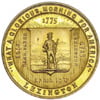
This isn't a common Bryan Dollar
 jonathanb
Posts: 4,115 ✭✭✭✭✭
jonathanb
Posts: 4,115 ✭✭✭✭✭
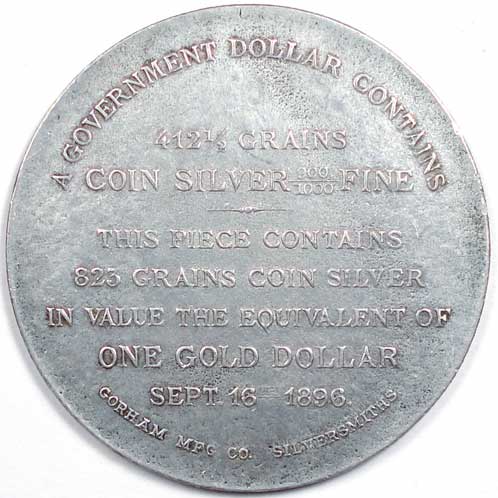
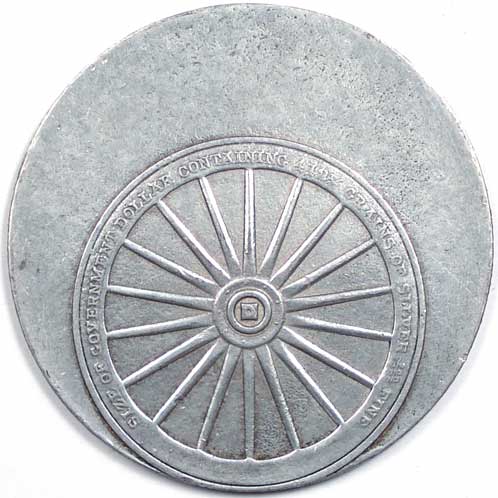
This looks like HK-780, a common Bryan Dollar (possibly the most common Bryan Dollar). It isn't. Do you know what it is?
0
Comments
I'm curious what the catch is, but it almost looks like a cast counterfeit. The Gorham dollars are usually of good quality and this one seems to have some surfaces oddities.
For a large selection of U.S. Coins & Currency, visit The Reeded Edge's online webstore at the link below.
The Reeded Edge
The weight is only 25 grams, which is less than half of what it should be. I'm pretty sure that this is not a modern counterfeit, although I don't know when it's from.
The strange thing is that it's not really that rare. In really nice condition, a real one might be worth $350 in very very nice condition. Just goes to show that anything might be counterfeit!
"823 Grains Coin Silver" on a single line...
I have a Bryan Dollar that I recently bought that has:
"823 Grains" on one line...
and "Coin Silver 900/1000 Fine" on the line directly below.
Also, my Bryan Dollar says "Spaulding & Co." at the bottom just above "Goldsmiths & Silversmiths" where the imaged example does not.
Michael Kittle Rare Coins --- 1908-S Indian Head Cent Grading Set --- No. 1 1909 Mint Set --- Kittlecoins on Facebook --- Long Beach Table 700
<< <i>Props go to Shortgapbob, this is indeed a counterfeit:
The weight is only 25 grams, which is less than half of what it should be. I'm pretty sure that this is not a modern counterfeit, although I don't know when it's from.
The strange thing is that it's not really that rare. In really nice condition, a real one might be worth $350 in very very nice condition. Just goes to show that anything might be counterfeit! >>
Well since it has copy on the edge has to be made sometime after 1973.
<< <i>Well since it has copy on the edge has to be made sometime after 1973. >>
The Hobby Protection Act of 1973 specifically says 'The word “COPY” shall be marked on either the obverse or the reverse surface of the item. It shall not be marked on the edge of the item.' It also has minimim size requirements that this one doesn't meet.
This may well have been produced after 1973... but since it doesn't meet the 1973 requirements to start with, I don't think that we can be sure either way.
Michael Kittle Rare Coins --- 1908-S Indian Head Cent Grading Set --- No. 1 1909 Mint Set --- Kittlecoins on Facebook --- Long Beach Table 700
<< <i>Props go to Shortgapbob, this is indeed a counterfeit:
The weight is only 25 grams, which is less than half of what it should be. I'm pretty sure that this is not a modern counterfeit, although I don't know when it's from.
The strange thing is that it's not really that rare. In really nice condition, a real one might be worth $350 in very very nice condition. Just goes to show that anything might be counterfeit! >>
That was my guess. The surfaces look unusually pitted for a Bryan Dollar.
BTW, if it's stamped with COPY, is it still technically a counterfeit?
auction about 10 years ago. I took it to FUN to sell a couple years ago, and was offered $150, and decided to just hold on to it, for
it's 'neatness factor'.
<< <i>The Bryan Dollar pictured has:
"823 Grains Coin Silver" on a single line...
I have a Bryan Dollar that I recently bought that has:
"823 Grains" on one line...
and "Coin Silver 900/1000 Fine" on the line directly below.
Also, my Bryan Dollar says "Spaulding & Co." at the bottom just above "Goldsmiths & Silversmiths" where the imaged example does not. >>
The Spaulding pieces are listed as numbers 16 (wagon wheel on the reverse) and 17 (blank reverse) in Fred Schornstein's book. He says that they are "scarce" while the Gorham pieces are "common." I have a small collection of these, but I don't have photos of all of them. This piece from the 1900 presidential campaign is said to be rare. It is listed a variety 10 in Schornstein's book. I also have one of the Tiffany & Co. pieces which I could photograph and post if there is an interest in it.
The copy that started this thread does not look like it is made out of silver. All of the original examples were made of standard coin silver (90% silver, 10% copper) and had messages that compared their weight and size to the U.S. Government silver dollar. The message was that a dollar had be that big to be worth a dollar. One piece from the 1900 campaign was the size of a Morgan dollar, and it was marked that it was only worth 48 cents. Schornstein says that this variety is common, but I have not seen a lot of them in my years as a collector.
<< <i>
Also, my Bryan Dollar says "Spaulding & Co." at the bottom just above "Goldsmiths & Silversmiths" where the imaged example does not.
The Spaulding pieces are listed as numbers 16 (wagon wheel on the reverse) and 17 (blank reverse) in Fred Schornstein's book. He says that they are "scarce" while the Gorham pieces are "common." I have a small collection of these, but I don't have photos of all of them. This piece from the 1900 presidential campaign is said to be rare. It is listed a variety 10 in Schornstein's book. I also have one of the Tiffany & Co. pieces which I could photograph and post if there is an interest in it. >>
Thanks for the information on the different varieties. Very cool 1900 examples too
Michael Kittle Rare Coins --- 1908-S Indian Head Cent Grading Set --- No. 1 1909 Mint Set --- Kittlecoins on Facebook --- Long Beach Table 700