Options
A 1608 Lion Dollar
 BillJones
Posts: 35,819 ✭✭✭✭✭
BillJones
Posts: 35,819 ✭✭✭✭✭
I purchased this coin at the recent FUN show because it is mentioned in the "Historical Background The Early Dollars of the U.S. 1794 - 1804" by R. W. Julian in volume 1 of Dave Bowers' two volume work on silver dollars. There Julian traces the history of the dollar sized coin back to 1486 when Archduke Sigismund of Tyrol struck the guldengroschen which was later shortened to gulden or guldiner. In 1520 the counts of Schlick in Bohemia, which was a part of what would become Czechoslovakia, began to strike these large silver coins on a regular basis. By the 1600s large silver coins were being struck all over the European continent. The coins were known as Joachimsthalers which was later shortened to thalers or talers.
I have posted an example of the Dutch version of these coins below. The Dutch provinces issued these coins which were known as Leeuwendaalders (lion dollars) from 1575 to 1713. Although these coins probably saw very little if any use in the American colonies, they nevertheless are an ancestor to the American silver dollar and are of some interest to American collectors.
Aside from the date area this coin is very well struck, and it has some very pretty envelope toning. According to John Kraljevich, who sold this piece to me, these coins were struck on a drop press which was the same device that used to make the Fugio cents.
This is now the oldest coin that has a date in my collection.
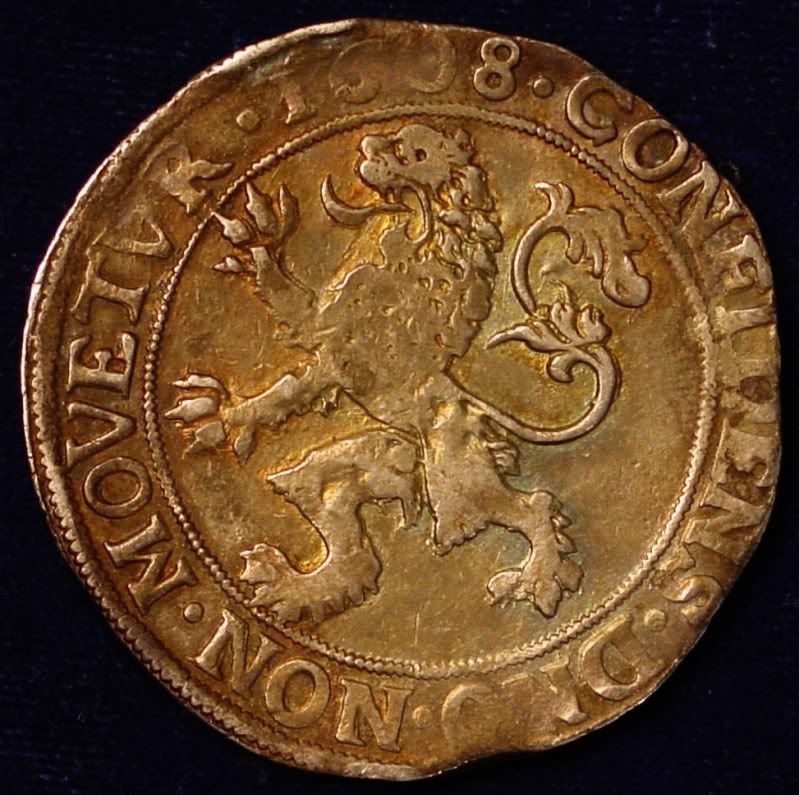

I have posted an example of the Dutch version of these coins below. The Dutch provinces issued these coins which were known as Leeuwendaalders (lion dollars) from 1575 to 1713. Although these coins probably saw very little if any use in the American colonies, they nevertheless are an ancestor to the American silver dollar and are of some interest to American collectors.
Aside from the date area this coin is very well struck, and it has some very pretty envelope toning. According to John Kraljevich, who sold this piece to me, these coins were struck on a drop press which was the same device that used to make the Fugio cents.
This is now the oldest coin that has a date in my collection.
Retired dealer and avid collector of U.S. type coins, 19th century presidential campaign medalets and selected medals. In recent years I have been working on a set of British coins - at least one coin from each king or queen who issued pieces that are collectible. I am also collecting at least one coin for each Roman emperor from Julius Caesar to ... ?
0
Comments
Congrats!
EVP
How does one get a hater to stop hating?
I can be reached at evillageprowler@gmail.com
<< <i>What an Impressive Coin! I am In awe of the mark free surfaces combined with great age. Has it a provenance? What is the rim treatment and weight? >>
The rim is plain, and the plachet is on the crude side. Sorry, but I don't have scale.
<< <i>Nice piece. These coins are tough to grade because of their strike issues. These coins are crazy tough to find in ChMS.
Congrats!
EVP >>
I would grade this one AU-55, but that would be an American collector's standard. The Europeans are more conservative from what I understand.
<< <i>Such a beautiful coin with some amazing history behind it, thanks for sharing! >>
<< <i>
<< <i>Such a beautiful coin with some amazing history behind it, thanks for sharing! >>
My maternal grandmothers name was Dollar, which is Scots-Irish and probably came from the town of Dollar in Clackmannanshire, Scotland. It would be interesting to know if there is any connection.
This is also my oldest coin with a date on it
Liberty: Parent of Science & Industry
"The lion dollar circulated throughout the Middle East and was imitated in several German and Italian cities. It was also popular in the Dutch East Indies as well as in the Dutch New Netherlands Colony (New York). The lion dollar also circulated throughout the English colonies during the Seventeenth and early Eighteenth centuries. Examples circulating in the colonies were usually fairly well worn so that the design was not fully distinguishable, thus they were sometimes referred to as "dog dollars." Larger Dutch silver coins as the ducatoon and the "rix" dollar (rijksdaalder) were also used in the colonies but neither of these coins had such a wide circulation or long lasting influence as the lion dollar.
In Maryland the lion dollar was mentioned as the most important circulating coin in documents of 1701 and 1708, with its value stated as 4s6d."
NEN always has a nice selection of graded pieces. They tend to range from $300 to $1500.
Right now they've got a couple of MS examples and one neat piece dated 1604.
--Severian the Lame
Steve
Edited to add: as usual, Baley has impressed me, not only by posting one from the 16th century, but also a CircCam!
Collector since 1976. On the CU forums here since 2001.
Not really looking for much these days but if I were, it might be a toner.
Nice pics too.