Options
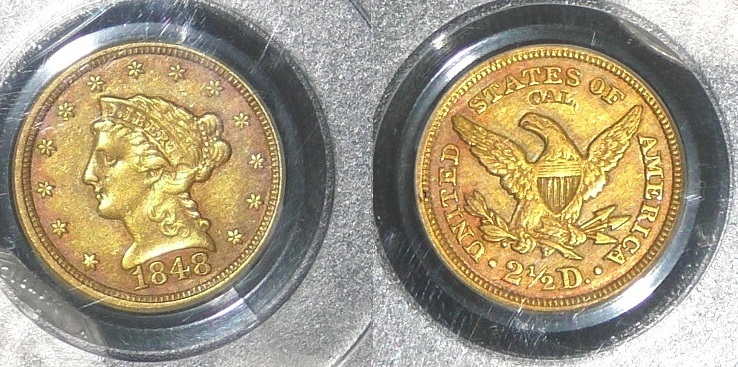
Back to the 1848-CAL quarter eagle. heh.
 topstuf
Posts: 14,803 ✭✭✭✭✭
topstuf
Posts: 14,803 ✭✭✭✭✭
Okay, not just because I got one recently, but for scholastic purposes  everything I read says they applied the "CAL" while in the die.
How?
Were the dies horizontal so a stamp could be done before removal (or ejection ?) of the coin? Seems they would have to be struck obverse down also. Makes me wonder how they didn't blur the obverse if stamping on the other side with no reverse die holding the coin in place.
????/
2
Comments
Strike all the coins.
Take the obverse die out of the press and stand it up on a work bench, possibly the same one where they punched dates and mint marks into dies.
Take a coin, fit it face down into the design in the obverse die.
Punch the CAL.
Repeat until all are punched.
yow!
But thanks. Hadn't thought of that. Wouldn't that make at least SOME of them all messed up on the obverse? Or are some?
CaptHenway's idea makes sense. There was not enough space between dies in a toggle press (or screw press, either) to allow a punch to be placed and struck. Thus, "CAL" had to be punched after the coin was removed from the press.
That's what I thought, too. But all the references that I have found say they were stamped IN the press.
http://www.pcgscoinfacts.com/Coin/Detail/7749
"The stamping appears to have been done while the coins were still in the press, as none of the obverse features appear to have been flattened. At least one example (the James F. Lindsay - 1978 GENA, Lot 1839 example) shows triple punching."
???????????
They are wrong.
While I was at ANACS, we saw one piece that apparently was not properly seated in the obverse die for the counterstamping. The date shows severe "machine doubling" where it was hit against the date in the die slightly offset to one side.
A classic case of someone having/giving half the story. Whoever wrote that had the right idea but presented it incorrectly. Yes, the coin was on the obverse die when counterstamped, but of course it was not still in the press - that was an incorrect assumption on someone's part that made no sense.
As to why all of the coins show no damage to the reverse, when the coin was set on the obverse die (which was on a workbench), it would have been maneuvered until the raised details on the coin dropped into the corresponding engraved elements on the die. Far from obliterating obverse details, the counterstamping would have reinforced or sharpened up the obverse details beneath the counterstamped area.
A good topic, though, as I am sure many people have wondered about this.
That is how I've imprinted all of my modern Lesher tokens. Doing it this way prevents distortion of the opposite side, even with a very hard hammer blow.
I have always wanted one but have never stepped up to the plate.
Me too, only gold coin I ever really wanted.
I read that the mint set up a device called a jig ("the jig is up" LOL) which is a mechanical device that performs a duplicate, repetitive movement over and over again. The struck coins were mounted on the obverse die face so that the jig could apply the "CAL." If the coins were not mounted on the obverse die, there would have been a flat spot, which almost always seen on counterstamped coins.
Yep. The Mint engraving dept had several jigs and alignment guides used for punching numerals, mintmarks, etc.
Are the dies reversible where the reverse die can be mounted above to strike the coin?
topstuf, What a gorgeous coin with great toning. It's one coin I always thought was special but have never been offered that was cleaned and unattractive.
Wasn't there one in the last few years where the obverse was deformed by the punching?? Will see if I can find it.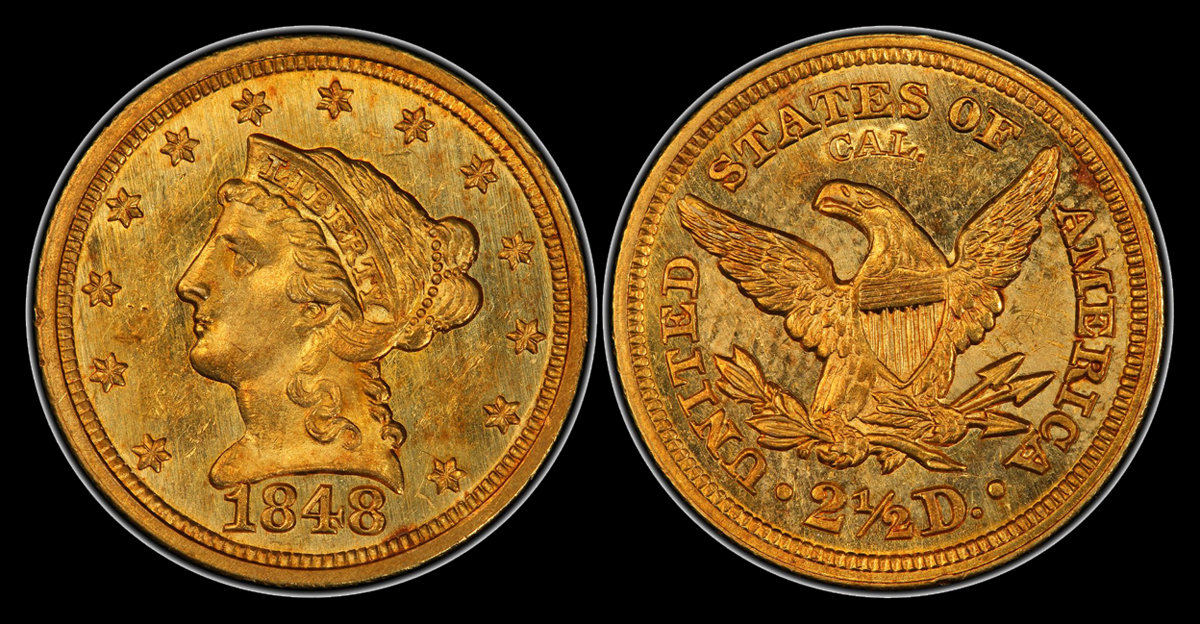
Like everything else, you have to examine every 1848 "CAL" very carefully. When I bought my piece, there was a higher graded example in an auction. It looked nice on the surface, but you REALLY examined it, you could that the surfaces had been moved around a bit. I purchased a very attractive PCGS AU-55 for quite a bit less money that had original surfaces.
Interesting discussion..... I am surprised there are no records stipulating the method...well, more clearly stipulating than what we have seen... I think the method Capt. Henway described is likely the answer... Cheers, RickO