Search
-
Re: Do Collectors Look to "Create" Rarity to Increase the Challenge (and Fun) of Collecting
 As a died-in-the-wool collector of die marriages and die states of draped bust half dollars, among other things, I have no desire to "create" rarity. My focus at present is to restore lost knowledge (the emission sequence of early half dollars) and to enjoy the peculiarities of early mint technology. I find it fascinating…
 -
Re: FUN Purchase, US Mint NA-6 Medal, from JK
 << <i>A very nice looking Navy medal, perhaps all the more interesting in the collection of an old retired Army Colonel. What can you tell us about the medal, its designer, and Captain Blakely? >> this bronze medal is from the original dies and was struck at the Philadelphia mint from Julian's "Medals of the United States…
 -
Re: Gallery Mint Museum by Ron Landis and Joe Rust
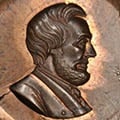
 That is a great story @WDP! It's pretty incredible that Ron noticed the feathers were punched in "one by one" and did the same on his own dies. Great research both in examining the original piece and seeing how it would be today. Here's my 1796 dollar with cud. After seeing all the coins with circular die cracks around the…
 -
Re: $5 1843 Dahlonega - Only known SPECIMEN or PROOF from the Dahlonega Mint
 << <i>id like someone to offer an opinion of why a proof coin would have no contact marks >> Here's the general methodology: Proof coins were struck from specially prepared, ultra-polished dies, special planchets, and struck one at a time, under increased pressure -- in order to ensure a razor-sharp strike. The Proofs…
 -
Re: If Kennedy wasn't assassinated who would.......
 I think there is a good chance Kennedy would still be on the half dollar today regardless. If he had survived, he would be about 89 today - the demographics are against him so he probably would have died anyway by now. Since he was a very popular President, he could easily have still been in line to be on the half if he…
 -
Re: 2015 Homestead Extra Chimney, Die Chip.
 It's a minor die chip and minor die chips are relatively common on quarters. Giving it a catchy name, doesn't make it any rarer. All it does is fool newer collectors into thinking it's something special, which it isn't. In God we Rust minor filled dies, spitting eagle minor die clashes, snow on the roof minor die chips;…
 -
Re: 1837 Reeded edge half with re-engraved collar.
 from Mine to Mint by Roger W. Burdette pg. 413, 4th paragraph under heading Edge Dies- Cutting Reeding "The Philadelphia Mint used a straight knurl to put reeding in the collar. The bored out collar was put in the chuck of a lathe and allowed to turn slowly. The knurl was held inside the collar while the latter revolved,…
 -
$1 1798 reverse wear pattern

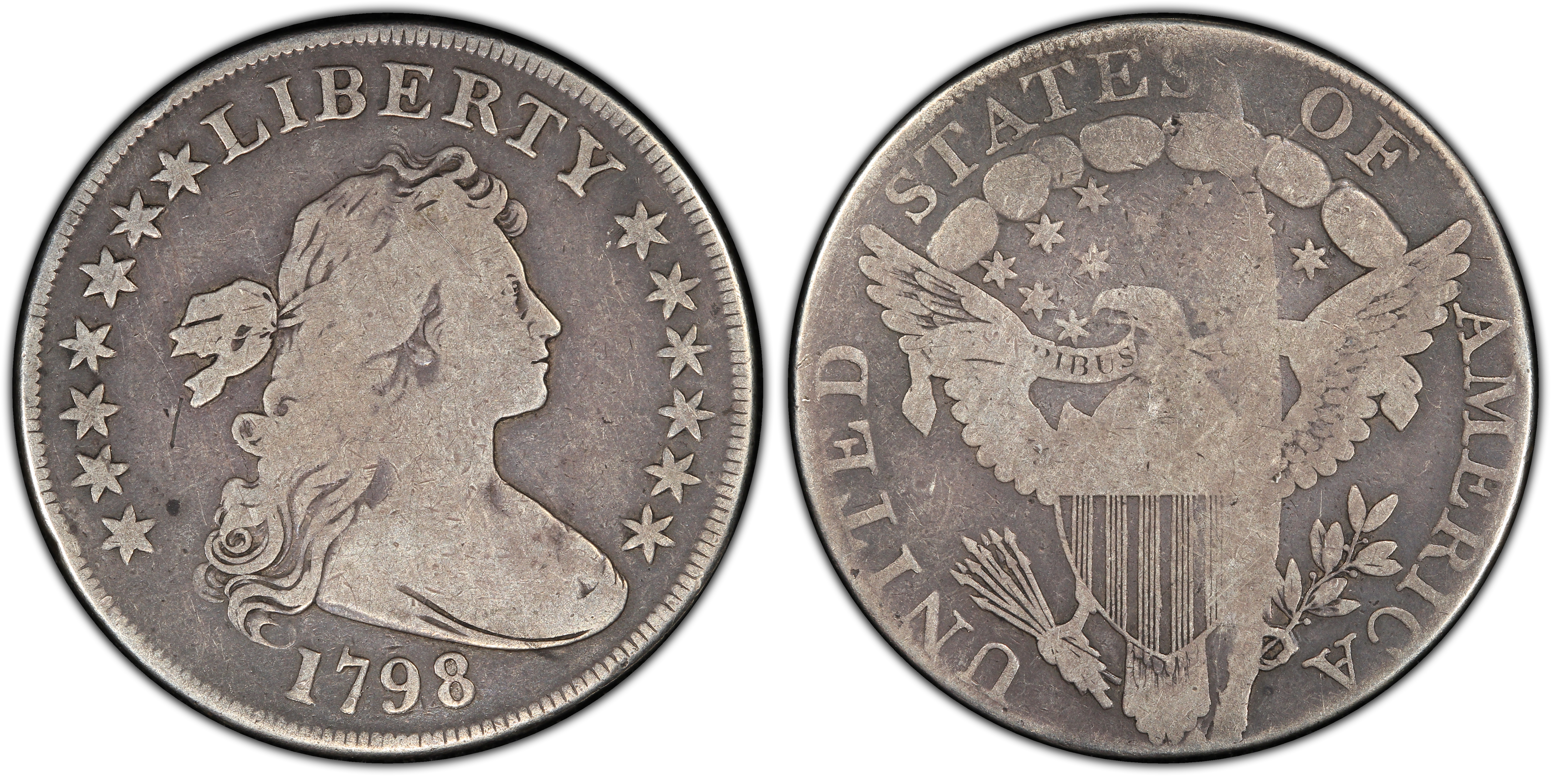 So when I saw this $1 1798 I wondered how did that vertical wear happen on the reverse. . . . . Another search of the variety ($1 1798 4 Lines Knob 9 - B-5 BB-93) revealed the answer. It is a big die crack from top to bottom. I suspect the height is uneven and perhaps from side to side as the striking is a little uneven on…
 -
Re: An example of why modern collecting is very volatile...
 Most moderns sell for a fraction of the difference in one 95-O upgrade from MS63 to MS64. I suppose someone finding a bag of 95-O's stuck away in a hoard would have an impact, but I think that misses my point. There are coins within each modern series that most of us EXPECT to explode. There are also coin's we expect…
 -
Re: Why does PCGS GD4 Morgans have a ton more detail than a GD4 early copper cent?

 This is a complicated issue because you are looking at two coins made during different eras when the technologies were totally different. The 1794 cent was when the U.S. mint was really an amateur operation. U.S. Government officials had been unable to attract professional coin makers from Europe, and the people who were…
>18151 results