Options
Bought an interesting and rare Colonial recently.
 Lakesammman
Posts: 17,702 ✭✭✭✭✭
Lakesammman
Posts: 17,702 ✭✭✭✭✭
Actually, a "copy" of a rare colonial. A well made electrotype.

To be honest, I didn't know much about it. But, the more I've learned, the more interesting it becomes.
It's a George Clinton copper coin. Very rare. A VF 20 specimen at the Garrett sale sold for $29K. There are only a handful, the Parmalee coin said to be Unc.
Clinton, no relation to Bill, was Revolutionary war hero, 1st Gov. of NY and served as VP under 2 different Presidents.
Here is his picture and more info, gleaned from the internet. If you have additional useful info, please post it below.

More about his life.
This, from PCGS and other sites.
Machin's Mills appeared to have been the most prolific of New York-related coinage. Thomas Machin attempted unsuccessfully to acquire an official patent from the New York legislature. This failure apparently mattered little, for at the time Machin was busily engaged in the coining enterprise and was producing issues of Vermont, imitation British halfpennies, Connecticut coppers, and others.
Some of the dies associated with Machin's Mills and with New York are believed to have been made in Birmingham, England, by Wyon. These were used to strike certain pieces in Birmingham and were later shipped to the United States for continued use. There are many die combinations among these issues, some of which are not logical, and nearly all are of great rarity.
The GEORGE CLINTON and LIBER NATUR LIBERTATEM DEFENDO issues are thought to have been samples made by James F. Atlee for Thomas Machin's petition to the New York State Assembly, mentioned above. Machin formed his partnership to make private coppers on the very day the state senate rejected his petition. Atlee kept the LIBER NATUS die, and in the Machin's Mills mint's last days this die and others were used in any combination, no matter how illogical, inadvertently creating pieces of exceptional rarity for future generations of numismatists.
Broadstruck provides additional information regarding Bolen restrikes.
1787 Bolen reproduction of the Clinton Pattern
Obverse: GEORGE * CLINTON *
Reverse: 1787 / EXCELSIOR
Weight: 158.6 g (10.28 grams) Diameter: 27 mm Reverse die alignment: 180°
Comments: This is a well preserved example of the reproduction of the Clinton pattern produced in 1869 by John Bolen. The obverse of this reproduction can be identified by the dot in the center of the O of George, added by Bolen to distinguish it from the original.
The reverse can be distinguished in several ways. The upper left corner of the first E in EXCELSIOR touches the baseline and is slightly to the right of the foot on the figure of Justice. On the original the corner of the E is directly under the foot. Also, in the center of the seal is the rising sun in a double oval frame. On the reproduction the outer oval is incomplete stopping at the first baseline on the right and at the second baseline on the left side, while on the original the outer oval is complete (with the upper baseline stopping where it meets the oval). Additionally the sun has fifteen rays in the reproduction while in the original the sun has thirteen rays. Also, Breen has pointed out that in the date the tops of the 78 are at the same height in the reproduction but on the original the 8 is higher. This reverse is also used in the following example of the Liber Natus pattern.
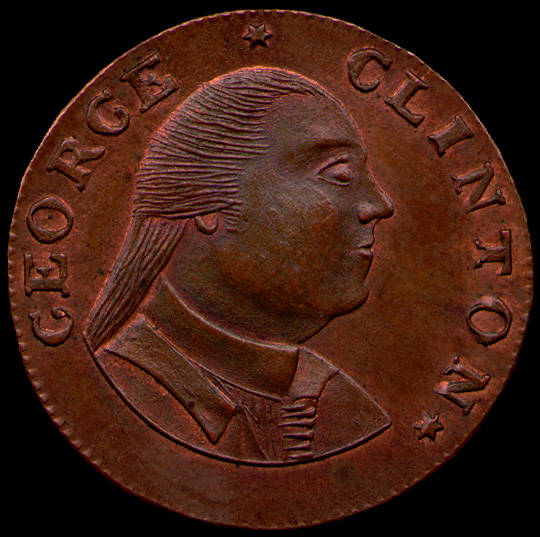
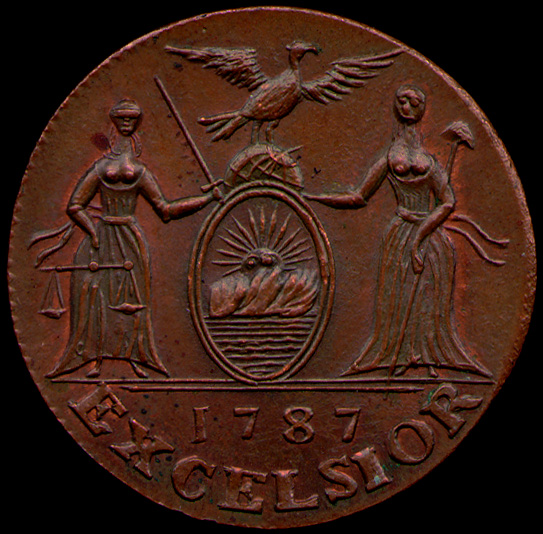
MLC kindly added this plate from the Parmelee sale.

To be honest, I didn't know much about it. But, the more I've learned, the more interesting it becomes.
It's a George Clinton copper coin. Very rare. A VF 20 specimen at the Garrett sale sold for $29K. There are only a handful, the Parmalee coin said to be Unc.
Clinton, no relation to Bill, was Revolutionary war hero, 1st Gov. of NY and served as VP under 2 different Presidents.
Here is his picture and more info, gleaned from the internet. If you have additional useful info, please post it below.
More about his life.
This, from PCGS and other sites.
Machin's Mills appeared to have been the most prolific of New York-related coinage. Thomas Machin attempted unsuccessfully to acquire an official patent from the New York legislature. This failure apparently mattered little, for at the time Machin was busily engaged in the coining enterprise and was producing issues of Vermont, imitation British halfpennies, Connecticut coppers, and others.
Some of the dies associated with Machin's Mills and with New York are believed to have been made in Birmingham, England, by Wyon. These were used to strike certain pieces in Birmingham and were later shipped to the United States for continued use. There are many die combinations among these issues, some of which are not logical, and nearly all are of great rarity.
The GEORGE CLINTON and LIBER NATUR LIBERTATEM DEFENDO issues are thought to have been samples made by James F. Atlee for Thomas Machin's petition to the New York State Assembly, mentioned above. Machin formed his partnership to make private coppers on the very day the state senate rejected his petition. Atlee kept the LIBER NATUS die, and in the Machin's Mills mint's last days this die and others were used in any combination, no matter how illogical, inadvertently creating pieces of exceptional rarity for future generations of numismatists.
Broadstruck provides additional information regarding Bolen restrikes.
1787 Bolen reproduction of the Clinton Pattern
Obverse: GEORGE * CLINTON *
Reverse: 1787 / EXCELSIOR
Weight: 158.6 g (10.28 grams) Diameter: 27 mm Reverse die alignment: 180°
Comments: This is a well preserved example of the reproduction of the Clinton pattern produced in 1869 by John Bolen. The obverse of this reproduction can be identified by the dot in the center of the O of George, added by Bolen to distinguish it from the original.
The reverse can be distinguished in several ways. The upper left corner of the first E in EXCELSIOR touches the baseline and is slightly to the right of the foot on the figure of Justice. On the original the corner of the E is directly under the foot. Also, in the center of the seal is the rising sun in a double oval frame. On the reproduction the outer oval is incomplete stopping at the first baseline on the right and at the second baseline on the left side, while on the original the outer oval is complete (with the upper baseline stopping where it meets the oval). Additionally the sun has fifteen rays in the reproduction while in the original the sun has thirteen rays. Also, Breen has pointed out that in the date the tops of the 78 are at the same height in the reproduction but on the original the 8 is higher. This reverse is also used in the following example of the Liber Natus pattern.
MLC kindly added this plate from the Parmelee sale.
Gone but not forgotten: IGWT, Speedy, Bear, BigE, HokieFore, John Burns, Russ, TahoeDale, Dahlonega, Astrorat, Stewart Blay, Oldhoopster, Ricko, Big Moose, Cardinal, CoinsAreFun.
0
Comments
Drunner
The Clinton is very appealing and it's my favorite of the the 3 colonial copies you recently acquired.
Since PCGS recently encapsulated a electrotype 1804 $1 you might be on to something with these!
It has the texture/features of an electrotype and was guaranteed to be so by the seller.
It's raw - not in a genuine holder.
Really??
<< <i>Since PCGS recently encapsulated a electrotype 1804 $1 you might be on to something with these!
Really??
<< <i>There are only a handful, the Parmalee coin said to be Unc. >>
Yes, plated in the Parmelee sale catalog (June 1890) as lot 452, and therein described as uncirculated.
Drunner
I am working on a complete set of Machin Mills 1/2 British Penny counterfeiit pieces under the exclusivee guidance of John Agre of CRO. Some of the pieces in the set are quite scarce that they are the only dates to be stickered by CAC.
by the way, some of the top dealers and experts on the Machin Mills Mint issues include John Agre, Terranova, Pistareen.
Machin Mills "Mint" was located on Machins Lake now called Orange Lake in Orange County, NY. It was formerly in Ulster County NY that was annexed by Orange County NY. It is located in the Town of Newburgh, NY, right near the headquarters of Orange County Choppers, regularly seen on Discovery Channel. They are right near where I live and work.
there is much more about the history and some of can be gleaned in multiple posts about Machins Mills here and also on the Internet.
<< <i>If the Chinese start counterfeiting Doilies, I will personally commandeer an F-4 (OK, dated, but that is the last ride I was checked out in) and deliver a Tac-Nuke to the location of your choice in China. No need to refuel . . it'll be a one-way ride.
Drunner >>
Hey, there are Chinese on these forums...
<< <i>Funk-a-delic! >>
Now thats the real deal
INYNWHWeTrust-TexasNationals,ajaan,blu62vette
coinJP, Outhaul ,illini420,MICHAELDIXON, Fade to Black,epcjimi1,19Lyds,SNMAN,JerseyJoe, bigjpst, DMWJR , lordmarcovan, Weiss,Mfriday4962,UtahCoin,Downtown1974,pitboss,RichieURich,Bullsitter,JDsCoins,toyz4geo,jshaulis, mustanggt, SNMAN, MWallace, ms71, lordmarcovan,JWP,dantheman984,olah_in_MA,USMC_6115
Like VOC Numismatics on facebook
Thanks for posting that photo plate from the Parmalee Sale, MidLifeCrisis. That is my favorite auction sale of all time.
Coin Rarities Online
1787 Bolen reproduction of the Clinton Pattern
Obverse: GEORGE * CLINTON *
Reverse: 1787 / EXCELSIOR
Weight: 158.6 g (10.28 grams) Diameter: 27 mm Reverse die alignment: 180°
Comments: This is a well preserved example of the reproduction of the Clinton pattern produced in 1869 by John Bolen. The obverse of this reproduction can be identified by the dot in the center of the O of George, added by Bolen to distinguish it from the original.
The reverse can be distinguished in several ways. The upper left corner of the first E in EXCELSIOR touches the baseline and is slightly to the right of the foot on the figure of Justice. On the original the corner of the E is directly under the foot. Also, in the center of the seal is the rising sun in a double oval frame. On the reproduction the outer oval is incomplete stopping at the first baseline on the right and at the second baseline on the left side, while on the original the outer oval is complete (with the upper baseline stopping where it meets the oval). Additionally the sun has fifteen rays in the reproduction while in the original the sun has thirteen rays. Also, Breen has pointed out that in the date the tops of the 78 are at the same height in the reproduction but on the original the 8 is higher. This reverse is also used in the following example of the Liber Natus pattern.
Dentil detail looks to be different than the Parmalee coin. Please comment if you disagree.
Thanks to Dave at CRO for providing me this coin. I was going to keep him secret but Oreville pulled back the curtain.
The Bolen Clinton copies from the 1860's are very well done, and quite desirable & collectible in their own right, but Lakesammman's piece is made from an original. Note the shape of the "R"s and the placement of the second seven in the date, for example.
I always assumed it was made from the Parmalee host coin, but it'd be fun to be proven otherwise. This is part of what makes numismatics fun!
Coin Rarities Online
Now...tear the roof off the sucker!!!
On the copy, 2 and 8 o'clock.