Options
Totally AT Blowtorch Toning....hows my work?
 ambro51
Posts: 14,385 ✭✭✭✭✭
ambro51
Posts: 14,385 ✭✭✭✭✭
Geez I think I could make a fortune on ebay with these!
This is Artificial Toning at its finest, and purest. I suppose it COULD be natural toning if you were maybe hit by lightning (God, nature, etc etc) and YOU and the Quarter went up to about 1000 degrees or so.....but if IF you catch it JUST right.....
(PS the skew is in the tilt of the coin in the picture, it didnt actually warp shapewise)
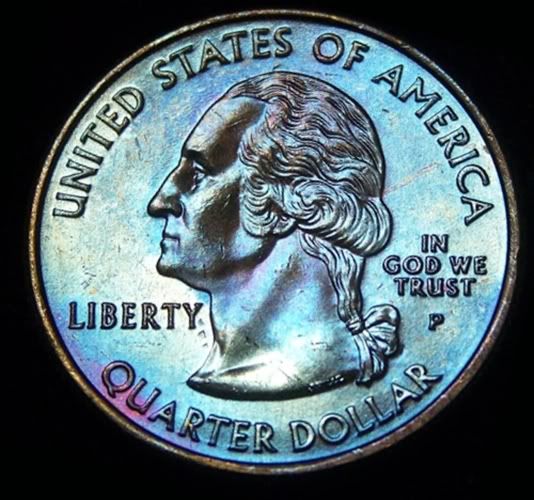

This is Artificial Toning at its finest, and purest. I suppose it COULD be natural toning if you were maybe hit by lightning (God, nature, etc etc) and YOU and the Quarter went up to about 1000 degrees or so.....but if IF you catch it JUST right.....
(PS the skew is in the tilt of the coin in the picture, it didnt actually warp shapewise)
0
Comments
``https://ebay.us/m/KxolR5
Edited to add: This is the very reason Larissa and Larsen don't collect monster toners for the Statehood Quarters... they're not all NT and it's too hard to tell the difference!
Many members on this forum that now it cannot fit in my signature. Please ask for entire list.
<< <i>Sad thing is so many get duped and waste a lot of money.... >>
If somebody gets duped by a coin that looks like that, they should find another hobby.
Russ, NCNE
it wont end up on ebay, promise.
nifty trick and one I use all the time in giving modern screws a 'heat blue' on some of my antique camera replicas.
(Hmmmm I wonder how hot you have to get an ASE to tone like that? Can anyone here answer?
<< <i>(Hmmmm I wonder how hot you have to get an ASE to tone like that? Can anyone here answer?
I keep failing at this... I don't know what I'm doing wrong; all my AT coins have plastic cuds on both the obverse and reverse?
<< <i>Why doesnt the thin strip of wood catch light ? >>
He's not using a match stick!
<< <i>It does burn a bit. on the reverse, where the color is lighter, thats were the coin was 'held'. >>
Maybe you should try sandwiching it in between two "sticks" and flipping the coin (like a pig roast)...
<< <i>mmmaybe I should go b ack to working on my anti gravity machine!
You too? Wanna share?
<< <i>no way. you figger it out yourself.
Interesting how you got the "sunset" in just the right spot.
<< <i>It does burn a bit. on the reverse, where the color is lighter, thats were the coin was 'held'. If you use small pliers, or hemostats to hold the coin, it leaves a gap in the toning on the rim where it was held. >>
I wonder if the type of wood used influences the colours in any way via gases escaping or if the wood has any effect or influence at all
<< <i>mmmaybe I should go b ack to working on my anti gravity machine!
Too late for that. A couple of brothers named Wright already invented that, and copycats have been improving on it ever since.
- Jim
This is why I like my coins white most of the time...it is too hard for me to tell if a coin is NT, AT or MA(the gray area) when the coins have crazy colors.
Not really looking for much these days but if I were, it might be a toner.
<< <i>
<< <i>Sad thing is so many get duped and waste a lot of money.... >>
If somebody gets duped by a coin that looks like that, they should find another hobby.
Russ, NCNE >>
I agree Ten Fold!
<< <i>
<< <i>
<< <i>Sad thing is so many get duped and waste a lot of money.... >>
If somebody gets duped by a coin that looks like that, they should find another hobby.
Russ, NCNE >>
I agree Ten Fold! >>
It's highly likely someone new to the hobby that purchases online, in isolation and without guidance could get duped. That's why finding coin collecting peers and communities like this one is important.
I've no blowtorch need or I'd try it myself.
I'm dying to see what a shiny golden dollar would do under a torch.
I AT'd these experimentally for education purposes. I was trying to both get a better understanding of toning in general as well as to have examples to educate myself and others as to what actual AT'd coins look like.
This next picture shows the progression of colors of an AT coin as it was being toned. The pictures are of the same coin taken every 10 seconds or so as it was being thermally oxidized.
And here is an educational AT vs. NT display I made a while back that was displayed by Jamie Franki at a coin design exhibition. The card reads as follows:
"The Progression of Colors on Artificially Toned Coins
The colors visible on these coins were produced by Thermal Oxidation, a process involving heat, atmospheric oxygen, atmospheric sulfur, copper and nickel. There are no pigments or dyes used. The colors are generated by a transparent oxide film grown on the surface of the coins. The thickness of the film dictates the color perceived as light passes through the film and is reflected of the surface of the coins. Similar coloration phenomena can be seen in naturewhen viewing a rainbow colored oil slick on a wet road or in the iridescent colors of some insects.
The coloration on these coins is called "artificial toning". When coins are artificially toned through Thermal Oxidation, the progression of colors goes from the untoned nickel to yellow, gold, orange, reddish-purple, bluish-purple on to blue and ultimately grey as the film grows thicker. Not all of the colors of the visible spectrum are produced by this method. True red and green are not produced.
Coins can also tone naturally over time from similar film formations involving sulfur, atmospheric gasses and moisture. Genuine toned coins have a more natural appearance and, when attractive, enhance the eye appeal and the value of collectable coins. Artificial toning, while sometimes attractive, often appears manufactured and does not add to the value of collectable coins except as a novelty. Often, artificial toning is done to deceive novice collectors by hiding signs of damage on the surface of the coin, and to add value. Therefore, coin collectors should learn to be able to recognize the appearance of artificial toning. One of the most effective means of learning to recognize artificial toning is to compare known naturally toned coins with known artificially toned coins as in this presentation. By handling a number of both over time you will be develop an "eye" for genuine color and the way it appears on the surfaces of coins. "
And here are a few others I artificially toned using different techniques
<< <i>WOW! Some of those ATs look NT!
If course, because...(read my signature)
Not really looking for much these days but if I were, it might be a toner.
<< <i>WOW! Some of those ATs look NT!
Thats why I prefer my coins white. I'd rather have a coin that was dipped, which is acceptable, than a fraudulently toned coin. ASE's get dipped on a regular basis to avoid spotting, proofs get dipped to remove haze......all within the realm of being an acceptable method. Blow torches, potatoes, bags with matches, Taco Bell napkins, gassing them, cooking them.....I'll stick with white coins, and accept it could have been dipped.
and was very proud of them, that had similar coloring scheme as that last nickel you posted.