Options
What do you think of this copy?
 BillJones
Posts: 35,893 ✭✭✭✭✭
BillJones
Posts: 35,893 ✭✭✭✭✭
For those who are so enamored with this 1964-D fantasy silver dollar, what do you think of this copy of the 1796, 16 star half dollar? This is the hardest type coin to get in the half cent through dollar set, and it is beyond the reach of a vast majority of collectors. I bought this when I couldn’t afford the real thing. Whatever thrill might have come with it left me soon after I got it.
It is a Gallery Mint product, and that company is no longer in business.
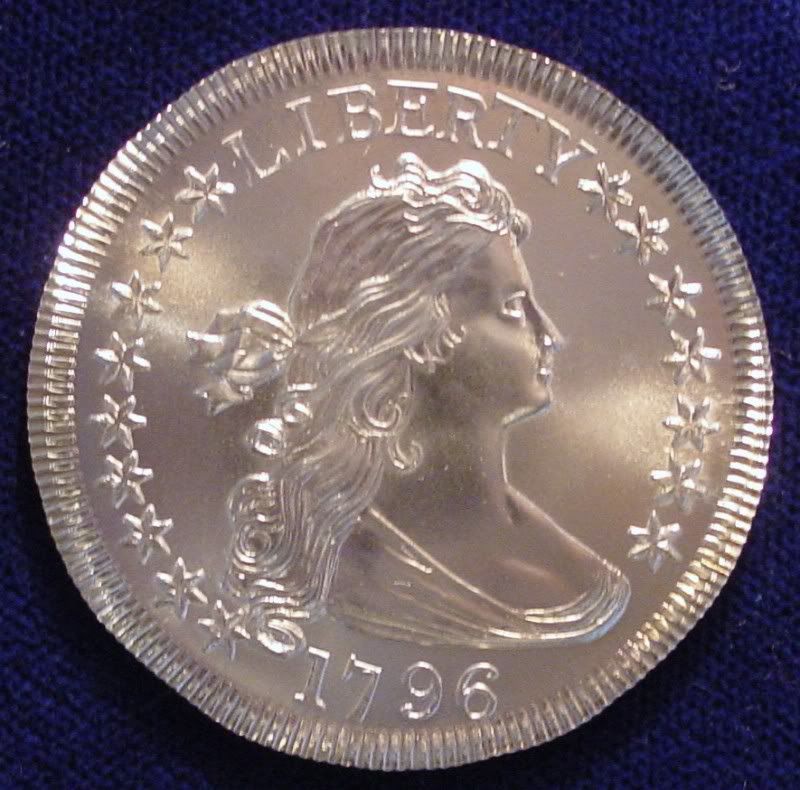
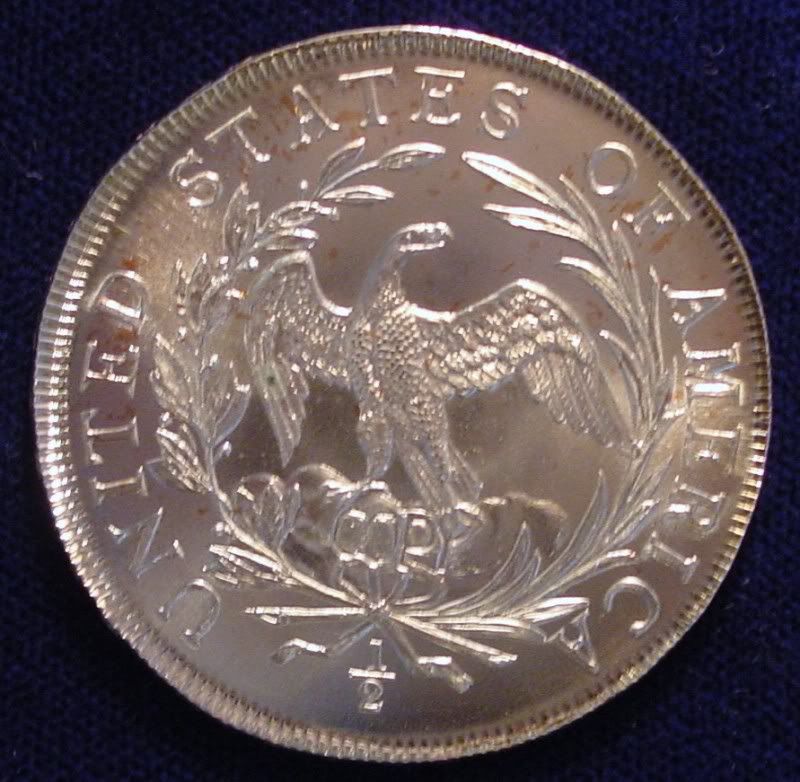
And here is an example of the real thing, all be a Fine-15 example.
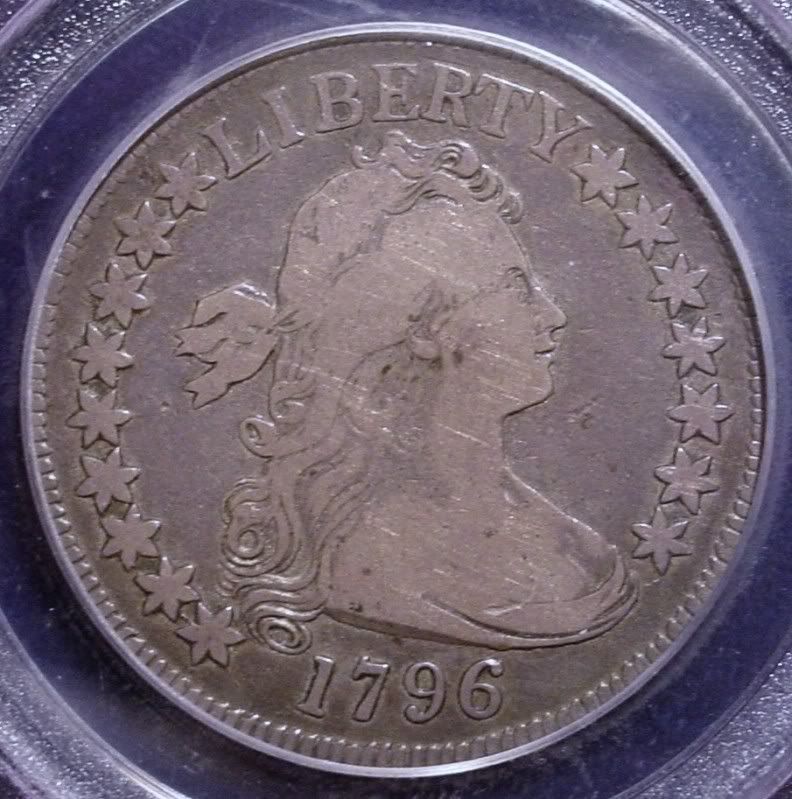
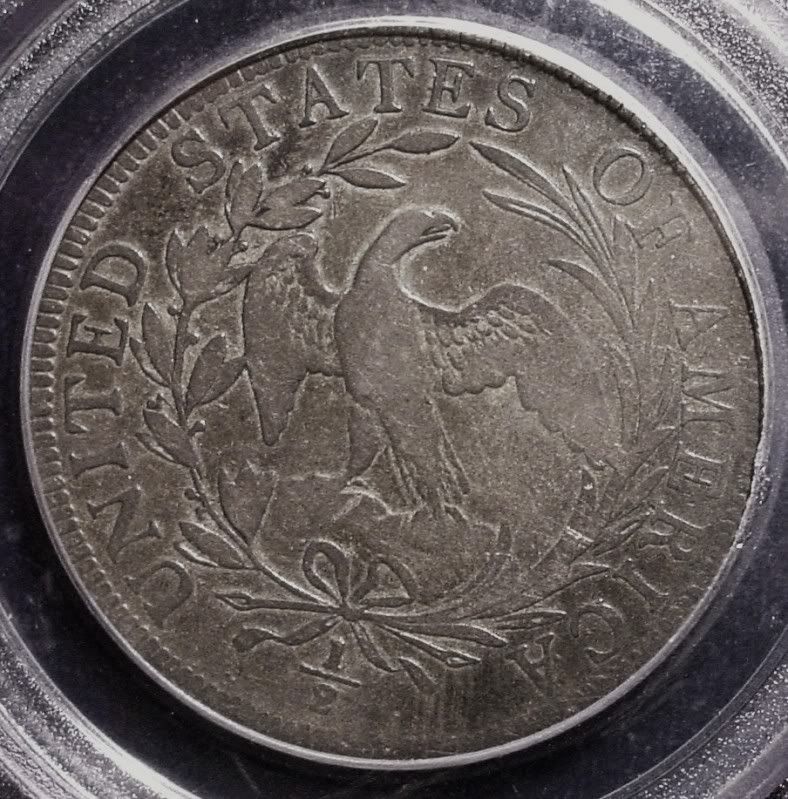
It is a Gallery Mint product, and that company is no longer in business.
And here is an example of the real thing, all be a Fine-15 example.
Retired dealer and avid collector of U.S. type coins, 19th century presidential campaign medalets and selected medals. In recent years I have been working on a set of British coins - at least one coin from each king or queen who issued pieces that are collectible. I am also collecting at least one coin for each Roman emperor from Julius Caesar to ... ?
0
Comments
I think Daniel Carr is slightly different in that he creates many of his own pieces, including the Ameros, hard times tokens, SCDs, etc. which allows him to create more of a following.
<< <i>Yes, but people with taking Gallery Mint pieces, putting some wear and grime on them, filling in the word "COPY" and trying to pass them off to collectors as the real thing. At one time a collector though he had found a new Sheldon number in the large cent series. As it turned out it was a Galley Mint copy that had been "aged." >>
It's a good thing the 1964-D Peace Dollar should avoid these problems since there are no known ones and any real ones would be illegal to own. Imagine the person buying a real one, only to have it confiscated.
I will say that there is a big difference in that it is a copy of a real coin rather than a fantasy piece, i.e., copy of a coin that doesn't exist. --Jerry
<< <i>Here's a 1793 large cent reproduction by the Gallery Mint Museum, overstruck on a Eureka Springs trolly token, without a COPY stamp:
I don't think "copy" would really add anything since the token it was overstruck on didn't exist in 1793, heck, arkansas didn't exist in 1793. --Jerry
<< <i>It's a copy of an existing coin. From a legacy perspective, I think Ron and GMM spent too much time creating COPY coins of existing coins, and not enough time on their own pieces. However, are COPY coins the reason they are no longer in business? Did the business end because Ron wanted to retire or was it due to lack of revenues?
I think Daniel Carr is slightly different in that he creates many of his own pieces, including the Ameros, hard times tokens, SCDs, etc. which allows him to create more of a following. >>
The goal of the Gallery Mint Museum was to produce enough revenue in order to build an actual museum for folks to attend. They had a shop and such and the owners started off making historic reproductions to raise the needed money. They also did coin club medals and such to aid that endeavor. In the end it was a variety of factors that caused them to close shop: they couldn't quite raise enough money, and then co-founder Joe Rust died, which had a devastating impact on surviving owner, Ron Landis, who stopped producing.
Landis and Carr are very similar in many respects, including the fact that both of them were finalists to design the reverse of what would become the golden dollar. Landis focused more on the older technology of minting and engraving, whilst Carr innovated with digital technology.
Landis wrote me that he may try to start up a smaller operation in Eureka Springs.
<< <i>Yes, but people with taking Gallery Mint pieces, putting some wear and grime on them, filling in the word "COPY" and trying to pass them off to collectors as the real thing. At one time a collector though he had found a new Sheldon number in the large cent series. As it turned out it was a Galley Mint copy that had been "aged." >>
I do understand what you are saying. The Gallery Mint people did have slight differences in their dies vs. the real coins, but you needed to have a picture of the real coin and sometimes a picture of the Gallery Mint copy, to determine whether a newly-found piece was actually a Gallery Mint copy.
For someone wanting to display both the obverse and reverse of an Uncirculated 1792 half disme, the Gallery Mint copies were a good substitute. Also, I know of a shop owner who has a super type coin set on display in his shop window. I asked him why he had a 1796 quarter, 1796 half, 1794 dollar, etc. in his shop window, and he said, they are Gallery Mint copies!
An authorized PCGS dealer, and a contributor to the Red Book.
Worry is the interest you pay on a debt you may not owe.
"Paper money eventually returns to its intrinsic value---zero."----Voltaire
"Everything you say should be true, but not everything true should be said."----Voltaire
<< <i>I don't care for any coin with COPY stamped on it. >>
I think many others agree with you (including me). I believe that's one reason Gallery Mint eventually failed.
<< <i>
<< <i>I don't care for any coin with COPY stamped on it. >>
I think many others agree with you (including me). I believe that's one reason Gallery Mint eventually failed. >>
I think they were too aggressive on using the COPY stamp. For example, it's completely unnecessary on their 1996 United State of Merriment Peace dollar:
It's kind of strange to think that aggressive reading of the Hobby Protection Act hurt a company making fantasy coins, but there's probably some truth to that.
If Ron starts up again, I hope he makes more of his own designs and leaves the COPY off of the fantasy coins.
<< <i>
<< <i>I don't care for any coin with COPY stamped on it. >>
I think many others agree with you (including me). I believe that's one reason Gallery Mint eventually failed. >>
Agree. The lack of COPY is also why Dan Carr's 1964-D peace dollar is so popular. If it had COPY stamped on it, he wouldn't have sold nearly as many coins. As far as I'm concerned, punching COPY into a coin is just another form of post mintage damage.
Worry is the interest you pay on a debt you may not owe.
"Paper money eventually returns to its intrinsic value---zero."----Voltaire
"Everything you say should be true, but not everything true should be said."----Voltaire
<< <i>I never thought that the word "COPY" was much of a problem on the piece I have (at the top of this thread). It was hidden in the clouds and not that obvious. >>
It's visible enough to be seen by the naked eye which makes it unacceptable to me.
Worry is the interest you pay on a debt you may not owe.
"Paper money eventually returns to its intrinsic value---zero."----Voltaire
"Everything you say should be true, but not everything true should be said."----Voltaire
P.S. I like the second one much better!
Yes, it is made of 8924 silver and was coined on a screw press with handmade dies
some very helpful folks sometimes observe that it's not as desireable as a real example, or that they'd rather have nothing in their collection than a copy, while they save up.
I always make sure to thank them for their astute point they're making
Liberty: Parent of Science & Industry
<< <i>
<< <i>I don't care for any coin with COPY stamped on it. >>
I think many others agree with you (including me). I believe that's one reason Gallery Mint eventually failed. >>
GMM had a strong following of collectors and the more Ron and company went on the road to shows, the more their following grew. The business was closed for very personal reasons (on which I won't elaborate). Ron's vision was to raise awareness on the early techniques of coin and medal manufacturing, not to make a buck knocking off "copies." His plans for an interactive museum on minting was nothing short of remarkable (although I think the choice of location was not). While a supremely talented and gifted artist, business was not his forte (his admission). Once the flow of new designs was stopped, the road trips ended, and the following fell back to a handful of loyal collectors.
See http://www.doubledimes.com for a free online reference for US twenty-cent pieces