3 bust quarters, 3 different dates, but same dies used

for sale, included in them was a great 1805 B4 bust quarter. This coin caught my attention because it went well with my 1806 B1 and 1807 B1.
All three of these coins share a common reverse die and the the 1805 and 1806/5 use the same obverse die. Amazing to me that the reverse die survived
3 years with few die cracks. Another amazing thing is how much better a strike the 1807 B1 has on the reverse. The dentils are very weak by 1807 but the
shield, and stars on the reverse are much more defined on the final use of this die.
Perhaps as the dentils (edge of the die) wore down, more of the central design was able to be impressed. Any other thoughts why the strike was better on the 1807


1805 B4 PCGS VF25


1806/5 B1


1807 B1 PCGS VG10


Comments
-
This content has been removed.
-
-
The re-use of reverse dies over multiple years was more prevalent during the Large Capped Bust Quarters, as this is the only heraldic eagle reverse to be used in more than one year, other than reverse A - used on both the 1804 B-1 & B-2, then on the 1805 B-1.
Any other thoughts why the strike was better on the 1807
I believe it had more to do with something else rather than the dentils being worn...I will wait to comment further to see if someone else has the same thoughts...
QN
BTW...I really like that 1805 B-4!
Go to Early United States Coins - to order the New "Early United States Half Dollar Vol. 1 / 1794-1807" book or the 1st new Bust Quarter book!
0 -
<< <i>Now THAT is astute observation, Fishteeth!
There is one die used for Bust Quarters that was used for four different varieties in four different years. Does anyone want to tell us what years those were? >>
>>
Can I answer or would that be against the rules...
QNGo to Early United States Coins - to order the New "Early United States Half Dollar Vol. 1 / 1794-1807" book or the 1st new Bust Quarter book!
0 -
<< <i>
<< <i>Now THAT is astute observation, Fishteeth!
There is one die used for Bust Quarters that was used for four different varieties in four different years. Does anyone want to tell us what years those were? >>
Can I answer or would that be against the rules...
QN >>
How about we leave the question open for a while to see if anyone else knows the answer?0 -
Congrats on the pick up Glad it went to a good home
Very cool thread topic btwPositive BST transactions with: too many names to list! 36 at last count.0 -
The 1823/2 re-worked reverse was used in 1824, 1825/2 B-1, & 1828 B-2, which is longer than the 1805,06,07 die seen in the OP.
Dentils don't "wear down" on a die. PM me if you are looking for U.S. auction catalogs0
 -
<< <i>
<< <i>
<< <i>Now THAT is astute observation, Fishteeth!
There is one die used for Bust Quarters that was used for four different varieties in four different years. Does anyone want to tell us what years those were? >>
Can I answer or would that be against the rules...
QN >>
How about we leave the question open for a while to see if anyone else knows the answer? >>
FirstMint is also disqualified as a known expert.
Do I get a free ASE if I answer first 0 -
Is it my imagination or is the obverse relief higher on the 1805 die than on the 1807?
 Andy Lustig
Doggedly collecting coins of the Central American Republic.
Visit the Society of US Pattern Collectors at USPatterns.com.0 -
Great Post!
This type of information is what I like to think of as numismatics, not just collecting.
0 -
<< <i>The 1823/2 re-worked reverse was used in 1824, 1825/2 B-1, & 1828 B-2, which is longer than the 1805,06,07 die seen in the OP. >>
Yeah Karl, if I can't answer then neither can you!
<< <i>Dentils don't "wear down" on a die. >>
Sure they can! Just look at many of the Capped Bust Halves...worn out! You can also see the worn dentils on the obverse die of 1835 B-1 LDS re-marriage as well.
I am still hoping someone else might guess about the reasons for the striking characteristics on the 1806/5 B-1 & 1807 B-1 versus the 1805 B-4...anyone?
QN
Go to Early United States Coins - to order the New "Early United States Half Dollar Vol. 1 / 1794-1807" book or the 1st new Bust Quarter book!
0 -
perhaps the die was lapped between those uses... would allow better striking of central details
Liberty: Parent of Science & Industry
0 -
I was having some fun with "worn down" dentils, cause I know that dies don't circulate; but they sure do get hammered!PM me if you are looking for U.S. auction catalogs0
-
amazing. good catch to
 0
0 -
Thanks for the info so far.
Here is an 1807 B2 also PCGS VG10 (sorry for the poor pics) This coin also has weakly struck dentils
but a very sharply struck shield and eagles head.
Perhaps the obverse, as Mr Eureka noted, was higher relief on the 1805. If the obverse really was higher relief
then more metal would have been needed to completly fill out the design, not enough left for the shield on the reverse.
Just another rambling thought
 0
0 -
As Andy said it could be because the one obverse was of greater depth.
Another possibility is that one obverse die was curved slightly more than the other.
TDProfessional Numismatist, Retired. 55 year member ANA. Former ANA Senior Authenticator. Winner of four ANA Heath Literary Awards; three Wayte and Olga Raymond Literary Awards; Numismatist of the Year Award 2009, and ANA Lifetime Achievement Award 2020. Winner of the PNG's 2026 Robert Friedberg Award for "The Enigmatic Lincoln Cents of 1922," Available now from Whitman or Amazon.0 -
<< <i>Is it my imagination or is the obverse relief higher on the 1805 die than on the 1807? >>
Somebody want to give me that for my birthday coming up????????Professional Numismatist, Retired. 55 year member ANA. Former ANA Senior Authenticator. Winner of four ANA Heath Literary Awards; three Wayte and Olga Raymond Literary Awards; Numismatist of the Year Award 2009, and ANA Lifetime Achievement Award 2020. Winner of the PNG's 2026 Robert Friedberg Award for "The Enigmatic Lincoln Cents of 1922," Available now from Whitman or Amazon.0 -
<< <i>
<< <i>The 1823/2 re-worked reverse was used in 1824, 1825/2 B-1, & 1828 B-2, which is longer than the 1805,06,07 die seen in the OP. >>
Yeah Karl, if I can't answer then neither can you!
<< <i>Dentils don't "wear down" on a die. >>
Sure they can! Just look at many of the Capped Bust Halves...worn out! You can also see the worn dentils on the obverse die of 1835 B-1 LDS re-marriage as well.
I am still hoping someone else might guess about the reasons for the striking characteristics on the 1806/5 B-1 & 1807 B-1 versus the 1805 B-4...anyone?
QN >>
I don't "know." I am sure I can take a stab at a few guesses. There is a good possibility that the die bulged slightly on the obverse (concaved,) thus causing the coin to require more material to strike it. Since the metal wasn't present, the coin didn't get struck fully.
It is also possible that the obverse die was simply designed to use more material when it was made. Low relief dies tend to strike-up easily. If the obverse had higher relief, and not enough striking pressure or metal, it wouldn't fully strike. (I think someone already said this.)
I guess it could also happen if the planchets were made too thin, or the die was filled with crud.
There were eras where this would have happened because the striking pressure was set too low. Not the case here because I believe a screw press was used, but I do wonder if there was a measurement or guage on the press, and it may have been set too high. My only problem with such a line of thought is...why wouldn't someone notice after a while. Clearly there were more than just a handful struck.
I would say that the star doesn't strike up well, because it is opposite the shoulder of miss liberty. Not enough material present to strike up that huge shoulder, and the star on the reverse. The only problem is that this doesn't tell us why the shield is weak.
There is an amazing amount of dentils that are very strongly struck. (Isn't this the coin that has more dentils than all the other draped quarters?) Perhaps this is the reason. There wasn't enough matreial to strike up the dentils AND the rest of the coin properly, so the problematic elements suffered from the lack of material.
I can't think of anything else at the moment.
0 -
Nice Thread.0
-
any other ideas?0
-
It could also be that the collar was looser on the 1807. With less resistance at the edge of the coin, the dies would get less resistance from the surface of the coin. That would allow them to get a little closer to each other in the striking process, which would improve the depth of strike detail. Except at the periphery.Andy Lustig
Doggedly collecting coins of the Central American Republic.
Visit the Society of US Pattern Collectors at USPatterns.com.0 -
I don't think that the open collar provided any compression that would influence the strike.
TDProfessional Numismatist, Retired. 55 year member ANA. Former ANA Senior Authenticator. Winner of four ANA Heath Literary Awards; three Wayte and Olga Raymond Literary Awards; Numismatist of the Year Award 2009, and ANA Lifetime Achievement Award 2020. Winner of the PNG's 2026 Robert Friedberg Award for "The Enigmatic Lincoln Cents of 1922," Available now from Whitman or Amazon.0 -
Aliens...Aliens and Bigfoot! They're behind everything I can't explain!0
-
I don't think that the open collar provided any compression that would influence the strike.
Tom - Think about the amazingly FB 1945 Broadstruck dimes you've seen over the years.Andy Lustig
Doggedly collecting coins of the Central American Republic.
Visit the Society of US Pattern Collectors at USPatterns.com.0 -
<< <i>I don't think that the open collar provided any compression that would influence the strike.
Tom - Think about the amazingly FB 1945 Broadstruck dimes you've seen over the years. >>
Totally different kind of press. Like comparing apples to squid sushi.
TDProfessional Numismatist, Retired. 55 year member ANA. Former ANA Senior Authenticator. Winner of four ANA Heath Literary Awards; three Wayte and Olga Raymond Literary Awards; Numismatist of the Year Award 2009, and ANA Lifetime Achievement Award 2020. Winner of the PNG's 2026 Robert Friedberg Award for "The Enigmatic Lincoln Cents of 1922," Available now from Whitman or Amazon.0 -
Totally different kind of press. Like comparing apples to squid sushi.
I'll need some convincing. Please explain.Andy Lustig
Doggedly collecting coins of the Central American Republic.
Visit the Society of US Pattern Collectors at USPatterns.com.0 -
<< <i>It could also be that the collar was looser on the 1807. With less resistance at the edge of the coin, the dies would get less resistance from the surface of the coin. That would allow them to get a little closer to each other in the striking process, which would improve the depth of strike detail. Except at the periphery. >>
Nice deduction Andy!
Yes, that is my assertion. The reeded collar die was very worn out and had expanded by the time the 1807 quarters were struck. This allowed the planchet to spread out more during striking, which caused the center of the coins to have more detail and depth than the peripherals or rims. This also accounts for the lack of complete reeds on every 1807 I have ever examined. The fact that the 1806/5 B-1's exhibit the same mushy strikes and do not have complete reeded edges, lead one to the conclusion that they may have been one of the last die marriages struck in 1806, when the collar die was very worn.
<<I don't think that the open collar provided any compression that would influence the strike.
TD>>
That is really something that needs to be examined more closely and perhaps previous thinking needs to be discarded.
According to all the research I have done, at least on the Bust Quarters, all of the Bust Quarters from at least 1804 - 1828 were struck inside some sort of reeded collar die, which impressed the reeded edge into the planchet during striking. Even though it was done with what we term an “open” collar die and not what we call a “closed” collar die, it still imparted the reeded edges during striking. The technological know how for accomplishing feat this was known as early as the 1780’s.
I have counted each die marriage's reeds and have examined hundreds of edges. You can follow the use of different collar dies over multiple years in much the same way you can in the Seated series. All of this info is included in my book and I am working on an article to be published at some point on the same subject. There is also previous writing about other denominations besides the quarters that touches upon the same subject.
QNGo to Early United States Coins - to order the New "Early United States Half Dollar Vol. 1 / 1794-1807" book or the 1st new Bust Quarter book!
0 -
There is a numismatic theatre presentation coming up at the Boston ANA that has to do with early minting techiniques and screw presses. I was asked to be on the panel, but couldn't attend this year due to work schedules.
Hopefully, those on the panel will present the latest research into collar dies and provide some theories and answers - such as were the collars one piece or segmented, etc.
The actual screws and the die cups on the screw presses wore out as well. These may have had an impact on alignment and the longevity of the dies.
It's an interesting and ongoing research project.
If only Henry Voigt had made some notes!PM me if you are looking for U.S. auction catalogs0 -
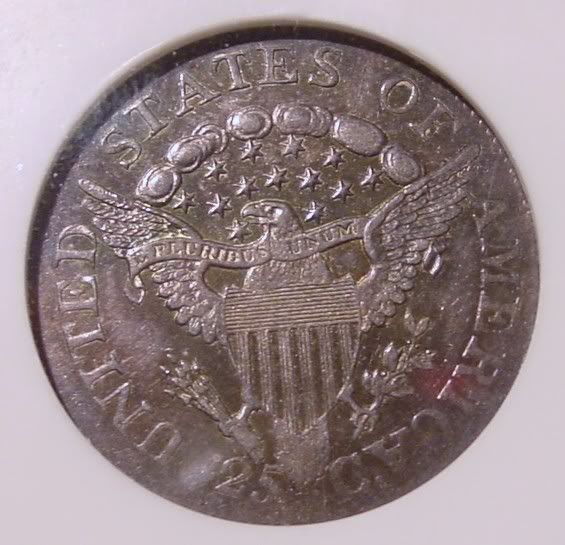
Here is an 1807 B-2 quarter. This is an example of the earliest die state. The relief on this coin is very low, which made a bear for me to photograph it. It has P-L surfaces on both sides. The grade is AU-55.
Given the low relief and the lack of a protective rim around the edge this coin could have gone from Mint State to VF or Fine after only a few months in circulation. I boght this coin raw many years ago and had it slabbed eight or nine years ago. If memory serves the reeding on this piece is incomplete, and the rim is not damaged.
It is believed, but not confirmed that this coin came from the Newcomer collection.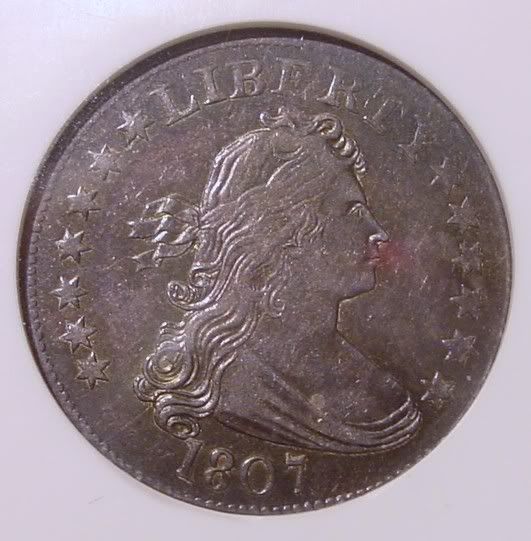
 Retired dealer and avid collector of U.S. type coins, 19th century presidential campaign medalets and selected medals. In recent years I have been working on a set of British coins - at least one coin from each king or queen who issued pieces that are collectible. I am also collecting at least one coin for each Roman emperor from Julius Caesar to ... ?0
 -
<<If only Henry Voigt had made some notes! >>
He actually did...if you know where to look! Those will be part of the forthcoming article.
Bill,
Your coin illustrates very well what we see on most 1807's, shallow relief, weak rims and incomplete reeds.
Nice example btw! The early die stage is very tough to find!
Whenever you want to sell please let me know!
QNGo to Early United States Coins - to order the New "Early United States Half Dollar Vol. 1 / 1794-1807" book or the 1st new Bust Quarter book!
0 -
<< <i>
<< <i>It could also be that the collar was looser on the 1807. With less resistance at the edge of the coin, the dies would get less resistance from the surface of the coin. That would allow them to get a little closer to each other in the striking process, which would improve the depth of strike detail. Except at the periphery. >>
Nice deduction Andy!
Yes, that is my assertion. The reeded collar die was very worn out and had expanded by the time the 1807 quarters were struck. This allowed the planchet to spread out more during striking, which caused the center of the coins to have more detail and depth than the peripherals or rims. This also accounts for the lack of complete reeds on every 1807 I have ever examined. The fact that the 1806/5 B-1's exhibit the same mushy strikes and do not have complete reeded edges, lead one to the conclusion that they may have been one of the last die marriages struck in 1806, when the collar die was very worn.
<<I don't think that the open collar provided any compression that would influence the strike.
TD>>
That is really something that needs to be examined more closely and perhaps previous thinking needs to be discarded.
According to all the research I have done, at least on the Bust Quarters, all of the Bust Quarters from at least 1804 - 1828 were struck inside some sort of reeded collar die, which impressed the reeded edge into the planchet during striking. Even though it was done with what we term an “open” collar die and not what we call a “closed” collar die, it still imparted the reeded edges during striking. The technological know how for accomplishing feat this was known as early as the 1780’s.
I have counted each die marriage's reeds and have examined hundreds of edges. You can follow the use of different collar dies over multiple years in much the same way you can in the Seated series. All of this info is included in my book and I am working on an article to be published at some point on the same subject. There is also previous writing about other denominations besides the quarters that touches upon the same subject.
QN >>
How might the struck coins have been extricated from the reeded collar?
TDProfessional Numismatist, Retired. 55 year member ANA. Former ANA Senior Authenticator. Winner of four ANA Heath Literary Awards; three Wayte and Olga Raymond Literary Awards; Numismatist of the Year Award 2009, and ANA Lifetime Achievement Award 2020. Winner of the PNG's 2026 Robert Friedberg Award for "The Enigmatic Lincoln Cents of 1922," Available now from Whitman or Amazon.0 -
<<How might the struck coins have been extricated from the reeded collar?
TD>>
That, my friend, is one of the mysteries yet to be figured out! Any thoughts?
QNGo to Early United States Coins - to order the New "Early United States Half Dollar Vol. 1 / 1794-1807" book or the 1st new Bust Quarter book!
0 -
<< <i><<How might the struck coins have been extricated from the reeded collar?
TD>>
That, my friend, is one of the mysteries yet to be figured out! Any thoughts?
QN >>
The logical explanation would be that they were struck in a plain, open coller.
By what reasoning do you come to the conclusion that they were struck in a reeded collar?
TDProfessional Numismatist, Retired. 55 year member ANA. Former ANA Senior Authenticator. Winner of four ANA Heath Literary Awards; three Wayte and Olga Raymond Literary Awards; Numismatist of the Year Award 2009, and ANA Lifetime Achievement Award 2020. Winner of the PNG's 2026 Robert Friedberg Award for "The Enigmatic Lincoln Cents of 1922," Available now from Whitman or Amazon.0 -
<<The logical explanation would be that they were struck in a plain, open coller.>>
But why is that the logical explanation? What evidence do you have for that assumption? Are you relying on what someone has stated in the past or from direct research and observation?
On the other hand there is evidence that does support the theory of a reeded collar die being used if you take the time to study the coins. Just because we have not figured out how the coins may have been ejected does not mean that the theory is not valid.
There needs to be more study and discussion about how these coins were produced rather than to simply rest on previous assumptions. Because we do not have any contemporary written evidence or engineering diagrams showing the mechanical aspects of the early mint (pre-1836), studying the coins produced from this early mint technology is the only remaining evidence to support any theories developed.
IMHO there has been very little time and research spent studying this aspect of the early mint and much conjecture, both subjective and objective is just repeated until it becomes “fact”.
No offense to you Tom at all, but it seems that some have already made up their minds as to what is the only way possible that something was accomplished and do not have an open mind about discovering something new or contrary to that thinking.
Anyone else have any thoughts?
QN
Go to Early United States Coins - to order the New "Early United States Half Dollar Vol. 1 / 1794-1807" book or the 1st new Bust Quarter book!
0 -
Interesting reading.
I may be wrong, but I remember reading about a few mint error early quarters with no reeding, similar to the few bust halves
without edge lettering. How would this happen if the reeding was imprinted at time of strike?0 -
<< <i>Interesting reading.
I may be wrong, but I remember reading about a few mint error early quarters with no reeding, similar to the few bust halves
without edge lettering. How would this happen if the reeding was imprinted at time of strike? >>
Quite the reverse…The fact that off-center Bust Quarter error coins are found without reeding is evidence that the reeding was not applied before striking and that it most likely was applied during striking. The planchet being off-center to the dies was the cause of the collar die not being engaged.
In the Bust Half series, it is well known that the lettered edge was applied to the blank planchets prior to striking. Therefore all of the known off-center coins still show a completed lettered edge.
The few Bust Halves that are known without lettered edges have no other error other than they are very flat rimmed and slightly larger in diameter than those with lettered edges. This is due to the planchet edge not being "upset" during the application of the lettered edge. There was also no collar die to contain the planchet (at least in the way one would think) resulting in the extra expansion of the planchet during striking.
QN
Go to Early United States Coins - to order the New "Early United States Half Dollar Vol. 1 / 1794-1807" book or the 1st new Bust Quarter book!
0 -
Ooh. Draped quarters. Those are the best Bust quarters.
That 1805 B4 is an absolute stunner. Very, very nice for the grade, too. Collector since 1976. On the CU forums here since 2001.
0 -
<< <i>
<< <i>It could also be that the collar was looser on the 1807. With less resistance at the edge of the coin, the dies would get less resistance from the surface of the coin. That would allow them to get a little closer to each other in the striking process, which would improve the depth of strike detail. Except at the periphery. >>
Nice deduction Andy!
Yes, that is my assertion. The reeded collar die was very worn out and had expanded by the time the 1807 quarters were struck. This allowed the planchet to spread out more during striking, which caused the center of the coins to have more detail and depth than the peripherals or rims. This also accounts for the lack of complete reeds on every 1807 I have ever examined. The fact that the 1806/5 B-1's exhibit the same mushy strikes and do not have complete reeded edges, lead one to the conclusion that they may have been one of the last die marriages struck in 1806, when the collar die was very worn.
<<I don't think that the open collar provided any compression that would influence the strike.
TD>>
That is really something that needs to be examined more closely and perhaps previous thinking needs to be discarded.
According to all the research I have done, at least on the Bust Quarters, all of the Bust Quarters from at least 1804 - 1828 were struck inside some sort of reeded collar die, which impressed the reeded edge into the planchet during striking. Even though it was done with what we term an “open” collar die and not what we call a “closed” collar die, it still imparted the reeded edges during striking. The technological know how for accomplishing feat this was known as early as the 1780’s.
I have counted each die marriage's reeds and have examined hundreds of edges. You can follow the use of different collar dies over multiple years in much the same way you can in the Seated series. All of this info is included in my book and I am working on an article to be published at some point on the same subject. There is also previous writing about other denominations besides the quarters that touches upon the same subject.
QN >>
Do any of these alleged collar dies show a distinctive reed or two that can be identified on coins from the same press run? A double-cut or extra-thick reed would suffice, or an unusual gap between two reeds.
If so, then this distinctive reed should fall next to the same spot on the rim of every coin, unless the dies themselves rotate relative to the collar.
If, on the other hand, the reeding is applied to the planchets which are then placed into the press at random, then the distinctive reed should appear around the coin at random.
Is there such a distinctive reed on the quarters of this era?
Are there any off-center quarters known for 1804-1807, or for 1815-1828? If so, this would easily prove if the reeding was added prior to or during the strike.
How about dimes of the same era, for the same reason?
FWIW, I once saw a Turban Head $10 of this era, either a 1799 or an 1801, that had been struck with a normal obverse and a fully brockaged reverse, which had been placed back in the press and struck an additional six times to try to obliterate the error. As I recall, the reeded edge was normal. That does not mean that a change in technology did not take place between 1801 and 1804.
If you can offer any of these proofs, I would be glad to see them.
TDProfessional Numismatist, Retired. 55 year member ANA. Former ANA Senior Authenticator. Winner of four ANA Heath Literary Awards; three Wayte and Olga Raymond Literary Awards; Numismatist of the Year Award 2009, and ANA Lifetime Achievement Award 2020. Winner of the PNG's 2026 Robert Friedberg Award for "The Enigmatic Lincoln Cents of 1922," Available now from Whitman or Amazon.0 -
<< <i>
<< <i><<How might the struck coins have been extricated from the reeded collar?
TD>>
That, my friend, is one of the mysteries yet to be figured out! Any thoughts?
QN >>
The logical explanation would be that they were struck in a plain, open coller.
By what reasoning do you come to the conclusion that they were struck in a reeded collar?
TD >>
By the way, please quote my entire comment.
I stated what I considered to be the logical explanation for the question, but asked for your reasoning to the contrary.
I did not state that your theory was impossible, as you implied in your reply to my abridged (by you) comment.
TDProfessional Numismatist, Retired. 55 year member ANA. Former ANA Senior Authenticator. Winner of four ANA Heath Literary Awards; three Wayte and Olga Raymond Literary Awards; Numismatist of the Year Award 2009, and ANA Lifetime Achievement Award 2020. Winner of the PNG's 2026 Robert Friedberg Award for "The Enigmatic Lincoln Cents of 1922," Available now from Whitman or Amazon.0 -
There are several "plain edge" off center, early quarters known; indicating that the reeding was not applied prior to striking.
Over the years, I have not seen anything in the edge reeding that would be a diagnostic as to a certain collar (double reeds, missing, etc.).
There are no known 1807 quarters that display complete reeding on the edge.
Perhaps someone who will be attending the Boston ANA will print out this thread and ask the panel members their thoughts and opinions. The panel members scheduled to appear are: Brad Karoleff, Dick Doty, John Dannreuther, Bill Eckberg, R.W. Julian, Craig Sholley, and Doug Mudd. Perhaps they can offer a few "facts" to confirm what they will be saying.
Hopefully, David Lisot will video this event, as it will offer the latest research on the oldest coinage.PM me if you are looking for U.S. auction catalogs0 -
<< <i>There are several "plain edge" off center, early quarters known; indicating that the reeding was not applied prior to striking.
Over the years, I have not seen anything in the edge reeding that would be a diagnostic as to a certain collar (double reeds, missing, etc.).
There are no known 1807 quarters that display complete reeding on the edge.
Perhaps someone who will be attending the Boston ANA will print out this thread and ask the panel members their thoughts and opinions. The panel members scheduled to appear are: Brad Karoleff, Dick Doty, John Dannreuther, Bill Eckberg, R.W. Julian, Craig Sholley, and Doug Mudd. Perhaps they can offer a few "facts" to confirm what they will be saying.
Hopefully, David Lisot will video this event, as it will offer the latest research on the oldest coinage. >>
Can you cite auction listings on any of those off-centers, or published articles? I just spoke with Fred Weinberg, and he could not recall ever seeing an off-center 1804-1807 quarter.
TDProfessional Numismatist, Retired. 55 year member ANA. Former ANA Senior Authenticator. Winner of four ANA Heath Literary Awards; three Wayte and Olga Raymond Literary Awards; Numismatist of the Year Award 2009, and ANA Lifetime Achievement Award 2020. Winner of the PNG's 2026 Robert Friedberg Award for "The Enigmatic Lincoln Cents of 1922," Available now from Whitman or Amazon.0 -
Oh my goodness, this is an interesting thread!
The hope of such conversation is why many of us keep visiting here after all these years of "been there, done that" coin discussionsLiberty: Parent of Science & Industry
0 -
I'm not as sharp on these as I used to be, and I'm sure there are others who can add the known examples of off-center strikes in the early quarter series.
There was an 1818/15 "plain edge" that was offered in the James A. Stack March 1975 sale by Stack's, lot 11. It had beautiful toning then, but has been since dipped. Stack died in 1951, and unfortunately, the earlier provenance is not recorded in the Stack's catalogue.
I know there are others (perhaps two or three) in the large size but come to think of it, I don't recall offhand any DB off-center strikes either.
Who can add to this?
Edited to add -
Tompkins lists several off-center strikes (with images) on p. 338, including the Stack coin mentioned, which came from the FCC Boyd collection.
There are several mis-aligned die pieces with an 1806 date.
PM me if you are looking for U.S. auction catalogs0 -
There was an 1818/15 "plain edge" that was offered in the James A. Stack March 1975 sale by Stack's, lot 11. It had beautiful toning then, but has been since dipped.
Was the toning something like this?
 Andy Lustig
Doggedly collecting coins of the Central American Republic.
Visit the Society of US Pattern Collectors at USPatterns.com.0 -
<< <i><<By the way, please quote my entire comment.
I stated what I considered to be the logical explanation for the question, but asked for your reasoning to the contrary.
I did not state that your theory was impossible, as you implied in your reply to my abridged (by you) comment.
TD>> >>
Sorry Tom but I did not think I needed to; it was posted directly above my post. Secondly, I never stated that you said my theory was impossible nor implied that you did. I was merely replying to your comment and trying to state some of the reasons.
QNGo to Early United States Coins - to order the New "Early United States Half Dollar Vol. 1 / 1794-1807" book or the 1st new Bust Quarter book!
0 -
Interesting pictures. The unstruck areas appear to not be upset. Would you say that this was the case?
TDProfessional Numismatist, Retired. 55 year member ANA. Former ANA Senior Authenticator. Winner of four ANA Heath Literary Awards; three Wayte and Olga Raymond Literary Awards; Numismatist of the Year Award 2009, and ANA Lifetime Achievement Award 2020. Winner of the PNG's 2026 Robert Friedberg Award for "The Enigmatic Lincoln Cents of 1922," Available now from Whitman or Amazon.0 -
Interesting pictures. The unstruck areas appear to not be upset. Would you say that this was the case?
I would.Andy Lustig
Doggedly collecting coins of the Central American Republic.
Visit the Society of US Pattern Collectors at USPatterns.com.0 -
<< <i>Interesting pictures. The unstruck areas appear to not be upset. Would you say that this was the case?
I would. >>
Thank you.
Let me throw out a speculation for discussion. If, as traditionally believed, quarter dollar planchets in this era were reeded prior to being struck, then that trip through the castaing machine to impart the reeding would also serve the function of the modern upsetting mill. No reeding, no upsetting. In other words, a Type One blank.
Whatever method for feeding planchets into the press (human fingers or early mechanical feed fingers) would be used to/ set for handling reeded edge Type Two planchets. If a blank/planchet skips the reeding/upsetting process, it might be more prone to being mis-fed into the press. Such a mis-feed could result in the blank/planchet not being centered on the dies, and being struck off center.
I do not have a Tompkins at hand. Do any of the other pictures show the unstruck areas well enough to tell if they are Type One or Type Two planchets, and/or plain or reeded edges?
TDProfessional Numismatist, Retired. 55 year member ANA. Former ANA Senior Authenticator. Winner of four ANA Heath Literary Awards; three Wayte and Olga Raymond Literary Awards; Numismatist of the Year Award 2009, and ANA Lifetime Achievement Award 2020. Winner of the PNG's 2026 Robert Friedberg Award for "The Enigmatic Lincoln Cents of 1922," Available now from Whitman or Amazon.0 -
Tompkins lists several off-center strikes (with images) on p. 338, including the Stack coin mentioned, which came from the FCC Boyd collection.
All of these appear to be on Type 1 planchets.Andy Lustig
Doggedly collecting coins of the Central American Republic.
Visit the Society of US Pattern Collectors at USPatterns.com.0 -
<< <i>Tompkins lists several off-center strikes (with images) on p. 338, including the Stack coin mentioned, which came from the FCC Boyd collection.
All of these appear to be on Type 1 planchets. >>
Interesting.Professional Numismatist, Retired. 55 year member ANA. Former ANA Senior Authenticator. Winner of four ANA Heath Literary Awards; three Wayte and Olga Raymond Literary Awards; Numismatist of the Year Award 2009, and ANA Lifetime Achievement Award 2020. Winner of the PNG's 2026 Robert Friedberg Award for "The Enigmatic Lincoln Cents of 1922," Available now from Whitman or Amazon.0



Leave a Comment
Categories
- All Categories
- 520K Coins and Currency - PCGS
- 328.5K U.S. Coin Forum
- 14.8K PCGS Set Registry Forum
- 5.2K Q & A Forum
- 41.4K World & Ancient Coins Forum
- 3K U.S. & World Currency Forum
- 96.4K Buy, Sell, & Trade - U.S. Coins
- 7.3K Buy, Sell & Trade - World & Ancient Coins
- 1.5K Buy, Sell & Trade - Currency
- 60 Random
- 246.2K Trading Cards, Autographs and Memorabilia - PSA
- 90.3K Trading Cards & Memorabilia Forum
- 1.7K Autographs Forum
- 16.4K PSA Set Registry Forum
- 22K Sports Talk
- 115K Buy, Sell & Trade - Cards & Memorabilia
- 663 Buy, Sell & Trade - Autographs
- 2.2K Stamps
- 1.5K Stamps Forum
- 670 Buy, Sell & Trade - Stamps
- 83 Coin Shows
- 83 General Coin Show Information and Discussion
- 11.9K Misc
- 11.9K Testing Forum