Options
So you think you know not to trust a seller's description?
 jonathanb
Posts: 4,163 ✭✭✭✭✭
jonathanb
Posts: 4,163 ✭✭✭✭✭
So you think you know not to trust a seller's description? It doesn't hurt to have a reminder every so often, and I got a heck of a reminder recently.
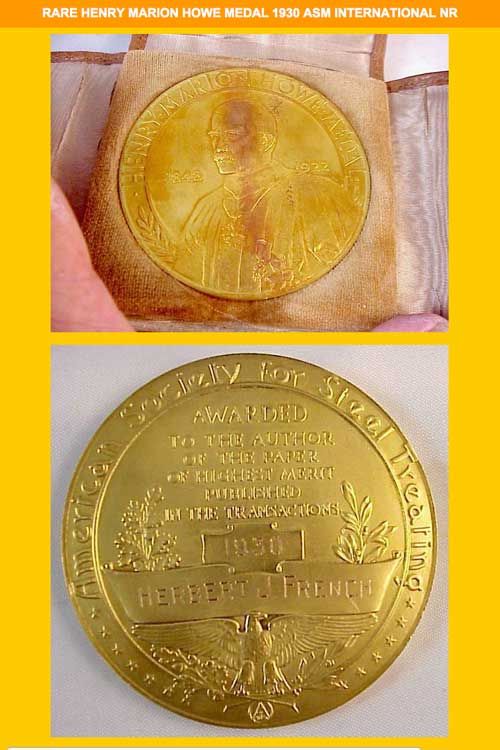
A long-time seller (who I actually had done business with before) posted a pair of listings for two medals awarded to the same person in 1930, with a starting bid of $9.99 each. I've posted the listings below. Each of the listings has a similar mistake in it. In one listing, the mistake doesn't really make a whole lot of difference. In the other listing, the mistake makes a HUGE difference.
I sort of saw the mistakes before placing my bids, but I convinced myself that the seller was right. I figured that no seller would get that wrong, and I bid as if the listings were both accurate. As it happens, there was only one other bidder, and I ended up winning the two medals for $41 and $43, including shipping. So I wasn't going to be hurt in any case, but that just means I got lucky. When I got these medals in hand, I saw that the actual value of these pieces was nowhere near my maximum bids. It sure helps to be lucky.
The take-home lesson is that there is nothing -- NOTHING -- that a seller can't manage to get wrong.
Can you spot the mistake that matters, even after I tell you that there's something to look for?
Here are the original listings. (I trimmed some whitespace, etc., and shrunk the page a bit to get it under the 50K limit for uploads, but it's still mostly readable):
First listing:
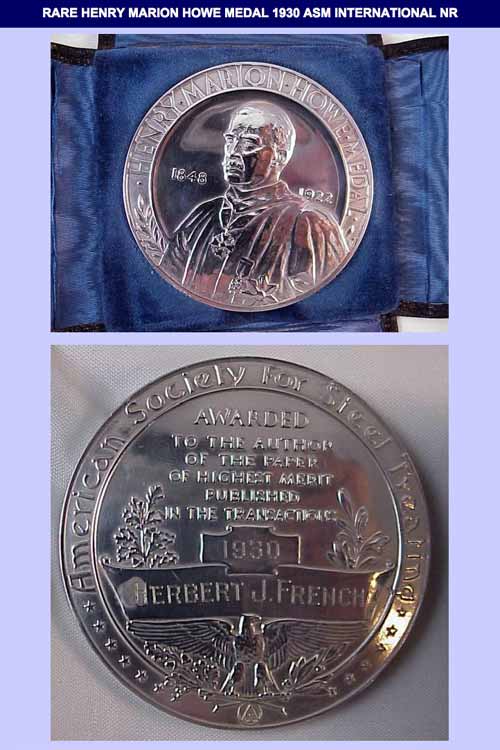
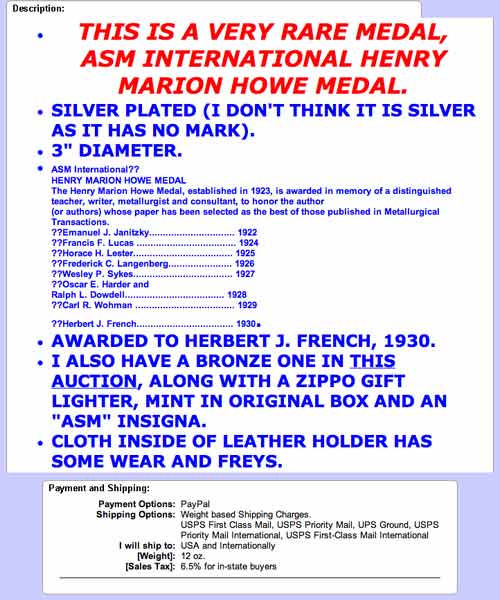
Second listing:
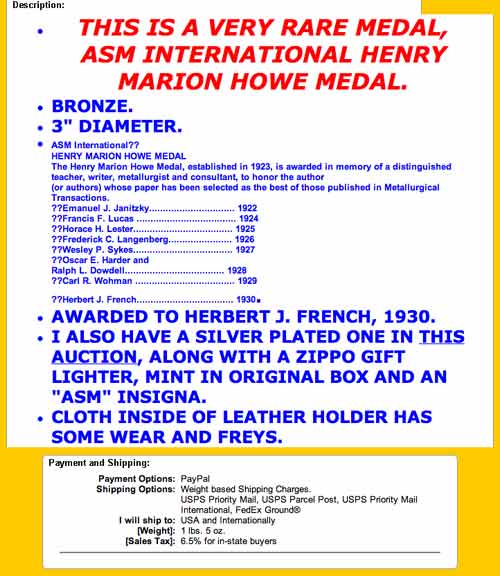
A long-time seller (who I actually had done business with before) posted a pair of listings for two medals awarded to the same person in 1930, with a starting bid of $9.99 each. I've posted the listings below. Each of the listings has a similar mistake in it. In one listing, the mistake doesn't really make a whole lot of difference. In the other listing, the mistake makes a HUGE difference.
I sort of saw the mistakes before placing my bids, but I convinced myself that the seller was right. I figured that no seller would get that wrong, and I bid as if the listings were both accurate. As it happens, there was only one other bidder, and I ended up winning the two medals for $41 and $43, including shipping. So I wasn't going to be hurt in any case, but that just means I got lucky. When I got these medals in hand, I saw that the actual value of these pieces was nowhere near my maximum bids. It sure helps to be lucky.
The take-home lesson is that there is nothing -- NOTHING -- that a seller can't manage to get wrong.
Can you spot the mistake that matters, even after I tell you that there's something to look for?
Here are the original listings. (I trimmed some whitespace, etc., and shrunk the page a bit to get it under the 50K limit for uploads, but it's still mostly readable):
First listing:
Second listing:
0
Comments
If this is the case, good catch!
60 years into this hobby and I'm still working on my Lincoln set!
Hm.
You would think this would be nagging the seller in the back of his mind. "Why is it so much heavier?"
Is there a difference in thickness or strike between the two medals?
Are the listed weights correct; have you weighed the medals yourself? Could be anything if those are seller provided weights.
I somehow think not.
The name is LEE!
You suck
Yogi Berra
If the second medal is gold...
Somehow during all the time the seller was handling the medals (while taking pictures, if nothing else), he managed not to notice that one weighed a whole lot more than the other.
Yes indeed, I assume the first medal is solid silver, and not silver plated. It weighs 180 grams. The second one weighs 270 grams -- of 18K gold.
Whee!
I don't collect society award medals of this type, but they do have a small following. I've seen others from the same time period and similar size and subject matter sell for a few hundred dollars, for example in previous Presidental auctions. Oddly, the metal content doesn't seem to matter much. Bronze, silver-plated bronze, gold-plated bronze, and solid silver medals all seem to bring similar prices. I'm a sucker for original cases, so I put in bids even though I wasn't dying to have them for my own collection. For the two pieces combined, my bids were less than $200, and yes, I feel pretty stupid about that in retrospect. If I had to learn the lesson, this was the way to do it, though!
jonathan
Henry Marion Howe Medal
Gold medal and certificate awarded to the author or authors of the best
paper presented before the Society and published in the Transactions.
Established 1923. (Transactions of the American Society for Steel Treating
4, 564-7, 1923)
And yes, you sure would think that the seller would have noticed the difference. That was another reason for me to ignore it. Bad idea!
jonathan
The name is LEE!
Great eye for detail, and awesome buys!
Wouldnt it be funny if the seller just recently lost some jewelery and sold some junk silver.......
oh yea... you suck!
Larry
<< <i>Gold medal and certificate awarded to the author or authors of the best ... >>
Good researching. I found that on Google also, and unfortunately that's something where knowing too much hurt me. "Gold medal" tends to be a fairly generic term. It usually means that the medal ends up being yellow-colored, but it doesn't necessarily mean that it was struck from gold at all, much less solid gold. I'm pretty sure that the gold medals awarded at the Olympics are gilt silver, for example.
...and I also found a listing on Google that said that some of these medals were produced in bronze, which matched the seller's description.
I thought briefly about contacting the society, but then I decided that even if they had the records, I wouldn't know whether to trust them either.
I thought even more briefly about asking the seller to confirm the weights, then decided that would be monumentally stupid on the very slim chance that he really was wrong...
<< <i>I thought even more briefly about asking the seller to confirm the weights, then decided that would be monumentally stupid on the very slim chance that he really was wrong... >>
Careful now, some will cry for you to give the seller "his fair share"!
The name is LEE!
Congratulations!
I was recently thinking about starting a thread asking for the biggest mistake, to your benefit, that you ever saw an eBay seller make. Ummm, OK, I will think of something else now.
<< <i>The take-home lesson is that there is nothing -- NOTHING -- that a seller can't manage to get wrong. >>
Now written in stone.
Do you plan to contact the seller now and explain his or her mistake?
How is this different from the coin shop story about the old man that didn't know what he had?
Just my thoughts with no malace towards the OP.
Regards, Larry
<< <i>Lot's of "congrats", and a couple of "you suck' so far but my question is this
Do you plan to contact the seller now and explain his or her mistake?
How is this different from the coin shop story about the old man that didn't know what he had?
Just my thoughts with no malace towards the OP.
Regards, Larry
What claim would the seller have to the money JonathanB could make selling these medals? You can bet he didn't pay anywhere close to what they are worth either.
very good puirchase YOU SUCK!!!
<< <i>I thought even more briefly about asking the seller to confirm the weights, then decided that would be monumentally stupid on the very slim chance that he really was wrong... >>
Buyer saw weights were off and didn't want to alarm seller.
<< <i>What claim would the seller have to the money JonathanB could make selling these medals? You can bet he didn't pay anywhere close to what they are worth either. >>
I don't think Seller has a claim to any extra money.
I just find it hard to understand why all the congratulations to a buyer on what some could consider a rip off of the seller.
Had the seller been an old man and the buyer a b/m coin shop what would the responses say?
Just thinkin out loud again with no malice towards the OP
Regards, Larry
Uggh, where's that thread a few days ago about people complaining no deals can be had on Ebay !!!!!
Do a Specific Gravity test for us and confirm the find. Wowzer.
<< <i>I just find it hard to understand why all the congratulations to a buyer on what some could consider a rip off of the seller. >>
This is not a rip-off. Consider, the seller listed these on a venue (eBay) which most would agree has an adequately large audience / pool of potential buyers. The seller accurately described the items to the best of his ability, and there was plenty time for any would-be buyers to view the listings, ask questions, and do their own due diligence to in order to determine the appropriate value of the items in question. And ultimately, the market decided the fair market value of these medals to be equal to the price the OP paid. Like it or not, this is the way a free market economy works.
I see no reason why savvy buyers should be made to feel guilty for getting a great bargain like this every once in a while. This is a part of what makes the coin collecting hobby fun and exciting for a lot of folks. Embrace it
Larry
anyway... you still suck
- Just check out my motto
Anyone questioning your purchase & whether the seller should be informed/reimbursed/etc. is an unctuous toady.
JMHO.
"Bongo hurtles along the rain soaked highway of life on underinflated bald retread tires."
~Wayne
Here is a link that states the medal is gold.....first page (58) number 191 right side
null
<< <i>COngrats. You did not rip the seller. The seller ripped them self. >>
That's my take on this, and other "infamous" posts.
Nice catch!
It's the thrill of the hunt that makes it fun!
Man, you beat my best score. Well done !
(The copper 76mm assay medals usually weigh between 210-250g, so 270g would not be too surprising. It would correspond to an average thickness of 6 to 7 mm; while a gold medal of that weight/diameter would have a thickness of around 3 mm.)
In any case, Amigo is right and a quick specific gravity check is what is needed.
Ed. S.
(EJS)
Steve
Thanks to Sumadora for that link. I hadn't found it on my own. I'm a lot happier with a description of a medal as being made "of gold" rather than "a gold medal". If I had seen that while the auction was open, I probably would have bid a lot higher.
Several people have asked about exact weights, etc. I'm not set up to do real specific gravity measurements, but if you want to trust my cheap scale and calipers, here are the numbers.
The white medal has a diameter of 76.2 mm, a thickness at edge of 4.5 mm, and a weight of 193.1 g. Treating it as a cylinder, that works out to a density of 9.41 g/cm3.
The yellow medal has a diameter of 76.1 mm, a thickness at edge of 4.5 mm, and a weight of 270.7 g. That works out to a density of 13.26 g/cm3.
According to various sites, the specific gravities should be copper = 8.92, silver = 10.4-10.5, 14K gold = 13.4, 18K gold = 15.5. So going by those numbers, the white one is a touch too dense for copper, while the yellow one is pretty close to 14K gold. If you think that the white one probably is silver, that means that my numbers are about 10% low, and the gold would be close to the number for 18K. FWIW, my numbers *should* be low, since the medals aren't truly cylinders and the thickness at the edge is greater than the thickness in the fields.
I showed it to the local dealer, whose opinions I trust, and suggested to him that it was 14K. He said that it was 18K, based on its heft and color, and he would have bought it from me as 18K so he had no reason to guess high.
If I sell it as bullion, I suppose I'll have it tested. If I sell it to a collector, then the difference between 14K and 18K gets folded into the numismatic value, and the only thing that matters is the bottom line anyway.
The ethics questions interest me.
Last month I posted a Beauregard Dime that was a rip of similar dollar value to this one. The biggest difference in my mind was that I bought that one knowing full well what I was doing. That was a case where I knew something that the seller didn't know, and wouldn't be expected to know. This gold medal was a case where the seller should have known, but messed up. Does that change the ethics? Maybe it does, maybe it doesn't.
19Lyds raises an interesting point that I hadn't considered. For this medal, I had an idea that it might be gold, and even though I didn't truly believe it, I *could have* contacted the seller and asked him to check. I chose not to do that. Should I have done that? I don't know. Does it make a difference that I didn't truly believe that it was gold? If I didn't contact the seller but I bid $4,000, would that have been different than not contacting the seller and bidding $100?
The Beauregard Dime took skill -- I bid because I knew something that the seller didn't. This gold medal was dumb luck -- I thought I was getting bronze all the way up to the point where I unwrapped it. Does skill vs luck change the responsibility of the buyer?
As MsMorrisine points out, we can be pretty confident that the seller bought the medal from someone else thinking that it was bronze, and paid them as if it was bronze. Should I owe him anything for spotting his mistake? I'm thinking probably not... but what if he had a record of who he bought it from in the first place? Should I give him a bonus on the promise that he tracks down the original owner and shares it with them? Or should I be responsible for tracking down the original owner myself? I think not in either case... but I also think it's less than 100% clear.
Ethical questions are always interesting to think about!
Bossman88 writes, "How is this different from the coin shop story about the old man that didn't know what he had?". *That* is an easy question. My feedback (1500) is less than half of the seller's (3400). If anything, this is totally the other way around. If the old man walked into a store and paid the prices he was quoted for an item, would you fault him for doing that? This was no newbie seller, and neither was it a seller who was selling one item outside his expertise. This seller sells coins, and has done so for a long time. In the "old man" case, the presumption is that the owner of the coin shop knows what he is doing. The seller in this case also should have known. I think we can agree he made a mistake, but it was from carelessness not ignorance, and that makes it nothing like the "old man" situation.
I'm waiting for the "Forum Moralists™" to jump your bones.
Edited to add: BTW, I'd be a peeing puppy had I won either of those auctions.
The name is LEE!
For the record... the bronze medal is much thicker than either of the others, 7.6 mm at the edge. it weighs 11.3 ounces on a postal scale, which works out to about 320 grams.
Here is the full set:
My YouTube Channel