Bank of California - A numismatic visit
Options

Dennis88
Posts: 5,797 ✭✭✭
As some of you might remember from a couple of threads around here, in June I visited the US for the very first time (I live in Europe). To be precise, Northern California.
Every visit to California should include San Francisco, and like so many people before me I have fallen in love with the city, its people (most of them), the food and so much more. Certainly a city I will hopefully visit many more times in my still young life (I'm 20).
During my visit to SF I visited several historic places, including the old San Francisco Mint (post to follow), Golden Gate Bridge, Financial District and a lot more. In one of my postings shortly before my visit, one recommended the Bank of California with a small museum. Because I was in the Financial District anyway, I decided to try to find the place on California street to see if it was worth the visit. After walking into the wrong bank at first, I found the Bank of California's main office, a nice building of the bank founded in 1864.
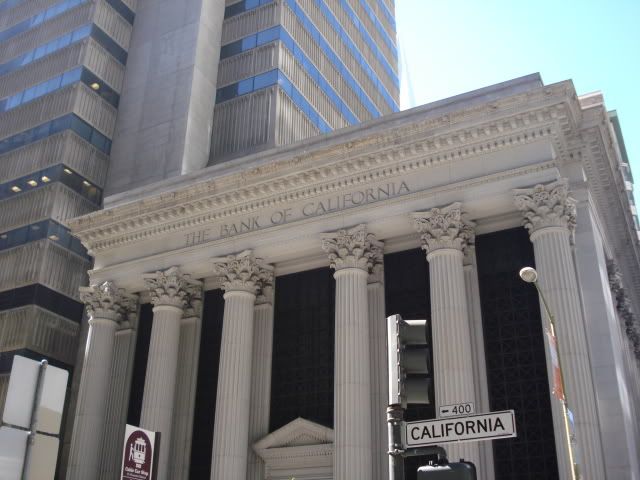
Outside view of the bank
Upon entrance I found the museum to be in the basement, downstairs. Small, as previously mentioned it certainly was as the whole place is not bigger then the average living room, if that large at all.
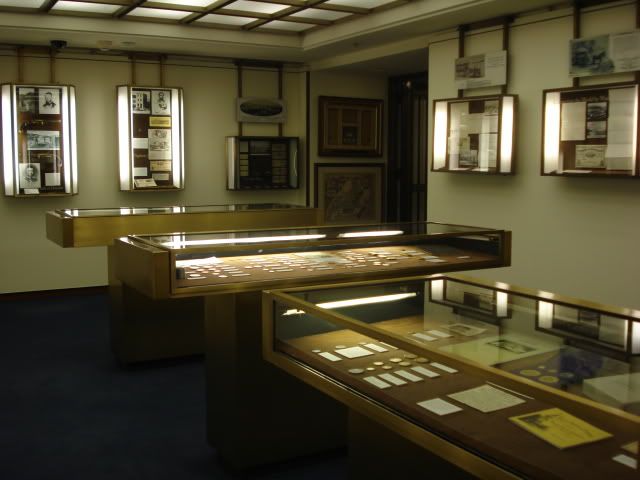
Overview of the museum
I slowly started to walk around a bit, as it was quite hot outside and the airconditioning was certainly welcome. First parts of the exhibition were a short history of California, especially of the Gold Rush era and a small part about the history of the bank itself. I immediately noticed that Pioneer Gold was a large part of what was there, at least 90%. Having just bought my first territioral gold coin (an 1849 Moffat & Co. $5 gold piece) I was certainly interested in this, and I was certainly glad that I found this place.
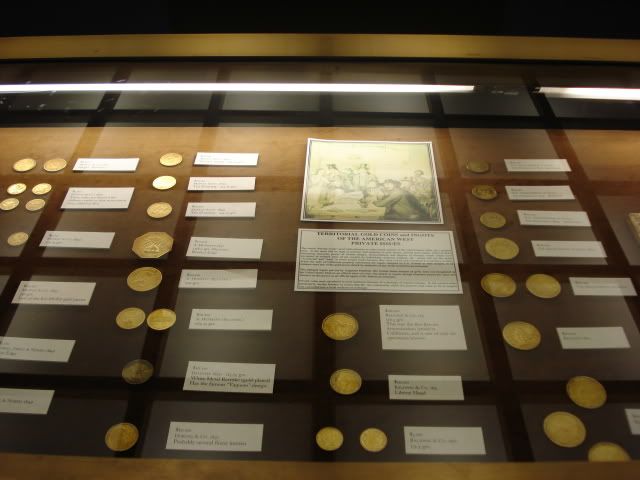
One of the display cases
One of the first items I saw were 4 notes of Gold-Backed paper money issued by the Mormons in 1849 in the State of Deseret were the Mormons moved to in the 1840's. These were signed by several people, including Brigham Young and issued in several denominations ($ .50, $1, $2 and $3) as the first currency printed west of the Mississippi. I had never seen or heard about these before, but I think it are some very historic issues. Anyone knows more about these?
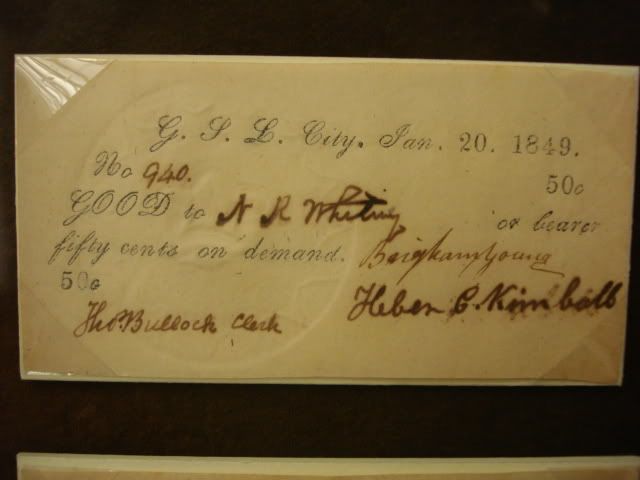
Mormon $ .50 currency piece signed by Brigham Young
Going over the display cases I discovered that not only the 1849 California Gold Rush was among the events highlighted, but other gold rushes afterwards (in particular Colorado) were also featured.
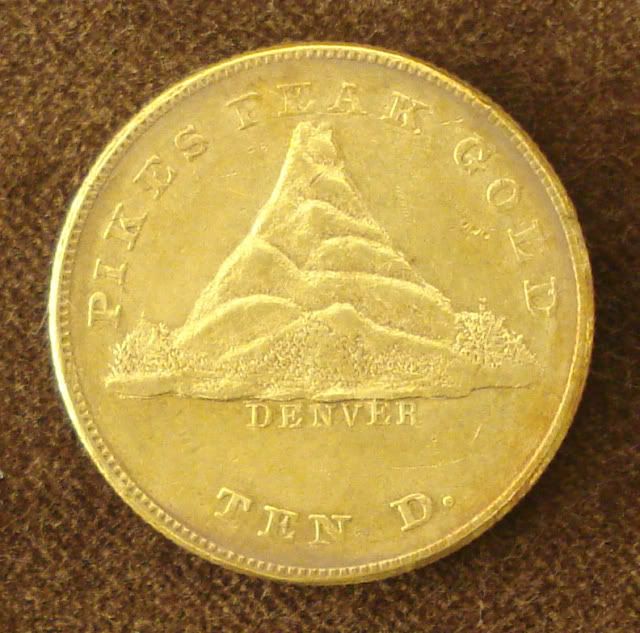
1860 Clark, Gruber & Co. $10.00 Pikes Peak
California territorial gold pieces were in every case. Included were multiple examples of Moffat & Co, Kellog & Co, Baldwin & Co, Norris, Gregg and Norris and Wass Moliter & Co pieces alongside lesser known firms. Many coins were in high condition although the overal mix between circulated and uncirculated was about 50/50. A few of the California territorial gold coin highlights:
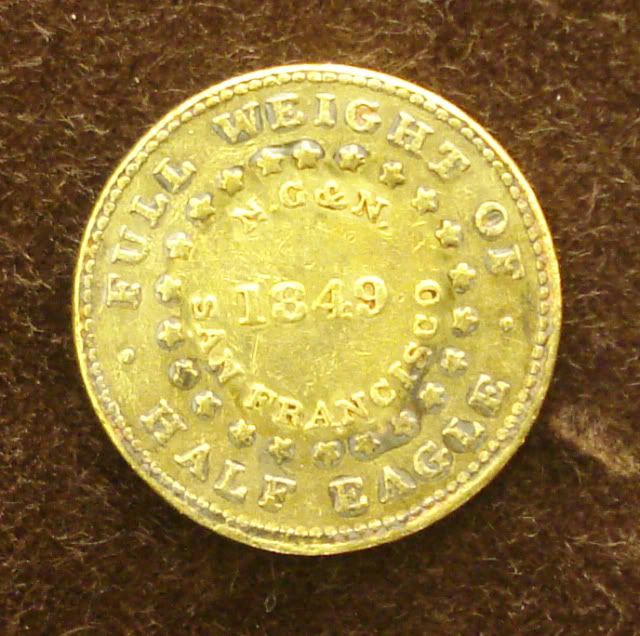
1849 Norris, Gregg and Norris $5, Plain Edge, Kagin-1 (R4)
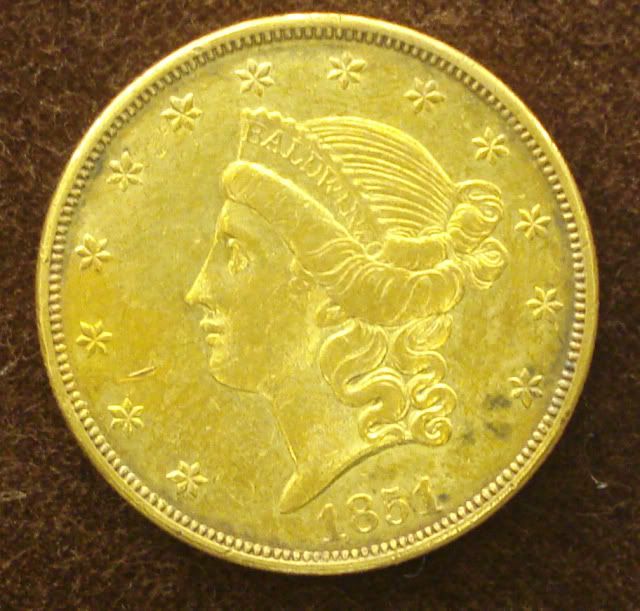
1851 Baldwin & Co. $20 Kagin-5 (High R7)
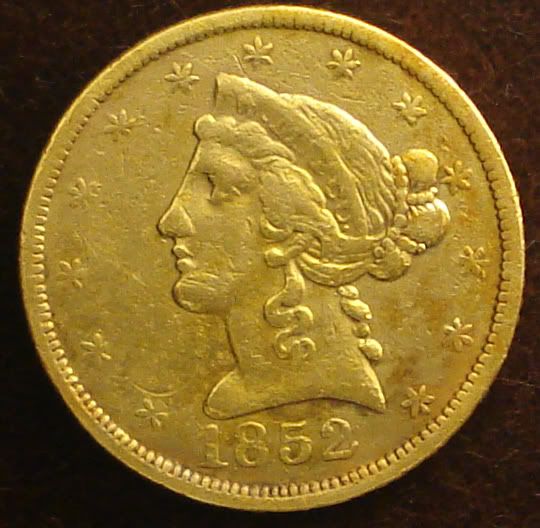
1852 Wass, Moliter & Co. $5, rounded bust, Kagin-1 (R6)
There were way too many highlights to put pictures of all of them in this thread, so I will only show the most important for now. Every item was simply described although some items, like Gold ingots had a bit more of an historic description.
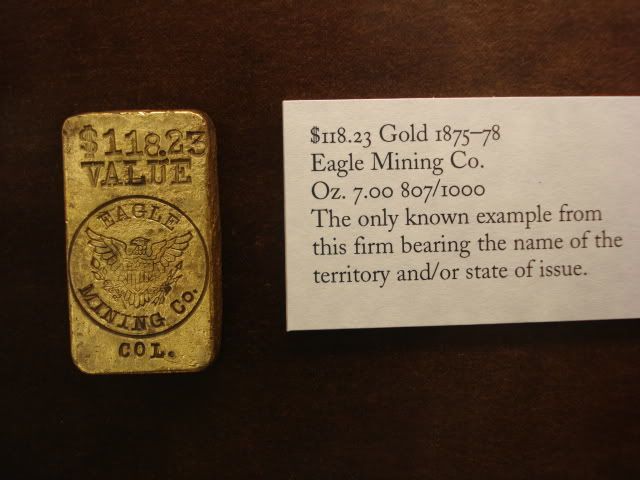
Another one of the ingots, this one shows the actual date of issue, January 11, 1853 (the 1-11 denotes the month/date of issue):
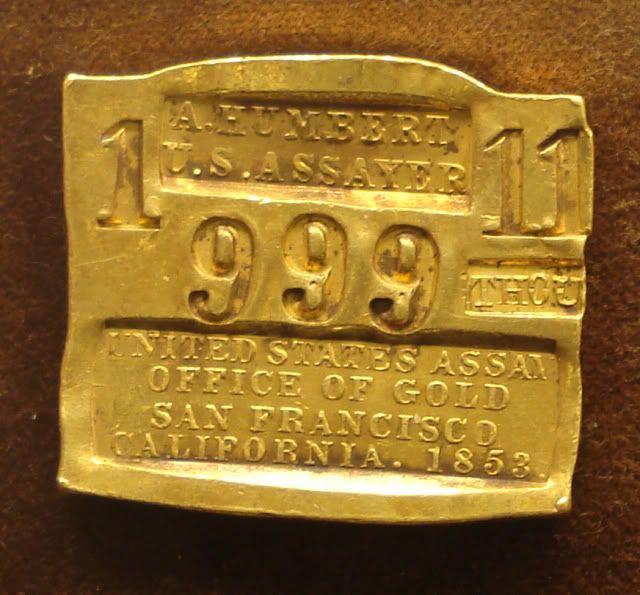
US Assay Office -Augustus Humbert Ingot
There were some territorial pattern gold pieces, most of them being excessively rare with almost no auction appereances. These were great to see, although most could only be viewed from one side. This is a much encountered problem at museums, and I think that a simple solution, like mirrors or whatever they can think off would be a worthwile addition. But even with only one side being visible, it was great to see some rare pattern/trail pieces:
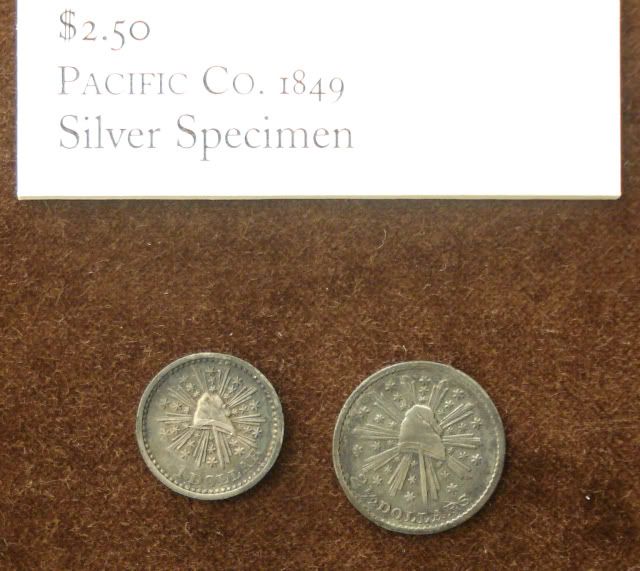
1849 Pacific Co. Silver Patterns, Kagin-1 (R8) and Kagin-2 (High R6)
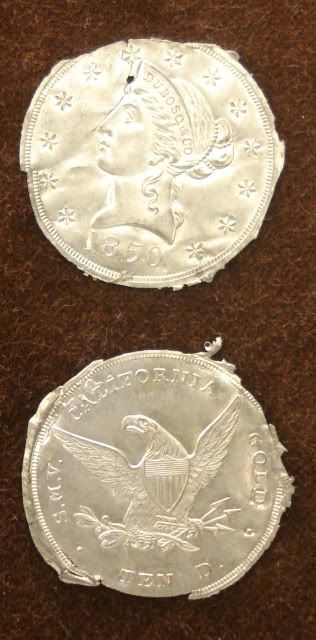
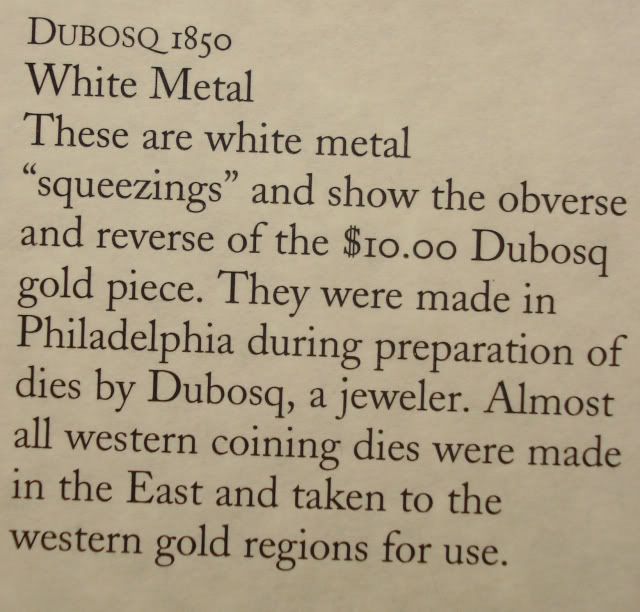
1850 Dubosq & Co white metal splashes, Kagin 3 and 3a (both R8)
My personal highlight was the following. Proof territiorial gold is rare. Only a few issues are known in proof format, and even then most so-called proof issues are disputed. The one below is, besides extremely rare a beautiful coin and a true proof. Many more US assay office issues were there, I'm unsure if there was a complete set of regular issues but I think they come quite close.
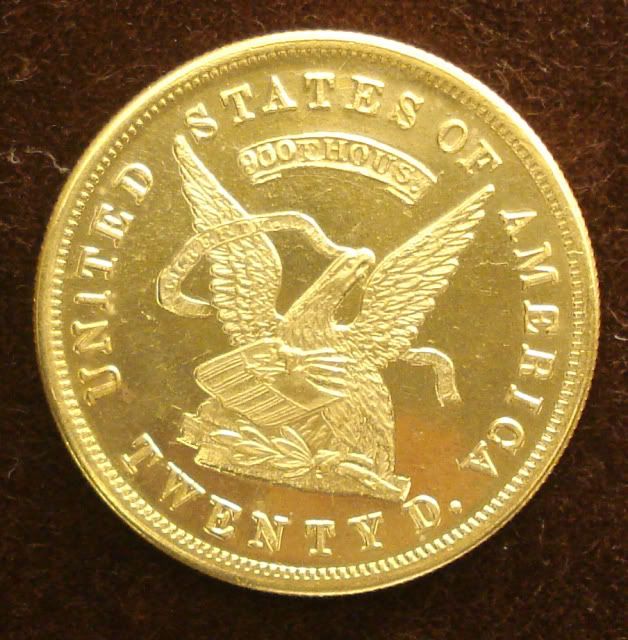
1853 US Assay Office $20 Proof
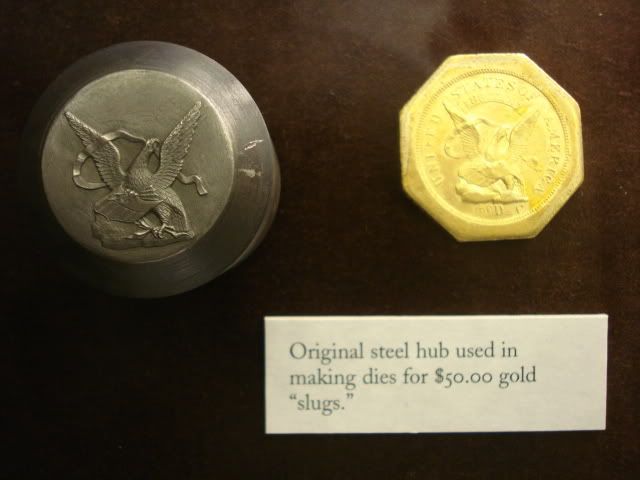
For lovers of slugs, here is the original hub:
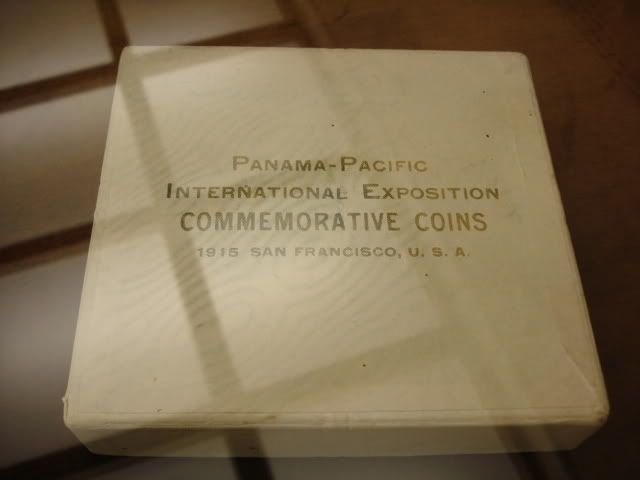
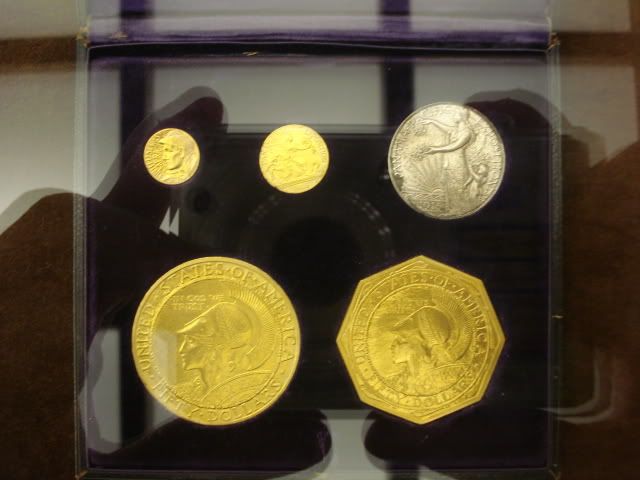
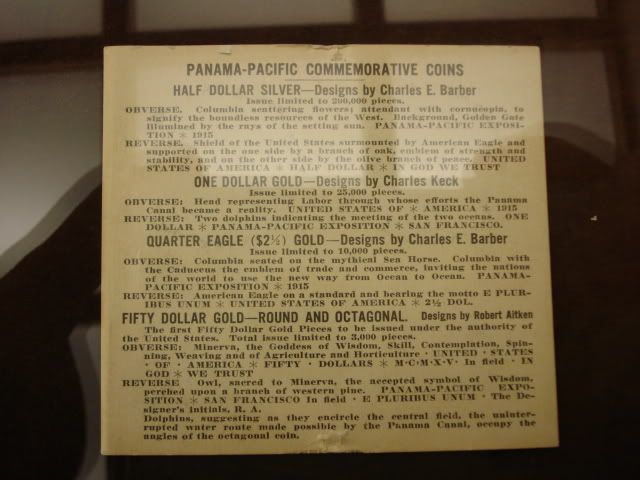
There were many more great territioral gold coins and related items. As for regular issues, there was not much to see besides a few High-Relief 1907 Saint Gaudens $20 gold pieces. One highlight however, was a complete set of 1915 Panama Pacific Commemorative coins in the original box:
Overall I was certainly impressed in finding this impressive collection in this not so well known museum. I spend a full 3 hours there, and to be honest I saw nobody else. There is some more information about the bank itself and some other historic items, like a bullion scale and wagon and an old plaquette which hang at the site of the first San Francisco mint. I was delighted to see that all coins seemed to be correctly handled, not showing any signs of cleaning. This is certainly something other museums can learn from (for example. the Danish National Museum in Copenhagen has a very nice medieval coin collection, but all show signs of excessive cleaning).
For any coin collector who visits San Francisco this is a must see. The museum is free of entrance, and you won't be interrupted by guards or other annoying people. One of the best museums/exhibits I have ever visited.
Dennis
Every visit to California should include San Francisco, and like so many people before me I have fallen in love with the city, its people (most of them), the food and so much more. Certainly a city I will hopefully visit many more times in my still young life (I'm 20).
During my visit to SF I visited several historic places, including the old San Francisco Mint (post to follow), Golden Gate Bridge, Financial District and a lot more. In one of my postings shortly before my visit, one recommended the Bank of California with a small museum. Because I was in the Financial District anyway, I decided to try to find the place on California street to see if it was worth the visit. After walking into the wrong bank at first, I found the Bank of California's main office, a nice building of the bank founded in 1864.
Outside view of the bank
Upon entrance I found the museum to be in the basement, downstairs. Small, as previously mentioned it certainly was as the whole place is not bigger then the average living room, if that large at all.
Overview of the museum
I slowly started to walk around a bit, as it was quite hot outside and the airconditioning was certainly welcome. First parts of the exhibition were a short history of California, especially of the Gold Rush era and a small part about the history of the bank itself. I immediately noticed that Pioneer Gold was a large part of what was there, at least 90%. Having just bought my first territioral gold coin (an 1849 Moffat & Co. $5 gold piece) I was certainly interested in this, and I was certainly glad that I found this place.
One of the display cases
One of the first items I saw were 4 notes of Gold-Backed paper money issued by the Mormons in 1849 in the State of Deseret were the Mormons moved to in the 1840's. These were signed by several people, including Brigham Young and issued in several denominations ($ .50, $1, $2 and $3) as the first currency printed west of the Mississippi. I had never seen or heard about these before, but I think it are some very historic issues. Anyone knows more about these?
Mormon $ .50 currency piece signed by Brigham Young
Going over the display cases I discovered that not only the 1849 California Gold Rush was among the events highlighted, but other gold rushes afterwards (in particular Colorado) were also featured.
1860 Clark, Gruber & Co. $10.00 Pikes Peak
California territorial gold pieces were in every case. Included were multiple examples of Moffat & Co, Kellog & Co, Baldwin & Co, Norris, Gregg and Norris and Wass Moliter & Co pieces alongside lesser known firms. Many coins were in high condition although the overal mix between circulated and uncirculated was about 50/50. A few of the California territorial gold coin highlights:
1849 Norris, Gregg and Norris $5, Plain Edge, Kagin-1 (R4)
1851 Baldwin & Co. $20 Kagin-5 (High R7)
1852 Wass, Moliter & Co. $5, rounded bust, Kagin-1 (R6)
There were way too many highlights to put pictures of all of them in this thread, so I will only show the most important for now. Every item was simply described although some items, like Gold ingots had a bit more of an historic description.
Another one of the ingots, this one shows the actual date of issue, January 11, 1853 (the 1-11 denotes the month/date of issue):
US Assay Office -Augustus Humbert Ingot
There were some territorial pattern gold pieces, most of them being excessively rare with almost no auction appereances. These were great to see, although most could only be viewed from one side. This is a much encountered problem at museums, and I think that a simple solution, like mirrors or whatever they can think off would be a worthwile addition. But even with only one side being visible, it was great to see some rare pattern/trail pieces:
1849 Pacific Co. Silver Patterns, Kagin-1 (R8) and Kagin-2 (High R6)
1850 Dubosq & Co white metal splashes, Kagin 3 and 3a (both R8)
My personal highlight was the following. Proof territiorial gold is rare. Only a few issues are known in proof format, and even then most so-called proof issues are disputed. The one below is, besides extremely rare a beautiful coin and a true proof. Many more US assay office issues were there, I'm unsure if there was a complete set of regular issues but I think they come quite close.
1853 US Assay Office $20 Proof
For lovers of slugs, here is the original hub:
There were many more great territioral gold coins and related items. As for regular issues, there was not much to see besides a few High-Relief 1907 Saint Gaudens $20 gold pieces. One highlight however, was a complete set of 1915 Panama Pacific Commemorative coins in the original box:
Overall I was certainly impressed in finding this impressive collection in this not so well known museum. I spend a full 3 hours there, and to be honest I saw nobody else. There is some more information about the bank itself and some other historic items, like a bullion scale and wagon and an old plaquette which hang at the site of the first San Francisco mint. I was delighted to see that all coins seemed to be correctly handled, not showing any signs of cleaning. This is certainly something other museums can learn from (for example. the Danish National Museum in Copenhagen has a very nice medieval coin collection, but all show signs of excessive cleaning).
For any coin collector who visits San Francisco this is a must see. The museum is free of entrance, and you won't be interrupted by guards or other annoying people. One of the best museums/exhibits I have ever visited.
Dennis
0
Comments
-
-
Excellent post!0
-
First class reportage.
Thanks."Inspiration exists, but it has to find you working" Pablo Picasso
0 -
Great stuff! Thank you!Winner of the Coveted Devil Award June 8th, 20100
-
Wonderful story and great pictures.

0 -
-
Wonderful!! Thanks for sharing.
 Becky0
 -
Now thats what makes this forum outstanding. Excellent post Dennis, and great pics.0
-
That looks like it's well worth a visit!
I like that Eagle Mining bar and Humbert ingot. Ed0 -
Great post...and terrific information, thanks!Mike
Visit my son's caringbridge page @ Runner's Caringbridge Page
"To Give Anything Less than Your Best, Is to Sacrifice the Gift" - Steve Prefontaine0 -
Nice post!
The notes from Salt Lake City are called "Valley Notes" and/or "White Notes" During that time period, due to the remoteness of SLC, circulating coinage was slim to none. Brigham Young, then president of the Mormon church cut blank pages from his personal journal, embossed them with the "Seal of the Twelve Apostles" and signed them (along with Bullock and Kimball) and they circulated in the SL Valley as cash.
Quite rare and collectible. These sell for about $2,000 or so each. As a side note, (in)famous forger Mark Hoffman counterfeited several of these.I used to be somebody, now I'm just a coin collector.
Recipient of the coveted "You Suck" award, April 2009 for cherrypicking a 1833 CBHD LM-5, and April 2022 for a 1835 LM-12, and again in Aug 2012 for picking off a 1952 FS-902.0 -
Speaking of counterfeits, the 1853 USAOG $20 "Proof" is one of the recently condemned "Transfer Die Forgeries".
The 999 Fine Humbert "Proofing" ingot is also a forgery, along with the Eagle Mining gold bar.
Many of the items in the Bank of California display are pieces that either came from, or were owned, by John Ford.PM me if you are looking for U.S. auction catalogs0 -
<< <i>Speaking of counterfeits, the 1853 USAOG $20 "Proof" is one of the recently condemned "Transfer Die Forgeries".
The 999 Fine Humbert "Proofing" ingot is also a forgery, along with the Eagle Mining gold bar.
Many of the items in the Bank of California display are pieces that either came from, or were owned, by John Ford. >>
Hmm, I didn't know that. Makes me look completely different about some of these pieces. I was not able to look at them up close, so was unable to tell about the condition/sources/authenticity of these pieces.
Dennis0 -
thanks for taking the time to post this; you did a good job
0 -
very cool, will have to remember this next time i'm up in SF
Michael Kittle Rare Coins --- 1908-S Indian Head Cent Grading Set --- No. 1 1909 Mint Set --- Kittlecoins on Facebook --- Long Beach Table 700
0 -
Excellent read, the PanPac set in the OGP is really cool, and more than likely extremely rare.
Thanks for taking the time to post it.
ScottWorld coins FSHO Hundreds of successful BST transactions U.S. coins FSHO0 -
All of the 1853 USAOG $20 "Transfer Die Forgeries" have certain characteristics (identical marks) that when you know them, stand out like a sore thumb.
These so-called Proof pieces were challenged by Abe Kosoff and John Pittman in 1958, the year they first appeared.
Later, in the mid 1960's, a study group, which included Eric P. Newman, presented a case against these as being modern counterfeits. It was Newman who first correctly identified the method of manufacture.
In the Februay 1994 issue of the Numismatist, p. 290, J.P. Martin & Tom Delorey (ANA Authentication Bureau) condemned these pieces as counterfeits.
At the 2008 ANA convention, the SPPN condemned these USAOG $20's as "Transfer Die Forgeries". These have been disputed for 50 years!
The other items mentioned are a very small part of the "Franklin Hoard" material, all of which have absolutely no validation to being made in the 19th century.
FYI - there are three known Eagle Mining bars with COL stamped on them.
PM me if you are looking for U.S. auction catalogs0 -
Super post!! Thanks for the visit!! “A nation can survive its fools, and even the ambitious. But it cannot survive treason from within. An enemy at the gates is less formidable, for he is known and carries his banner openly."
- Marcus Tullius Cicero, 106-43 BC0 -
Woah, I don't remember seeing that stuff when my family went to SF, but then again I was 8! 0
-
nicely done... excellent images and thanks for posting them
Experience the World through Numismatics...it's more than you can imagine.
0 -
Very nice thanks for sharing.
President, Racine Numismatic Society 2013-2014; Variety Resource Dimes; See 6/8/12 CDN for my article on Winged Liberty Dimes; Ebay
0 -
I love the Mormon $0.50 currency piece signed by Brigham Young.Buyer and seller of vintage coin boards!
 0
0 -
With the seismic risk of the bay area, that place could be 100% buried in a few seconds. IMO, they should be moved to a safer location...maybe my place a few hundred mile away . 0
-
Thanks for the virtual museum tour... I never knew that this museum existed when I visited SF two years ago.
Thanks also to the other posters for their comments and knowledge about the museum exhibits.
I really enjoyed this thread.
0 -
-
Great thread, Dennis!!Always took candy from strangers
Didn't wanna get me no trade
Never want to be like papa
Working for the boss every night and day
--"Happy", by the Rolling Stones (1972)0 -
I live near SF and did not even know about this museum.

Thanks for sharing.0 -
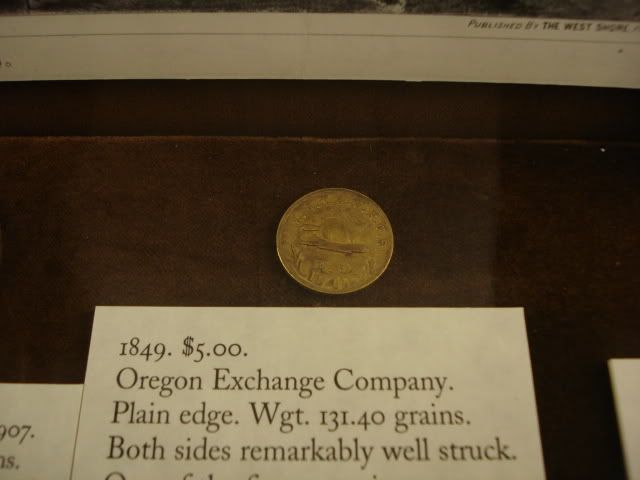
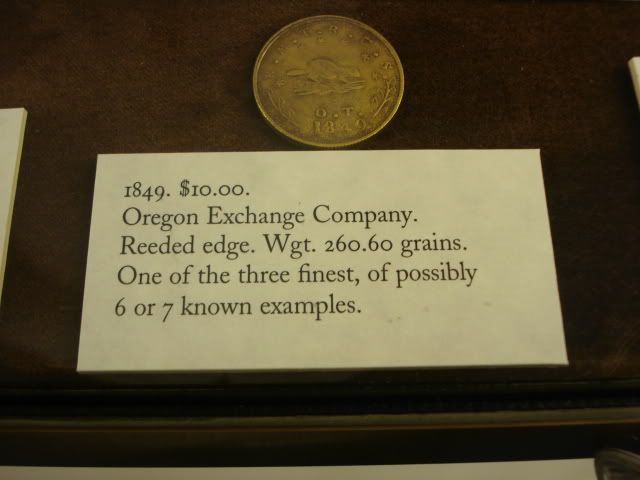
Gold coinage minted by the Oregon Exchange Company:
0 -
Very Nice! Keep the pics coming!
 “A nation can survive its fools, and even the ambitious. But it cannot survive treason from within. An enemy at the gates is less formidable, for he is known and carries his banner openly."
- Marcus Tullius Cicero, 106-43 BC0 -
nice
yeah, that Pan-Pac set is outtasite.0 -
very impressiveeverything in life is but merely on loan to us by our appreciation....lose your appreciation and see0
-
Very nice post! Informative and well illustrated. Thank you!
Mike
0 -
Were there any notices about who actually owned the material on display?
PM me if you are looking for U.S. auction catalogs0 -
I really enjoyed viewing that - thank you!There are two ways to conquer and enslave a nation. One is by the sword. The other is by debt.
–John Adams, 18260 -
Super post! I live in the Bay Area and visit SF frequently, but I never knew that was there.
I've always loved that building, by the way.
0 -
COOL STUFF0
-
WOW! Awesome stuff!All coins kept in bank vaults.
PCGS Registries
Box of 20
SeaEagleCoins: 11/14/54-4/5/12. Miss you Larry!0 -
<< <i>Were there any notices about who actually owned the material on display? >>
Nothing there. They have a small leaflet which you can get for free but there is only a short history of the bank listed.
Dennis0 -
Great thread! 0
-
I remembered this thread today and looked it up. Tomorrow I have court in SF. When I finish with the hearing I am going over to check out the museum at the Bank Of California and check out, first hand, all the great stuff on display there.
A five years ago my youngest son went on a field trip to Sacramento [4th grade] to see the Capital, Sutters Fort, the Calif. Train Museum, Old Sacramento and the Wells Fargo Bank in Sacramento. I went along as a parent chaperone. Well we got to Wells Fargo. Big glass tower with a large first floor area that is a museum. A Wells Fargo Stage coach greets you upon entry. Also a Wells Fargo Bank from the 1850's is recreated. The Wells Fargo tour guide did a great job. He took the kids over to the large safe, opened it and took out a 40 pound gold bar. He handed it to my son to hold. My son's eyes popped out of his head while holding the bar. Likewise I was amazed and so were his classmates. We calculated the value of the bar at the the spot price of gold. It was about $288,000.00 at the time. Probably worth at least double that today. Gold coins and other Gold Rush era artifacts are on display. If you are ever in Sacramento, sto by the Wells Fargo Bank and check things out.0 -
You Sir,
ARE AWESOME
Thanks for the Journey.0 -
Excellent "reading" Dennis. Thank you!0
-
W O W!!!!

I regret soooo much, that I didn't been in coin collecting back in the 2002 - when I was in SF.
Great report - eagerly waiting 4 more!
Regards, Rok0 -
S2, thx for resurrecting this, I missed it the first time.0
-
The exhibit has been around for some time (perhaps, though, not in the same form or always on view). I have a folder at my desk filled with b&w images of the material (some of which Dennis shows here), and of Hal F. Marks, then curator. They were taken by V.M. Hanks (a well-known collector from SF, who has since passed). I believe the images date to the early 1970s, as there was one or two of the bank's annual reports were in the same folder from that period. The display was at time termed the "Money of the American West" Museum. I've been there, but don't remember if it is still called that.0
-
Well after a long court hearing this morning, I took about 45 minutes [which I did not bill to my client] to stop by and check out the museum before heading back to the office. It was well worth the 45 minutes.
The bank building is just great. The exterior as shown in the picture at the beginning of this thread is ideal for a bank. It's appearance communicates an image of a grand, stable bank. The interior merely reinforces the same image.
The museum was great. Lots of information on the California Gold Rush days, on SF and on the development of the West. Lots of letters, bank records, drafts, checks, account ledgers, pictures, etc. Displays with explanations of the contents.
And of course the coins, currency, ingots and other money related items. Opening a 2009 Red Book and seeing color photos of private and public gold coinage, slugs, etc. is one thing. Seeing the real thing, in large and wide ranging quantities, in a very attractive display is much much better.
The number of gold coins, ingots, nuggets, etc. on display would make any collector's eyes pop open. Many of the coins, if not most of the coins were circulated, so they were actually used in commerce. The MS coins were also very nice. My favorite were some of the privately minted pieces [especially those from my hometown, Denver, Colo.], the proof gold piece and the Pan Pac Set in original Shreve & Co. packaging.
The best part of the trip to the museum was that during my entire visit, I was the only one there. No crowds to bump elbows with [like on the bourse], not a single other person to deal with [thus I could take my time, soak everything in that I wanted to and not have to consider anything other than my own thoughts] and it was very quiet.
For those who like gold and/or the history of the Western US, this museum should be placed on your to see list the next time you are in San Francisco.0 -
SanctionII, thanks for adding to a great report
0 -
ttt just for kewlness!Professional Numismatist, Retired. 55 year member ANA. Former ANA Senior Authenticator. Winner of four ANA Heath Literary Awards; three Wayte and Olga Raymond Literary Awards; Numismatist of the Year Award 2009, and ANA Lifetime Achievement Award 2020. Winner of the PNG's 2026 Robert Friedberg Award for "The Enigmatic Lincoln Cents of 1922," Available now from Whitman or Amazon.0
-


 of 4-17-04 004.jpg)




Leave a Comment
Categories
- All Categories
- 520.1K Coins and Currency - PCGS
- 328.5K U.S. Coin Forum
- 14.8K PCGS Set Registry Forum
- 5.2K Q & A Forum
- 41.4K World & Ancient Coins Forum
- 3K U.S. & World Currency Forum
- 96.4K Buy, Sell, & Trade - U.S. Coins
- 7.3K Buy, Sell & Trade - World & Ancient Coins
- 1.5K Buy, Sell & Trade - Currency
- 61 Random
- 246.2K Trading Cards, Autographs and Memorabilia - PSA
- 90.3K Trading Cards & Memorabilia Forum
- 1.7K Autographs Forum
- 16.4K PSA Set Registry Forum
- 22K Sports Talk
- 115K Buy, Sell & Trade - Cards & Memorabilia
- 663 Buy, Sell & Trade - Autographs
- 2.2K Stamps
- 1.5K Stamps Forum
- 670 Buy, Sell & Trade - Stamps
- 83 Coin Shows
- 83 General Coin Show Information and Discussion
- 11.9K Misc
- 11.9K Testing Forum