Options
Question on 1866 5c reverse struck through die cap (full brockage).
 IGWT
Posts: 4,975 ✭
IGWT
Posts: 4,975 ✭
There has been some speculation that the Mint set obverse dies as the anvil dies (and reverse dies as the hammer dies) in an experimental attempt to solve striking difficulties in the first year of the Shield 5c series. Pictured below is an 1866 5c with the reverse struck through a die cap. If you look closely, you'll see that the cap was pounded thin enough so that the large "5" of reverse die appears on the coin, but the cap was still sufficiently formed to leave a full, clear inverted and incuse image of the obverse. What do you think: Is it more likely that the cap formed on the anvil die (meaning that the obverse die was the hammer die) or that the cap formed on the hammer die (meaning that the reverse die was the hammer die)? Please explain your reasoning. Special thanks to Broadstruck for helping me find the coin.
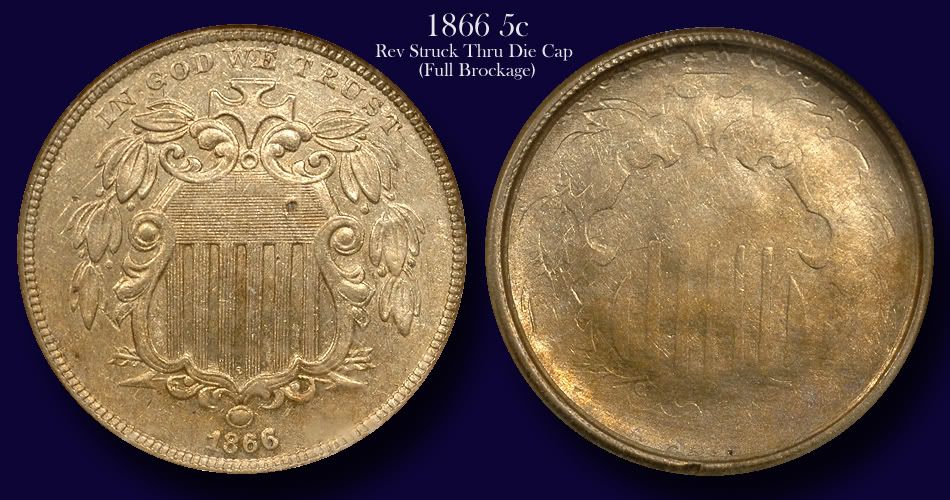
And, just for the heck of it, here's its sister, an 1866 or '67 with obverse struck through a die cap.
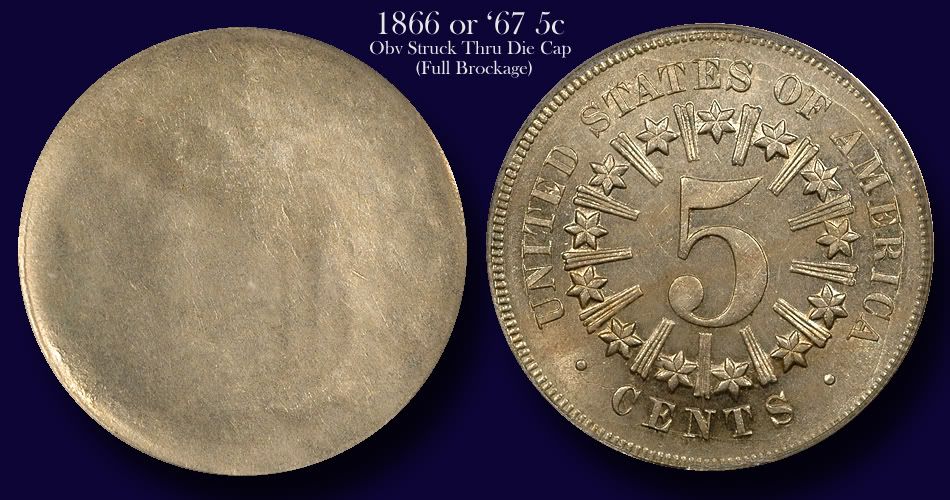
And, just for the heck of it, here's its sister, an 1866 or '67 with obverse struck through a die cap.
0
Comments
-Paul
John Dannreuther 1866 Shield Nickel Mint State
This is the continuation of a multi-part series on nickel coinage. As noted in the first article on the Three Cent nickel series, calling them "nickels" is a misnomer, as they only contained one-fourth nickel with copper composing the other three-fourths. No matter, they are nickels to almost everyone and when, in 1866, James Longacre adapted his shield and leaf motif from the two-cent coin that debuted two years earlier, he introduced one of the most widely used coins in American commerce. Although not everyone can remember the nickel Coke or the nickel candy bar (I guess I am showing my age since I can), this everyday coin had a rough beginning.
Longacre had come a long way in his knowledge of how designs would strike, but the difficulty in striking nickel-alloy coins would confound him. In fact, the problem in striking the first Shield nickels was so great that he used the obverse die in the anvil, or lower, position to fully strike the obverse. This resulted in weakness on the reverse, which was not fully corrected until the rays (or bars, as some would speculate) were removed in early 1867. Some numismatists have conjectured that the "stars and bars" reverse was Longacre's secret homage to the Confederacy, but there is really no historical information to support this hypothesis. There is nothing like a little intrigue to create interest, however, and the removal of the rays/bars created a two-year type coin -- the Shield nickel With Rays -- a quite popular item. Once the rays were removed, the striking problems essentially disappeared, although nickel coinage gave the Mint problems lasting until the middle of the twentieth century (check out the strike on some of the 1950s era Jefferson nickels). Today, with the Mint's super heavy-duty presses, the Jefferson nickel's strike is in most cases superb.
The "Longacre" doubling mentioned in the article on Three Cent nickels was not a problem with Shield nickels, as only occasionally will one find a Shield nickel with extra outlines on the obverse leaves or reverse stars. In fact, one notes many more coins with missing detail for this series rather than with extra detail. Basining and polishing of the working dies was often quite vigorous, especially on some of the Proof issues in the late 1860s and early 1870s. Someone must have noticed this problem, for the coins struck in the mid-1870s and later do not have the excessive polishing.
Even with the striking problems, in 1866, the inaugural year of issuance, over fourteen million Shield nickels were struck. Public acceptance for the new five-cent coin over the silver half dime made the latter coin irrelevant, although half dimes were still produced until 1873. As with most first-year-of-issue coins, the 1866 With Rays Shield nickels are available in all grades up to MS-66, although they are quite elusive in that grade with only a dozen or so coins graded that high by PCGS. Because of the previously mentioned striking problems, 1866 Shield nickels are almost never (NEVER!) encountered that grade higher than MS-66 (PCGS still has not graded a coin MS-67!). From the standpoint of marks some coins certainly could be classified at a higher level, but lack of luster and pizzazz, two other key factors in grading, keep most 1866 Shield nickels in the lower echelon of the grading scale. One of the most commonly seen weaknesses for the entire Shield nickel series -- both With Rays and No Rays -- is the shield area itself. The lines, both vertical and horizontal, are often indistinct and on some coins are missing, almost as if they have been intentionally smashed after they were struck, which of course, is not the case. There are not as many clashed dies in the Shield nickel series as seen with the Three Cent nickel issuance, perhaps because the coining presses jammed less often with the slightly larger planchets. Planchet flaws, lint marks, and the like are also less often seen than on their diminutive Three Cent nickel cousins, which is not to say they do not exist, as the Proof Shield nickels seem to have just as many as the Three Cent nickel Proofs -- the Mint State Shield nickels just seem to have fewer planchet irregularities. As with all mint-related defects, they only affect the grade when they become severe. The Redbook only lists one variety for the 1866, the dramatically doubled date coin, although there are several other doubled dates for that year. In fact, nearly all of the Shield nickels in the 1860s and 1870s have some dies with doubled dates -- some minor and others quite dramatic.
The next year saw two distinct types for the Shield nickel, as the With Rays coinage was suspended in February of 1867 after slightly more than two million coins had been struck. The Chief Coiner supposedly refused to strike any more of the With Rays type because of the difficulty in their manufacture - -in fact, some have speculated that the 15 Proofs struck in February were not even the With Rays type, as Breen notes in his Proof encyclopedia. However, in the second part of this article, you will see very compelling evidence that those coins were With Rays examples, contrary to the evidence that the Coiner said he would not strike them. Anyway, the 1867 With Rays coins are much tougher to find in nice condition than their 1866 counterparts, although there are some pristine examples to be found -- in fact PCGS has graded a single example of this coin MS-67! However, only two examples in MS-66 have been certified, indicating how much tougher it is to locate than the 1866. The problems for 1867 are similar to 1866 when it comes to obtaining high-grade examples -- dull luster, mediocre strike, and lack of eye appeal are the main culprits holding down their grade.
Longacre removed the rays from the dies (a new master die sans the rays was prepared), and the No Rays type Shield nickel was born. It seems likely that the obverse die was returned to its normal position, the upper or hammer die. Strike problems were certainly lessened by the new design and most 1867 No Rays Shield nickels have decent strikes. However, dull luster was still a problem, as noted previously the twenty-five percent nickel alloy was difficult to strike -- the dies wore rather quickly and only the first strikes have the "silvery" blast that collectors prize when searching for examples for their collections. The 1867 No Rays coins are certainly more available in higher grades than the With Rays coins (with over 28 million coins struck this is understandable), although the population data indicates they are still difficult to obtain with only about twice as many graded in MS-65 and MS-66. As with the whole Shield nickel series, coins that grade MS-67 are virtually non-existent. PCGS has never graded an example in that grade for the 1867 No Rays coin.
Most 1868 Shield nickels are similar to the 1867 No Rays coins (again, slightly over 28 million coins were produced), although there seem to be more examples that are dull or exhibit mushy strikes. The lines of the shield often are indistinct, as are the cross hatches of the reverse stars, although the striking problems are nowhere near as severe as for the With Rays coins of 1866 and 1867. Thus, high-grade examples are not often encountered and are highly prized when located. The new collector is often baffled by the disparity in price between just a few points on the grading scale, but the experienced collector understands this, having searched high and low for a pristine example. Just as a D flawless diamond brings many multiples of a lesser quality diamond, the MS-66 1868 Shield nickel brings multiples of the MS-64 coin. The population data indicates, however, that the 1868 is slightly more available than the 1867 No Rays in grades of MS-64, MS-65, and MS-66. Of course, above the MS-66 grade the 1868 is a rarity with no coins graded that lofty position by PCGS!
The issue of 1869 concludes the group of similar looking and about equal rarity coins. Of the first three No Rays years, the 1869 is the toughest to find in MS-64, MS-65, and MS-66. In my experience, this date seems to have slightly better luster and strike than the 1867 and 1868, although this does not seem to have translated into more high-grade examples. Perhaps, the slight modification in the dies in this year (a new master obverse die was introduced mid-year) helped the striking and die wear problems, but with only slightly more than 16 million coins produced, one understands its slight edge in high-grade rarity. Of course, as with the entire series, in MS-67 grade it is a super rarity.
The 1870 Shield nickel starts the second grouping of similar looking and similar rarity issues (1870-1876). This date, along with the next six years, is at least twice as difficult to find in MS-65 and MS-66 as the 1867-1869 grouping. However, the dies for this year (as well as the rest of the entire series) seem to have been more carefully basined, leading to better striking characteristics and more lustrous coins. In fact, prooflike examples of this year and later years are sometimes encountered. The reduced mintages (slightly less than 5 million for 1870) are the obvious reasons for the increased rarity in all grades for this year and the following years until 1882. This, again, is a super rarity in MS-67 condition with no examples thus graded by PCGS. Many also would consider this date a super rarity in MS-66, as only a couple of coins have merited that grade.
1871 can be characterized as the twin of 1870 in MS-65 and MS-66, as they have very similar population data. However, it is much tougher in the lower grades as only slightly more than a half million coins were produced -- the fourth lowest commercial production for the entire series. Many of this date have the fine die polish that produces the brilliant, silvery effect seen on superior nickel strikings. In most cases, it cannot really be called prooflike, although compared to some of the earlier issues, the luster can be called superb. Most 1871 Shield nickels have a good strike to go along with this better luster, so marks are the primary reason they fail to attain a high grade. This low mintage date is very popular with collectors and often brings a premium to the similar rarity dates around it.
With a mintage of slightly more than 6 million, the 1872 would seem to be much more available than the 1871; however, only in the lower grades is this true. Since very few nineteenth century numismatists cared much about condition, and only a few more Uncirculated examples of this date were saved than for 1871, the lower Mint State grades are the only ones that can be rather easily obtained. The population data bears this out, just as it shows that in MS-65 and MS-66 it is of nearly equal rarity to the 1870 and 1871. There are a few more MS-66 examples for this date than the previous two years, but in MS-65 their population data are nearly identical. The strike and luster of the 1872 is more similar to 1870 than 1871 with less silvery examples seen. Once the dies lose their pristine state, nickel coins struck from them have a deeper gray color, their luster best described as satin. After more strikings, the luster becomes flat, pale, and dull -- these examples, of course, not garnering a very high grade even when they are virtually mark free.
The 1873 Closed 3 issue is very difficult to ascertain its true rarity, since the population data is skewed because of some Closed 3 coins included in the data for Open 3 examples. PCGS, unfortunately, did not designate these from the beginning in 1986, as almost no one cared and they were almost identically priced. (In 1986, the Redbook had them identically priced in MS-60, while today the Closed 3 is more than double the price of the Open 3 in MS-60!) Today's more sophisticated collectors and dealers do care and until more data is available, one must use some logic and some guesswork. Since most Closed 3 coinage in all series is more difficult to obtain, one must conclude that the Closed 3 1873 Shield nickel is more rare than the Open 3. (The fact that many people mistook the Closed 3 for an 8 led to the Mint's changing to Open 3 punches early in 1873.) My experience bears this out, and although the difference is not as dramatic as the Open and Closed 3 gold dollars, perhaps the 1873 Closed 3 Shield nickel is 5 times more rare than the Open 3. The price references certainly do not indicate this great of a disparity, but until recently this was the case with most denominations that have both Open and Closed 3 varieties. Time should fix this and those who purchase Closed 3 examples will probably be rewarded in the future by a widening of the price differential. Since both the Closed 3 and Open 3 are tough coins in MS-65 and MS-66, one must conclude that the Closed 3 will someday be considered one of the real rarities of the entire Shield nickel series.
Since the population data is skewed, and some of the Open 3 examples in MS-65 and MS-66 are probably Closed 3 examples, one sees that the 1873 Open 3 Shield nickel is also a very tough coin to obtain in MS-65 and MS-66. The dealer and collector specialists in nickel coinage have known this for some time, but the general coin public looks at the 4 and a half million mintage in 1873 and concludes that it must be rather common -- both Open and Closed 3 varieties. At the next major show you attend, check out the dealers' stocks of all Mint State Shield nickel coinage -- you will be surprised at the paucity of offerings. If you do not attend shows, check out auction catalogs and retail listings in the trade papers and magazines. Myths are hard to dispel but the population reports certainly have helped to educate collectors (and dealers) as to which coins that previously have been considered common are really quite rare. Anyway, most Open 3 1873 nickels have average luster and strike, so finding a well-struck lustrous example is a challenge. When one is found with these attributes, an extra premium is warranted.
The 1874 has a mintage of about 3 and a half million coins, so it fits in with 1870, 1872, and 1873 in that respect, and in MS-65 and MS-66, it is of similar rarity. As with those dates, most 1874 Shield nickels have decent strike and luster, so marks tend to be the factor that determines whether they grade MS-64 and less or MS-65 and better. Most examples fall into the less category with only a couple of MS-66 examples found in the population data and only a couple dozen MS-65 examples. Finding a fresh-looking coin with sparkling luster and good strike is a problem with only a few examples showing up for sale each year. This sounds like a broken record, but 1874 is another sleeper in the Shield nickel series.
In 1875, the mintage dropped to just slightly more than 2 million coins. The lower Uncirculated grades are seen with about the same frequency as 1874, and, interestingly, in MS-65 and MS-66 are about the same rarity. Like their Three Cent nickel cousins, the 1875 Shield nickels are often found with fine die polish in the fields (and within the shield) and are sometimes confused with Proof strikings -- and vice versa -- that sometimes have similar-looking die polish (unusual for Proofs, not unusual for circulation strikes). Sometimes to determine the correct designation status, one must look at the third side -- the edge -- to properly classify an example. This is the most difficult year to determine Proof/Mint State status for the Shield nickel series, since some of the Proofs have beveled rims similar to circulation strikes. The polished planchets, however, give the Proofs a deep prooflike edge unlike the edge seen on business strikes. Luster and strike usually are not the problem with this issue, so the marks, or rather the lack of marks, determine whether a coin makes the upper echelon of the grading scale. The scratchy, broken record you hear is a voice saying underrated... underrated.
With 1876, we reach the end of the similar looking and similar rarity Shield nickels. A mintage of slightly more than 2 and a half million coins make it a sibling of the other dates in its group. Many of this issue have the silvery look that is so desired in nickel coinage, but most do not have the fine die polish seen in 1871 and 1875. There also seems to be more frosty coins of this date than for 1870-1875. It is just as difficult to locate in MS-65 and MS-66 with examples seldom offered at shows or auctions. When an example does appear, there is an astute collector or dealer waiting to snap it up.
As with 1877 and 1878 Three Cent nickels, these dates in Shield nickels have been reported in Mint State. If one turns them on edge, you note the deeply mirrored third side seen on Proofs; the Mint records so indicate all examples in these years were only struck for collectors. The slight frost in the fields that some coins exhibit is a result of the difficulty in striking nickel coinage and the likelihood that some coins were struck only once. Almost all silver and gold Proofs are struck at least twice, while the copper and nickel Proofs did not always receive this extra striking.
Starting with 1879, circulation strikes resumed, however in much lower quantities -- the next three years are the lowest mintage Shield nickels of the series. The 1879 had a minuscule 25,900 circulation strikes produced, although, as with the Three Cent nickels, the quality of striking was dramatically improved. This was partially due to the fresher dies of these low mintage years. Most examples are well struck with prooflike and semi-prooflike examples quite common and a few frosty coins also available. There are more MS-66 coins seen for this year than in previous years, although the total number of Mint State examples seen is certainly fewer, as would be expected with its lower mintage. Although coins are sometimes available in MS-65 and MS-66, they often bring as much or more as the more rare dates from 1867 through 1876. As with the dimes, quarters, and half dollars of this era, the sexy low mintages often mean more in the pricing realm than actual number of surviving specimens. Hoarding of coins had been going on for quite a while after the Panic of 1873, so specie hoarding was by the general population, not just collectors. Since the lower mintages also were the result of a drop in demand for specie because of the slow economy, as soon as any new coins became available, they were stashed away by whoever was lucky enough to obtain them. Although the populace certainly suffered during these tough economic times, today's collector can thank them for providing choice examples for their enjoyment.
The lowest mintage circulation strike Shield nickel, the 1880 with only 16,000 struck, also is the most rare in all grades. A low mintage does not always equate to rarity, but in this case it does. This coin is nearly impossible to find in true Mint State. This is emphasized because many of the 1880 Shield nickels offered as Mint State are really Proofs. It appears that the Proof die was used to strike business strikes or, if you prefer, the circulation strike die was used to strike Proofs. Either way, it was likely an economy measure by the Mint, which also was suffering through the hard times. This is the only Shield nickel that PCGS has not graded even a single example MS-66 or higher and only a couple have garnered the MS-65 level. Finding a frosty Mint State coin can be a frustrating experience, as even the true business strikes encountered likely are to be somewhat prooflike, if not totally prooflike! This is the stopper to the series for the business strike collector. It is not a sleeper, however, as virtually everyone knows the near impossibility of finding one of these jewels.
With a mintage of 68,000, one would expect the 1881 to only be slightly more available than the 1879, but a hoard found more than a decade ago in Maine makes this one of the more available Shield nickels in MS-66 and one of only three dates of the No Rays type (1882 and 1883 are the others) found in MS-67! It is still quite scarce in Mint State, but the hoard examples (reportedly 50 or so coins) were all very nice. Many thanks to the unknown hoarder! By the way, all the hoard coins are frosty, no question Mint State coins!
The 1882 Shield nickel has the highest mintage (over 11 million) of any No Rays date other than the 1867-1869 group. One would expect that many MS-65 and MS-66 examples are to be found -- and that is the case! It is the second most common No Rays Shield nickel in MS-65 and MS-66, with a couple of MS-67 examples also found. The strike and luster are great for this issue; many frosty specimens are seen, as well as prooflike, semi-prooflike, and satin coins. This and the 1883 are the only two Shield nickel dates that have over 100 MS-65 examples graded by PCGS. Type collections usually have this or the 1883 as their representative No Rays Shield nickel.
1883 Shield nickels should be a tough coin. With slightly less than a million and a half coins struck, it is the fifth lowest mintage in the entire Shield nickel series. It is also the most common! Not only is it the most common Uncirculated Shield nickel encountered in high grades, it is the most common in all Uncirculated grades! There are twice as many MS-66 examples as for any other date! Why? It is really a simple explanation. Early in the year, the Shield nickel series was discontinued in favor of the new Liberty Head or "V" nickel series. Collectors hoarded the old and new series. The general population hoarded them. Everybody hoarded them. Thanks, guys. Because of the hoarders, today's collectors have an affordable type coin. They are usually found well struck and have satin to fully prooflike luster. With a little searching, you can find just the "look" you desire in a Shield nickel. However, there is a variety of 1883 that is one of the most popular and most desired of all nickel coinage -- the overdate!
Because the new Liberty Head type was being developed, the Mint took several 1882-dated dies and punched an 1883 logotype over the 1882. Of course, die steel was still expensive at this time, so economy was another reason for the overdating. A die was a precious commodity and would not be thrown away unless it was broken or worn out. Thus, today we have a great variety -- the 1883/2. Do not be confused by the filled-die 1882 that sometimes is offered as this scarce overdate. If there is no 3 present it cannot be a genuine 1883/2. It is known that at least four 1882 dies received the 1883 logotype creating the most desirable variety in the Shield nickel series. (Walter Breen lists another overdate die with the 2 to the right of the 3, but there is controversy as to whether it is really a 2 or a repunched 3.) The highest premiums are paid for the examples from die pair number one that clearly show the 2 under the 3 of the date and it should be noted that PCGS will not certify examples as 1883/2 without some part of the 2 visible even if the die is the overdate die. (This is the same situation as the 1858/7 Flying Eagle cent, whose die is easily identifiable by the broken wing tip. PCGS will not certify those examples as 1858/7 without some part of the 7 visible under or around the 8.) This first die pair has the 2 to the left and slightly below the 3. As noted, this die is the most desirable of the overdates with some examples showing almost the entire 2. The other varieties have varying amounts of the 2 visible and bring prices commensurate with the amount of underdate showing.
In the next part of this study of Shield nickels, the Proof examples will be discussed date by date.
Another reason to believe it was the hammer die that was capped lies in the fact that I see dentils occurring on a different level of the strike than the main details of the brockage. This means, I think, that the capped die must have struck this coin slightly off center, imparting the dentils first and then the rest of the design. Because the obverse is centered, we know the planchet was centered and within the collar. I don't see how the anvil die could have imparted an off-center strike given this.
On the other (no date) coin, there is no finning. Using the opposite of the reasoning above, I think the lack of finning indicates that it was the anvil die that was capped in this case. I am puzzled by the lack of detail in the brockage on this coin - the thicker metal implied by a brockage should have brought out more of the design. Perhaps the die cap had been hit so many times most of the design was obliterated.
Both coins point to the obverse being the anvil die, in my opinion.
Both of these coins make excellent study material and require really thinking through the mint processes to form an opinion. I do not study error coins that often, and I don't know if my analysis is correct.
http://www.shieldnickels.net
-- In fact, the problem in striking the first Shield nickels was so great that he used the obverse die in the anvil, or lower, position to fully strike the obverse. --
Thanks for quoting the piece on Shields by John Dannreuther. When I started this thread, I couldn't remember where I had first read the bit about the obervse die being used as the anvil, and you've provided the answer. Thanks again for directing me to the coin.
Howard:
-- Both coins point to the obverse being the anvil die, in my opinion. --
You make some good points, as always, in the explanation leading to your conclusion. I need to turn the ideas over in my mind for a while before I can agree or disagree; and, unfortunately, my day job is calling me away.
<< <i>Broadstruck:
-- In fact, the problem in striking the first Shield nickels was so great that he used the obverse die in the anvil, or lower, position to fully strike the obverse. --
Thanks for quoting the piece on Shields by John Dannreuther. When I started this thread, I couldn't remember where I had first read the bit about the obervse die being used as the anvil, and you've provided the answer. Thanks again for directing me to the coin.
Howard:
-- Both coins point to the obverse being the anvil die, in my opinion. --
You make some good points, as always, in the explanation leading to your conclusion. I need to turn the ideas over in my mind for a while before I can agree or disagree; and, unfortunately, my day job is calling me away. >>
Mint Errors offer a lot of answers as to how a coin design was struck.
Sometimes it takes a bit to wrap your mind around the answer as it's customary to believe that all Obverses are struck with the Hammer die.
For another example here's my Obverse Merc Die Cap...
<< <i>Broadstruck... at times you leave me speechless... great information... Thanks, Cheers, RickO >>
It's a shame as most all of the guide books written on 19th and 20th century coinage rarely ever touch upon the actual die configurations.
Those are 2 nice examples!!!
I just recently started on the proof shield nickels, and i am looking for all info i can find.
NGC registry V-Nickel proof #6!!!!
working on proof shield nickels # 8 with a bullet!!!!
RIP "BEAR"
<< <i>Edited to delete because Broadstruck linked to JD's article in the previous post. >>
JD's article is also linked from The Shield Nickel Website on the articles page.
http://www.shieldnickels.net
<< <i>
It's a shame as most all of the guide books written on 19th and 20th century coinage rarely ever touch upon the actual die configurations.
Nor do they cover lots of other minting subjects on which there are current day questions. Couple examples:
1. How were dentils put on dies?
2. Was some kind of jig used for punching dates into dies?
3. What's the meaning/purpose of the misplaced date coins?
http://www.shieldnickels.net
<< <i>Where is the 2nd part to this article located? (part 2 is proofs)
Those are 2 nice examples!!!
I just recently started on the proof shield nickels, and i am looking for all info i can find. >>
The second part of the article is unfortunately missing from the PCGS website.
The Peters & Mohon book on Shield and Liberty nickels has lots of good info on shield proofs.
http://www.shieldnickels.net