Options
143 Years ago today....
 speety
Posts: 5,424 ✭
speety
Posts: 5,424 ✭
(Thanks to Barndog for pointing this out on the BST forum) On April 9, 1865 after four years of Civil War, approximately 630,000 deaths and over 1 million casualties, General Robert E. Lee surrendered the Confederate Army of Northern Virginia to Lieutenant General Ulysses S. Grant, at the home of Wilmer and Virginia McLean in the town of Appomattox Court House , Virginia. General Lee arrived at the Mclean home shortly after 1:00 p.m. followed a half hour later by General Grant.
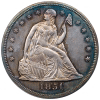
To remember the War that kept our nation together and had brother fighting brother in a tragic and bloody war, post your coins dated 1865.
Here's my two, an XF-45 and an AU-50:


To remember the War that kept our nation together and had brother fighting brother in a tragic and bloody war, post your coins dated 1865.
Here's my two, an XF-45 and an AU-50:
Want to buy an auction catalog for the William Hesslein Sale (December 2, 1926). Thanks to all those who have helped us obtain the others!!!
0
Comments
Please.
Here's from a direct decendant
9 April, 1865 – A Fateful Day for Many Southerners
by Lewis Regenstein
One hundred and forty-three years ago today, on 9 April, 1865, Robert E. Lee surrendered his Army of Northern Virginia to Union Commander Ulysses S. Grant, marking the effective end of the South’s struggle for independence.
It was a fateful day for the South, and in particular for my great grandfather and his four elder brothers, all of whom were fighting for the Confederacy.
On that day, the eldest brother Joshua Lazarus Moses was killed a few hours after Lee, unbeknownst to the troops elsewhere, had surrendered. Josh was commanding an artillery battalion (Culpepper's Battery or Culpepper's Light Artillery) that was firing the last shots in defense of Mobile, before being overrun by a Union force outnumbering his 13 to one. In this battle, Fort Blakeley, one of his brothers, Horace, was captured, and another, Perry, was wounded.
Joshua had also been in the thick of the fighting in the War’s opening battle, when Fort Sumter was attacked in April, 1861. Josh was the last Confederate Jew to fall in battle. His first cousin, Albert Moses Luria, was the first, killed at age 19 at the Battle of Seven Pines (Fair Oaks) in Virginia on 31 May, 1862.
While Lee was surrendering at Appomattox, a 2,500-man unit attached to Sherman’s army, known as Potter’s Raiders, was heading towards my family’s hometown of Sumter, South Carolina. Sherman had just burned nearby Columbia, and it was feared that his troops were headed to Sumter to do the same.
My then 16-year-old great grandfather, Andrew Jackson Moses, rode out to defend his hometown, along with some 157 other teenagers, invalids, old men, and the wounded from the local hospital. It was a mission as hopeless as it was valiant, but Sumter’s rag-tag defenders did manage to hold off Potter’s battle-seasoned veterans for over an hour before being overwhelmed by this vastly superior force, outnumbering theirs by some 15 to one.
Jack got away with a price on his head, and Sumter was not burned after all. But some buildings were, and there are documented instances of murder, rape, and arson by the Yankees.
The fifth bother, Isaac Harby Moses, having served with distinction in combat in Wade Hampton's cavalry, later rode home from North Carolina after the Battle of Bentonville (North Carolina), the War’s last major battle, where he commanded his company, all of the officers having been killed or wounded. He never surrendered to anyone, his Mother proudly observed in her memoirs.
Earlier, as a member of a company of Citadel Cadets, he had his horse shot out from under him, and was attacked by a Union soldier wielding a sword. He was among those who fired the very first shots of the conflict, when his cadet company opened up on the Union ship, Star of the West, which was attempting to resupply the besieged Fort Sumter in January, 1861, three months before the War officially began.
Over two dozen members of the extended Moses family fought in the War, serving and working closely with such legendary generals as Robert E. Lee, James Longstreet, and Wade Hampton, and firing some of the first and last shots of the War in its opening and closing battles. They fought on horseback and on ships, in the trenches and in the infantry. They built fortifications, led their men in charges, and one had responsibility for provisioning an entire army corps of some 50,000 men. The extended family sacrificed at least nine of its sons for The Cause.
Like their comrades-in-arms, the Moses’ were fighting for their homeland – not for slavery, as is so often said, but for their families, homes, and country. Put simply, most Confederate soldiers felt they were fighting because an invading army from the North was trying to kill them, burn their homes, and destroy their cities.
The hard-pressed Confederates were usually heavily outnumbered, outgunned, and out-supplied, but rarely outfought, showing amazing courage, skill, and valor.
9 April, 1865 – A Fateful Day for Many Southerners
Coin's for sale/trade.
Tom Pilitowski
US Rare Coin Investments
800-624-1870
Thank you for posting that. this is a tad off topic, but there is a book called the Jewish Confederates, which is a very interesting read if you are intersted. I wish I could post a coin of 1865, but all my coins are bust halves.
Senior Numismatist
Legend Rare Coin Auctions
<< <i>On April 9, 1865 after four years of Civil War.... >>
You mean the "War of Northern Aggression"? That's what we were always taught to call it.
BTW, that's usually pronounced the "Wahw of Nahw-thun Ag-gray-us-shun."
60 years into this hobby and I'm still working on my Lincoln set!