Home› U.S. Coin Forum
Options

The 1826 C-1 Half Cent Provides Some Interesting Sidelights

BillJonesBillJones Posts: 36,020 ✭✭✭✭✭
imageimage

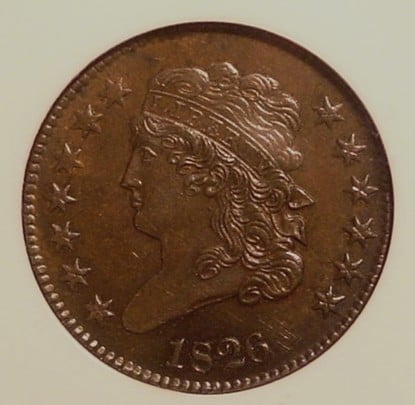
One of the interesting features of many 19th century coins is that they often have interesting variations that are seldom seen on modern coins. A case in point is the 1826 Cohen - 1 half cent. This variety is the more common of the two 1826 varieties by a fairly wide margin.

The diagnostic feature of the variety is the patch raised lines that is the right of the date. This was the result of a blundered die. When the die sinker was preparing the die he punched in the “6” in the date too far to the left. Noting his error, he filled in the spot leaving a group of telltale lines.

Today some collectors have taken an interest in rotated dies. For this variety, all of the coins show rotated dies to a degree, in this case about 15 degrees as shown in the picture.

Finally, although it’s not noted in the die variety books, this variety is quite often very sharply struck. All of Ms. Liberty’s hair do is show in vivid detail, even on pieces in EF condition.

This piece is in an NGC MS-64 brown holder. It is the second 1826 C-1 that I have owned and clearly the better one. First piece dated back to my days as a half cent by die variety collector, which ended more than a decade ago.

I’m not sure if I’m going to keep this piece or sell it, but it has been fun looking back on a variety that drew my attention years ago.
Retired dealer and avid collector of U.S. type coins, 19th century presidential campaign medalets and selected medals. In recent years I have been working on a set of British coins - at least one coin from each king or queen who issued pieces that are collectible. I am also collecting at least one coin for each Roman emperor from Julius Caesar to ... ?

Comments

  • Options
    LeianaLeiana Posts: 4,349 ✭
    Neat coin!

    I agree that coins from this era have little quirks that make them different from modern coins, and that's why I like them.

    For instance, I just learned about my 1804 C-11 half cent, and that it is a very late die state for the variety. It's got 20 degrees of rotation.

    I like how on your coin you can kinda see a shadow of the 6 under the raised lines. Is it an earlier die state? I imagine the lines would wear away from the die after a while, kinda like clash marks do.

    Thanks for sharing a cool coin! image

    -Amanda
    image

    I'm a YN working on a type set!

    My Buffalo Nickel Website Home of the Quirky Buffaloes Collection!

    Proud member of the CUFYNA
  • Options
    BillJonesBillJones Posts: 36,020 ✭✭✭✭✭
    This is Breen's die state IV, which is actually kind of late in the game because Breen cited five in total. On earlier die states, the erasure lines are stronger and the hair detail is even starper. As was the case with many 19th century coins, these dies were lapped a few times to remove clash marks and improve the luster of the finished coin.
    Retired dealer and avid collector of U.S. type coins, 19th century presidential campaign medalets and selected medals. In recent years I have been working on a set of British coins - at least one coin from each king or queen who issued pieces that are collectible. I am also collecting at least one coin for each Roman emperor from Julius Caesar to ... ?
  • Options
    Excellent post image
  • Options
    MyqqyMyqqy Posts: 9,777 ✭
    I love moderns and classics both- but classics like this half cent have a special place in my heart due to their variations and character. Thanks for showing us this cool coin!
    My style is impetuous, my defense is impregnable !
  • Options
    CoxeCoxe Posts: 11,139 ✭
    I just consigned my braider hairs to FUN and reviewed each of them and they often have little details like your '26. A 1 was punched in the wrong spot on both the 1851 and 1854 dates, though the guy from 1826 probably wasn't working on the mint dies then. The 1851 has it to the right if the date and all 1851 half cents generally show the base. Better struck ones with no or little wear will show varying amounts of the lower upright. The 1854 has the errant punched 1 to the left of the date. Only the real first strikes of that issue show it as a short dash. (Hope the cataloguer catches that on my piece.)
    Select Rarities -- DMPLs and VAMs
    NSDR - Life Member
    SSDC - Life Member
    ANA - Pay As I Go Member
  • Options
    MikeInFLMikeInFL Posts: 10,192 ✭✭✭✭
    What a great coin and write up -- thanks for taking the time and sharing!

    I can appreciate the varieties of half cents being a large cent collector, and see the lower number of varieties for half cents as making this series more attainable for variety collectors. One of the things that attracted me to old copper in the first place was the vast number of varieties and how each one of them had a little bit of a story about them -- and your coin is a perfect example.

    Take care...Mike

    Collector of Large Cents, US Type, and modern pocket change.
  • Options
    lkeneficlkenefic Posts: 9,574 ✭✭✭✭✭
    Thanks for the info...neat post...even neater coin!!
    Collecting: Dansco 7070; Middle Date Large Cents (VF-AU); Box of 20;

    Successful BST transactions with: SilverEagles92; Ahrensdad; Smitty; GregHansen; Lablade; Mercury10c; copperflopper; whatsup; KISHU1; scrapman1077, crispy, canadanz, smallchange, robkool, Mission16, ranshdow, ibzman350, Fallguy, Collectorcoins, SurfinxHI, jwitten, Walkerguy21D, dsessom.
  • Options
    richardshipprichardshipp Posts: 5,647 ✭✭✭


    << <i>Excellent post image >>


    image
  • Options
    marmacmarmac Posts: 1,534 ✭✭✭✭
    Great write up on the date and great coin. 1826 is one of my favorite dates in the classic head series. Though not a tough date, it is in shorter supply than many of the other later date half cents.

    In Bill Eckberg's study, he suggests a surviving population of 3700 (estimate) for the C-1 and a measly 210 (estimate) for the C-2 variety of 1826.


    Great coin and thanks for sharing.


  • Options
    AuldFartteAuldFartte Posts: 4,597 ✭✭✭✭
    Great post, Bill. Very informative image
    I had an 1826 C-1 (raw UNC) and it was probably the nicest strike of any of my Classic Head Half Cents. I kinda wish I hadn't sold those things image
    image

    My OmniCoin Collection
    My BankNoteBank Collection
    Tom, formerly in Albuquerque, NM.
  • Options
    thanks for this informative post! and sharing your knowledge and insight!
  • Options
    NumisOxideNumisOxide Posts: 11,050 ✭✭✭✭✭
    Nice info, great coin.
  • Options
    AZLARRYAZLARRY Posts: 1,189 ✭✭
    Very imformative post as usual, thanks.
    image
  • Options
    speetyspeety Posts: 5,424 ✭
    Interesting post and cool coin! Thanks!
    Want to buy an auction catalog for the William Hesslein Sale (December 2, 1926). Thanks to all those who have helped us obtain the others!!!

  • Options
    dcarrdcarr Posts: 10,329 ✭✭✭✭✭
    How does the rarity of the "C-1" variety compare the the 6 over horizontal 6 variety ? (I don't know the variety number of this one):

    image
    image
    image
  • Options
    BillJonesBillJones Posts: 36,020 ✭✭✭✭✭
    Breen wrote the the 1826 C-2 half cent was a high R-3, almost an R-4. In an earlier post marmac wrote that there are 210 examples. At any rate it is a lot scacer than the C-1, and hard to find above VF. The coin you posted is a very nice example, and grades EF-40 IMO.
    Retired dealer and avid collector of U.S. type coins, 19th century presidential campaign medalets and selected medals. In recent years I have been working on a set of British coins - at least one coin from each king or queen who issued pieces that are collectible. I am also collecting at least one coin for each Roman emperor from Julius Caesar to ... ?
  • Options
    marmacmarmac Posts: 1,534 ✭✭✭✭
    Nice C-2 dcarr- XF-ish.

    The C-2 as noted by Bill Jones, is tough in higher grades. In lower grades it is a relatively easy coin to come across unattributed. In higher grade, it is a different story- they are tough. Very few of the well known Half cent collections that have come to market have had a C-2 in Unc. The Brobston collection for example, was only an XF (probably AU by todays standards).


    Here are my coins- The C-2 is most easily attributed by the position of the high leaf on the reverse. Attributing either variety by the obverse differences (C-2 under digit remnaants, C-1 Die file lines) is easy on the early die states, but on the later die states , a low grade coin is much more easily attributed by the reverse imho.
    1826 C-1
    image
    image

    1826 C-2
    image
    image
  • Options
    marmacmarmac Posts: 1,534 ✭✭✭✭
    anyone else ?
  • Options
    LongacreLongacre Posts: 16,720 ✭✭✭
    Great post! I love half cents and one that I own has a cool rotated die, too.
    Always took candy from strangers
    Didn't wanna get me no trade
    Never want to be like papa
    Working for the boss every night and day
    --"Happy", by the Rolling Stones (1972)
  • Options
    A couple of CC Level examples. Enjoy!
    MSpur1

Leave a Comment

BoldItalicStrikethroughOrdered listUnordered list
Emoji
Image
Align leftAlign centerAlign rightToggle HTML viewToggle full pageToggle lights
Drop image/file