Options
Collecting Silver Bust Coinage
 JrGMan2004
Posts: 7,557 ✭
Collector's of Silver Bust coinage often come from a much different mold from your regular coin collectors. Most Bust collectors are "plastic weary" in that they do not collect certified coins, and coins that they do buy in slabs, are cracked out for their collection. The reasons vary from collector to collector. Some like them better raw for study, others for aesthetic reasons, but much of this stems from the fact that many coins have been messed with through the years and would not slab at NGC or PCGS or would get a net grade from ANACS.
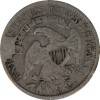
Completely original, unmolested Bust coins sell for a nice premium and with good reason; they are tough to find! Circulated Bust coins ofter get a hard dove gray color, especially in VF and lower grades, while XFs and up are often less grey and much of the time are still silver in color. My theory, is that the grey color requires a certain amount of handling and then time for it to get that color, and it seems in my experience, that the VF grade is that point where they get real gray. This grey color is often a good sign for a coin that has not been cleaned or messed with. But you should never assume. As my drama teacher used to say, "When you assume, you make an 'ass' out of 'u' and 'me.'" You should still check for hairlines (Tiny scraches usually going in multiple directions and appearing in the fields and on the devices). Also watch for scratches and other damage, such as solder, holing and on smaller coins, bends in the coin.
Problems aren't always unacceptable. It's up to your own eye and goals for your collection to decide what is acceptable for you! Many collectors from times past would clean their coins before placing them into albums. This was a common practice many years ago. These coins then may have been left in their albums for many years before returning to the market, often retoning in the interim. Be weary, as these retoned coins can be deceiving, often hiding hairlines. Check very carefully before buying. While I will buy these coins for my collection, I won't pay a large premium for them, because they have been messed with, and I like original coins. Small scratchs and other detractions can sometimes be acceptable, but again, it is up to your person preferences!
Another facet of Bust coin collecting, is collecting by die marriages. A die marriage, is when an obverse die and a reverse die were paired and used to strike coins. At the time, only the central desgin was impressed into the dieface from the hubs. The stars, letters and numerals were all pressed into each die by hand, making each die unique and distinguishable from other dies. Through the years, several numismatists have conducted studies of Bust coinage, and have identified these dies and marriages, and also studies of their scarcity. Notable examples are Overton for Bust Halfs, and Russ Logan and John McCloskey for Half-Dimes. Die marriage collectors use these authoritative references to identify what dies were used to strike their coins. These collectors also seek out coins that are scarce because of their die marriage. The date could be easilly found, but finding a coin struck with two specific dies, can be hard. The scale for showing the rarity, goes from R.8, 1-3 coins known to exist, counted down to R.1, 1,000+ known to exist. And of course these collectors always have their eyes open, looking for new die marriages that have not been found before. The goal of a die marriage collector is usually to collect an example of every die marriage for a particular series, often a very daunting task, especially in the Bust Half area, where there are several die marriages that are unique, or only a few known, which are often held in strong hands that won't let go for some time.
I hope this may help some of you peoples out there get an insight more into the life of a Silver Bust Collector
Cladiator's sigline for some illustration
-George
42/92
42/92
0
Comments
so interesting i am going to read it again.
<< <i>I hope this may help some of you peoples out there get an insight more into the life of a Silver Bust Collector >>
Man, I've never had anyone want to get an insight on my life before
Hey...well put and good writting Georgio.
<< <i>
<< <i>I hope this may help some of you peoples out there get an insight more into the life of a Silver Bust Collector >>
Man, I've never had anyone want to get an insight on my life before
Hey...well put and good writting Georgio. >>
I like your new sigline, and it's a nice pic to go along with the article
42/92
Also, many that are slabbed even by PCGS and NGC are not problem-free.
It's interesting you mention strong hands holding rare dates/die marraiges. A recent phenomenon that's often discussed here is that of the changing hands of many extraordinarily rare coins - the 1913 liberty nickels, stellas, proof gold, 1870-s half dime, etc - takes place every few years, rather than the once-in-a-generation (if that) trading of these pieces in the past. With rare bust coinage varieties (along with other specialty areas, such as early large cents), there still are some coins that really are so rare and held so closely. They often will never see the light of a public auction.
<< <i>Another reason bust half collectors prefer them free from plastic is for the better appreciation of the "third side" - the lettered edge, of which there are also varieties.
Also, many that are slabbed even by PCGS and NGC are not problem-free.
It's interesting you mention strong hands holding rare dates/die marraiges. A recent phenomenon that's often discussed here is that of the changing hands of many extraordinarily rare coins - the 1913 liberty nickels, stellas, proof gold, 1870-s half dime, etc - takes place every few years, rather than the once-in-a-generation (if that) trading of these pieces in the past. With rare bust coinage varieties (along with other specialty areas, such as early large cents), there still are some coins that really are so rare and held so closely. They often will never see the light of a public auction. >>
Quite true, on all 3 counts...
Though, I must make mention, there are two fairly large Half-Dime collections that will be coming to auction this fall, one being that of the great Jules Reiver...
42/92
42/92
Do you know of a good book for bust dimes?
Thanks for sharing...Mike
<< <i>I just received and read the Logan and McCloskey Half Dime book, "Federal Half Dimes 1792-1837". A nice book on the various dies used for this series that should make attribution a breeze. I picked up the book because I want to pick up a few half dime varieties for my Dansco, and your post really helped educate me on the bust coins in general. I'll also pick up the Overton book too.
Do you know of a good book for bust dimes?
Thanks for sharing...Mike >>
Yes, JRCS put out a similar book as the Logan and McCloskey Book some years earlier... I believe a few copies are still available from JRCS...
42/92
<< <i>Does ANACs usually give a net grade if a bust coin has been cleaned or do some leak through like PCGS or NGC? >>
No TPG is perfect... I think ANACS does a better job at telling it like it is... but sometimes NGC and PCGS "net" grade a coin that's been lightly cleaned or has a light scratch or even a light bend... I've heard of people cracking coins from their holders, only to find that the coin was bent...
42/92
<< <i>Yes, JRCS put out a similar book as the Logan and McCloskey Book some years earlier... I believe a few copies are still available from JRCS...
Is this the one you're talking about?
Davis, David J., Logan, Russell J., Lovejoy, Allen F., McCloskey, John W., Subjack, William J., Early United States Dimes 1796-1837 John Reich Collectors Society, Ypsilanti, MI 1984. $75. or $125 Deluxe Edition
Thanks...Mike
<< <i>
<< <i>Yes, JRCS put out a similar book as the Logan and McCloskey Book some years earlier... I believe a few copies are still available from JRCS...
Is this the one you're talking about?
Davis, David J., Logan, Russell J., Lovejoy, Allen F., McCloskey, John W., Subjack, William J., Early United States Dimes 1796-1837 John Reich Collectors Society, Ypsilanti, MI 1984. $75. or $125 Deluxe Edition
Thanks...Mike >>
Yes
42/92
<< <i>... but sometimes NGC and PCGS "net" grade a coin that's been lightly cleaned or has a light scratch or even a light bend... >>
I have an 1819 in PCGS XF-40 that I believe has been net graded and docked 5 points or more due to dipping... it's nice looking but has very little luster.
42/92
<< <i>Great post JrGMan2004. >>
Thanks stman.
42/92
Here is a nice NGC AU58 I bought the other day. The luster is so nice and it has some toning on the edges, which means it probably hasn't been dipped more than once, if ever (I can hope). I have to open my safe every day to take a good five minute stare at it. My scanner has washed out the luster just a bit, but it is fairly close.
Tyler
We all thank you for the time spent and knowledge loaned to the collecting world, more of whom need to understand and then collect bust coinage.
And there are multiple ways to start and expand a collection, with every price and budget included. Good to vf examples are quite affordable, even when certified; so it is not necessary to buy only raw coins , at least until you are confident in the problems areas that need to be avoided.
Several board members have posted beautiful examples of AU bust halves that cost less than $500. On the high end, pop 5 or less 65's can be purchased for far less than a 1909-SVDB in 66 rd. And even the 1796 or 97 half has sold recently in XF 40 for less than the last SVDB in 67.
While many of the circulated ones have problems, I can assure all that there are original highly toned(not AT) examples that are WOW coins. And except for the 1796 quarter, most of the dates have not exploded like other key dates in more recent series.
Remember, this series(early and capped bust silver coins) dated from 1794 to 1839, and almost all dates are available in some grade, and the pops of the certified coins are extensive. This is not even counting the raw coins owned by most collectors.
I look forward to many new devotees in this area, and will be happy to share my experiences in the bust half series.
extremely well done
Like VOC Numismatics on facebook
Didn't wanna get me no trade
Never want to be like papa
Working for the boss every night and day
--"Happy", by the Rolling Stones (1972)
Very nice write up,George.
I collect Bust Dollars and think,repairs and retooling are the hardest to detect,the doctors are good at their job.
Like you suggest,get the books and learn,collecting Busties can be fun.
Thanks again.
Brian
Heritage will be selling the collection, in Dallas, the week of 1/23/06. Whether you decide to bid or not, just looking at the collection will provide you with a wonderful numismatic experience. You may watch the catalog in progress at http://www.heritagecoins.com/common/auction/preview.php?Sale_No=390
If you need any personal representation, I will be in attendance, or if you need any specific information, I will certainly try to help you.
I firmly believe in numismatics as the world's greatest hobby, but recognize that this is a luxury and without collectors, we can all spend/melt our collections/inventories.
eBaystore
That is really interesting. Perhaps you can share with us some of the issues that you came across when trying to help complete the collection, such as how difficult it was to find the varieties, how long it took to compile the collection, etc., or anything else that you feel you can share. The pictures don't look like they are posted yet, but I look forward to taking a look when they are.
Didn't wanna get me no trade
Never want to be like papa
Working for the boss every night and day
--"Happy", by the Rolling Stones (1972)
His first love was large cents and early dollars. As he neared retirement in the 1970's, he expanded further into the silver coins.
He loved the thrill of the chase and really enjoyed the die varieties and different die states.
This collection will be THE auction to watch for those that have these specialized interests.
I firmly believe in numismatics as the world's greatest hobby, but recognize that this is a luxury and without collectors, we can all spend/melt our collections/inventories.
eBaystore
Julian,
Thanks for the link to Jules' collection at Heritage. WOW! I love the fact that most of the coins are raw, for some reason. Real collector stuff. What a fantastic run of bust quarters. Can't wait for the auction. I will be there! Will there be any bust halves in the sale?
PS - nice post George!
Our eBay auctions - TRUE auctions: start at $0.01, no reserve, 30 day unconditional return privilege & free shipping!
There are over 1100 halves in the collection. All different die varieties and many of the die states will be sold in January. There will be subsequent sales of less valuable die states by Heritage after the first sale.
I firmly believe in numismatics as the world's greatest hobby, but recognize that this is a luxury and without collectors, we can all spend/melt our collections/inventories.
eBaystore
Now, SHhhhhhhhhhhhhhhhhhhhhhhhh!!!
What do you want, all those millions of collectors of common modern coins to chase up the prices on genuinely rare old Americana from when our country was young??
I agree these coins are cool, but hush up!
There are only a few dozen or couple hundred of several important varieties that I don't have yet..
I'd like to finish my sets before prices on these early coins go into the stratosphere
edit: oh, I forgot:
Liberty: Parent of Science & Industry
42/92