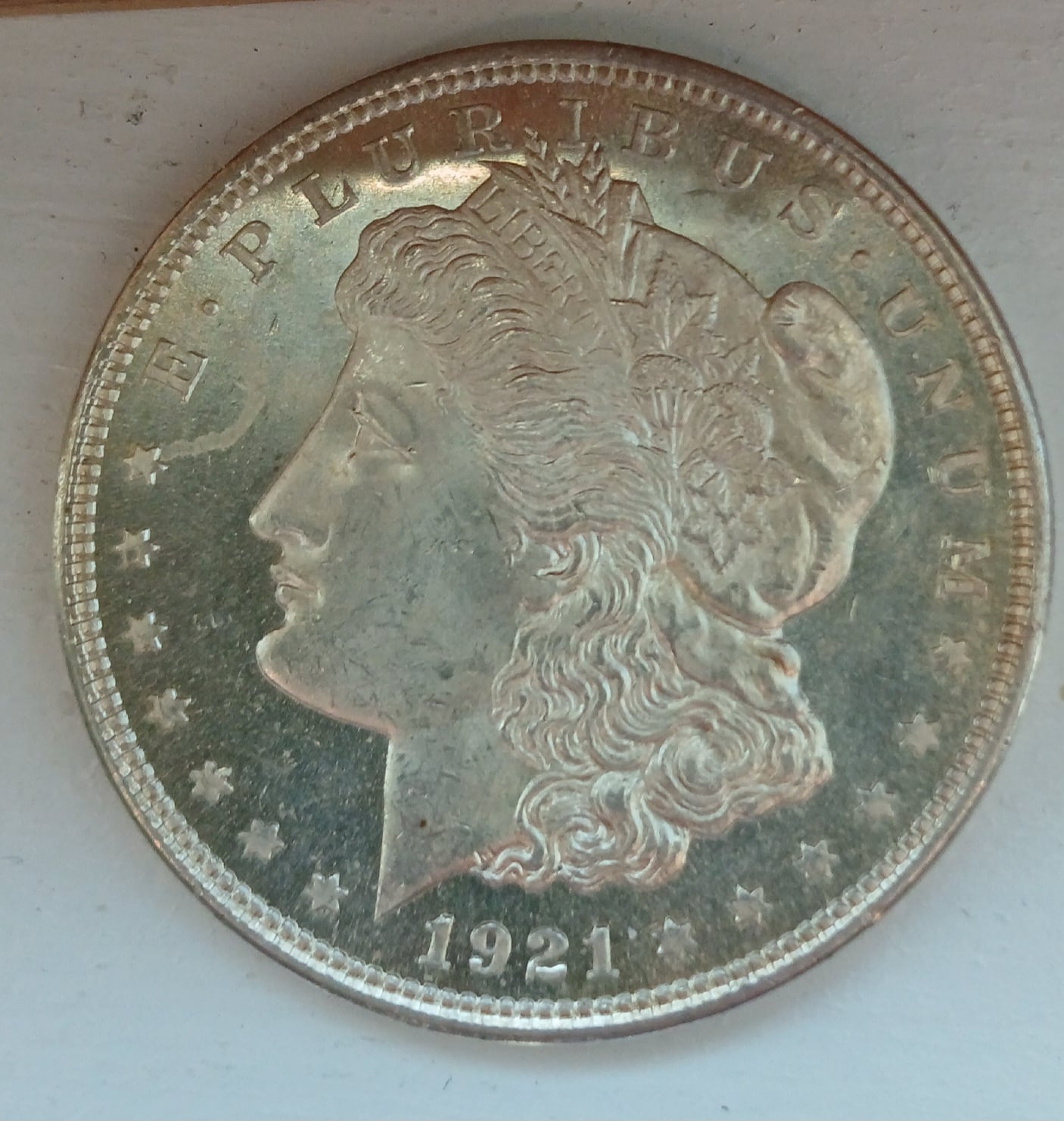
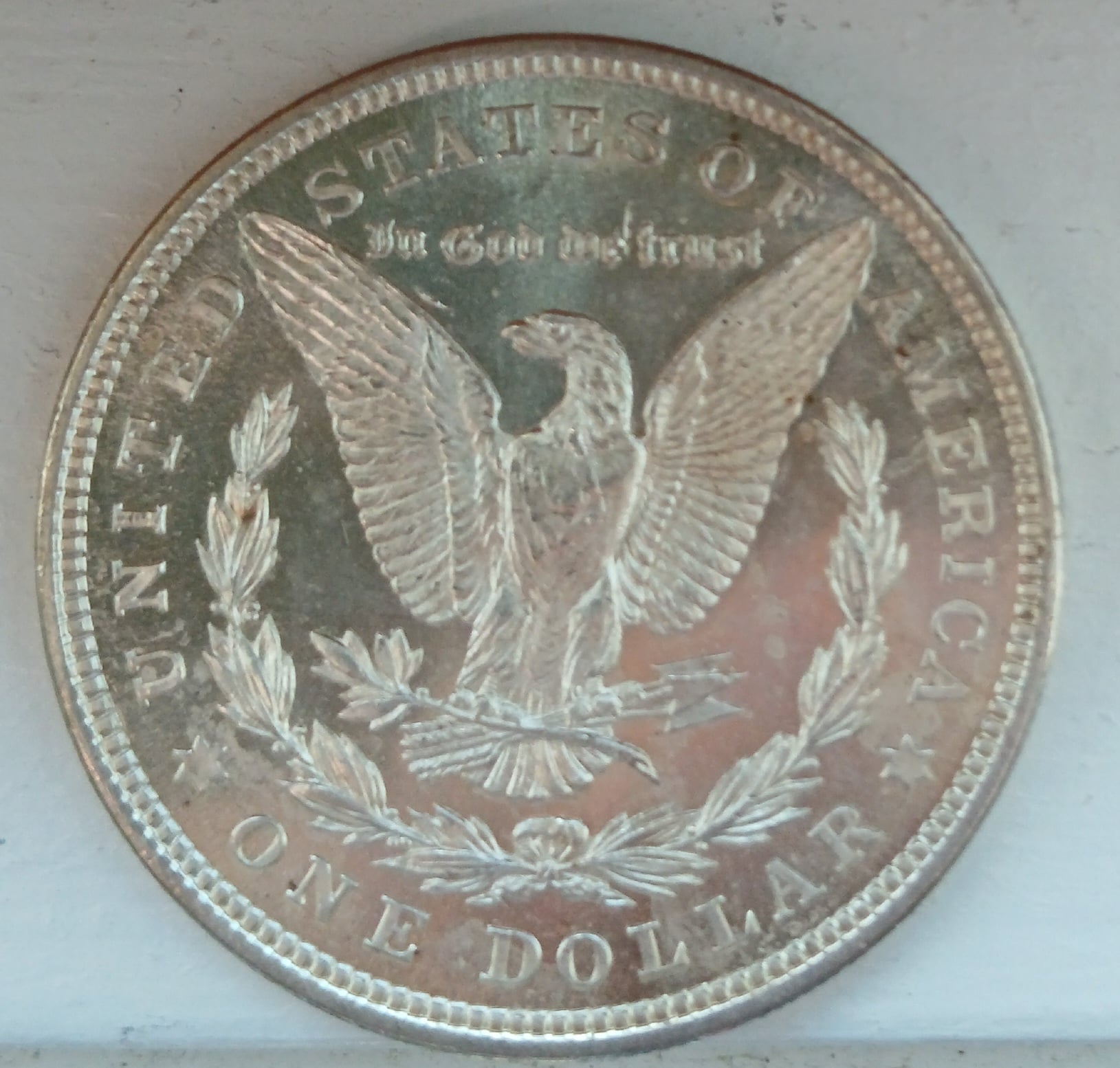
I was curious to see how this would look in proof so using another AI and only this image, I got the following. Now imagine you are buying a coin only off the proof AI image below, and you get the coin above. It's not like photography where you can potentially rotate it in the light to get the same look.
There is no way its acceptable. I think a coin should be posted raw. Exactly the way it looks as if it was in your hand. Never enhanced by anything. Thats just my opinion.
Example:
Student of numismatics and collector of Morgan dollars
Successful BST transactions with: Namvet Justindan Mattniss RWW olah_in_MA
Dantheman984 Toyz4geo SurfinxHI greencopper RWW bigjpst bretsan MWallace logger7 JWP BruceS bigjpst
JWP PROMETHIUS88
Despite the need so many humans have to pretend that everything in life is binary, it turns out that few things in life are binary.
This would be a prime example.
I don't care what method a seller uses to get a good photograph of the coin being sold. I care a great deal how accurately the photograph portrays the actual coin. If that is done using "AI," that's fine with me.
Speaking of things that aren't "binary," AI is a very complex subject. There are AI-powered denoising packages that are spectacular, and no rational person can object to them. There are generative-AI photos that are absurd, and no rational person can like them.
@FlyingAl said:
Any use of AI in coin photography is, in my opinion, unethical.
Coin photography relies on accuracy, and the use of AI changes the image into something that does not exist. For that reason, the seller is advertising something that does not exist.
. THIS ^
“We are only their care-takers,” he posed, “if we take good care of them, then centuries from now they may still be here … ”
@FlyingAl said:
Any use of AI in coin photography is, in my opinion, unethical.
Coin photography relies on accuracy, and the use of AI changes the image into something that does not exist. For that reason, the seller is advertising something that does not exist.
. THIS ^
If 1) an image is changed by AI; 2) it shows what a coin looks like more accurately than another type of image; and 3) the seller discloses it, how is that unethical?
Mark Feld* of Heritage Auctions*Unless otherwise noted, my posts here represent my personal opinions.
I don't get the fixation people have with how an image is created or edited. As long as it accurately reflects a coin's appearance, I don't care if it's made with an Etch-a-Sketch, crayons and a Sharpie.
@FlyingAl said:
Any use of AI in coin photography is, in my opinion, unethical.
Coin photography relies on accuracy, and the use of AI changes the image into something that does not exist. For that reason, the seller is advertising something that does not exist.
. THIS ^
If 1) an image is changed by AI; 2) it shows what a coin looks like more accurately than another type of image; and 3) the seller discloses it, how is that unethical?
Because #2 is impossible. AI cannot make a coin look more like it does in hand, because AI is creating something that does not exist.
I don’t believe that (despite whatever flaws they might have) some AI images aren’t more accurate than many of the alternatives. For example, perhaps an AI image will have a detail in the coin’s design slightly wrong. It could still be far more accurate than a non-AI image that’s way off on the color or doesn’t show numerous marks that are on the coin. Maybe you don’t look at enough well-intended images posted here and elsewhere that look dramatically different from the coin.😉
Mark Feld* of Heritage Auctions*Unless otherwise noted, my posts here represent my personal opinions.
One glance at the coin in the OP should make anyone say "no". Without looking at the original, you can tell that there are things in the photo which do not match any genuine 1805 quarter, starting with the shape of the 5 in the date. If it is possible for an AI model to change one thing, it's possible for it to change anything. Therefore, nothing in the enhanced photo can be trusted.
@dizzlecc said:
I'll take an unpopular position and say yes. AI enhanced photos are here, and we have to learn to manage them. It has already been mentioned that we learned to deal with photoshop juiced images.
Learning how to deal with them does not mean that it became an acceptable practice.
@messydesk said:
One glance at the coin in the OP should make anyone say "no". Without looking at the original, you can tell that there are things in the photo which do not match any genuine 1805 quarter, starting with the shape of the 5 in the date. If it is possible for an AI model to change one thing, it's possible for it to change anything. Therefore, nothing in the enhanced photo can be trusted.
@dizzlecc said:
I'll take an unpopular position and say yes. AI enhanced photos are here, and we have to learn to manage them. It has already been mentioned that we learned to deal with photoshop juiced images.
Learning how to deal with them does not mean that it became an acceptable practice.
People learn (or fail to learn) how to deal with subpar non-AI images all the time. And many of their shortcomings can be more serious or costly to a large number of buyers than some of the AI issues.
Mark Feld* of Heritage Auctions*Unless otherwise noted, my posts here represent my personal opinions.
@messydesk said:
One glance at the coin in the OP should make anyone say "no". Without looking at the original, you can tell that there are things in the photo which do not match any genuine 1805 quarter, starting with the shape of the 5 in the date. If it is possible for an AI model to change one thing, it's possible for it to change anything. Therefore, nothing in the enhanced photo can be trusted.
@dizzlecc said:
I'll take an unpopular position and say yes. AI enhanced photos are here, and we have to learn to manage them. It has already been mentioned that we learned to deal with photoshop juiced images.
Learning how to deal with them does not mean that it became an acceptable practice.
People learn (or fail to learn) how to deal with subpar non-AI images all the time. And many of their shortcomings can be more serious or costly to a large number of buyers than some of the AI issues.
But those images are actually something that exists. There is no difference between posting an image of a galaxy that doesn't exist and a AI coin image, because they're both equally not real and not available for sale.
Clearly, we can’t come to an agreement on this issue.
Mark Feld* of Heritage Auctions*Unless otherwise noted, my posts here represent my personal opinions.
Two quick thoughts:
First, I wonder if there would be a different outcome to this poll if it was private vs public.
Second, I also question when color came upon the scene vs black and white if the same debate would have taken place back then.
Late to the thread, absolutely not, in no way, manner or form should coin images be enhanced, altered, juiced with AI. It is bad enough to have the mostly horrible images of most coins up for sale or auction, but to mislead people by changing them to something even more misleading.................... How about everyone who sells learn to accurately, by standard photographic methods, capture the coin exactly how it looks in hand? I don't trust 99% of the coin images I see on the web already. Add AI into it? Yikes............................................
This thread is yet another spectacular illustration of how people form rigid opinions based on very incomplete knowledge and/or understanding, and fear.
Precious few people truly understand all that AI is, or can be. And, as a PSA, I'll point out that "generative AI" is only a very tiny portion of what AI is, or can be.
Why anybody cares what process is used to get a very accurate photo of the coin is a mystery. Yes, people will misuse AI, but that has nothing to do with AI being "evil," when it's the people being evil.
Being an avid photographer, and having a son who it fairly high in the food chain of AI, I have a bit of understanding what it is, and how it is applied to photography; enough to know that it's far more than the vast majorty of people "get." It can be a fabulous tool for rendering a remarkably accurate photo, just as it can be a powerful tool for fraud.
Being ignorant of what AI is, or afraid of what AI might be, won't change anything. Gaining an understanding of what it is, and can be, at least will get one some tools for dealing with it.
@FlyingAl said:
Any use of AI in coin photography is, in my opinion, unethical.
Coin photography relies on accuracy, and the use of AI changes the image into something that does not exist. For that reason, the seller is advertising something that does not exist.
This is literally true, nondeterministic results create a coin which by definition doesn't exist as presented. Might be the basis of a nice litigation?
@dizzlecc said:
I'll take an unpopular position and say yes. AI enhanced photos are here, and we have to learn to manage them. It has already been mentioned that we learned to deal with photoshop juiced images. It does enforce a few standard rules of collecting. It's better to see and buy coins in person when you can view the coin in hand. Find dealers who are trusted and build relationships with them. Take an extra layer of caution when buying something from a new source or a deal that looks too good.
Take a beat and understand what AI does by definition. As you say lighting and juicing can be undone. And you're 100% anyone should buy based on the coin in hand, but AI is way beyond anything we e seen in the hobby so far
@124Spider said:
This thread is yet another spectacular illustration of how people form rigid opinions based on very incomplete knowledge and/or understanding, and fear.
Precious few people truly understand all that AI is, or can be. And, as a PSA, I'll point out that "generative AI" is only a very tiny portion of what AI is, or can be.
Why anybody cares what process is used to get a very accurate photo of the coin is a mystery. Yes, people will misuse AI, but that has nothing to do with AI being "evil," when it's the people being evil.
Being an avid photographer, and having a son who it fairly high in the food chain of AI, I have a bit of understanding what it is, and how it is applied to photography; enough to know that it's far more than the vast majorty of people "get." It can be a fabulous tool for rendering a remarkably accurate photo, just as it can be a powerful tool for fraud.
I was trying to come up with a use case for "enhancing" a photo with AI, trying to draw parallels with using AI in medical imaging to improve image quality. After all, improved image quality is the goal of an enhancement. One popular application is noise reduction, which doesn't come into play with coins, since there is no real reason to use a noise-prone camera setting on a coin photo. Another is feature visibility, whether anatomic or an implanted device. This often goes hand-in-hand with noise reduction, but it doesn't have to. For both of these, one of the biggest problems is a model that hallucinates. An image enhanced for better usability that suddenly has a new vessel, lesion, tissue tear, or other feature that is not present in the original could lead to improper patient diagnosis and treatment. Feature visibility on coins photos is something we'd all like to improve, and it's the popular AI application we've seen.
In order to prevent an AI algorithm that gives such undesirable hallucinations from reaching a clinic, they must be cleared by the FDA, being shown to be at least equivalent to non-AI algorithms they supersede with rather rigorous testing. In the case of something that doesn't exist, there's no basis for comparison, but the same rigor must be followed to demonstrate that the algorithm won't produce something potentially harmful under normal circumstances. It also needs to be deterministic -- producing the same output every time it is given the same input.
For medical images, "normal circumstances" includes very specific operating parameters for the acquisition of the image, whether X-ray, ultrasound, MR, or PET. There are no such parameters defined for coin photography as standard practice. There are tendencies for acquisition of good images, but not hard standards.
The bigger problem is that even if there were hard image acquisition standards, there is no rigorous testing and approval process that would send a message to everyone that some algorithm is appropriate to use on enhancing coin images. If side-effects of enhancement include hallucinations that add (or remove) contact marks, a glow that resembles hairlines, a shift in the color that isn't present, (dizziness, headaches, loss of appetite, suicidal tendencies...) or some other falsehood, the algorithm is unacceptable. Nothing so far has shown it doesn't include those, in part because nothing has gone through any independent testing process to ensure that, much less a rigorous one. Develop something that can clear FDA-style scrutiny and publish the test results used for clearance, and I'll consider changing my response.
@124Spider said:
This thread is yet another spectacular illustration of how people form rigid opinions based on very incomplete knowledge and/or understanding, and fear.
>
Why anybody cares what process is used to get a very accurate photo of the coin is a mystery.
I'm sure you didn't mean it this way literally... You're buying something based on the image? Seems like you might want to know.
A collectible coin isn't a generic object that needs to be convincingly represented. It's a unique physical specimen whose individual characteristics are precisely what determine its desirability, authenticity, and value. Washing it through a nondeterministic processor doesn't serve the buyer. Heck even deterministic processes doesn't guarantee something that accurately represents that thing the real world, to the eye.
@124Spider said:
This thread is yet another spectacular illustration of how people form rigid opinions based on very incomplete knowledge and/or understanding, and fear.
Precious few people truly understand all that AI is, or can be. And, as a PSA, I'll point out that "generative AI" is only a very tiny portion of what AI is, or can be.
Why anybody cares what process is used to get a very accurate photo of the coin is a mystery. Yes, people will misuse AI, but that has nothing to do with AI being "evil," when it's the people being evil.
Being an avid photographer, and having a son who it fairly high in the food chain of AI, I have a bit of understanding what it is, and how it is applied to photography; enough to know that it's far more than the vast majorty of people "get." It can be a fabulous tool for rendering a remarkably accurate photo, just as it can be a powerful tool for fraud.
Being ignorant of what AI is, or afraid of what AI might be, won't change anything. Gaining an understanding of what it is, and can be, at least will get one some tools for dealing with it.
Given you are a photographer and are you highlighting some forms of AI you feel is acceptable, can you present some techniques with before and after photos for others to understand the topic better?
@124Spider said:
This thread is yet another spectacular illustration of how people form rigid opinions based on very incomplete knowledge and/or understanding, and fear.
>
Why anybody cares what process is used to get a very accurate photo of the coin is a mystery.
I'm sure you didn't mean it this way literally... You're buying something based on the image? Seems like you might want to know.
A collectible coin isn't a generic object that needs to be convincingly represented. It's a unique physical specimen whose individual characteristics are precisely what determine its desirability, authenticity, and value. Washing it through a nondeterministic processor doesn't serve the buyer. Heck even deterministic processes doesn't guarantee something that accurately represents that thing the real world, to the eye.
@124Spider said:
This thread is yet another spectacular illustration of how people form rigid opinions based on very incomplete knowledge and/or understanding, and fear.
Precious few people truly understand all that AI is, or can be. And, as a PSA, I'll point out that "generative AI" is only a very tiny portion of what AI is, or can be.
Why anybody cares what process is used to get a very accurate photo of the coin is a mystery. Yes, people will misuse AI, but that has nothing to do with AI being "evil," when it's the people being evil.
Being an avid photographer, and having a son who it fairly high in the food chain of AI, I have a bit of understanding what it is, and how it is applied to photography; enough to know that it's far more than the vast majorty of people "get." It can be a fabulous tool for rendering a remarkably accurate photo, just as it can be a powerful tool for fraud.
Being ignorant of what AI is, or afraid of what AI might be, won't change anything. Gaining an understanding of what it is, and can be, at least will get one some tools for dealing with it.
Given you are a photographer and are you highlighting some forms of AI you feel is acceptable, can you present some before and after photos for others to understand the topic better?
When I photograph birds, I have to crank up the ISO (to support the very fast shutter speeds to capture a flying beastie). This causes significant noise in the image. There are a number of excellent AI-driven denoising packages out there that do a remarkable job of getting rid of that noise, without touching the good stuff. No rational person can object to that use of AI.
Similarly, there are AI-driven sharpening routines, which do an amazing job of de-blurring images. It doesn't "create" anything, but it does an excellent job of bringing out details which otherwise would be more difficuilt--or impossible--to bring out. No rational can object to that, IMO.
I don't believe that anybody needs to use denoising for photographing coins, since they typically don't move very fast. But one can sharpen a photo to get rid of lens blur or tiny bits of out-of-focus problem. No rational person can object to that, either, IMO.
My point is that "AI" is lots more than "creating content." And, as time goes on, it will be more. My assertion is simply that I care only about getting the most accurate picture of the coin that I can, since I have never bought a significant coin by seeing it in hand--I don't go to shows, and there are no good coins shops anywhere in my area of which I'm aware, so all my purchases have been made online.
AI is a "brave new world," without doubt. We all are battered with fake AI "photos" and "videos" constantly. I'm sure that unscrupulous coin-sellers will do all they can to cheat with AI, as they have done with Photoshop and god-knows-what-else for years. That's unfortunate, but buying from truly reputable sources will limit the exposure to such shoddy practices. But rejecting all use of AI in this world is both unrealistic, and unhelpful.
Thanks for the info.
It may be useful to hear from people that use AI for coin photos and view some results on some concrete techniques.
Recently here on some concrete, but unexpected, results from AI with coin photos that resulted in some hallucinations.
@124Spider said:
This thread is yet another spectacular illustration of how people form rigid opinions based on very incomplete knowledge and/or understanding, and fear.
Precious few people truly understand all that AI is, or can be. And, as a PSA, I'll point out that "generative AI" is only a very tiny portion of what AI is, or can be.
Why anybody cares what process is used to get a very accurate photo of the coin is a mystery. Yes, people will misuse AI, but that has nothing to do with AI being "evil," when it's the people being evil.
Being an avid photographer, and having a son who it fairly high in the food chain of AI, I have a bit of understanding what it is, and how it is applied to photography; enough to know that it's far more than the vast majorty of people "get." It can be a fabulous tool for rendering a remarkably accurate photo, just as it can be a powerful tool for fraud.
Being ignorant of what AI is, or afraid of what AI might be, won't change anything. Gaining an understanding of what it is, and can be, at least will get one some tools for dealing with it.
Given you are a photographer and are you highlighting some forms of AI you feel is acceptable, can you present some before and after photos for others to understand the topic better?
When I photograph birds, I have to crank up the ISO (to support the very fast shutter speeds to capture a flying beastie). This causes significant noise in the image. There are a number of excellent AI-driven denoising packages out there that do a remarkable job of getting rid of that noise, without touching the good stuff. No rational person can object to that use of AI.
Similarly, there are AI-driven sharpening routines, which do an amazing job of de-blurring images. It doesn't "create" anything, but it does an excellent job of bringing out details which otherwise would be more difficuilt--or impossible--to bring out. No rational can object to that, IMO.
I don't believe that anybody needs to use denoising for photographing coins, since they typically don't move very fast. But one can sharpen a photo to get rid of lens blur or tiny bits of out-of-focus problem. No rational person can object to that, either, IMO.
My point is that "AI" is lots more than "creating content." And, as time goes on, it will be more. My assertion is simply that I care only about getting the most accurate picture of the coin that I can, since I have never bought a significant coin by seeing it in hand--I don't go to shows, and there are no good coins shops anywhere in my area of which I'm aware, so all my purchases have been made online.
AI is a "brave new world," without doubt. We all are battered with fake AI "photos" and "videos" constantly. I'm sure that unscrupulous coin-sellers will do all they can to cheat with AI, as they have done with Photoshop and god-knows-what-else for years. That's unfortunate, but buying from truly reputable sources will limit the exposure to such shoddy practices. But rejecting all use of AI in this world is both unrealistic, and unhelpful.
These people are talking about using AI generation to combine multiple images into one, not denoising. Even then, coin photographs are taken in ideal conditions, where there is no need to use those AI packages at all.
Those of us who are saying that AI isn’t necessarily unacceptable if it results in an image that’s more true to life than an alternative, aren’t all talking about using AI generation to combine multiple images into one.
And I’m sure you’ve seen huge quantities of coin photographs that have been taken in conditions or by methods that are far from”ideal”.
Mark Feld* of Heritage Auctions*Unless otherwise noted, my posts here represent my personal opinions.
@124Spider said:
This thread is yet another spectacular illustration of how people form rigid opinions based on very incomplete knowledge and/or understanding, and fear.
Precious few people truly understand all that AI is, or can be. And, as a PSA, I'll point out that "generative AI" is only a very tiny portion of what AI is, or can be.
Why anybody cares what process is used to get a very accurate photo of the coin is a mystery. Yes, people will misuse AI, but that has nothing to do with AI being "evil," when it's the people being evil.
Being an avid photographer, and having a son who it fairly high in the food chain of AI, I have a bit of understanding what it is, and how it is applied to photography; enough to know that it's far more than the vast majorty of people "get." It can be a fabulous tool for rendering a remarkably accurate photo, just as it can be a powerful tool for fraud.
Being ignorant of what AI is, or afraid of what AI might be, won't change anything. Gaining an understanding of what it is, and can be, at least will get one some tools for dealing with it.
Given you are a photographer and are you highlighting some forms of AI you feel is acceptable, can you present some before and after photos for others to understand the topic better?
When I photograph birds, I have to crank up the ISO (to support the very fast shutter speeds to capture a flying beastie). This causes significant noise in the image. There are a number of excellent AI-driven denoising packages out there that do a remarkable job of getting rid of that noise, without touching the good stuff. No rational person can object to that use of AI.
Similarly, there are AI-driven sharpening routines, which do an amazing job of de-blurring images. It doesn't "create" anything, but it does an excellent job of bringing out details which otherwise would be more difficuilt--or impossible--to bring out. No rational can object to that, IMO.
I don't believe that anybody needs to use denoising for photographing coins, since they typically don't move very fast. But one can sharpen a photo to get rid of lens blur or tiny bits of out-of-focus problem. No rational person can object to that, either, IMO.
My point is that "AI" is lots more than "creating content." And, as time goes on, it will be more. My assertion is simply that I care only about getting the most accurate picture of the coin that I can, since I have never bought a significant coin by seeing it in hand--I don't go to shows, and there are no good coins shops anywhere in my area of which I'm aware, so all my purchases have been made online.
AI is a "brave new world," without doubt. We all are battered with fake AI "photos" and "videos" constantly. I'm sure that unscrupulous coin-sellers will do all they can to cheat with AI, as they have done with Photoshop and god-knows-what-else for years. That's unfortunate, but buying from truly reputable sources will limit the exposure to such shoddy practices. But rejecting all use of AI in this world is both unrealistic, and unhelpful.
These people are talking about using AI generation to combine multiple images into one, not denoising. Even then, coin photographs are taken in ideal conditions, where there is no need to use those AI packages at all.
Those of us who are saying that AI isn’t necessarily unacceptable if it results in an image that’s more true to life than an alternative, aren’t all talking about using AI generation to combine multiple images into one.
And I’m sure you’ve seen huge quantities of coin photographs that have been taken in conditions or by methods that are far from”ideal”.
It's important to discuss concrete, or real, use cases, so we can discuss the nuances and specifics of application. Are there some you are thinking of, Mark?
While AI-powered denoising packages were used an an example that none can object to, it appears that there's no general need for these in coin photography. So what AI we discussing, and can there be some examples?
For example, there was recently a discussion on an AI tool in the link below. When I was introduced to it, my immediate thought was that this is a tool for using AI to convert images "taken in conditions or by methods that are far from”ideal” ... "for a dealer to use AI-enhanced photography in selling". However, posters in the thread seemed to converge on the technology isn' t ready yet.
@124Spider said:
This thread is yet another spectacular illustration of how people form rigid opinions based on very incomplete knowledge and/or understanding, and fear.
Precious few people truly understand all that AI is, or can be. And, as a PSA, I'll point out that "generative AI" is only a very tiny portion of what AI is, or can be.
Why anybody cares what process is used to get a very accurate photo of the coin is a mystery. Yes, people will misuse AI, but that has nothing to do with AI being "evil," when it's the people being evil.
Being an avid photographer, and having a son who it fairly high in the food chain of AI, I have a bit of understanding what it is, and how it is applied to photography; enough to know that it's far more than the vast majorty of people "get." It can be a fabulous tool for rendering a remarkably accurate photo, just as it can be a powerful tool for fraud.
Being ignorant of what AI is, or afraid of what AI might be, won't change anything. Gaining an understanding of what it is, and can be, at least will get one some tools for dealing with it.
Given you are a photographer and are you highlighting some forms of AI you feel is acceptable, can you present some before and after photos for others to understand the topic better?
When I photograph birds, I have to crank up the ISO (to support the very fast shutter speeds to capture a flying beastie). This causes significant noise in the image. There are a number of excellent AI-driven denoising packages out there that do a remarkable job of getting rid of that noise, without touching the good stuff. No rational person can object to that use of AI.
Similarly, there are AI-driven sharpening routines, which do an amazing job of de-blurring images. It doesn't "create" anything, but it does an excellent job of bringing out details which otherwise would be more difficuilt--or impossible--to bring out. No rational can object to that, IMO.
I don't believe that anybody needs to use denoising for photographing coins, since they typically don't move very fast. But one can sharpen a photo to get rid of lens blur or tiny bits of out-of-focus problem. No rational person can object to that, either, IMO.
My point is that "AI" is lots more than "creating content." And, as time goes on, it will be more. My assertion is simply that I care only about getting the most accurate picture of the coin that I can, since I have never bought a significant coin by seeing it in hand--I don't go to shows, and there are no good coins shops anywhere in my area of which I'm aware, so all my purchases have been made online.
AI is a "brave new world," without doubt. We all are battered with fake AI "photos" and "videos" constantly. I'm sure that unscrupulous coin-sellers will do all they can to cheat with AI, as they have done with Photoshop and god-knows-what-else for years. That's unfortunate, but buying from truly reputable sources will limit the exposure to such shoddy practices. But rejecting all use of AI in this world is both unrealistic, and unhelpful.
These people are talking about using AI generation to combine multiple images into one, not denoising. Even then, coin photographs are taken in ideal conditions, where there is no need to use those AI packages at all.
Those of us who are saying that AI isn’t necessarily unacceptable if it results in an image that’s more true to life than an alternative, aren’t all talking about using AI generation to combine multiple images into one.
And I’m sure you’ve seen huge quantities of coin photographs that have been taken in conditions or by methods that are far from”ideal”.
It's important to discuss concrete, or real, use cases, so we can discuss the nuances and specifics of application. Are there some you are thinking of, Mark?
While AI-powered denoising packages were used an an example that none can object to, it appears that there's no general need for these in coin photography. So what AI we discussing, and can there be some examples?
For example, there was recently a discussion on an AI tool in the link below. When I was introduced to it, my immediate thought was that this is a tool for using AI to convert take images "taken in conditions or by methods that are far from”ideal” ... "for a dealer to use AI-enhanced photography in selling". However, posters in the thread seemed to converge on the technology isn' t ready yet.
No, I’m not thinking of any real cases. Hopefully, we can see such examples posted here before too long. Some of the emphatic “No’s” that I’ve seen stated here seem to disregard the countless terribly misleading non-AI images that are out there. And many of them were shot with the best of intentions.
Mark Feld* of Heritage Auctions*Unless otherwise noted, my posts here represent my personal opinions.
@124Spider said:
This thread is yet another spectacular illustration of how people form rigid opinions based on very incomplete knowledge and/or understanding, and fear.
Precious few people truly understand all that AI is, or can be. And, as a PSA, I'll point out that "generative AI" is only a very tiny portion of what AI is, or can be.
Why anybody cares what process is used to get a very accurate photo of the coin is a mystery. Yes, people will misuse AI, but that has nothing to do with AI being "evil," when it's the people being evil.
Being an avid photographer, and having a son who it fairly high in the food chain of AI, I have a bit of understanding what it is, and how it is applied to photography; enough to know that it's far more than the vast majorty of people "get." It can be a fabulous tool for rendering a remarkably accurate photo, just as it can be a powerful tool for fraud.
Being ignorant of what AI is, or afraid of what AI might be, won't change anything. Gaining an understanding of what it is, and can be, at least will get one some tools for dealing with it.
Given you are a photographer and are you highlighting some forms of AI you feel is acceptable, can you present some before and after photos for others to understand the topic better?
When I photograph birds, I have to crank up the ISO (to support the very fast shutter speeds to capture a flying beastie). This causes significant noise in the image. There are a number of excellent AI-driven denoising packages out there that do a remarkable job of getting rid of that noise, without touching the good stuff. No rational person can object to that use of AI.
Similarly, there are AI-driven sharpening routines, which do an amazing job of de-blurring images. It doesn't "create" anything, but it does an excellent job of bringing out details which otherwise would be more difficuilt--or impossible--to bring out. No rational can object to that, IMO.
I don't believe that anybody needs to use denoising for photographing coins, since they typically don't move very fast. But one can sharpen a photo to get rid of lens blur or tiny bits of out-of-focus problem. No rational person can object to that, either, IMO.
My point is that "AI" is lots more than "creating content." And, as time goes on, it will be more. My assertion is simply that I care only about getting the most accurate picture of the coin that I can, since I have never bought a significant coin by seeing it in hand--I don't go to shows, and there are no good coins shops anywhere in my area of which I'm aware, so all my purchases have been made online.
AI is a "brave new world," without doubt. We all are battered with fake AI "photos" and "videos" constantly. I'm sure that unscrupulous coin-sellers will do all they can to cheat with AI, as they have done with Photoshop and god-knows-what-else for years. That's unfortunate, but buying from truly reputable sources will limit the exposure to such shoddy practices. But rejecting all use of AI in this world is both unrealistic, and unhelpful.
These people are talking about using AI generation to combine multiple images into one, not denoising. Even then, coin photographs are taken in ideal conditions, where there is no need to use those AI packages at all.
Those of us who are saying that AI isn’t necessarily unacceptable if it results in an image that’s more true to life than an alternative, aren’t all talking about using AI generation to combine multiple images into one.
And I’m sure you’ve seen huge quantities of coin photographs that have been taken in conditions or by methods that are far from”ideal”.
The core principle here is that I, and many others, would prefer that less than ideal photograph than one "improved" by AI.
AI should not be used as a crutch to improve an inability to image coins IMO.
Many of those who shoot images already use various “crutches” in order to make improvements in accuracy. Not everyone has your exceptional skills.
Mark Feld* of Heritage Auctions*Unless otherwise noted, my posts here represent my personal opinions.
@124Spider said:
This thread is yet another spectacular illustration of how people form rigid opinions based on very incomplete knowledge and/or understanding, and fear.
Precious few people truly understand all that AI is, or can be. And, as a PSA, I'll point out that "generative AI" is only a very tiny portion of what AI is, or can be.
Why anybody cares what process is used to get a very accurate photo of the coin is a mystery. Yes, people will misuse AI, but that has nothing to do with AI being "evil," when it's the people being evil.
Being an avid photographer, and having a son who it fairly high in the food chain of AI, I have a bit of understanding what it is, and how it is applied to photography; enough to know that it's far more than the vast majorty of people "get." It can be a fabulous tool for rendering a remarkably accurate photo, just as it can be a powerful tool for fraud.
Being ignorant of what AI is, or afraid of what AI might be, won't change anything. Gaining an understanding of what it is, and can be, at least will get one some tools for dealing with it.
Given you are a photographer and are you highlighting some forms of AI you feel is acceptable, can you present some before and after photos for others to understand the topic better?
When I photograph birds, I have to crank up the ISO (to support the very fast shutter speeds to capture a flying beastie). This causes significant noise in the image. There are a number of excellent AI-driven denoising packages out there that do a remarkable job of getting rid of that noise, without touching the good stuff. No rational person can object to that use of AI.
Similarly, there are AI-driven sharpening routines, which do an amazing job of de-blurring images. It doesn't "create" anything, but it does an excellent job of bringing out details which otherwise would be more difficuilt--or impossible--to bring out. No rational can object to that, IMO.
I don't believe that anybody needs to use denoising for photographing coins, since they typically don't move very fast. But one can sharpen a photo to get rid of lens blur or tiny bits of out-of-focus problem. No rational person can object to that, either, IMO.
My point is that "AI" is lots more than "creating content." And, as time goes on, it will be more. My assertion is simply that I care only about getting the most accurate picture of the coin that I can, since I have never bought a significant coin by seeing it in hand--I don't go to shows, and there are no good coins shops anywhere in my area of which I'm aware, so all my purchases have been made online.
AI is a "brave new world," without doubt. We all are battered with fake AI "photos" and "videos" constantly. I'm sure that unscrupulous coin-sellers will do all they can to cheat with AI, as they have done with Photoshop and god-knows-what-else for years. That's unfortunate, but buying from truly reputable sources will limit the exposure to such shoddy practices. But rejecting all use of AI in this world is both unrealistic, and unhelpful.
These people are talking about using AI generation to combine multiple images into one, not denoising. Even then, coin photographs are taken in ideal conditions, where there is no need to use those AI packages at all.
Those of us who are saying that AI isn’t necessarily unacceptable if it results in an image that’s more true to life than an alternative, aren’t all talking about using AI generation to combine multiple images into one.
And I’m sure you’ve seen huge quantities of coin photographs that have been taken in conditions or by methods that are far from”ideal”.
The core principle here is that I, and many others, would prefer that less than ideal photograph than one "improved" by AI.
AI should not be used as a crutch to improve an inability to image coins IMO.
Many of those who shoot images already use various “crutches” in order to make improvements in accuracy. Not everyone has your exceptional skills.
Sure, but some of those are acceptable and others are not.
On that, we agree. I think I’ll quit while we’re in agreement.😉
Mark Feld* of Heritage Auctions*Unless otherwise noted, my posts here represent my personal opinions.
@124Spider said:
This thread is yet another spectacular illustration of how people form rigid opinions based on very incomplete knowledge and/or understanding, and fear.
Precious few people truly understand all that AI is, or can be. And, as a PSA, I'll point out that "generative AI" is only a very tiny portion of what AI is, or can be.
Why anybody cares what process is used to get a very accurate photo of the coin is a mystery. Yes, people will misuse AI, but that has nothing to do with AI being "evil," when it's the people being evil.
Being an avid photographer, and having a son who it fairly high in the food chain of AI, I have a bit of understanding what it is, and how it is applied to photography; enough to know that it's far more than the vast majorty of people "get." It can be a fabulous tool for rendering a remarkably accurate photo, just as it can be a powerful tool for fraud.
Being ignorant of what AI is, or afraid of what AI might be, won't change anything. Gaining an understanding of what it is, and can be, at least will get one some tools for dealing with it.
Given you are a photographer and are you highlighting some forms of AI you feel is acceptable, can you present some before and after photos for others to understand the topic better?
When I photograph birds, I have to crank up the ISO (to support the very fast shutter speeds to capture a flying beastie). This causes significant noise in the image. There are a number of excellent AI-driven denoising packages out there that do a remarkable job of getting rid of that noise, without touching the good stuff. No rational person can object to that use of AI.
Similarly, there are AI-driven sharpening routines, which do an amazing job of de-blurring images. It doesn't "create" anything, but it does an excellent job of bringing out details which otherwise would be more difficuilt--or impossible--to bring out. No rational can object to that, IMO.
I don't believe that anybody needs to use denoising for photographing coins, since they typically don't move very fast. But one can sharpen a photo to get rid of lens blur or tiny bits of out-of-focus problem. No rational person can object to that, either, IMO.
My point is that "AI" is lots more than "creating content." And, as time goes on, it will be more. My assertion is simply that I care only about getting the most accurate picture of the coin that I can, since I have never bought a significant coin by seeing it in hand--I don't go to shows, and there are no good coins shops anywhere in my area of which I'm aware, so all my purchases have been made online.
AI is a "brave new world," without doubt. We all are battered with fake AI "photos" and "videos" constantly. I'm sure that unscrupulous coin-sellers will do all they can to cheat with AI, as they have done with Photoshop and god-knows-what-else for years. That's unfortunate, but buying from truly reputable sources will limit the exposure to such shoddy practices. But rejecting all use of AI in this world is both unrealistic, and unhelpful.
These people are talking about using AI generation to combine multiple images into one, not denoising. Even then, coin photographs are taken in ideal conditions, where there is no need to use those AI packages at all.
Those of us who are saying that AI isn’t necessarily unacceptable if it results in an image that’s more true to life than an alternative, aren’t all talking about using AI generation to combine multiple images into one.
And I’m sure you’ve seen huge quantities of coin photographs that have been taken in conditions or by methods that are far from”ideal”.
The core principle here is that I, and many others, would prefer that less than ideal photograph than one "improved" by AI.
AI should not be used as a crutch to improve an inability to image coins IMO.
Many of those who shoot images already use various “crutches” in order to make improvements in accuracy. Not everyone has your exceptional skills.
Sure, but some of those are acceptable and others are not.
On that, we agree. I think I’ll quit while we’re in agreement.😉
@P0CKETCHANGE said:
I realize I'm stirring the pot on this topic again, but the proliferation of AI-enhanced photography in our hobby raises a lot of questions for me about where the ethical boundary lines should be drawn.
A well-known dealer is offering the coin below on their website, and included this photo in the listing. It's clearly AI-manipulated (look at the lettering and the textured surfaces). There is no mention of AI usage in the listing.
My question: Is it acceptable for a dealer to use AI-enhanced photography in selling? Yes, No, or "It Depends"? Feel free to express your reasoning in the comments.
One thing that comes to mind is that when @MarkF was a dealer, he was exceptionally reputable, both in his own listings and in the hobby in general. His coin website was exceptional in his disclosure of coins he was selling and he was a member of the PNG committee to address then rampant issue of coin doctoring.
To sell at Mark's level, and reputation, I would minimally expect disclosure from the dealer.
@MarkF How do you think you would handle this yourself if you were still selling coins today, say for coins listed on your website? Would you use AI or not use AI? In the scenario that AI was used, would you disclose it? Would you provide non-AI photos to go with the AI-enhanced photos?
@P0CKETCHANGE said:
I realize I'm stirring the pot on this topic again, but the proliferation of AI-enhanced photography in our hobby raises a lot of questions for me about where the ethical boundary lines should be drawn.
A well-known dealer is offering the coin below on their website, and included this photo in the listing. It's clearly AI-manipulated (look at the lettering and the textured surfaces). There is no mention of AI usage in the listing.
My question: Is it acceptable for a dealer to use AI-enhanced photography in selling? Yes, No, or "It Depends"? Feel free to express your reasoning in the comments.
One thing that comes to mind is that when @MarkF was a dealer, he was exceptionally reputable, both in his own listings and in the hobby in general. His coin website was exceptional in his disclosure of coins he was selling and he was a member of the PNG committee to address then rampant issue of coin doctoring.
To sell at Mark's level, and reputation, I would minimally expect disclosure from the dealer.
@MarkF How do you think you would handle this if you were still selling coins today, say for coins listed on your website? Would you use AI or not use AI? In the scenario that AI was used, would you disclose it? Would you provide non-AI photos to go with the AI-enhanced photos?
Thank you for your very nice comments!
If I were still selling coins today, I’d pay a quality photographer (from among those who post here) to take much better images than I could. I did that with many of my coins when I had my own business and would do it for all of my coins today. I’d ask them what type of editing they were doing and would disclose that in my listings.
One thing that I did with my coin listings and which I do these days, when screening auction lots for Heritage clients, is to comment on how the coin looks in hand compared to how it appears in the image. For example, I’d point out any flaws of consequence that didn’t show in the image or note differences in luster and/or color, etc. in other words, I’d try to put them in my seat as a viewer of the coin.
Mark Feld* of Heritage Auctions*Unless otherwise noted, my posts here represent my personal opinions.
A few commenters are rightly honing in on the versatility of AI to do different things in the photography process.
Importantly, this thread is focused on the generative AI that was used to create the image in the OP. By its nature, generative AI creates something entirely new; it can only ever be a representative coin-like image.
Now, AI can also be used to adjust the levels on coin photographs, without generating a new image, in the same way the photographer adjusts levels in post-processing of coin images (exposure, highlights, sharpness, etc.).
The ethical fork in the path during processing is whether the adjustments improve the accuracy of the image compared to what the coin looks like in-hand. Ultimately, it is up to the human to judge this, whether done manually or by AI.
Superb collections are built more by omission than by addition.
I would not knowingly buy a coin from AI generated photos, and I disdain AI generated photos for the reasons articulated by numerous posters in this thread already.
@P0CKETCHANGE said:
A few commenters are rightly honing in on the versatility of AI to do different things in the photography process.
Importantly, this thread is focused on the generative AI that was used to create the image in the OP. By its nature, generative AI creates something entirely new; it can only ever be a representative coin-like image.
Now, AI can also be used to adjust the levels on coin photographs, without generating a new image, in the same way the photographer adjusts levels in post-processing of coin images (exposure, highlights, sharpness, etc.).
The ethical fork in the path during processing is whether the adjustments improve the accuracy of the image compared to what the coin looks like in-hand. Ultimately, it is up to the human to judge this, whether done manually or by AI.
I’m confused, as the original question posed was “Is it acceptable for a dealer to use AI-enhanced photography in selling?”. And to me, that’s very different from “Importantly, this thread is focused on the generative AI that was used to create the image in the OP”.
As I’ve I’ve been debating - at least as far as I was concerned - with @FlyingAI and others, I don’t think AI enhanced images are necessarily unethical or improper to use if they’re as or more true to life than other options. On the other hand, I don’t feel the same about AI generated images.
Mark Feld* of Heritage Auctions*Unless otherwise noted, my posts here represent my personal opinions.
@124Spider said:
This thread is yet another spectacular illustration of how people form rigid opinions based on very incomplete knowledge and/or understanding, and fear.
Precious few people truly understand all that AI is, or can be. And, as a PSA, I'll point out that "generative AI" is only a very tiny portion of what AI is, or can be.
Why anybody cares what process is used to get a very accurate photo of the coin is a mystery. Yes, people will misuse AI, but that has nothing to do with AI being "evil," when it's the people being evil.
Being an avid photographer, and having a son who it fairly high in the food chain of AI, I have a bit of understanding what it is, and how it is applied to photography; enough to know that it's far more than the vast majorty of people "get." It can be a fabulous tool for rendering a remarkably accurate photo, just as it can be a powerful tool for fraud.
Being ignorant of what AI is, or afraid of what AI might be, won't change anything. Gaining an understanding of what it is, and can be, at least will get one some tools for dealing with it.
Given you are a photographer and are you highlighting some forms of AI you feel is acceptable, can you present some before and after photos for others to understand the topic better?
When I photograph birds, I have to crank up the ISO (to support the very fast shutter speeds to capture a flying beastie). This causes significant noise in the image. There are a number of excellent AI-driven denoising packages out there that do a remarkable job of getting rid of that noise, without touching the good stuff. No rational person can object to that use of AI.
Similarly, there are AI-driven sharpening routines, which do an amazing job of de-blurring images. It doesn't "create" anything, but it does an excellent job of bringing out details which otherwise would be more difficuilt--or impossible--to bring out. No rational can object to that, IMO.
I don't believe that anybody needs to use denoising for photographing coins, since they typically don't move very fast. But one can sharpen a photo to get rid of lens blur or tiny bits of out-of-focus problem. No rational person can object to that, either, IMO.
My point is that "AI" is lots more than "creating content." And, as time goes on, it will be more. My assertion is simply that I care only about getting the most accurate picture of the coin that I can, since I have never bought a significant coin by seeing it in hand--I don't go to shows, and there are no good coins shops anywhere in my area of which I'm aware, so all my purchases have been made online.
AI is a "brave new world," without doubt. We all are battered with fake AI "photos" and "videos" constantly. I'm sure that unscrupulous coin-sellers will do all they can to cheat with AI, as they have done with Photoshop and god-knows-what-else for years. That's unfortunate, but buying from truly reputable sources will limit the exposure to such shoddy practices. But rejecting all use of AI in this world is both unrealistic, and unhelpful.
These people are talking about using AI generation to combine multiple images into one, not denoising. Even then, coin photographs are taken in ideal conditions, where there is no need to use those AI packages at all.
No, "these people" are talking about "using AI." As a group, they view "AI" as the same as "generative AI." I am trying to point out that "generative AI" is only a tiny bit of what "AI" is.
Words have meanings. Just because people misuse a word does not change the meaning of that word.
If the question were "Do you think it's ok to use generative AI to create a 'photo' of a coin when selling a coin," the answer, obviously, is "no." but that's not what was asked.
In reference to what was asked, let's take a look at the photo in the OP that started this discussion. Does it seem like Generative AI is being used? If not GenAI, what kind of AI? Either way, is the practice acceptable? Can we hypothesize as to what is happening with the lettering and surfaces, and whether it's acceptable?
@P0CKETCHANGE said:
A well-known dealer is offering the coin below on their website, and included this photo in the listing. It's clearly AI-manipulated (look at the lettering and the textured surfaces). There is no mention of AI usage in the listing.
[...]
@MFeld said:
I’m confused, as the original question posed was “Is it acceptable for a dealer to use AI-enhanced photography in selling?”. And to me, that’s very different from “Importantly, this thread is focused on the generative AI that was used to create the image in the OP”.
As I’ve I’ve been debating - at least as far as I was concerned - with @FlyingAI and others, I don’t think AI enhanced images are necessarily unethical or improper to use if they’re as or more true to life than other options. On the other hand, I don’t feel the same about AI generated images.
You’re correct, they are different things, but given that I included an example of a generative AI rendering in my OP, that is what the poll was speaking to and most of the initial responses were to that.
I don’t consider AI making a brightness adjustment to a photo (but otherwise not altering the photo), to be “AI-enhanced”, because that’s something a human or a saved setting in Photoshop could do just as easily.
Superb collections are built more by omission than by addition.
@MFeld said:
I’m confused, as the original question posed was “Is it acceptable for a dealer to use AI-enhanced photography in selling?”. And to me, that’s very different from “Importantly, this thread is focused on the generative AI that was used to create the image in the OP”.
As I’ve I’ve been debating - at least as far as I was concerned - with @FlyingAI and others, I don’t think AI enhanced images are necessarily unethical or improper to use if they’re as or more true to life than other options. On the other hand, I don’t feel the same about AI generated images.
You’re correct, they are different things, but given that I included an example of a generative AI rendering in my OP, that is what the poll was speaking to and most of the initial responses were to that.
I don’t consider AI making a brightness adjustment to a photo (but otherwise not altering the photo), to be “AI-enhanced”, because that’s something a human or a saved setting in Photoshop could do just as easily.
Making standard brightness adjustments, or sharpening, or other transformations like resizing, rotation, etc. are not considered AI.
I'm not sure I've actually heard any types of AI-enhancements for coins in this thread other than Generative AI. This is why I'm interested to understand what non-generative approaches to AI are being discussed here. AI denoising was mentioned, but it's seems accepted that this isn't useful for coins after discussion. It seems that the discussions hypothesizing coin use of AI that is non-generative may be using it as a straw-person argument, but with no references to actual, concrete practices. Is this the case? If this isn't the case, it would be useful to highlight specific AI uses that are non-generative, ideally with before and after photos.
In the end, if the only type of AI being discussed for coins is Generative AI, then an AI discussion on coins appears to be a Generative AI discussion on coins.
@124Spider said:
This thread is yet another spectacular illustration of how people form rigid opinions based on very incomplete knowledge and/or understanding, and fear.
Precious few people truly understand all that AI is, or can be. And, as a PSA, I'll point out that "generative AI" is only a very tiny portion of what AI is, or can be.
Why anybody cares what process is used to get a very accurate photo of the coin is a mystery. Yes, people will misuse AI, but that has nothing to do with AI being "evil," when it's the people being evil.
Being an avid photographer, and having a son who it fairly high in the food chain of AI, I have a bit of understanding what it is, and how it is applied to photography; enough to know that it's far more than the vast majorty of people "get." It can be a fabulous tool for rendering a remarkably accurate photo, just as it can be a powerful tool for fraud.
Being ignorant of what AI is, or afraid of what AI might be, won't change anything. Gaining an understanding of what it is, and can be, at least will get one some tools for dealing with it.
Given you are a photographer and are you highlighting some forms of AI you feel is acceptable, can you present some before and after photos for others to understand the topic better?
When I photograph birds, I have to crank up the ISO (to support the very fast shutter speeds to capture a flying beastie). This causes significant noise in the image. There are a number of excellent AI-driven denoising packages out there that do a remarkable job of getting rid of that noise, without touching the good stuff. No rational person can object to that use of AI.
Similarly, there are AI-driven sharpening routines, which do an amazing job of de-blurring images. It doesn't "create" anything, but it does an excellent job of bringing out details which otherwise would be more difficuilt--or impossible--to bring out. No rational can object to that, IMO.
I don't believe that anybody needs to use denoising for photographing coins, since they typically don't move very fast. But one can sharpen a photo to get rid of lens blur or tiny bits of out-of-focus problem. No rational person can object to that, either, IMO.
My point is that "AI" is lots more than "creating content." And, as time goes on, it will be more. My assertion is simply that I care only about getting the most accurate picture of the coin that I can, since I have never bought a significant coin by seeing it in hand--I don't go to shows, and there are no good coins shops anywhere in my area of which I'm aware, so all my purchases have been made online.
AI is a "brave new world," without doubt. We all are battered with fake AI "photos" and "videos" constantly. I'm sure that unscrupulous coin-sellers will do all they can to cheat with AI, as they have done with Photoshop and god-knows-what-else for years. That's unfortunate, but buying from truly reputable sources will limit the exposure to such shoddy practices. But rejecting all use of AI in this world is both unrealistic, and unhelpful.
These people are talking about using AI generation to combine multiple images into one, not denoising. Even then, coin photographs are taken in ideal conditions, where there is no need to use those AI packages at all.
No, "these people" are talking about "using AI." As a group, they view "AI" as the same as "generative AI." I am trying to point out that "generative AI" is only a tiny bit of what "AI" is.
Words have meanings. Just because people misuse a word does not change the meaning of that word.
If the question were "Do you think it's ok to use generative AI to create a 'photo' of a coin when selling a coin," the answer, obviously, is "no." but that's not what was asked.
In reference to what was asked, let's take a look at the photo in the OP that started this discussion. Does it seem like Generative AI is being used? If not GenAI, what kind of AI? Either way, is the practice acceptable? Can we hypothesize as to what is happening with the lettering and surfaces, and whether it's acceptable?
@P0CKETCHANGE said:
A well-known dealer is offering the coin below on their website, and included this photo in the listing. It's clearly AI-manipulated (look at the lettering and the textured surfaces). There is no mention of AI usage in the listing.
[...]
I do not know that that is "AI-manipulated." One can get the same effects without AI, by using too much sharpening (not AI sharpening; old-fashioned sharpening).
The point is that photos you see online have been "manipulated" since at least the start of Photoshop. IMO, there's nothing wrong with "manipulating" a photo, if the result is a true-to-life representation of that coin. And I do not agree with the mindless demonization of "AI," as if (i) all AI-enhanced photos are "bad" (they're not), and (ii) photos are not "manipulated" (for better or for worse) by means other than AI.
The "demon" here should be misleading photos (and the people who post them), not "AI."
Comments
Here's an example of what AI can do.
@Goob posted this fantasy coin design made by AI this morning in the following thread. This is a good design to try AI-enhancing because it doesn't exist in training sets.
https://forums.collectors.com/discussion/comment/14188530/#Comment_14188530
I was curious to see how this would look in proof so using another AI and only this image, I got the following. Now imagine you are buying a coin only off the proof AI image below, and you get the coin above. It's not like photography where you can potentially rotate it in the light to get the same look.
There is no way its acceptable. I think a coin should be posted raw. Exactly the way it looks as if it was in your hand. Never enhanced by anything. Thats just my opinion.
Example:
Student of numismatics and collector of Morgan dollars
Successful BST transactions with: Namvet Justindan Mattniss RWW olah_in_MA
Dantheman984 Toyz4geo SurfinxHI greencopper RWW bigjpst bretsan MWallace logger7 JWP BruceS bigjpst
JWP PROMETHIUS88
Despite the need so many humans have to pretend that everything in life is binary, it turns out that few things in life are binary.
This would be a prime example.
I don't care what method a seller uses to get a good photograph of the coin being sold. I care a great deal how accurately the photograph portrays the actual coin. If that is done using "AI," that's fine with me.
Speaking of things that aren't "binary," AI is a very complex subject. There are AI-powered denoising packages that are spectacular, and no rational person can object to them. There are generative-AI photos that are absurd, and no rational person can like them.
This is a complex subject, understood by few.
.
THIS ^
“We are only their care-takers,” he posed, “if we take good care of them, then centuries from now they may still be here … ”
Todd - BHNC #242
If 1) an image is changed by AI; 2) it shows what a coin looks like more accurately than another type of image; and 3) the seller discloses it, how is that unethical?
Mark Feld* of Heritage Auctions*Unless otherwise noted, my posts here represent my personal opinions.
I don't get the fixation people have with how an image is created or edited. As long as it accurately reflects a coin's appearance, I don't care if it's made with an Etch-a-Sketch, crayons and a Sharpie.
Because #2 is impossible. AI cannot make a coin look more like it does in hand, because AI is creating something that does not exist.
Coin Photography
Like I said it should look like it does raw. No need for anything else.
Student of numismatics and collector of Morgan dollars
Successful BST transactions with: Namvet Justindan Mattniss RWW olah_in_MA
Dantheman984 Toyz4geo SurfinxHI greencopper RWW bigjpst bretsan MWallace logger7 JWP BruceS bigjpst
JWP PROMETHIUS88
I don’t believe that (despite whatever flaws they might have) some AI images aren’t more accurate than many of the alternatives. For example, perhaps an AI image will have a detail in the coin’s design slightly wrong. It could still be far more accurate than a non-AI image that’s way off on the color or doesn’t show numerous marks that are on the coin. Maybe you don’t look at enough well-intended images posted here and elsewhere that look dramatically different from the coin.😉
Mark Feld* of Heritage Auctions*Unless otherwise noted, my posts here represent my personal opinions.
Are any dealers using "AI-enhanced photography in selling" now?
Are any using the denoising packages mentioned by @124Spider ?
One glance at the coin in the OP should make anyone say "no". Without looking at the original, you can tell that there are things in the photo which do not match any genuine 1805 quarter, starting with the shape of the 5 in the date. If it is possible for an AI model to change one thing, it's possible for it to change anything. Therefore, nothing in the enhanced photo can be trusted.
Learning how to deal with them does not mean that it became an acceptable practice.
Keeper of the VAM Catalog • Professional Coin Imaging • Prime Number Set • World Coins in Early America • British Trade Dollars • Variety Attribution
People learn (or fail to learn) how to deal with subpar non-AI images all the time. And many of their shortcomings can be more serious or costly to a large number of buyers than some of the AI issues.
Mark Feld* of Heritage Auctions*Unless otherwise noted, my posts here represent my personal opinions.
But those images are actually something that exists. There is no difference between posting an image of a galaxy that doesn't exist and a AI coin image, because they're both equally not real and not available for sale.
Coin Photography
Clearly, we can’t come to an agreement on this issue.
Mark Feld* of Heritage Auctions*Unless otherwise noted, my posts here represent my personal opinions.
Two quick thoughts:
First, I wonder if there would be a different outcome to this poll if it was private vs public.
Second, I also question when color came upon the scene vs black and white if the same debate would have taken place back then.
I would be shocked if AI denoising isn't used routinely in photography of all sorts, including coin photography.
The problem with this subject is that people believe that "AI" means "made up." AI is far more complicated than that.
Late to the thread, absolutely not, in no way, manner or form should coin images be enhanced, altered, juiced with AI. It is bad enough to have the mostly horrible images of most coins up for sale or auction, but to mislead people by changing them to something even more misleading.................... How about everyone who sells learn to accurately, by standard photographic methods, capture the coin exactly how it looks in hand? I don't trust 99% of the coin images I see on the web already. Add AI into it? Yikes............................................
This thread is yet another spectacular illustration of how people form rigid opinions based on very incomplete knowledge and/or understanding, and fear.
Precious few people truly understand all that AI is, or can be. And, as a PSA, I'll point out that "generative AI" is only a very tiny portion of what AI is, or can be.
Why anybody cares what process is used to get a very accurate photo of the coin is a mystery. Yes, people will misuse AI, but that has nothing to do with AI being "evil," when it's the people being evil.
Being an avid photographer, and having a son who it fairly high in the food chain of AI, I have a bit of understanding what it is, and how it is applied to photography; enough to know that it's far more than the vast majorty of people "get." It can be a fabulous tool for rendering a remarkably accurate photo, just as it can be a powerful tool for fraud.
Being ignorant of what AI is, or afraid of what AI might be, won't change anything. Gaining an understanding of what it is, and can be, at least will get one some tools for dealing with it.
This is literally true, nondeterministic results create a coin which by definition doesn't exist as presented. Might be the basis of a nice litigation?
Take a beat and understand what AI does by definition. As you say lighting and juicing can be undone. And you're 100% anyone should buy based on the coin in hand, but AI is way beyond anything we e seen in the hobby so far
I was trying to come up with a use case for "enhancing" a photo with AI, trying to draw parallels with using AI in medical imaging to improve image quality. After all, improved image quality is the goal of an enhancement. One popular application is noise reduction, which doesn't come into play with coins, since there is no real reason to use a noise-prone camera setting on a coin photo. Another is feature visibility, whether anatomic or an implanted device. This often goes hand-in-hand with noise reduction, but it doesn't have to. For both of these, one of the biggest problems is a model that hallucinates. An image enhanced for better usability that suddenly has a new vessel, lesion, tissue tear, or other feature that is not present in the original could lead to improper patient diagnosis and treatment. Feature visibility on coins photos is something we'd all like to improve, and it's the popular AI application we've seen.
In order to prevent an AI algorithm that gives such undesirable hallucinations from reaching a clinic, they must be cleared by the FDA, being shown to be at least equivalent to non-AI algorithms they supersede with rather rigorous testing. In the case of something that doesn't exist, there's no basis for comparison, but the same rigor must be followed to demonstrate that the algorithm won't produce something potentially harmful under normal circumstances. It also needs to be deterministic -- producing the same output every time it is given the same input.
For medical images, "normal circumstances" includes very specific operating parameters for the acquisition of the image, whether X-ray, ultrasound, MR, or PET. There are no such parameters defined for coin photography as standard practice. There are tendencies for acquisition of good images, but not hard standards.
The bigger problem is that even if there were hard image acquisition standards, there is no rigorous testing and approval process that would send a message to everyone that some algorithm is appropriate to use on enhancing coin images. If side-effects of enhancement include hallucinations that add (or remove) contact marks, a glow that resembles hairlines, a shift in the color that isn't present, (dizziness, headaches, loss of appetite, suicidal tendencies...) or some other falsehood, the algorithm is unacceptable. Nothing so far has shown it doesn't include those, in part because nothing has gone through any independent testing process to ensure that, much less a rigorous one. Develop something that can clear FDA-style scrutiny and publish the test results used for clearance, and I'll consider changing my response.
Keeper of the VAM Catalog • Professional Coin Imaging • Prime Number Set • World Coins in Early America • British Trade Dollars • Variety Attribution
>
I'm sure you didn't mean it this way literally... You're buying something based on the image? Seems like you might want to know.
A collectible coin isn't a generic object that needs to be convincingly represented. It's a unique physical specimen whose individual characteristics are precisely what determine its desirability, authenticity, and value. Washing it through a nondeterministic processor doesn't serve the buyer. Heck even deterministic processes doesn't guarantee something that accurately represents that thing the real world, to the eye.
Given you are a photographer and are you highlighting some forms of AI you feel is acceptable, can you present some techniques with before and after photos for others to understand the topic better?
We disagree. So be it.
When I photograph birds, I have to crank up the ISO (to support the very fast shutter speeds to capture a flying beastie). This causes significant noise in the image. There are a number of excellent AI-driven denoising packages out there that do a remarkable job of getting rid of that noise, without touching the good stuff. No rational person can object to that use of AI.
Similarly, there are AI-driven sharpening routines, which do an amazing job of de-blurring images. It doesn't "create" anything, but it does an excellent job of bringing out details which otherwise would be more difficuilt--or impossible--to bring out. No rational can object to that, IMO.
I don't believe that anybody needs to use denoising for photographing coins, since they typically don't move very fast. But one can sharpen a photo to get rid of lens blur or tiny bits of out-of-focus problem. No rational person can object to that, either, IMO.
My point is that "AI" is lots more than "creating content." And, as time goes on, it will be more. My assertion is simply that I care only about getting the most accurate picture of the coin that I can, since I have never bought a significant coin by seeing it in hand--I don't go to shows, and there are no good coins shops anywhere in my area of which I'm aware, so all my purchases have been made online.
AI is a "brave new world," without doubt. We all are battered with fake AI "photos" and "videos" constantly. I'm sure that unscrupulous coin-sellers will do all they can to cheat with AI, as they have done with Photoshop and god-knows-what-else for years. That's unfortunate, but buying from truly reputable sources will limit the exposure to such shoddy practices. But rejecting all use of AI in this world is both unrealistic, and unhelpful.
Thanks for the info.
It may be useful to hear from people that use AI for coin photos and view some results on some concrete techniques.
Recently here on some concrete, but unexpected, results from AI with coin photos that resulted in some hallucinations.
https://forums.collectors.com/discussion/1126207/shoutout-to-coinstudio-ai#latest
These people are talking about using AI generation to combine multiple images into one, not denoising. Even then, coin photographs are taken in ideal conditions, where there is no need to use those AI packages at all.
Coin Photography
I posted this thread several months ago:
https://forums.collectors.com/discussion/1122047/ethics-of-ai-improved-numismatic-images-removing-prongs
That thread isn't quite on topic for this thread, since I'm not selling anything based on those pictures. But it does address that question as asked.
Those of us who are saying that AI isn’t necessarily unacceptable if it results in an image that’s more true to life than an alternative, aren’t all talking about using AI generation to combine multiple images into one.
And I’m sure you’ve seen huge quantities of coin photographs that have been taken in conditions or by methods that are far from”ideal”.
Mark Feld* of Heritage Auctions*Unless otherwise noted, my posts here represent my personal opinions.
It's important to discuss concrete, or real, use cases, so we can discuss the nuances and specifics of application. Are there some you are thinking of, Mark?
While AI-powered denoising packages were used an an example that none can object to, it appears that there's no general need for these in coin photography. So what AI we discussing, and can there be some examples?
For example, there was recently a discussion on an AI tool in the link below. When I was introduced to it, my immediate thought was that this is a tool for using AI to convert images "taken in conditions or by methods that are far from”ideal” ... "for a dealer to use AI-enhanced photography in selling". However, posters in the thread seemed to converge on the technology isn' t ready yet.
https://forums.collectors.com/discussion/1126207/shoutout-to-coinstudio-ai#latest
Thanks for posting this thoughtful thread @jonathanb . It brings up some important thoughts and I'll post there on this.
No, I’m not thinking of any real cases. Hopefully, we can see such examples posted here before too long. Some of the emphatic “No’s” that I’ve seen stated here seem to disregard the countless terribly misleading non-AI images that are out there. And many of them were shot with the best of intentions.
Mark Feld* of Heritage Auctions*Unless otherwise noted, my posts here represent my personal opinions.
The core principle here is that I, and many others, would prefer that less than ideal photograph than one "improved" by AI.
AI should not be used as a crutch to improve an inability to image coins IMO.
Coin Photography
Many of those who shoot images already use various “crutches” in order to make improvements in accuracy. Not everyone has your exceptional skills.
Mark Feld* of Heritage Auctions*Unless otherwise noted, my posts here represent my personal opinions.
Sure, but some of those are acceptable and others are not.
Coin Photography
On that, we agree. I think I’ll quit while we’re in agreement.😉
Mark Feld* of Heritage Auctions*Unless otherwise noted, my posts here represent my personal opinions.
Coin Photography
One thing that comes to mind is that when @MarkF was a dealer, he was exceptionally reputable, both in his own listings and in the hobby in general. His coin website was exceptional in his disclosure of coins he was selling and he was a member of the PNG committee to address then rampant issue of coin doctoring.
To sell at Mark's level, and reputation, I would minimally expect disclosure from the dealer.
@MarkF How do you think you would handle this yourself if you were still selling coins today, say for coins listed on your website? Would you use AI or not use AI? In the scenario that AI was used, would you disclose it? Would you provide non-AI photos to go with the AI-enhanced photos?
Thank you for your very nice comments!
If I were still selling coins today, I’d pay a quality photographer (from among those who post here) to take much better images than I could. I did that with many of my coins when I had my own business and would do it for all of my coins today. I’d ask them what type of editing they were doing and would disclose that in my listings.
One thing that I did with my coin listings and which I do these days, when screening auction lots for Heritage clients, is to comment on how the coin looks in hand compared to how it appears in the image. For example, I’d point out any flaws of consequence that didn’t show in the image or note differences in luster and/or color, etc. in other words, I’d try to put them in my seat as a viewer of the coin.
Mark Feld* of Heritage Auctions*Unless otherwise noted, my posts here represent my personal opinions.
A few commenters are rightly honing in on the versatility of AI to do different things in the photography process.
Importantly, this thread is focused on the generative AI that was used to create the image in the OP. By its nature, generative AI creates something entirely new; it can only ever be a representative coin-like image.
Now, AI can also be used to adjust the levels on coin photographs, without generating a new image, in the same way the photographer adjusts levels in post-processing of coin images (exposure, highlights, sharpness, etc.).
The ethical fork in the path during processing is whether the adjustments improve the accuracy of the image compared to what the coin looks like in-hand. Ultimately, it is up to the human to judge this, whether done manually or by AI.
Superb collections are built more by omission than by addition.
I would not knowingly buy a coin from AI generated photos, and I disdain AI generated photos for the reasons articulated by numerous posters in this thread already.
I’m confused, as the original question posed was “Is it acceptable for a dealer to use AI-enhanced photography in selling?”. And to me, that’s very different from “Importantly, this thread is focused on the generative AI that was used to create the image in the OP”.
As I’ve I’ve been debating - at least as far as I was concerned - with @FlyingAI and others, I don’t think AI enhanced images are necessarily unethical or improper to use if they’re as or more true to life than other options. On the other hand, I don’t feel the same about AI generated images.
Mark Feld* of Heritage Auctions*Unless otherwise noted, my posts here represent my personal opinions.
No, "these people" are talking about "using AI." As a group, they view "AI" as the same as "generative AI." I am trying to point out that "generative AI" is only a tiny bit of what "AI" is.
Words have meanings. Just because people misuse a word does not change the meaning of that word.
If the question were "Do you think it's ok to use generative AI to create a 'photo' of a coin when selling a coin," the answer, obviously, is "no." but that's not what was asked.
In reference to what was asked, let's take a look at the photo in the OP that started this discussion. Does it seem like Generative AI is being used? If not GenAI, what kind of AI? Either way, is the practice acceptable? Can we hypothesize as to what is happening with the lettering and surfaces, and whether it's acceptable?
@P0CKETCHANGE Do you know if the dealer with the photo in your original post is on the PCGS forums?
Can we find some non-altered image to compare with?
You’re correct, they are different things, but given that I included an example of a generative AI rendering in my OP, that is what the poll was speaking to and most of the initial responses were to that.
I don’t consider AI making a brightness adjustment to a photo (but otherwise not altering the photo), to be “AI-enhanced”, because that’s something a human or a saved setting in Photoshop could do just as easily.
Superb collections are built more by omission than by addition.
I’m not sure, but the post isn’t about a particular dealer and I do not want to call anyone out.
I did post a comment that showed an actual, non-AI photo of the coin. It’s on the first page of this thread.
Superb collections are built more by omission than by addition.
Making standard brightness adjustments, or sharpening, or other transformations like resizing, rotation, etc. are not considered AI.
I'm not sure I've actually heard any types of AI-enhancements for coins in this thread other than Generative AI. This is why I'm interested to understand what non-generative approaches to AI are being discussed here. AI denoising was mentioned, but it's seems accepted that this isn't useful for coins after discussion. It seems that the discussions hypothesizing coin use of AI that is non-generative may be using it as a straw-person argument, but with no references to actual, concrete practices. Is this the case? If this isn't the case, it would be useful to highlight specific AI uses that are non-generative, ideally with before and after photos.
In the end, if the only type of AI being discussed for coins is Generative AI, then an AI discussion on coins appears to be a Generative AI discussion on coins.
I do not know that that is "AI-manipulated." One can get the same effects without AI, by using too much sharpening (not AI sharpening; old-fashioned sharpening).
The point is that photos you see online have been "manipulated" since at least the start of Photoshop. IMO, there's nothing wrong with "manipulating" a photo, if the result is a true-to-life representation of that coin. And I do not agree with the mindless demonization of "AI," as if (i) all AI-enhanced photos are "bad" (they're not), and (ii) photos are not "manipulated" (for better or for worse) by means other than AI.
The "demon" here should be misleading photos (and the people who post them), not "AI."
Show me an example.