Options
Mark the Bird Fidrych
 JWP
Posts: 38,300 ✭✭✭✭✭
JWP
Posts: 38,300 ✭✭✭✭✭
in Sports Talk
The Detroit tigers honored mark Fydrych.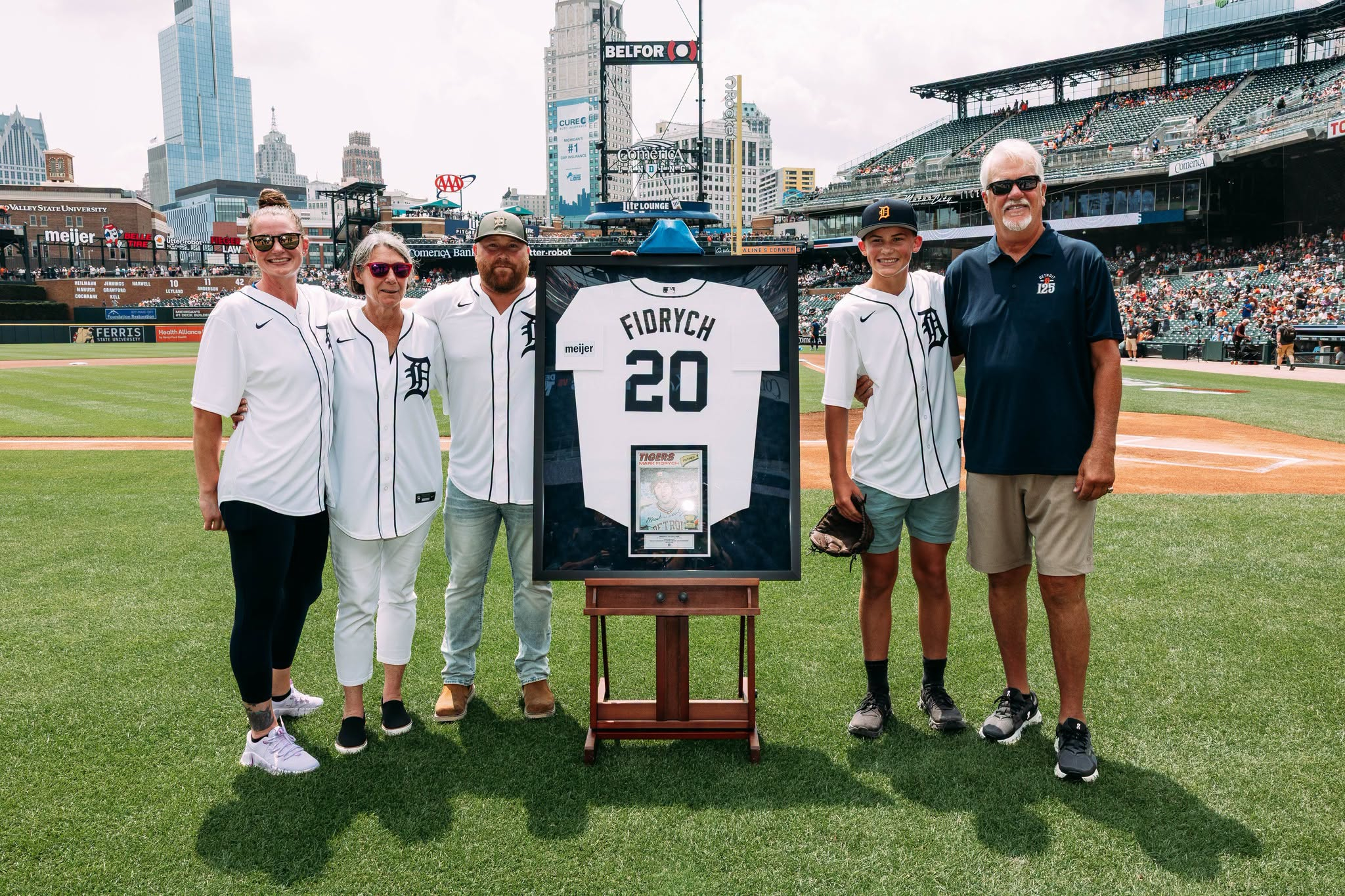
USN & USAF retired 1971-1993
Successful Transactions with more than 100 Members
3
Comments
I was just getting into baseball when he started pitching for Detroit - I only remember his curly hair and he was kinda goofy - but that's all I remember..............
"When they can't find anything wrong with you, they create it!"
He was a super pitcher. Detroit just over pitched him and left him in the finish too many games. He talked to the ball and looked like Big Bird on the mound. I saw him pitch in Oakland and yjr park was almost sold out too. He was one of a kind ballplayer and was really good.
USN & USAF retired 1971-1993
Successful Transactions with more than 100 Members
Fidrych somehow was even better his second year than his first, which no one remembers because it got cut short. He was 6-2 with a 1.83 ERA heading into the start where he tore his rotator cuff. The Tigers abused the heck out of him, just criminal. He injured his knee in spring training in 1977 (shagging fly balls for some reason), leading to him starting the season on the DL. Made his first start on May 27. Detroit protected their superstar by..........having him throw 7 complete games in 8 starts coming off a knee injury. Insane.
In 1976, as a rookie and keeping in mind he didn't make his first start until May 15, he threw 24 complete games in just 29 starts. 4 of those starts were 11+ innings!
It's infuriating the way he was misused even by 1970s standards.
He was still just barely 31 years old (in 1985) when it was discovered he had a torn rotator cuff that could be repaired and potentially lead to a comeback. By then, Mark was done with baseball and pain and just wanted to live quietly so he didn't have the surgery.
His story is such a joyous and sad one all combined. A big "what if?" story combined with massive popularity that continues on throughout Michigan to this day, all ending in a tragic accident on his farm when he was just 54.
Historically, I’d compare him to Smoky Joe Wood. He burned bright for a short while and then flamed out.
The reason he had a short career was due the manager pitching him so late in the game. He pitched 24 complete games and pitch in 250 innings his rookie year. He pitched in 31 games and started 29 games. His record was 19-9 as a rookie
USN & USAF retired 1971-1993
Successful Transactions with more than 100 Members
Many dont know THE BIRD made a comeback in 1983 for the Red Sox, but didnt make it past spring training.
2025 SEC bowl record 4-10
SEC bowl record vs BIG TEN last two years 2-8
Because his arm was still damaged. He was properly diagnosed a year or two later but declined the surgery and possible comeback as he was just tired of being in pain.
It was a great season but his legend is probably much greater for leaving the game than it would have been had he stayed. Count the pitchers of the past 100 years who went on to successful careers after striking out 3.5 batters per nine innings in their first full season as starter. I don't need to wait while you count because there aren't any. Would Fidrych have been the lone exception? No way to know, but the odds were agin it.
He was up to 5.67 K/9 in 1977 when he got hurt. To name a contemporary, Jim Palmer averaged 5.0.
Fidrych did improve slightly in a very short "season", but that wasn't my point. If you look at a pitcher's FIRST season as a starter and see fewer than 5 Ks per 9 innings, you are overwhelmingly likely to be looking at a pitcher who will not be very good. (If you see less than 6, you're still PROBABLY looking at a pitcher who will not be very good, but there are plenty of exceptions.)
And while Palmer ended his career at right about 5 Ks per 9 innings, in his first season as a starter, 1966, he pitched 208.1 innings and struck out 147, which is 6.35 per 9 innings. When he was under 30, it was 5.6 Ks per 9 innings, and at 30+ it was 4.3 Ks per 9 innings. Still, old man Palmer was striking out more batters than rookie Fidrych. I'm not saying it's impossible for Fidrych to have developed into a great pitcher over a long career; I'm saying it was damned unlikely.
If its all about strikeouts, then wouldn't Ryan be considered the GOAT?
2025 SEC bowl record 4-10
SEC bowl record vs BIG TEN last two years 2-8
it's not all about strikeouts, but it's not, not all about strikeouts either. You can only rely on contact management and defense to carry you for so long.
Do the flip side and see how many guys came in to MLB as young pure rookie with elite control right off the bat, which will hinder his strikeout total a bit. He also pitched in the DH league, so comparing him to players who got to face hitting pitchers is a bit unfair too. Same with comparing him to other eras where strikeouts were more plentiful.
Fidrych was not a soft tosser that would normally be associated with a low strikeout pitcher.. He was hitting 93 MPH late in a game(per the broadcasters in that game saying his MPH in game).
So if you are looking at future growth and see a kid with elite control throwing 93 MPH and with a philosophy/goal of throwing a complete game, there is without a doubt more 'swing and miss' in his arsenal...which dd start to show in his second season while still improving his already elite BB rate.
I know there are some soft tossing Left Handers that match your question, but it the end, here is one guy who pitched 16 years:
Joaqin Andujar:
His rookie year 175 IP with 3.1 K/9
His second year 158 IP with 3.9/9
Andjuar endeed up throwing 2,153 IP with a 99 ERA+ with 127 wins.
While that isn't a super star, keep in mind that Andujar did that with a putrid 3.8 BB/9 in his first two years, so going forward I would expect far more out of Fidrych's underlying BB and K ratios.
But there is an elite pitcher to look at:
Greg Maddux. A pitcher with similar velocity.
The young pitcher that comes to mind for me with Fidrych is Greg Maddux....except Fidrych already had elite control. Maddux was below NL average in K% his first semi full season; 14.4% to 15.7% league average, compared to Fidrych rookie season of 9.7% to 12.4%.
While Maddux's K rate is still better than Fidrych's in their first years when adjusted for their era, Fidrych did that while throwing 24 complete games! It is much harder to hold that K rate while throwing complete games every time ,and since Fidrych was 2nd in complete games in his era compared to Maddux (with having only one complete game) and his league leaders have 12,12,10,9 it eliminates the era factor in that measurement in the complete game aspect to consider.
in 1977 FIdrych's K'% was 12.9 and the AL average was 13%. Fidrych threw 7 complete games in 11 starts too.
In Maddux's second full year his K% was 13.4% to NL league average of 15.1%.
So I would say Fidrych certainly had more All Star capable years ahead of him with a 93 MPH fastball and elite control....and who knows what type of 'out pitch' he could have developed, just like all pitchers who develop either control or a new pitch to further their careers. He was just a newb kid swimming in the bewilderment of his rise to stardom, so the real work of becoming a MLB hadn't really begun yet for him.
As I said, it is not impossible that Fidrych would have been the first pitcher in history to go on to have a great career after starting off with such a low K rate. It is possible. But finding one example of a pitcher who had an OK career, and a non-example of a pitcher who had a higher K rate does not refute my position, it bolsters it. My position, again, is that it is damned unlikely that Fidrych would have gone on to have a great career. Could he have been an average pitcher for a couple thousand innings? Sure he could have, but even that is unlikely. Andujar did it - and I'm a HUGE fan of Andujar - but he was himself a stark exception by even having an OK career.
I'll put it this way - if you get into some long-term fantasy league and you draft pitchers after their first season as a starter, you would be a fool to draft a pitcher who struck out as few batters as Fidrych did. The odds that you took the best pitcher available for the remainder of their careers are essentially zero.
If i was his coach and I had him coming in to MLB immediately as a 21 year old showing elite command and home run prevention( while thorwing complete games at a higher rate than anyone in the league), and with 93 MPH veloctity, and with an already Cy Young caliber season under his MLB bet, I would have him in several all star games going forward. I wouldn't be thinking of fantasy leagues. If strikeouts weren't wanted, I would have gotten them, plain and simple.
@dallasactuary how many rookie pitchers have even thrown 250 innings since WWII? Then add being only 21 years old.
You keep glossing over his 4.7 K per 9 innings in his second year. HIs strikeouts were not only in there, they came out some in his second year. His K rate was league average that year. Sure, you ignore it because it is only 87 IP, but then use only one year to make a bold and short sighted declaration.
He threw harder than you think and he had more of that in there too since his stated goal was to complete the game and be democratic with the balls in play.
Why do you think he would only have been as good as Andjuar?
They each threw exactly 331 IP in their first two years.
Adujar had 3.8 BB per 9 innings and 3.5 K per 9 innings. 0.5 HR per 9
Fidrych had 1.8 BB per 9 innings and a 3.8 K per 9 innings. 0.4 HR per 9
Andujar threw 13 complete games.
FIdrych threw 31 complete games.
Those are your primary indicators...and Andujar didn't conserve his velocity like Fidrych did to throw complete games so often.
And Fidrych did that in the DH league so Fidrych's already leading indicators are really further than what those are showing when you consider Fidrych never had luxury of three easy outs a game vs a hitting pitcher(with adding more K"s too).
So for your fantasy question, it is extremely easy to pick which of those pitchers going forward would be better, and since Andujar was league average, it is a slam dunk that Fidrych would be above league average...(and even a tick higher when you add the DH factor pulling down his numbers). Add a smarter organization and Fidrych would have had SEVERAL more All Star years...especially consider Andujar got FOUR all star appearances for being a lesser pitcher with those weak indicators.
So yes.
PS Not to mention those are not stadium adjusted. You like stadium adjustments and those HR per 9 innings gap gets further with their stadium adjustment(and a DH adjustment).
Lets forget for a second how poor of an analysis it would be to look at predicting a pitchers' future success by ONLY looking at strikeouts and completely ignoring base on balls and HR allowed. And lets forget about ignoring the other key factors above that any baseball sense would recognize. And also forget how using just one season is kind of dumb too.
Lets at least look at one key factor in this disucsusion:
These are the batter results(for their first full season) that the pitcher gave up to MLB hitters(excluding facing the opposing teams pitcher batting):
Player A
996 plate appearances against, 97 strikeouts....for kicks 53 base on balls, and 12 HR allowed.
Player B
644 plate appearances against, 92 strikeouts....for kicks 71 base on balls, and 17 HR allowed.
Player C
780 Plate appearances against, 68 strikeouts....for kicks 63 base on balls, and 12 HR allowed.
Forgetting ballpark factors, and forgetting eras where strikeouts were or were not more plentiful(tho none of these guys are PRE WAR).
Which of those three pitchers is giving the indicators of being the best pitcher? Which pitcher was the worst strikeout pitcher? Which one gave the worst overall indicators?
FYI, Early Wynn is NOT one of those pitchers, but in his first full season of pitching he averaged only 2.7 K per 9 innings...so @dallasactuary your question is blown right there even though its terribly incomplete picture was already blown .
.
Early Wynn 2.7 K per 9 innings in his first full season...and 3.1 in his second
You can skip the rest of the posts above that filled in all of the key missing pieces to your quesiont, because Early Wynn averaged 2.7 K per 9 innings in his first year....and 3.1 in his second. .
.
I don't really even know how to respond to any of this, other than to repeat myself. What any pitcher did in their second season is quite obviously irrelevant to the single only point I made; I didn't "gloss over it" I completely ignored it, and will continue to do so.
But you did find Early Wynn. In the entire history of baseball, you went back 80+ years and found an exception to the rule; possibly the only exception, but I don't know that. And Wynn is fascinating, and I don't know his story. He was not only a terrible strikeout pitcher as a rookie, he was a terrible strikeout pitcher until he was 30. Not coincidentally, he was also a bad pitcher until he was 30. At 30, something changed, and I have no idea what it was. Maybe a better pitching coach, maybe surgery to correct some problem he'd been battling his whole career, Who knows. But at 30 he started striking people out, and he became, well, if not a "great" pitcher, at least a very good pitcher with some great seasons.
I will repeat my statement one last time: it is damned unlikely that Mark Fidrych would have had a long, successful career had he not been injured in his sophomore season. Not impossible, but damned unlikely. That you had to go back 80+ years to find a single exception more or less proves that I'm correct, although you don't seem to see that.
You don't know how to respond because you are wrong. Not just about Wynn, but about reading Fidrych's indicators compared to other excellent pitchers...and he out indicated Greg Maddux and Tom Glavine above...and yes had a better K rate than Glavine.
Sometimes it is easier to just admit you are wrong and move on.
Also, you are saying "going back 80 years as if that is making some kind of point'....you do realize Fidrych's rookie year is going back 50 years now.
What I said is that, looking only at a pitcher's K rate in his rookie season, it is very unlikely that a pitcher with a K rate as low as Fidrych had would go on to have a successful career. That you call that statement "wrong" displays an almost unimaginable inability to comprehend what I said. I am not wrong. Sure, if you start looking at other things, maybe the picture changes in some way. But that's not what I said.
On one thing we are in complete agreement - sometimes it is easier to just admit you are wrong and move on. So move on, or at least stop misrepresenting what it is I said. What I said is correct, without any doubt at all. Some of the things you are saying are also correct, but you are talking about things that I am not talking about.
You were wrong.
I double dare you to actually quote something I said, not mis-paraphrase it which is all you've done, that was "wrong".
Early Wynn. So yes, you were wrong.
Also wrong with Joaqin Andujar. If winning 127 games with 2,200 IP, four all star games...that is a successful and if it isn't successful, then you are better off saying "you won't be a HOF pitcher" then you wouldn't be as wrong.
So, I didn't know about Early Wynn, and we can split hairs about whether Andujar had a "successful" career as I meant the word when I said it. THAT is what I was wrong about that has your panties so twisted? OK. At least we are now in complete agreement that nothing I said related to Fidrych was wrong, which was, obviously, the actual point I was making. It was damned unlikely that he was going to have a successful career given how few batters he struck out as a rookie. THAT was my point, and I'm glad to see you are finally agreeing with me on my one and only point.
What are these goalposts doing over here?
So you were wrong. You asked for the quote where you were wrong so I gave it to you. So just say, "I was wrong," because you were.
Then we are back to looking at the bigger picture...the indicators, the base on balls, home run prevention, the IP, and the complete games.
Tom Glavine first full year strikeout rates are worse than Fidrych's(when eliminating the luxury of facing the opposing starting pitcher as a better), so your premise has more holes in it. There are more too.
Fidrych's indicators in his first two years were better than Greg Maddux's first four years...and Fidrych threw harder than Maddux.
Fidrych indicators were far better than Andujar's too, and I asked above, if Andujar went on to have his "spitting hairs" successful career, then why woulnd't Fidrychs's superior indicators give a better glimpse of him being far better than Andujar going forward?
Especially since Fidrych already had superior end results in the book and not just the indicators?
Then Fidrych himself, because in his second year he was an All Star pitcher....that is successful, no matter if you think it isn't or not.. He was also a league average K rate pitcher.
Also:
Mel Harder
Red ruffing
Lon Warnake
Bob Friend
Lew Burdette won 200 games and had lower K rates and didn't face a DH.
Yes, they came before Fidrych, but they are closer in time to Fidrych than we are right now.
There are more too, especially if you add/eliminate the DH factor that Fidrych had to face that so many others did not.
So no, the picture you are tryin to paint is not only flat out missing players that go against your statement, it is grossly incomplete and short sighted like I said before.
And I like my panties.
@dallasactuary
I want to add that in 1977 when Fidrych started the year fresh(before he felt his arm go which was when he likely tore his rotator cuff), this is what his indicators looked like:
69 IP
7 complete games
5.1 K per 9 innings.
14.7% K rate
1.0 BB per 9 innings
4.9 K/BB ratio
0.1 HR allowed. So one HR allowed. Incredible.
1.83 ERA and a 2.19 Fielding Independent ERA.
19.9 Run Expectancy runs saved above league average.
2.0 Win Probability Added
That was a Cy Young/MVP caliber season in the making. When adjusting for having to face a DH for those indicators that is a prime Greg Maddux season in the making right there.
You may choose to ignore that, but if you are ever looking for pitchers, look for someone with those indicators...and if you knew he could throw 93 MPH in the late innings after already throwing a million complete games in a row, then you know you have something. Period.
So clearly, a 21 year old rookie coming off a 3.5 K per 9 innings rookie campaign where he was abused could certainly be excellent to great!
Or maybe if he pitched like most rookies pitched and stopped after 134 IP and 13 COMPLETE GAMES IN 15 STARTS when his K rate was 11.6% in a DH league, then his rookie year K rate would not have sent YOU running and getting YOUR panties in a bunch to begin with.
looking at it from a purely statistical perspective... since it wasn't until the mid 1960s that the K/9 actually climbed past 5 (and kept going) looking at examples from the pre-war era isn't really compelling. K/9 wasn't a signal as far as future success was concerned. Post-integration things really changed. There are contemporary examples for Fidrych, but they're thin at best.
Maddux isn't a good example here. In 1987 he had 101 Ks in 155.2 innings which was right around the league average at 5.8. His rookie season was more defined by his lack of command than anything else. Glavine is a good example of well-below-league-average K/9 in his first 300 innings. Glavine and Maddux struggled early with mediocre K/BB and their command tightened significantly over their early careers. Fidrych already had elite command... so what was he going to add to the mix other than relying on sustained weak-contact and his arm staying healthy.
None of this is to say he couldn't have had a successful career, but he would have had an uphill battle. Pitchers who had a poor K/9 rate and a poor K/BB rate have room to grow perhaps more than a pitcher with excellent command and a bad K-rate. We'll never know.
I conceded I was wrong about Early Wynn. I thought there were no exceptions to my rule, but it turns out there is one. But looking at the rest of your list, I see another thing I said that was technically wrong. I said to find a pitcher "in the last 100 years". What I was thinking when I said that was to exclude the 1920s and 1930s when having low strikeout rates was far more common. That you went back to the 30's and found some of those pitchers is on me, I should have used a more precise figure than the approximate "100" I threw out there.
And neither one of us is right or wrong about what it means to have a "successful" career, since we haven't agreed on what the word means. I certainly didn't mean to include Andujar under that word, and Bob Friend is pushing it, too. Sure, these are pitchers with careers worth having, but they each only had a few seasons that could even be called "very good". People talk about Mark Fidrych like he was prevented from becoming Greg Maddux by his injury, and that's laughable. But if all people mean is that might have been another Andujar, then sure, no argument from me. But I think what people think Fidrych might have become is closer to Maddux than Andujar, and what I meant by "successful" was, too.
At the end of the day, it was damned unlikely that Fidrych would have had a, let's switch from "successful" to "memorable" career. Would Fidrych be as famous 60 years after he retired as Bob Friend is today? Absolutely he might have been. If you are arguing that Fidrych might have been the next Bob Friend, then we are now in agreement. If you are arguing that he might have been the next {insert name of pitcher people actually remember} then we're back where we started. It's possible that he might have been good enough that people would still be talking about him decades later, but it is damned unlikely.
And no matter how often you bring up what Fidrych did in his sophomore season, I'm not going to bite since it has absolutely nothing to do with my argument.
Nothing wrong with most of what you said except the very last sentence. It is like you say in the fielding exercise, that there is no proof, only evidence. His second year is simply more evidence, and very good evidence at that. If your argument is how the rest of his career would go, then you cannot just discard that evidence as you are doing.
Also, it is a veery easy assumption that Fidrych would be superior to Andujar by a good margin. He already 1 and 1/2 seasons under his belt better than Andujar ever did, and the compelling superior indicators Fidrych had over Andujar makes it an easy pick.
So yes, somewhere between Andujar and Maddux for his career. Maybe a little lesser version of Bret Saberhagen is where I would see it.
'In a 2009 interview with writer Dave O’Hara, Kimm said, “I was his personal catcher. He was the best pitcher in baseball at that time and he had the best pitches and control of any pitcher that I’ve ever seen. He was always a great guy and teammate, Mark never let the special treatment go to his head.” '
He had the velocity with heavy sink and control...and the results. All of Fidrych's indicators back up everything good that has been said about his ability.
Fidyrch had admassed 64.3 Run Expectancy runs prevented ABOVE LEAGUE AVERAGE beofore his arm went dead in Baltimore in 1977. His indicators in 1977 were off the charts for that time before the injury.
I often hear the blame goes to Ralph Houk's handling of Fidrych.
Fred Gladding was the pitching coach for the Tigers & he played 13 years with a good ERA but only started one game in his career. You would have to imagine the combo of them did him no service but despite Staub/LeFlore starting in the All-Star game, that team wasn't that good.
Houk was a WWII hero but I was looking at his managerial record & I wondered if Gary Coleman could have managed the 61 & 62 Yankees and gotten the same results.
Has anyone read a biography on Fidrych and how he or others perceived Houk & Gladding?
Erik
I'm really conflicted here, sometimes the forum just doesn't make sense. One of the loudest bitches members make about MLB is that pitchers don't pitch past the 5th-6th innings. Now here we are and everyone is complaining that the Bird was ruined because he pitched past the 5th-6th innings.
Can't have it both ways, fellas.
"Those who would give up essential Liberty, to purchase a little temporary Safety, deserve neither Liberty nor Safety," --- Benjamin Franklin
Mix the wrong medications again?
Yeah, the "mishandling" BS is part of the myth that has grown up around Fidrych. Fidrych wasn't even in the top 10 in innings pitched that year. And while he did lead the league in complete games, he threw one, count 'em one, more than Jim Palmer who pitched 70+ more innings than Fidrych overall. He also pitched only one more CG than Frank Tanana (who pitched 40+ more innings overall than Fidrych) and Tanana wasn't much older than Fidrych and went on to pitch 3,300 more innings over 17 more seasons. Having a glass arm is what made Fidrych famous. The single only reason we still talk about him today is that glass arm, so talking about what might have been if hadn't had a glass arm creates a sort of paradox, because if he hadn't had a glass arm we wouldn't be talking about him at all.
He didn't have his first start until May 15th that year. He threw 24 complete games in 29 starts. That was a heavy intense condensed workload.
I will need to do some research on the perception of Houk & Gladding's handling of Fidrych. I couldn't imagine they or the Tigers medical staff handled things properly. How much was preventative versus reactive, not sure yet.
Tanana is an interesting comparison. His post-1977 stats at age 23 were not the same in ERA and strikeouts and I believe had to re-invent his approach to become more finese, as he was also used heavily.
Erik
It sounds intense today, but it was done by lots of pitchers for decades, and was still being done in 1977. That Fidrych was pitching 9 innings almost every game, while Palmer, Tanana, and several others were pitching 8 innings half the time and 9 innings half the time left Fidrych as the CG leader, but his workload was no more intense than theirs or several others who kept pitching for a decade or more after that. Clearly, the workload was too intense for Fidrych, but I just don't see blaming the manager when he had no way to know Fidrych would buckle when so many others before him and alongside him hadn't.
The definitive book on Fidrych is by Doug Wilson and it does not talk about his perception of those two as I recall. It's also my favorite baseball bio ever, just a tremendous book.
Fidrych had 24 CGs in 1976 - five of which were 10+ innings, 4 of them being 11+. Palmer had three starts of 10+, one of which was a CG. Tanana had 3 games of 10+ innings, including a 13-inning start, none of them CGs.
Palmer was also a 12-year veteran in 1976. Tanana is an interesting example for you to use since he famously blew out his arm from overwork in 1979.
Most people point to Fidrych being overworked in 1977 and not just 1976. He returned from a knee injury in late May and proceeded to throw 7 CGs in his first 8 starts, 2 of them on 3 days of rest.
Tanana is an interesting example for you to use since he famously blew out his arm from overwork in 1979.
2,777 innings is a lot of pitching to do with a blown out arm. Just sayin'. There's straining your arm and missing part of a season, and there's straining your arm and never being able to pitch again. Strong arms vs. glass arms - strong wins.
I think I'm being asked to believe that pitching 8 innings per start is easy on the arm, but pitching the ninth inning causes irreparable harm. And I'm not buying it. Vida Blue threw just as many CG as Fidrych as a rookie, and then had a nice, long career. Seaver and Valenzuela didn't have as many CG but they averaged nearly 8 innings per start year after year and had very nice careers. There are a LOT of similar examples.
That Fidrych had a weak arm was already clear because he couldn't strike anyone out. That it gave out so early probably shouldn't have surprised anyone.
Fidrych had a torn rotator cuff, Tanana didn't. Tanana also famously lost about 15+ mph off his fastball.
"couldn't strike anyone out" - why do you keep bringing this up when it's already been disproven? He struck out 8 three times in 1976, and 9 once in 1977. And 6 three other times in 1977. Those aren't amazing numbers but they got the job done. Mike Flanagan won a Cy Young and pitched for 18 years - under 5k/9. Dave McNally - won 20 four straight years, had a lower ERA than Mclain in 1968 - 5.0/9. Fidrych was at 5.5 when he got hurt - 10% higher than the league average in 1977.
last batter of a complete game W against the Yanks in '76
his stuff looked good to me
no walks
and what he did after the game was over is something you'll never witness today
Good God, that means he was averaging less than 3 per game in his other starts! Disproven? I do not think that word means what you think it means.
That's why any competent projection looks at more than just strikeouts. There is a reason why BB ratio and HR ratio are key components. You should know that. You completely ignoring that is putting your baseball acumen at risk.
Plus Fidrcyh was getting ground balls approximately 22% better than AL average pitcher...aren't you always saying strikeouts don't matter for hitters and that ground balls for hitters are bad? Would it matter if that tapper back to the mound that Fidrych produced was a strikeout instead?? Would that have gotten you excited?
He could have easily pitched outside the zone more to produce more strikeouts and then sacrifice his BB/9 ratio to something like 3.6 per 9 like a young Palmer, and fall behind in the count more and have his HR ratio increase too. Would that have gotten you excited?
Then by 1977 he was ultra elite for that era before his arm went. These ratios for that era are elite.
69 IP
7 complete games
5.1 K per 9 innings.
14.7% K rate
1.0 BB per 9 innings
4.9 K/BB ratio
0.1 HR allowed. So one HR allowed. Incredible.
1.83 ERA and a 2.19 Fielding Independent ERA.
So he did increase his K rate and actually reduced his walk rate and reduced his HR rate. That is a huge step indicator.
So are you going to go back in all of those discussions and apologize to all the people who went so hard after hitters who strike out, and now you are saying the strikeouts do in fact matter to such a high degree as you are making them out to be in this discussion??
Or, the reality is, the strikeouts for a pitcher is more to do with projections for a pitcher going forward in what he can control, because an out is an out in the results...and the strikeouts are only one component of that projection...and that is the only one you are focusing on, and why you are wrong.
he went from 34 innings in rookie ball in '74 to 250 innings in MLB in '76 so the argument that he wasn't overused is on shaky ground. because 12 other pitchers in the AL threw 250+ innings in '76 is a tidy fact that means nothing. those 12 were all established veterans. Houk wasn't doing anything differently as far as the volume for a pitcher in 1976... he was just doing it to a Rookie, with no accumulated durability, who had pitched 171 innings the year before and 34 the year before that. Baseball wasn't a field of science like it is today and no one thought to look at where volume and intensity meet at the point of failure for a MLB pitcher... now they do. so Houk looks stupid in retrospect but back then no one took notice.
it might be an unpleasant fact that K-rate is the most predictive and repeatable pitching skill there is, but it's a fact nonetheless and at 3.9K/9 Fidrych would have had some challenges. The split in his bWar and FIP is interesting. in 1976 his FIP was 3.15 vs. a 2.34 ERA. A 0.81 run gap with a FIP-based WAR would give him around half of the 9.6 he has on bbref. I'm not saying one number is better than the other - only that when things disagree that's a hint to look closer. In 1976 you're arguing between whether it was an all-time season for a pitcher or just a really good one so that's splitting hairs. The issue I have is that in 1976 his 2.34 ERA was built primarily on great control, ground balls, weak contact, and great defense. Today we observe regression towards FIP which makes the argument for continued success at the level he performed before injury shaky. Tanana is a good example.. Koosman. I don't know, but those seem like similar guys to his potential all things considered.
I have made, what, a dozen posts now? It still does not seem to have sunk in that I am ONLY talking about what happened in Fidrych's rookie season, and how that has historically been an outstanding predictor of future success. That's it. You can talk about "competent projections" and what happened in his second season 'til the cows come home, it still won't have ANYTHING to do with the one and only point I made, which is why I have ignored 100% of it and will continue to do so.
I thought the astoundingly high correlation of a low K rate as a rookie to an ultimately unmemorable career was interesting. My investment in this topic begins and ends there. And I'm looking at what has actually happened in the history of baseball. The confidence of the counterarguments defending pure hypotheticals without any factual basis is impressive, but as I've said, I don't know how to respond.
I'll stop now.
Which confirms my initial thought...that your initial thought was incomplete and short sighted.
FYI 1976 was only the second year Fidrych had ever started a professional baseball game. He had a grand total of 22 Minor league starts under his belt before his summer of 1976 season.
So he was a newb as newb could be. HIs arm was certainly not stamina built yet and he still had a lot to grow in on the field with his game plan and arsenal.
BGR he fed the team easy sinking ground balls at a high rate and FIP doesn't always measure those extremes very well. I would not call them great defensively at all. You could have played second base and fielded many of those two hoppers.
I've reached the end of the discussion as well. Fidrych was a great story, and was a breath of fresh air for MLB.
I'll leave it with one of the best video biographies and enjoy the story since we had enough stats in the discussion.
In 1976, sure. But it was completely different in 1977. As I mentioned, he was 10% above league average in 1977. So, yes, "disproven".