@Typekat said:
PCGS and the market have spoken.
Really, that’s all the “Proof” we need.
Funny as it sounds, a high realized auction item doesn't guarantee authenticity. There are many examples of classic "rare" issues that end up not genuine or not as described with more research. Often times, the numismatic cataloger is the breakthrough researcher to uncover unknown facts, puts the pieces together, and tells the story.
For there to be no story to this coin, and untrue facts from the opinionated description, this was disappointing from a numismatic research standpoint.
"But seek ye first the kingdom of God and His righteousness and all these things shall be added unto you" Matthew 6:33. Young fellow suffering from Bust Half fever.
BHNC #AN-10
JRCS #1606
@Typekat said:
PCGS and the market have spoken.
Really, that’s all the “Proof” we need.
Funny as it sounds, a high realized auction item doesn't guarantee authenticity. There are many examples of classic "rare" issues that end up not genuine or not as described with more research. Often times, the numismatic cataloger is the breakthrough researcher to uncover unknown facts, puts the pieces together, and tells the story.
For there to be no story to this coin, and untrue facts from the opinionated description, this was disappointing from a numismatic research standpoint.
Seems like most Proof Bust halves are certified by whether it looks good enough to be one since only a few years are associated with any possible documentation. PCGS population shows at least one each year since 1818, except for 1819, Of the few I have seen, some I liked, some I didn't. I have not seen the 1824 so have no conclusion about it.
The certified numbers are a lot fewer than have been called raw proofs in auctions and pricelists over the years. This applies to all the early series.
Some proof coins, like the 1820's to 1840's gold in the Smithsonian, seem to have been struck for no apparent reason in tiny numbers without documentation.
However, I know what you mean, but cannot think of examples right now.
Are there particular examples you had in mind?
"To Be Esteemed Be Useful" - 1792 Birch Cent --- "I personally think we developed language because of our deep need to complain." - Lily Tomlin
@Typekat said:
PCGS and the market have spoken.
Really, that’s all the “Proof” we need.
Funny as it sounds, a high realized auction item doesn't guarantee authenticity. There are many examples of classic "rare" issues that end up not genuine or not as described with more research. Often times, the numismatic cataloger is the breakthrough researcher to uncover unknown facts, puts the pieces together, and tells the story.
For there to be no story to this coin, and untrue facts from the opinionated description, this was disappointing from a numismatic research standpoint.
Seems like most Proof Bust halves are certified by whether it looks good enough to be one since only a few years are associated with any possible documentation. PCGS population shows at least one each year since 1818, except for 1819, Of the few I have seen, some I liked, some I didn't. I have not seen the 1824 so have no conclusion about it.
The certified numbers are a lot fewer than have been called raw proofs in auctions and pricelists over the years. This applies to all the early series.
Some proof coins, like the 1820's to 1840's gold in the Smithsonian, seem to have been struck for no apparent reason in tiny numbers without documentation.
However, I know what you mean, but cannot think of examples right now.
Are there particular examples you had in mind?
Back from the dawn of American numismatic collecting, there have been innumerable times a polished, EDS, or freshly lapped coin had been called "proof." I agree with you, on a mass scale and over the span of centuries, we have certainly cracked down on the number of cataloged "proofs." That claim was often uses as a blanket description for examples that had a special appearance. Nowadays we have separated Prooflike, Proof, and Specimen for greater accuracy. Nevertheless, to me, the "looks good enough" checklist is neither scientific nor consistent for a coin such as this. Vivid proof-like bust halves can be found on occasion. What specifically makes these EDS proof-like specimens different from existing certified proofs?
"But seek ye first the kingdom of God and His righteousness and all these things shall be added unto you" Matthew 6:33. Young fellow suffering from Bust Half fever.
BHNC #AN-10
JRCS #1606
@TallahasseeCoinClub said:
I thought it would sell for somewhat more but that final value is hardly peanuts.
For the series, and the market that supports a coin such as this, the realized price was a healthy number.
"But seek ye first the kingdom of God and His righteousness and all these things shall be added unto you" Matthew 6:33. Young fellow suffering from Bust Half fever.
BHNC #AN-10
JRCS #1606
@jesbroken said:
Just for curiosity's sake, who was the cataloger at Scotsman's for this coin? If already mentioned, my apologies, but I missed it. Thank you.
Jim
"Cataloger James Garcia pointed to the unusually sharp rendering of Liberty’s hair beneath the cap, which he said could only have resulted from multiple strikes." Link in coinweek article
Note; I couldn't find a James Garcia on the Scotsman staff web page.
"But seek ye first the kingdom of God and His righteousness and all these things shall be added unto you" Matthew 6:33. Young fellow suffering from Bust Half fever.
BHNC #AN-10
JRCS #1606
@tradedollarnut said:
Congrats to the new owner. He knows his stuff and says it’s definitely a proof
Maybe he would like to share why it is a proof for our education.
"But seek ye first the kingdom of God and His righteousness and all these things shall be added unto you" Matthew 6:33. Young fellow suffering from Bust Half fever.
BHNC #AN-10
JRCS #1606
@tradedollarnut said:
He told me proof surfaces in the devices and square rims
By “proof surfaces in the devices”, I’m guessing he meant around the letters LIBERTY in the headband on the obverse and within the shield stripes on the reverse. I look at those two areas for clues regarding the Proof status of Capped Bust coinage. My experience has been that it’s usually a good indicator.
Mark Feld* of Heritage Auctions*Unless otherwise noted, my posts here represent my personal opinions.
If this is proved to NOT be a proof, PCGS's guarantee will have to make the buyer whole...
Short of determining that the coin was deceptively altered, how could anyone possibly prove that the coin is not a proof? Or, for that matter, prove that it is? These are completely subjective calls.
Andy Lustig
Doggedly collecting coins of the Central American Republic. Visit the Society of US Pattern Collectors at USPatterns.com.
@tradedollarnut said:
He told me proof surfaces in the devices and square rims
By “proof surfaces in the devices”, I’m guessing he meant around the letters LIBERTY in the headband on the obverse and within the shield stripes on the reverse. I look at those two areas for clues regarding the Proof status of Capped Bust coinage. My experience has been that it’s usually a good indicator.
That’s where I usually look and I assumed it is what he is talking about but I did not quiz him any further than his statement
Bust halves don't have defined rims, nor could the edges be possibly squared. Rims were made with a closed collar after the usage of the steam press. As the planchet expanded during the striking process the rims were squared at the joint between the collar and the obverse or reverse die. There is nothing in the striking process to square the "rims".
Regarding polishing seen in the devices, there were no special processes for polishing proof dies and circ strike dies. They were all polished. The areas on a proof die will be polished exactly the same as a circ strike die. Is the coin below a proof just because the recesses (shield lines, LIBERTY, etc) are polished?
1829 PCGS MS-62 PL
Or is this coin below not a proof because the recesses (shield lines, LIBERTY, etc) are not polished?
1830 PCGS Proof-65+
I'm not here to argue with everyone, just want to challenge assumed facts or wrong information. The hobby is littered with assumed facts that need to be broken down and covered with truth.
Edit: 1831 typo-->1830
"But seek ye first the kingdom of God and His righteousness and all these things shall be added unto you" Matthew 6:33. Young fellow suffering from Bust Half fever.
BHNC #AN-10
JRCS #1606
If this is proved to NOT be a proof, PCGS's guarantee will have to make the buyer whole...
Short of determining that the coin was deceptively altered, how could anyone possibly prove that the coin is not a proof? Or, for that matter, prove that it is? These are completely subjective calls.
If they can't be defined as a proof, SHOULD they be defined as a proof by a TPG?
"But seek ye first the kingdom of God and His righteousness and all these things shall be added unto you" Matthew 6:33. Young fellow suffering from Bust Half fever.
BHNC #AN-10
JRCS #1606
If this is proved to NOT be a proof, PCGS's guarantee will have to make the buyer whole...
Short of determining that the coin was deceptively altered, how could anyone possibly prove that the coin is not a proof? Or, for that matter, prove that it is? These are completely subjective calls.
Indeed. In my time in Chicago we bought in a Bust Half from the early 30's that I thought was a Proof, but we couldn't get either god to agree with me. C'est la vie!
Professional Numismatist, Retired. 55 year member ANA. Former ANA Senior Authenticator. Winner of four ANA Heath Literary Awards; three Wayte and Olga Raymond Literary Awards; Numismatist of the Year Award 2009, and ANA Lifetime Achievement Award 2020. Winner of the PNG's 2026 Robert Friedberg Award for "The Enigmatic Lincoln Cents of 1922," Available now from Whitman or Amazon.
Bust halves don't have defined rims, nor could the edges be possibly squared. Rims were made with a closed collar after the usage of the steam press. As the planchet expanded during the striking process the rims were squared at the joint between the collar and the obverse or reverse die. There is nothing in the striking process to square the "rims".
Regarding polishing seen in the devices, there were no special processes for polishing proof dies and circ strike dies. They were all polished. The areas on a proof die will be polished exactly the same as a circ strike die. Is the coin below a proof just because the recesses (shield lines, LIBERTY, etc) are polished?
1829 PCGS MS-62 PL
Or is this coin below not a proof because the recesses (shield lines, LIBERTY, etc) are not polished?
1831 PCGS Proof-65+
I'm not here to argue with everyone, just want to challenge assumed facts or wrong information. The hobby is littered with assumed facts that need to be broken down and covered with truth.
A] obvious mint state
B] obvious proof
Some coins don’t need that determining factor to reveal themselves.
Bust halves don't have defined rims, nor could the edges be possibly squared. Rims were made with a closed collar after the usage of the steam press. As the planchet expanded during the striking process the rims were squared at the joint between the collar and the obverse or reverse die. There is nothing in the striking process to square the "rims".
Regarding polishing seen in the devices, there were no special processes for polishing proof dies and circ strike dies. They were all polished. The areas on a proof die will be polished exactly the same as a circ strike die. Is the coin below a proof just because the recesses (shield lines, LIBERTY, etc) are polished?
1829 PCGS MS-62 PL
Or is this coin below not a proof because the recesses (shield lines, LIBERTY, etc) are not polished?
1831 PCGS Proof-65+
I'm not here to argue with everyone, just want to challenge assumed facts or wrong information. The hobby is littered with assumed facts that need to be broken down and covered with truth.
A] obvious mint state
B] obvious proof
Some coins don’t need that determining factor to reveal themselves.
Please help us out and explain... How are the planchet and dies obviously prepared for presentation purposes in this case?
"But seek ye first the kingdom of God and His righteousness and all these things shall be added unto you" Matthew 6:33. Young fellow suffering from Bust Half fever.
BHNC #AN-10
JRCS #1606
Should the "look test" be the ONLY factor in determining a $100,000 premium to a coin?
"But seek ye first the kingdom of God and His righteousness and all these things shall be added unto you" Matthew 6:33. Young fellow suffering from Bust Half fever.
BHNC #AN-10
JRCS #1606
@jacrispies said:
Should the "look test" be the ONLY factor in determining a $100,000 premium to a coin?
Yes, actually. Because there are no manufacturing records or defined criteria. You rarely get an 1834 in a full presentation set, so it’s all about the ‘look test’.
Bust halves don't have defined rims, nor could the edges be possibly squared. Rims were made with a closed collar after the usage of the steam press. As the planchet expanded during the striking process the rims were squared at the joint between the collar and the obverse or reverse die. There is nothing in the striking process to square the "rims".
Regarding polishing seen in the devices, there were no special processes for polishing proof dies and circ strike dies. They were all polished. The areas on a proof die will be polished exactly the same as a circ strike die. Is the coin below a proof just because the recesses (shield lines, LIBERTY, etc) are polished?
1829 PCGS MS-62 PL
Or is this coin below not a proof because the recesses (shield lines, LIBERTY, etc) are not polished?
1830 PCGS Proof-65+
I'm not here to argue with everyone, just want to challenge assumed facts or wrong information. The hobby is littered with assumed facts that need to be broken down and covered with truth.
Edit: 1831 typo-->1830
When trying to determine whether a coin is a Proof, I try not to make any assumptions. I look for clues, which might help sway my opinion one way or another. And I’m opposed to giving the benefit of the doubt to coins that aren’t convincing in their appearance.
Mark Feld* of Heritage Auctions*Unless otherwise noted, my posts here represent my personal opinions.
Bust halves don't have defined rims, nor could the edges be possibly squared. Rims were made with a closed collar after the usage of the steam press. As the planchet expanded during the striking process the rims were squared at the joint between the collar and the obverse or reverse die. There is nothing in the striking process to square the "rims".
Regarding polishing seen in the devices, there were no special processes for polishing proof dies and circ strike dies. They were all polished. The areas on a proof die will be polished exactly the same as a circ strike die. Is the coin below a proof just because the recesses (shield lines, LIBERTY, etc) are polished?
1829 PCGS MS-62 PL
Or is this coin below not a proof because the recesses (shield lines, LIBERTY, etc) are not polished?
1831 PCGS Proof-65+
I'm not here to argue with everyone, just want to challenge assumed facts or wrong information. The hobby is littered with assumed facts that need to be broken down and covered with truth.
A] obvious mint state
B] obvious proof
Some coins don’t need that determining factor to reveal themselves.
Please help us out and explain... How are the planchet and dies obviously prepared for presentation purposes in this case?
I don’t believe that’s a requirement under the definition of a proof. But I’m ok if we call them all specimens and sidestep the issue. Shrug
Would it be unreasonable for PCGS to take the position that when a coin really truly looks like a proof, it’s a proof as far as they’re concerned? I mean, it’s their grading service, so their call, right?
Bust halves don't have defined rims, nor could the edges be possibly squared. Rims were made with a closed collar after the usage of the steam press. As the planchet expanded during the striking process the rims were squared at the joint between the collar and the obverse or reverse die. There is nothing in the striking process to square the "rims".
Regarding polishing seen in the devices, there were no special processes for polishing proof dies and circ strike dies. They were all polished. The areas on a proof die will be polished exactly the same as a circ strike die. Is the coin below a proof just because the recesses (shield lines, LIBERTY, etc) are polished?
1829 PCGS MS-62 PL
Or is this coin below not a proof because the recesses (shield lines, LIBERTY, etc) are not polished?
1831 PCGS Proof-65+
I'm not here to argue with everyone, just want to challenge assumed facts or wrong information. The hobby is littered with assumed facts that need to be broken down and covered with truth.
A] obvious mint state
B] obvious proof
Some coins don’t need that determining factor to reveal themselves.
Please help us out and explain... How are the planchet and dies obviously prepared for presentation purposes in this case?
I don’t believe that’s a requirement under the definition of a proof. But I’m ok if we call them all specimens and sidestep the issue. Shrug
That solution absolutely makes the most sense. Specimen is an umbrella term that could accurately encompass all so-called proofs, early die states, and shiny coins alike.
"But seek ye first the kingdom of God and His righteousness and all these things shall be added unto you" Matthew 6:33. Young fellow suffering from Bust Half fever.
BHNC #AN-10
JRCS #1606
@tradedollarnut said:
Heh. Andy’s quote from another thread:
Would it be unreasonable for PCGS to take the position that when a coin really truly looks like a proof, it’s a proof as far as they’re concerned? I mean, it’s their grading service, so their call, right?
I'll respond with my question posted earlier on this page: "If they can't be defined as a proof, SHOULD they be defined as a proof by a TPG?"
It's a deeper question that touches ethics and truth. If neither are held with integrity, then the fruit of the company generally holds less weight.
And thanks for taking the time to converse, this is a great discussion.
"But seek ye first the kingdom of God and His righteousness and all these things shall be added unto you" Matthew 6:33. Young fellow suffering from Bust Half fever.
BHNC #AN-10
JRCS #1606
Going back to the 1825 PL, that’s one heckuva well struck coin! The hair details seem unusually well defined.
Maybe one of our BHNs can tell us:
Is that strong a strike seen on other MS 1825 halves, maybe of that Overton #?
(By the way, I’m not suggesting it’s a “Proof” or not.)
30+ years coin shop experience (ret.) Coins, bullion, currency, scrap & interesting folks. Loved every minute!
@tradedollarnut said:
He told me proof surfaces in the devices and square rims
"Square rims" are not at all what I would expect or immediately look for on an open-collar proof striking, unless he meant the inner rim?
Also, the presence or lack of presence of mirrored finish within shield stripes, around devices, etc. is an indicator and not definitive for anything. Proof Seated coinage can attest to that.
That being said, the point has been made above... I prefer the mindset of "PCGS certified it as a proof" over "it is a proof by any standard". For me, I am in the 80/20 range thinking that it IS, indeed, an astounding proof coin and we are all very fortunate to witness it coming out of hiding.
PCGS called this 3CN a proof. The dies used struck both proof and business coins. There is no luster or frosting left, the edge and rims appear the same as any well circulated 3CN. PCGS could not with any certainty determine the strike type of this coin. Yet they called it a proof. I know this is a different series and situation, but decisions made like this should give pause as to what PCGS is actually looking at when they determine strike type on a highly subjective coin.
In John W. Dannreuther's new reference, United States Proof Coins Volume III: Silver Part Two, he specifically uses the terms "specially struck format" for defining so-called proof coins from this era. In addition to this, he makes his opinion clear by stating, "The author would change the PCGS nomenclature if there was a do over, as these coins and many others specially struck before rims and tight collars were employed would be classified as master-coins (MS as their prefix instead of PR), just as they were called by their minters when they were struck."
I tend to agree with him, although I had never heard of the term "master-coins". The overarching definition of Proof coinage is a muddy gray area for the open collar era, thus would be more accurately defined as something completely different than Proof (such as master-coins mentioned), or a general statement of Specimen.
When Dannreuther states that specific coins are "no brainer proofs", he is alluding to that the coin is no-question a special looking coin that was struck as likely one of the first off the dies, as well as carefully preserved as such with qualities such as specific toning style and lack of contact marks. He is very clear on the concerns and controversy for proof status of specific coins. There will always be controversy for these. As a result, I am surprised at the prices the issues are consistently bringing at auction.
"But seek ye first the kingdom of God and His righteousness and all these things shall be added unto you" Matthew 6:33. Young fellow suffering from Bust Half fever.
BHNC #AN-10
JRCS #1606
@TrickleCharge said:
PCGS called this 3CN a proof. The dies used struck both proof and business coins. There is no luster or frosting left, the edge and rims appear the same as any well circulated 3CN. PCGS could not with any certainty determine the strike type of this coin. Yet they called it a proof. I know this is a different series and situation, but decisions made like this should give pause as to what PCGS is actually looking at when they determine strike type on a highly subjective coin.
Understandable that PCGS would go for the lower value in situations on indistinguishable coins in regard to circ Proofs versus Business strikes.
Your point is well made about other Proofs. Though on things like Proof Bust coins, if consulted experts agree with the designation and there is not a way to prove or disprove, then they are not at much financial risk since the designation is so unlikely to change without documentation turning up.
People, which are the market, have to decide what is acceptable to them in terms of designation and price on a case by case basis where documentation does not exist.
Not so much different from the raw days, though many value the official feeling a slab gives to a designation. A couple of examples are the raw Proof 1828 50c at under $7k in 2006 to 192k as PCGS Proof-58 in 2023 and the 1850 Gold $1 at around $7k as possible Proof raw in 1995 to $130k as PCGS Proof-60 in 2013. Prices can change a lot both up and down when reappearing even after being slabbed. Opinions make the coin market go round.
Separately, it seems PCGS has been moving from Proof to Specimen on some of the 1838-O Halves and 1894-S Dimes. Though such a move doesn't change the value on these.
"To Be Esteemed Be Useful" - 1792 Birch Cent --- "I personally think we developed language because of our deep need to complain." - Lily Tomlin
The purchaser of the Proof 1824/1 half dollar has the finest collection of Proof bust coins on the planet. The Smithsonian Collection is lacking several coins that are in this collection. If both JD and the buyer think this coin is a Proof, I would have to agree.
@TrickleCharge said:
PCGS called this 3CN a proof. The dies used struck both proof and business coins. There is no luster or frosting left, the edge and rims appear the same as any well circulated 3CN. PCGS could not with any certainty determine the strike type of this coin. Yet they called it a proof. I know this is a different series and situation, but decisions made like this should give pause as to what PCGS is actually looking at when they determine strike type on a highly subjective coin.
Understandable that PCGS would go for the lower value in situations on indistinguishable coins in regard to circ Proofs versus Business strikes.
Your point is well made about other Proofs. Though on things like Proof Bust coins, if consulted experts agree with the designation and there is not a way to prove or disprove, then they are not at much financial risk since the designation is so unlikely to change without documentation turning up.
People, which are the market, have to decide what is acceptable to them in terms of designation and price on a case by case basis where documentation does not exist.
Not so much different from the raw days, though many value the official feeling a slab gives to a designation. A couple of examples are the raw Proof 1828 50c at under $7k in 2006 to 192k as PCGS Proof-58 in 2023 and the 1850 Gold $1 at around $7k as possible Proof raw in 1995 to $130k as PCGS Proof-60 in 2013. Prices can change a lot both up and down when reappearing even after being slabbed. Opinions make the coin market go round.
Separately, it seems PCGS has been moving from Proof to Specimen on some of the 1838-O Halves and 1894-S Dimes. Though such a move doesn't change the value on these.
You make some good points. And just to be clear, I'm not saying the bust half isn't a proof. Still, when a TPG makes it common practice to determine strike type based solely on liability, we should scrutinize their decisions on any coin where strike type isn't black and white.
@jacrispies said:
Should the "look test" be the ONLY factor in determining a $100,000 premium to a coin?
Grading services don’t tell us how much we have to pay for a coin. It’s up to the buyer to decide how much a PR or SP designation is worth to him. And if the buyer decides the premium should be 100K, that’s on him, not on the TPG.
Andy Lustig
Doggedly collecting coins of the Central American Republic. Visit the Society of US Pattern Collectors at USPatterns.com.
@jacrispies said:
In John W. Dannreuther's new reference, United States Proof Coins Volume III: Silver Part Two, he specifically uses the terms "specially struck format" for defining so-called proof coins from this era. In addition to this, he makes his opinion clear by stating, "The author would change the PCGS nomenclature if there was a do over, as these coins and many others specially struck before rims and tight collars were employed would be classified as master-coins (MS as their prefix instead of PR), just as they were called by their minters when they were struck."
I tend to agree with him, although I had never heard of the term "master-coins". The overarching definition of Proof coinage is a muddy gray area for the open collar era, thus would be more accurately defined as something completely different than Proof (such as master-coins mentioned), or a general statement of Specimen.
When Dannreuther states that specific coins are "no brainer proofs", he is alluding to that the coin is no-question a special looking coin that was struck as likely one of the first off the dies, as well as carefully preserved as such with qualities such as specific toning style and lack of contact marks. He is very clear on the concerns and controversy for proof status of specific coins. There will always be controversy for these. As a result, I am surprised at the prices the issues are consistently bringing at auction.
Master coins and Proofs are the same thing, just one term was used before the other in mint documents. I forget what year(s) the changeover occurred, but I'd imagine it's probably around 1858.
@jacrispies said:
In John W. Dannreuther's new reference, United States Proof Coins Volume III: Silver Part Two, he specifically uses the terms "specially struck format" for defining so-called proof coins from this era. In addition to this, he makes his opinion clear by stating, "The author would change the PCGS nomenclature if there was a do over, as these coins and many others specially struck before rims and tight collars were employed would be classified as master-coins (MS as their prefix instead of PR), just as they were called by their minters when they were struck."
I tend to agree with him, although I had never heard of the term "master-coins". The overarching definition of Proof coinage is a muddy gray area for the open collar era, thus would be more accurately defined as something completely different than Proof (such as master-coins mentioned), or a general statement of Specimen.
When Dannreuther states that specific coins are "no brainer proofs", he is alluding to that the coin is no-question a special looking coin that was struck as likely one of the first off the dies, as well as carefully preserved as such with qualities such as specific toning style and lack of contact marks. He is very clear on the concerns and controversy for proof status of specific coins. There will always be controversy for these. As a result, I am surprised at the prices the issues are consistently bringing at auction.
Master coins and Proofs are the same thing, just one term was used before the other in mint documents. I forget what year(s) the changeover occurred, but I'd imagine it's probably around 1858.
I would love to see a Mint Document showing the context and usage of the term "master coins". Does anyone have a reference for this?
My implied assumption is that Master Coins and today's Proof Coins carry much different contemporary definitions, thus would not be equally comparable. I would appreciate to hear the counterargument and my mind changed.
"But seek ye first the kingdom of God and His righteousness and all these things shall be added unto you" Matthew 6:33. Young fellow suffering from Bust Half fever.
BHNC #AN-10
JRCS #1606
@jacrispies said:
In John W. Dannreuther's new reference, United States Proof Coins Volume III: Silver Part Two, he specifically uses the terms "specially struck format" for defining so-called proof coins from this era. In addition to this, he makes his opinion clear by stating, "The author would change the PCGS nomenclature if there was a do over, as these coins and many others specially struck before rims and tight collars were employed would be classified as master-coins (MS as their prefix instead of PR), just as they were called by their minters when they were struck."
I tend to agree with him, although I had never heard of the term "master-coins". The overarching definition of Proof coinage is a muddy gray area for the open collar era, thus would be more accurately defined as something completely different than Proof (such as master-coins mentioned), or a general statement of Specimen.
When Dannreuther states that specific coins are "no brainer proofs", he is alluding to that the coin is no-question a special looking coin that was struck as likely one of the first off the dies, as well as carefully preserved as such with qualities such as specific toning style and lack of contact marks. He is very clear on the concerns and controversy for proof status of specific coins. There will always be controversy for these. As a result, I am surprised at the prices the issues are consistently bringing at auction.
Master coins and Proofs are the same thing, just one term was used before the other in mint documents. I forget what year(s) the changeover occurred, but I'd imagine it's probably around 1858.
I would love to see a Mint Document showing the context and usage of the term "master coins". Does anyone have a reference for this?
My implied assumption is that Master Coins and today's Proof Coins carry much different contemporary definitions, thus would not be equally comparable. I would appreciate to hear the counterargument and my mind changed.
Best I could find for you. Both terms used interchangeably in the same 1859 document. Image from NNP.
Comments
I thought it would sell for somewhat more but that final value is hardly peanuts.
Official PCGS account of:
www.TallahasseeCoinClub.com
Funny as it sounds, a high realized auction item doesn't guarantee authenticity. There are many examples of classic "rare" issues that end up not genuine or not as described with more research. Often times, the numismatic cataloger is the breakthrough researcher to uncover unknown facts, puts the pieces together, and tells the story.
For there to be no story to this coin, and untrue facts from the opinionated description, this was disappointing from a numismatic research standpoint.
"But seek ye first the kingdom of God and His righteousness and all these things shall be added unto you" Matthew 6:33. Young fellow suffering from Bust Half fever.
BHNC #AN-10
JRCS #1606
Seems like most Proof Bust halves are certified by whether it looks good enough to be one since only a few years are associated with any possible documentation. PCGS population shows at least one each year since 1818, except for 1819, Of the few I have seen, some I liked, some I didn't. I have not seen the 1824 so have no conclusion about it.
The certified numbers are a lot fewer than have been called raw proofs in auctions and pricelists over the years. This applies to all the early series.
Some proof coins, like the 1820's to 1840's gold in the Smithsonian, seem to have been struck for no apparent reason in tiny numbers without documentation.
However, I know what you mean, but cannot think of examples right now.
Are there particular examples you had in mind?
"To Be Esteemed Be Useful" - 1792 Birch Cent --- "I personally think we developed language because of our deep need to complain." - Lily Tomlin
Back from the dawn of American numismatic collecting, there have been innumerable times a polished, EDS, or freshly lapped coin had been called "proof." I agree with you, on a mass scale and over the span of centuries, we have certainly cracked down on the number of cataloged "proofs." That claim was often uses as a blanket description for examples that had a special appearance. Nowadays we have separated Prooflike, Proof, and Specimen for greater accuracy. Nevertheless, to me, the "looks good enough" checklist is neither scientific nor consistent for a coin such as this. Vivid proof-like bust halves can be found on occasion. What specifically makes these EDS proof-like specimens different from existing certified proofs?
"But seek ye first the kingdom of God and His righteousness and all these things shall be added unto you" Matthew 6:33. Young fellow suffering from Bust Half fever.
BHNC #AN-10
JRCS #1606
For the series, and the market that supports a coin such as this, the realized price was a healthy number.
"But seek ye first the kingdom of God and His righteousness and all these things shall be added unto you" Matthew 6:33. Young fellow suffering from Bust Half fever.
BHNC #AN-10
JRCS #1606
Just for curiosity's sake, who was the cataloger at Scotsman's for this coin? If already mentioned, my apologies, but I missed it. Thank you.
Jim
When a man who is honestly mistaken hears the truth, he will either quit being mistaken or cease to be honest....Abraham Lincoln
Patriotism is supporting your country all the time, and your government when it deserves it.....Mark Twain
how could a buyer go wong.......
If this is proved to NOT be a proof, PCGS's guarantee will have to make the buyer whole...
Nah - they’d just reholder it as a specimen and call it good.
Or even just call it a proof like MS and claim a mechanical error
"Cataloger James Garcia pointed to the unusually sharp rendering of Liberty’s hair beneath the cap, which he said could only have resulted from multiple strikes."
Link in coinweek article
Note; I couldn't find a James Garcia on the Scotsman staff web page.
"But seek ye first the kingdom of God and His righteousness and all these things shall be added unto you" Matthew 6:33. Young fellow suffering from Bust Half fever.
BHNC #AN-10
JRCS #1606
I know James well and have found him to be a very dedicated and knowledgeable numismatist.
Jim
When a man who is honestly mistaken hears the truth, he will either quit being mistaken or cease to be honest....Abraham Lincoln
Patriotism is supporting your country all the time, and your government when it deserves it.....Mark Twain
Congrats to the new owner. He knows his stuff and says it’s definitely a proof
Maybe he would like to share why it is a proof for our education.
"But seek ye first the kingdom of God and His righteousness and all these things shall be added unto you" Matthew 6:33. Young fellow suffering from Bust Half fever.
BHNC #AN-10
JRCS #1606
He told me proof surfaces in the devices and square rims
By “proof surfaces in the devices”, I’m guessing he meant around the letters LIBERTY in the headband on the obverse and within the shield stripes on the reverse. I look at those two areas for clues regarding the Proof status of Capped Bust coinage. My experience has been that it’s usually a good indicator.
Mark Feld* of Heritage Auctions*Unless otherwise noted, my posts here represent my personal opinions.
Short of determining that the coin was deceptively altered, how could anyone possibly prove that the coin is not a proof? Or, for that matter, prove that it is? These are completely subjective calls.
Doggedly collecting coins of the Central American Republic.
Visit the Society of US Pattern Collectors at USPatterns.com.
That’s where I usually look and I assumed it is what he is talking about but I did not quiz him any further than his statement
+@MFeld
Bust halves don't have defined rims, nor could the edges be possibly squared. Rims were made with a closed collar after the usage of the steam press. As the planchet expanded during the striking process the rims were squared at the joint between the collar and the obverse or reverse die. There is nothing in the striking process to square the "rims".
Regarding polishing seen in the devices, there were no special processes for polishing proof dies and circ strike dies. They were all polished. The areas on a proof die will be polished exactly the same as a circ strike die. Is the coin below a proof just because the recesses (shield lines, LIBERTY, etc) are polished?
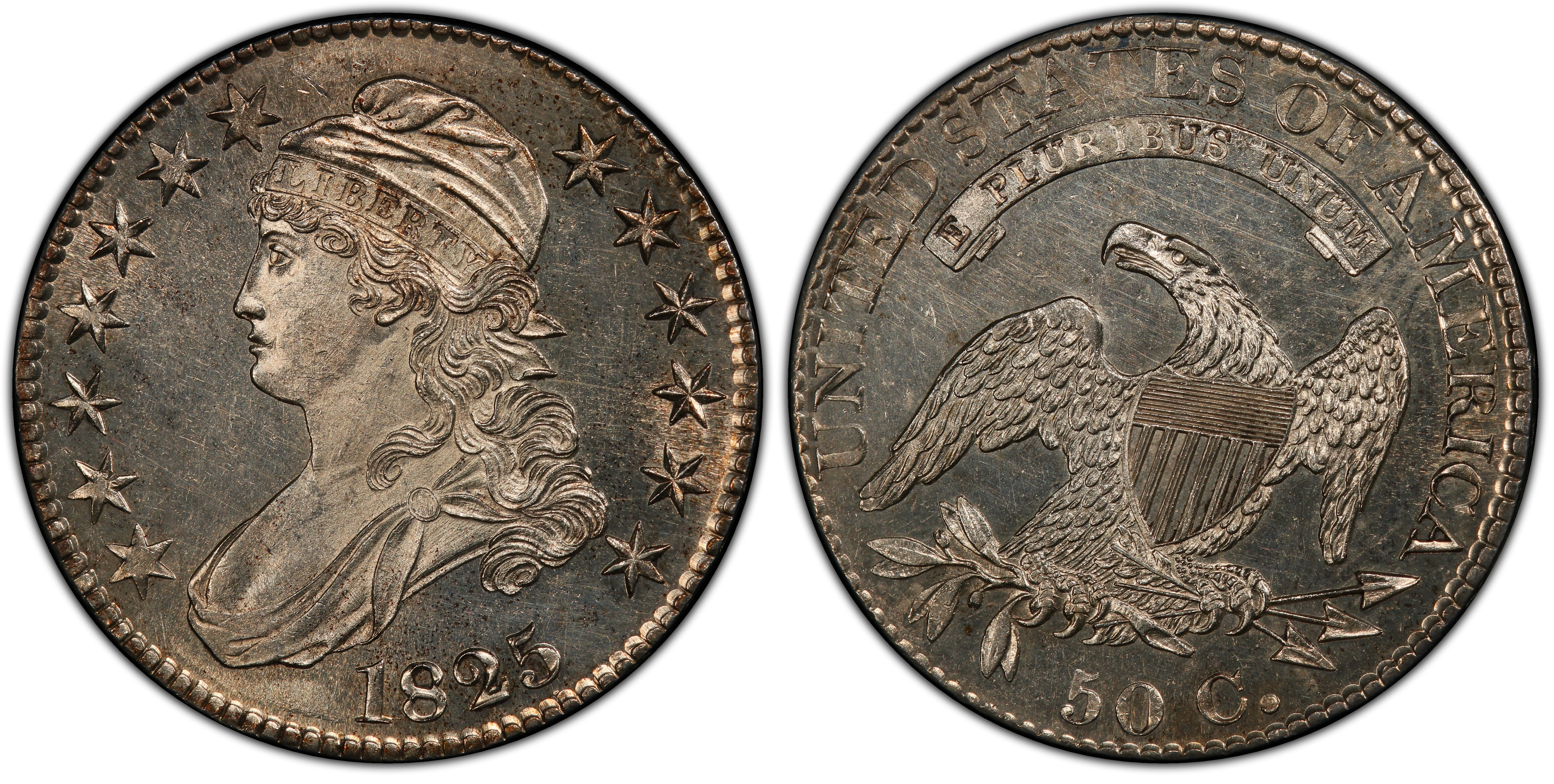
1829 PCGS MS-62 PL
Or is this coin below not a proof because the recesses (shield lines, LIBERTY, etc) are not polished?
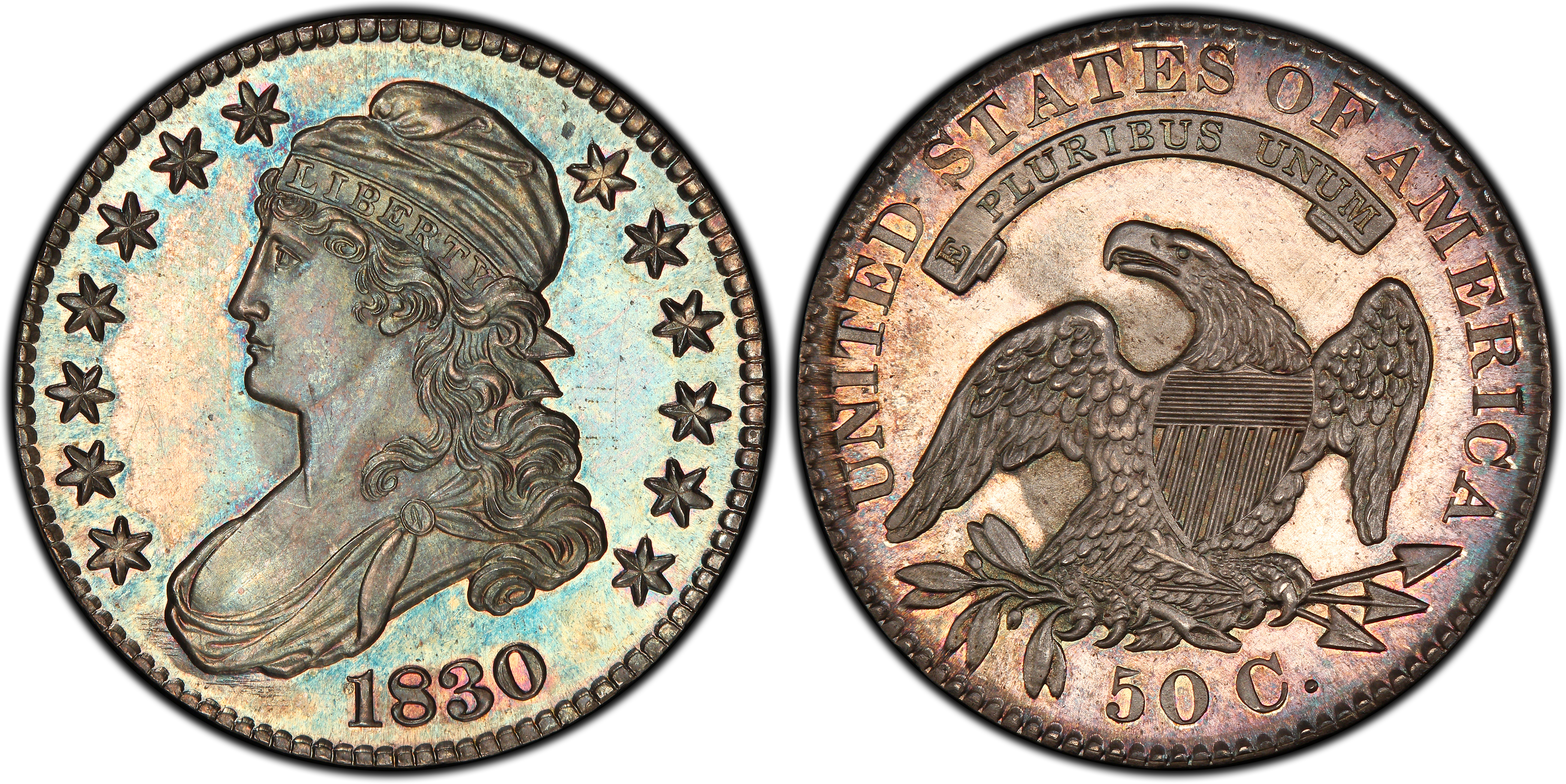
1830 PCGS Proof-65+
I'm not here to argue with everyone, just want to challenge assumed facts or wrong information. The hobby is littered with assumed facts that need to be broken down and covered with truth.
Edit: 1831 typo-->1830
"But seek ye first the kingdom of God and His righteousness and all these things shall be added unto you" Matthew 6:33. Young fellow suffering from Bust Half fever.
BHNC #AN-10
JRCS #1606
If they can't be defined as a proof, SHOULD they be defined as a proof by a TPG?
"But seek ye first the kingdom of God and His righteousness and all these things shall be added unto you" Matthew 6:33. Young fellow suffering from Bust Half fever.
BHNC #AN-10
JRCS #1606
Indeed. In my time in Chicago we bought in a Bust Half from the early 30's that I thought was a Proof, but we couldn't get either god to agree with me. C'est la vie!
A] obvious mint state
B] obvious proof
Some coins don’t need that determining factor to reveal themselves.
Please help us out and explain... How are the planchet and dies obviously prepared for presentation purposes in this case?
"But seek ye first the kingdom of God and His righteousness and all these things shall be added unto you" Matthew 6:33. Young fellow suffering from Bust Half fever.
BHNC #AN-10
JRCS #1606
Should the "look test" be the ONLY factor in determining a $100,000 premium to a coin?
"But seek ye first the kingdom of God and His righteousness and all these things shall be added unto you" Matthew 6:33. Young fellow suffering from Bust Half fever.
BHNC #AN-10
JRCS #1606
Yes, actually. Because there are no manufacturing records or defined criteria. You rarely get an 1834 in a full presentation set, so it’s all about the ‘look test’.
When trying to determine whether a coin is a Proof, I try not to make any assumptions. I look for clues, which might help sway my opinion one way or another. And I’m opposed to giving the benefit of the doubt to coins that aren’t convincing in their appearance.
Mark Feld* of Heritage Auctions*Unless otherwise noted, my posts here represent my personal opinions.
I don’t believe that’s a requirement under the definition of a proof. But I’m ok if we call them all specimens and sidestep the issue. Shrug
Heh. Andy’s quote from another thread:
Would it be unreasonable for PCGS to take the position that when a coin really truly looks like a proof, it’s a proof as far as they’re concerned? I mean, it’s their grading service, so their call, right?
That solution absolutely makes the most sense. Specimen is an umbrella term that could accurately encompass all so-called proofs, early die states, and shiny coins alike.
"But seek ye first the kingdom of God and His righteousness and all these things shall be added unto you" Matthew 6:33. Young fellow suffering from Bust Half fever.
BHNC #AN-10
JRCS #1606
I'll respond with my question posted earlier on this page: "If they can't be defined as a proof, SHOULD they be defined as a proof by a TPG?"
It's a deeper question that touches ethics and truth. If neither are held with integrity, then the fruit of the company generally holds less weight.
And thanks for taking the time to converse, this is a great discussion.
"But seek ye first the kingdom of God and His righteousness and all these things shall be added unto you" Matthew 6:33. Young fellow suffering from Bust Half fever.
BHNC #AN-10
JRCS #1606
Going back to the 1825 PL, that’s one heckuva well struck coin! The hair details seem unusually well defined.
Maybe one of our BHNs can tell us:
Is that strong a strike seen on other MS 1825 halves, maybe of that Overton #?
(By the way, I’m not suggesting it’s a “Proof” or not.)
30+ years coin shop experience (ret.) Coins, bullion, currency, scrap & interesting folks. Loved every minute!
"Square rims" are not at all what I would expect or immediately look for on an open-collar proof striking, unless he meant the inner rim?
Also, the presence or lack of presence of mirrored finish within shield stripes, around devices, etc. is an indicator and not definitive for anything. Proof Seated coinage can attest to that.
That being said, the point has been made above... I prefer the mindset of "PCGS certified it as a proof" over "it is a proof by any standard". For me, I am in the 80/20 range thinking that it IS, indeed, an astounding proof coin and we are all very fortunate to witness it coming out of hiding.
Official PCGS account of:
www.TallahasseeCoinClub.com
PCGS called this 3CN a proof. The dies used struck both proof and business coins. There is no luster or frosting left, the edge and rims appear the same as any well circulated 3CN. PCGS could not with any certainty determine the strike type of this coin. Yet they called it a proof. I know this is a different series and situation, but decisions made like this should give pause as to what PCGS is actually looking at when they determine strike type on a highly subjective coin.
In John W. Dannreuther's new reference, United States Proof Coins Volume III: Silver Part Two, he specifically uses the terms "specially struck format" for defining so-called proof coins from this era. In addition to this, he makes his opinion clear by stating, "The author would change the PCGS nomenclature if there was a do over, as these coins and many others specially struck before rims and tight collars were employed would be classified as master-coins (MS as their prefix instead of PR), just as they were called by their minters when they were struck."
I tend to agree with him, although I had never heard of the term "master-coins". The overarching definition of Proof coinage is a muddy gray area for the open collar era, thus would be more accurately defined as something completely different than Proof (such as master-coins mentioned), or a general statement of Specimen.
When Dannreuther states that specific coins are "no brainer proofs", he is alluding to that the coin is no-question a special looking coin that was struck as likely one of the first off the dies, as well as carefully preserved as such with qualities such as specific toning style and lack of contact marks. He is very clear on the concerns and controversy for proof status of specific coins. There will always be controversy for these. As a result, I am surprised at the prices the issues are consistently bringing at auction.
"But seek ye first the kingdom of God and His righteousness and all these things shall be added unto you" Matthew 6:33. Young fellow suffering from Bust Half fever.
BHNC #AN-10
JRCS #1606
Understandable that PCGS would go for the lower value in situations on indistinguishable coins in regard to circ Proofs versus Business strikes.
Your point is well made about other Proofs. Though on things like Proof Bust coins, if consulted experts agree with the designation and there is not a way to prove or disprove, then they are not at much financial risk since the designation is so unlikely to change without documentation turning up.
People, which are the market, have to decide what is acceptable to them in terms of designation and price on a case by case basis where documentation does not exist.
Not so much different from the raw days, though many value the official feeling a slab gives to a designation. A couple of examples are the raw Proof 1828 50c at under $7k in 2006 to 192k as PCGS Proof-58 in 2023 and the 1850 Gold $1 at around $7k as possible Proof raw in 1995 to $130k as PCGS Proof-60 in 2013. Prices can change a lot both up and down when reappearing even after being slabbed. Opinions make the coin market go round.
Separately, it seems PCGS has been moving from Proof to Specimen on some of the 1838-O Halves and 1894-S Dimes. Though such a move doesn't change the value on these.
"To Be Esteemed Be Useful" - 1792 Birch Cent --- "I personally think we developed language because of our deep need to complain." - Lily Tomlin
The purchaser of the Proof 1824/1 half dollar has the finest collection of Proof bust coins on the planet. The Smithsonian Collection is lacking several coins that are in this collection. If both JD and the buyer think this coin is a Proof, I would have to agree.
You make some good points. And just to be clear, I'm not saying the bust half isn't a proof. Still, when a TPG makes it common practice to determine strike type based solely on liability, we should scrutinize their decisions on any coin where strike type isn't black and white.
Grading services don’t tell us how much we have to pay for a coin. It’s up to the buyer to decide how much a PR or SP designation is worth to him. And if the buyer decides the premium should be 100K, that’s on him, not on the TPG.
Doggedly collecting coins of the Central American Republic.
Visit the Society of US Pattern Collectors at USPatterns.com.
Master coins and Proofs are the same thing, just one term was used before the other in mint documents. I forget what year(s) the changeover occurred, but I'd imagine it's probably around 1858.
Coin Photography
I would love to see a Mint Document showing the context and usage of the term "master coins". Does anyone have a reference for this?
My implied assumption is that Master Coins and today's Proof Coins carry much different contemporary definitions, thus would not be equally comparable. I would appreciate to hear the counterargument and my mind changed.
"But seek ye first the kingdom of God and His righteousness and all these things shall be added unto you" Matthew 6:33. Young fellow suffering from Bust Half fever.
BHNC #AN-10
JRCS #1606
Best I could find for you. Both terms used interchangeably in the same 1859 document. Image from NNP.
Coin Photography