Options
First and only known PROOF 1824/1 Capped Bust half-dollar certified
 TallahasseeCoinClub
Posts: 499 ✭✭✭✭
TallahasseeCoinClub
Posts: 499 ✭✭✭✭
Here's a link to one of several stories already out there:
https://coinnews.net/2026/07/13/proof-1824-1-half-dollar-auction/
PCGS gets the honors on this one  .
.
Enjoy!
Official PCGS account of:
www.TallahasseeCoinClub.com
5
Comments
Perhaps it is Proof Like and not an actual proof? I would think that some mint production record would designate proof strikes. But, what do I know? She's a beauty!
BST transactions: dbldie55, jayPem, 78saen, UltraHighRelief, nibanny, liefgold, FallGuy, lkeigwin, mbogoman, Sandman70gt, keets, joeykoins, ianrussell (@GC), EagleEye, ThePennyLady, GRANDAM, Ilikecolor, Gluggo, okiedude, Voyageur, LJenkins11, fastfreddie, ms70, pursuitofliberty, ZoidMeister,Coin Finder, GotTheBug, edwardjulio, Coinnmore, Nickpatton, Namvet69,...
Neat coin.
I noticed that near the bottom of the article, it said “The catalog team also questioned whether the discovery could point to the existence of a proof 1824/2 half cent.”
I don’t understand why the discovery of the half dollar would have anything to do with the possible existence of an 1824/2 half cent, when there weren’t even any circulation strikes produced that year.
Mark Feld* of Heritage Auctions*Unless otherwise noted, my posts here represent my personal opinions.
There are multiple examples of series with dates that are "proof only" emissions.
Official PCGS account of:
www.TallahasseeCoinClub.com
There’s almost always an element of subjectivity to PR and SP designations on early U.S. coinage, and documentation is almost non-existent. If I were in charge of a TPG, I would not let that stop me for designating these coins as something special, but my disclaimers would be very clear about the subjectivity and guesswork involved.
Doggedly collecting coins of the Central American Republic.
Visit the Society of US Pattern Collectors at USPatterns.com.
How many of those are over-dates? And what do you think the chances are that such a coin exists, but hasn’t surfaced by now?
Mark Feld* of Heritage Auctions*Unless otherwise noted, my posts here represent my personal opinions.
Andy, what “disclaimers” are you speaking of? Currently, I don’t see them being publicized by the major grading companies.
Mark Feld* of Heritage Auctions*Unless otherwise noted, my posts here represent my personal opinions.
Well, I think that you just reiterated the point of the speculation you quoted!
Official PCGS account of:
www.TallahasseeCoinClub.com
I completely agree.
Official PCGS account of:
www.TallahasseeCoinClub.com
Yes, as a response to your previous reply that “There are multiple examples of series with dates that are "proof only" emissions”. As I felt it was at least somewhat beside the point, since the speculation concerned a Proof-only over-date.
Mark Feld* of Heritage Auctions*Unless otherwise noted, my posts here represent my personal opinions.
At a local shop some proof coins came in from 1883; proof Morgan, Trade dollar, liberty nickel. Missing were cent, dime, quarter, half dollar. Some years had sets and some didn't I assume.
"...heading to sale with a conservative pre-auction estimate of $75,000 to $90,000." Very likely into the six figures in the current market hungry for rarities like this.
The coin being discussed is from 1824 and there were certainly no Proof sets produced that year.
Mark Feld* of Heritage Auctions*Unless otherwise noted, my posts here represent my personal opinions.
the never ending possibility, til then
I realize that. It looks like 1858 was the first year the proof sets were available:
"The U.S. Mint first began selling proof sets to the public in 1858, offering collectors "minor coinage sets" (smaller denominations) and silver coin sets, followed by complete gold proof sets in 1861. While individual proof coins were crafted as early as the 1810s, organized sets weren't consistently packaged and sold as a collectible option until the mid-19th century." https://finestknown.com/u-s-proof-coins/
https://www.coinnews.net/wp-content/uploads/2026/07/Proof-1824-1-overdate-Capped-Bust-half-dollar.jpg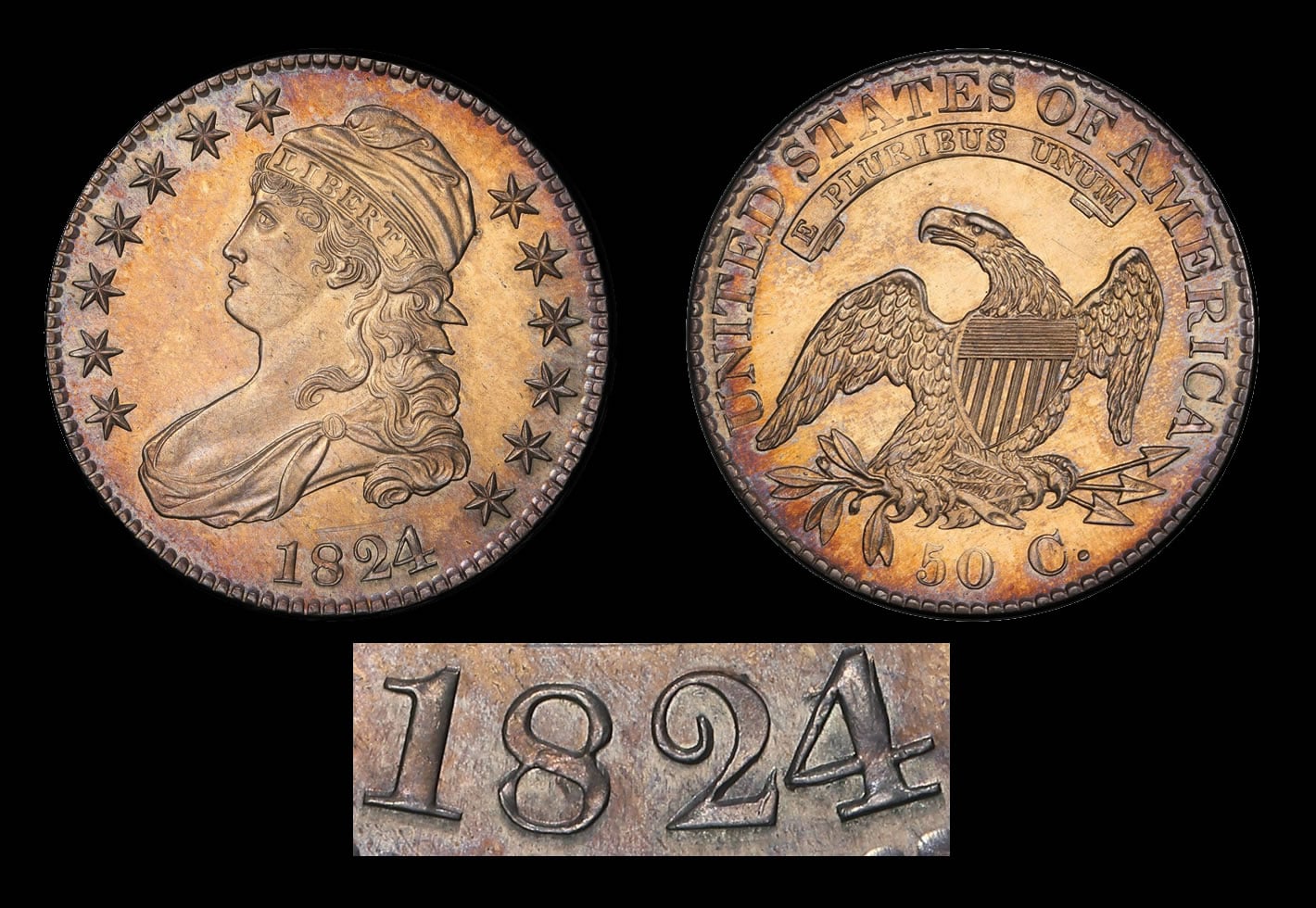
30+ years coin shop experience (ret.) Coins, bullion, currency, scrap & interesting folks. Loved every minute!
Long before 1858, proofs were made available to collectors and dealers with connections at the Mint. And then there were proof sets created for official purposes, like the 1834 King of Siam set.
Doggedly collecting coins of the Central American Republic.
Visit the Society of US Pattern Collectors at USPatterns.com.
@jacrispies has some interesting thoughts on this!
Collector of Capped Bust Halves, SLQ's, Commems, and random cool stuff! @davidv_numismatics on Instagram
On my browser, an ad separated that sentence from the previous one: "Scotsman cited known proofs of the 1824 cent, 1824/2 dime, 1824/2 quarter and 1824/1 quarter eagle as precedents."
I would like to know the evidence that points to this coin being a proof. For a new discovery, one has to ask the hard questions. EDS does not automatically make this a proof.
Regarding the description, at least the cataloger put the disclaimer: "This description expresses opinion and conjecture on the cataloger's part...."
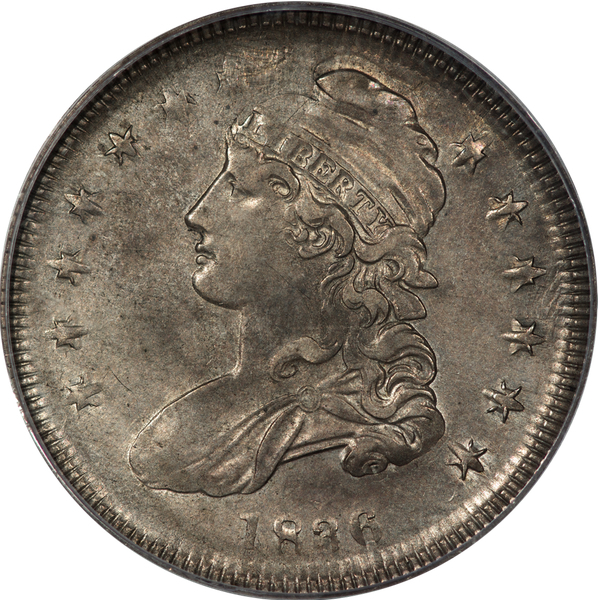
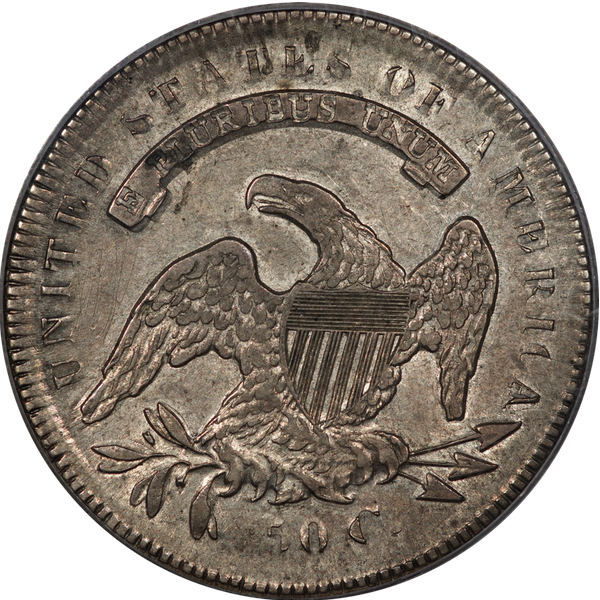
This coin was NOT struck twice, and neither was the planchet over-polished to create weak spots. This is shallow guessing for a catalog description, not backed by any observable evidence.
This is what a centered double strike ACTUALLY looks like on an open-collar setup. Ironically it weakens design details, not sharpens them. You cannot double strike an open collar setup, the planchet will spread too much and slur the entire design.
"But seek ye first the kingdom of God and His righteousness and all these things shall be added unto you" Matthew 6:33. Young fellow suffering from Bust Half fever.
BHNC #AN-10
JRCS #1606
Maybe they meant half eagle?
Keeper of the VAM Catalog • Professional Coin Imaging • Prime Number Set • World Coins in Early America • British Trade Dollars • Variety Attribution
How much of this designation is wishful thinking instead of reality? It's kind of like deciding if Pluto is a planet or not.
Custom album maker and numismatic photographer.
Need a personalized album made? Design it on the website below and I'll build it for you.
https://www.donahuenumismatics.com/.
Mechanical error is the more likely explanation.
My Collection of Old Holders
Never a slave to one plastic brand will I ever be.
What makes you think so?
"But seek ye first the kingdom of God and His righteousness and all these things shall be added unto you" Matthew 6:33. Young fellow suffering from Bust Half fever.
BHNC #AN-10
JRCS #1606
Does not look anything like a proof to me. Proof designations on early US coins were grievously mishandled by the early TPGs in my opinion, and it’s unfortunate to see that they continue to be.
Gobrecht's Engraved Mature Head Large Cent Model
https://www.instagram.com/rexrarities/?hl=en
I think the odds of it being a mechanical error are extremely slim. If it was, quality control in checking the coin and grading label, was less than exceptional.
Mark Feld* of Heritage Auctions*Unless otherwise noted, my posts here represent my personal opinions.
Less than exceptional QC?!? PCGS?!?!
(Sarcasm aside, probably not likely this particular one is a mech error)
chopmarkedtradedollars.com
I may attend the show that will have lot viewing for this. Out of my price range. But I might have to go and check it out now.
Fortunately, I am not in charge of a TPG.
Doggedly collecting coins of the Central American Republic.
Visit the Society of US Pattern Collectors at USPatterns.com.
Same, here.😉
Mark Feld* of Heritage Auctions*Unless otherwise noted, my posts here represent my personal opinions.
Not to mention that if this were a mechanical error, the CoinNews.net article would have a correction, they'd have nuked the cert on it, and the Scotsman lot would have been pulled by now.
Keeper of the VAM Catalog • Professional Coin Imaging • Prime Number Set • World Coins in Early America • British Trade Dollars • Variety Attribution
Since it seems that many (most) question this as a proof the other option is that PCGS messed up and incorrectly misattributed it as a proof. Now that could not have happened at the world's number one (according to PCGS) grading firm.
 All kidding aside there are many known/reported cases of mechanical errors by all the TPG's, seems just as likely as any other possible explanation.
People make mistakes, here is just one such example. I bought this coin via a Heritage auction in 2021, if you check the cert number you will see it is no longer active. I had the cert corrected because NGC assigned it the wrong cert number, someone submitted this coin along with an SLQ for reholdering. NGC swapped the cert numbers between the two coins. However, that is only part of the story, when this cert was active the NGC cert lookup showed the grade as AU64, a double mechanical error. So here we have a double mechanical error and it was not caught by the auction house.
I recognize that the coin in this thread is far more likely to be scrutinized than my example, but these types of mistakes do happen and by all the TPG's.
Read above, mechanical errors can and do pass through auctions without being pulled. Additionally, there is a multi-page thread about a Lincoln cent that was set to be auctioned off and would have been had it not been caught. That was a much easier coin to dispute than this coin is. And then there are the 1964 SMS coins that have been auctioned off despite the concerns over the true identity of those coins. Lots of questionable lots and mechanical errors have crossed the auction block of major auction firms.
My Collection of Old Holders
Never a slave to one plastic brand will I ever be.
Awesome coin.
Thanks for posting.
I enjoyed the article.
It's sad (to me at least) how one can spend a lifetime collecting amazing coins or other collectibles, share them w family over the years only to have them all sold off as soon as one dies.
I know it is unlikely to happen, but it would be beneficial to see the TPG justify their decision with an explanation in cases like these. "It's a proof because PCGS says it is" just doesn't cut it.
I agree but to many buyers, that does cut it.
Mark Feld* of Heritage Auctions*Unless otherwise noted, my posts here represent my personal opinions.
That's true. I'm sure the coin will realize a price much higher than a PL business strike just because of the holder it is in.
Not to derail, but there is an 1880 5c at auction right now which is certified as an F15 circulation strike. It is pretty clearly reverse JD-1, which is accepted to be only used on proofs. Despite the evidence pointing to a proof strike, the coin is currently bid up to the more valuable business strike value just because the TPG has called it that.
I was curious if you have any observable evidence to add to the discussion. "Most question this as a proof" doesn't hold much weight.
Mechanical error can't be strongly argued either because there is little context to make that claim, i.e. swapped label with another coin etc.
"But seek ye first the kingdom of God and His righteousness and all these things shall be added unto you" Matthew 6:33. Young fellow suffering from Bust Half fever.
BHNC #AN-10
JRCS #1606
If you are going to quote me you should do so correctly, I did not say "Most question this as a proof". What I said is that "many (most) question this as a proof". I was assuming that readers would understand that I am referring to the members here with the word "many". And added most in quotes as more of a question than an absolute, perhaps that was not clear to you.
As far as observable evidence I think that is pretty straight forward, the coin does not look like a proof in the photo. And again, many who have replied to this thread don't see it as a proof either. This would not be the first time that mistakes on TPG labels involving PR vs MS have happened. I never ruled out the possibility of PCGS making a mistaken determination, meaning the label is typed correctly but wrong. Nor have I ruled out PCGS getting it right and everyone who has replied questioning the PF status as wrong. Only proposed a theory that had not been offered which is (imo) just as possible as the other two theories.
What is your opinion, proof or not and what is your observable evidence to support your opinion? And no you cannot use the PCGS label as evidence.
My Collection of Old Holders
Never a slave to one plastic brand will I ever be.
Blah blah blah. If JD says it’s a proof in hand, that carries 10x weight over what the internet thinks off of images
Does anyone want to venture what this coin will hammer for at auction? My guess $125K at least.
Did J.D. view the coin in hand and say it was a Proof?
Mark Feld* of Heritage Auctions*Unless otherwise noted, my posts here represent my personal opinions.
Even if he did, what were his reasons? JD knows his stuff, don't get me wrong, but coins like these deserve an explanation beyond 'an expert says it is, so it must be'.
PCGS has him look at everything that's out of the ordinary that has claims to being called a proof, so the working assumption is that he saw it.
Keeper of the VAM Catalog • Professional Coin Imaging • Prime Number Set • World Coins in Early America • British Trade Dollars • Variety Attribution
While I agree with you, unfortunately, the major grading companies don’t make a habit out of giving explanations for their grading decisions - not even for especially rare and/or esoteric coins. And that includes early, undocumented Proofs.
Mark Feld* of Heritage Auctions*Unless otherwise noted, my posts here represent my personal opinions.
Thank you - I thought that was possibly the case but wasn’t certain.
Mark Feld* of Heritage Auctions*Unless otherwise noted, my posts here represent my personal opinions.
I would vote for the two of you. Mark presumably has more time these days.
Looks like a really nicely struck business strike to me. Overdate proof sounds like hens' teeth.
"Look up, old boy, and see what you get." -William Bonney.
Pencil me in for > $200,000.
Official PCGS account of:
www.TallahasseeCoinClub.com
I have a hard time attributing "proof" to bust halves without documentation, especially because surviving VEDS examples can present just as premier as a presentation piece. Proofs were not struck twice so even strike quality isn't a reliable attribute, as EDS examples usually have a better strike anyway.
Studying another certified early 1820s proof bust half dollar recently, I recognized by the die state, it was likely struck as one of the first 10 coins from the dies. Additional notable lack of contact marks, toning that points to special care in velvet or a coin cabinet, etc. points to this other coin being a specially handled coin from it's creation. I agreed with PCGS on this other example.
Without studying this 1824 proof in hand, it is difficult to credit those qualities to this example without high power in hand inspection or documentation. I find the PCGS photos wash out all those important details, so my opinion is neutral for now.
"But seek ye first the kingdom of God and His righteousness and all these things shall be added unto you" Matthew 6:33. Young fellow suffering from Bust Half fever.
BHNC #AN-10
JRCS #1606
Hammered at $132,000.
Official PCGS account of:
www.TallahasseeCoinClub.com
PCGS and the market have spoken.
Really, that’s all the “Proof” we need.
30+ years coin shop experience (ret.) Coins, bullion, currency, scrap & interesting folks. Loved every minute!
At a total price of $155,760 there must be at least a few that consider it a full proof. Seems like a fairly strong price.
1824/1 O-101 PCGS PR-63
https://scoins.com/lot.aspx?a=39&l=725
That may be the highest price for a Lettered Edge Bust Half slabbed Proof-63, though there was an 1828 in PCGS Proof-58 that sold for a huge $192k in 8-2023 after bringing only $6,555 as a raw Proof in a 2006 auction, A few higher graded proof years have brought higher prices though all less than $260k while several brought even lower than this 63 graded coin.
1828 Capped Bust Half Dollar. O-118a. Unique as a Proof. Square Base 2, Small 8s, Large Letters. Proof-58 (PCGS
https://pcgs.com/auctionprices/item/1828-50c/6206/5540794657017082734
"To Be Esteemed Be Useful" - 1792 Birch Cent --- "I personally think we developed language because of our deep need to complain." - Lily Tomlin