Options
American Plantation Tokens - actually American?
 oldabeintx
Posts: 3,224 ✭✭✭✭✭
oldabeintx
Posts: 3,224 ✭✭✭✭✭
I see colonials discussed so rarely here I hesitate to post this. Is anyone aware of documentary evidence that these tokens/coins actually circulated in the colonies? Any written accounts or finds by detectorists? Many thanks.
0
Comments
Im thinking that this is where the private mints popped up in conjunction with the states blessing just to have some circulating change in the area. I dont see why it wouldn't circulate, jmo 😗
(Interesting topic to)
Not close. Suggest you do a little research. Google will do.
We both do
GPT
Plantation coinage (more accurately called Plantation Token) is one of the earliest forms of coin-like money associated with the English colonies in North America, but whether it's "American" depends on how you define the term.
Here's the background:
Plantation Tokens were struck in England around 1652.
They were likely intended for use in the English colonies, especially in Virginia Colony, although historians still debate exactly where and how widely they circulated.
They are made of brass, not silver or gold.
One side shows a crowned king, while the other depicts a rose, with the inscription "PLANTATION."
Are they actually American?
There are two schools of thought:
Yes, in a colonial sense. Many collectors consider them among the earliest coins or tokens made specifically for English America because they were intended for use in the colonies.
No, in a strict sense. They were manufactured in England before the United States existed, so they are not American coins in the modern national sense. They are better described as colonial tokens.
Because of this, most references classify them as colonial American numismatic items rather than U.S. coins.
Interesting topic
Successful BST:here and ATS, bumanchu, wdrob, hashtag, KeeNoooo, mikej61, Yonico, Meltdown, BAJJERFAN, Excaliber, lordmarcovan, cucamongacoin, robkool, bradyc, tonedcointrader, mumu, Windycity, astrotrain, tizofthe, overdate, rwyarmch, mkman123, Timbuk3,GBurger717, airplanenut, coinkid855 ,illini420, michaeldixon, Weiss, Morpheus, Deepcoin, Collectorcoins, AUandAG, D.Schwager, blu62vette, morgan13, torinoCobra71, JWP, promethius88,
I agree... definitely an interesting topic. My understanding is the first actual coins struck in America were the "NE" tokens and Pine Tree (ect.) shillings minted in Boston from 1652 to 1662.
Successful BST transactions with: SilverEagles92; Ahrensdad; Smitty; GregHansen; Lablade; Mercury10c; copperflopper; whatsup; KISHU1; scrapman1077, crispy, canadanz, smallchange, robkool, Mission16, ranshdow, ibzman350, Fallguy, Collectorcoins, SurfinxHI, jwitten, Walkerguy21D, dsessom.
Here’s what the Red Book says, which is consistent with other sources I’ve encountered.
They were the first coins authorized by royal patent for use here, struck in 1688 and restruck in 1828 from original dies. They were originally struck in tin. They show James II on horseback. The denomination is 1/24 real (hence they were coins , although most of us think of them as tokens) the real being the most common coinage standard in the colonies at the time. Originals are very scarce, restrikes are much more attainable. All were struck in England.
I can find no evidence that they made it here and since they were made of tin, they would not have been a success nor popular (my guess) as they blacken quickly (tin pest) and are an odd denomination. I read elsewhere that they were minted solely due to the influence of tin miners in England, which further suggests that these would not have had much commercial interest, if any (except to tin miners).
My interest, in addition to colonials in general, is in foreign coins that circulated in the colonies and later as legal tender. I almost bought one of the restrikes, but the more I learn about these, the more skeptical I am that these were ever used by our colonists.
PS. The more one learns about “colonials” the more examples one finds of coins and tokens that have been collected as colonials solely because of tradition, established in the 19th century I reckon. The most absurd example is the Mott token.
Very much so! The Franklin press tokens, Kentucky tokens, many of the George Washington tokens, all come to mind. I suppose these ones are included because of the American themes even though they had little relevance in terms of circulation. Then there are the London Elephant tokens, no American provenance. Interesting topic, I never gave a great deal of thought to the plantation tokens, guess I have to change that!
How about some basic details for those of us unfamiliar with the subject.
Is this what we're talking about?
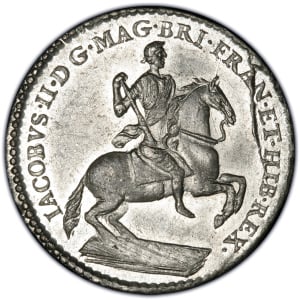
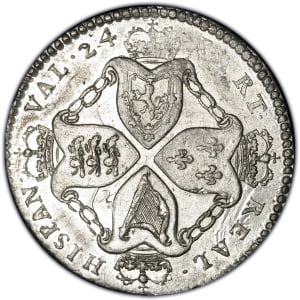
The Google search I did turned up different information that what was posted earlier in this thread - that these are from 1688 and are made of tin.
There's a lengthy article about these tokens on the PCGS Coin Facts web site.
Worry is the interest you pay on a debt you may not owe.
"Paper money eventually returns to its intrinsic value---zero."----Voltaire
"Everything you say should be true, but not everything true should be said."----Voltaire
I don’t know how many actually made it to the colonies, but I do believe they saw use in England. Which I say because every now and then a see a small group of mostly awful pieces turn up in London auctions, and they sort of smell like detectorist finds.
Doggedly collecting coins of the Central American Republic.
Visit the Society of US Pattern Collectors at USPatterns.com.
Many of the colonials that are listed in the Red Book are coins that because of their dates and the “stories” attached to them, such as the North American Token, Continental Dollars, much of Washingtonia, 1776 Massachusetts copper, 1776 New Hampshire copper, Franklin tokens, etc. IMHO, they are just stuff. Nova Constellatio’s are ok as they were used as undertypes on state copper such as Vermont’s and Connecticut’s.
This is so true. For every discussion of colonials (my top interest), there are 10,000 posts about the latest "2026 Mint Set" or "Independance Quarter" or whatever. Anyone know a messageboard where they talk about colonials?
(For the record, I own one of the 1828 restrikes, which I regret now, as it isn't that much more of a stretch to get an original, though they sure look worse)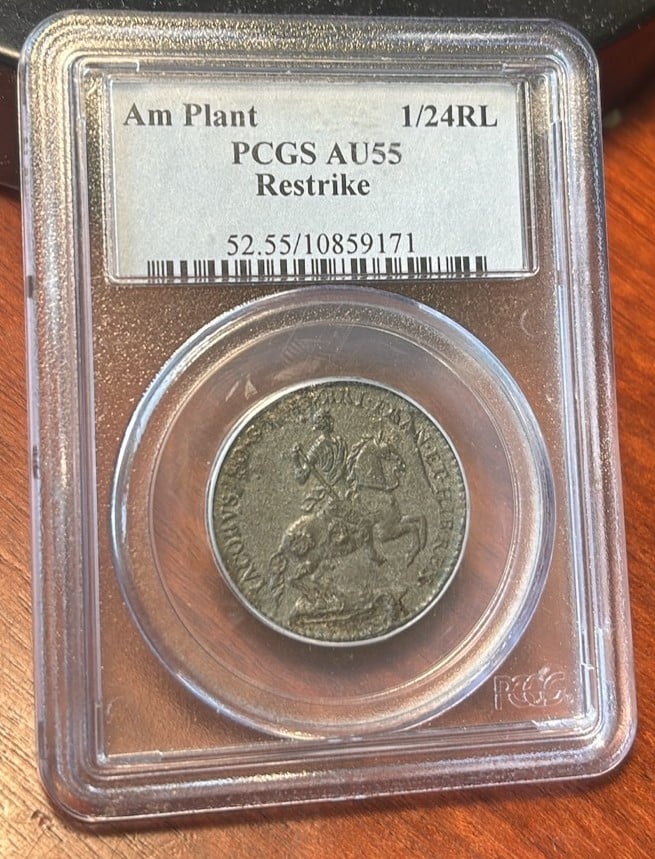
I wonder when, if ever, all the silly stuff will at least cease to be included as “colonials” in the Red Book and elsewhere. I’ve collected Conder tokens that have more historical relevance.
BTW a case can certainly be made to include the subject coins/tokens in a colonial collection whether they made it here or not. The first coins authorized by royal patent for use in
America makes them historically relevant and interesting. The 1/24 real denomination is a great link to the Spanish dollar.
It’s one thing if people want to collect for instance, Franklin or Kentucky Tokens. It’s another thing to believe that they are colonials. They are not.
The Nova Constellatios also circulated heavily in America.
Yes. They also were used as undertypes. The mints bought the Nova’s for a discount and made a quick profit on them.
In theory, if any of these coins ever actually had reached the colonies and made it into public hands, they would certainly have been used in commerce, as the Colonies were always starved of money in any form, especially the "small change" that these coins would represent.
In practice, I doubt any of them actually made it, since the king named on them was overthrown by revolution at about the same time as the coins were being struck. Given the very small numbers of surviving specimens, it seems likely that either the mintages were always low (and thus never in a high enough quantity to get a batch together for export) of if original mintages were higher and a batch was exported, then on arrival in the colonies the local authorities must have said "no, he's not the king anymore, we don't want them" and either melted them down or sent them back (depending on how desperately the locals would have needed tin, I suppose).
The latter option seems possible to me, in the light that original mintages seem to have been high enough for the creation of at least three die varieties (normal, sideways-4, and HB-instead-of-HIB).
Ultimately, to me they are a "what might have been, if history had run a slightly different course, but ultimately were not". Not entirely unlike the 1964 silver dollar, in that regard: things that were made, but never actually used.
Roman emperor Marcus Aurelius, "Meditations"
Apparently I have been awarded the DPOTD twice.
As part of my collecting project I collected types that have been found in Jamestown and Williamsburg. No AP tokens but lots of other small change. Tough to prove a negative, but so far all the circumstantial evidence and reasoning point to the conclusion that these stayed in England.
Sorry if this is dragging your post off course, but I'd like to keep it going to get more attention. I find the Nova Constellatio coppers intriguing, and they may have more of an American connection than is generally accepted. In a nutshell, the conventional version is that they were contracted for by an American merchant after the proposed Nova Constellatio coinage fee through and struck in England. Some of the dies at least made it to the US, as a Nova Constellatio reverse die was muled with Immune Columbia obverse to strike coins, most likely at Machin's mill mint. There has also been study that punch linked some of the Nova dies with American made dies indicating possible US minting of some of the varieties. Nothing certain of course but very interesting.
Possible that this might morph into a colonial thread? Strange to me that there isn’t more interest in the early years of our nation among collectors of US coins. Anyway, yes the Nova Constellatio coppers are interesting, well-executed and full of historic symbolism. Unlike the subject coin/token of this thread, I believe I read that they did circulate here and have a legitimate place in a US colonial collection. At the moment I’m focusing on coins with a foreign origin that actually circulated and will add an example to the set. Thanks for the reminder.
I feel very confident in saying that the Vermont landscape coppers were in fact copied from the Nova Constellatio design. Remember that the reverses of the landscapes depict both blunt and pointed rays. I seriously doubt that the Vermont die engravers came up with that unique idea on their own. I’m not sure why, but off the top of my head the only Vermont’s that used Nova’s as an undertype were the 1787 Bust right. Sometimes the undertype is so pronounced that one can ID the Nova variety. The undertype’s when found that were used on the 1788 bust right’s were contemporary counterfeit Irish halfpence.
I wish I was more organized, a while back I read an article about the die punch linkage involving the Nova constellatio coppers, but can't remember where or when I read it! I'd like to revisit it, must have been in the C4 publication or the Journal of Early American Numismatics from the ANS.
I seldom see well worn Nova’s, so I question how extensively they were used in everyday commerce. They are rather plentiful in VF and finer condition. The Vermont coiners probably bought them up quite cheap and saved good money using them as host planchets. Nova’s are certainly deserving for inclusion in a colonial type collection.
Some discussions here about coins/tokens/coppers that should be omitted from colonial type based on more recent scholarship. Here’s one group of types I’ve included even though they are tangential, but nonetheless very pertinent to Colonial/US history: Conder tokens with Thomas Paine as the subject. Certainly more worthy than a Mott token.
Also, inspired by @oldabeintx, here is the AI list of Jamestown and Williamsburg types:
Archaeological excavations in Jamestown and Colonial Williamsburg have yielded an incredibly diverse array of coinage, reflecting the early American colonies' complex cash-starved economies and reliance on global trade networks.
Coin Types Found at Jamestown
Archaeologists working with the Jamestown Rediscovery Project have uncovered over 500 coins, jettons, and tokens at the original James Fort site. These finds showcase a fascinating glimpse into a barter economy heavily reliant on foreign currency valued strictly by its raw metal weight.
Irish Pennies and Halfpennies (1601–1602): Over 100 copper pennies minted in England under Queen Elizabeth I for use in Ireland have been found in the fort's wells and pits. After being rejected in Ireland and recalled, they were essentially obsolete mint surplus shipped over as token currency to get the fiscal economy started. Jamestown contains the highest concentration of these specific Irish pennies in the world.
English Silver Halfpennies (ca. 1607–1615): Tiny silver coins issued by King James I. They feature a Tudor rose on the obverse and a Scottish thistle on the reverse to mark the unification of the crowns. Fewer than a handful have been painstakingly recovered from the fort.
English Farthings: Numerous small copper farthings from the early Stuart era have been cataloged, including the Harrington, Lennox, Richmond, Maltravers, and Rose varieties.
Spanish Silver Reales: Pieces of silver currency spanning from
1/2 Reale up to the famous 8 Reales ("pieces of eight"). These coins often circulated for decades and were sometimes physically cut into halves or quarters to act as small change.
Other European Issues: Reflecting the global nature of Atlantic shipping, excavations have turned up:
French Liards
German Sechslings
Italian Sesinos
Swedish Öre and Riga Schillings
Spanish Cuartos
Modified / Apotropaic Coins: Many silver and copper-alloy coins have been discovered tightly bent, rolled, or pierced. 1 Rather than serving a monetary purpose, these were altered by superstitious settlers for good luck, to signify vows, or as charms to ward off illness and witchcraft. 2
Modified Coins & Jettons | Historic Jamestowne
Coin Types Found at Colonial Williamsburg
As the capital shifted to Williamsburg in the 18th century, the currency profile evolved from the early, chaotic mixture of 17th-century European coins into a more systematic, yet still deeply varied, marketplace.
Spanish Silver Reales: Continued to serve as the bedrock of hard currency throughout the 18th century in Williamsburg. Spanish dollars (8 Reales) and fractional parts were universally accepted.
English Copper Halfpennies and Farthings: Massive quantities of William & Mary, King George I, George II, and George III copper halfpennies have been excavated from Williamsburg tavern lots, gardens, and street drainage ravines.
Contemporary Counterfeit Coppers: Because small change was perpetually scarce, a vast percentage of the "English" halfpennies circulating in 18th-century Williamsburg were actually contemporary copper counterfeits imported secretly or cast locally.
Virginia Halfpennies (1773): The only officially authorized coinage struck specifically for the colony of Virginia. Minted in London out of copper, these coins featured King George III on one side and the Virginia coat of arms on the other. Large quantities made it to the colony just before the Revolution and are a hallmark find in Williamsburg soil.
Post-Colonial and Early American Federal Issues: Due to Williamsburg's continued prominence into the early republic, excavations (such as those at the First Baptist Church site) have yielded early 19th-century American federal coinage, including US Liberty Cents and fractional silver.
Thanks for posting above. It was tough finding some of the types found in Jamestown. My collection is slabbed, so the majority had to be bought raw and submitted. A few were details graded, but I’m ok with details for these types if the problems occurred through use. Slight ED ok as well. Was a fun project.
Then there are Hawai'i plantation tokens,...mostly from Maui, late 1800's.
 - "")
- "")
fka renman95, Sep 2005, 7,000 posts
Just ran across my 1958 Red Book. Of course, the prices look crazy low (where are the keys to my Time Machine?), but a colonial that stood out:
NE shilling Fine - $300
Not colonial but:
Half Disme Unc - $400