Options
2021 Lincoln Cent Name The Error
 USSID18
Posts: 695 ✭✭✭✭✭
USSID18
Posts: 695 ✭✭✭✭✭
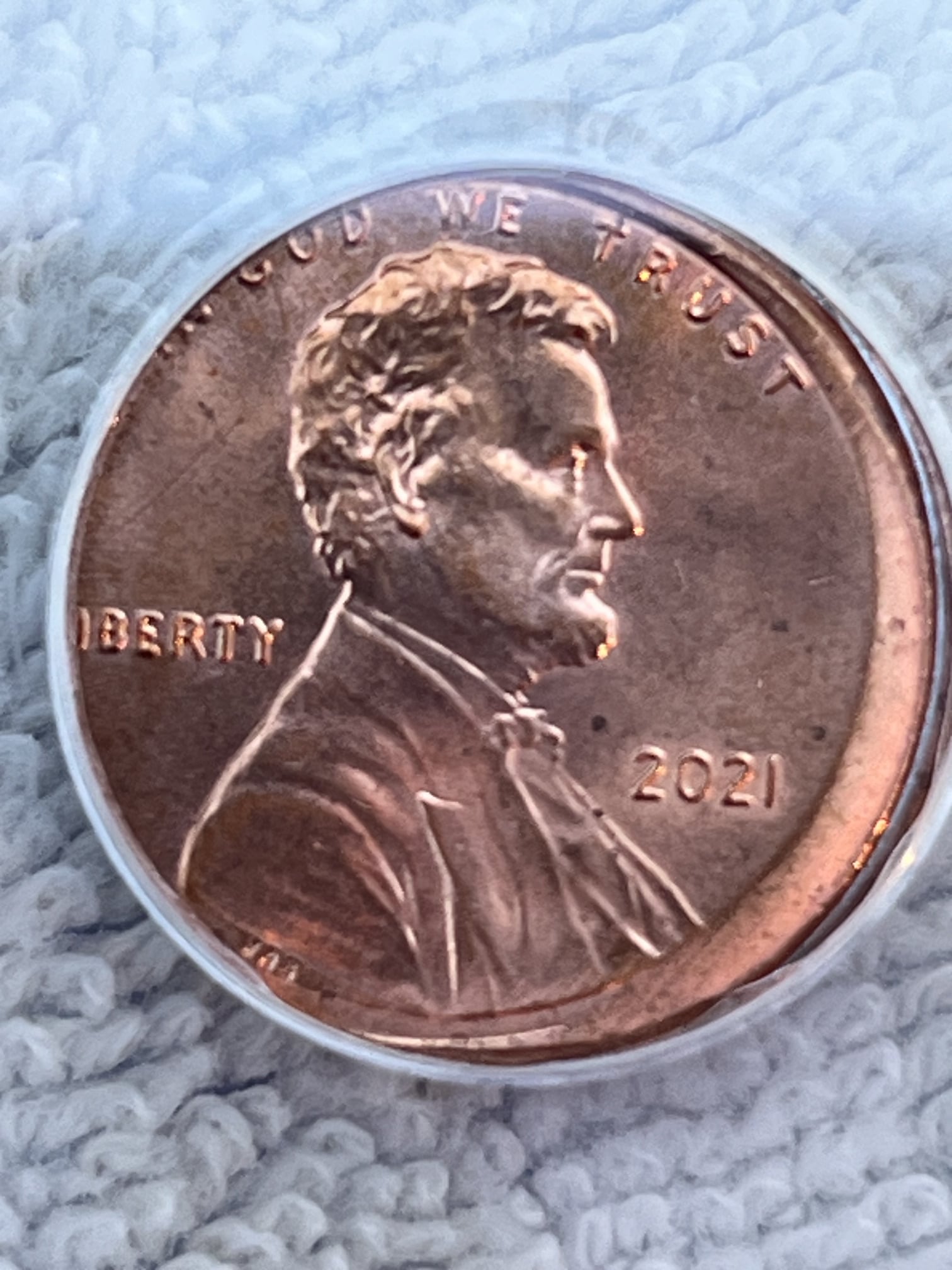
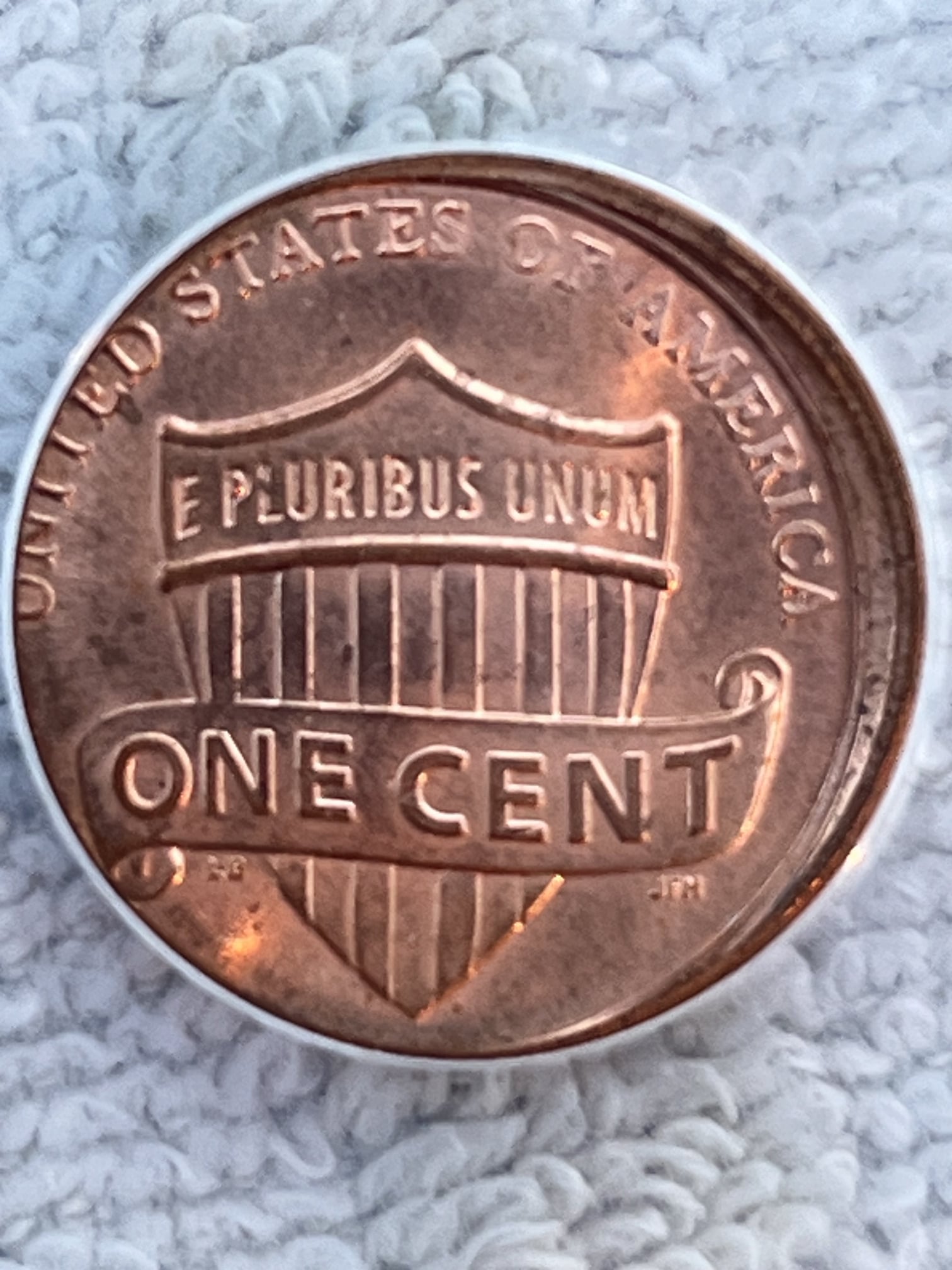
It's been slabbed but I'm questioning the error.
1
Comments
It is an off-centered strike, as evidenced by some missing design elements.
What do you think it is?
I'd like to get a few more opinions first.
So if you do not get a few more responses are you going to take this secret to your grave?
Mis-aligned die.
No. I just want more eyes on it. There are some major error guys here that will give their opinions.
Is it in some sort of holder? If so, can we see it out of the holder?
Also, how about a shot of the edge where the rim of the design meets the edge of the coin? Either or both places where they meet.
It's still in the holder Tom. Hold on, let me see what I can do.
Hint: It's also in a ANACS holder.
I don't think mis-aligned die because both sides are aligned with each other (I'd expect mis-aligned dies to be more asymmetric with respect to each other). Clearly off-center but I'm wondering if broadstruck as well. The rim looks weird in the unstruck area, especially on the reverse.
I’m going with off centre strike. Doesn’t look broadstruck to me.
Am I correct in thinking that the obverse is more off center than the reverse?
I really can't tell Tom. Hope these pictures work for you?
It looks to me like an absolute typical off-center strike and I wouldn't consider describing that t in any other way?
Off-center strikes are much rarer on modern strikes than they were 26 years ago. That doesn't change the description though.
Could be, but I want to sleep on it.
The weird cryptic BS is annoying
it does appear partial collar
5% off center is what I would call it
Have patience my son. When @CaptHenway says he wants to sleep on it, tells me it's not a common error that jumps out at you. I'm going out to hit some banks this morning before they close. I'll be back this afternoon.
Wouldn't mind hearing from these guys as well:
@Byers
@seanq
@FredWeinberg
@SullivanNumismatics
Good morning. Have a croissant.
That rim above OF AMERICA, especially above OF AM, looks as though the planchet was seated in the collar during the strike. If that is so, and I really cannot say that it was without seeing the edge of the coin out of the holder, the only possible explanation would be dual misaligned dies, which I have never seen. It would also mean that there should be more of these around, which I have never heard of.
I wish I knew more about the modern sideways presses. Years ago I wrote to the manufacturer of the press for a possible story about how the planchets got fed in that never got written, and they sent me a PDF(?) file about the press with a lot of technical information, but as I recall it said nothing about the die holders. Will see if I can find that file and double check.
Contact ANACS and see if by any chance their records show any notes about the coin by the Authenticator/ Graders. In ancient days we used to make notes for our records that did not appear on the paper certificates, but that was in the pre-computer days when we had actual paper to write on.
So, it might just be a simple off-center strike, which is still something in the modern low error rate era, but something about it does seem odd.
TD
Here you go. Thanks for sleeping on it. It looked odd to me as well. Is this a plausible explanation?
Interesting.
Went back through that tech manual file that I have and of course there is no good picture of the striking mechanism in the common horizontal strike presses. I did find this picture of the dial feed plate for a vertical strike press, which could be used for a bi-metallic or tri-metallic coin or token where the planchet parts are assembled prior to the strike, and they have do this atop a flat horizontal plate to prevent gravity from causing some of the pieces to fall out of the dial feed plate. The vertical strike press is also used for medals, which can receive multiple strikes with the dial feed plate being frozen before being ejected from the coining chamber.
The multi-armed dial feed plate on a horizontal strike coin press is similar, except that it stands on its side and rotates past the pair of dies. Think of it as a clock face, with the dies at the 12 o'clock position. A feed tube deposits an upset rim planchet into the curved notch at the end of one of the arms of the dial feed plate somewhere around the 1 to 1:30 o'clock position while the dial is stopped because a coin is being struck. The dial feed plate then rotates counterclockwise, starting and stopping, until the planchet is between the dies, where it again stops.
The hammer die moves forward, horizontally, via a simple knuckle action drive with an average stroke of approximately 8 mm. It pushes the planchet off of the end of the dial feed plate arm into the coining chamber for the strike. The face of the anvil die sits within a steel tube that serves as a collar. The anvil die is cammed to retract to accept a planchet from the dial feed plate for the strike, and then push forward to eject the struck coin back onto the notched end of the dial feed plate arm afterwards. The dial feed plate advances, in starts and stops, until the struck coin simply falls off via gravity into a hopper.
And now, back to the OP coin.
Considering the process described above, the first thing is that the collar mechanism prevents the anvil die from becoming misaligned, which eliminates the possibility of two misaligned dies. That leaves the possibility of an off-center strike.
The curved end of the dial feed plate would seem to prevent the planchet from being off center either right, left or down as the hammer die first touches it, so that would suggest that the planchet somehow defied gravity and was off center UPWARDS during the strike. How could this happen? Could the planchet have somehow been bouncing a bit when the hammer die caught it? It seems unlikely as these presses are amazingly efficient at high speed operation, but for lack of information I cannot rule it out.
Here is another possibility. A small piece of debris came into the Mint in one of the bins of planchets that came from the outside supplier, and made its way into the feed mechanism along with the planchets. By chance it fell into the curved end of a dial feed plate arm ahead of a planchet, and held that planchet up as the hammer die tried to shove the planchet into the collar and against the anvil die. That might leave a mark from the edge of the hole in the collar similar to an old-style press "tilted partial collar strike," but I must admit that I am guessing here due to unfamiliarity with the technology.
So, I can't say that ANACS was wrong in their description, though I am inclined to go with the simpler "slight off-center strike." I would still like to see the piece in hand out of the holder before saying anything more about it.
TD
They had this picture but it is useless for our purposes.
Thank you for the detailed synopsis Tom! 👍 I need to read it a few times and digest it. 👍
Any tilted partial collar strike I have seen has the full design and resembles a slight broadstrike more than an off center. Unfortunately there is no way to examine the rim with the coin slabbed, and I do not know enough about the new horizontal presses to understand how a partial collar strike could end up looking like this. Occam's Razor says it's slightly off center, I would need to know more to call it anything else.
Sean Reynolds
"Keep in mind that most of what passes as numismatic information is no more than tested opinion at best, and marketing blather at worst. However, I try to choose my words carefully, since I know that you guys are always watching." - Joe O'Connor
Yes, it looks like it.
I agree with @seanq I have a couple of tilted partial collar errors and have seen a fair number of them. All have the design elements 100 percent visible. In my opinion, the subject coin is still an off-centered strike.
That's what it looks like, but the question is, with the dial feed plate holding it in place during the strike, unlike the older presses where the feed fingers retracted prior to the strike, how did the planchet get off center?
It's an off-center strike with a prominent collar scar on the obverse. Most off-center strikes on recent coins reflect the presence of a stiff collar.