Rarity assessment of coins with mint errors.
 Matematics
Posts: 24 ✭
Matematics
Posts: 24 ✭
Good day. Well, I submitted my 3 coins, with mint errors, for NGC certification... the coins should be returned somewhere in half a year, that is, around 12/12/2026... Well, while I'm waiting, I should at least calculate the reserve price for each coin for the auction... because given the auctions' approach to these coins, there is no hope of an auction that corresponds to the value, so it is imperative to insure yourself so as not to lose your valuables due to the incompetence of third parties... Although I myself have only been taking numismatics seriously for a few years... so I am still quite new to these issues  ... So I decided, as an amateur, to calculate it publicly on this forum, to determine the value of coins along established numismatic rules.... I really hope that this does not violate the rules of your forum, because there is a desire to receive corrections and examples from other like-minded people, because I am a newbie... thank you very much for your understanding. In this video, I amateurishly define the three bases by which I will assess the rarity of a coin with mint errors.
 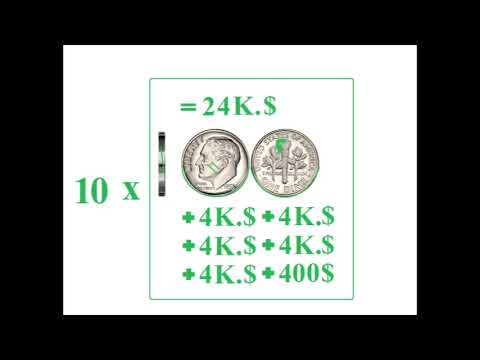 https://www.youtube.com/watch?v=BUW8uXiXRn0 So if you want to post your own coins evaluations in this topic, then do so, when I post my amateur evaluations of the three coins. Then everyone is free to post their own. But on the one condition, that the coin has Mint Errors on all Three Sides, which are the obverse, the reverse and the edge. Thank you for your understanding. And have a pleasant and fruitful time about the world of numismatics. I wish everyone happiness
Comments
I think you are going to be disappointed when you get your “error” coins back.
Thinks like scratches and gouges are not errors, they are damage. Even your
double rim is probably a misaligned die which looks to be in spec.
Can you supply a clear photo of both sides of one of coins so we may evaluate it.
Well, I really don't understand the premise of this, unless it's shooting for the sky for/with post-mint damage.
If a coin has "multiple errors" on it, then it's almost entirely certain that it's not a mint error or variety, but rather just damage. Ockham's Razor says that the most likely explanation for a coin with multiple defects is the simplest explanation: that a single event has caused all of the damage.
In the extremely rare circumstance that a coin actually does have multiple independent errors on it, then the value is not going to be simply additive, due to the rarity of having multiple independent errors happening simultaneously.
For example: suppose a 1955 doubled die penny is worth about $2000 in AU. An off-centre normal 1955 penny might be worth say $100. But an off-centre doubled die penny is going to be worth a lot, lot more than $2100 - assuming such a coin were to actually exist, which it probably doesn't.
Roman emperor Marcus Aurelius, "Meditations"
Apparently I have been awarded the DPOTD twice.
My first coin would be a 1 Euro coin from Spain, minted in 2008.
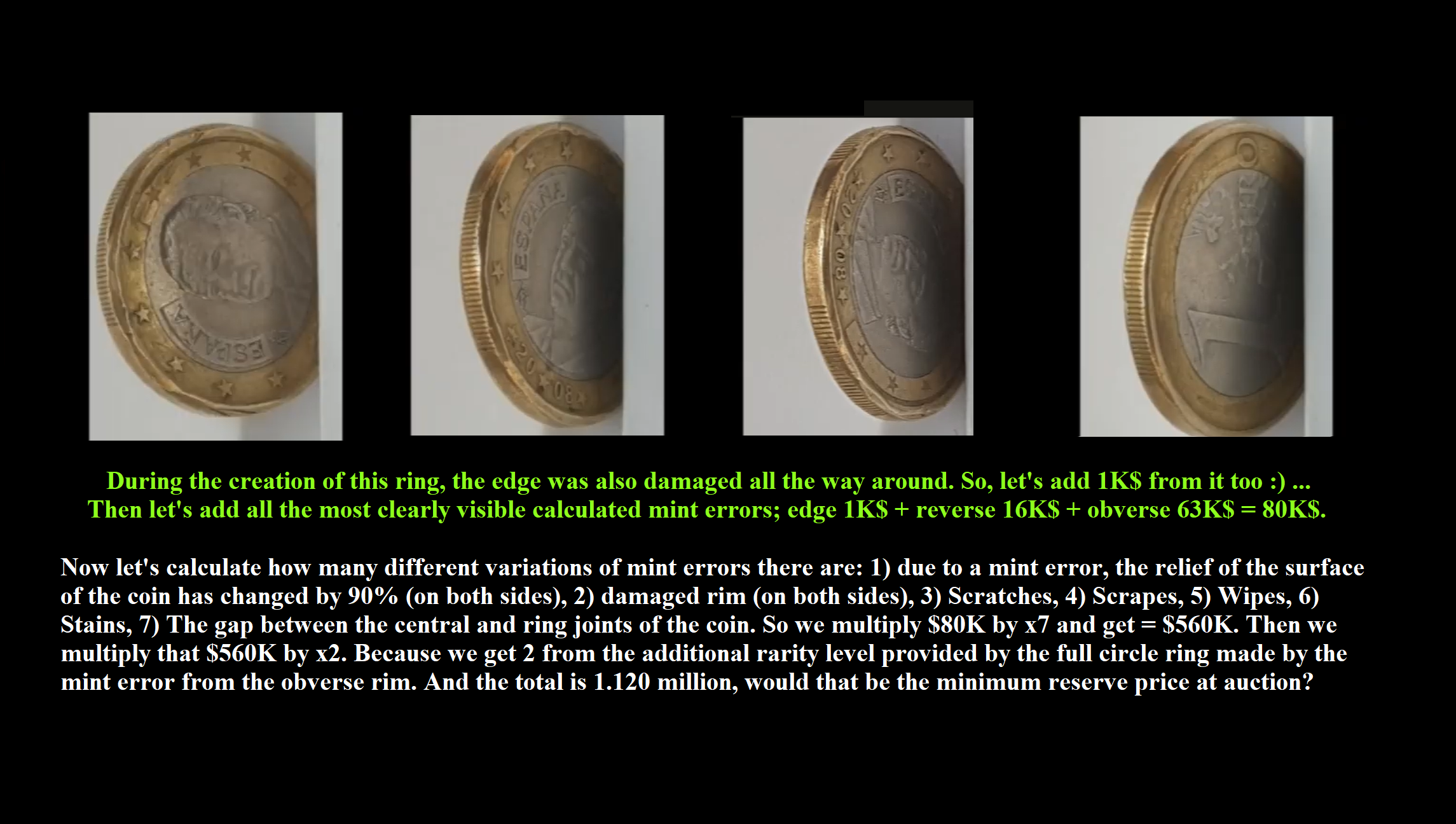
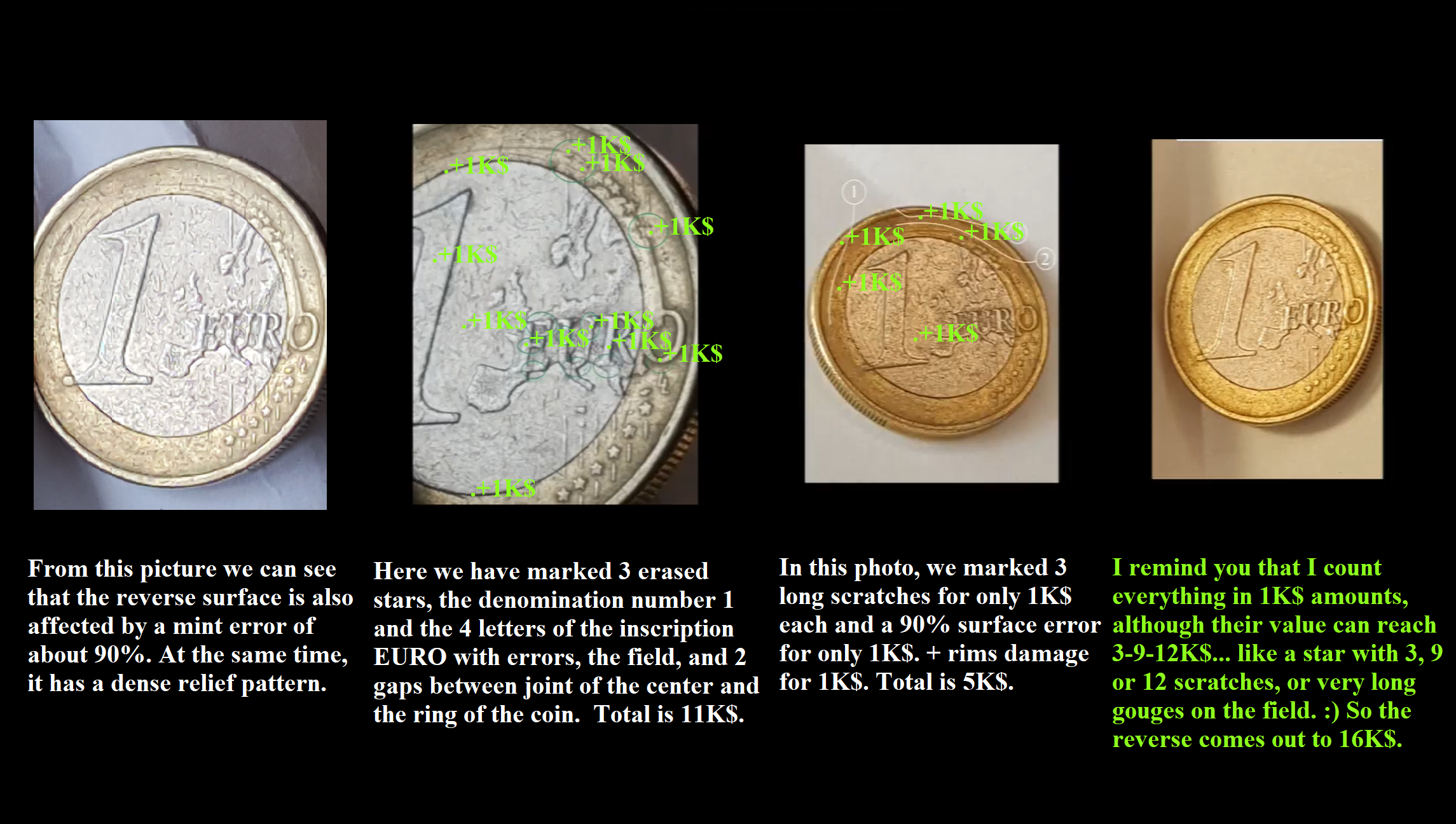
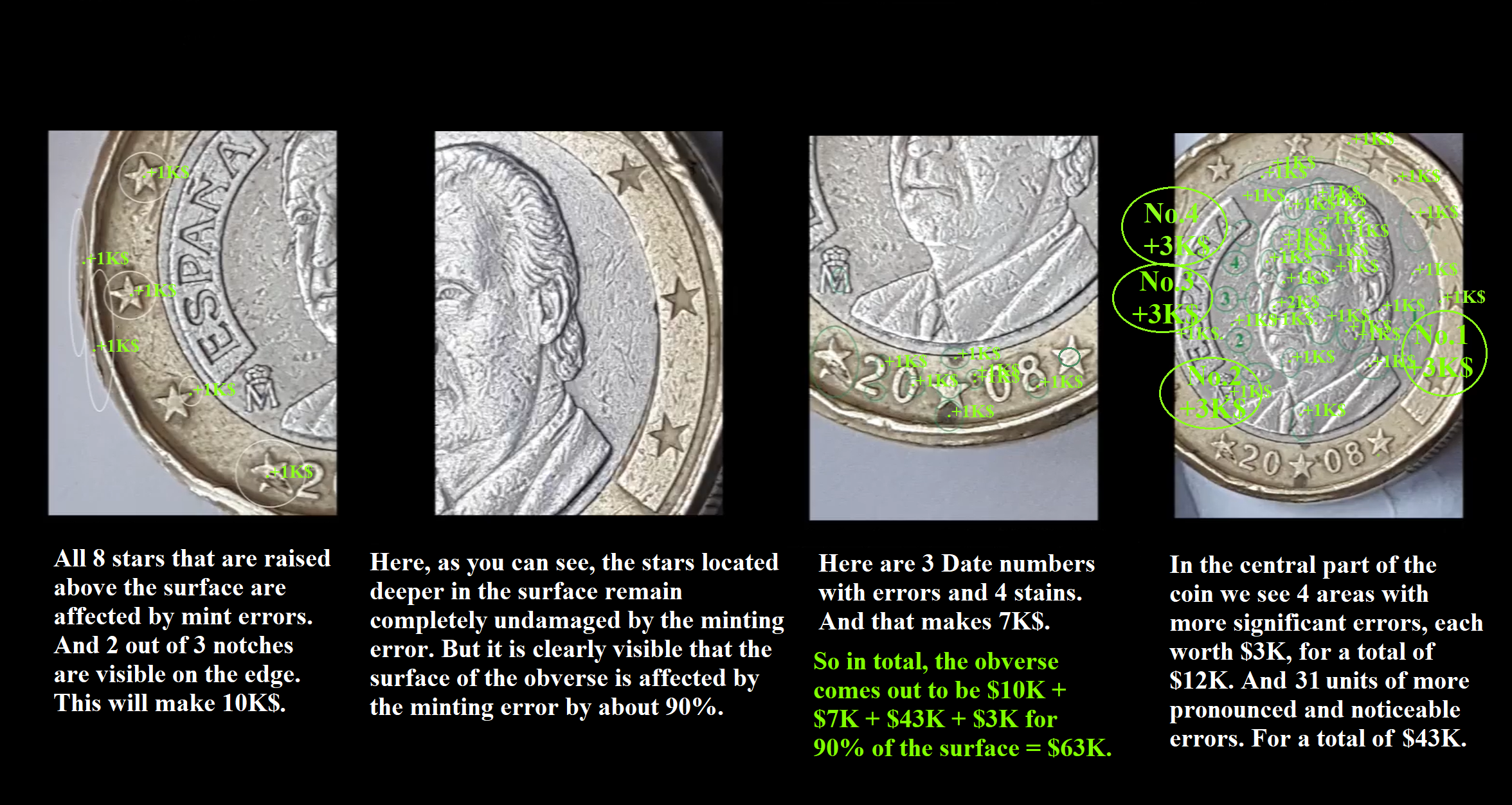
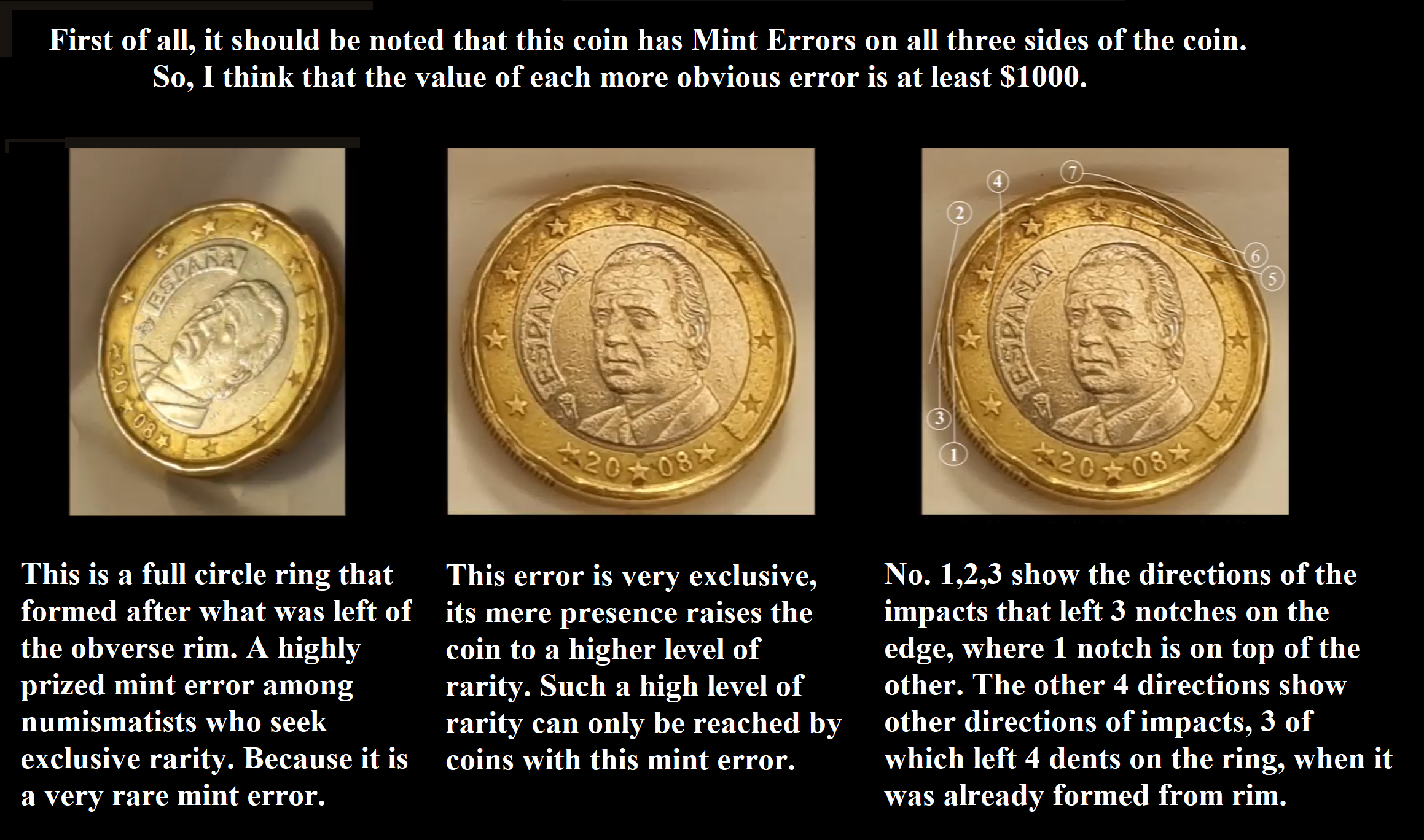
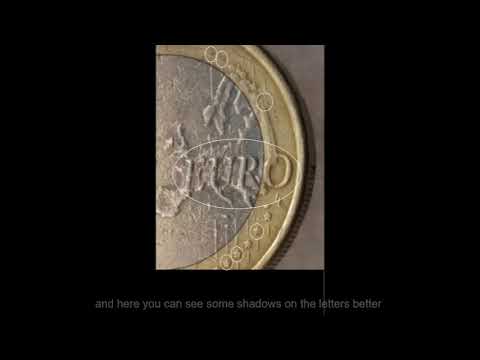 https://www.youtube.com/watch?v=Q6QoN2mRAs0&t=5s
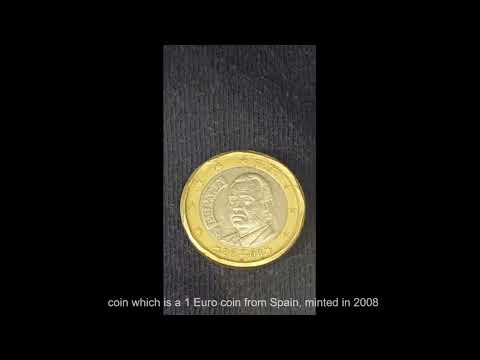 https://www.youtube.com/watch?v=YqsFTYjRnP0&t=61s
A more detailed review can be seen in these videos
Enjoy your viewing.
And the second coin is on his way
Big disappointment ahead.
Sorry, but that 1 euro coin absolutely, definitely does not have any mint errors on it at all., It is all merely post-mint damage. Your coin might still be worth 1 euro, it might be considered too badly damaged to be legal tender any more (depends if it still passes a vending machine test). It is definitely not worth 10 euro, let alone the thousands or millions you seem to think it might be worth.
Once again, you do not calculate the value of an error by assigning values to individual nicks dents and scratches and then adding up all the numbers. That's not how coin valuations work.
Roman emperor Marcus Aurelius, "Meditations"
Apparently I have been awarded the DPOTD twice.
In looking at the images only (not the video), all of the coins look circulated.
Even as a legitimate error, I've never heard of common coins like these being worth much of anything in the condition illustrated.
"So, I think that the value of each more obvious error is at least $1000."
I would take the "Under" on that.
So maybe you could tell me how you think coin valuation works? ... that would be a great lesson... Thank you.
Amazing thanks to you, we decided that once the NGC certification is confirmed, we will put this coin up for auction at a reserve price of x3, which is 3.36 million, and when, no one will buy it, we will keep it for ourselves
  Thanks for the good idea
A coin is valued as a whole, entire coin, rather than the sum of it's parts.
The value of a coin - as with the value of anything else, really - is a result of supply and demand. "Supply" is its rarity - how many of the things actually exist and are available for people to buy. "Demand" is how many collectors actually want it. For a coin to be valuable, it needs to have both low supply (high rarity) and high demand. There isn't a strict, logical mathematical formula I can give you, because coin valuing is fundamentally illogical, fueled to an extent by marketing and sentiment.
The 1955 DDO Lincoln cent is an excellent example. The rarity is fairly fixed - we think there are about 20,000 of the coins in existence. The demand, thanks to decades of hype and the fact that a lot of Lincoln cent albums provide an empty hole for this variety, far exceeds the 20,000 supply. The coins are, therefore, valuable. There are plenty of much "rarer" error coins that have a much lower value than the 1955 DDO, simply because no-one has heard of them and there's therefore much less demand for them.
Roman emperor Marcus Aurelius, "Meditations"
Apparently I have been awarded the DPOTD twice.
If all 3 of your coins are like the one shown through all the images, the value of your coins will be "-120 US", the cost to get them certified. I see no errors at all in your images (not the video), just normal wear and tear from being circulated. Sorry, but you should have posted your question BEFORE sending them to a TPG.
Yes, all three are similar and until they are certified, they are worth 1 euro but if the certification confirms that the errors were made at the mint... then all this turns into coins of exclusive rarity... because they all have at least a few Mint errors that cause great interest among collectors... and such variations in these 3 coins are rare and even exclusively rare
  ... therefore, the only thing we have to do now is wait for confirmation or denial from the certification body
  and only then will it be clear how rare they are
  Well, now we continue the calculation and continue our journey through the intricacies of numismatics
Well, I wish you good luck and pass along to you "don't believe everything that you see on youtube".
There is no way anyone "taking numismatics seriously for a few years" thinks these are errors. And then that they are prized by numismatists. And worth any money.
Is this real? Please tell me this is a troll?
God helps us
Are you going to send them in to get cac'ed?
So here comes the presentation of the second coin calculation... but I want to say in advance that this calculation completely FAILS... because you will see when the presentation of the third coin is calculated, which has only a little more than 12 errors... And such a calculation method does not reveal its true value and rarity at all... so that such a calculation does not reflect the true value. But for the sake of fun and for the sake of science, so to speak , let's continue to the end and make sure that it is true that such a calculation fails and therefore it is not valid
For a more detailed look at the coin, if you are interested, you can watch these two videos.
Enjoy... And until the third coin representation to fulfill the idea to the end
This coin is a French 2 Euro Cent, minted in 1999. It is known that sometimes there are double or even triple solar systems... then I think that the highest possible price is when there are two or even three suns in one solar system
As we mentioned earlier, this calculation failed to calculate the value of a tiny but very valuable coin. Therefore, this only confirms that the real value, as Sapyx already mentioned, arises from supply and demand, and the value grows with high demand and low supply... So apparently, the interest of collectors gives the initial value of the coin and then all other errors act as an increase in the initial value given by collectors. This can be imagined as a solar system where the Sun, is the starting value that collectors indicate, and the planets orbiting the Sun are all other mint errors that add value to the already existing starting value...
For a more detailed look at the coin, if you are interested, you can watch these two videos.
As I mentioned after I publish 3 coins, anyone who wants to publish their coin with available mint marks on all 3 sides. I kindly invite you to do so. Even if you are not sure whether it can be a coin with mint marks on three sides, please post it here and we will try to find the answer together and we will all have a good time Thank you for your attention. Enjoy your journey through the world of numismatics...
I think that you need to look up the definition of "error" in both the dictionary and any reputable coin book ... I would suggest Wexler. You have a nice Euro collection worth 3 euros. I also think that you should reread the comments from the folks here on what they have told you.
Yes, doesn't it look very silly Could be wonderful if you post some example of the real double mint error coin with the error on all three sides of the coin that could be worthy
  Thank You very much
Not silly, it's suspicious. What's the obsession with multiple error coins? Oh, you think it makes you rich.
That's kind of hard for us to do, because as I said in an earlier post, coins with multiple errors on them like that effectively don't exist. If you Google "multiple errors coin" on Google, you will get millions of hits, mostly people on Facebook and elsewhere asking about coins they mistakenly believe have "multiple errors" on them. They do not; virtually every single one of those millions of people (including you) are incorrect in their belief that their coins have "multiple errors".
Most instances of coins with "multiple errors" are, as I said in a previous post, mint errors where a single improbable event has generated multiple different effects. A good example of this is an "off-centre broadstrike". A "broadstrike" is a mint error where a coin is struck with the collar die missing. An "off-centre" coin is where the blank is not centred correctly between the two dies when it is struck. But because it is the collar die that is an important component of the mechanism that makes sure the blank is centred correctly, getting an "off-centre broadstrike" is not all that improbable - in fact, I would presume that most broadstrikes are at least a little bit off-centre, so it's not really all that extra-special.
Here are some Error-Ref examples:
Off-centre coin
Broadstrike
Off-centre Broadstrike
All that being said, two completely separate independent events causing two different unrelated errors to appear on the same coin is improbable, but not impossible. It's just really hard to find examples on the Internet, due to all the aforementioned false alarms from people believing that's what they have. But I did find one. Here's a link to somebody selling an Indian coin that is both a slightly off-centre capped die broadstrike and has some die cracks: https://coinbazzar.com/shop/coins/25-paisa-cu-ni-year-1974-calcutta-mint-with-die-capped-off-centre-and-die-crack-errors-collectable-grade/
That coin is selling for 655 Indian rupees (about US$6.90 at current exchange rates). As you can see, just because a coin has "multiple errors" on it does not mean it is worth millions of dollars. Indian error coins are generally worth less than US or EUro errors, because the quality control at Indian mints is much lower and a lot more errors tend to escape.
Roman emperor Marcus Aurelius, "Meditations"
Apparently I have been awarded the DPOTD twice.
Well, you did compare ... but you are right, how can you not become at least a little obsessed when you come across such coins
  ... When over time, while researching, you start to immerse yourself more and more in each coin... I unknowingly became obsessed with them...
  Please forgive me for my weakness...
  And what about wealth... as I understand it, you know that big, even very big, money is worthless and even very harmful and dangerous if you have nowhere to use it properly... stagnant water starts to rust... water must flow and when it flows, it must bring social benefits and not just narrow selfish incentives... somehow that's how it is
Wexler's Die Varieties Very interesting material, Thank you very much for this wonderful link. I now know more about the Double Mintmark Error and about Of center and so on but I didn't find anything about stains, their colors and variations... I also didn't see anything about Double Rime and the changed relief of the coin surface with individual patterns that can be symmetrical and asymmetrical... Isn't that what collectors value the most now?
  Strange... I thought that was it... Well, I guess I was very wrong...
  Well, then we'll keep the coins to ourselves, at least for a while... until better times, when there will be more clarity on these issues.
... I see that my coins have, along the links you provided, at least this; off-metals, including doubled dies, multiple errors, double strikes, Striking Errors, Struck-Through Errors
Post-Strike, Stutter Strikes...
Here we have discussed and we have an offer for you, dear admins... if you help us find suitable buyers, we can share 1% of the collected amount after taxes with you. What do you think about this? if you want and can join this cause, then let's talk...
Well, you must be reading between the lines with Wexler, because all I see in your coins is heavy wear through circulation .... heavy scratches, gouges, displaced metal, and environmental damage, none of which are errors from the Mint. I can just imagine you with a huge grin on your face, as you type out the words for the next post that you know isn't factual.
Why is this being entertained? Obviously trolling ... person is taking Obviously circulated coins and trying to apply a rarity value to them... why does this post have any interaction?
Its just fun! Anyone who has the time to create multiple useless annotated images is very dedicated to the art of trolling, and just has to be interacted with to properly achieve peak form.
Yes it's hard to know who is trolling who. The 'troll' has to put so much effort into their trolling while we hardly have to put a few seconds thought into it. Maybe they can make a video about how we can all get rich by throwing our collections into a dumpster fire and seeing what damage it can do.