Well the OP has been a good sport and we have been (as normal) a tad brutal and cynical. IF this coin is indeed “something “ with value then good for him. IF it comes back in a “Genuine Damaged” then I do still commend his well mannered perseverance. …….at that point though I’d crack it out and spend it.
@ambro51 said:
Well the OP has been a good sport and we have been (as normal) a tad brutal and cynical. IF this coin is indeed “something “ with value then good for him. IF it comes back in a “Genuine Damaged” then I do still commend his well mannered perseverance. …….at that point though I’d crack it out and spend it.
While I get your point about spending it I hope he does not do that. All that will do is start another cycle when another microscope wielding, weigh every coin searcher finds it again.
No way would I consider buying copper 1c struck by a zinc era die without a specific gravity noted on the holder. In this thread I learned that's a $299 upcharge to verify a $5,000 transitional error.
This goes beyond having error's weight on label as I think most errors should include that often overlooked detail.
@ambro51 said:
Well the OP has been a good sport and we have been (as normal) a tad brutal and cynical. IF this coin is indeed “something “ with value then good for him. IF it comes back in a “Genuine Damaged” then I do still commend his well mannered perseverance. …….at that point though I’d crack it out and spend it.
While I get your point about spending it I hope he does not do that. All that will do is start another cycle when another microscope wielding, weigh every coin searcher finds it again.
if it survives more circulation. if i'm right then it's all ready corroding
No way would I consider buying copper 1c struck by a zinc era die without a specific gravity noted on the holder. In this thread I learned that's a $299 upcharge to verify a $5,000 transitional error.
This goes beyond having error's weight on label as I think most errors should include that often overlooked detail.
I wouldn't hesitate... if it actually weighed 3.1 grams.
All comments reflect the opinion of the author, even when irrefutably accurate.
mikebyers.com Dealer in Major Mint Errors, Die Trials & Patterns - Author of NLG Best World Coin Book World's Greatest Mint Errors - Publisher & Editor of minterrornews.com.
yeah. this isn't like a typical grading situation. they have to take time to figure out what is going on. who knows how long it will take. but i'd expect it faster than another 45 days
PCGS provides no information in the attributes regarding the metal composition. This raises the question: what exactly is this planchet?
I'd guess what they mean is that it is a regular planchet core with thicker than usual plating. That would be consistent with "thick plating" and no other notation about content.
@TomB said:
So, for those who specialize in this niche, what is the likely value range now for the coin?
It's worth what someone is willing to pay for it. That's a useless answer, even if it's the best we've got.
As far as I know, this may be the first time that description has been applied to an error coin. That means there are no existing collectors. It could be that nobody cares, and the value is close to zero. It could be that someone likes the novelty and is willing to pay something. The OP might recover their slabbing fees. I wouldn't be surprised if they don't, though.
Obviously I don't love this description. It might be accurate. I don't know how PCGS possible could have measured the thickness of the plating directly. If they didn't measure, the rest is just a guess.
A zinc cent is nominally 2.5% copper, so 0.0625 grams of copper. This coin is overweight by 0.37 grams. If the extra weight comes entirely from extra-thick plating, then the plating is about 7x thicker than it should be. (Feel free to check my math.)
I totally believe that the plating could be 7x thicker than normal. I just don't know how PCGS could know that for sure.
It would be lovely if @SullivanNumismatics could weigh in here, to describe what sort of testing was done. Bonus points if PCGS has developed a new technique that others could use to find more examples of this type.
I'm not sure that anyone is actively looking for this type of "error". I think this whole exercise was due to the firestorm started here. If there are no others slabbed then it will be because this is a fairly unique scenario.
I think/hope this Will change the way TPGs approach these cents whose weight is in between zinc and bronze planchets.
PCGS provides no information in the attributes regarding the metal composition. This raises the question: what exactly is this planchet?
I'd guess what they mean is that it is a regular planchet core with thicker than usual plating. That would be consistent with "thick plating" and no other notation about content.
This. There's nothing else they need to say. For the record, this was suggested earlier.
All comments reflect the opinion of the author, even when irrefutably accurate.
PCGS provides no information in the attributes regarding the metal composition. This raises the question: what exactly is this planchet?
I'd guess what they mean is that it is a regular planchet core with thicker than usual plating. That would be consistent with "thick plating" and no other notation about content.
Agree. THe core is different than the surface, so the only possible explanation is a normal zinc core with heavy copper plating. I still wish that somebody had done a specific gravity test on it.
I personally am going to assume that the extra copper plating was applied after it left the Mint.
TD
Professional Numismatist, Retired. 55 year member ANA. Former ANA Senior Authenticator. Winner of four ANA Heath Literary Awards; three Wayte and Olga Raymond Literary Awards; Numismatist of the Year Award 2009, and ANA Lifetime Achievement Award 2020. Winner of the PNG's 2026 Robert Friedberg Award for "The Enigmatic Lincoln Cents of 1922," Available now from Whitman or Amazon.
I realize it may seem as though I am still trying to believe that this is yet another grading error—the second one so far—especially after NGC admitted that their initial attribution was incorrect, and now that PCGS has offered two different attributions of its own. After all, the designation currently assigned is quite vague; it does not fully disclose the nature of the minting error. For all we know, it could simply be a base metal coin with a thick plating.
@CoinOM said:
I realize it may seem as though I am still trying to believe that this is yet another grading error—the second one so far—especially after NGC admitted that their initial attribution was incorrect, and now that PCGS has offered two different attributions of its own. After all, the designation currently assigned is quite vague; it does not fully disclose the nature of the minting error. For all we know, it could simply be a base metal coin with a thick plating.
They don't need to tell you more. It is not unheard of to have thinner or thicker plating. How much more explanation do they need to give you for something that is known to happen.
And it is a "base metal coin", zinc core with copper plating. In this case, an extra thick copper plating.
All comments reflect the opinion of the author, even when irrefutably accurate.
PCGS provides no information in the attributes regarding the metal composition. This raises the question: what exactly is this planchet?
I'd guess what they mean is that it is a regular planchet core with thicker than usual plating. That would be consistent with "thick plating" and no other notation about content.
Agree. THe core is different than the surface, so the only possible explanation is a normal zinc core with heavy copper plating. I still wish that somebody had done a specific gravity test on it.
I personally am going to assume that the extra copper plating was applied after it left the Mint.
TD
Why?
All comments reflect the opinion of the author, even when irrefutably accurate.
PCGS provides no information in the attributes regarding the metal composition. This raises the question: what exactly is this planchet?
I'd guess what they mean is that it is a regular planchet core with thicker than usual plating. That would be consistent with "thick plating" and no other notation about content.
Agree. THe core is different than the surface, so the only possible explanation is a normal zinc core with heavy copper plating. I still wish that somebody had done a specific gravity test on it.
I personally am going to assume that the extra copper plating was applied after it left the Mint.
TD
Why?
Because the Mint's had no planchet plating equipment. They bought the planchets ready plated.
Professional Numismatist, Retired. 55 year member ANA. Former ANA Senior Authenticator. Winner of four ANA Heath Literary Awards; three Wayte and Olga Raymond Literary Awards; Numismatist of the Year Award 2009, and ANA Lifetime Achievement Award 2020. Winner of the PNG's 2026 Robert Friedberg Award for "The Enigmatic Lincoln Cents of 1922," Available now from Whitman or Amazon.
PCGS provides no information in the attributes regarding the metal composition. This raises the question: what exactly is this planchet?
I'd guess what they mean is that it is a regular planchet core with thicker than usual plating. That would be consistent with "thick plating" and no other notation about content.
Agree. THe core is different than the surface, so the only possible explanation is a normal zinc core with heavy copper plating. I still wish that somebody had done a specific gravity test on it.
I personally am going to assume that the extra copper plating was applied after it left the Mint.
TD
Why?
Because the Mint's had no planchet plating equipment. They bought the planchets ready plated.
But that's diffetent than it being applied after it left thr Mint. Why couldn't the supplier have done it.
All comments reflect the opinion of the author, even when irrefutably accurate.
Have you ever had a coin where NGC and PCGS reached different conclusions?
Yes. NGC would not attribute a 1849 over far 6 H10C due to its late die state. The coin was in a NGC holder, so I wanted to keep it that way. When it was not attributed, I crossed it to PCGS and they got it right.
If one grading service does not attribute an error, do you ever try resubmitting it elsewhere?
Yes. Same coin above.
oih82w8 = Oh I Hate To Wait _defectus patientia_aka...Dr. Defecto - Curator of RMO's
Comments
Well the OP has been a good sport and we have been (as normal) a tad brutal and cynical. IF this coin is indeed “something “ with value then good for him. IF it comes back in a “Genuine Damaged” then I do still commend his well mannered perseverance. …….at that point though I’d crack it out and spend it.
While I get your point about spending it I hope he does not do that. All that will do is start another cycle when another microscope wielding, weigh every coin searcher finds it again.
My Collection of Old Holders
Never a slave to one plastic brand will I ever be.
The adventure has been insightful for me.
No way would I consider buying copper 1c struck by a zinc era die without a specific gravity noted on the holder. In this thread I learned that's a $299 upcharge to verify a $5,000 transitional error.
This goes beyond having error's weight on label as I think most errors should include that often overlooked detail.
i wouldn't spend it. i'd keep it as, at least, a curiosity
if it survives more circulation. if i'm right then it's all ready corroding
It most definitely has started to corrode, but it will take centuries for it to become just zinc dust. Plenty of time to be weighed again.
My Collection of Old Holders
Never a slave to one plastic brand will I ever be.
.> @Mr Lindy said:
I wouldn't hesitate... if it actually weighed 3.1 grams.
All comments reflect the opinion of the author, even when irrefutably accurate.
So……. Still waiting…….
@CoinOM any news?
It’s gone dark.
He was last active on May 16th.
Specific gravity test would answer the question once and for all:
How much copper does this penny contain?
95% copper-5% zinc weighs 3.1 grams
95% zinc-5% copper weighs 2.5 grams
Science, using the test for this item's specific gravity, has the answer.
“Never let yesterday use up too much of today.”
Will Rogers
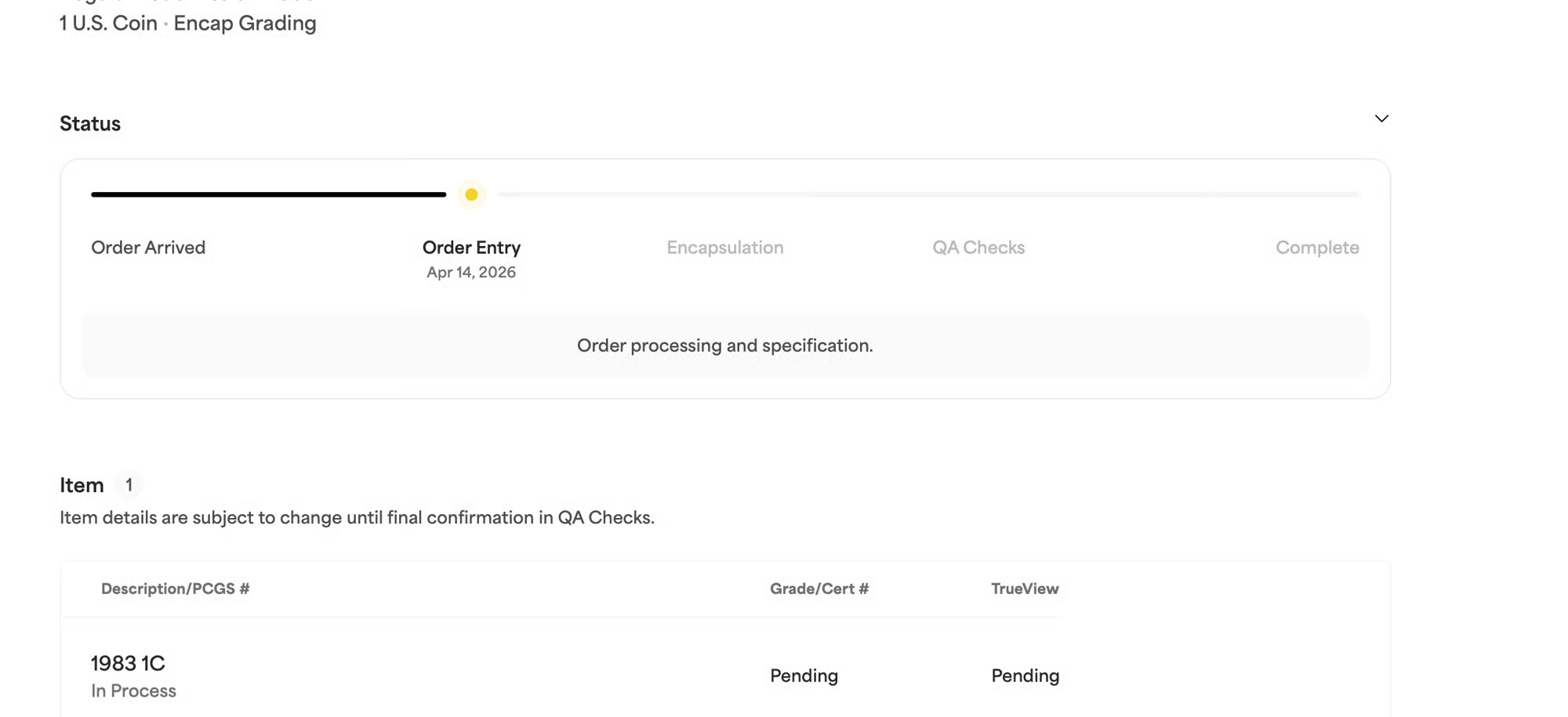
He should have an answer soon according to the screenshot he posted 5 weeks ago?...
.
I'm still waiting....
I contacted support, and they told me that the order would be processed within 15 to 40 days. So, I'm waiting.
yeah. this isn't like a typical grading situation. they have to take time to figure out what is going on. who knows how long it will take. but i'd expect it faster than another 45 days
So a faster than normal order.
Encapsulation. Here is the public link for the order stats:
https://www.pcgs.com/shared-orders/order-details/26603237
1983 1C – Thick Plating, 2.87g
So, for those who specialize in this niche, what is the likely value range now for the coin?
In honor of the memory of Cpl. Michael E. Thompson
i guess that's settled
PCGS provides no information in the attributes regarding the metal composition. This raises the question: what exactly is this planchet?
I'd guess what they mean is that it is a regular planchet core with thicker than usual plating. That would be consistent with "thick plating" and no other notation about content.
In honor of the memory of Cpl. Michael E. Thompson
It's worth what someone is willing to pay for it. That's a useless answer, even if it's the best we've got.
As far as I know, this may be the first time that description has been applied to an error coin. That means there are no existing collectors. It could be that nobody cares, and the value is close to zero. It could be that someone likes the novelty and is willing to pay something. The OP might recover their slabbing fees. I wouldn't be surprised if they don't, though.
Obviously I don't love this description. It might be accurate. I don't know how PCGS possible could have measured the thickness of the plating directly. If they didn't measure, the rest is just a guess.
A zinc cent is nominally 2.5% copper, so 0.0625 grams of copper. This coin is overweight by 0.37 grams. If the extra weight comes entirely from extra-thick plating, then the plating is about 7x thicker than it should be. (Feel free to check my math.)
I totally believe that the plating could be 7x thicker than normal. I just don't know how PCGS could know that for sure.
It would be lovely if @SullivanNumismatics could weigh in here, to describe what sort of testing was done. Bonus points if PCGS has developed a new technique that others could use to find more examples of this type.
I'm not sure that anyone is actively looking for this type of "error". I think this whole exercise was due to the firestorm started here. If there are no others slabbed then it will be because this is a fairly unique scenario.
I think/hope this Will change the way TPGs approach these cents whose weight is in between zinc and bronze planchets.
This. There's nothing else they need to say. For the record, this was suggested earlier.
All comments reflect the opinion of the author, even when irrefutably accurate.
Agree. THe core is different than the surface, so the only possible explanation is a normal zinc core with heavy copper plating. I still wish that somebody had done a specific gravity test on it.
I personally am going to assume that the extra copper plating was applied after it left the Mint.
TD
i'm looking at the lettering and don't think it's got the look of a secondary plating job
I realize it may seem as though I am still trying to believe that this is yet another grading error—the second one so far—especially after NGC admitted that their initial attribution was incorrect, and now that PCGS has offered two different attributions of its own. After all, the designation currently assigned is quite vague; it does not fully disclose the nature of the minting error. For all we know, it could simply be a base metal coin with a thick plating.
They don't need to tell you more. It is not unheard of to have thinner or thicker plating. How much more explanation do they need to give you for something that is known to happen.
And it is a "base metal coin", zinc core with copper plating. In this case, an extra thick copper plating.
All comments reflect the opinion of the author, even when irrefutably accurate.
Why?
All comments reflect the opinion of the author, even when irrefutably accurate.
when it is a plated zinc coin, they don't need to specify that the core is zinc. it goes without saying.
Because the Mint's had no planchet plating equipment. They bought the planchets ready plated.
it could have survived in the plating equipment for a few rounds before escaping
Still no specific gravity test or composition test? This seems so lazy?
How else would they know? I would think that they did do the SP test.
OP @CoinOM you can ask them what testing method was used. Ask for the lead Manager in the grading dept?
grading is grading. this sounds more like the error expert's job
The grading dept (as a whole) is also responsible to authenticate coins. No?
i'd think they'd recognize it as a real zincoln and defer to the error person on why it is too heavy for its type
That's too bad !
It would have been a lot more fun if it was really as submitted.
Sorry to hear.......
But that's diffetent than it being applied after it left thr Mint. Why couldn't the supplier have done it.
All comments reflect the opinion of the author, even when irrefutably accurate.
There already was XRF. To couldn't know bulk composition without destruction. Specific gravity would not give you composition.
All comments reflect the opinion of the author, even when irrefutably accurate.
Yes. NGC would not attribute a 1849 over far 6 H10C due to its late die state. The coin was in a NGC holder, so I wanted to keep it that way. When it was not attributed, I crossed it to PCGS and they got it right.
Yes. Same coin above.
BST transactions: dbldie55, jayPem, 78saen, UltraHighRelief, nibanny, liefgold, FallGuy, lkeigwin, mbogoman, Sandman70gt, keets, joeykoins, ianrussell (@GC), EagleEye, ThePennyLady, GRANDAM, Ilikecolor, Gluggo, okiedude, Voyageur, LJenkins11, fastfreddie, ms70, pursuitofliberty, ZoidMeister,Coin Finder, GotTheBug, edwardjulio, Coinnmore, Nickpatton, Namvet69,...
I already sent an email. Waiting for it. Thanks
Why does the obverse look different from the reverse? I just can’t agree with thick plating.
What explanation would you agree with?
My Collection of Old Holders
Never a slave to one plastic brand will I ever be.
PMD
what type of pmd causes an extra 0.37 grams overweight ?
Post mint copper plating was advanced as a potential cause early in the thread.