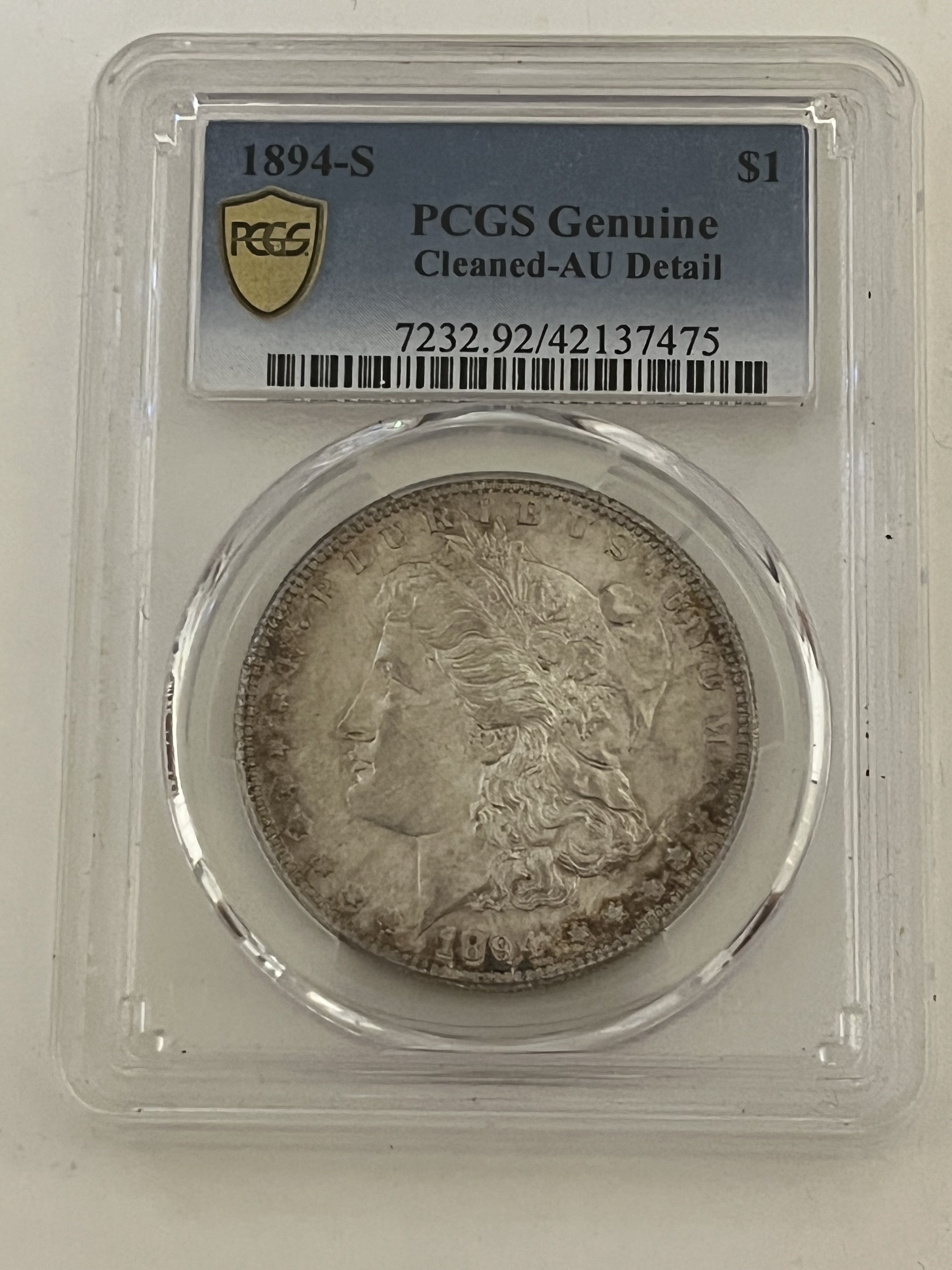
I don't buy coins in "detail holders" So as far as I'm concerned they can call it whatevr they want, I'm not interested
However, the problem I see is having detailed coins that are in straight graded holders
@alaura22 said:
However, the problem I see is having detailed coins that are in straight graded holders
I don't see people asking for that. What some want is to use numerical grades in addition to a description of whatever the "details" issue is when possible.
@oldabeintx said:
BTW I don’t really a dog in this fight either. Just an interesting topic. In fact I
Prefer the status quo because I can continue to pick up some beautiful coins of historical interest on the cheap.
I don't think :XF40 chopmarked" is going to sell for more than "XF details. Chopmarked". F15 cleaned will sell for the same as F details, cleaned.
Perhaps. But there is a chopmarked registry set. Not sure if grades come into play. Would like to see some specialists chime in, but I would bet they would pay more for a graded example.
My comment was geared mainly towards early gold that circulated in the colonies and/or later as legal tender. I’ve picked up some AU and Unc details coins with very small test cuts or counter marks for little more than melt. These are beautiful coins that, to me, have added history. Saved many thousands, which I doubt would have been the case if they had been graded.
@oldabeintx said:
BTW I don’t really a dog in this fight either. Just an interesting topic. In fact I
Prefer the status quo because I can continue to pick up some beautiful coins of historical interest on the cheap.
I don't think :XF40 chopmarked" is going to sell for more than "XF details. Chopmarked". F15 cleaned will sell for the same as F details, cleaned.
Perhaps. But there is a chopmarked registry set. Not sure if grades come into play. Would like to see some specialists chime in, but I would bet they would pay more for a graded example.
There is a BIG difference in pricing between a numerically graded, chopmarked coin than details only grading. Depending on the date, I would say the difference starts at a 25% premium for the numerically graded and easily tops a 100% premium on a regular basis.
There are several different reasons for this and due to the nature of the coins it's tough to do an apples to apples comparison except for coins that sold in a details only holder and then sold later in a numerically graded details holder.
I think this is more of a semantics discussion as far as what is denoted on the holder and how detailed the description is. Like I said I don’t have a problem with the numerical grade along with the “holed” or “chop marked” or whatever descriptor to differentiate it.
In the case of the Beaver tokens, EVERY example in a holder has a hole in it (as far as I’m aware), so I really don’t see the difference whether or not It says the word “details”. By definition, “details” is just describing the level of wear…which is replaced with an actual number…and then clearly labeled “holed”. The word details comes negatively charged so I guess you could say it’s bothersome, but to whom, exactly? They’re all holed, so it’s a level playing field and it’s not like theres collectors with unholed examples at a disadvantage with the classification or price guides. That would be an entirely different discussion.
I can see how slippery of a slope this is, and I’m not sure whether a guarantee applies to coins like this but it was the TPG who would have to write any checks, so who are we to stop them if they want to make a grade guarantee on coins like this? Also, from the TPG pov - maybe they wanted to save the “details” and “genuine” labels for the coins that are not only holed, but also too problematic to assign a number…and thus need to be further classified from the otherwise problem free but holed examples, like the following coins?
@MFeld - I agree with you that market grading often occurs, and very well occurred here. but then we’re back to the “old man yells at cloud” headline. As you know, market grading has been around from TPG inception, in fact one the very principals of host TPG was rumored to have stated the controversial mantra - “we are not in the business of grading coins, our job is to be the arbiters of value”…. Something like that. We don’t have to go down that existential grading rabbit hole but those of us who have been around know what went on, what goes on, and it’s seemingly clear we have no control over it.
Don’t shoot the messenger, fellas. Just my experience and observations. I could crack out that token out and enjoy it just the same, the coin is what it is and absent a collector w/o eyesight, I don’t think anyone’s being misled the way things are. I do acknowledge the concerns with holder stigmas and future market value…but if you want my full opinion from a dealer’s perspective, I’d have to write several more paragraphs….
I don’t do details coins period. I have known a problem coin dealer who did them. I believe he is deceased. So for me it is a moot issue. I believe he had a pricing system for them. Something like x pct of base straight grade. Some shows his table next to mine and he sold his stuff well. Was amazed at his volume on that stuff. Do you know any problem coin dealers?
I don’t see the TPG’s entering that arena any time soon. Maybe one day a grading system for them. Good to UNC. No mumerical grades. Then a graduated pricing system for them could be developed.
To confuse things a little more consider the Dexter 1804 dollar. I think I’ll just throw up my hands, leave all this to the TPG’s, and look for arbitrage opportunities among details-graded coins.
@MasonG said:
I don't have a dog in this fight so whatever the TPGs decide is fine by me, but I will say I don't see why it should be a problem to give a numerical grade to a coin with a flaw, as long as the flaw doesn't make it impractical/impossible to grade the coin (many parking lot coins, for example). Grade it, note any problems...
XF45 - Holed
AU50 - Chopmarked
VF35 - Test Cut
Next!
For those who are for that, where do you draw the line?
Here are some examples to consider:.
MS65 Cleaned
MS67 Obverse Scratches
MS63 Engraved Devices
MS64 Artificial Toning
Proof 66 Reverse Spot Removal
Proof 68 Altered Surfaces
Next.
Where? I don't know. Suppose the examples you noted were actually used. What problems would that cause?
As far as I’m concerned, there would be one major problem - absurdity. It would make a mockery out of our grading system because the issues negate the qualifications for the accompanying straight grades. So, too, do holes, test-cuts and chop-marks.
I understand that others can and some do have different opinions.
Mark Feld* of Heritage Auctions*Unless otherwise noted, my posts here represent my personal opinions.
@MFeld said:
It would make a mockery out of our grading system because the issues negate the qualifications for the accompanying straight grades. So, too, do holes, test-cuts and chop-marks.
I guess I don't see how noting a coin's grade as "XF45 Chopmarked" or "AU50 Holed" when the coin actually meets that description makes any more of a mockery out of our grading system than "XF Details Chopmarked" or "AU Details Holed" does.
@MFeld said:
It would make a mockery out of our grading system because the issues negate the qualifications for the accompanying straight grades. So, too, do holes, test-cuts and chop-marks.
I guess I don't see how noting a coin's grade as "XF45 Chopmarked" or "AU50 Holed" when the coin actually meets that description makes any more of a mockery out of our grading system than "XF Details Chopmarked" or "AU Details Holed" does.
But then, that's just me.
The examples that I gave (which I think I would be absurd) didn’t include the word “Details”. My major objection is and would be the omission of that word.
Edited to add: Numerical grades have inherently included certain condition qualifications And damage of the types being discussed have historically precluded those conditions.
Mark Feld* of Heritage Auctions*Unless otherwise noted, my posts here represent my personal opinions.
@MFeld said:
It would make a mockery out of our grading system because the issues negate the qualifications for the accompanying straight grades. So, too, do holes, test-cuts and chop-marks.
I guess I don't see how noting a coin's grade as "XF45 Chopmarked" or "AU50 Holed" when the coin actually meets that description makes any more of a mockery out of our grading system than "XF Details Chopmarked" or "AU Details Holed" does.
But then, that's just me.
The problem with calling a coin "AU Details Holed" is once a coin is holed it is no longer "Almost Uncirculated". It is far away from Uncirculated.
If a Classic car had bullet holes on the hood it would be a far cry from, "Almost New"
My answer to your question about straight grading a test cut $5 Lib is no- it should get a details grade with a test cut citation on the label
As for the use of details and using your example:
You did not think an XF40 chopmarked will sell for more than XF Details chopmarked
I do not see it that way at all. There is a negative inference with a slabbed coin that has details on the label. Details implies that there is an issue or even multiple issues with a coin whereby a numerical grade is not possible. A Trade Dollar that is graded XF40 chopmarked is one that exhibits no issues that prevents a straight grade. In contrast, an XF Details chopmarked grade raises concerns that the Trade Dollar may have significant issues with it that would preclude a numerical grade- including but not limited to a cleaning, environmental damage or another type of impairment.
There are reasons PCGS numerically graded chopmarked Trade Dollars will sell for more $$.
Experience the World through Numismatics...it's more than you can imagine.
In some instances a numerical grade would probably work fine. In others it would almost certainly create a mess. I keep thinking back to that gold buffalo nickel. If I made the same cut on a common date buffalo nickel or gold piece, would it get a numerical grade? If not, then why? If the gold buffalo had 3 test cuts should it still straight grade? What about 2 cuts, but half the size? Ultimately I think it's up to the collector to know when to look past the holder when confronted with a no grade details coin. It's not a perfect system by any means, but without it you introduce chaos.
My answer to your question about straight grading a test cut $5 Lib is no- it should get a details grade with a test cut citation on the label
As for the use of details and using your example:
You did not think an XF40 chopmarked will sell for more than XF Details chopmarked
I do not see it that way at all. There is a negative inference with a slabbed coin that has details on the label. Details implies that there is an issue or even multiple issues with a coin whereby a numerical grade is not possible. A Trade Dollar that is graded XF40 chopmarked is one that exhibits no issues that prevents a straight grade. In contrast, an XF Details chopmarked grade raises concerns that the Trade Dollar may have significant issues with it that would preclude a numerical grade- including but not limited to a cleaning, environmental damage or another type of impairment.
There are reasons PCGS numerically graded chopmarked Trade Dollars will sell for more $$.
My point was that the details referred to the chop, not some other damage.
All comments reflect the opinion of the author, even when irrefutably accurate.
Suppose Al Capone put that bullet in it? What’s the Bonnie & Clyde death car worth. My point is that “grades in whatever form can help determine value. The Dexter dollar by your rules should be details proof graffiti but it’s graded 65Pf. Why, because even though the value may not be higher, it might - because there is more information imparted.
@MFeld said:
It would make a mockery out of our grading system because the issues negate the qualifications for the accompanying straight grades. So, too, do holes, test-cuts and chop-marks.
I guess I don't see how noting a coin's grade as "XF45 Chopmarked" or "AU50 Holed" when the coin actually meets that description makes any more of a mockery out of our grading system than "XF Details Chopmarked" or "AU Details Holed" does.
But then, that's just me.
The problem with calling a coin "AU Details Holed" is once a coin is holed it is no longer "Almost Uncirculated". It is far away from Uncirculated.
If a Classic car had bullet holes on the hood it would be a far cry from, "Almost New"
If the holed coin displays the details and luster of one that that barely circulated, I don’t see why not. For example, if it has circulated for a week and looks like a solid AU, then someone decides to wear it around their neck, so drills a hole in it, why not “AU Details, Holed”?
Mark Feld* of Heritage Auctions*Unless otherwise noted, my posts here represent my personal opinions.
@RedRocket said:
The problem with calling a coin "AU Details Holed" is once a coin is holed it is no longer "Almost Uncirculated". It is far away from Uncirculated.
A coin you get in change at the mini-mart is, by definition, in circulation. So- it can't be Uncirculated according to your argument. I would disagree.
@jmlanzaf said:
It's too fine a grading system when you have damage.
Depending on the damage, I don't think so. Chopmarks and holes? It seems a trivial exercise to just grade the coin as you would any other coin and note the damage. Other flaws such as environmental damage or surface modifications might be more difficult, which is why I previously noted "as long as the flaw doesn't make it impractical/impossible to grade".
And your point is the problem… details creates the negative inference for the chopmarked Trade Dollar. And chopmarked does not create a negative inference… in contrast it does more to describe the state of preservation of the coin based on its intended use in the Orient. Details should still be used to distinguish typical impairment issues that prevent a numerical grade.
Experience the World through Numismatics...it's more than you can imagine.
@MFeld said:
It would make a mockery out of our grading system because the issues negate the qualifications for the accompanying straight grades. So, too, do holes, test-cuts and chop-marks.
I guess I don't see how noting a coin's grade as "XF45 Chopmarked" or "AU50 Holed" when the coin actually meets that description makes any more of a mockery out of our grading system than "XF Details Chopmarked" or "AU Details Holed" does.
But then, that's just me.
The problem with calling a coin "AU Details Holed" is once a coin is holed it is no longer "Almost Uncirculated". It is far away from Uncirculated.
If a Classic car had bullet holes on the hood it would be a far cry from, "Almost New"
And your point is the problem… details creates the negative inference for the chopmarked Trade Dollar. And chopmarked does not create a negative inference… in contrast it does more to describe the state of preservation of the coin based on its intended use in the Orient. Details should still be used to distinguish typical impairment issues that prevent a numerical grade.
Disagree. Chopmark is a negative inference for people who don't like chopmarks. And it's largely semantic if it says "chopmarked". I'll still think of it as damaged and you won't. And the same is true of "details". You'll ignore the "details". In that sense, I don't really care.
I see no reason why details can't be used for multiple issues, each of which is listed. This is what they do for things like comics and baseball cards. Damage is damage. As we say in many threads here, "it didn't leave the Mint that way".
All comments reflect the opinion of the author, even when irrefutably accurate.
@MasonG said:
I think TPG graders are capable of determining a numerical grade for a chopmarked trade dollar that has no other damage.
Do you?
Not always. Have you looked at a lot of chopmarked coins? When you've got a dozen chop marks scattered over the coin, how do you distinguish 50 from 53 from 55? It's totally arbitrary at that point.
All comments reflect the opinion of the author, even when irrefutably accurate.
@jmlanzaf said:
Not always. Have you looked at a lot of chopmarked coins?
Yes, I have. Here are three I've sold, my opinion is below:
Anybody so confused by those chops he can't grade the coin should not be working as a grader.
More difficult, but still in the "gradeable" ballpark.
I'm out. Good luck.
What do you think?
@jmlanzaf said:
When you've got a dozen chop marks scattered over the coin, how do you distinguish 50 from 53 from 55? It's totally arbitrary at that point.
I've already said it several times but will go back to it again: "as long as the flaw doesn't make it impractical/impossible to grade."
The argument against giving these coins numerical grades seems to keep coming around to "If you can't grade them all, you shouldn't grade any". I'm saying "Grade the ones you can."
edited to add... "Grade the ones you can" is the policy for straight-graded coins.
@jmlanzaf said:
Not always. Have you looked at a lot of chopmarked coins?
Yes, I have. Here are three I've sold, my opinion is below:
Anybody so confused by those chops he can't grade the coin should not be working as a grader.
More difficult, but still in the "gradeable" ballpark.
I'm out. Good luck.
What do you think?
@jmlanzaf said:
When you've got a dozen chop marks scattered over the coin, how do you distinguish 50 from 53 from 55? It's totally arbitrary at that point.
I've already said it several times but will go back to it again: "as long as the flaw doesn't make it impractical/impossible to grade."
The argument against giving these coins numerical grades seems to keep coming around to "If you can't grade them all, you shouldn't grade any". I'm saying "Grade the ones you can."
edited to add... "Grade the ones you can" is the policy for straight-graded coins.
OK.
I'm saying who cares if it's a 50 or a 53 when it's beat on with a hammer. I think AU details is sufficient. But the TPGs really should put a number on it. Then people can submit it 5x trying to go from a 50 to a 53. It's a gold mine!
All comments reflect the opinion of the author, even when irrefutably accurate.
@oldabeintx said:
Suppose Al Capone put that bullet in it? What’s the Bonnie & Clyde death car worth. My point is that “grades in whatever form can help determine value. The Dexter dollar by your rules should be details proof graffiti but it’s graded 65Pf. Why, because even though the value may not be higher, it might - because there is more information imparted.
Interesting point, yet I would think no matter who it was that drilled the hole you would rather own a classic rarity without the hole (damage).
@RedRocket said:
Even among Chopmarked)( Trade dollar collectors, wouldn't they also prefer a Trade dollar that wasn't chopmarked?
No.
I don't collect chopmarked trade dollars because that's all I can find (they are generally more difficult to find than non-chopped coins) or because that's what I can afford (other than 1884 & 1885 issues, I could probably swing just about any other T$).
I collect chopmarked coins because of their history, the stories they tell, the scarcity, and the individuality of each coin.
@jmlanzaf said:
I'm saying who cares if it's a 50 or a 53 when it's beat on with a hammer. I think AU details is sufficient. But the TPGs really should put a number on it. Then people can submit it 5x trying to go from a 50 to a 53. It's a gold mine!
The people that collect these coins seem to care. I'd think that's a decent reason to consider the idea. And if they want to resubmit to try to get a higher grade, that's up to them.
@RedRocket said:
Even among Chopmarked)( Trade dollar collectors, wouldn't they also prefer a Trade dollar that wasn't chopmarked?
No.
I don't collect chopmarked trade dollars because that's all I can find (they are generally more difficult to find than non-chopped coins) or because that's what I can afford (other than 1884 & 1885 issues, I could probably swing just about any other T$).
I collect chopmarked coins because of their history, the stories they tell, the scarcity, and the individuality of each coin.
@jmlanzaf said:
I'm saying who cares if it's a 50 or a 53 when it's beat on with a hammer. I think AU details is sufficient. But the TPGs really should put a number on it. Then people can submit it 5x trying to go from a 50 to a 53. It's a gold mine!
The people that collect these coins seem to care. I'd think that's a decent reason to consider the idea. And if they want to resubmit to try to get a higher grade, that's up to them.
I considered the idea. I also considered the counterarguments.
All comments reflect the opinion of the author, even when irrefutably accurate.
The argument against giving these coins numerical grades seems to keep coming around to "If you can't grade them all, you shouldn't grade any". I'm saying "Grade the ones you can."
This. The TPG,s have adopted this principle in part, referencing the examples given, but I believe they can do more if the demand is there.
@jmlanzaf said:
I'm saying who cares if it's a 50 or a 53 when it's beat on with a hammer. I think AU details is sufficient. But the TPGs really should put a number on it. Then people can submit it 5x trying to go from a 50 to a 53. It's a gold mine!
The people that collect these coins seem to care. I'd think that's a decent reason to consider the idea. And if they want to resubmit to try to get a higher grade, that's up to them.
I considered the idea. I also considered the counterarguments.
Of those counterarguments, which ones do you find to be most convincing?
@jmlanzaf said:
I'm saying who cares if it's a 50 or a 53 when it's beat on with a hammer. I think AU details is sufficient. But the TPGs really should put a number on it. Then people can submit it 5x trying to go from a 50 to a 53. It's a gold mine!
The people that collect these coins seem to care. I'd think that's a decent reason to consider the idea. And if they want to resubmit to try to get a higher grade, that's up to them.
I considered the idea. I also considered the counterarguments.
Of those counterarguments, which ones do you find to be most convincing?
Mine? Lol.
Mark's. He did work in the business.
It also depends on whether we are just talking the numbers or whether we're taking about details vs straight grades.
To some degree, I don't care that much about the numbers issue, although I think it's a little silly if it is "details".
I do really feel it needs to have "details" unless they separate them from the Trade dollar series completely.
All comments reflect the opinion of the author, even when irrefutably accurate.
Although I started this thread with the implication that I was looking for numerical grades on certain coins that received details grades, I’m actually pretty ambivalent on this subject as I can pick out the “gradable” coins from the ones I consider unworthy (e.g. AT, tooled, harshly cleaned, serious ED, whizzed, and similar).
After reading the posts and seeing the examples above, I would however advocate more CONSISTENCY within each grading service and between the grading services. Or, at least within each service.
On the other hand, sometimes it's crazy what exceptions can be made for certain coins. For example, Judd-44a, which is graded XF-40:
It's got 35 problems that would normally prevent a straight grade. 33 of those are the "P" stamps, one is the "platina" engraving, and one is a nasty staple gash between the 5th and 6th stars on the obverse.
Unlike some other special pieces, like the 1870-S three dollar piece or the gold buffalo nickel, this coin isn't unique - there's at least one more out there and it doesn't have the same modifications as this one. On top of that, it's not clear if the punches and the engraving were done at the mint, a situation which would make the straight grade much more understandable. As far as we know someone just beat the heck out of it for fun.
Just something interesting to think about, I'm not saying that this coin shouldn't have gotten a straight grade but I'm sure some of y'all would.
@dunkleosteus430 said:
It's got 35 problems that would normally prevent a straight grade.
It's like many other "special" coins that are treated differently from how most coins are when it comes to how they're graded.
Nothing to see here- move along folks.
I'm just showing what I think might be the most extreme example of that. It's also not like several of the other special coins because the damage is extensive and probably done by some random guy rather than a mint employee or an assayer.
@dunkleosteus430 said:
It's got 35 problems that would normally prevent a straight grade.
It's like many other "special" coins that are treated differently from how most coins are when it comes to how they're graded.
Nothing to see here- move along folks.
I'm just showing what I think might be the most extreme example of that. It's also not like several of the other special coins because the damage is extensive and probably done by some random guy rather than a mint employee or an assayer.
How do we know it's not done at the Mint?
All comments reflect the opinion of the author, even when irrefutably accurate.
@jmlanzaf said:
But given that it was a pattern, I think it's possible it was "canceled" at the Mint.
I do, too. Still, it received a numerical grade- seems like that's a demonstration that it would be possible to do the same with other counterstamped coins.
@MFeld said:
It would make a mockery out of our grading system because the issues negate the qualifications for the accompanying straight grades. So, too, do holes, test-cuts and chop-marks.
I guess I don't see how noting a coin's grade as "XF45 Chopmarked" or "AU50 Holed" when the coin actually meets that description makes any more of a mockery out of our grading system than "XF Details Chopmarked" or "AU Details Holed" does.
But then, that's just me.
The problem with calling a coin "AU Details Holed" is once a coin is holed it is no longer "Almost Uncirculated". It is far away from Uncirculated.
If a Classic car had bullet holes on the hood it would be a far cry from, "Almost New"
And your point is the problem… details creates the negative inference for the chopmarked Trade Dollar. And chopmarked does not create a negative inference… in contrast it does more to describe the state of preservation of the coin based on its intended use in the Orient. Details should still be used to distinguish typical impairment issues that prevent a numerical grade.
Disagree. Chopmark is a negative inference for people who don't like chopmarks. And it's largely semantic if it says "chopmarked". I'll still think of it as damaged and you won't. And the same is true of "details". You'll ignore the "details". In that sense, I don't really care.
I see no reason why details can't be used for multiple issues, each of which is listed. This is what they do for things like comics and baseball cards. Damage is damage. As we say in many threads here, "it didn't leave the Mint that way".
I have two PCGS graded Peru 4 reales (1754 and 1767) graded "AU details, chop mark" where I don't see any other indication for the "details" label, and in this thread now concurrently reading it's ok for trade dollars. Spanish colonial coinage also circulated in the orient.
Comments
I don't buy coins in "detail holders" So as far as I'm concerned they can call it whatevr they want, I'm not interested
However, the problem I see is having detailed coins that are in straight graded holders
Mike
My Indians
Dansco Set
I don't see people asking for that. What some want is to use numerical grades in addition to a description of whatever the "details" issue is when possible.
Perhaps. But there is a chopmarked registry set. Not sure if grades come into play. Would like to see some specialists chime in, but I would bet they would pay more for a graded example.
My comment was geared mainly towards early gold that circulated in the colonies and/or later as legal tender. I’ve picked up some AU and Unc details coins with very small test cuts or counter marks for little more than melt. These are beautiful coins that, to me, have added history. Saved many thousands, which I doubt would have been the case if they had been graded.
There is a BIG difference in pricing between a numerically graded, chopmarked coin than details only grading. Depending on the date, I would say the difference starts at a 25% premium for the numerically graded and easily tops a 100% premium on a regular basis.
There are several different reasons for this and due to the nature of the coins it's tough to do an apples to apples comparison except for coins that sold in a details only holder and then sold later in a numerically graded details holder.
chopmarkedtradedollars.com
I think this is more of a semantics discussion as far as what is denoted on the holder and how detailed the description is. Like I said I don’t have a problem with the numerical grade along with the “holed” or “chop marked” or whatever descriptor to differentiate it.
In the case of the Beaver tokens, EVERY example in a holder has a hole in it (as far as I’m aware), so I really don’t see the difference whether or not It says the word “details”. By definition, “details” is just describing the level of wear…which is replaced with an actual number…and then clearly labeled “holed”. The word details comes negatively charged so I guess you could say it’s bothersome, but to whom, exactly? They’re all holed, so it’s a level playing field and it’s not like theres collectors with unholed examples at a disadvantage with the classification or price guides. That would be an entirely different discussion.
I can see how slippery of a slope this is, and I’m not sure whether a guarantee applies to coins like this but it was the TPG who would have to write any checks, so who are we to stop them if they want to make a grade guarantee on coins like this? Also, from the TPG pov - maybe they wanted to save the “details” and “genuine” labels for the coins that are not only holed, but also too problematic to assign a number…and thus need to be further classified from the otherwise problem free but holed examples, like the following coins?
@MFeld - I agree with you that market grading often occurs, and very well occurred here. but then we’re back to the “old man yells at cloud” headline. As you know, market grading has been around from TPG inception, in fact one the very principals of host TPG was rumored to have stated the controversial mantra - “we are not in the business of grading coins, our job is to be the arbiters of value”…. Something like that. We don’t have to go down that existential grading rabbit hole but those of us who have been around know what went on, what goes on, and it’s seemingly clear we have no control over it.
Don’t shoot the messenger, fellas. Just my experience and observations. I could crack out that token out and enjoy it just the same, the coin is what it is and absent a collector w/o eyesight, I don’t think anyone’s being misled the way things are. I do acknowledge the concerns with holder stigmas and future market value…but if you want my full opinion from a dealer’s perspective, I’d have to write several more paragraphs….
Founder- Peak Rarities
Website
Instagram
Facebook
No, not for me.
I don’t do details coins period. I have known a problem coin dealer who did them. I believe he is deceased. So for me it is a moot issue. I believe he had a pricing system for them. Something like x pct of base straight grade. Some shows his table next to mine and he sold his stuff well. Was amazed at his volume on that stuff. Do you know any problem coin dealers?
I don’t see the TPG’s entering that arena any time soon. Maybe one day a grading system for them. Good to UNC. No mumerical grades. Then a graduated pricing system for them could be developed.
To confuse things a little more consider the Dexter 1804 dollar. I think I’ll just throw up my hands, leave all this to the TPG’s, and look for arbitrage opportunities among details-graded coins.
As far as I’m concerned, there would be one major problem - absurdity. It would make a mockery out of our grading system because the issues negate the qualifications for the accompanying straight grades. So, too, do holes, test-cuts and chop-marks.
I understand that others can and some do have different opinions.
Mark Feld* of Heritage Auctions*Unless otherwise noted, my posts here represent my personal opinions.
I guess I don't see how noting a coin's grade as "XF45 Chopmarked" or "AU50 Holed" when the coin actually meets that description makes any more of a mockery out of our grading system than "XF Details Chopmarked" or "AU Details Holed" does.
But then, that's just me.
The examples that I gave (which I think I would be absurd) didn’t include the word “Details”. My major objection is and would be the omission of that word.
Edited to add: Numerical grades have inherently included certain condition qualifications And damage of the types being discussed have historically precluded those conditions.
Mark Feld* of Heritage Auctions*Unless otherwise noted, my posts here represent my personal opinions.
The problem with calling a coin "AU Details Holed" is once a coin is holed it is no longer "Almost Uncirculated". It is far away from Uncirculated.
If a Classic car had bullet holes on the hood it would be a far cry from, "Almost New"
@jmlanzaf
My answer to your question about straight grading a test cut $5 Lib is no- it should get a details grade with a test cut citation on the label
As for the use of details and using your example:
You did not think an XF40 chopmarked will sell for more than XF Details chopmarked
I do not see it that way at all. There is a negative inference with a slabbed coin that has details on the label. Details implies that there is an issue or even multiple issues with a coin whereby a numerical grade is not possible. A Trade Dollar that is graded XF40 chopmarked is one that exhibits no issues that prevents a straight grade. In contrast, an XF Details chopmarked grade raises concerns that the Trade Dollar may have significant issues with it that would preclude a numerical grade- including but not limited to a cleaning, environmental damage or another type of impairment.
There are reasons PCGS numerically graded chopmarked Trade Dollars will sell for more $$.
Experience the World through Numismatics...it's more than you can imagine.
It's too fine a grading system when you have damage.
But IDK, some people seem to be talking straight grades, others are talking gradations.
All comments reflect the opinion of the author, even when irrefutably accurate.
In some instances a numerical grade would probably work fine. In others it would almost certainly create a mess. I keep thinking back to that gold buffalo nickel. If I made the same cut on a common date buffalo nickel or gold piece, would it get a numerical grade? If not, then why? If the gold buffalo had 3 test cuts should it still straight grade? What about 2 cuts, but half the size? Ultimately I think it's up to the collector to know when to look past the holder when confronted with a no grade details coin. It's not a perfect system by any means, but without it you introduce chaos.
My point was that the details referred to the chop, not some other damage.
All comments reflect the opinion of the author, even when irrefutably accurate.
Suppose Al Capone put that bullet in it? What’s the Bonnie & Clyde death car worth. My point is that “grades in whatever form can help determine value. The Dexter dollar by your rules should be details proof graffiti but it’s graded 65Pf. Why, because even though the value may not be higher, it might - because there is more information imparted.
If the holed coin displays the details and luster of one that that barely circulated, I don’t see why not. For example, if it has circulated for a week and looks like a solid AU, then someone decides to wear it around their neck, so drills a hole in it, why not “AU Details, Holed”?
Mark Feld* of Heritage Auctions*Unless otherwise noted, my posts here represent my personal opinions.
A coin you get in change at the mini-mart is, by definition, in circulation. So- it can't be Uncirculated according to your argument. I would disagree.
Depending on the damage, I don't think so. Chopmarks and holes? It seems a trivial exercise to just grade the coin as you would any other coin and note the damage. Other flaws such as environmental damage or surface modifications might be more difficult, which is why I previously noted "as long as the flaw doesn't make it impractical/impossible to grade".
@jmlanzaf
And your point is the problem… details creates the negative inference for the chopmarked Trade Dollar. And chopmarked does not create a negative inference… in contrast it does more to describe the state of preservation of the coin based on its intended use in the Orient. Details should still be used to distinguish typical impairment issues that prevent a numerical grade.
Experience the World through Numismatics...it's more than you can imagine.
Disagree. Chopmark is a negative inference for people who don't like chopmarks. And it's largely semantic if it says "chopmarked". I'll still think of it as damaged and you won't. And the same is true of "details". You'll ignore the "details". In that sense, I don't really care.
I see no reason why details can't be used for multiple issues, each of which is listed. This is what they do for things like comics and baseball cards. Damage is damage. As we say in many threads here, "it didn't leave the Mint that way".
All comments reflect the opinion of the author, even when irrefutably accurate.
I think TPG graders are capable of determining a numerical grade for a chopmarked trade dollar that has no other damage.
Do you?
Not always. Have you looked at a lot of chopmarked coins? When you've got a dozen chop marks scattered over the coin, how do you distinguish 50 from 53 from 55? It's totally arbitrary at that point.
All comments reflect the opinion of the author, even when irrefutably accurate.
Yes, I have. Here are three I've sold, my opinion is below:
What do you think?
I've already said it several times but will go back to it again: "as long as the flaw doesn't make it impractical/impossible to grade."
The argument against giving these coins numerical grades seems to keep coming around to "If you can't grade them all, you shouldn't grade any". I'm saying "Grade the ones you can."
edited to add... "Grade the ones you can" is the policy for straight-graded coins.
Even among Chopmarked)( Trade dollar collectors, wouldn't they also prefer a Trade dollar that wasn't chopmarked?
Depends on if they are collecting chopmarks or not, even for the same collector in different collections.
@jmlanzaf
We disagree.
Experience the World through Numismatics...it's more than you can imagine.
I know. But it's okay. I'm not really that passionate about it. I don't care about holders.
All comments reflect the opinion of the author, even when irrefutably accurate.
OK.
I'm saying who cares if it's a 50 or a 53 when it's beat on with a hammer. I think AU details is sufficient. But the TPGs really should put a number on it. Then people can submit it 5x trying to go from a 50 to a 53. It's a gold mine!
All comments reflect the opinion of the author, even when irrefutably accurate.
Interesting point, yet I would think no matter who it was that drilled the hole you would rather own a classic rarity without the hole (damage).
No.
I don't collect chopmarked trade dollars because that's all I can find (they are generally more difficult to find than non-chopped coins) or because that's what I can afford (other than 1884 & 1885 issues, I could probably swing just about any other T$).
I collect chopmarked coins because of their history, the stories they tell, the scarcity, and the individuality of each coin.
chopmarkedtradedollars.com
The people that collect these coins seem to care. I'd think that's a decent reason to consider the idea. And if they want to resubmit to try to get a higher grade, that's up to them.
Solid answer and logical.
Thanks for sharing.
I considered the idea. I also considered the counterarguments.
All comments reflect the opinion of the author, even when irrefutably accurate.
This. The TPG,s have adopted this principle in part, referencing the examples given, but I believe they can do more if the demand is there.
Of those counterarguments, which ones do you find to be most convincing?
Mine? Lol.
Mark's. He did work in the business.
It also depends on whether we are just talking the numbers or whether we're taking about details vs straight grades.
To some degree, I don't care that much about the numbers issue, although I think it's a little silly if it is "details".
I do really feel it needs to have "details" unless they separate them from the Trade dollar series completely.
All comments reflect the opinion of the author, even when irrefutably accurate.
Although I started this thread with the implication that I was looking for numerical grades on certain coins that received details grades, I’m actually pretty ambivalent on this subject as I can pick out the “gradable” coins from the ones I consider unworthy (e.g. AT, tooled, harshly cleaned, serious ED, whizzed, and similar).
After reading the posts and seeing the examples above, I would however advocate more CONSISTENCY within each grading service and between the grading services. Or, at least within each service.
On the other hand, sometimes it's crazy what exceptions can be made for certain coins. For example, Judd-44a, which is graded XF-40:
It's got 35 problems that would normally prevent a straight grade. 33 of those are the "P" stamps, one is the "platina" engraving, and one is a nasty staple gash between the 5th and 6th stars on the obverse.
Unlike some other special pieces, like the 1870-S three dollar piece or the gold buffalo nickel, this coin isn't unique - there's at least one more out there and it doesn't have the same modifications as this one. On top of that, it's not clear if the punches and the engraving were done at the mint, a situation which would make the straight grade much more understandable. As far as we know someone just beat the heck out of it for fun.
Just something interesting to think about, I'm not saying that this coin shouldn't have gotten a straight grade but I'm sure some of y'all would.
It's like many other "special" coins that are treated differently from how most coins are when it comes to how they're graded.
Nothing to see here- move along folks.
I'm just showing what I think might be the most extreme example of that. It's also not like several of the other special coins because the damage is extensive and probably done by some random guy rather than a mint employee or an assayer.
How do we know it's not done at the Mint?
All comments reflect the opinion of the author, even when irrefutably accurate.
Here's an unholed one - HA images:
Coin Rarities Online
The coin is what it is. It doesn't know where it was counterstamped. If PCGS can give that one a numerical grade, why not others?
That wasn't my point. But given that it was a pattern, I think it's possible it was "canceled" at the Mint.
All comments reflect the opinion of the author, even when irrefutably accurate.
With defect noted, I see.
I do, too. Still, it received a numerical grade- seems like that's a demonstration that it would be possible to do the same with other counterstamped coins.
That token is clearly defective for the issue. It should be given an Unc details grade because it is "UnHoled".
"To Be Esteemed Be Useful" - 1792 Birch Cent --- "I personally think we developed language because of our deep need to complain." - Lily Tomlin
I have two PCGS graded Peru 4 reales (1754 and 1767) graded "AU details, chop mark" where I don't see any other indication for the "details" label, and in this thread now concurrently reading it's ok for trade dollars. Spanish colonial coinage also circulated in the orient.
First (and last) coin I ever submitted to PCGS