Kellogg's Kellogg
 PeakRarities
Posts: 4,858 ✭✭✭✭✭
PeakRarities
Posts: 4,858 ✭✭✭✭✭
Almost 6 years after the discovery of gold at Sutter's Mill, It had appeared that California would finally have its own branch mint. A much needed intervention, after repeated requests from California Citizens to the Federal Government, for a practical and mass produced medium of Exchange.
Lewis Aiken Birdsall was named Superintentent of the new mint in June 1853, and he was joined by Philadelphia Mint employee George Eckfeldt, who was to oversee the construction and upgrades necessary to transform the US Assay office in San Francisco to a functional, fully operating US Mint.
But alas, in typical government fashion, the project was being choked out by bureaucracy, and mismanagement. Limited to a pitiful budget of $300,000, Birdsall reportedly lamented that he wasn't involved in the arrangement of contracts for parting acids necessary to refine Cali gold (perhaps for reasons of personal interest), and by the time additional machinery arrived in December of 1853, the new venture had been plagued by personal greed and political infighting, yet another delay most emblematic of the California Coining experience thus far.
The public, forced to endure with cumbersome $50 slugs and well worn private & Assay gold still in circulation, was likely thrilled to see the following ad in several San Fran newspapers:
ASSAY OFFICE.
"THE UNDERSIGNED, who have been connected with the U. S. Assay Office from its commencement, have opened an Office for MELTING AND ASSAYING GOLD, in the basement of J. P. Haven’s Building, No. 106 Montgomery Street, one door south of Lucas, Turner & Co.’s Banking House—and nearly opposite to Adams & Co.’s.
KELLOGG & RICHTER San Francisco, December 19th, 1853. — — —
MESSRS. KELLOGG & RICHTER have been employed (the former as Cashier, and the latter as Practical Assayer) in the U.S. Assay Office, from its commencement to its close. We take pleasure in bearing testimony to their industry, integrity, and skill, and in commending them to the confidence and patronage of the public.
CURTIS & PERRY,
A. HUMBERT, Late U. S. Assayer."
On January 14, 1854, bankers and merchants petitioned the new assay office to issue coins, as reported by the Daily Alta California:
"PRIVATE Coin. — Some days since, a number of bankers in this city and Sacramento addressed a communication to Messrs. Kellogg & Richter, Assayers, stating that there was a scarcity of coin here and desiring them to issue private coin until the commencement of operations in the Mint should obviate the necessity of any further private issues. The bankers express great confidence in the skill and integrity of Messrs. Kellogg & Richter, and they having acceded to their request, will commence their coining operations in a few days."
A little over two weeks later, Kellogg announced, “we shall be able to comply with your request 10 days from this date.” The firm’s speedy response to public demand for coins probably had something to do with their connection to Curtis & Perry, who evidently provided the new company with dies left over from the final Moffat & Company issue of double eagles. In fact, the earliest Kellogg & Company $20 reverse die appears to be the same one that was used to strike the 1853 Moffat & Company $20s.
On February 9th, the Sacramento Daily Union wrote that, “Messrs. Kellogg & Richter, Assayers, will issue private coin until the mint goes into operation here, agreeably to a request from a number of bankers of this city and Sacramento.” On the 11th, the San Francisco Herald reported:
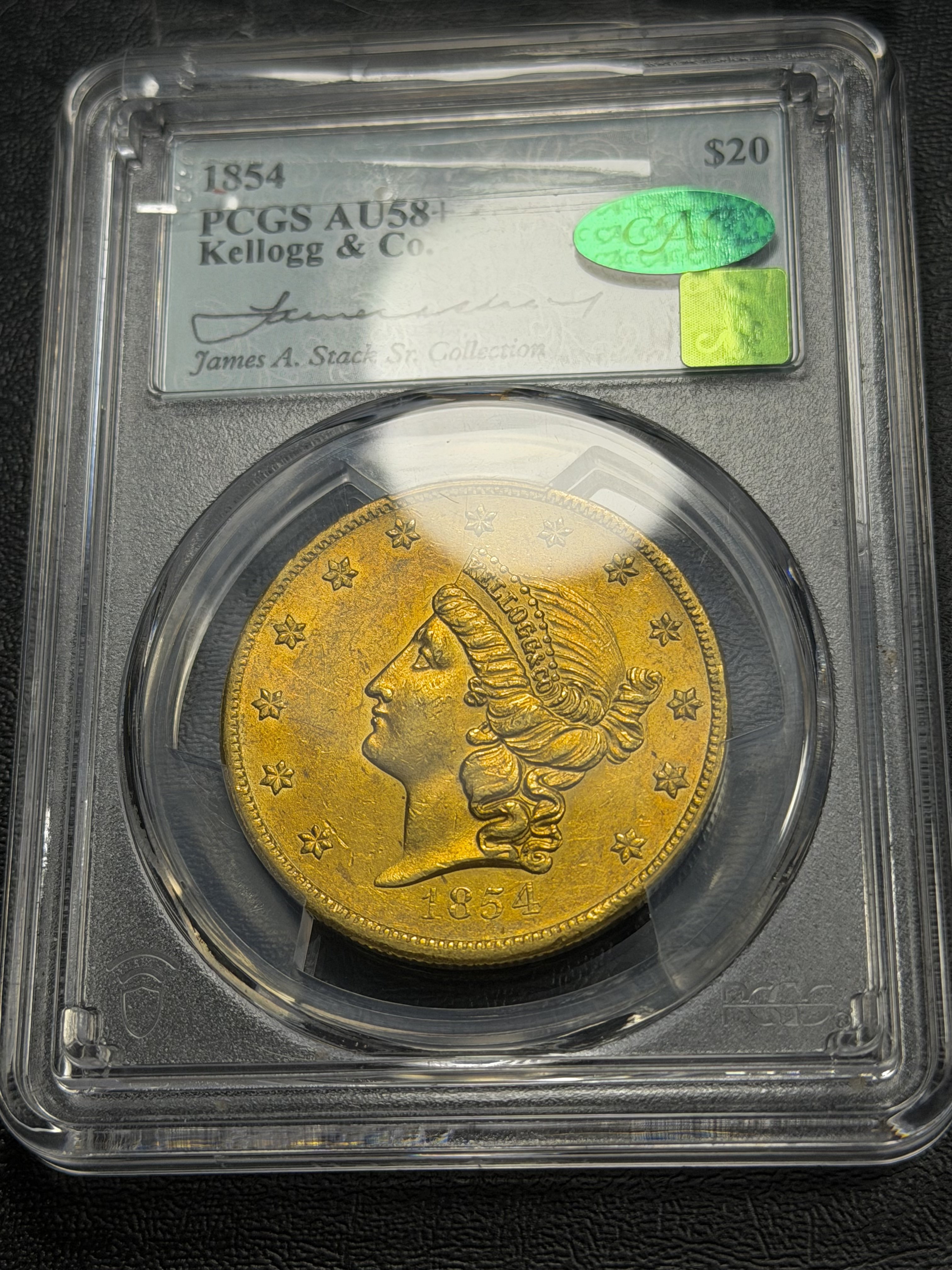
"We have seen today the first issue of the new Twenty Dollar pieces issued by Messrs. Kellogg & Richter. It is an exact and very handsome imitation of the United States coin, the only difference being the motto upon the cap of the Goddess of Liberty which adorns one side of the coin. On the front cap are the words, KELLOGG & CO. inscribed in the place of the word LIBERTY which marks the regular piece. The appearance of the new coin is highly creditable to Messrs. Kellogg & Co., who enjoy the highest degree of confidence from the business community. We learn that they will be able to issue about $20,000 per diem with their present arrangements, which will probably be speedily improved and their facilities for coinage increased."
From the start, Kellogg’s coining business was brisk, and although Richter left San Francisco on April 15th – the day that the new Branch Mint opened – the business continued to issue coins. Regular shortages of parting acids forced the mint to suspend production during its first two years, allowing Kellogg & Co. to continue striking millions of dollars’ worth of gold through 1855.
Following Richter’s 1854 departure, Kellogg worked with assayer John Hewston, Jr., and established a separate refining business before forming a partnership with former United States Assayer, Augustus Humbert, on April 2, 1855.
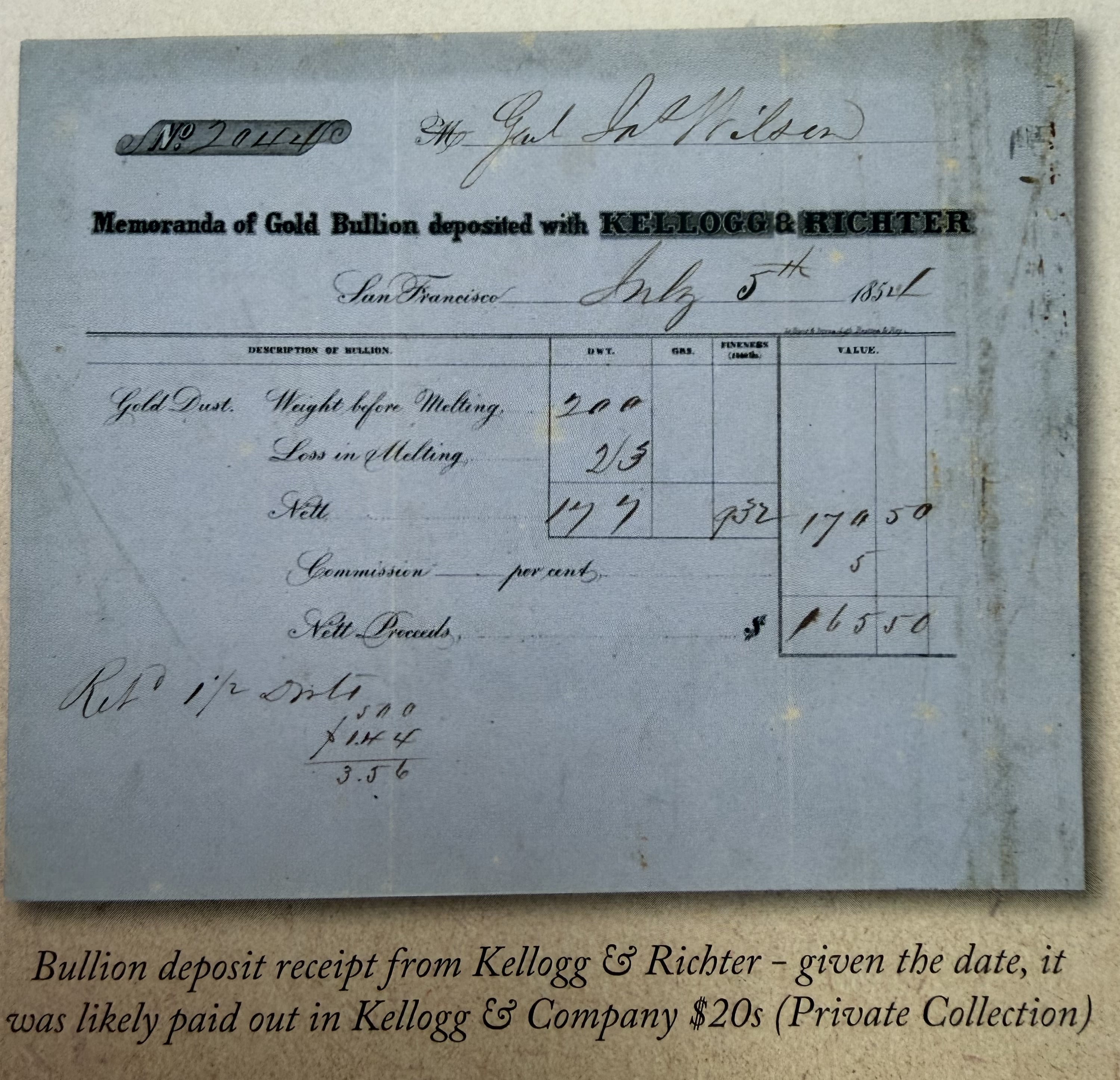
On May 1st, the Daily Alta California published an article about the monetary situation in California that outlined the importance of the issues of Kellogg & Company, which it identifies as “the principal private assay office in the Country”:
"We cannot conceal our disgust at the whole course of the government regarding the coinage of gold in California. It is not generally known, but is nevertheless the fact, that the principal private assay office in the Country effects over fifty per cent more towards the supply of coin to the country than the United States Mint does. The highest point reached by the Mint has been about $1,500,000 per month in coin. The assay office has, for weeks at a time, manufactured from $60,000 to $80,000 per diem. Every banker in the State will acknowledge that but for the assay office the financial crisis in this State would have been prolonged for weeks and weeks. To it the holders of bullion had to look for coin, and but for it San Francisco might at this moment have been bankrupt."
Hopefully, this provides some insight into how Instrumental John G. Kellogg was in the world of California Gold.....and why I just needed to own this coin. I knew from the moment I first saw it that I would have to prepare for absolute war, and I knew well in advance that the coin would sell for multiples of its published "guides". Despite its understated "value" of 30k by both PCGS and CPG (ha), I had the coin itself figured for about 65-75k, and anything in excess was subjective to the perceived value of the story behind it. I was forced to abandon my mindset as a dealer, and really tap in to the inner collector and ask myself how far I'd go....and I was actually pleasantly surprised that I only had to go 3x guide, when I would have stretched into 6 figures for it.
One of my favorite things about George Kellogg (and Augustus Humbert, as well), was that they were both astute coin collectors who saved some of the best preserved specimens for their own collections. It is my speculative (or hopeful) theory that the two had formed a collecting friendship-in addition to their 1855 coining partnership, and provided feedback to each other on what they would decide to each put away. Based on the marginal amount of wear on this coin, I don't think it was in circulation longer than a couple months, and perhaps it was about the best you could possibly find in early 1855.
There are several enigmatic pioneer examples that could only be explained by some type of collaboration between Kellogg & Humbert, including but not limited to the $50 Humbert Slug Proof , the fabled SP-69 Kellogg $20, or the 1852/1 .884 $20 "proof", all of which belonged personally to Augustus Humbert. Kellogg's own collection was a tad more modest, containing mostly circulation issues that weren't specially produced. He did also own, in addition to this coin, the finest known circulation $20 Kellogg, currently encapsulated as MS-65 w/cac, sold in the first Elder sale before my coin. I can't afford that coin anymore, but at least I was able to snag this one-
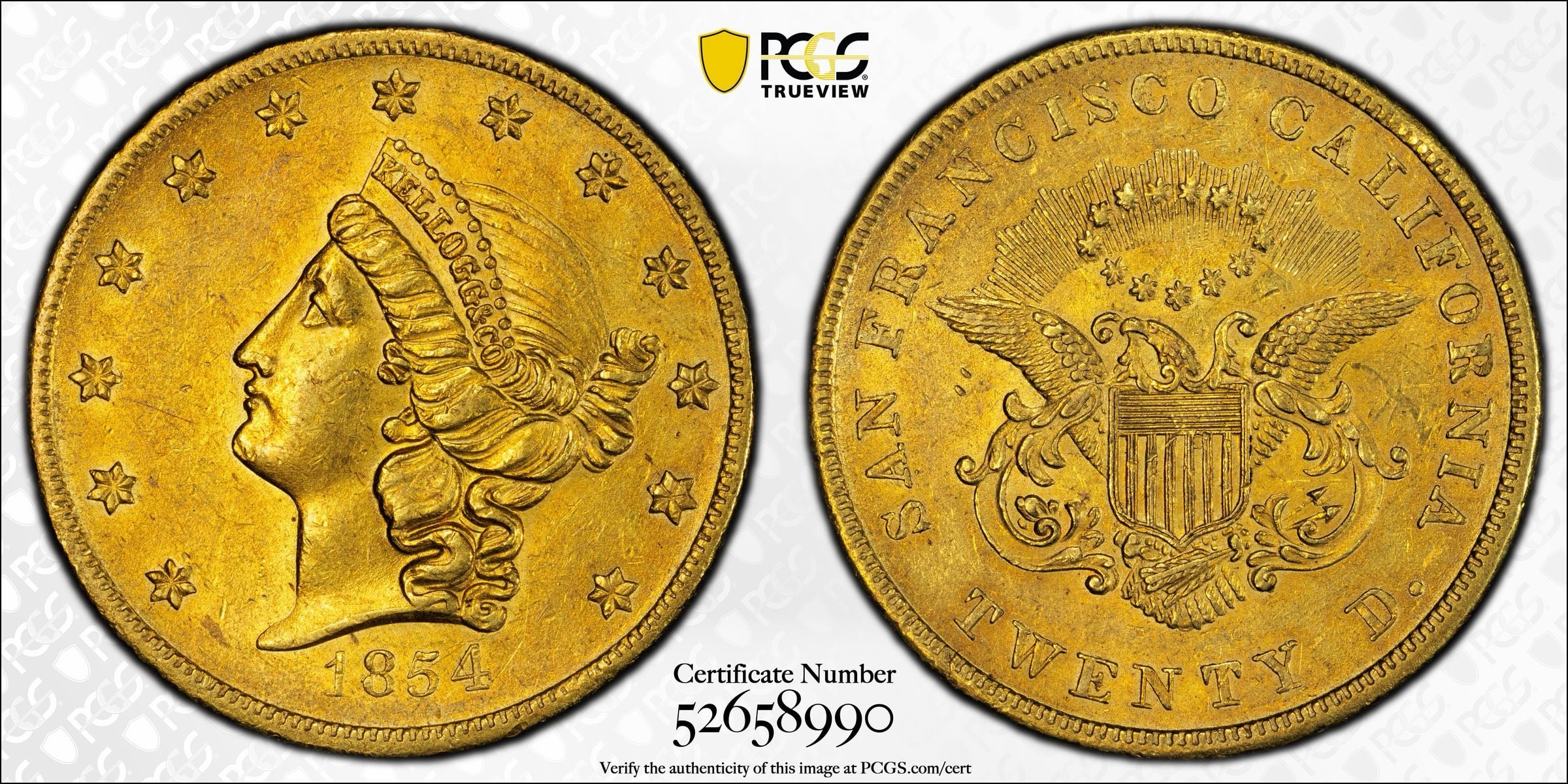
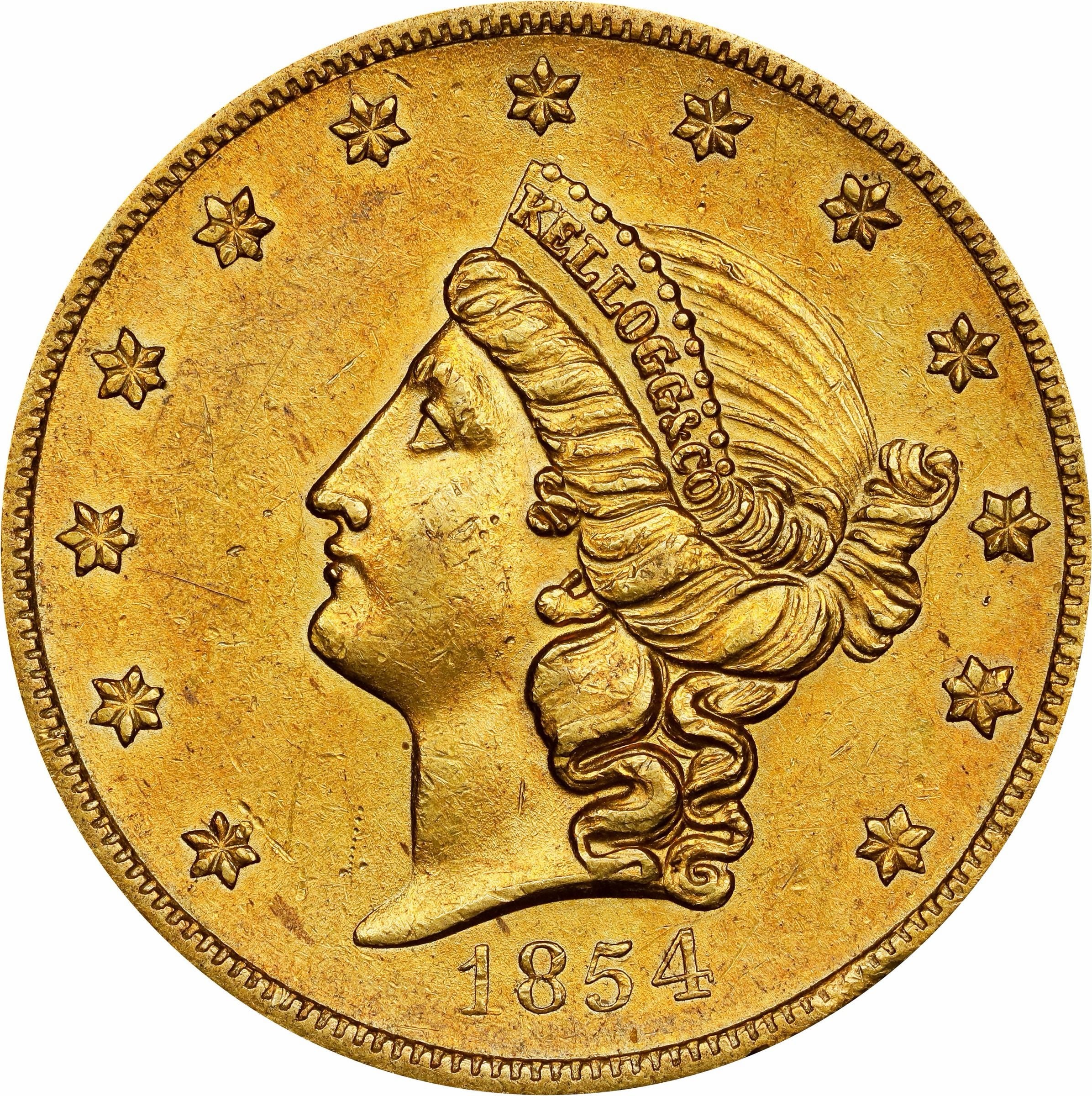
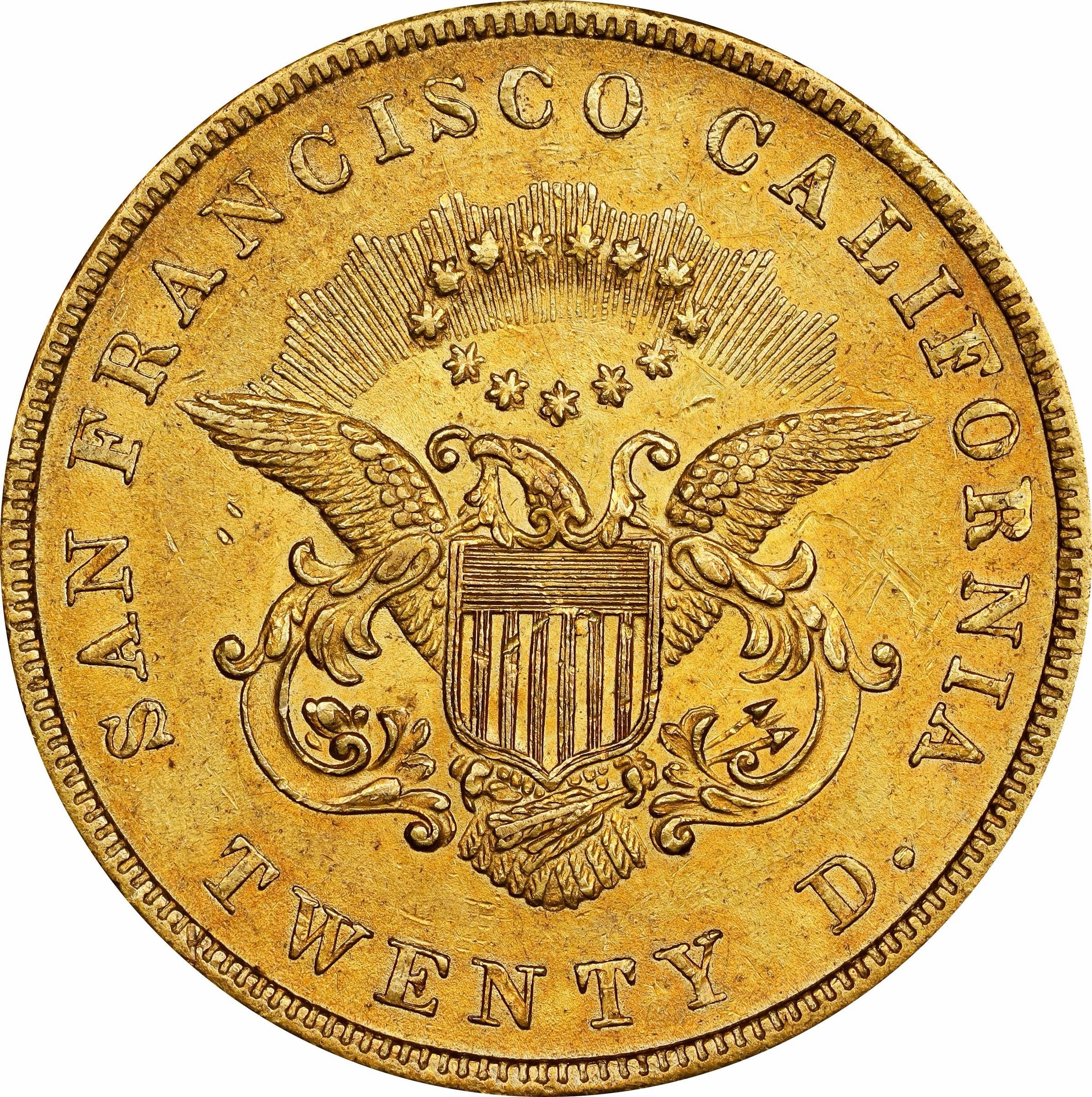
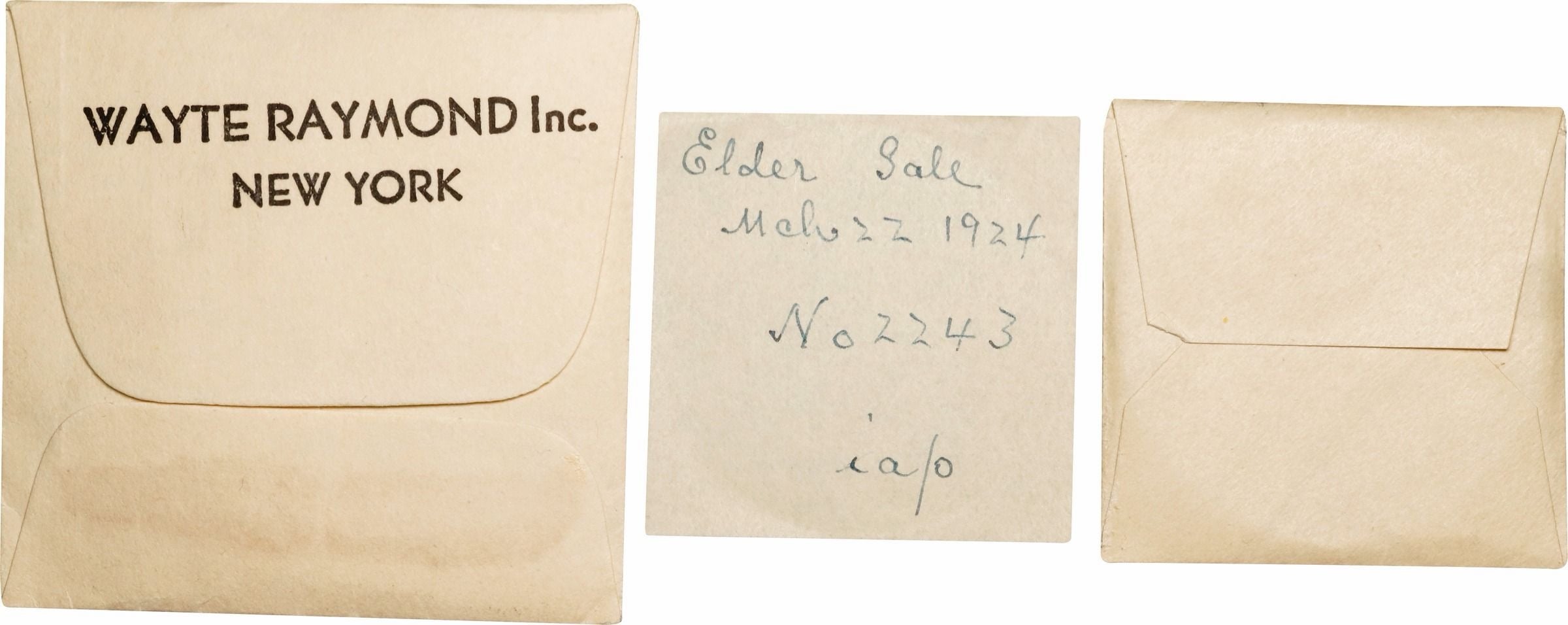
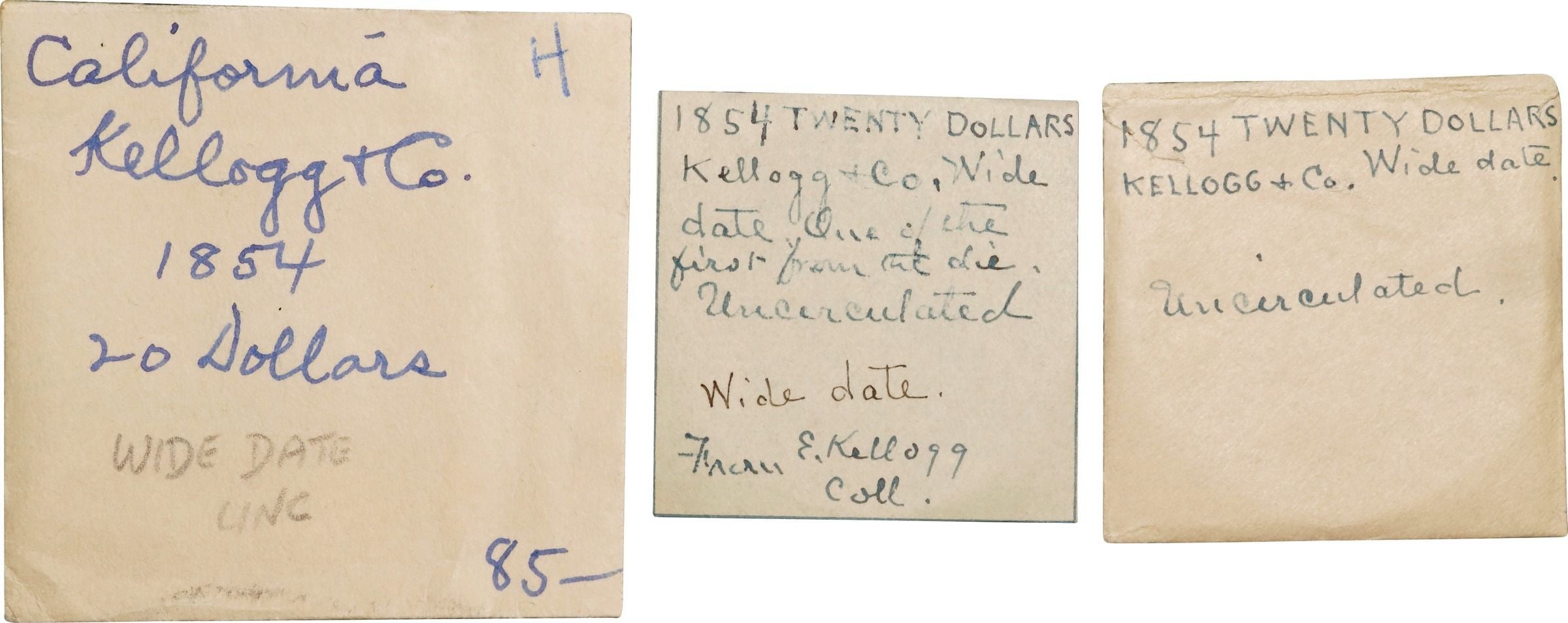
Stack's Bowers wrote -
Kellogg is interesting to numismatists not simply for his Forrest Gump-like association with nearly every major pioneer coining operation in San Francisco, but because he was a collector himself. Two sales of Kellogg's coins were conducted by Thomas Elder, the first in October 1916 offering seven coins, the second in March 1924 offering five. In the introduction to the first sale, Elder wrote:
These coins are owned by Mrs. Paul Kellogg, daughter of the late John Glover Kellogg, the well known Assayer and member of the firm of Kellogg & Company. The coins were collected by Mr. Kellogg, senior, himself. This lot includes a choice octagonal slug dated 1851, with incuse edge, uncirculated; an uncirculated Mormon $20 gold coin, a piece of great rarity and value, and the finest known example; an Augustus Humbert $20, the rare "884 Thous" type, In brilliant proof state; the exceedingly rare Moffat & Co. $10 with eagle and banner on the reverse, in proof state; an Oregon $5.00 beaver coin in very fine preservation; a Norris, Grigg [sic] & Norris $5, and other pieces.
While census records do not show Kellogg had a son named Paul (nor a daughter who married a Paul), these clearly came from Kellogg's family. The second sale was a consignment from the estate of Kellogg's son Edward Russell Kellogg after his 1923 death in the train station in Syracuse.
The 12 total coins that could potentially be traced to Kellogg's collection include just four struck in his name: a gem Mint State 1854 $20 was in the 1916 sale, while the March 1924 sale included a copper pattern 1854 $20, a majestic Proof 1855 Kellogg & Company $50, and this coin. It has not appeared for competition at public auction since Kellogg's son's estate trustees consigned it in 1924. As a coin, this is lovely, nicer than the vast majority seen. But the opportunity to buy Kellogg's own specimen is a truly once-in-a-lifetime event.
Provenance: From the James A. Stack, Sr. Collection. Earlier from the personal collection of John Glover Kellogg; Edward Kellogg, by descent; Thomas Elder's sale of March 1924, lot 2243; Hillyer Ryder Collection; Ryder Estate, February 1928; sold en bloc to Wayte Raymond, May 1945; Wayte Raymond to James A. Stack, Sr., ca. 1947.
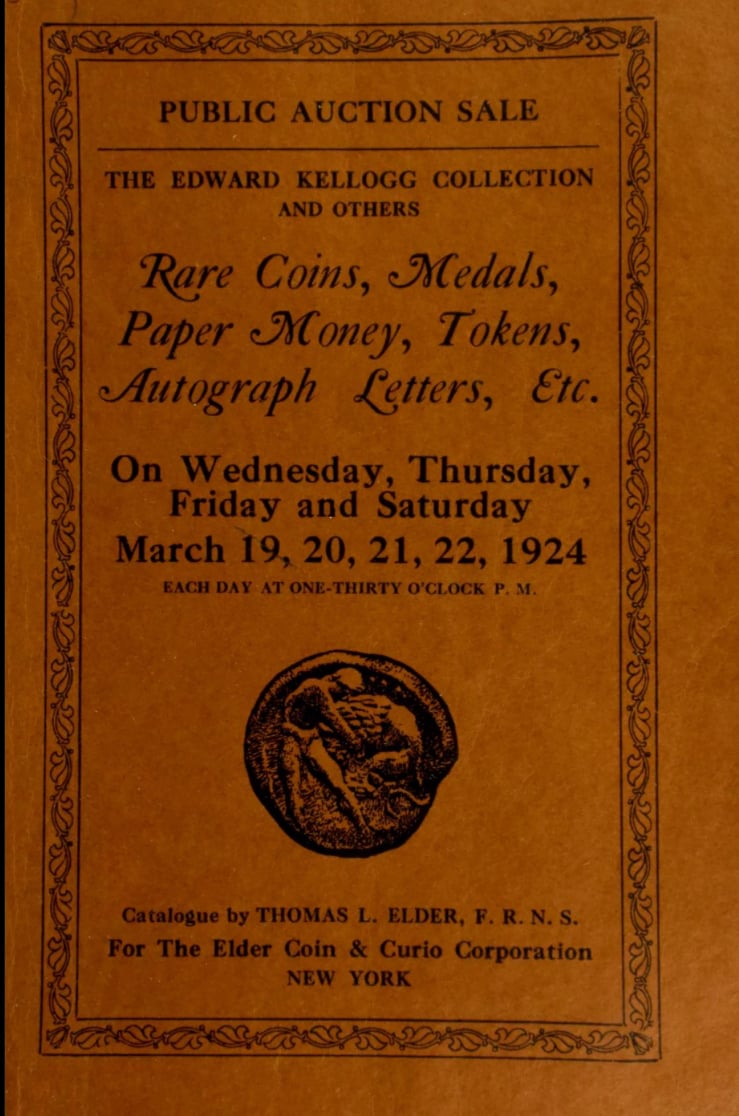
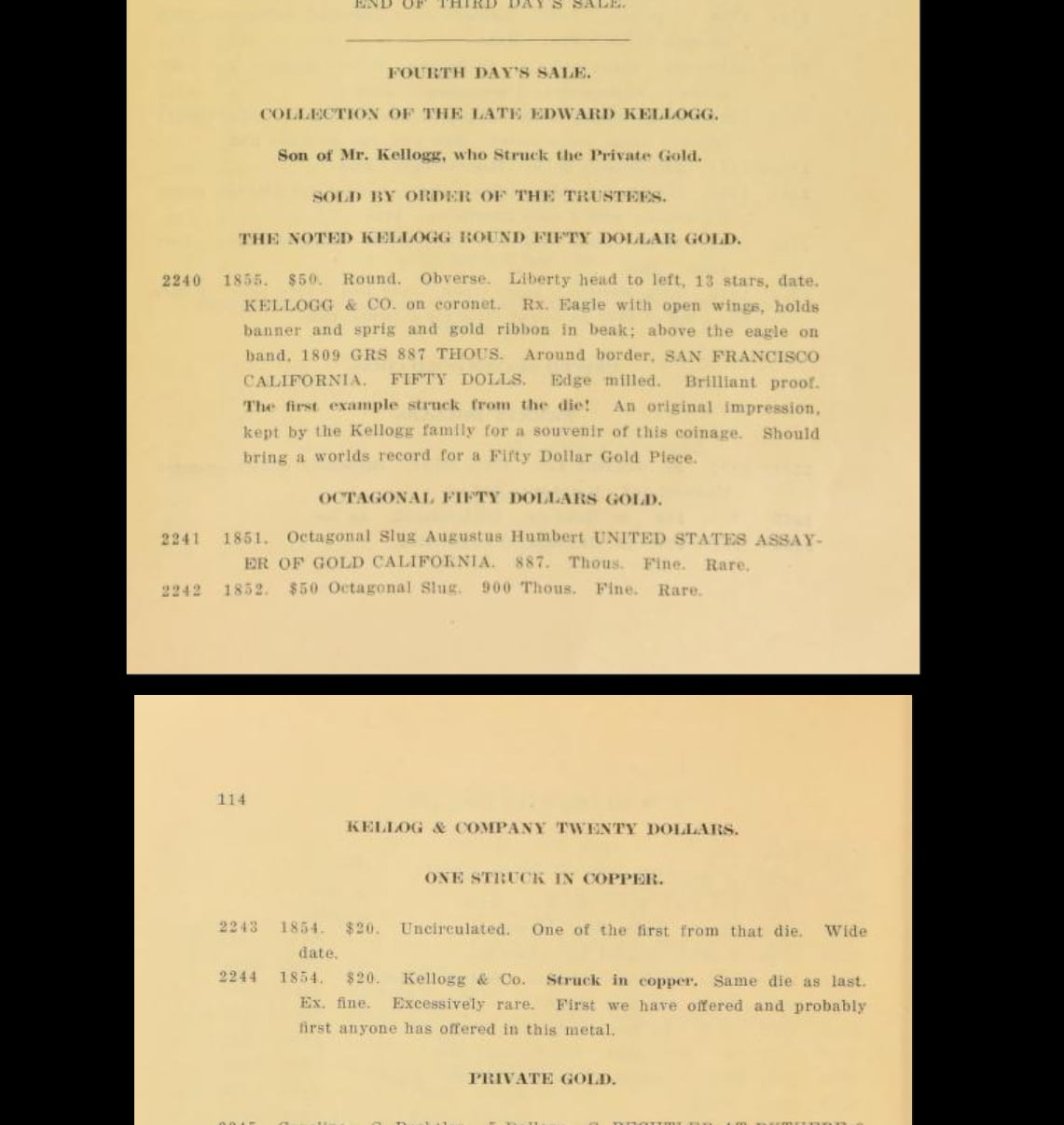
Here in the original Elder catalogue, you can see the matching description from the old flip, which reads "uncirculated, one of the first from that die. Wide date".
In a special introduction written by John Kraljevich, specifically about the pioneer gold from the Stack sale, he aptly described my feelings for a storied coin such as this -
"John Glover Kellogg’s own 1854 Kellogg $20 and his own 1849 Moffat $5, souvenirs from companies he helped run, transcend the concept of numismatic rarities; they are personal relics of one of this field’s most renowned characters."
Comments
Ill come out of lurking to say wow to that one. Well bought
11.5$ Southern Dollars, The little “Big Easy” set
Wonderful coin and equally wonderful writeup. Congratulations !
PS - I love your passion for coins and their history.
Mark Feld* of Heritage Auctions*Unless otherwise noted, my posts here represent my personal opinions.
So damn cool!
I love this coin. Glad you purchased it!
"But seek ye first the kingdom of God and His righteousness and all these things shall be added unto you" Matthew 6:33. Young fellow suffering from Bust Half fever.
BHNC #AN-10
JRCS #1606
Great coin and history lesson.
Love it 👍
Wow Dan. Thanks for the history lesson. What a great coin with awesome historical relevance. You must be over the moon.
Exceptional.
Experience the World through Numismatics...it's more than you can imagine.
Sick read and sick coin!
Proud follower of Christ! I love the USA! Land of the Bright and Beautiful! 🇺🇸🇺🇸🇺🇸🇺🇸🇺🇸
Super coin and super writeup.
Couldn't be in better hands for its current stewardship. Thanks for sharing Dan!
Really cool coin!
BST transactions: dbldie55, jayPem, 78saen, UltraHighRelief, nibanny, liefgold, FallGuy, lkeigwin, mbogoman, Sandman70gt, keets, joeykoins, ianrussell (@GC), EagleEye, ThePennyLady, GRANDAM, Ilikecolor, Gluggo, okiedude, Voyageur, LJenkins11, fastfreddie, ms70, pursuitofliberty, ZoidMeister,Coin Finder, GotTheBug, edwardjulio, Coinnmore, Nickpatton, Namvet69,...
Awesome coin and an awesome lesson in the history of her! Congrat's on a very cool pick up!!
“We are only their care-takers,” he posed, “if we take good care of them, then centuries from now they may still be here … ”
Todd - BHNC #242
What a wonderful coin and write-up. I know how special this one is in general and for you in particular. Nicely done.
I just feel bad for whoever ended up with your old Kellogg $20...he'll just have to console himself with his remarkable intelligence, striking good looks, and a lovely and original coin,
chopmarkedtradedollars.com
Wow! Nice story and specimen. Thanks for sharing.
Quite the coin Sir! And a harbinger of the tremendous juggernaut that has followed. Now bring back the San Francisco Mint!
Well, just Love coins, period.
outstanding and very educational writeup as well as a spectacular coin. Congratulations and thanks for sharing
Top 10 Cal Fractional Type Set
successful BST with Ankurj, BigAl, Bullsitter, CommemKing, DCW(7), DesertMoon, Downtown1974, Elmerfusterpuck, Joelewis, Mach1ne, Minuteman810430, Modcrewman, Nankraut, Nederveit2, Philographer(5), Proofcollection, Realgator, Silverpop, SurfinxHI, TomB and Yorkshireman(3)
Ah, Numismatics!
Here is a little known fact. In the late 1800’s Kellogg placed these coins in random boxes of
I just got the strings fixed on my world’s smallest violin 🎻 , but I don’t think I want to risk it again for your situation… sadly you’ll have to just cry yourself to sleep in silence 😂.
Founder- Peak Rarities
Website
Instagram
Facebook
The disovery of gold in California/Sutter's Mill....was the inpsiration for the creation of the Double Eagle.
With so much gold needing to be minted, and with gold coins being widely-used on the West Coast (California actually banned paper currency)...it was felt that the DE could absorb the newly-discovered gold faster than smaller denominations.
Senator Thomas Benton of Missouri predicted that the Double Eagle would be in greater demand than the gold dollar. He was right; the double eagle denomination lasted eighty-five years to the gold dollar’s forty.
Amazing! Congratulations on a once in a lifetime aquisition.
Dan touched on Kellogg's (and Humbert's) collecting activities and the remarkable coins they chose to preserve. At least one other coin in the Stack collection traced back to Kellogg's personal holdings. There may have been more, but I was so focused on pursuing this piece that I didn't spend as much time committing the others to memory.
Unfortunately, I wasn't successful in acquiring this example, but I think it's a wonderful illustration of the kinds of coins that appealed to Kellogg as a collector and that later found their way directly into the James Stack collection.
This is a gorgeous, well struck example of a classic type.
chopmarkedtradedollars.com
What a tremendous thread.
I learned a lot.
(Keep these coming!)
AU50+ ???
Barely AU but really attractive? It is a nonsense grade.
I am sure @PeakRarities can comment at length but it may be that PCGS has painted itself into a corner with its extreme variation in territorial grading standards and skills over the years. It's absurd when comparing multiple coins of the same grade, more than any other series I've seen. It's one of the reasons pricing is so all over the place.
chopmarkedtradedollars.com
Seriously cool!
My YouTube Channel
My observations lately are that PCGS has been grading pioneer very conservatively…but it seems as though they give out a + more often than they used to. Rather than reserve the + for the coins that are just lustrous or shiny, they seem to be giving them out for really nice originality and skin.
Specifically with the James A Stack collection, I thought some of the coins could have been graded higher, ie a coin I like as a 53 but it’s graded 50+.
I actually like this shift, because it no longer encourages people to brighten the coins and make them brighter for the sake of a higher grade. To this day, the most original coins are still punished for not having enough luster, even though they have plenty of luster under the thick skin.
Here’s my other grab out of that auction, and 1849 Moffat graded 50+ as well- a very tough issue and one of only two stickered coins of this “Ten D” variety.
Founder- Peak Rarities
Website
Instagram
Facebook
It's super gratifying to see folks appreciate provenance like this. The coins from the James A. Stack pioneer gold are wonderful, but the stories of where they've been since they left circulation is even better!
Really well written. The history of these coins are what holds their weight in value. Its obviously not your typical "gold coin".
I read the entire editorial by Dan. Magnificent comes to mind.
I collect Morgan's but I also have an appreciation and inyerest for all things numismatic.
Very special indeed!
Dan is this coin for your collection or your inventory?
Student of numismatics and collector of Morgan dollars
Successful BST transactions with: Namvet Justindan Mattniss RWW olah_in_MA
Dantheman984 Toyz4geo SurfinxHI greencopper RWW bigjpst bretsan MWallace logger7 JWP BruceS bigjpst
JWP PROMETHIUS88
Oh these two are deep, deep in my collection, and almost impossible to
upgrade so it’s unlikely they’ll go anywhere for a while…
And just for the record, most of my information is pulled from David Mccarthy’s book. I re phrased it in my words but parts of it are hard to tell the story any better than he did. Stacks did an excellent job on the catalogue descriptions as well. Thanks though 🙏
Founder- Peak Rarities
Website
Instagram
Facebook
Love the look of original old gold. Awesome coin Dan. Being a San Francisco native these pioneers are special to me.