1819/8 Half Dollars, A Study of the Numerals
 jacrispies
Posts: 1,658 ✭✭✭✭✭
jacrispies
Posts: 1,658 ✭✭✭✭✭
The 1819 yeardate for lettered edge Capped Bust half dollars has a large quantity of overdates. O-101, O-102, O-103, O-104, and O-106 die varieties are all 1819/8 half dollars. Without attributing the entire coin to the die marriage in order to determine if a coin is an overdate, one can simply look at the numerals.
The style of 1818 has:
1. flat-top 1s;
2. 8s that appear to be styled with one continuous loop; thick crossbar.
1819/8 O-101 Small 9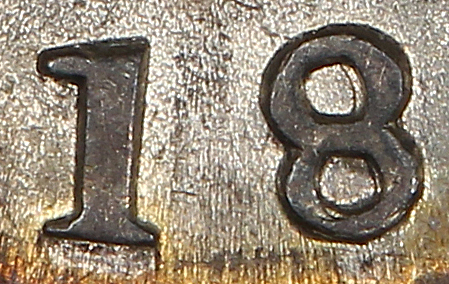
1819/8 O-103 Large 9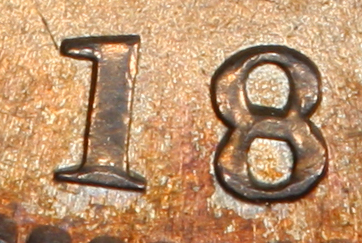
The newly introduced 1819 style numerals show:
1. Pointed top 1s
2. 8s that appear to be styled as two individual circles; thin crossbar.
1819 O-107, normal date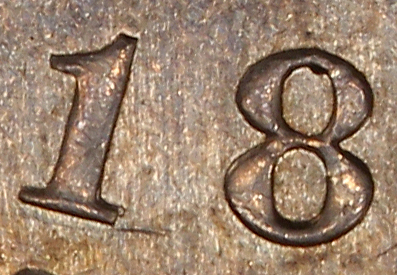
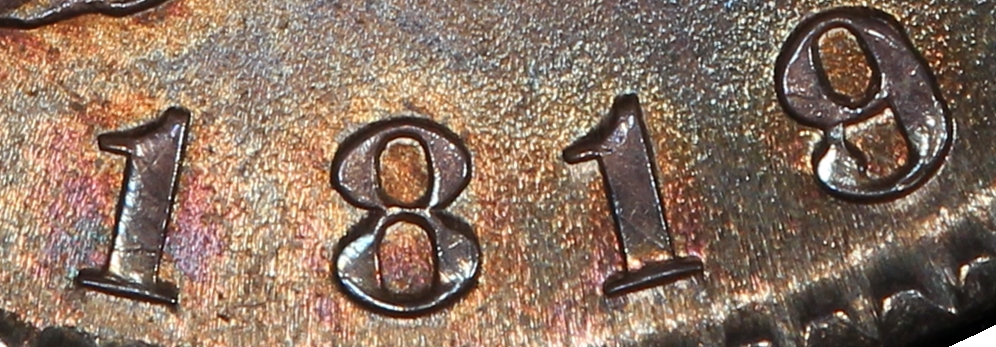
Overton designated the O-105 die marriage as an overdate as well. And while the O-105 is still recognized by PCGS as an overdate, many bust half dollar collectors do not, and consider this as a normal 1819 die marriage. While the last digit clearly has something going on, the 1s and 8s were created from the new 1819 numerals. Was the die reworked? Or an 8 accidently punched into a die created in 1819?
"But seek ye first the kingdom of God and His righteousness and all these things shall be added unto you" Matthew 6:33. Young fellow suffering from Bust Half fever.
BHNC #AN-10
JRCS #1606
Comments
Great thread and educational on varieties. Adding my 1819/8.
Excellent analysis Chase! Simple, clean and easy to understand ... and a must consideration for all CBH aficionado's
.
I am of the mindset that the O-105 is NOT an overdate, but consider the 9 to have a graver mark or other type of date blunder, and the observation of the date types from 1818 and 1819 further supports that hypothesis.
.
Also, FWIW ... I had the pleasure of previewing the coin above, the Newman-Green coin, shown by @Inspired70 above ... and IMO one of the finest 1819 of all marriages.
... and she is absolutely the finest known (by a mile!) 1819/8 O-106
Interestingly enough, I bought the OTHER 1819/8 O-106 that Heritage sold in August of 2024, the ex-Prouty coin, a lowly (by comparison) P55cac
.
And for further comparison of date types, here is my 19/8-101, the 18/9 "small 9" variety, also in P55cac
“We are only their care-takers,” he posed, “if we take good care of them, then centuries from now they may still be here … ”
Todd - BHNC #242
@pursuitofliberty that 1819/8 O-106 sure looks way better to me than a P55. She is hammer struck, particularly on the obverse and the fields are super clean. Sure looks better than a 55 to me, but will defer to the CBH aficionados!
Great post!
As an aside, the digits used on the 1819/8 and 1819 large cents have the same characteristics.
Excellent observation!
There is something on the high elevation of the 9 that merits further study.
Has anyone ever suggested the possibility of a 9 over an inverted 9? Not saying that that is what it is, but I am going to explore the possibility.
TD
Went and grabbed some images off of that fabulous resource, CoinFacts. Here are the first three O-105's in their image file:
Definitely something connecting the ball of the 9 to the loop above, and definitely something sticking out of the upper right border of the 9. I think that a 9 over inverted 9 is a plausible explanation. What think thee?
TD
@CaptHenway Tom, I have looked at this DM over and over again more than a few times ... until my eyes were fuzzy. I just can't see the shape of a digit that makes sense (although I agree, and always have, it does appear to be "something").
I think the OP should share this thread more widely for further input, and I'm going to as well.
“We are only their care-takers,” he posed, “if we take good care of them, then centuries from now they may still be here … ”
Todd - BHNC #242
.
Agreed!
Successful BST transactions with forum members thebigeng, SPalladino, Zoidmeister, jacrispies, coin22lover, coinsarefun, jwitten, CommemKing.
It's a doozy, all right.
I am also willing to consider what I think jacrispies is suggesting that maybe the engraver accidentally punched a new-style 8 in the fourth date digit position, in 1819, and then corrected it with a 9.
Think about it. The Engraver (or whoever was dating dies at this time; Roger W. Burdette has some thoughts on the matter) was working with a "1" punch, an "8" punch, and a "9" punch. Pick up the "1" punch. Punch. Pick up the "8" punch. Punch. Pick up the "1" punch. Punch. Get distracted by something. Lose your place. What was the last thing I punched? Oh, the "1." Let's see, an "8" goes after the "1." Picks up the "8" punch. Punch. Dammit, that was supposed to be a "9!" Picks up the "9" punch. Punch. There, nobody will even notice.
I can think of another possible "Engraving while distracted" moving violation. There was a 1795 $5 reverse die punched UNITED STATED OF AMERICA that was then corrected with an "S" over the errant "D." The two uses of "TE" before the last letters in UNITED STATES might have caused the mixup, just like the two "1"'s in 1819.
TD
Thanks for the responses! I'll do some overlays later. I'm at a milestone event this weekend and will return for the study on Monday.
Certainly plausible, we have the 1814 E/A and 1795 A/E varieties in the half dollar series as well. Letter mixups were a relatively common mistake at the first Mint, across multiple engravers.
"But seek ye first the kingdom of God and His righteousness and all these things shall be added unto you" Matthew 6:33. Young fellow suffering from Bust Half fever.
BHNC #AN-10
JRCS #1606
Certified O-102 overdate
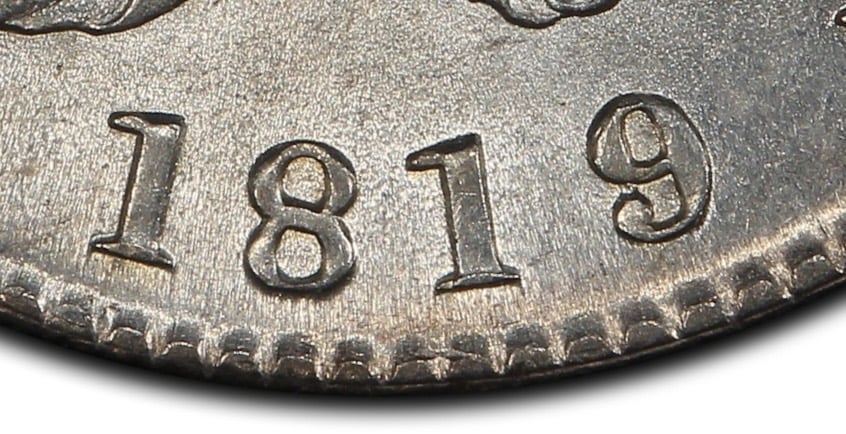
Style of 1818 numerals:
Certified O-105
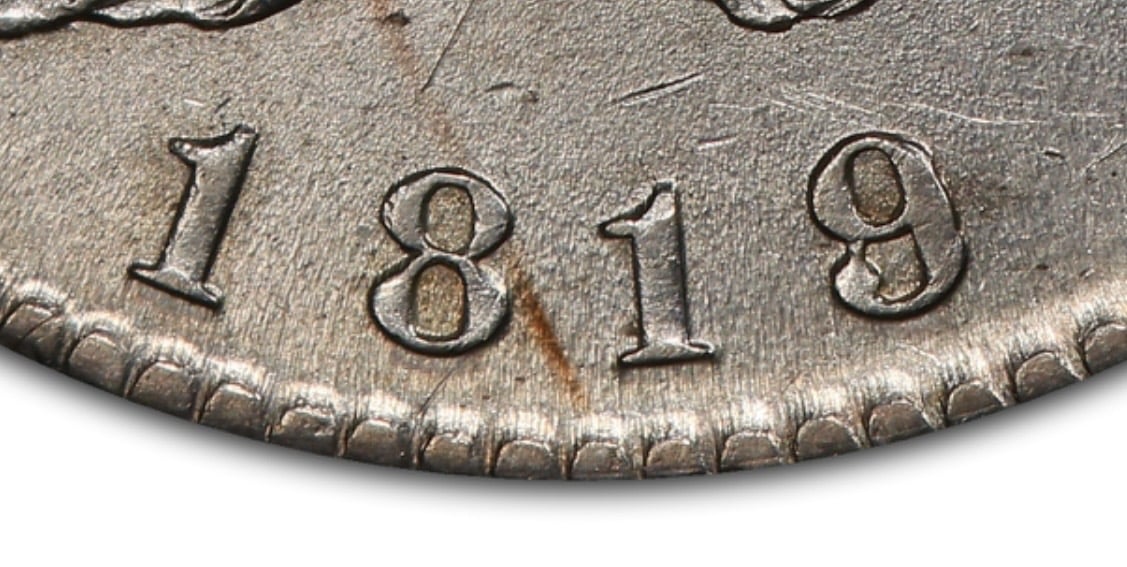
Style of 1819 numerals:
Comparing the bridge in the between the tail and loop of the 9, the O-105 looks identical to the O-102 overdate. Additionally, the O-105 has an extra bulge on the upper loop of the 9 that matches the extra width of the 8.
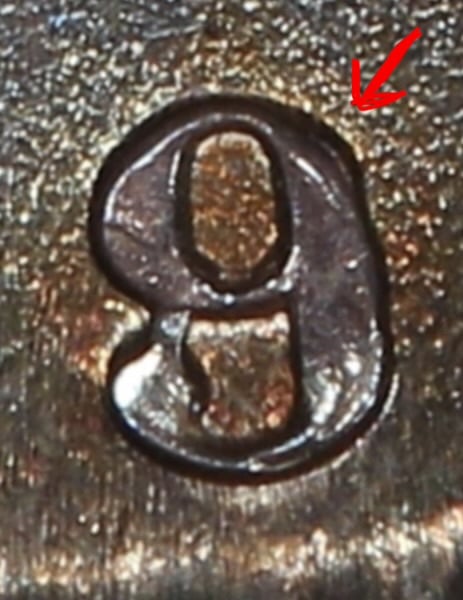
This bulge shares an appearance with the O-104 die marriage:
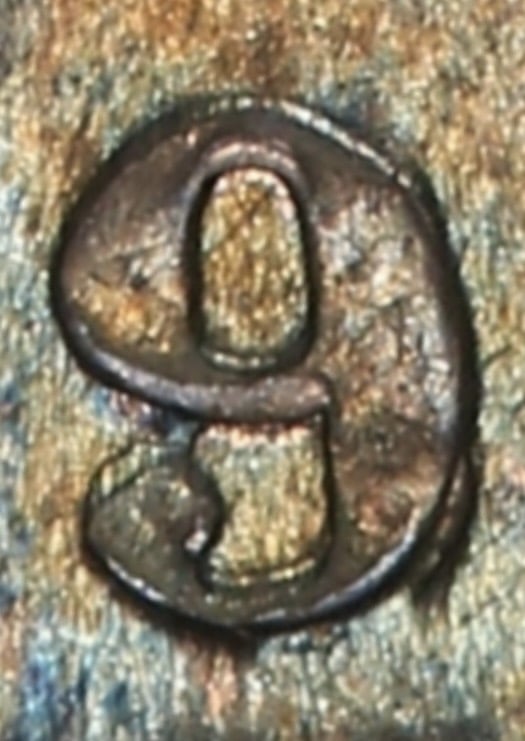
The O-105 9/Inverted 9 theory doesn't look right. Here, within the loop of the 9, there are two small notches reminiscent of a round loop as an undertype. The bottom half of the 9 underneath the crossbar is squared off. So the 9/Inv 9 isn't correct either.
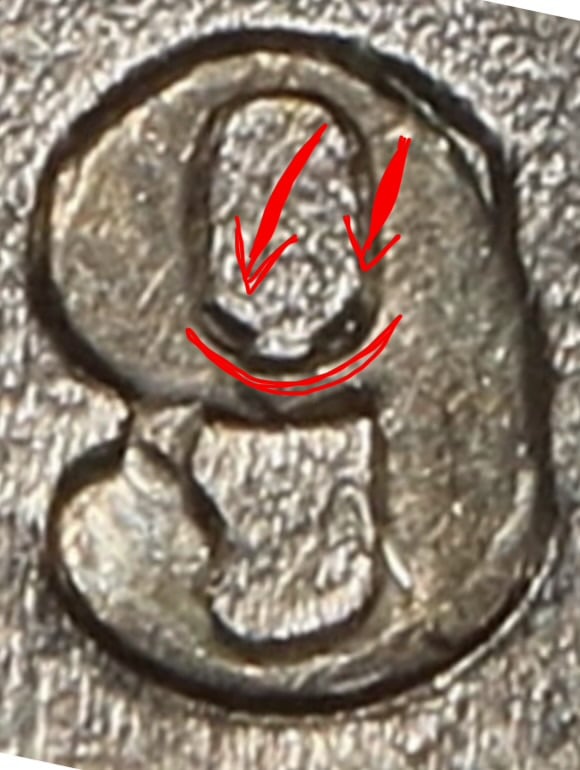
After studying these beautiful closeups, I believe there is strong evidence that shows the 1819 O-105 die marriage is also an overdate, likely rooting from a mistake rather than die repurposing.
"But seek ye first the kingdom of God and His righteousness and all these things shall be added unto you" Matthew 6:33. Young fellow suffering from Bust Half fever.
BHNC #AN-10
JRCS #1606
Makes sense to me.
How about "1819/8, Style of 1819" The others would be of course "1819/8, Style of 1818"
I like that
"But seek ye first the kingdom of God and His righteousness and all these things shall be added unto you" Matthew 6:33. Young fellow suffering from Bust Half fever.
BHNC #AN-10
JRCS #1606
@pursuitofliberty what are your thoughts at this point?
"But seek ye first the kingdom of God and His righteousness and all these things shall be added unto you" Matthew 6:33. Young fellow suffering from Bust Half fever.
BHNC #AN-10
JRCS #1606
Hmmmmmm ..... well, since you're calling me out
.
I like the ... "1819/8, Style of 1819" The others would be of course "1819/8, Style of 1818"
That goes along with your original post, and is a neat way to describe it ... IF the Style of 1819 IS an overdate. Of that part I am still not convinced.
.
I also agree that the 105 is not a 9 over inverted 9. I absolutely do not see that.
.
Nothing I see makes me think the 105 is an overdate, and using Occam's Razor and the astute observation of the different date logotypes, I can only really consider it a date punch "blunder", unique to the Die Marriage.
.
Edgar Souders is the first I know of that pointed out the distinct 1's in the date, and also makes a compelling case that the "blunder", as it were, is nothing more than a graver slip or a die chip.
He also makes a further case for why the 105 is not an overdate based on the emission sequence of the 105 for the 1819's.
Please refer to pages 448/449 in the Second Edition of his fantastic work Bust Half Fever, 1807-1836.
.
Finally, here is a very detailed and extremely well focused image I have of the date portion in question for the 105 DM.
.
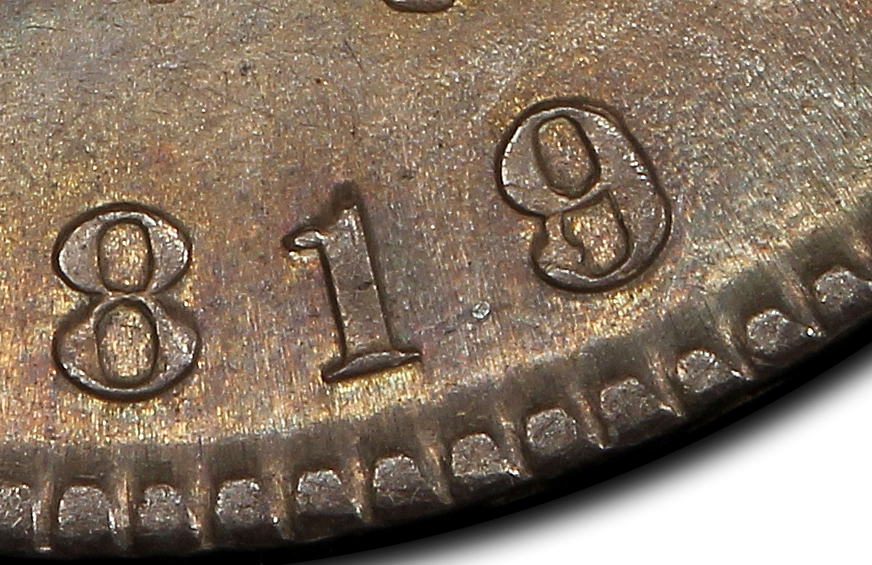
“We are only their care-takers,” he posed, “if we take good care of them, then centuries from now they may still be here … ”
Todd - BHNC #242
I will amicably "agree to disagree" as to the overdate status. I have given up on the inverted 9 hypothesis, but I do think that it is a 9/ new style 8.
It has what Bill Fivaz calls "character," what with the extra bulges and all. Perhaps somebody will turn up an earlier die state piece that will settle the argument, as I did with the 1849/846 Half Dime that disproved all of the so-called 1849/848 varieties.
TD
I can accept that, and while I am near certain it is not a "left over die" overdate due to the date logotype, I can accept it could be some other type of overdate ... but still, as of today, I am not convinced.
One thing's for sure though, I try to keep an open mind about these things.
“We are only their care-takers,” he posed, “if we take good care of them, then centuries from now they may still be here … ”
Todd - BHNC #242
I forgot to post my overlay of the 9/8. I boosted the contrast so you can see the outline of the 8 better. All three protruding points of the 9 match up perfectly with the 8 style of 1819.
I'll look at the emission sequence and read BHF later today. I haven't referenced that in a while, excited to check it out again! It's one of my favorite books.
The only non-overdate theory left that makes sense is a repunched 9. I can see how the engraver could have repunched the 9 slightly lower the second time, leaving the details in the loop of the 9, the ball at the end of the tail, and the bulge at the upper right side of the loop.
"But seek ye first the kingdom of God and His righteousness and all these things shall be added unto you" Matthew 6:33. Young fellow suffering from Bust Half fever.
BHNC #AN-10
JRCS #1606
Happened to be in the ANA Library yesterday autographing some of my 1922 Cent books for the ANA's inhouse sales store, so I looked up some of the references mentioned here for the sake of those not familiar with them.
Here are excerpts from the ANS COAC article on striking orders and emission orders.
I find it interesting that the OP's challenged variety, the 1819 Overton-105 that I suggested be called "1819/8, Style of 1819," is die linked to Overton-106, an unquestioned 1819/8 overdate which I suggested be called "1819/8, Style of 1818," and that both of these dies are surmised to have been struck and emitted late in the year. If I could understand better the methodology by which this emission order was surmised I might challenge it, but I do not, so I cannot.
Has anybody studied the design hubs and/or punches used during 1819 to see if any of them deteriorated in any perceptible way during the year, to see if this might prove or disprove the alleged emission order?
TD
The emission sequence was compiled from attributing and die stating the bar dies that placed the edge lettering on each coin. Because a pair of bar dies has shown to be used on 2-3+ sets of obverse/reverse dies, the overlapping usage can bring forth an order to the releases of the die marriages.
If the "struck late in the year" holds any water for the validity of an overdate, than the style of 1818 O-106 should not be an overdate either because it was struck AFTER the O-105 according to the emission sequence. This shows that the emission sequence likely has no direct factor on determining overdates.
"But seek ye first the kingdom of God and His righteousness and all these things shall be added unto you" Matthew 6:33. Young fellow suffering from Bust Half fever.
BHNC #AN-10
JRCS #1606
Indeed.
To clarify, we are talking about the two bars with raised letters on them that are used in a Castaing machine to impress incused letters into the planchets prior to their being struck, correct?
This process has absolutely nothing to do with the actual coining process. Planchets were lettered, and sometime later those planchets were struck. Different steps in the process.
Who is to say that once a pair of edge lettering bars was put into use, they were left in the Castaing machine and used continually until they wore out? The early Philadelphia Mint quite often worked spasmodically, subject to the variable deposits of gold and silver, and the availability of copper planchets purchased from abroad. When there was no work to be done, it would have logical to place the dies used for that work into a safe or vault for safekeeping. Why not put away die punches and lettering bars for safekeeping as well?
Multiple sets of edge lettering bars were used in 1819. What if one particular pair of lettering bars was used in early 1819 to edge letter one particular large batch of planchets that was then struck into Overton 105 and Overton-106 coins, and after all the planchets on hand were lettered the edge lettering bars were simply put back into the vault for safekeeping. The next time some planchets needed to be edge lettered, a different pair of edge lettering bars were taken out, AT RANDOM, and used. Look at how many dies of this era were used and put away and taken out later and reused with a different opposing die.
Let us hypothesize that by the time that this particular pair of edge lettering dies was used again, AT RANDOM, they were used to letter a batch of planchets that were struck with dies that could be associated with a much later coinage. That does not mean that the O-105 and O-106 dies were struck consecutively with that much later coinage.
I submit that the die sequencing charts are fatally flawed because they do not allow for the possibility that various tools were used randomly and non-sequentially. If I am correct, then the die sequencing charts cannot be used to dismiss O-105 as a non-overdate. It must be judged solely upon the evidence seen on the coins.
I think that there is enough visual evidence, such as the bar connecting the ball of the 9 to the upper loop and the various bulges where the bulges of an 8 might have remained, to call this die a legitimate overdate. Your mileage may vary. All I ask is that you look at the evidence again and make up your own mind, and not automatically agree with somebody else's opinion that might have been well-meaning but wrong.
Tom DeLorey
Although there may be truths in your concern, I believe there is more consistency in the bar die processes than you may realize. The edges of the O-105 and O-106 was struck with bar die pair #6, which also struck the O-102 in 1820. Isn't that a sign of a later striking? The O-101 shares an edge with 1818, isn't it safe to consider that was the first die marriage struck of the date?
Secondly, the first Mint showed significant value to hardened die steel for the cost and time to prepare those dies. To assume there could be bar dies everywhere sounds far fetched of a thought. We see this tight schedule with the experiments and design changes. The changes begin to reflect quickly on a specific year, rather than the design change affecting multiple years and die marriages. For example, the star added in 1814, and the "experimental" edges with portioned die marriages in 1809.
I would love to look at the original data to see how these die emission sequence conclusions were formulated and their strategies to attributing the edge dies.
Nevertheless, I think the O-105 is an overdate. Especially with the 8/9 overlay, the details match up perfectly. Not sure if you misunderstood me here.
"But seek ye first the kingdom of God and His righteousness and all these things shall be added unto you" Matthew 6:33. Young fellow suffering from Bust Half fever.
BHNC #AN-10
JRCS #1606
Fair enough. Now let me ask a question:
How many Castaing Machines did the Philadelphia Mint have in use in 1819?
I have never heard this question addressed for this or any other year, and I have no idea what the correct answer is. "Only One" would be a terrible choke point in a production system that could be completely shut down if the one machine broke down. and would you want to be the one guy to hand-crack over 2.2 million half dollar planchets through only one machine? Then you need one or more pairs of spare edge bars in case one edge pair wears out, which does appear to be a recurring problem.
OK, let us assume that for the sake of argument you have two Castaing machines in everyday use. Over half of your production is Cents that do not need edge designs, but every so often you still need to retool one Castaing Machine to put reeded edges on Quarter Dollars or Half Eagles. Do a bunch of planchets that become O-105 and O-106 halves early in the year, take that pair of edge bars off and put them in the vault for safekeeping (imaging what they would be worth to a counterfeiter!), and make reeded edges for a while. When it is time to make Halves again, grab a random pair of lettered edge dies out of the vault and slap them in the Castaing Machine. Not the pair you were using before, who cares? They read the same.
Late in the year repeat this Do-Si-Do and randomly return the die pair previously used to letter the O-105 and O-106 planchets to one of the Castaing Machine. Use that pair into early 1820, and all of those O-105 and O-106 strikes suddenly look like late production.
TD
@CaptHenway To your overall theory—the attributed bar dies clearly have a broad pattern of being consistently assigned to obv/rev dies. They aren't being used and thrown around willy nilly, and that sounds like an unreasonable assumption to make based on the empirical evidence.
Castaing machines were used for lettered edge half cents (up to 1795), large cents (up to 1795), half dollars (up to 1836), and dollars (up to 1803). So from 1803 to 1836, capped bust halves were only the coins that required the Castaing machine. I believe the half cents and large cents post-1797? had upset rims on a different machine setup.
What are you pointing to, and what is the relevance to the research topic?
"But seek ye first the kingdom of God and His righteousness and all these things shall be added unto you" Matthew 6:33. Young fellow suffering from Bust Half fever.
BHNC #AN-10
JRCS #1606
I am not saying that the edge lettering bars were thrown around willy nilly. I am saying that it is possible that one particular pair of edge lettering bars may have been used to letter the edges of one production run of planchets early in the year that ended up being struck as O-105 and O-106, and then been placed back in the die vault for a while because there was no silver to be coined for a while, and then sat there for a long while as other pairs of edge lettering bars were used to letter subsequent batches of planchets, and then finally taken out many months later and used to letter some planchets in early 1820. Thus the O-105 and O-106 strikes are edge bar linked to an 1820 coinage, but there is absolutely no proof that these were CONSECUTIVE coinages!
Look at the Bust Dollar and Liberty Cap Half Dime reverse dies that were used and placed in the vault for a while before being taken back out and reused multiple times over multiple years. A reverse die was just another tool. A pair of edge lettering bars was just another tool.
It is my understanding that Castaing Machines were used to impart the reeded edges on gold planchets and the lesser silver planchets during this era. Have you heard otherwise? If so, the preparation of gold Half Eagles and silver Quarter Dollars in 1819 would have required that the edge lettering bars on at least one Castaing Machine be switched out and then switched back in from time to time, which could have resulted in one or more pair of edge lettering bars having discontinuous production runs.
Bottom line: Die Pairs O-105 and O-106 could have been used to strike coins early in the year, when Die Pairs 101 to 104 are presumed to have been struck.
@CaptHenway Read "Dismissing the Castaing Machine Myth" on page 30 of the April 2016 JRJ: https://nnp.wustl.edu/library/book/568039
Early reeded edge coins were struck with a close collar (as opposed to closed collar or open collar), where the diameter of the reeding collar was large enough to impart most of the edge reeding, yet often times leaving areas of weakness. This setup still left room for substantial planchet expansion.
And a more recent personal observation; off center early reeded edge coins do not have an upset rim on the unstruck portions. Meaning they were struck without an upsetting mill or Castaing machine. Off center bust halves and early dollars clearly have an upset rim seen on off center examples.
"But seek ye first the kingdom of God and His righteousness and all these things shall be added unto you" Matthew 6:33. Young fellow suffering from Bust Half fever.
BHNC #AN-10
JRCS #1606
Interesting.
The article states that when the new Closed Collar technology started to get phased in in 1827, it introduced a new technology for ejecting struck coins from reeded collars. This implies that there was an earlier technology for ejecting struck coins from reeded collars. Do you have any idea what that might have been? When was the technology for raising the anvil die to push the struck coin up and out of the reeded collar invented?
Even if the Castaing Machines(s) were not used to reed gold and silver planchets, that does not affect my argument that a particular pair of edge lettering bars might have been used at greatly different times within one or two consecutive calendar years, thereby falsely implying that the early batch of lettered edge planchets MUST have been made and used immediately before the later batch of lettered edge planchets they are edge die linked to. I repeat my example of Draped Bust Dollar reverse dies and Capped Bust Half Dime reverse dies used in no chronological order.
Are there records in existence showing delivery dates for the various coinages of 1819, which might indicate gaps in production during which the Coiner might reasonably have been expected to place coin dies and edge lettering bars into a vault for safekeeping? The 1820 Assay Commission report might give deliveries by month or even date.
In the meantime we have this very minimalist Mint Report for 1820 referencing huge gaps in the 1819 coinage:
I have been interested in reading more about the feeding mechanisms, but never found a reference on how they actually worked. If you know of anything, I would be happy to see it.
As mentioned before, because of the consistency in use of the attributed bar dies, I can't get on board with this. Do you see a bar die that was used in 1812 and reused in 1818, or something to that extreme? I see nothing more than a one year spread on the usage of bar dies. The exception is 1814-1817 which had only one die marriage of 1815 in between.
In 1819, coins were made on demand of the depositor, so I don't think this information can be used to the accuracy of the discussion. Additionally, the Mint Report of 1820 would likely include coins dated 1818 that were struck in 1819.
With an interesting detail contained in the document, Patterson says they can strike 7.5 million cents with a single press over a year's span. One Castaing Machine sounds like a probability.
"But seek ye first the kingdom of God and His righteousness and all these things shall be added unto you" Matthew 6:33. Young fellow suffering from Bust Half fever.
BHNC #AN-10
JRCS #1606
I was able to see and study a VLDS 1819 O-105 this past weekend, and while I don't think it is a leftover die from 1818 (due to the 1's in date), I am now convinced it is a 9 over 8 date punch error. As Chase pointed out, the digits line up entirely, and on a VLDS coin, the 3D representation is unmistakable, at least to what I see.
Just because emission order on the 106 is off, does not mean the 106 is not an overdate. I am convinced the obverse die is an overdate, and was also from a leftover die originally produced and dated in 1818. This could have happened as new dies arrived before the reused and redated dies were retired, and then the (redated) 106 obverse did not enter service until later.
My 2c ... waiting for a flight home
“We are only their care-takers,” he posed, “if we take good care of them, then centuries from now they may still be here … ”
Todd - BHNC #242
@pursuitofliberty Thanks for the update! That is pretty cool, and I agree. Safe travels home.
"But seek ye first the kingdom of God and His righteousness and all these things shall be added unto you" Matthew 6:33. Young fellow suffering from Bust Half fever.
BHNC #AN-10
JRCS #1606
From Roger W. Burdette, here is a copy of the list of silver coins retained for the Annual Assay Commission between Feb. 9, 1819, and Feb, 11, 1820. Roger explained to me that back then they assayed the coins struck between one Assay Commission to the next, and not from the start of the previous calendar year to the end of the previous calendar year. I never knew that. Another Assay document shows the last gold coinage of 1819 as August 4th. Copper coins of course were not reserved for the Assay commission.
The report shows a steady coinage of Half Dollars from February 9, 1819 to August 31, 1819, and then no silver coinage for the last four months of 1819 and the first 40+ days of 1820. There was a simultaneous coinage of 1819 silver Quarters for about three weeks overlapping the end of February and the beginning of March, and one more batch struck in August.
Here is the long gap between the 1819 coinage and the 1820 coinage when it would have been most prudent for the Coiner to put all of his important tools in the vault for safekeeping, including a pair of edge lettering bars previously used, at some unknown date, to letter the batch of planchets used to strike the O-105 1819/8 Style of 1819 coins and the O-106 1819/8 Style of 1818 coins. Whenever the production of 1820 Halves did begin, it would have meant nothing if a used but still serviceable pair of edge lettering bars was taken out of the vault and used.
TD
Edited to add: PDF file not posting. Let me fiddle with it.
All from the National Archives courtesy of Roger W. Burdette.
I am glad that we agree that the O-105 is an overdate.
Do you agree with my assessment that just because the O-105 and O-106 pairs of coining dies are lettering die pair linked to an 1820 coining die pair they could have been struck many months apart?
TD
If I understand the question, I'm not sure I necessarily agree with "many months" apart for the 105 and 106 striking ... but many has different meanings to different people. "Many weeks" (a couple months maybe) sounds feasible.
“We are only their care-takers,” he posed, “if we take good care of them, then centuries from now they may still be here … ”
Todd - BHNC #242
Let me recapitulate my argument.
First, I believe that O-105 and O-106 are both 9/8 overdates, even though they have different style 1 punches, and that they were struck as part of one continuous batch using the same reverse die and first the O-105 obverse and then the O-106 obverse.
Second, Souders claims that the O-105 obverse is not an overdate for several reasons, one of them being the different style 1's. I believe that 1819 Overton numbers 101, 102, 103, 104 and 106 were intentionally made from leftover 1818 dies of the style of 1818, with the flat topped 1's, and that these dies were almost certainly overdated in very early 1819.
Third, I believe that the O-105 obverse was probably UN-intentionally made in 1819, again probably early in the year, using the Style of 1819 punches, with the person engraving the dies accidentally dating it 1818 (force of habit?) and then correcting the last digit with a 9 punch. There are three other cases during the tenure of Engraver Robert Scot where a wrong letter was accidentally punched into a die and then corrected. In each case it was in the word STATES, which has a repeated letter, just as 1819 has a repeated "1."
Fourth, Souders cites the ANS COAC Leaman-Gunnet Edge and Die Sequence article to incorrectly claim that O-105 was struck "late in the year." The Lehman-Gunnet Edge Emission sequence only states that the Edge Lettering Dies used to edge letter the planchets struck by O-105 and O-106 were NEXT used to letter the planchets used to strike the 1820 O-102 coins. Those Edge Lettering Dies could have sat in the die vault for many , many months before being taken out and used again in 1820. There are many documented cases of coinage dies sitting in a vault and being used later, sometimes years later. Why could the same not have happened with Edge Lettering Dies?
Fifth, getting back to Souders' claim that the 1819 O-105's were struck "late in the year," because it was edge die linked to an eventual 1820 coinage, the 1819 log of silver coins reserved for the Assay Commission (provided by Roger W. Burdette) proves that NOTHING was struck in Silver "late in the year," nor in the first 40+ days of 1820 The 1820 Mint Report from the Newman Numismatic Portal confirms that there was substantial down time in 1819. I suspect that Souders simply made an educated guess, but that he did not have the Assay Commission delivery reports that would have proven him wrong.
I propose that the Redbook listing for 1819/8 Halves be changed to
"1819/8, Style of 1818 (Flat-topped 1s)" and
"1819/8, Style of 1819 (Pointed 1s)"
Tom DeLorey
Tom, I like points 1 thru 3, if we take all three in their entirety.
To your 4th and 5th point ... I would postulate that the 105 and 106 were struck in succession within the Emission order, without delays between, due to the combination of their reverse die pairing AND their edge lettering dies.
However, knowing that, and seeing from your research that there seemed to be little delay in striking through the end of August in 1819, I would also consider that the 105 and 106 might possibly be the LAST of the emission order, unless there are other left-over edge dies used in 1820. I have no way to know that, of course, but it would seem that these dies were used in succession (usually), and so it would make sense to my production side mind given all else, that unless other edge dies were also seen on 1820 or later pieces, these would be the last in the emission order.
Finally, I have a draft edition copy of Edgar Sounders work, with some notations ... and after some cursory review this morning, I do not see he had the Assay Commission delivery reports you have referenced.
Adding a thought before posting ... regarding the Redbook changes I am not sure anything should change there.
However, if it does, I will strongly encourage you (or the editors) involve Steve Herrman of the BHNC as an official representative of our Club and our studies. Chase or I can make connections if you do not otherwise have them.
“We are only their care-takers,” he posed, “if we take good care of them, then centuries from now they may still be here … ”
Todd - BHNC #242
Thank you. I am willing to concede that the consecutive striking of O-105 and O-106 MAY have constituted the last silver coinage in August of 1819, before the five+ month down time when no silver coinage of any coinage was struck. I simply wanted to divorce their striking from their tenuous connection to the 1820 striking of 1820 O-102, which Souders suggested (no doubt with the best of intentions) as meaning that the O-105 was probably not an overdate. I think that we are all in agreement now that the 1819 O-105 is an overdate, despite the "Style of 1819" punches?
I would be happy to work with Mr. Herrman before suggesting anything to the Redbook. I will send you a private message withy my contact information that you can pass along to him.
BTW, speaking of the Redbook, I had dinner last week with Ken Bressett, who is hale and hearty at 97, though of course he no longer has anything to do with the book.
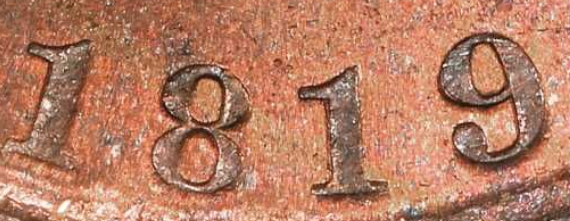
I appreciate Walkerguy21D for pointing this out. Using the comparison to the digits used on the Matron Head cents, we can see the 9's are also included in the Style of 1818/1819 difference.
Looking at the number 9:
Style of 1818 (Small 9): Circular hole, knob on tail of 9 curls inward, moderately consistent numeral thickness.
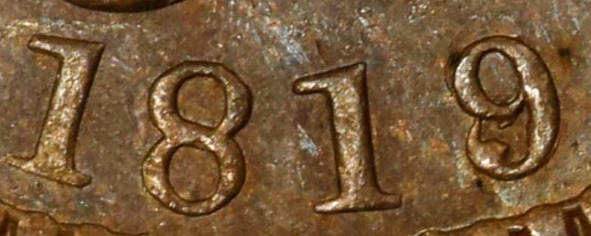
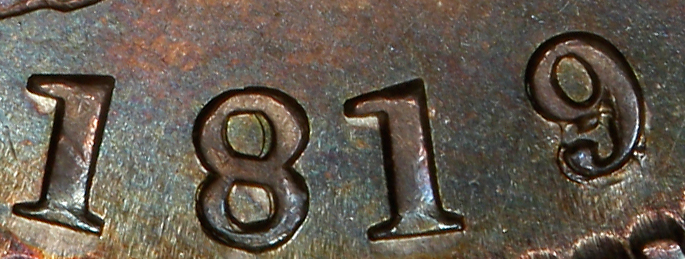
Cent N-1 Proof
Half Dollar O-101
Style of 1819 (Large 9): More rectangular hole, knob on tail of 9 sticks upward, excessively thin and thick parts of the numeral.
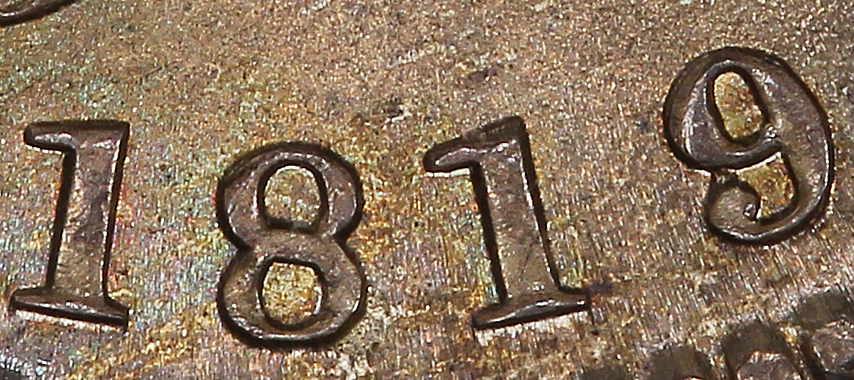
Cent N-8
Half Dollar
The Large Cent SMALL overdate uses the same numeral as the Half Dollar LARGE overdate, and vice versa. Oopsies!!
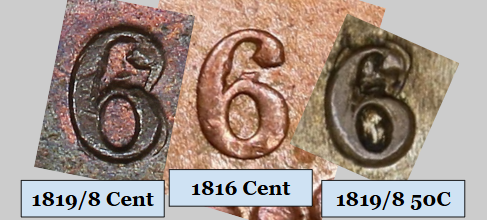
Now why are there both large and small versions of the 9 punch. Well, the style of 1818 #9 punch was the same used on the 1816 large cents! The #6 punch was simply turned upside down. The obvious protruding knife-like shape coming out of the center top loop is seen on all the digits across all denominations and 1816 die marriages.
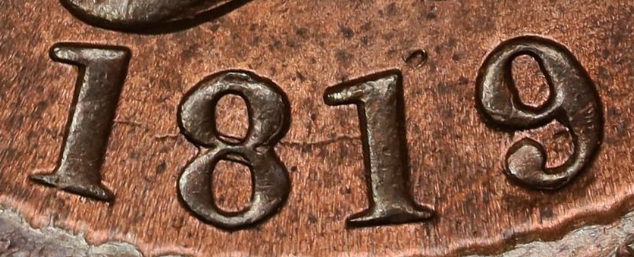
Fun fact, on the 1819/(8) so called overdate N-2 Matron Head cent, looking at the number 8, the style of 1819 was punched OVER the style of 1818. You can see the thick center beam under the thin beam on the 8.
"But seek ye first the kingdom of God and His righteousness and all these things shall be added unto you" Matthew 6:33. Young fellow suffering from Bust Half fever.
BHNC #AN-10
JRCS #1606
Excellent research!
Edited to add: That last picture with the "Style of 1819 8" punched over the "Style of 1818 8" is amazing!
jacrispies Cent images made me go over to the Heritage Archives to see what else I could find. Not too much, except some circumstantial evidence that perhaps supports my theory that the 1819/8 O-105 Style of 1819 date is the result of a blundered die.
1819 $5 with Blundered Denomination, the 5 followed by a close 0 as though to make a 50 Cent die, that was then corrected by punching a D over the 0.
1819 Quarter Dollar with a strongly repunched denomination.
Great sleuthing, @jacrispies.
I really like your images.
I need to print this out and add it to my Newcomb book.
I love this kind of thread!
My hobby website Groovycoins.com, new and improved!
Same here!
Real research and shared knowledge by real numismatists. Leave the political, sticker, and parking lot error threads to the trolls and last-word guys.
Still waiting for any response from the Bust Half Dollar community, other than the two gentlemen who participated above.