Which coins historically have been used in coin-operated machines?
 logger7
Posts: 9,515 ✭✭✭✭✭
logger7
Posts: 9,515 ✭✭✭✭✭
I was thinking about all the coin-operated machines over the years.
I'm assuming that only quarters, dimes and nickels have been compatible and that only currently circulating coins could be used.
Were Buffalo nickels ever compatible? I'm assuming that Mercury dimes were compatible and possibly Barbers?
1
Comments
I remember as a kid in the 1940s buying gum at gumball machines for a penny!
I remember buying Cokes from a Coke machine for a nickel (Buffalo)!
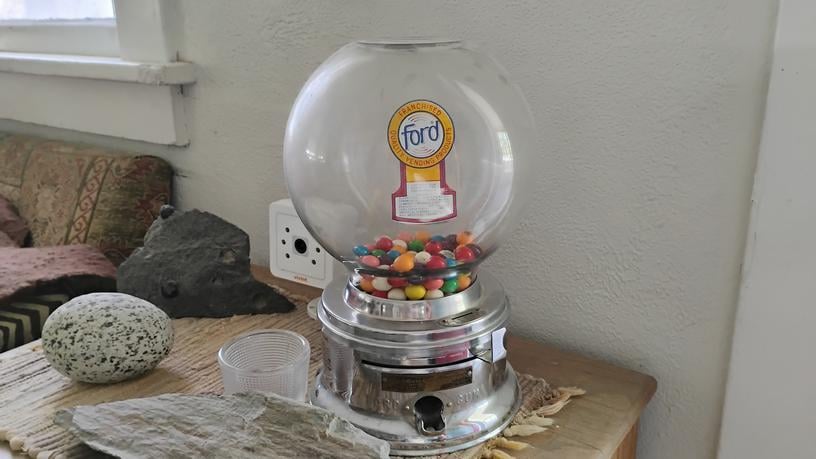
There were plenty of penny candy vending machines when I was a kid. I have a penny gumball machine, needs refilling.
In the 1980s a restaurant I went to had a restored 1950s jukebox that took halves. It had a card listing the coins it accepted that had a drawing of a Franklin half.
In the 1980s and early ‘90s the local post office had a stamp vending machine that accepted cents through quarters.
witty quote goes here
I'm not sure I understand the question.
Why wouldn't Buffalo nickels be "compatible"? I've used dateless buffalo nickels in vending machines.
You cast a wider net by using the term "coin-operated machines" rather than "vending machines". Small dollars are/were widely accepted in machines, and aside from gumball machines there used to be stamp machines in many post offices that took cents. My local supermarkets accept half dollars at the self-checkouts.
Back in the old days casinos accepted large dollar coins in slot machines.
It might be easier to figure out when coin-operated machines came into use. The coins in active circulation at the time were probably accepted in the machines. I'd expect that machines were never calibrated to accept gold coins, and silver dollars were rarely accepted.
Pre 1949’s slot machines used 1c, 5c, 10c, 25c, 50c, and $1 coins. Modern machines used 5c, 10c, 25c, 50c, and $1 coins. The newest ones take $1, $5, $10, $20, $50, and $100 bills. The only circulating denom that won’t generally work in a slot machine is the $2 bill.
Buffalo nickel, merc dime then slq quarters and barber qtrs
I have a water refill station nearby that charges $0.50 a gallon. I wish it took half dollars instead of just quarters.
Custom album maker and numismatic photographer.
Need a personalized album made? Design it on the website below and I'll build it for you.
https://www.donahuenumismatics.com/.
In Meijer stores you can still ride "Sandy" for one cent.
When I was a kid in the '60s and '70s, it was mostly nickels, dimes, and quarters, but there were a few gumball machines that accepted 1-cent... by the '80s and '90s, seemingly every machine was just quarters. By the mid '00s I was using vending machines that also accepted $1 coins too...
Successful BST transactions with: SilverEagles92; Ahrensdad; Smitty; GregHansen; Lablade; Mercury10c; copperflopper; whatsup; KISHU1; scrapman1077, crispy, canadanz, smallchange, robkool, Mission16, ranshdow, ibzman350, Fallguy, Collectorcoins, SurfinxHI, jwitten, Walkerguy21D, dsessom.
I remember buying Cokes from a Coke machine for a dime. (Tonawanda)
DPOTD-3
'Emancipate yourselves from mental slavery'
CU #3245 B.N.A. #428
Don
I grew up in the age of penny gum ball machines. There was even a machine in a store near my Grandma's house that dispensed a small quantity of Spanish peanuts, loose, into your hand under the outlet, for a penny. Yeah, unsanitary as hell, but we didn't care.
When I moved to Sidney, O. in 1973 to work for Coin World the parking meters on the town square were cheap to encourage people to shop downtown, without allowing people who worked downtown to take up a parking space all day. 12 minutes for a penny or an hour for a nickel. If you went over the cop left a small envelope under your windshield wiper with your license plate number written on it and you stuck a quarter in it and left it in a drop box attached to one of the meter posts.
Corner gas station by our house had the small (6-1/2 oz.?) Cokes for a nickel, but you had to drink it there and leave the bottle, which was otherwise worth two cents at the corner store on the same block. Their candy machine had Lifesavers and packs of gum for a nickel. Various candy bars in it were either a nickel or a dime. Over at that corner store there was penny candy, pretzel sticks 2 for a penny, and the holy grail, a 16-ounce Pepsi for a dime (plus two cents for the bottle). After Cuba fell to Castro the price eventually went up to 11 cents because of the embargo on Cuban sugan, and we were devastated.
Pay phones had slots for nickels, dimes and quarters so you could pay whatever the operator told you to put in for toll calls. Local calls were still a nickel. When roll hunting cent rolls you would occasionally get a cent that had been cut down to the size of a dime to fool a pay phone, which were not very sophisticated. Somebody's time was worth nine cents.
There was a "steak and egger" 24 hour restaurant two blocks over that was built in 1961 or 1962 when half dollars still circulated. Juke box by the door but each booth had a remote jukebox control with pages you could flip to see the songs. One song for a dime, 3 for a quarter or 7 for a half dollar.
The laundromat my Ma used for a while after our washing machine broke and Dad couldn't afford to replace it charged one quarter for each washing machine load and one dime to start the dryer, but of course it always took multiple dimes to dry the clothes for eight people. They had one change machine that would give you four quarters for a paper dollar, another machine that would give you two dimes and a nickel for a quarter, or five dimes for a half dollar. If I went with her the dryer got the dimes and the candy machine got the nickels. Dad had a bread route so he got half dollars from customers, that Ma would bring to the laundromat to get that extra dime out of the change machine rather than two nickels, so I got no candy that day.
The point is, prices were incredibly cheap, and if I "broke a dollar" that Grandma gave me it might take me more than a week to spend all of the change on multiple purchases,
When I managed to amass a dollar in change, on occasion I'd go the the pink store (the corner liquor store that was painted... pink) and exchange it for a silver dollar just to carry it around for a while. As noted, that was a lot of money for a kid so it would (sooner rather than later) end up being spent on baseball cards or something.
The first nickelodeon was back shortly after the turn of the previous century. Most heavily worn shield nickels passed through these machines many times as did all the heavily worn V nickels. Vending machines have been around forever and started getting common ion the 1850's. Nickels were also used extensively to operate pay telephones especially in the 1920's. So many people were pounding a bit of lead into the center holes in tokens to make "plug nickels" that oddly shaped metal tokens necessary to operate them were issued by the establishments that had the phones. These "telephone tokens" were made by Yale et al and few survive because they were gathered up in WWII scrap drives. Machines started accepting more silver and making change in the '40's as prices went higher and selection expanded.
Machines have lost a lot of usage because even toll booths require handfuls of change because 25c is the largest circulating. Just like you can't pay cash for a house or even a car any longer, it's harder to find a can of pop for eight or ten quarters.
Now days coins go through machines even more often because they go through a counter almost every time they get used. They from store to customer to bank counter.
I am somewhat familiar with early to mid 20th century slot machines and trade stimulators. Trade stimulators came out to combat the anti-gambling laws of the depression era. Those machines usually have windows to see the last few coins deposited into the machine. Mechanical machines can't tell the difference between a jefferson nickel and a buffalo nickel, so contemporary players often put slugs/blanks/fakes into the machine. The viewing window provides accountability by the store workers amidst payout.
I personally use dateless buffalo nickels in my 1930s slot machine.
"But seek ye first the kingdom of God and His righteousness and all these things shall be added unto you" Matthew 6:33. Young fellow suffering from Bust Half fever.
BHNC #AN-10
JRCS #1606
dc metro and usps vending machines were made to take small dollars. i suppose the usps vending machines are rare now
I also vaguely recall from the 1990s that a town in Massachusetts (can't remember which) also still had penny parking meters.
Collector of Liberty Seated Half Dimes, including die pairs and die states
Early to mid 70's: I don't recall seeing/using SLQ's or Barbers. A few Mercs maybe. I recall gumball machines being a penny. A nickel for a small toy. My favorite soda machine had bottles, a long thin glass side door, and a big button to smash to dispense the bottle w/bottle cap. I don't remember the price but man were those cold and appreciated on a hot day.
USAF veteran 1984-2005
Given the incredible growth of the economy after 1964, the clad quarter would be a good candidate.
Mid to late 1960s the local gas stations had condom machines in the mens restrooms. Cost 25 cents for the really good ones or other wise 3 for a quarter out of the other machine. There was always a line for the mens room at the service station closest to the drive in movies.
Phone calls were a dime and everyone wore penny loafers with a dine in the penny slot so you always had money to call home.
Cokes were 5 cents for the small bottles and you could bring the bottle back for 2 cent deposit (this was in the mid 1950s). Later on cokes went to 7 cents and finally to a dime by the end of the 50s and early 60s.
Basically everything since inception of coin-op.
Buffs were heavily used in the Bingo gaming machines of the 40s- 50s. Some even had coin hoppers paid out like slots.
Some 80s pinball machines manufacturers tried SBA coin acceptors, the coin window had just a $ sign, many players would fold up a dollar bill and shove it down the slot. SBA dollar coin option didn't last long.
I remember slugs you could find at construction sites that would mimic quarters and some people would use them in machines.
In time the machines got more and more accurate in differentiating real from fake or inappropriate coins.
Here's a quick overview:
"Coin-operated machines identify coins through a combination of physical, electronic, and magnetic tests performed in a fraction of a second. Modern coin acceptors rely on these multi-layered checks to determine a coin's denomination and authenticity.
"Core Identification Methods
Size and Dimensional Analysis:
Light Sensors: When a coin is inserted, it passes between infrared LEDs and phototransistors. The duration and pattern of the shadow it casts allow the machine to calculate its diameter and thickness.
Mechanical Cradles: Older or simpler machines use physical slots and balanced cradles that only allow coins of a specific size and weight to pass through.
Metallic Composition (Electronic Signature):
Electromagnetic Sensors: The coin passes through an electromagnetic field generated by a copper coil.
Eddy Current Testing: As the coin moves, it creates "ripples" or disturbances (eddy currents) in the magnetic field. These disturbances vary based on the coin's conductivity and material density, creating a unique "electronic signature".
Inductive Sensors: These measure how the coin disrupts a magnetic field to identify the specific metal alloy used in genuine currency, such as copper or nickel.
Weight and Mass Verification:
Electronic Scales: High-precision sensors weigh each coin to a fraction of a gram.
Counterweights: Mechanical sorters may use pivoted arms with counterweights that only tip if the coin meets the required weight.
Velocity and Sound:
Speed Tracking: Some machines use a second set of light sensors to measure the coin's speed as it rolls down a ramp; different weights and surface textures cause coins to roll at different rates.
Acoustic Analysis: Experimental technology analyzes the distinct sound a coin makes when it strikes a surface inside the machine to further verify its density.
"Security and Sorting
Anti-Fraud Mechanisms: To prevent "coin-on-a-string" tricks, machines use one-way levers or traps that allow the coin to fall in but block it from being pulled back out.
Rejection: If a coin's signature (size, metal, or weight) does not match the pre-programmed reference table, the machine activates a diverter that sends the object to the reject chute.
Sorting: Once verified, the coin is directed into specific storage tubes or columns based on its denomination for use as future change."
All I know is that back in 1991, the vending machine at work could spit out a 1950-D nickel in AU condition.
I use only buffalo nickels in my Bally Skill roll. Have a dish full of them next to the machine. To play, you drop a nickel into the top, then use the levers on the sides to flick nickels across each level tying to score as many points as possible. To win, make it all the way to the bottom.
Very cool. Not a common Bally piece.
speaking technically, if a buffalo nickel & Jefferson nickels are the same size, wouldent they both work in the same machine?> @logger7 said:
Micah Langford - https://www.oldglorycoinsandcurrency.com/