Although this is a world gold die trial, not U.S. it is interesting for several reasons.
The regular issue is silver. This gold die trial was struck in 1904 because of the new portrait, over a struck gold die trial from 1903 with the previous portait.
Although just designated as a die trial, there is more to it!
mikebyers.com Dealer in Major Mint Errors, Die Trials & Patterns - Author of NLG Best World Coin Book World's Greatest Mint Errors - Publisher & Editor of minterrornews.com.
@DelawareDoons said:
As the first professional to see this coin after 40ish years of hiding, I feel like I should chime in. I figured it was bad within a few minutes of having it in my hands. It wasn't until we discovered it was published in the Judd book that we considered the possibility that it might be a legitimate US Mint product. I remained extremely skeptical. Key part here: All of my coworkers, who I won't run around name dropping, but are all very well-known and respected within the business, didn't like it either.
Do you know who I am? I'm a nobody. I'm a grunt. If I was able to pick this out that quickly, as far as I'm concerned, it's inexcusable that so many highly regarded industry luminaries missed it in the past. Embarrassing, even.
Know who had counterfeit $3 gold blanks laying around after 1900? The major counterfeiting operation out of the Middle East circa the 1940s-1960's. That is the most likely origin of this piece based on my research when it was in my possession. I tried to match it up with proof reverse dies from the entire run based on a few die markers I picked up in-hand and could find nothing that matched well enough to sell me on it.
Not matching up a coin with die markers is not, by itself, definitive proof that the coin is counterfeit.
There are coins that have been certified that were struck from unknown dies, that matched no known die markers, including this 1795 Bust Dollar that I sold for $375k.
mikebyers.com Dealer in Major Mint Errors, Die Trials & Patterns - Author of NLG Best World Coin Book World's Greatest Mint Errors - Publisher & Editor of minterrornews.com.
@DelawareDoons said:
As the first professional to see this coin after 40ish years of hiding, I feel like I should chime in. I figured it was bad within a few minutes of having it in my hands. It wasn't until we discovered it was published in the Judd book that we considered the possibility that it might be a legitimate US Mint product. I remained extremely skeptical. Key part here: All of my coworkers, who I won't run around name dropping, but are all very well-known and respected within the business, didn't like it either.
Do you know who I am? I'm a nobody. I'm a grunt. If I was able to pick this out that quickly, as far as I'm concerned, it's inexcusable that so many highly regarded industry luminaries missed it in the past. Embarrassing, even.
Know who had counterfeit $3 gold blanks laying around after 1900? The major counterfeiting operation out of the Middle East circa the 1940s-1960's. That is the most likely origin of this piece based on my research when it was in my possession. I tried to match it up with proof reverse dies from the entire run based on a few die markers I picked up in-hand and could find nothing that matched well enough to sell me on it.
This is a convincing agrument.
Especially when you consider it first appeared in 1962. Where did it come from? Some Grandpa's closet, who happened to be former mint employee who stole and struck it on a $3 planchet after hours, smuggled it out of the mint, and hid it for at least 5 decades, probably 6, maybe even more? Or was it a splasher/test piece from a massive counterfeiting operation that dumped countless above-average quality counterfeit Pre-33 US gold into the market in the same era? Occam's Razor is tremendously relevant here.
I didn't even get into the three lines and two 0's, there's no way those markings are period to the turn of the century, imho.
"It's like God, Family, Country, except Sticker, Plastic, Coin."
There are examples of pieces de caprice, intentionally made, smuggled out, unique to date, hidden for decades, before being sold.
A great example is this unique gold Buffalo Nickel that was kept in a family for 100 years, unknown to the numismatic community.
It is also an example of a grading service changing their mind. This changed a $78k coin sold in auction (PCGS net graded test cut) to a $400k coin sold to a Trust with the #1 Registry set of Buffalo Nickels (NGC straight graded AU 53)
Slabbed details test cut by PCGS, then straight graded by NGC, then crossed in the NGC holder to a straight graded PCGS holder.
So… anything is possible!
mikebyers.com Dealer in Major Mint Errors, Die Trials & Patterns - Author of NLG Best World Coin Book World's Greatest Mint Errors - Publisher & Editor of minterrornews.com.
Neither of those examples are comparable. There are significantly more artifacts around the lettering on the fake, and I am aware of what orange peel is and do not agree that that is what’s going on here.
Every characteristic I posted is consistent with a mechanical (impact) transfer die counterfeit. None of them are post-strike. The wormy raised line on the U could almost single handedly condemn the coin.
.
What you have been posting is characteristics of the genuine master hub for the Quarter Eagle reverse, circa 1900.
You don't seem to recognize what you are looking at.
Your condemnation of the wormy line on the "U" is incorrect.
This is not the same thing as the Omega Saint-Gaudens high-relief.
Here is a genuine 1900 proof reverse that has a faint instance of that same line:
Pareidolia.
@Byers said:
Although this is a world gold die trial, not U.S. it is interesting for several reasons.
The regular issue is silver. This gold die trial was struck in 1904 because of the new portrait, over a struck gold die trial from 1903 with the previous portait.
Although just designated as a die trial, there is more to it!
This is a funny choice because the Dupriez reference is famously full of restrikes (whether noted as such or not), and that piece has die rust all over the neck…seems more likely a later concoction with genuine mint dies. But at least it doesn’t look like it’s struck from transfer dies!
However, this inspired me to briefly search CoinArchives for records of gold foreign die trials. Out of millions of auction records over the last 25+ years, I didn’t find anything comparable to the present piece. I am actually a bit surprised how consistent that is over all the world mints, but it does make sense.
Neither of those examples are comparable. There are significantly more artifacts around the lettering on the fake, and I am aware of what orange peel is and do not agree that that is what’s going on here.
Every characteristic I posted is consistent with a mechanical (impact) transfer die counterfeit. None of them are post-strike. The wormy raised line on the U could almost single handedly condemn the coin.
.
What you have been posting is characteristics of the genuine master hub for the Quarter Eagle reverse, circa 1900.
You don't seem to recognize what you are looking at.
Your condemnation of the wormy line on the "U" is incorrect.
This is not the same thing as the Omega Saint-Gaudens high-relief.
Here is a genuine 1900 proof reverse that has a faint instance of that same line:
Pareidolia.
@Byers said:
Although this is a world gold die trial, not U.S. it is interesting for several reasons.
The regular issue is silver. This gold die trial was struck in 1904 because of the new portrait, over a struck gold die trial from 1903 with the previous portait.
Although just designated as a die trial, there is more to it!
This is a funny choice because the Dupriez reference is famously full of restrikes (whether noted as such or not), and that piece has die rust all over the neck…seems more likely a later concoction with genuine mint dies. But at least it doesn’t look like it’s struck from transfer dies!
However, this inspired me to briefly search CoinArchives for records of gold foreign die trials. Out of millions of auction records over the last 25+ years, I didn’t find anything comparable to the present piece. I am actually a bit surprised how consistent that is over all the world mints, but it does make sense.
It is funny because I forgot to mention about the Belgium restrikes in my post. A great example of a likely restrike with official genuine mint dies. A PCGS set of these (obverse and reverse) sold in a Japanese auction as a pair, in gem condition but not designated as restrikes.
I forgot what they looked like ( whether they had rust).
mikebyers.com Dealer in Major Mint Errors, Die Trials & Patterns - Author of NLG Best World Coin Book World's Greatest Mint Errors - Publisher & Editor of minterrornews.com.
@dcarr said:
Has anybody here ever examined (or even seen) a broad-struck proof coin circa 1900 ?
A broad-struck proof coin is going to exhibit characteristics that are not normally seen.
Dan- coincidentally, years ago I sold a very broadstruck 1900 IHC pr 66 NGC. I will try and dig out the images…
Maybe it was a few years earlier. I will look.
mikebyers.com Dealer in Major Mint Errors, Die Trials & Patterns - Author of NLG Best World Coin Book World's Greatest Mint Errors - Publisher & Editor of minterrornews.com.
I sure hope you don't work in forensics.
Otherwise, a lot of guilty people will be going free.
.
Well I sure hope you don’t work in a grading room. Otherwise, a lot of guilty coins will be going free. Again, there are much, much better transfer fakes out there than this coin, so I shudder to think what would be let through!
My takeaway from a thread like this is 4 fold. 1. Makes one think. 2.Helps one learn more as there is always something new.3.Don't accept all as gospel/face value.4 Makes one wonder what else is out there waiting to be uncovered.
Successful transactions:Tookybandit. "Everyone is equal, some are more equal than others".
They can determine such fakes to be fakes because transfer counterfeits have consistent characteristics that will generally not be seen on genuine items. Essentially every decent fake of a milled coin is a transfer of some kind from a genuine example.
The difference between a “good quality” and a “bad quality” transfer counterfeit comes down to the quantity and severity of those detectable characteristics. This piece is not, in my opinion from the images, of particularly good quality, and I am surprised that it passed as genuine for as long as it did.
I entirely disagree with these assumptions. Terms such as "generally" are inserted here after an assertion which many would not accept. These as you finally concluded are not spark erosions and you can not prove transfer of any type as this was also assertion without decent base. The blowups support you nought either, but bless you for having a steady opinion.
Love that Milled British (1830-1960) Well, just Love coins, period.
I sure hope you don't work in forensics.
Otherwise, a lot of guilty people will be going free.
.
Well I sure hope you don’t work in a grading room. Otherwise, a lot of guilty coins will be going free. Again, there are much, much better transfer fakes out there than this coin, so I shudder to think what would be let through!
.
Maybe you can find a known counterfeit with die markers that match the subject item.
mikebyers.com Dealer in Major Mint Errors, Die Trials & Patterns - Author of NLG Best World Coin Book World's Greatest Mint Errors - Publisher & Editor of minterrornews.com.
I sure hope you don't work in forensics.
Otherwise, a lot of guilty people will be going free.
.
Well I sure hope you don’t work in a grading room. Otherwise, a lot of guilty coins will be going free. Again, there are much, much better transfer fakes out there than this coin, so I shudder to think what would be let through!
.
Maybe you can find a known counterfeit with die markers that match the subject item.
.
That would certainly be helpful. As of now I am not convinced that it is a counterfeit die. It might be, but I don't think that that has been proven.
Numismatist. 54 year member ANA. Former ANA Senior Authenticator. Winner of four ANA Heath Literary Awards; three Wayte and Olga Raymond Literary Awards; Numismatist of the Year Award 2009, and ANA Lifetime Achievement Award 2020. Author of "The Enigmatic Lincoln Cents of 1922," Available now from Whitman or Amazon.
I posted this earlier but it may have gotten lost in the shuffle.
mikebyers.com Dealer in Major Mint Errors, Die Trials & Patterns - Author of NLG Best World Coin Book World's Greatest Mint Errors - Publisher & Editor of minterrornews.com.
I did not know NGC took photos of pieces they made a disposition on and did not slab.
You need to request it.
mikebyers.com Dealer in Major Mint Errors, Die Trials & Patterns - Author of NLG Best World Coin Book World's Greatest Mint Errors - Publisher & Editor of minterrornews.com.
I was working an ANA show one time when a guy came up to the table and handed me an uncancelled S-Mint Seated Liberty With Motto reverse die. He was looking for offers. I did not have much time to study it for diagnostics, but it was a genuine U.S. Mint die in pretty decent condition.
If somebody took a trial piece from it in any metal at any time in the last 150+ years, how would you either certify or condemn that trial piece?
Numismatist. 54 year member ANA. Former ANA Senior Authenticator. Winner of four ANA Heath Literary Awards; three Wayte and Olga Raymond Literary Awards; Numismatist of the Year Award 2009, and ANA Lifetime Achievement Award 2020. Author of "The Enigmatic Lincoln Cents of 1922," Available now from Whitman or Amazon.
@CaptHenway said:
I was working an ANA show one time when a guy came up to the table and handed me an uncancelled S-Mint Seated Liberty With Motto reverse die. He was looking for offers. I did not have much time to study it for diagnostics, but it was a genuine U.S. Mint die in pretty decent condition.
If somebody took a trial piece from it in any metal at any time in the last 150+ years, how would you either certify or condemn that trial piece?
Too broad a question. Define "pretty decent", first of all. Then "somebody " would still need to match the planchet composition and approximate striking pressure. And if they did all that, it would be quite hard to tell.
I'm fairly certain there are undetected (undetectable?) counterfeits in TPG holders. Look how long it took the micro O counterfeits to be discovered.
All comments reflect the opinion of the author, even when irrefutably accurate.
@CaptHenway said:
I was working an ANA show one time when a guy came up to the table and handed me an uncancelled S-Mint Seated Liberty With Motto reverse die. He was looking for offers. I did not have much time to study it for diagnostics, but it was a genuine U.S. Mint die in pretty decent condition.
If somebody took a trial piece from it in any metal at any time in the last 150+ years, how would you either certify or condemn that trial piece?
Too broad a question. Define "pretty decent", first of all. Then "somebody " would still need to match the planchet composition and approximate striking pressure. And if they did all that, it would be quite hard to tell.
I'm fairly certain there are undetected (undetectable?) counterfeits in TPG holders. Look how long it took the micro O counterfeits to be discovered.
Who says that a die trial has to be on anything specific, or struck at any particular pressure?
Numismatist. 54 year member ANA. Former ANA Senior Authenticator. Winner of four ANA Heath Literary Awards; three Wayte and Olga Raymond Literary Awards; Numismatist of the Year Award 2009, and ANA Lifetime Achievement Award 2020. Author of "The Enigmatic Lincoln Cents of 1922," Available now from Whitman or Amazon.
Who says that a die trial has to be on anything specific, or struck at any particular pressure?
They've been none to be struck on paper/cardboard.
That is not correct:
I handled cardboard die trials of 3 Cent pieces and gold commems:
mikebyers.com Dealer in Major Mint Errors, Die Trials & Patterns - Author of NLG Best World Coin Book World's Greatest Mint Errors - Publisher & Editor of minterrornews.com.
Who says that a die trial has to be on anything specific, or struck at any particular pressure?
They've been none to be struck on paper/cardboard.
Case in point ...
JA-1870-2 (Mis labled by PCGS as 1870-1) A reverse “splasher” or die trial, struck on white metal or lead. i think a paper or cardboard backing.
PCGS slabbed as GENUINE.
Correct!
There are some in the Judd pattern book struck on cardboard (I just gave 2 examples in my previous post) as well as some on paper/cardboard backed lead and white metal splashers.
mikebyers.com Dealer in Major Mint Errors, Die Trials & Patterns - Author of NLG Best World Coin Book World's Greatest Mint Errors - Publisher & Editor of minterrornews.com.
@CaptHenway said:
I was working an ANA show one time when a guy came up to the table and handed me an uncancelled S-Mint Seated Liberty With Motto reverse die. He was looking for offers. I did not have much time to study it for diagnostics, but it was a genuine U.S. Mint die in pretty decent condition.
If somebody took a trial piece from it in any metal at any time in the last 150+ years, how would you either certify or condemn that trial piece?
Too broad a question. Define "pretty decent", first of all. Then "somebody " would still need to match the planchet composition and approximate striking pressure. And if they did all that, it would be quite hard to tell.
I'm fairly certain there are undetected (undetectable?) counterfeits in TPG holders. Look how long it took the micro O counterfeits to be discovered.
Who says that a die trial has to be on anything specific, or struck at any particular pressure?
Fair. I was thinking more of a coin than a random die trial.
All comments reflect the opinion of the author, even when irrefutably accurate.
Who says that a die trial has to be on anything specific, or struck at any particular pressure?
They've been none to be struck on paper/cardboard.
.
I think @RedRocket maybe meant to write "They've been KNOWN to be struck on paper/cardboard.".
.
Thank you.
YES!
I miswrote.
No worries!
mikebyers.com Dealer in Major Mint Errors, Die Trials & Patterns - Author of NLG Best World Coin Book World's Greatest Mint Errors - Publisher & Editor of minterrornews.com.
@CaptHenway said:
I was working an ANA show one time when a guy came up to the table and handed me an uncancelled S-Mint Seated Liberty With Motto reverse die. He was looking for offers. I did not have much time to study it for diagnostics, but it was a genuine U.S. Mint die in pretty decent condition.
If somebody took a trial piece from it in any metal at any time in the last 150+ years, how would you either certify or condemn that trial piece?
Good question. There are coins struck outside of the U.S. Mint, but with genuine Mint dies, featured in Appendix C of the Judd book, as you obviously know, but maybe some collectors were not aware of this.
Here is a perfect coin that addresses several issues in this thread, and in CaptHenway’s post:
•Gold Die Trial struck from rusted dies
•Unique and finally certified by PCGS
in 2006 after decades of floating around raw between dealers
•Genuine U.S. Mint die but privately struck outside of the Mint
•Listed in US Patterns, photo by Mike Byers
Now for the story!!
I was offered this die trial raw from Larry Demerer (National Coin Investments), the same firm where I purchased the gold Die Trial from his Partner, Paul Nugget which is what this thread is all about.
It was raw, rusted, funky looking, and to address CaptHenry’s question…I had no idea whether to get it certified or condemn it. In fact, the more I examined it, the more I was convinced that it was counterfeit, so I passed… even at $1500. This was in 1998 I think.
Eventually it appears in 2006 in the inventory of Ron Karp (NYGM) at a major show. He shows it to me. It’s still raw. I’m thinking that this will never slab! It’s 15k. I pass and thank him.
A year later I notice it in his inventory list. I call him. Now it’s in a PCGS MS 63 holder, Judd # and all! I jump on it and purchase it for $80k!
I display it at the Long Beach CA coin show, in my show case at my corner table. No action on it. Ok.
A week later John Albanese calls. (yes, THAT John Albanese, from CAC). He instantly buys it sight unseen at $100k for another dealer. It is placed in the world famous Simpson Collection.
Here is a screenshot of the coin on my website, and here is a screenshot from US Patterns:
mikebyers.com Dealer in Major Mint Errors, Die Trials & Patterns - Author of NLG Best World Coin Book World's Greatest Mint Errors - Publisher & Editor of minterrornews.com.
@CaptHenway said:
I was working an ANA show one time when a guy came up to the table and handed me an uncancelled S-Mint Seated Liberty With Motto reverse die. He was looking for offers. I did not have much time to study it for diagnostics, but it was a genuine U.S. Mint die in pretty decent condition.
If somebody took a trial piece from it in any metal at any time in the last 150+ years, how would you either certify or condemn that trial piece?
Good question. There are coins struck outside of the U.S. Mint, but with genuine Mint dies, featured in Appendix C of the Judd book, as you obviously know, but maybe some collectors were not aware of this.
Here is a perfect coin that addresses several issues in this thread, and in CaptHenway’s post:
•Gold Die Trial struck from rusted dies
•Unique and finally certified by PCGS
in 2006 after decades of floating around raw between dealers
•Genuine U.S. Mint die but privately struck outside of the Mint
•Listed in US Patterns, photo by Mike Byers
Now for the story!!
I was offered this die trial raw from Larry Demerer (National Coin Investments), the same firm where I purchased the gold Die Trial from his Partner, Paul Nugget which is what this thread is all about.
It was raw, rusted, funky looking, and to address CaptHenry’s question…I had no idea whether to get it certified or condemn it. In fact, the more I examined it, the more I was convinced that it was counterfeit, so I passed… even at $1500. This was in 1998 I think.
Eventually it appears in 2006 in the inventory of Ron Karp (NYGM) at a major show. He shows it to me. It’s still raw. I’m thinking that this will never slab! It’s 15k. I pass and thank him.
A year later I notice it in his inventory list. I call him. Now it’s in a PCGS MS 63 holder, Judd # and all! I jump on it and purchase it for $80k!
I display it at the Long Beach CA coin show, in my show case at my corner table. No action on it. Ok.
A week later John Albanese calls. (yes, THAT John Albanese, from CAC). He instantly buys it sight unseen at $100k for another dealer. It is placed in the world famous Simpson Collection.
Here is a screenshot of the coin on my website, and here is a screenshot from US Patterns:
And when Simpson sold it through Heritage in 2020, it brought 156K.
Andy Lustig
Doggedly collecting coins of the Central American Republic.
Visit the Society of US Pattern Collectors at USPatterns.com.
@CaptHenway said:
I was working an ANA show one time when a guy came up to the table and handed me an uncancelled S-Mint Seated Liberty With Motto reverse die. He was looking for offers. I did not have much time to study it for diagnostics, but it was a genuine U.S. Mint die in pretty decent condition.
If somebody took a trial piece from it in any metal at any time in the last 150+ years, how would you either certify or condemn that trial piece?
Good question. There are coins struck outside of the U.S. Mint, but with genuine Mint dies, featured in Appendix C of the Judd book, as you obviously know, but maybe some collectors were not aware of this.
Here is a perfect coin that addresses several issues in this thread, and in CaptHenway’s post:
•Gold Die Trial struck from rusted dies
•Unique and finally certified by PCGS
in 2006 after decades of floating around raw between dealers
•Genuine U.S. Mint die but privately struck outside of the Mint
•Listed in US Patterns, photo by Mike Byers
Now for the story!!
I was offered this die trial raw from Larry Demerer (National Coin Investments), the same firm where I purchased the gold Die Trial from his Partner, Paul Nugget which is what this thread is all about.
It was raw, rusted, funky looking, and to address CaptHenry’s question…I had no idea whether to get it certified or condemn it. In fact, the more I examined it, the more I was convinced that it was counterfeit, so I passed… even at $1500. This was in 1998 I think.
Eventually it appears in 2006 in the inventory of Ron Karp (NYGM) at a major show. He shows it to me. It’s still raw. I’m thinking that this will never slab! It’s 15k. I pass and thank him.
A year later I notice it in his inventory list. I call him. Now it’s in a PCGS MS 63 holder, Judd # and all! I jump on it and purchase it for $80k!
I display it at the Long Beach CA coin show, in my show case at my corner table. No action on it. Ok.
A week later John Albanese calls. (yes, THAT John Albanese, from CAC). He instantly buys it sight unseen at $100k for another dealer. It is placed in the world famous Simpson Collection.
Here is a screenshot of the coin on my website, and here is a screenshot from US Patterns:
And when Simpson sold it through Heritage in 2020, it brought 156K.
I want to thank Andy who assisted me in part of the transaction.
mikebyers.com Dealer in Major Mint Errors, Die Trials & Patterns - Author of NLG Best World Coin Book World's Greatest Mint Errors - Publisher & Editor of minterrornews.com.
They can determine such fakes to be fakes because transfer counterfeits have consistent characteristics that will generally not be seen on genuine items. Essentially every decent fake of a milled coin is a transfer of some kind from a genuine example.
The difference between a “good quality” and a “bad quality” transfer counterfeit comes down to the quantity and severity of those detectable characteristics. This piece is not, in my opinion from the images, of particularly good quality, and I am surprised that it passed as genuine for as long as it did.
I entirely disagree with these assumptions. Terms such as "generally" are inserted here after an assertion which many would not accept. These as you finally concluded are not spark erosions and you can not prove transfer of any type as this was also assertion without decent base. The blowups support you nought either, but bless you for having a steady opinion.
They can determine such fakes to be fakes because transfer counterfeits have consistent characteristics that will generally not be seen on genuine items. Essentially every decent fake of a milled coin is a transfer of some kind from a genuine example.
The difference between a “good quality” and a “bad quality” transfer counterfeit comes down to the quantity and severity of those detectable characteristics. This piece is not, in my opinion from the images, of particularly good quality, and I am surprised that it passed as genuine for as long as it did.
I entirely disagree with these assumptions. Terms such as "generally" are inserted here after an assertion which many would not accept. These as you finally concluded are not spark erosions and you can not prove transfer of any type as this was also assertion without decent base. The blowups support you nought either, but bless you for having a steady opinion.
The distinction between spark erosion and mechanical is not as massive as it seems to be taken in this thread…they are both forms of transfer dies. They share some similarities, and they have some differences.
And yes, studying these characteristics is how new fakes are found. On any given day there are multiple counterfeits submitted to the TPGs that have never been seen by them before (meaning, not from that exact counterfeit die). Characteristics like those I listed are how they are identified. I’m sorry that the commenters in this thread are not familiar with those characteristics, but that does not make me wrong.
I used to have the second, or perhaps third, best collection of the coin of Honduras in the 1922 and earlier period. They are wonderful to collect because of the amazingly poor die quality usually found on them.
I was once offered a notorious Five Pesos gold coin which the gold trading department at the Bundesbank in Germany had counterstamped with the word FALSCH, because they did not understand the poor die quality of the piece. They are a fine Third Party Authentication Service, even if only an in-house one. One of their Authenticators even worked for me for a while at ANACS. But they made an honest mistake, as I did on a coin or two in my time at ANACS.
Numismatist. 54 year member ANA. Former ANA Senior Authenticator. Winner of four ANA Heath Literary Awards; three Wayte and Olga Raymond Literary Awards; Numismatist of the Year Award 2009, and ANA Lifetime Achievement Award 2020. Author of "The Enigmatic Lincoln Cents of 1922," Available now from Whitman or Amazon.
@CaptHenway said:
I used to have the second, or perhaps third, best collection of the coin of Honduras in the 1922 and earlier period. They are wonderful to collect because of the amazingly poor die quality usually found on them.
I was once offered a notorious Five Pesos gold coin which the gold trading department at the Bundesbank in Germany had counterstamped with the word FALSCH, because they did not understand the poor die quality of the piece. They are a fine Third Party Authentication Service, even if only an in-house one. One of their Authenticators even worked for me for a while at ANACS. But they made an honest mistake, as I did on a coin or two in my time at ANACS.
TPG services are not immune from making mistakes. Here’s another story…
Over 20 years ago at a Long Beach coin show, I purchased from Silvano DiGenova a 1812 (I think that was the date) $5 gold piece. It was AU 58 to MS 62. Double struck on just the reverse, and the obverse involved another planchet. RAW not certified.
Being a mint error dealer for decades, I knew it was genuine, but the error explanation was a bit complicated and the coin was slightly odd looking.
I showed it to Mike Faraone who was an ANACS authenticator at the time (later for PCGS) who agreed it was genuine.
I showed Fred Weinberg at his table, we discussed the error sequence, and he agreed it was genuine.
I wrote up the submission. Fred signed it stating it was genuine and that Mike Byers was walking it thru PCGS at the show and to expedite it. The point of Fred signing it was that the submission wasn’t delayed. (Mint errors were gathered and delivered to Fred at his office in batches. Since he had seen and authenticated this one already, he signed the submission form.)
The next morning I pick up my submission… COUNTERFEIT. I spoke to 2 PCGS finalizers who ‘explained’ why it was counterfeit.
I placed it in a box with other ‘projects’ and threw it in my safe. A few years later I sold it to Andy Lustig raw and explained the situation.
A short time after, JD (John Dannreuther) offered it for sale. PCGS had finally authenticated it. JD was involved with PCGS in many capacities. I am in NO way implying that JD was involved in anything suspicious. His reputation is beyond excellent!!
I am also not criticizing PCGS. They provide a superb service!! Mistakes are made.
My point is… here was a ‘COUNTERFEIT’ $5 gold coin slabbed counterfeit by PCGS, that later slabbed authentic by the SAME grading company.
So anything is possible and this serves as an example of a condemned coin that finally was certified authentic.
And it won’t be the last time!
mikebyers.com Dealer in Major Mint Errors, Die Trials & Patterns - Author of NLG Best World Coin Book World's Greatest Mint Errors - Publisher & Editor of minterrornews.com.
@CaptHenway said:
I used to have the second, or perhaps third, best collection of the coin of Honduras in the 1922 and earlier period. They are wonderful to collect because of the amazingly poor die quality usually found on them.
I was once offered a notorious Five Pesos gold coin which the gold trading department at the Bundesbank in Germany had counterstamped with the word FALSCH, because they did not understand the poor die quality of the piece. They are a fine Third Party Authentication Service, even if only an in-house one. One of their Authenticators even worked for me for a while at ANACS. But they made an honest mistake, as I did on a coin or two in my time at ANACS.
TPG services are not immune from making mistakes. Here’s another story…
Over 20 years ago at a Long Beach coin show, I purchased from Silvano DiGenova a 1812 (I think that was the date) $5 gold piece. It was AU 58 to MS 62. Double struck on just the reverse, and the obverse involved another planchet. RAW not certified.
Being a mint error dealer for decades, I knew it was genuine, but the error explanation was a bit complicated and the coin was slightly odd looking.
I showed it to Mike Faraone who was an ANACS authenticator at the time (later for PCGS) who agreed it was genuine.
I showed Fred Weinberg at his table, we discussed the error sequence, and he agreed it was genuine.
I wrote up the submission. Fred signed it stating it was genuine and that Mike Byers was walking it thru PCGS at the show and to expedite it. The point of Fred signing it was that the submission wasn’t delayed. (Mint errors were gathered and delivered to Fred at his office in batches. Since he had seen and authenticated this one already, he signed the submission form.)
The next morning I pick up my submission… COUNTERFEIT. I spoke to 2 PCGS finalizers who ‘explained’ why it was counterfeit.
I placed it in a box with other ‘projects’ and threw it in my safe. A few years later I sold it to Andy Lustig raw and explained the situation.
A short time after, JD (John Dannreuther) offered it for sale. PCGS had finally authenticated it. JD was involved with PCGS in many capacities. I am in NO way implying that JD was involved in anything suspicious. His reputation is beyond excellent!!
I am also not criticizing PCGS. They provide a superb service!! Mistakes are made.
My point is… here was a ‘COUNTERFEIT’ $5 gold coin slabbed counterfeit by PCGS, that later slabbed authentic by the SAME grading company.
So anything is possible and this serves as an example of a condemned coin that finally was certified authentic.
And it won’t be the last time!
With all of your talk of unreliable verdicts on authenticity, how can you justify your chosen title for this thread???
Andy Lustig
Doggedly collecting coins of the Central American Republic.
Visit the Society of US Pattern Collectors at USPatterns.com.
(4) No Decisions and (1) Counterfeit… to Authenticated! And it did NOT match a die or another struck coin!
In 2004 in a FUN Heritage Auction, there was a 1928 Standing Liberty Quarter struck on a cent planchet! Incredibly rare!
PCGS, NGC, ANACS and ICG all said ‘No Decision’.
It had 3 die cracks and
silver flakes imbedded into the planchet.
And…no known genuine struck silver coins were known with these die cracks!
I was convinced that it was genuine.
I bought it after the auction ended for approximately $9k.
The next day Jim Halperin ( yes THAT Jim Halperin of Heritage Galleries) calls me…
“Hi Mike! Yesterday I noticed that you purchased the SLQ on a cent planchet from our auction after it ended. We would like to split it with you 50/50. I believe it to be genuine and you do too.”
I was humbled and flattered. This was Jim Halperin. I couldn’t say no! We split it!
Upon receiving the coin, I drove to Fred Weinberg’s. We do tons of business both ways. We had lunch, did business, analyzed the coin, and decided it was genuine. Fred wrote it up, signed it so there was no delay, and off I was to PCGS for a same day walk thru mint error, which was a rare occurance for PCGS.
Fred was wonderful. His assistant Kathy, had to call PCGS in advance and set it up.
PCGS was very polite and accomodating even though this was an unusual submission procedure. I got there in the afternoon. I pick up the coin the next morning.
COUNTERFEIT.
I call Dave Camire ( yes THAT Dave Camire, NGC grading finalizer, mint error expert, and president of NCS) and explained the situation:
Jim Halperin ( some consider him the top grader and authenticator in the world)
split it with me since we both believe it to be genuine. I showed Fred Weinberg in his office and he agreed. But PCGS wouldn’t slab it. No known regular issued silver coin have those die cracks. The silver flakes and overall look tell me that it’s genuine.
Dave said that obviously he needs to carefully examine it. But if authentic, this is what happened:
The reverse die was used and struck a batch of silver coins. That explains the imbedded silver flakes in the surface. The die cracked in several places and was discarded. The Mint was able to locate the bin with these coins and destroyed them. Somehow this off metal with the die cracks escaped the Mint, very likely intentional.
I submitted the coin to NGC.
Not only did Dave Camire say it was definitely genuine, but that NGC had already authenticated one. It’s in the world famous Mark Lighterman ( current President of ANA) off metal collection.
I placed it in my personal collection for many years, until I sold it. The NGC insert designates it from the Byers Collection.
So here is a coin, rejected by PCGS, NGC, ANACS and ICG, rejected again by PCGS even after Fred authenticated it, subsequently certified by NGC the second time around.
So anything is possible and this serves as an example of another condemned coin that finally was certified authentic. And an example of a coin being certified even with no match to a die or another coin.
Once again, I must repeat that in my opinion PCGS and NGC do a wonderful job authenticating and grading. But occasionally mistakes are made.
@CaptHenway said:
I used to have the second, or perhaps third, best collection of the coin of Honduras in the 1922 and earlier period. They are wonderful to collect because of the amazingly poor die quality usually found on them.
I was once offered a notorious Five Pesos gold coin which the gold trading department at the Bundesbank in Germany had counterstamped with the word FALSCH, because they did not understand the poor die quality of the piece. They are a fine Third Party Authentication Service, even if only an in-house one. One of their Authenticators even worked for me for a while at ANACS. But they made an honest mistake, as I did on a coin or two in my time at ANACS.
TPG services are not immune from making mistakes. Here’s another story…
Over 20 years ago at a Long Beach coin show, I purchased from Silvano DiGenova a 1812 (I think that was the date) $5 gold piece. It was AU 58 to MS 62. Double struck on just the reverse, and the obverse involved another planchet. RAW not certified.
Being a mint error dealer for decades, I knew it was genuine, but the error explanation was a bit complicated and the coin was slightly odd looking.
I showed it to Mike Faraone who was an ANACS authenticator at the time (later for PCGS) who agreed it was genuine.
I showed Fred Weinberg at his table, we discussed the error sequence, and he agreed it was genuine.
I wrote up the submission. Fred signed it stating it was genuine and that Mike Byers was walking it thru PCGS at the show and to expedite it. The point of Fred signing it was that the submission wasn’t delayed. (Mint errors were gathered and delivered to Fred at his office in batches. Since he had seen and authenticated this one already, he signed the submission form.)
The next morning I pick up my submission… COUNTERFEIT. I spoke to 2 PCGS finalizers who ‘explained’ why it was counterfeit.
I placed it in a box with other ‘projects’ and threw it in my safe. A few years later I sold it to Andy Lustig raw and explained the situation.
A short time after, JD (John Dannreuther) offered it for sale. PCGS had finally authenticated it. JD was involved with PCGS in many capacities. I am in NO way implying that JD was involved in anything suspicious. His reputation is beyond excellent!!
I am also not criticizing PCGS. They provide a superb service!! Mistakes are made.
My point is… here was a ‘COUNTERFEIT’ $5 gold coin slabbed counterfeit by PCGS, that later slabbed authentic by the SAME grading company.
So anything is possible and this serves as an example of a condemned coin that finally was certified authentic.
And it won’t be the last time!
With all of your talk of unreliable verdicts on authenticity, how can you justify your chosen title for this thread???
It’s all documented but you have a point. Should the title be:
Is it counterfeit, questionable authenticity or genuine?
mikebyers.com Dealer in Major Mint Errors, Die Trials & Patterns - Author of NLG Best World Coin Book World's Greatest Mint Errors - Publisher & Editor of minterrornews.com.
@Byers
However this all turns out, I've got a couple of takeaways:
1- This has not only been an extremely entertaining thread it is also an enlightening one along with being educational.
2- You really love this hobby and your contributions to it! Your affection and enthusiasm are contagious and makes me enjoy it even that much more. I'm sure others who have read and participated within would agree.
@Rexford makes the most convincing argument. A look at Proof QEs of the time frame will tell you everything you need to know.
Below are a selection of reverses from several Proof QEs. Notice how none of them show device polish, and they are all fully struck.
I need to recheck my sources here, but I'm fairly certain the die polishing process for pre-1909 Proofs made it nearly impossible to polish relief areas on Proof coins. That became an issue later on when the curvature of the dies more closely matched that of the devices, which didn't happen until 1909 or so (hence the Matte and Satin/Sandblast Proofs). The die trial here shows extensive polishing of the relief areas, something that would have almost certainly rejected the die and is inconsistent with genuine US Mint work.
@RedRocket said: @Byers
However this all turns out, I've got a couple of takeaways:
1- This has not only been an extremely entertaining thread it is also an enlightening one along with being educational.
2- You really love this hobby and your contributions to it! Your affection and enthusiasm are contagious and makes me enjoy it even that much more. I'm sure others who have read and participated within would agree.
Thank you RedRocket!
mikebyers.com Dealer in Major Mint Errors, Die Trials & Patterns - Author of NLG Best World Coin Book World's Greatest Mint Errors - Publisher & Editor of minterrornews.com.
Comments
Although this is a world gold die trial, not U.S. it is interesting for several reasons.
The regular issue is silver. This gold die trial was struck in 1904 because of the new portrait, over a struck gold die trial from 1903 with the previous portait.
Although just designated as a die trial, there is more to it!
This is a convincing agrument.
Not matching up a coin with die markers is not, by itself, definitive proof that the coin is counterfeit.
There are coins that have been certified that were struck from unknown dies, that matched no known die markers, including this 1795 Bust Dollar that I sold for $375k.
Especially when you consider it first appeared in 1962. Where did it come from? Some Grandpa's closet, who happened to be former mint employee who stole and struck it on a $3 planchet after hours, smuggled it out of the mint, and hid it for at least 5 decades, probably 6, maybe even more? Or was it a splasher/test piece from a massive counterfeiting operation that dumped countless above-average quality counterfeit Pre-33 US gold into the market in the same era? Occam's Razor is tremendously relevant here.
I didn't even get into the three lines and two 0's, there's no way those markings are period to the turn of the century, imho.
"It's like God, Family, Country, except Sticker, Plastic, Coin."
Maybe some aren’t aware that this happens.
There are examples of pieces de caprice, intentionally made, smuggled out, unique to date, hidden for decades, before being sold.
A great example is this unique gold Buffalo Nickel that was kept in a family for 100 years, unknown to the numismatic community.
It is also an example of a grading service changing their mind. This changed a $78k coin sold in auction (PCGS net graded test cut) to a $400k coin sold to a Trust with the #1 Registry set of Buffalo Nickels (NGC straight graded AU 53)
Slabbed details test cut by PCGS, then straight graded by NGC, then crossed in the NGC holder to a straight graded PCGS holder.
So… anything is possible!
Pareidolia.
This is a funny choice because the Dupriez reference is famously full of restrikes (whether noted as such or not), and that piece has die rust all over the neck…seems more likely a later concoction with genuine mint dies. But at least it doesn’t look like it’s struck from transfer dies!
However, this inspired me to briefly search CoinArchives for records of gold foreign die trials. Out of millions of auction records over the last 25+ years, I didn’t find anything comparable to the present piece. I am actually a bit surprised how consistent that is over all the world mints, but it does make sense.
Gobrecht's Engraved Mature Head Large Cent Model
https://www.instagram.com/rexrarities/?hl=en
It is funny because I forgot to mention about the Belgium restrikes in my post. A great example of a likely restrike with official genuine mint dies. A PCGS set of these (obverse and reverse) sold in a Japanese auction as a pair, in gem condition but not designated as restrikes.
I forgot what they looked like ( whether they had rust).
.
I sure hope you don't work in forensics.
Otherwise, a lot of guilty people will be going free.
.
Has anybody here ever examined (or even seen) a broad-struck proof coin circa 1900 ?
A broad-struck proof coin is going to exhibit characteristics that are not normally seen.
don't let the toxicity of the pm forum, get you into side-eyed digs here
Dan- coincidentally, years ago I sold a very broadstruck 1900 IHC pr 66 NGC. I will try and dig out the images…
Maybe it was a few years earlier. I will look.
Well I sure hope you don’t work in a grading room. Otherwise, a lot of guilty coins will be going free. Again, there are much, much better transfer fakes out there than this coin, so I shudder to think what would be let through!
Gobrecht's Engraved Mature Head Large Cent Model
https://www.instagram.com/rexrarities/?hl=en
We would all benefit from less ego and more open minds. Just saying.
Doggedly collecting coins of the Central American Republic.
Visit the Society of US Pattern Collectors at USPatterns.com.
And thus would of rejoined the " Coin World" to be discovered here.
My takeaway from a thread like this is 4 fold. 1. Makes one think. 2.Helps one learn more as there is always something new.3.Don't accept all as gospel/face value.4 Makes one wonder what else is out there waiting to be uncovered.
I entirely disagree with these assumptions. Terms such as "generally" are inserted here after an assertion which many would not accept. These as you finally concluded are not spark erosions and you can not prove transfer of any type as this was also assertion without decent base. The blowups support you nought either, but bless you for having a steady opinion.
Well, just Love coins, period.
.
Maybe you can find a known counterfeit with die markers that match the subject item.
.
Here are the images taken by NGC:
That would certainly be helpful. As of now I am not convinced that it is a counterfeit die. It might be, but I don't think that that has been proven.
Fantastic post!
Thanks to all that provided such powerful knowledge and expertise.
I can't stop re-reading it.
Wayne
Kennedys are my quest...
I posted this earlier but it may have gotten lost in the shuffle.
I did not know NGC took photos of pieces they made a disposition on and did not slab.
OMG ... My Mother was Right about Everything!
I wake up with a Good Attitude Every Day. Then … Idiots Happen!
Agreed.
And that bit of knowledge adds to the growing list of things I've learned reading this thread.
You need to request it.
I was working an ANA show one time when a guy came up to the table and handed me an uncancelled S-Mint Seated Liberty With Motto reverse die. He was looking for offers. I did not have much time to study it for diagnostics, but it was a genuine U.S. Mint die in pretty decent condition.
If somebody took a trial piece from it in any metal at any time in the last 150+ years, how would you either certify or condemn that trial piece?
Too broad a question. Define "pretty decent", first of all. Then "somebody " would still need to match the planchet composition and approximate striking pressure. And if they did all that, it would be quite hard to tell.
I'm fairly certain there are undetected (undetectable?) counterfeits in TPG holders. Look how long it took the micro O counterfeits to be discovered.
All comments reflect the opinion of the author, even when irrefutably accurate.
Who says that a die trial has to be on anything specific, or struck at any particular pressure?
They've been none to be struck on paper/cardboard.
That is not correct:
I handled cardboard die trials of 3 Cent pieces and gold commems:
Case in point ...
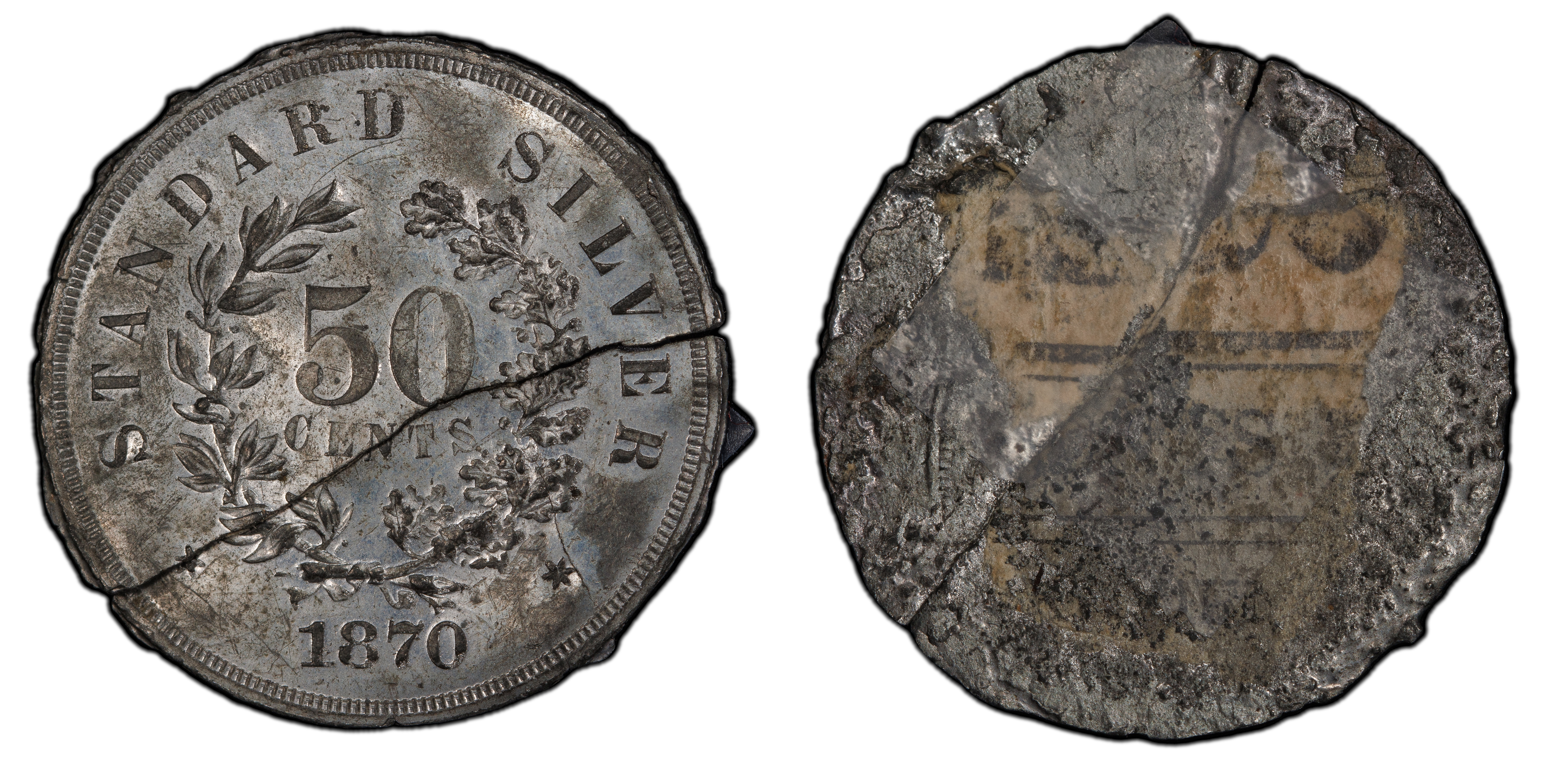
JA-1870-2 (Mis labled by PCGS as 1870-1) A reverse “splasher” or die trial, struck on white metal or lead. i think a paper or cardboard backing.
PCGS slabbed as GENUINE.
OMG ... My Mother was Right about Everything!
I wake up with a Good Attitude Every Day. Then … Idiots Happen!
.
.
.
I think @RedRocket maybe meant to write "They've been KNOWN to be struck on paper/cardboard.".
.
Correct!
There are some in the Judd pattern book struck on cardboard (I just gave 2 examples in my previous post) as well as some on paper/cardboard backed lead and white metal splashers.
Fair. I was thinking more of a coin than a random die trial.
All comments reflect the opinion of the author, even when irrefutably accurate.
Thank you.
YES!
I miswrote.
No worries!
Good question. There are coins struck outside of the U.S. Mint, but with genuine Mint dies, featured in Appendix C of the Judd book, as you obviously know, but maybe some collectors were not aware of this.
Here is a perfect coin that addresses several issues in this thread, and in CaptHenway’s post:
•Gold Die Trial struck from rusted dies
•Unique and finally certified by PCGS
in 2006 after decades of floating around raw between dealers
•Genuine U.S. Mint die but privately struck outside of the Mint
•Listed in US Patterns, photo by Mike Byers
Now for the story!!
I was offered this die trial raw from Larry Demerer (National Coin Investments), the same firm where I purchased the gold Die Trial from his Partner, Paul Nugget which is what this thread is all about.
It was raw, rusted, funky looking, and to address CaptHenry’s question…I had no idea whether to get it certified or condemn it. In fact, the more I examined it, the more I was convinced that it was counterfeit, so I passed… even at $1500. This was in 1998 I think.
Eventually it appears in 2006 in the inventory of Ron Karp (NYGM) at a major show. He shows it to me. It’s still raw. I’m thinking that this will never slab! It’s 15k. I pass and thank him.
A year later I notice it in his inventory list. I call him. Now it’s in a PCGS MS 63 holder, Judd # and all! I jump on it and purchase it for $80k!
I display it at the Long Beach CA coin show, in my show case at my corner table. No action on it. Ok.
A week later John Albanese calls. (yes, THAT John Albanese, from CAC). He instantly buys it sight unseen at $100k for another dealer. It is placed in the world famous Simpson Collection.
Here is a screenshot of the coin on my website, and here is a screenshot from US Patterns:
And when Simpson sold it through Heritage in 2020, it brought 156K.
Doggedly collecting coins of the Central American Republic.
Visit the Society of US Pattern Collectors at USPatterns.com.
I want to thank Andy who assisted me in part of the transaction.
This has been quite an instructive thread! Thanks to all participants for sharing their knowledge.
I'm sure I'm not the only one of modest knowledge who will read this thread and learn quite a bit
Serving the greater Mechanicsburg and Camp Hill, PA area
https://zenithbullionconsulting.wordpress.com/
Well as usual 7Jaguars, you are entirely wrong.
Gobrecht's Engraved Mature Head Large Cent Model
https://www.instagram.com/rexrarities/?hl=en
Please, let us keep this civil.
The distinction between spark erosion and mechanical is not as massive as it seems to be taken in this thread…they are both forms of transfer dies. They share some similarities, and they have some differences.
And yes, studying these characteristics is how new fakes are found. On any given day there are multiple counterfeits submitted to the TPGs that have never been seen by them before (meaning, not from that exact counterfeit die). Characteristics like those I listed are how they are identified. I’m sorry that the commenters in this thread are not familiar with those characteristics, but that does not make me wrong.
Gobrecht's Engraved Mature Head Large Cent Model
https://www.instagram.com/rexrarities/?hl=en
I used to have the second, or perhaps third, best collection of the coin of Honduras in the 1922 and earlier period. They are wonderful to collect because of the amazingly poor die quality usually found on them.
I was once offered a notorious Five Pesos gold coin which the gold trading department at the Bundesbank in Germany had counterstamped with the word FALSCH, because they did not understand the poor die quality of the piece. They are a fine Third Party Authentication Service, even if only an in-house one. One of their Authenticators even worked for me for a while at ANACS. But they made an honest mistake, as I did on a coin or two in my time at ANACS.
TPG services are not immune from making mistakes. Here’s another story…
Over 20 years ago at a Long Beach coin show, I purchased from Silvano DiGenova a 1812 (I think that was the date) $5 gold piece. It was AU 58 to MS 62. Double struck on just the reverse, and the obverse involved another planchet. RAW not certified.
Being a mint error dealer for decades, I knew it was genuine, but the error explanation was a bit complicated and the coin was slightly odd looking.
I showed it to Mike Faraone who was an ANACS authenticator at the time (later for PCGS) who agreed it was genuine.
I showed Fred Weinberg at his table, we discussed the error sequence, and he agreed it was genuine.
I wrote up the submission. Fred signed it stating it was genuine and that Mike Byers was walking it thru PCGS at the show and to expedite it. The point of Fred signing it was that the submission wasn’t delayed. (Mint errors were gathered and delivered to Fred at his office in batches. Since he had seen and authenticated this one already, he signed the submission form.)
The next morning I pick up my submission… COUNTERFEIT. I spoke to 2 PCGS finalizers who ‘explained’ why it was counterfeit.
I placed it in a box with other ‘projects’ and threw it in my safe. A few years later I sold it to Andy Lustig raw and explained the situation.
A short time after, JD (John Dannreuther) offered it for sale. PCGS had finally authenticated it. JD was involved with PCGS in many capacities. I am in NO way implying that JD was involved in anything suspicious. His reputation is beyond excellent!!
I am also not criticizing PCGS. They provide a superb service!! Mistakes are made.
My point is… here was a ‘COUNTERFEIT’ $5 gold coin slabbed counterfeit by PCGS, that later slabbed authentic by the SAME grading company.
So anything is possible and this serves as an example of a condemned coin that finally was certified authentic.
And it won’t be the last time!
With all of your talk of unreliable verdicts on authenticity, how can you justify your chosen title for this thread???
Doggedly collecting coins of the Central American Republic.
Visit the Society of US Pattern Collectors at USPatterns.com.
Ok, here is another story.
(4) No Decisions and (1) Counterfeit… to Authenticated! And it did NOT match a die or another struck coin!
In 2004 in a FUN Heritage Auction, there was a 1928 Standing Liberty Quarter struck on a cent planchet! Incredibly rare!
PCGS, NGC, ANACS and ICG all said ‘No Decision’.
It had 3 die cracks and
silver flakes imbedded into the planchet.
And…no known genuine struck silver coins were known with these die cracks!
I was convinced that it was genuine.
I bought it after the auction ended for approximately $9k.
The next day Jim Halperin ( yes THAT Jim Halperin of Heritage Galleries) calls me…
“Hi Mike! Yesterday I noticed that you purchased the SLQ on a cent planchet from our auction after it ended. We would like to split it with you 50/50. I believe it to be genuine and you do too.”
I was humbled and flattered. This was Jim Halperin. I couldn’t say no! We split it!
Upon receiving the coin, I drove to Fred Weinberg’s. We do tons of business both ways. We had lunch, did business, analyzed the coin, and decided it was genuine. Fred wrote it up, signed it so there was no delay, and off I was to PCGS for a same day walk thru mint error, which was a rare occurance for PCGS.
Fred was wonderful. His assistant Kathy, had to call PCGS in advance and set it up.
PCGS was very polite and accomodating even though this was an unusual submission procedure. I got there in the afternoon. I pick up the coin the next morning.
COUNTERFEIT.
I call Dave Camire ( yes THAT Dave Camire, NGC grading finalizer, mint error expert, and president of NCS) and explained the situation:
Jim Halperin ( some consider him the top grader and authenticator in the world)
split it with me since we both believe it to be genuine. I showed Fred Weinberg in his office and he agreed. But PCGS wouldn’t slab it. No known regular issued silver coin have those die cracks. The silver flakes and overall look tell me that it’s genuine.
Dave said that obviously he needs to carefully examine it. But if authentic, this is what happened:
The reverse die was used and struck a batch of silver coins. That explains the imbedded silver flakes in the surface. The die cracked in several places and was discarded. The Mint was able to locate the bin with these coins and destroyed them. Somehow this off metal with the die cracks escaped the Mint, very likely intentional.
I submitted the coin to NGC.
Not only did Dave Camire say it was definitely genuine, but that NGC had already authenticated one. It’s in the world famous Mark Lighterman ( current President of ANA) off metal collection.
I placed it in my personal collection for many years, until I sold it. The NGC insert designates it from the Byers Collection.
So here is a coin, rejected by PCGS, NGC, ANACS and ICG, rejected again by PCGS even after Fred authenticated it, subsequently certified by NGC the second time around.
So anything is possible and this serves as an example of another condemned coin that finally was certified authentic. And an example of a coin being certified even with no match to a die or another coin.
Once again, I must repeat that in my opinion PCGS and NGC do a wonderful job authenticating and grading. But occasionally mistakes are made.
It’s all documented but you have a point. Should the title be:
Is it counterfeit, questionable authenticity or genuine?
@Byers
However this all turns out, I've got a couple of takeaways:
1- This has not only been an extremely entertaining thread it is also an enlightening one along with being educational.
2- You really love this hobby and your contributions to it! Your affection and enthusiasm are contagious and makes me enjoy it even that much more. I'm sure others who have read and participated within would agree.
@Rexford makes the most convincing argument. A look at Proof QEs of the time frame will tell you everything you need to know.
Below are a selection of reverses from several Proof QEs. Notice how none of them show device polish, and they are all fully struck.
I need to recheck my sources here, but I'm fairly certain the die polishing process for pre-1909 Proofs made it nearly impossible to polish relief areas on Proof coins. That became an issue later on when the curvature of the dies more closely matched that of the devices, which didn't happen until 1909 or so (hence the Matte and Satin/Sandblast Proofs). The die trial here shows extensive polishing of the relief areas, something that would have almost certainly rejected the die and is inconsistent with genuine US Mint work.
Coin Photography
"i've never seen a proof one like this before" => must be counterfeit ?
Thank you RedRocket!