Options
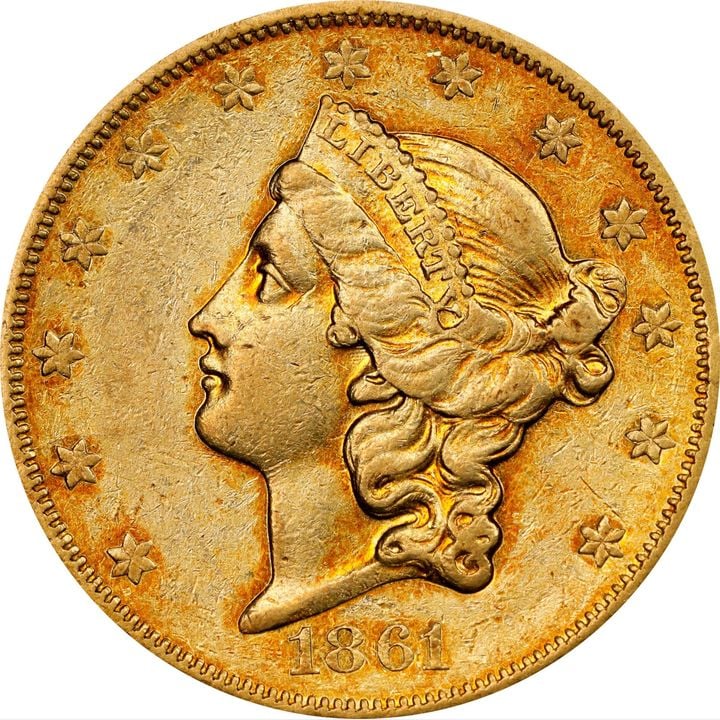
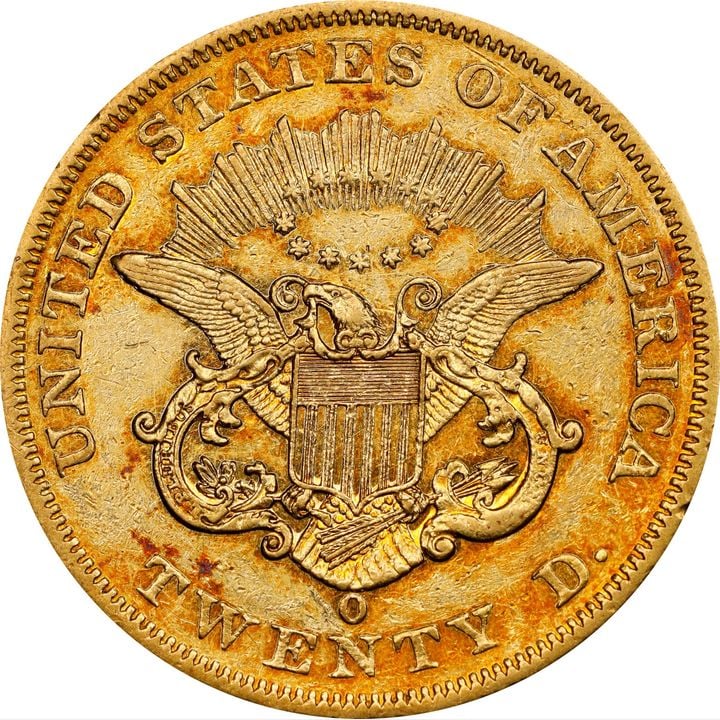
Photo of the James Stack Sr 1861-O Liberty $20
 oreville
Posts: 12,432 ✭✭✭✭✭
oreville
Posts: 12,432 ✭✭✭✭✭
A Collectors Universe poster since 1997!
20
Comments
That looks like an OGH 45 with a sticker. Love the look
Nice color.
AU-50 in a newer PCGS holder with a green sticker. David Hall gave it a gold CMG. Tough to find these not excessively baggy or cleaned.
I wished it was graded lower by PCGS with a CAC gold sticker. LOL.
I'm curious if there is a consensus on when this may have been struck? Before the Civil War?
"Identification and Rarity
Identifying which authority struck a specific 1861-O double eagle is difficult because they all used the same U.S. dies.
Heritage Auctions
"Physical Markers: Some experts, like Doug Winter, suggest that coins with a specific die crack extending from the rim past the second star toward Liberty’s chin may have been struck under Confederate authority.
Survival Rate: Out of the original mintage of 17,741, only an estimated 150 to 250 examples are known to exist today across all grades.
Condition: Most survivors are found in Very Fine (VF) or Extra Fine (XF) condition. Mint State (uncirculated) examples are incredibly rare, with only 3 to 5 specimens thought to exist." AI
I do not think CAC even approved any 1861-O $20 in mint state 60 or above.
@logger7 this one is believed to be stuck by authority of the confederate states of america as evidenced by the die crack from the top of the second star to liberty's chin.
I like the Color
It's all about what the people want...
So nice.
Terrific looking coin. Color is great and oh so cool date/mintmark.
Doug Winters thinks I way overpaid for this coin. I do think I paid a strong price but not an absurd price. I do believe that the James Stack Sr pedigree does have some value.
I also think that any 1861-O Liberty $20 that can be shown to be struck by the Confederate States of America are more valuable.
Is that carbon/impurities or dirt on the planchet?
Throw a coin enough times, and suppose one day it lands on its edge.
One of my customers was an underbidder on this coin, I just told him when he walked in, that it got upgraded and stickered. He looked at it in Baltimore in Nov and liked it.
Diary of Elias R. Dufour — April 12, 1861
New Orleans Mint
Fictional account based on the historical circumstances of the 1861‑O Confederate double eagle.
I walked to the Mint this morning with the deliberate stride of a man who knows the world is changing and refuses to be carried along by it. The city trembles with rumors—Fort Sumter fired upon, the Confederacy awakening into its own certainty—but the Mint stands as it always has: a fortress of stone, iron, and purpose. Men may trade flags, but gold obeys no government. It answers only to weight, purity, and the judgment of the mind that values it.
Inside, the air smelled of metal and oil. The presses were running—slowly, methodically—under the new authority. The dies were the same as before, the legend unchanged: UNITED STATES OF AMERICA. A contradiction, yes, but a practical one. The Confederacy has no dies of its own, and the bullion will not wait for philosophy to catch up with necessity.
I watched a tray of freshly struck double eagles carried to the counting table. One coin caught the light with an intensity that separated it from the rest. Its fields were not dull like the usual business strikes; they held a faint mirror, as if the metal itself remembered the moment of its creation. A die freshly lapped, perhaps. A surface unclouded by repetition.
I asked to see it.
The clerk hesitated—habit, not authority—and then placed it in my hand. I turned it under the lamp. Liberty’s face rose from the field with a clarity that felt almost defiant. And there, running from the rim outside the second star to her chin, was a thin, unmistakable crack in the die’s impression. A flaw, yes—but also a signature. A mark of the exact moment in history when this coin was born.
This was no Union strike. No Louisiana State strike. This was Confederate—April of 1861, when the Mint still had bullion to work and the presses still obeyed the men who had seized them.
I felt the weight of it—twenty dollars, but more than that. A unit of value that would outlive the paper promises of any government. A piece of gold that would travel farther than any soldier, survive more than any proclamation.
The clerk counted out the coins owed to me for the cotton I had deposited. I chose this one deliberately. I wanted the coin that bore the truth of this moment: a nation dividing, a mint improvising, a die cracking under the strain of history.
As I slipped it into my purse, I felt no sentimentality. Only recognition. This coin would not remain with me long. Gold never does. It moves through the world like an idea—tested, exchanged, judged, and carried forward by those who understand its worth.
But for this day, it is mine. And I will remember the look of it: the reflective fields, the bold date, the crack across Liberty’s chin like a prophecy.
The Confederacy may rise or fall. But this coin will endure.
If it’s natural, it’s the copper in the gold-copper alloy which was not mixed property. If it’s artificial, it could iodine or whatever else coin doctors use. Given the source and certification, it’s natural.
I also saw this coin before the auction. I did not merely like it. I fell in love with it. I did not want to lose it. This would be the one coin I do not intend to sell in my lifetime. I got lucky that it sold to me below a crazy high price.
I am not aware of this coin being upgraded with PCGS. Certainly not by me.
Oreville,
I thought it was in a 45 holder in the auction, my mistake. I know it wasn't stickered. I did not view it myself, my customer did. They had already taken the auction lots back to HQ as I was only at show on sat, so I didnt get to see it myself.
When I viewed it when it first was available for viewing, it was graded PCGS AU-50 with a green sticker and a David Hall CMG-X sticker.
I thought the coin looked more like an ultra high-end XF-45 that was so gorgeous that I had no argument with it being graded AU-50. The copper impurity hid the luster that would have normally qualified the coin as AU-50.
These 1861-O Liberty $20’s usually look horrible.
JA and I discussed this coin before I bid on it. He felt it was a no brainer high quality coin and a great future purchase but did not know what the final price would be. I had previously sold my very substandard 1861-O $20 that I bought very cheaply 30 years ago and learned to hate it over the years. I still sold it for a nice profit.
I don’t see a die crack.
You should also keep your 1921 Walker ex- Jack Lee. It is too special to be released into the wild.
"Look up, old boy, and see what you get." -William Bonney.
Do you suggest I get buried with these coins instead? Not a good thing for silver coin preservation but the 1861-O $20 can handle the ground better!
Releasing a coin into the wild? Now that is funny. I am sure you would love to once again foster care for your walker you released into the wild.
Looking at the coin in person and comparing it to the photo can be confusing.
What appears to be orange coloration the edge of the devices is NOT coloration but intense mirror-like surfaces giving rise to the appropriate AU-50 grade. I can see why David Hall thought it was undergraded although I thought he was over enthusiastic.
I plan to research the historical provenance of James Stack’s purchase with StacksBowers staff and report it here.
This is great reading.
What is even more amazing is reading about James Stack Sr obsession with protecting the legacy of his collection and not allowing his grandchildren (or even great grandchildren) to sell his coins until they were 25 years old.
A nice coin that proves that coins do not have to be perfect, or even Uncirculated, to be fascinating.
Many years ago at one of the three coin shops I worked at in Chicagoland we bought in a gorgeous Turban Head $10 that slabbed at AU-58, rightly so as I thought. I asked one high end customer if he would like first shot at it, and he sniffed and said that he NEVER bought anything less than Mint State. I silently thought him a fool.
Astonishingly good photo!
Official PCGS account of:
www.TallahasseeCoinClub.com