@lkenefic said:
Copper is one of the more reactive metals used in minting coins. Unless these coins were held in some special atmospheric condition, how can they retain mint luster all of these years without oxidizing?
Seems like they would need to have been covered in shellac or varnish or some sort long ago, not sure what was used but that would block oxidation, and now you could remove it with acetone. Both have been available for a very long time, but you would need a collector thinking beyond their own lifetime.
Prior to the age of plastic, collectors (and museums) would routinely wax or lacquer their shiny copper and bronze coins, to keep them fresh and shiny red. Prior to the invention of plastic, "natural plastics" such as shellac and beeswax would have been used. A nice thick coating of olive oil was also a common treatment, but olive oil contains sulfur so this would not have preserved the redness (though generating a rich glossy brown coloration in its place). Being natural substances, they were also more prone to biodegradation and mould than modern synthetic plastics, so in that sense the protection itself needed protection, perhaps being removed and replaced every generation or two.
Even today, museums still preserve coins this way. In the 1950s the British Museum invented a synthetic wax compound specifically for use as an artifact preserving agent; now marketed as Renaissance Wax, or "Renwax" for short, they still use this to preserve their coin collection, and many "old-school" collectors who prefer old-fashioned coin cabinets to modern plastic 2x2s, flips, or slabs, also still use Renwax or something similar to help preserve their coins.
Bear in mind that coin collecting was also quite different in culture back in the 1600s and 1700s. Back then, not only was it a hobby just for the rich, but the dominant paradigm was that only ancient and mediaeval coins were truly worth collecting, with modern freshly-minted coins looked down upon by "real coin collectors" as not having any history behind them. So the vast majority of such coins would remain unprotected, hence their scarcity today.
Waste no more time arguing what a good man should be. Be one. Roman emperor Marcus Aurelius, "Meditations"
@lkenefic said:
Copper is one of the more reactive metals used in minting coins. Unless these coins were held in some special atmospheric condition, how can they retain mint luster all of these years without oxidizing?
Seems like they would need to have been covered in shellac or varnish or some sort long ago, not sure what was used but that would block oxidation, and now you could remove it with acetone. Both have been available for a very long time, but you would need a collector thinking beyond their own lifetime.
Prior to the age of plastic, collectors (and museums) would routinely wax or lacquer their shiny copper and bronze coins, to keep them fresh and shiny red. Prior to the invention of plastic, "natural plastics" such as shellac and beeswax would have been used. A nice thick coating of olive oil was also a common treatment, but olive oil contains sulfur so this would not have preserved the redness (though generating a rich glossy brown coloration in its place). Being natural substances, they were also more prone to biodegradation and mould than modern synthetic plastics, so in that sense the protection itself needed protection, perhaps being removed and replaced every generation or two.
Even today, museums still preserve coins this way. In the 1950s the British Museum invented a synthetic wax compound specifically for use as an artifact preserving agent; now marketed as Renaissance Wax, or "Renwax" for short, they still use this to preserve their coin collection, and many "old-school" collectors who prefer old-fashioned coin cabinets to modern plastic 2x2s, flips, or slabs, also still use Renwax or something similar to help preserve their coins.
Bear in mind that coin collecting was also quite different in culture back in the 1600s and 1700s. Back then, not only was it a hobby just for the rich, but the dominant paradigm was that only ancient and mediaeval coins were truly worth collecting, with modern freshly-minted coins looked down upon by "real coin collectors" as not having any history behind them. So the vast majority of such coins would remain unprotected, hence their scarcity today.
I believe these practices mainly apply to coins struck prior to the medieval period. However, in the case of the possibly oldest red copper coin graded by a TPG grading company (https://leunumismatik.com/en/lot/70/3641), this does not appear to apply. The coin was likely discovered together with other pieces (possibly in a roll or small group), and may have been positioned in the middle, which helped preserve its original mint-state red (RD) copper colour. This is a clear example of a condition-rarity lottery.
@oldabeintx said:
I own a slabbed and very red 1739 duit as part of my colonial set. Given the price, they must be common. I’m guessing part of a hoard.
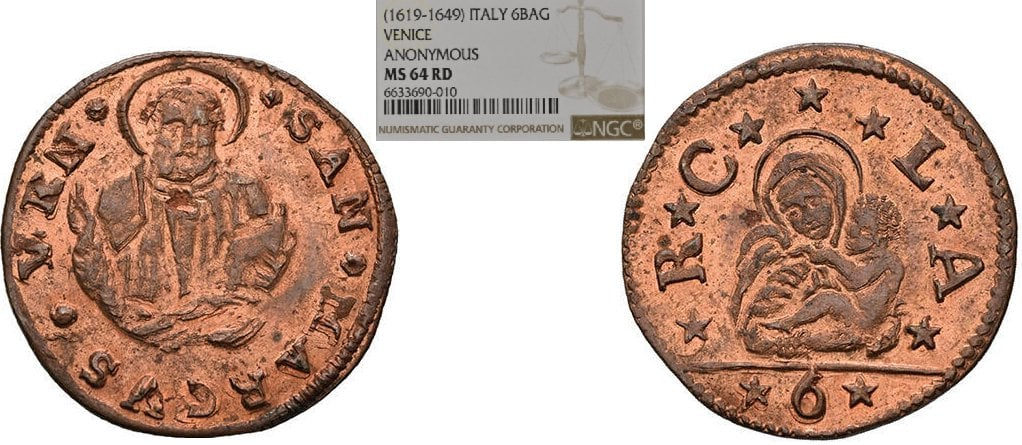
The new oldest red (RD) copper colour coin graded by a TPG company in the world is the following Venice 6 Bagattini 1619 MS64 RD NGC, which will be auctioned in some days (https://leunumismatik.com/en/lot/70/3641 ):
What is the grade of the coin you are referring to (Duit of 1739)? Do you have a picture of it?
@oldabeintx said:
I own a slabbed and very red 1739 duit as part of my colonial set. Given the price, they must be common. I’m guessing part of a hoard.
We still have not seen any picture of the 1739 red Duit. Do you have any? From what I have researched there is no red RD duit of 1739 graded. There is only on 1755, but it is far from the 2 coins above.
Apparently, the coin of tomorrow Leu's auction is the oldest one.
I once owned an 1819 Large Cent that had lots and lots of red. About 50% red is what I was seeing. I liked this coin a lot for it's color but disliked a very noticeable staple scratch (not made by me) on it's obverse. The collector with ordinary common sense, doing the staple removal job in a deliberate unhurried fashion saves the coin the indignity of a staple scratch. It's a fact. Staple scratch should never happen!
I owned the half red half brown 1819 Cent for just a few months or so sometime in the 1980s.Then she was gone from my collection for another collector to behold.
Fondly remembered, 40 years later.
Jesus said, "If those who lead you say to you, 'See, the kingdom is in the sky,' then the
birds of the sky will precede you. If they say to you, 'It is in the sea,' then the fish will
precede you. Rather, the kingdom is inside of you, and it is outside of you. When you
come to know yourselves, then you will become known, and you will realize that it is you
who are the sons of the living father. But if you will not know yourselves, you dwell in
poverty and it is you who are that poverty."--- Gospel of Thomas (Lamdin translation)
Red has received numerous- really too many to count (with some embarrassingly begging him and imploring him)- on providing a stickering service for full blown RED early copper Large Cents. As of now, although this would provide a profitable avenue for both Red and the recipients, his time is much too valuable to allow for such a high in demand service.
Red also fields many requests on the best ways to collect coins, via all social media platforms.
Although Red cannot respond to all such requests, including that of @jmlanzaf he will continue to provide his expertise here on the boards.
We still have not seen any picture of the 1739 red Duit. Do you have any? From what I have researched there is no red RD duit of 1739 graded.
Just checked my inventory - it’s graded RB but it’s as red as many coins graded red. Memory. Sorry to mislead. I posted it only because a duit was mentioned in another post. You won’t see a picture of it unless you look it up. My foreign coins are kept at my second home and I don’t take pictures in any event.
Comments
Prior to the age of plastic, collectors (and museums) would routinely wax or lacquer their shiny copper and bronze coins, to keep them fresh and shiny red. Prior to the invention of plastic, "natural plastics" such as shellac and beeswax would have been used. A nice thick coating of olive oil was also a common treatment, but olive oil contains sulfur so this would not have preserved the redness (though generating a rich glossy brown coloration in its place). Being natural substances, they were also more prone to biodegradation and mould than modern synthetic plastics, so in that sense the protection itself needed protection, perhaps being removed and replaced every generation or two.
Even today, museums still preserve coins this way. In the 1950s the British Museum invented a synthetic wax compound specifically for use as an artifact preserving agent; now marketed as Renaissance Wax, or "Renwax" for short, they still use this to preserve their coin collection, and many "old-school" collectors who prefer old-fashioned coin cabinets to modern plastic 2x2s, flips, or slabs, also still use Renwax or something similar to help preserve their coins.
Bear in mind that coin collecting was also quite different in culture back in the 1600s and 1700s. Back then, not only was it a hobby just for the rich, but the dominant paradigm was that only ancient and mediaeval coins were truly worth collecting, with modern freshly-minted coins looked down upon by "real coin collectors" as not having any history behind them. So the vast majority of such coins would remain unprotected, hence their scarcity today.
Roman emperor Marcus Aurelius, "Meditations"
Apparently I have been awarded the DPOTD twice.
I believe these practices mainly apply to coins struck prior to the medieval period. However, in the case of the possibly oldest red copper coin graded by a TPG grading company (https://leunumismatik.com/en/lot/70/3641), this does not appear to apply. The coin was likely discovered together with other pieces (possibly in a roll or small group), and may have been positioned in the middle, which helped preserve its original mint-state red (RD) copper colour. This is a clear example of a condition-rarity lottery.
I own a slabbed and very red 1739 duit as part of my colonial set. Given the price, they must be common. I’m guessing part of a hoard.
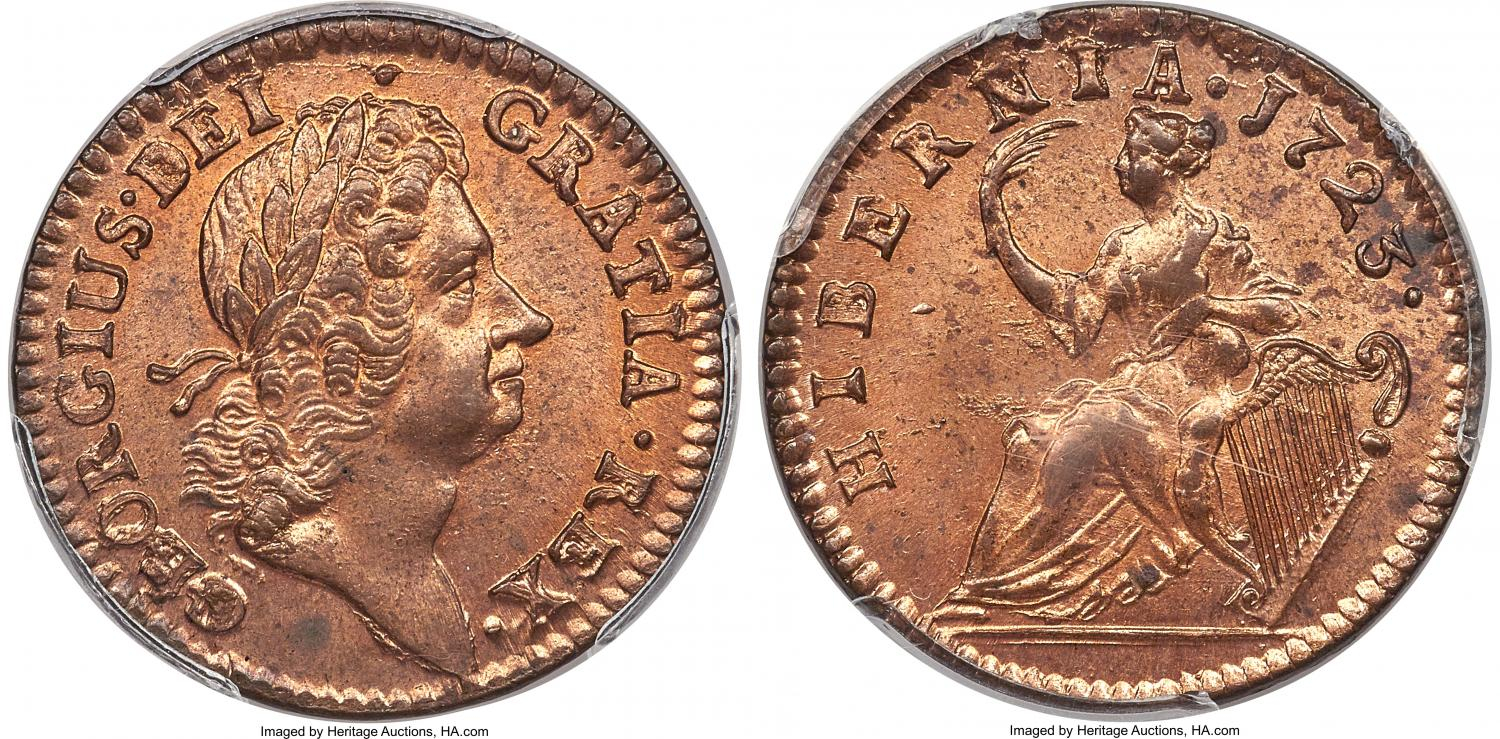
Well apparently this coin of yours would have been a little far from our list. So far, the oldest was the following 1723 1/2 P Hibernia Halfpenny MS64 RD PCGS (https://coins.ha.com/itm/colonials/1723-1-2-p-hibernia-halfpenny-ms64-red-pcgs-secure-cac-m-468-gb9-w-13120-r4-pcgs-182-/a/1272-3006.s?ic4=ListView-ShortDescription-071515):
The new oldest red (RD) copper colour coin graded by a TPG company in the world is the following Venice 6 Bagattini 1619 MS64 RD NGC, which will be auctioned in some days (https://leunumismatik.com/en/lot/70/3641 ):
What is the grade of the coin you are referring to (Duit of 1739)? Do you have a picture of it?
We still have not seen any picture of the 1739 red Duit. Do you have any? From what I have researched there is no red RD duit of 1739 graded. There is only on 1755, but it is far from the 2 coins above.
Apparently, the coin of tomorrow Leu's auction is the oldest one.
I once owned an 1819 Large Cent that had lots and lots of red. About 50% red is what I was seeing. I liked this coin a lot for it's color but disliked a very noticeable staple scratch (not made by me) on it's obverse. The collector with ordinary common sense, doing the staple removal job in a deliberate unhurried fashion saves the coin the indignity of a staple scratch. It's a fact. Staple scratch should never happen!
I owned the half red half brown 1819 Cent for just a few months or so sometime in the 1980s.Then she was gone from my collection for another collector to behold.
Fondly remembered, 40 years later.
Jesus said, "If those who lead you say to you, 'See, the kingdom is in the sky,' then the
birds of the sky will precede you. If they say to you, 'It is in the sea,' then the fish will
precede you. Rather, the kingdom is inside of you, and it is outside of you. When you
come to know yourselves, then you will become known, and you will realize that it is you
who are the sons of the living father. But if you will not know yourselves, you dwell in
poverty and it is you who are that poverty."--- Gospel of Thomas (Lamdin translation)
@RedRocket How do I get a Red designation on my coins?
All comments reflect the opinion of the author, even when irrefutably accurate.
Red has received numerous- really too many to count (with some embarrassingly begging him and imploring him)- on providing a stickering service for full blown RED early copper Large Cents. As of now, although this would provide a profitable avenue for both Red and the recipients, his time is much too valuable to allow for such a high in demand service.
Red also fields many requests on the best ways to collect coins, via all social media platforms.
Although Red cannot respond to all such requests, including that of @jmlanzaf he will continue to provide his expertise here on the boards.
Warmest Regards,
Red R.
Just checked my inventory - it’s graded RB but it’s as red as many coins graded red. Memory. Sorry to mislead. I posted it only because a duit was mentioned in another post. You won’t see a picture of it unless you look it up. My foreign coins are kept at my second home and I don’t take pictures in any event.
2710987-017. NGC64RB