The Danish Asiatic Piastre (“Greenland Dollar”): 1771 Original and Restrike History and Census
 Boosibri
Posts: 12,709 ✭✭✭✭✭
Boosibri
Posts: 12,709 ✭✭✭✭✭
The Danish Asiatic Piastre (“Greenland Dollar”): 1771 Original and Restrike History and Census
The Danish Asiatic Piastre, popularly known as the Greenland Dollar, is a classic numismatic rarity that has been sought after by collectors for more than 150 years. The Danish Asiatic Company, seeking to capitalize on the expanding Far East trade in tea and porcelain, issued coinage to support commercial activity in regions where Denmark had been operating successfully for many years. Prior to this initiative, the Company relied heavily on Spanish Pillar Dollars, often purchased at a modest premium, to facilitate trade settlements (Salvesen, NI Bulletin, Vol. 16, No. 7).
This article focuses specifically on the pieces dated 1771: the original strikings of that year and the 1774 restrikes (which also bear the 1771 date). A subsequent installment will address the 1777 issues struck at the Kongsberg mint. Much of the foundational research on these coins was published by Harald Salvesen, the noted Norwegian collector and scholar, and the analysis below draws significantly from his census and historical findings.
Design and Symbolism
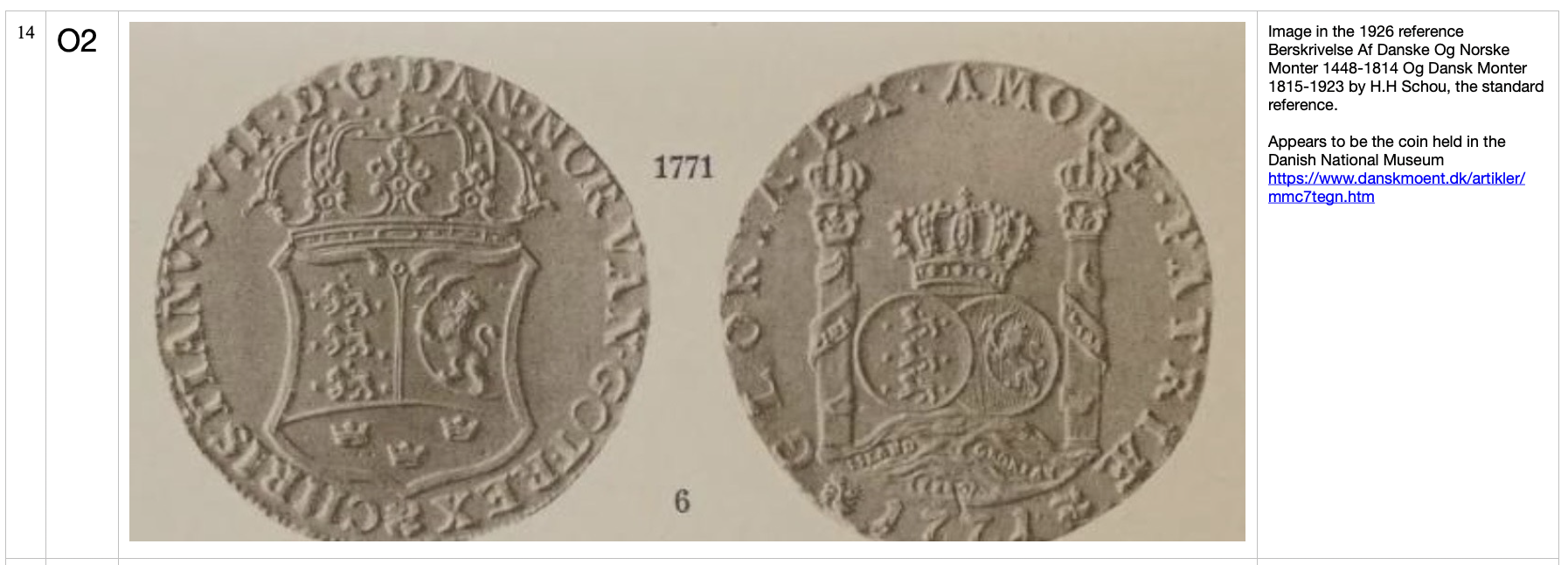
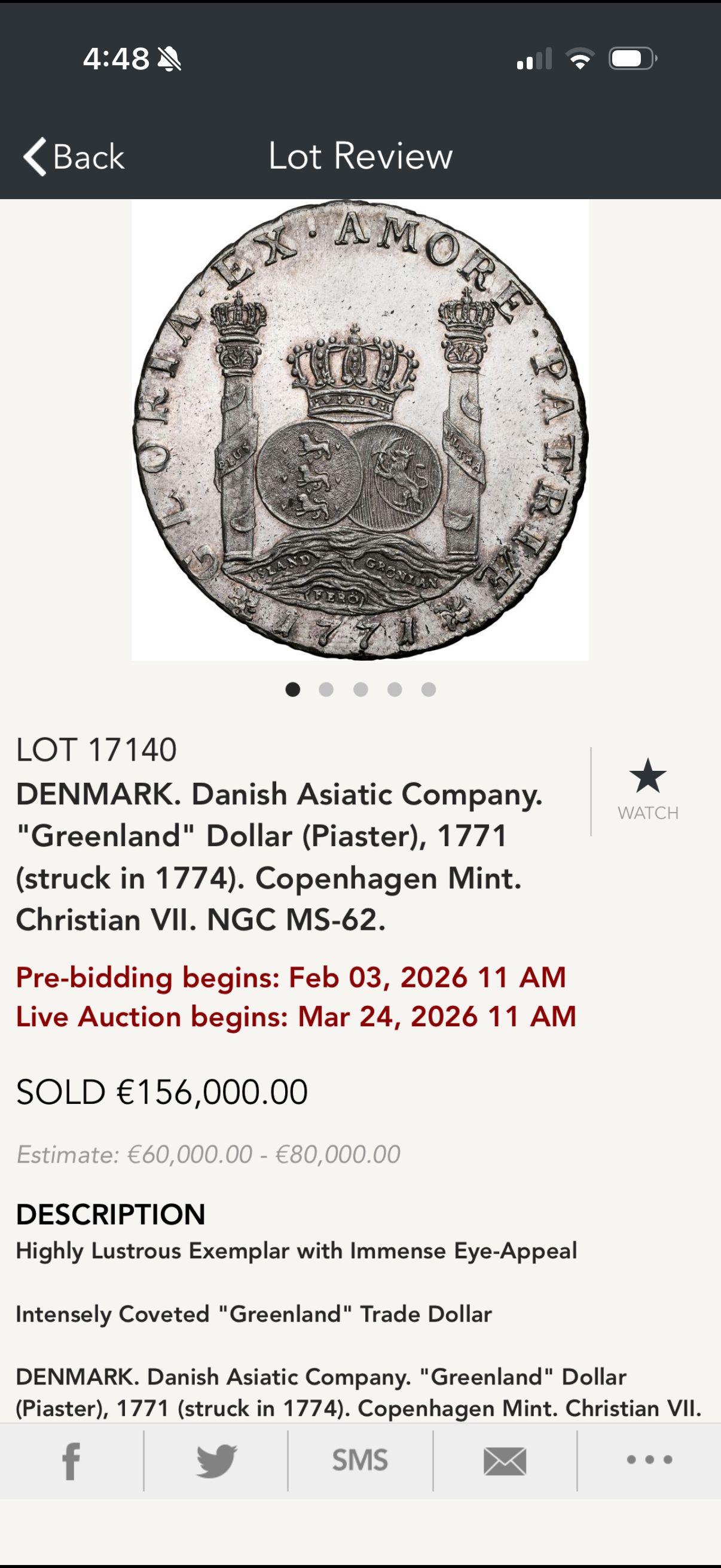
The design of the Greenland Dollar closely mimics the visual elements of the Spanish Pillar Dollar - the dominant trade coin of the period. The obverse features the iconic two pillars each wrapped in the ribbons of “Plvs” and “Vltra” with the globes of the Pillar Dollar replaced with the symbols of the Danish and Norwegian coat of arms. Beneath the globes, three land forms labeled ISLAND, FERO, and GRONLAN, representing Iceland, the Faro Islands and Greenland. Surrounding the central design, the Latin legend GLORIA. EX. AMORE. PATRIAE translates to “Glory through love of the Fatherland”.
The reverse continues the Pillar inspired theme with a large crown resting on top of a shield featuring the Danish and Norwegian coat of arms, with legends naming Christian VII under whose authority the coins were issued.
Chronology of Minting
Original Strikings - 543 produced in Copenhagen from one obverse die. These coins were never deployed at scale and surviving examples are extremely rare. Five examples are documented with three in private hands. One example is in the British Museum (obtained in 1843) and another in the University Museum of Oslo.
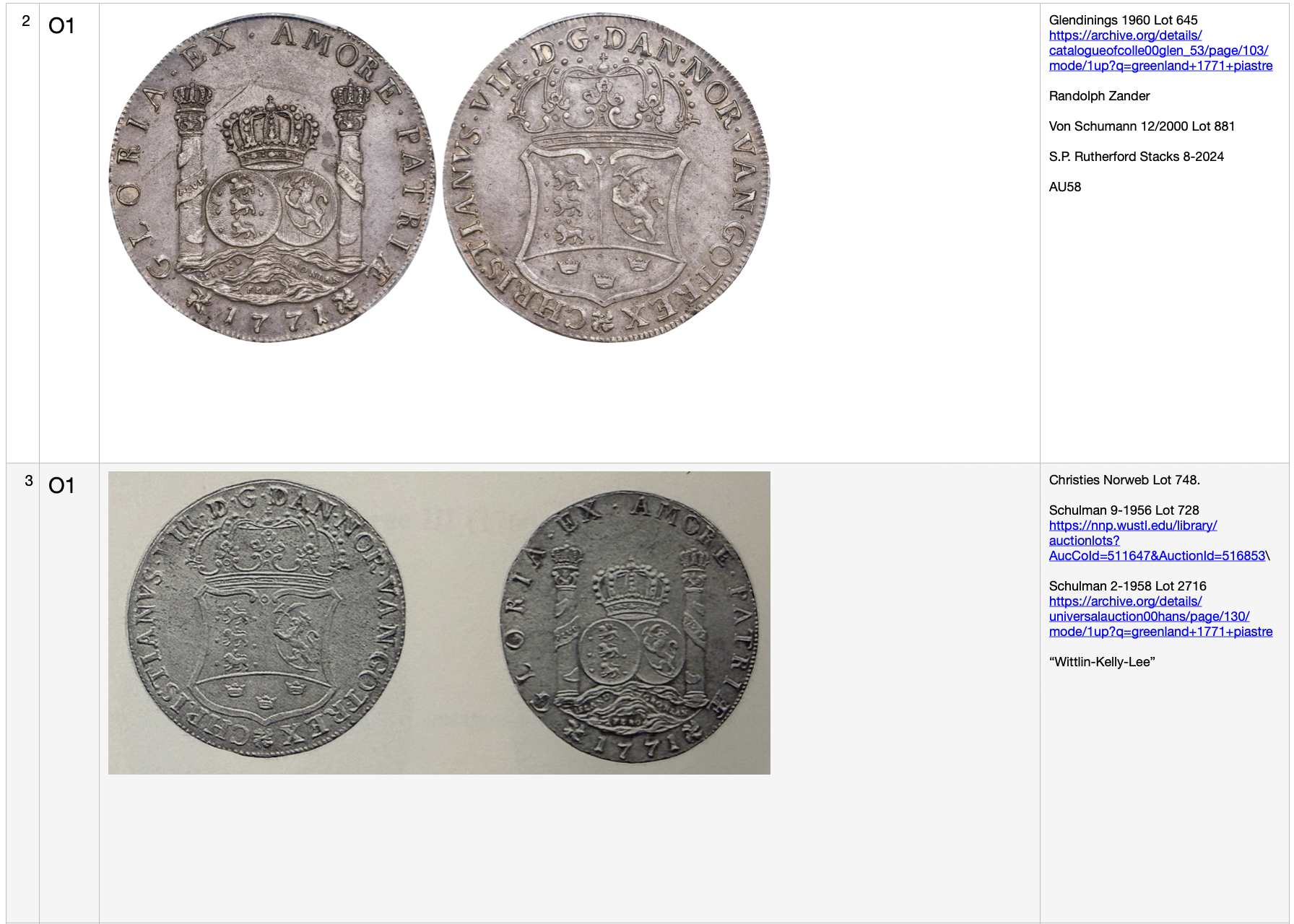
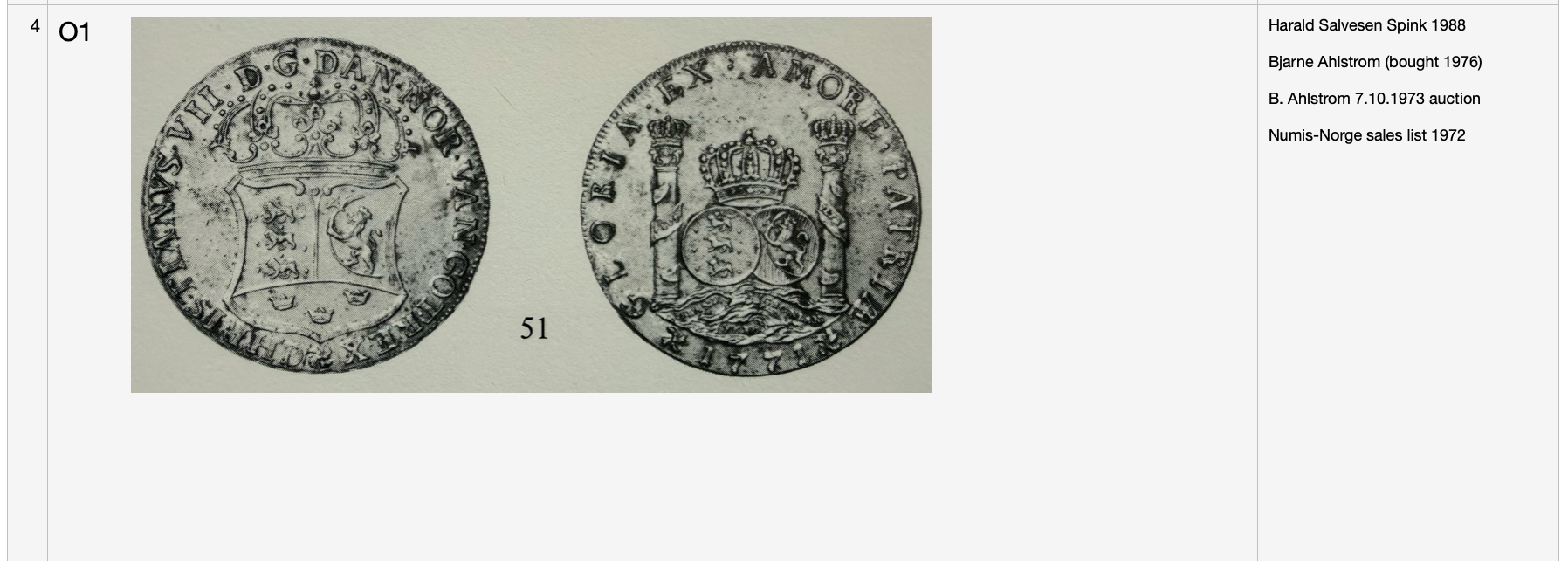
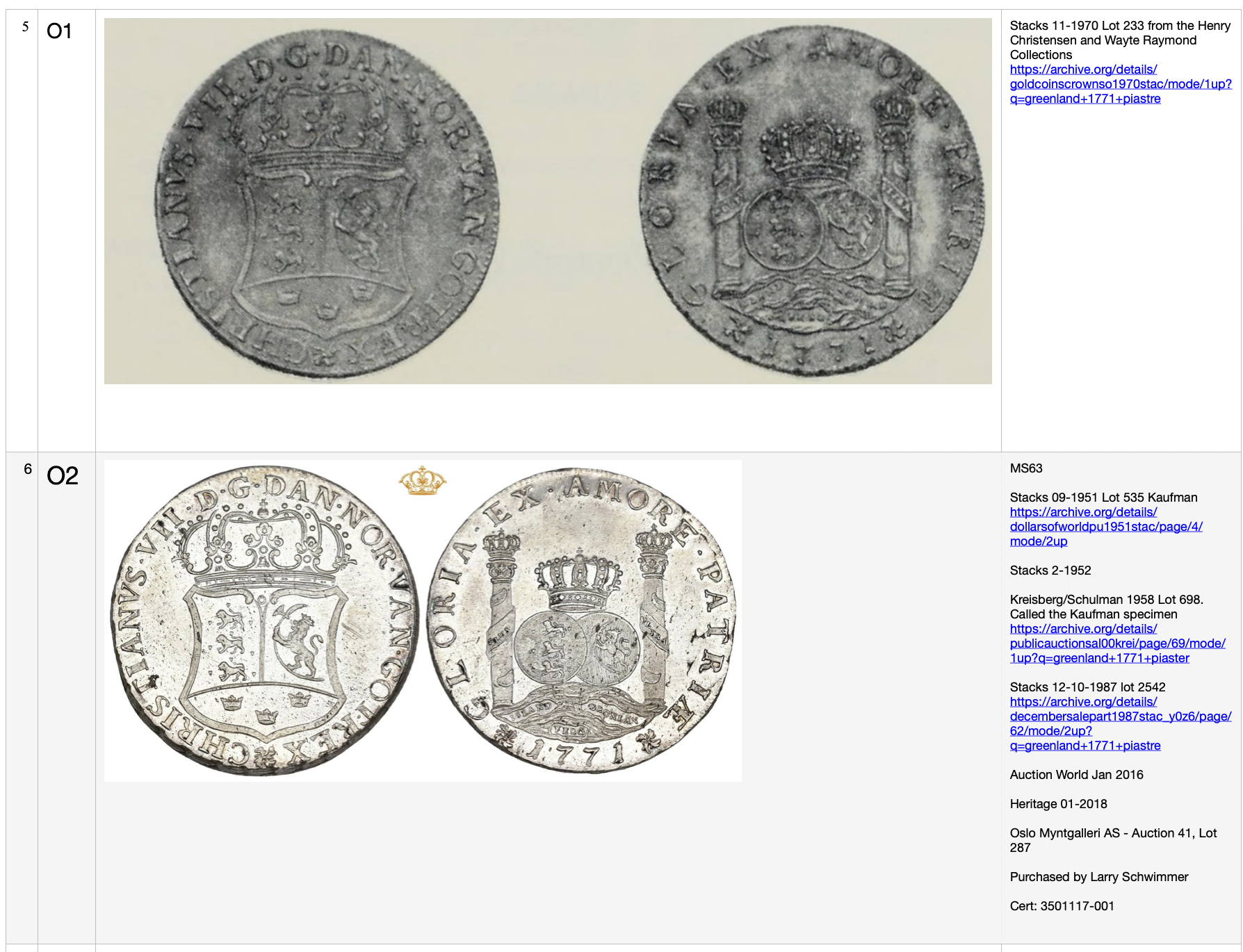
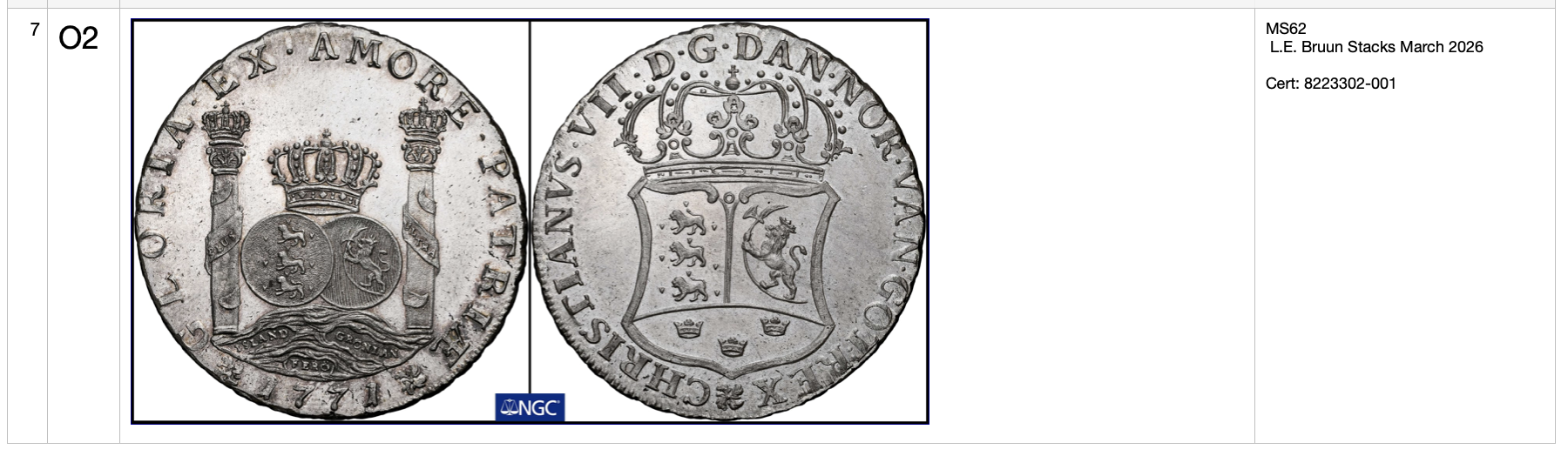
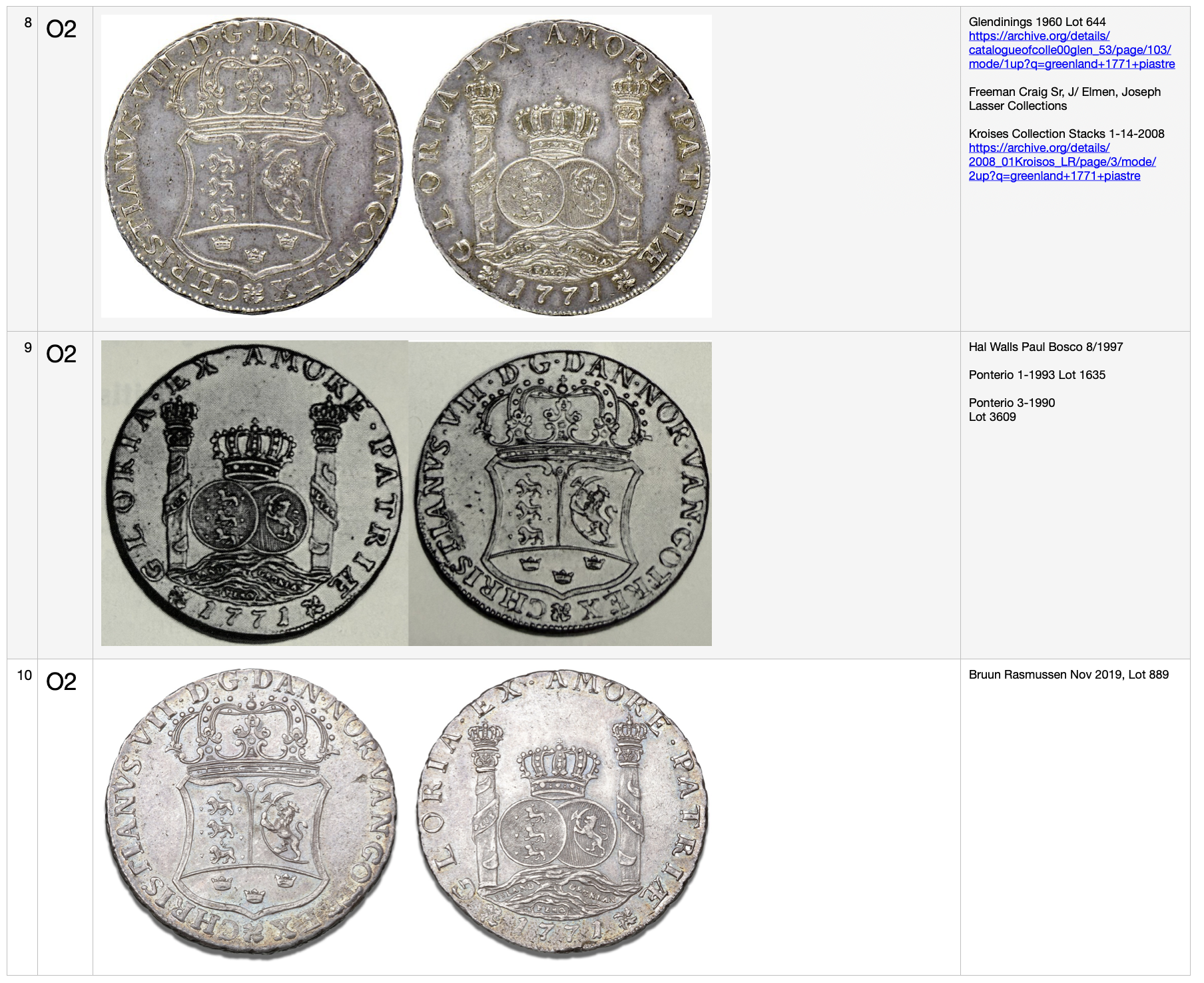
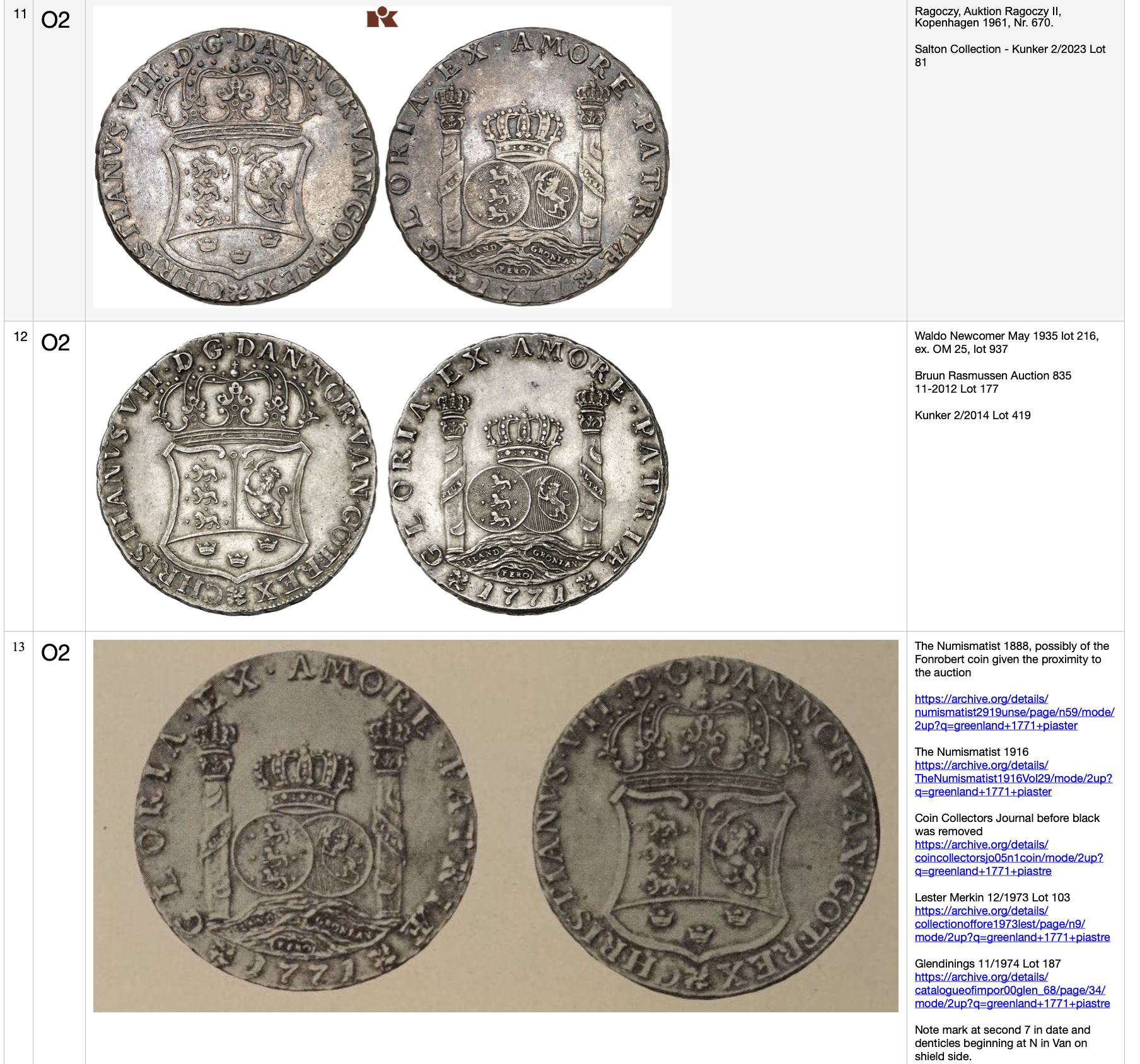
1774 Restikes dated 1771 - 44,900 produced with two obverse dies. Approximately 24 exist today with half in private hands and the balance in museums around the world (Salvesen estimates from 1988 Spink sale and Paul Bosco sale of the Hal Walls collection). I have identified 13 coins which have appeared in public sales thus far.
1777 Norwegian Issue - 50,001 pieces. Struck at the Kongsberg mint with a slightly modified design with two varieties, the very rare “Island” variety and the more common “Islan” variety. 3-4 examples of the Island variety exist. Three are in museums and the LE Bruun coin (assuming it was not considered by Harald Salvesen in his 1987 work to be a museum) is the fourth. Salvesen documented 21 of the Islan variety with 12 in museums.
Origin of the Term “Greenland Dollar"
The term Greenland Dollar originates from the 1878 Adolf Weyl sale of the Jules Fonrobert epic which became a standard reference for catalogers of the future. The very first lot in the massive sale was a 1771 “Gronland” and the second was a 1777 dated coin. Scott Coin & Stamp quickly picked up this cataloging and even in 1888, The Numismatist featured an article on the coin, incorrectly noting that the issue was made for its colonies, obviously weighing in the inclusion of the name of its colonies within the waters of the design. This misinterpretation persisted for decades and influenced catalogers in America and in Europe while amplifying the allure of the Greenland Dollar as a rarity which was prominently featured whenever offered at public auction. In 1925, another article appeared in The Numismatist titled "Danish Coins Wrongly Attributed" by O.B. Carlson where he correctly lays out the facts of their issue and intended use to no avail. While the facts are now clear, the nickname is firmly set.
Die Varieties
The 1771 original striking and the 1771 restrikes are distinguishable primarily through their obverse dies:
A. Original Die
The original 1771 issue is identifiable by the position of the G in Gloria, which sits directly above the waterline and does not extend past the base of the left pillar.
All confirmed originals use this single die.
B. The Restrike Dies (Obverse I and II)
There were two obverse dies used for the 1774 restrikes. They can be separated easily using the following diagnostics:
Obverse I
- The A in AMORE is offset to the left of the coins vertical centerline
- The Pillars are more slender and the crown is larger.
- The lettering is more fine/thin
Obverse II
- The A in AMORE is positioned directly on the centerline, aligned above the central cross of the crown.
- Crown is smaller
- Pillars are thicker, especially in the middle
- Letter punches are thicker
Among the 13 confirmed restrikes appearing in public auctions, five are obverse I and eight are obverse II.
Provenance Attribution
Attributing individual specimens to historical appearances is challenging due to poor and inconsistent imaging. Matching coins to images requires a layering approach which involves:
-Die Diagnostics: Separating the identified coins into obverse I and Obverse II to limit the population to compare
-Flan Contour: The outline of the flan including irregularities and denticle placements. While not perfect due to photographs often being imaged in catalogs from cut outs of photographs, it is often the best tactic when no identifying mark is available.
-Unique marks and toning patterns: These are useful and often the primary tactic however in this work, many coin images lack satisfactory diagnostics.
Using this framework, the census was constructed with reasonable accuracy.
The MS66 Hauberg/Zinck/Lustig/Millennia Specimen
The finest known example of the 1771 restrike, graded MS66 by NGC, is offered in the 2026 NYINC Heritage sale as part of the Eternal Collection. The auction description correctly assigns a provenance to the Goldberg 2008 Millennia sale and the 2011 Hesselgesser sale. where the coin sold for $178,000 and $174,000 respectively.
As an aside, the cataloging of the Hesselgesser sale and this coin in particular was dreadful. The description of the lot was for a 1777 Greenland Dollar and not a 1771 and also incorrectly linked the coin to the Irving Goodman sale previously held by Goldberg. This underscores the importance of independently verifying all listed provenances.
The coin came into the Millennia collection via Andy Lustig, who purchased the coin from the noted Zinck family collection which was sold in five parts by Thomas Hoiland’s auction house which is now a part of Bruun Rasmussen. This coin was featured in the second part of the auction series sold in 2002. The Zinck family collection was a multi-generational collection which sought to assemble a complete collection of Danish and Norwegian coins by variety, based upon the 1926 work by Schou. It is unclear when the coin was purchased by the Zinck family, however a letter obtained fortuitously from Darwin Palmer while researching Chilean Pillar Dollars included a letter between Mr. Palmer and Harald Salvesen where Salvesen notes that a “perfect” 1771 Greenland dollar sold recently (1982) for $15,000 in Europe.
In the Zinck catalog and in the 2008 Milllennia auction catalog, the coin was additionally assigned the provenance to the 1929 Peter Christian Hauberg collection. Hauberg was the director of the Royal Danish Mint Coins and Medals collection, as well as noted numismatics, scholar and author of many important Scandinavian works.
Upon referencing the 1929 Hauberg sale and comparing images, initially the two coins appeared different. Notably what appeared to be a die crack through GLORIA, and weakness in the lower reverse shield did not match the Zinck coin. However, upon closer inspection of the flan and denticle pattern, they appeared to be a near perfect match. There was also the presence of an odd new design element on the reverse with a line connecting the crown to the shield in the upper right. I suspect that the 1929 image is an image of a plaster taken of the Hauberg coin in preparation of the catalog. These added elements of the “die crack”, shield weakness, and new design element, were defects in the plaster and not actually features of the coin. No other coin in the census features these elements and no two coins come nearly this close to being matched so perfectly in their size, shape and denticle placement.
The provenance chain based upon suspected or confirmed images is:
*Hauberg
*Zinck
*Lustig
*Millennia
*Hesselgesser
*Eternal
For naming purposes, I call this the Hauberg/Zinck coin. The whereabouts of the coin between the 1929 Hauberg sale and the presumed sale in the early 1980’s remains a mystery. Many auction appearances from the late 1800’s to present have been analyzed. Many catalogs from the earlier periods contain “proofs, FDC, Unc’s” but are unplated. One of the best leads is the Virgil Brand papers where in 1944 after Brands death and his brother Armin was selling the collection with much of it consigned to BG Johnson. There is a notation in the ledger for two 1771 Greenland Dollars consigned to Johnson at $100 and a corresponding set of papers in the BG Johnson invoices to Schulman for the same year of a Greenland dollar noted as “Unc. Splendid” “Paid $115".
Census of Documented Coins
Special thanks to Matthew Ruttley for his internet sleuthing assistance.
Originals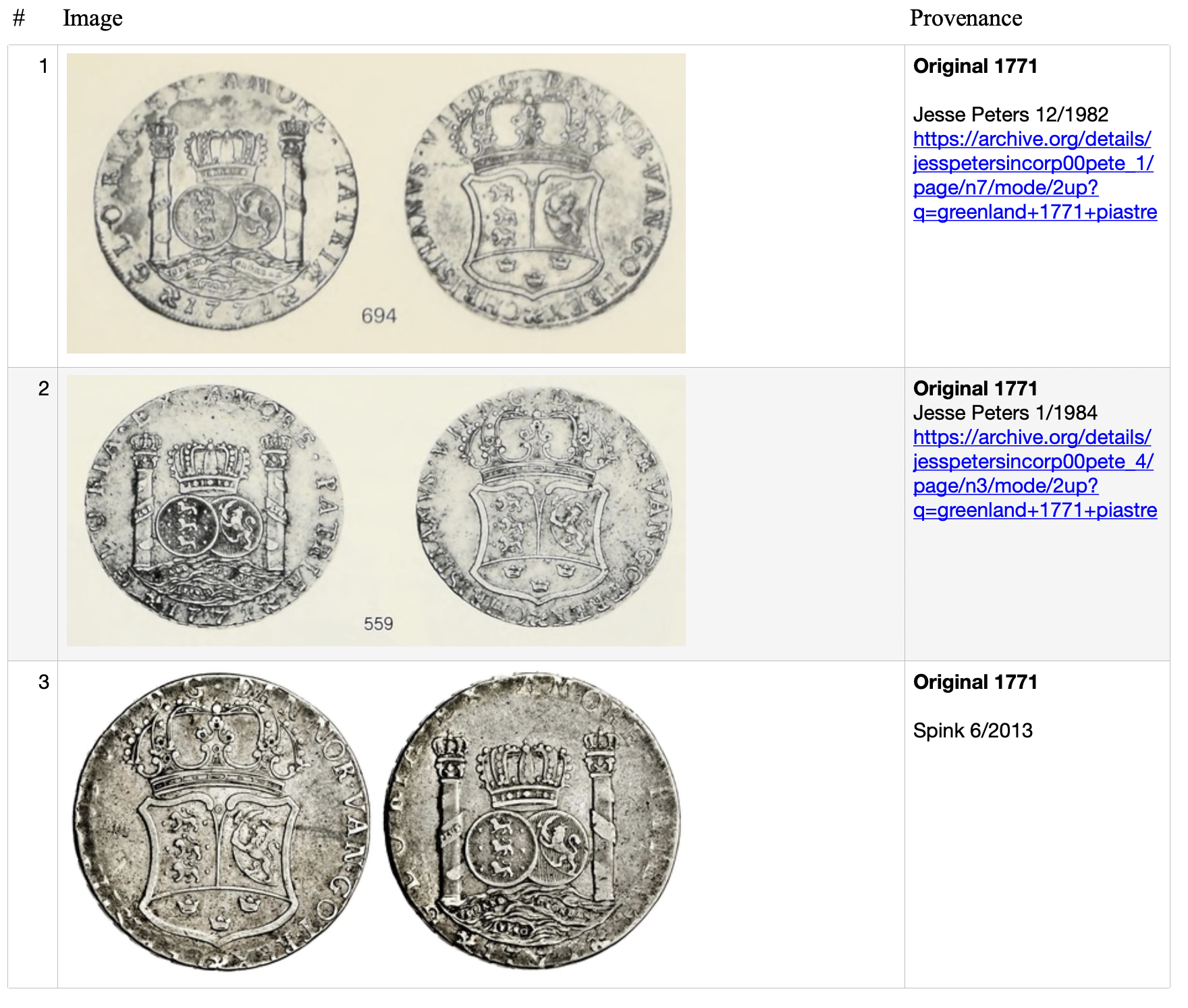
Restrikes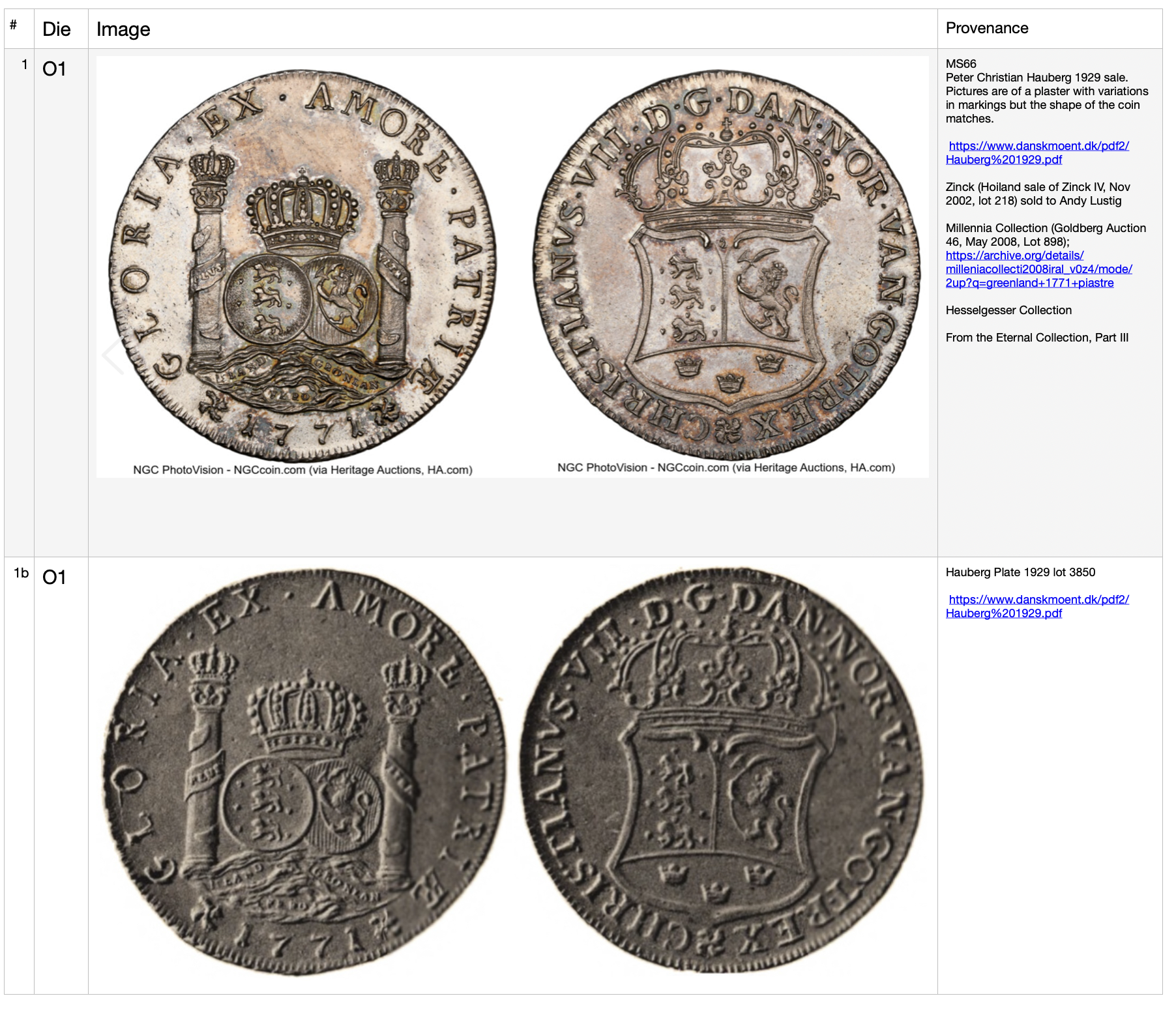
Comments
@Boosibri impressive
Absolutely impressive! I had the Auction 111 of the William H. Bleyer Collection from Jess Peters from 1982 in front of me as I read this and realized---you had that coin as your first coin! Thank you for sharing this!
Great information and a great read as always @boosibri. Thanks for sharing!
Nice work!
As a Danish coin, it doesn’t really belong in your collection, right?
Great write up. That MS-66 sure hit a record high today.
TalerUniverse.com is a curated numismatic project dedicated to the silver talers, crowns, and medals of the Habsburg Empire and the Holy Roman Empire, spanning the 16th–18th centuries. The collection emphasizes historically significant issues, rare mint varieties, and high-grade NGC/PCGS examples, presented with detailed historical context, scholarly references, and high-resolution photography. TalerUniverse aims to serve both as a private collection showcase and a growing reference resource for collectors, researchers, and students of early-modern European coinage.
Man that went for some money!
That Rutherford AU at $40k looks like the biggest bargain ever right now!
I'm BACK!!! Used to be Billet7 on the old forum.
Bad scratch on that coin. It’s up for sale again at Kunker.
Latin American Collection
Oh that’s SCRATCH?! I figured it must have been a strike error or die crack. Seems like it’s in the wrong holder, that’s a doozie!
I'm BACK!!! Used to be Billet7 on the old forum.
Great research- well written
Experience the World through Numismatics...it's more than you can imagine.
I thought of the same too! I had to look closely as well!
I’m curious to know if these type of write-ups and censuses are worth publishing in a magazine or other more widely disseminated format. I don’t mean to flatter myself, just genuinely curious if the format and content is interesting enough to be well received.
Latin American Collection
I think so, especially if you’re able to add a little human interest, an antidote of sorts. What makes it special?
I'm BACK!!! Used to be Billet7 on the old forum.
I think it would be worth it.
At the very least, it's educational to all numismatists on a basic level.
More so however, I feel, every little step taken in the study of important coinage such as this can go a long way toward helping future researchers and scholars, especially when care and accuracy have gone into the narrative.
Coming in 14 days. Video posted in case you want to get a better look: https://www.numisbids.com/sale/10184/lot/477
Latin American Collection
I suspect this could easily fit into an article in a number of Numismatic publications. It is concise and highlights the partial spectrum of what exists. Perhaps the more important question is simply this... If you were not doing this, who would?
It is admirable to undertake the research and present a brief overview as you have done here. Well done.
Experience the World through Numismatics...it's more than you can imagine.
Useful and interesting information. I would encourage you to try and publish.
My current "Box of 20"
Very impressed by your research. Scholarly, concise, pleasure to read. Thanks so much for sharing. Peace Roy
BST: endeavor1967, synchr, kliao, Outhaul, Donttellthewife, U1Chicago, ajaan, mCarney1173, SurfinHi, MWallace, Sandman70gt, mustanggt, Pittstate03, Lazybones, Walkerguy21D, coinandcurrency242 , thebigeng, Collectorcoins, JimTyler, USMarine6, Elkevvo, Coll3ctor, Yorkshireman, CUKevin, ranshdow, CoinHunter4, bennybravo, Centsearcher, braddick, Windycity, ZoidMeister, mirabela, JJM, RichURich, Bullsitter, jmski52, LukeMarshall, coinsarefun, MichaelDixon, NickPatton, ProfLiz, Twobitcollector,Jesbroken oih82w8, DCW
All I can say is that I’d absolutely subscribe/read. I would think your work could get traction easily enough if folks knew where/when/how to source it.
I might consider some changes to your variety notes. I used the following coins for the three varieties:
Spink - original
Stack's - restrike #1
Oslo Mynt - restrike #2
Each variety has its own obverse. In addition, the original reverse is different from the shared(?) reverse of the restrike varieties.
For the reverses, the difference is most obvious is the relation between the cross and the legend. On the original, the cross points (just left of center) of the dot between G and DAN. On the restrikes, it points to the serif of the D of DAN. In addition, the R of NOR is normal on the originals, whereas its base is repunched on the restrikes.
I think how you differentiate the original obverse is the best way. But for the restrikes, I think they may be a bit misdescribed. To my eyes, the first restrike has its cross points to the outer left serif of the A, if not slightly to the left of it. The second restrike has its cross pointing to the inner right serif of the A. (The original appears to have the cross point to the inner left serif of A.)
In addition, the end of ISLAND is different for the three dies. In the original it is straight. For the first restrike, it curves up. The second restrike, curves down.
Ed. S.
(EJS)
while researching Chilean Pillar Dollars included a letter between Mr. Palmer and Harald Salvesen where Salvesen notes that a “perfect” 1771 Greenland dollar sold recently (1982) for $15,000 in Europe
The MS66 example sold for $414800. The Danes plagiarized this world classc and today, their copy sells for multipoes of most if not all original 8 reales. Excelkent write up, better and ´more interesting than most Numismatist or other articles that I.ve read.
myEbay
DPOTD 3
The Bruun coin sold from a strong €156,000 today.
Latin American Collection
That it did.
I'm BACK!!! Used to be Billet7 on the old forum.
The number tells the story… wow.
Experience the World through Numismatics...it's more than you can imagine.
For posterity, that’s $181,000 today.
This goes to show, don’t price a coin solely based on its current TPG grade.
"Gloria Ex Amore Patriae" - beautiful.
I was again the brides maid being the first underbidder. Guess it wasn’t meant to be this time.
Latin American Collection