Ok, I guess I'll go ahead a wrap it up about Harry Greb, aka "The Pittsburgh Windmill", aka "The Smoke City Wildcat." I don't really need to say much about him, his resume speaks for itself, his reputation speaks for itself, he's a bada$$.
Hmm, one thing about Buster Douglas, he was one heck of a technical boxer, just wasn't always motivated, if he would have stayed focused and motivated, look out. He had a beautiful jab, was a great combination puncher, and had a vicious uppercut in his toolbox.
In 1988, Buster Douglas knocked Mike Williams down three times with a power jab, twice in the 3rd round and once in the 7th, before finishing him with a combination similar to the one he took Tyson out with. Buster really did have the tools to be an all-time great and Hall of Famer.
''Boxers are, by the nature of their trade, the most isoIated of all professionaI sportsmen. Team pIayers are free to spread the bIame for defeat, and even soIo performers may seek soIace in the shortcomings of others. AthIetes might blame jostIing competitors, or imponderables like the weather or the stack of the track; tennis pIayers can't rant about the myopic lines judges or the badIy strung racquets. But when a fighter loses - barring injury or temporary insanity which sometimes affIicts ringside officiaIs - whatever excuses he derises are irrelevant. All that matters is that, on the night, he went up against a man who was better than he was.''
Jack Blackburn, 1900s and 1910s lightweight who went on to train the great Joe Louis. Blackburn wore a signature scar down his left cheek that was a result of his own brother slashing him with a switchblade during a drunken fight in 1908. Blackburn would famously be called "Chappie" by Louis.
Jack Blackburn was a great fighter, one of the most feared lightweights in history, and later became a brilliant trainer, he guided Sammy Mandell and Bud Taylor to world titles, and of course he was the trainer of the great Joe Louis, the most dominant heavyweight in boxing history. But one thing about Blackburn, he had a violent reputation, unless you were close to him like Louis was, you really wanted to keep your distance from him and leave him be.
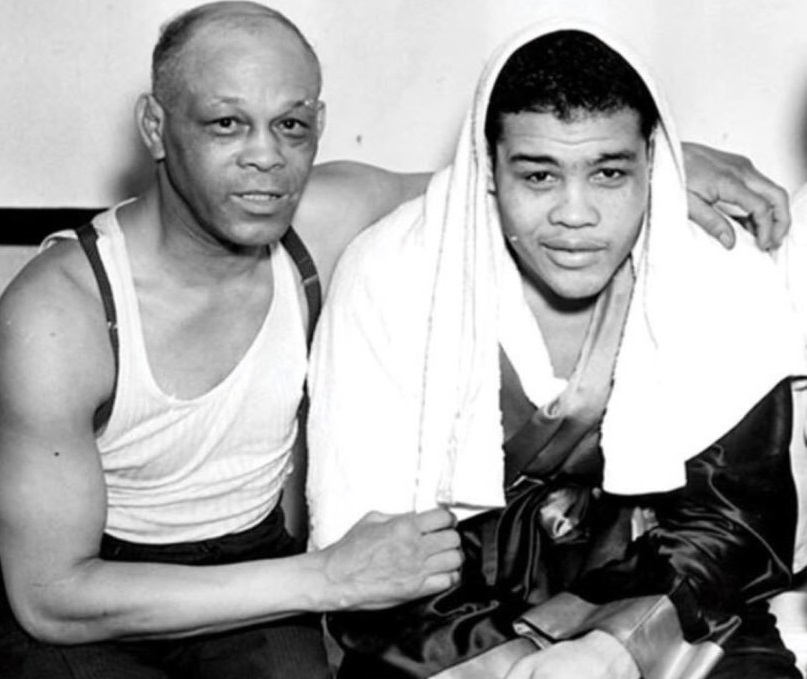
Jack Blackburn with Joe Louis
THE TUMULTUOUS LIFE & TIMES OF JACK BLACKBURN
"CHAPPIE"
By: Lou Eisen
"I remember Chappie saying, 'Don't go for the knockout yet. Keep jabbing him off balance so he can't get that right in, and for God's sake keep your left arm high.' I wish I had listened to him." — Joe Louis after his first fight and subsequent knockout loss against former world heavyweight champion, Max Schmeling, 1936.
Jack Blackburn is considered by many boxing historians to be among the several greatest trainers in the over three-hundred year history of prizefighting. It was Blackburn who turned a young, raw and, naïve AAU amateur champion named Joseph Louis Barrow into the greatest fighting machine ever to enter the prize ring. In terms of boxing credentials, you just can’t get any better than being the creator and trainer of Joe Louis. With Louis, Blackburn had achieved that most elusive of feats - perfection. Sadly, Blackburn is largely forgotten now. He was part of a bygone era, now long lost to the ages. Blackburn was not only a magnificent trainer. He was also a brilliant lightweight fighter in his time and fought and beat some of boxing’s biggest names in every weight division.
Jack Blackburn & Joe Louis
Why is Blackburn worth remembering? Well, because any list of boxing’s greatest trainers that does not include Jack Blackburn at the very top is simply not legitimate. The cataclysmic effect Blackburn had on the prize ring exists to this very day.
Joe Louis and Jack Blackburn always referred to each other as “Chappie,” much in the same way that Angelo Dundee (another all-time great trainer) almost never called Muhammad Ali by his name. He always referred to him as, “The Big Guy.” Angelo never had the privilege of meeting Blackburn although his older brother, promoter Chris Dundee, knew Blackburn well. Chris Dundee said that Blackburn was a cantankerous man and a brilliant trainer, when he was sober. He also added the caveat, “If you were around him when he was drunk, you were literally putting your own life on the line. He was a terrifying man when inebriated.” And yet, the fighters he trained loved him like a father.
ORIGINS
Charles Henry “Jack” Blackburn was born on May 20, 1883 in Versailles, Woodford County, Kentucky. The year of his birth is especially significant because he entered the world during the post Reconstruction era in the South, after the American Civil War. It was during this period that all of the civil and social advances made by African Americans in the Deep South were violently taken away by the KKK and other Southern racists. It would be another one hundred years before any progress regarding civil rights for African Americans was achieved.
Kentucky was a border state which never switched its allegiance to the Confederacy during the American Civil War. Still, Kentucky was a Southern state and African Americans had absolutely no rights to speak of in Kentucky when Blackburn was born and while he was growing up in that state. Muhammad Ali was born in Louisville, Kentucky on January 17, 1942, fifty-nine years after the birth of Blackburn, and yet, growing up, he had no more rights afforded him than Blackburn had almost sixty years earlier.
Blackburn was a frustratingly stubborn man, even within his own family. He never accepted the ignorant and vile theory that he was inferior to white men just because of the color of his skin. This refusal to knuckle under to the racist status quo precipitated many of his most violent, alcohol-fueled rages. Blackburn was always ready to defend his own honor from even the slightest provocation, real or inferred.
Blackburn was not a political man by nature but he certainly was well aware of the dangers experienced by Black men, women and children every day in the South, who dared stand up for their basic civil rights. However, even given the inherent dangers of being African American in the Deep South during the period known as Reconstruction, Blackburn was never known to have backed down from any man during his lifetime. Blackburn was an authentic tough guy. Authentic tough guys are a rare breed indeed. Later on, all men, irrespective of their skin color or ethnicity, knew well enough to leave Blackburn the hell alone.
Blackburn was born with a giant chip on his shoulder which only grew bigger as he aged. He was a very nasty but brilliant man. The fact that he had a nasty disposition should not come as a surprise, when you consider the never ending racial slurs and many humiliations he was forced to suffer in public.
Blackburn was the son of an itinerant preacher, or so it was said. In truth there is very little information available about the true identities of his parents. His parents and some of his siblings had been slaves. He was the youngest of eight children. Blackburn had three sisters, Lillie, Eva and Alice. He also had four older brothers, William, George, John and Fred. Of his seven siblings, Blackburn was closest with his brother Fred. Ironically Fred was the one sibling with whom Jack fought the most.
Blackburn was recorded in some official state and county records as being a mulatto. This was untrue. His parents were incorrectly listed as Louis Henry and Hellen Redd. This is simply not possible because the Redd’s were similar in age to Blackburn’s eldest siblings. As of today, no contemporary birth records or information has been found that could categorically state the true identity of Blackburn’s parents. In fact, he may not have known the actual identities of his parents himself.
At the very young and impressionable age of ten, his family opted for a change of scenery and relocated to Terre Haute, Indiana. Because his father was a minister, and subjected to the vagaries of that lifestyle, the family moved often, usually to any Southern city that required a minister to tend to a wayward congregation. The Blackburn family also lived in Indianapolis for a short time.
In Terre Haute, Indiana, Blackburn shared a place with his elder brother John and a brother-in-law named James Spalding. Being African American, none of the three men were afforded the opportunity to even apply for jobs. By the time he was 16, Blackburn stood 5’ 10” and weighed 135 pounds. He is believed to have started boxing professionally at the tender young age of 16 in 1899. Blackburn chose boxing because he was naturally strong and quick and he loved fighting more than life itself. His temperament fit his chosen profession perfectly. If ever a man was literally born to fight, it was Blackburn. Blackburn estimated he participated in over 400 professional fights, which is probably true. In Blackburn’s era, fighters only made money when they fought. Product endorsements and personal appearance fees for Black fighters were more than sixty years in the future.
Many fighters at the beginning of the twentieth century fought four or five times a week and sometimes more. Many top fighters like George Dixon often fought more than once a night. After their scheduled bout, they would fight somewhere else in an undisclosed location, under an alias. Such clandestine fights allowed meant they did not have to share their earnings with their managers. Blackburn fought a lot because he was an extremely gift fighter who was willing to fight any man in any weight division. He took minimal punishment during his ring career because he was a much smarter ring man than anyone he faced, with the exception of Joe Gans and Sam Langford.
Blackburn was not the only member of his family to enjoy fisticuffs. Despite the fact that their father preached love and peace and forgiveness in church, the Blackburn siblings were involved in street fights on an almost daily basis. When they couldn’t find trouble on the street, they fought each other. What distinguished the Blackburn siblings from other families that fought was the fact that they were extraordinarily violent. Many of them carried guns and switchblades, which they sometimes used on each other. The Blackburn’s simply did not know how to refuse a fight. Jack’s life-long love affair with booze started in his early teens. Jack could be found on many nights in some seedy bar drinking himself into a prolonged stupor, which almost always ended up evolving into vicious, blood-splattered brawls, which usually spilled out onto the street and claimed a variety of victims, both Black and white.
To disrespect Blackburn when he was sober was, needless to say, a very dangerous and stupid thing to do because he was always in the mood to fight. However, to verbally denigrate him when he was drunk was needlessly putting your very life at risk. Mind you, the people foolish enough to insult him were usually more drunk than Blackburn. Based solely on his reputation, most people learned early to give him a wide berth at all times and especially when he was imbibing alcohol in vast amounts. Blackburn was a snarling, nasty man when he was sober. When he was drunk, his intentions turned murderous.
Interestingly, his brothers refused to stop disparaging him, even when he was smashed. Blackburn never held back when attacking his brothers. He only weighed 135 pounds but he stood 5’10”, which was considered rather tall for a lightweight. Fighting was the only way Blackburn knew how to express himself. This was certainly peculiar because you’d think his brothers who obviously knew him better than anyone else would have learned early on not to antagonize him.
Blackburn was a loner by nature. He was a man of very few words. He was not one for idle chit chat. He preferred to do his talking in the ring. To call Blackburn moody or taciturn would be a cosmic understatement. He always kept his thoughts to himself. The only person he ever opened up to was Louis, who was very much like a son to him. Blackburn truly loved Louis and Louis felt the same way about Blackburn. Louis remarked many years later, “All those things you saw me do in the ring didn’t come to me naturally. Chappie taught me all of that. He was very patient. Without him in my corner, I never would have amounted to nothing.”
During his 23-year career. Blackburn, like most African American fighters was paid very little for his fistic services. Many white managers unrepentantly stole most of the purse money from their Black fighters, who were often lucky to receive any pay for their ring endeavours. Blackburn had to fight often likely just to stay solvent.
BOXING CAREER
He made his professional boxing debut on Sunday, April 29, 1900 at the Alexandria Athletic Club in Alexandria, Indiana. Back then, a professional debut did not mean a fighter was engaging in his first professional prizefight. A debut meant it was the first time he was fighting in front of the assembled press. Blackburn had been fighting several years by this time. How do we know this? Blackburn faced fellow novice Albert Bean, in a scheduled 15-round bout. In that era, no one made their professional debut in a fifteen-round fight. Blackburn would have had many fights under his belt to know how to pace himself over the course of fifteen rounds.
Blackburn soundly thrashed Beam in seven one-sided rounds. According to the newspaper, the Indianapolis Freeman, “Chas. (“Kid”) Blackburn easily defeated Al Beam, of Nashville, Tennessee in seven rounds”.[1] The fight was likely contested at 135 pounds. Blackburn was said to have known what he was doing in the ring, meaning he was an experienced fighter.
From 1900 to 1903, Blackburn fought mostly in and around Indianapolis and Terre Haute. In what was reputed to have been only his second fight ever (although this is certainly untrue), on Friday, June 15, 1900, at the Empire Theatre in Maywood, Indiana, Blackburn scored a 4-round decision over the superbly skilled Kentucky Rosebud, Walter Edgerton. This was considered a great accomplished as Edgerton held a knockout victory over the phenomenal Canadian, George Dixon, the first man of African descent ever to win an undisputed world boxing title.
In 1903, Blackburn switched his base of operations to the boxing mad state of Pennsylvania. His first fight in Pennsylvania took place at the Masonic Hall in Allegheny. Blackburn knocked out the overmatched Kid Reynolds in two rounds. This was followed by two fights in Pittsburgh. He then regularly fought out of one of the world’s greatest boxing hubs, Philadelphia. Incredibly, his very first fight in Philadelphia was against the magnificent fellow African American, Dave Holly. The newspapers scored the fight a draw although the Philadelphia Item scored the bout for Blackburn.
Only one month after facing Holly, Blackburn scored a draw against the very accomplished Jack Twin Sullivan over eight rounds. Remarkably, Blackburn managed to score a six round newspaper decision over future Hall of Famer Joe Gans, considered by many to be the greatest fighter of all time. Just two fighters later, Blackburn held Sam Langford, the greatest fighter to never win a world title, to a draw over 12 hard fought rounds in Boston. In 1904, Blackburn managed to score a six-round draw with Langford in what was considered a rather tame affair.
Canada’s Sam Langford stood only 5’6” but he was the hardest puncher and strongest fighter on the planet during his epic career. No one in the sport ever faced Langford willingly. He was a destroyer of men. Langford ended the careers of many fighters. No man was ever the same again physically or mentally after facing Sam Langford. Yet, Blackburn used his magnificent boxing skills to keep the fight manageable. Their second fight was likely a controlled exhibition (much like the Jake Paul-Mike Tyson fight, except with much more skill being showcased) where they had mutually agreed not to knock each other out.
Not too long after his draw with Langford, Blackburn lost a fifteen round points decision to Joe Gans in Baltimore. Gans was from Baltimore. The fight was contracted to take place at 140 pounds. Gans entered the ring at 135-pounds whereas Blackburn was said to have weighed somewhere in the neighborhood of 155-pounds. The 20-pound weight advantage did Blackburn no good as Gans was just too skilled for any living fighter at that point in time. Anyone facing Gans had to be absolutely perfect to even have a change against him and usually, even that wasn’t good enough.
On December 9, 1904, Blackburn faced Langford once again, this time fighting him to a 15-round draw. Langford only weighed 141 pounds for this fight and thus was not the monster he would soon become. Langford was being trained by fellow Canadian, George “Budge” Byers, who considered Langford to still be a work in progress. On September 20, 1905, Langford and Blackburn fought to a 10-round draw in Allentown. It’s rather intriguing that Langford fought Blackburn so many times while most other pugilists avoided Langford like the Plague. However, it is quite probable that at least some of their draws were pre-arranged fights.
The Blackburn-Langford predetermined draws came a cropper on October 7, 1905 in Philadelphia. The Philadelphia Item newspaper reported that word had leaked out that both fighters had agreed to take it easy on each other (which was not uncommon back then when two elite level fighters were facing each other). After only one round, the referee told both men they must try in earnest to knock each other out. Both Blackburn and Langford refused and the bout was declared a no-contest.
On June 29, 1906, Blackburn again clashed with great Joe Gans, losing a one-sided newspaper decision over six-rounds. One of the local papers stated that, “Gans showed that he was his opponent’s master in every department of the game.” There was never any shame attached in losing to Gans as he was by far the best fighter on the planet. In 1907, Blackburn took on talented middleweight Jim Barry, who fought heavyweights regularly, and split two fights with him, winning the first on points and losing the rematch by decision.
On November 11, 1920, Blackburn scored a 6-round newspaper decision over future undisputed world welterweight champion, Harry Lewis. On December 24, 1907, won a newspaper decision over the highly-ranked middleweight contender Mike Donovan, who outweighed him significantly. Donovan fought Blackburn a host of times but he never managed any better than a draw against him. Weight differentials usually meant nothing to Blackburn as his balance, punching power and defensive prowess were usually far superior to any of his opponents not named Gans. On June 10, 1908, Blackburn lost a newspaper decision to the light-heavyweight world champion, Philadelphia Jack O’Brien. O’Brien dropped Blackburn in the first stanza and in the last round as well. The light-heavyweight world title was not at stake in this fight.
In the first part of the last century, world champion boxers usually only risked their titles in outdoor arenas because such venues held many more fans than indoor arenas, thus the money you could earn for a title was significantly more. This practice continued right up until the era of Joe Louis. Simply put, you could make more money selling 80,000 tickets to a fight at Yankee Stadium than you could selling 18,000 ducats to a bout at Madison Square Garden.
VIOLENT NIGHT
December 29, 1908 turned out to be a fateful night for Blackburn. He scored a 6-round newspaper decision over Harry Mansfield in Philadelphia but that is insignificant. It’s what took place after the fight that changed the course of Blackburn’s life and, along with it, boxing history. The next day, Blackburn got into a vicious alcohol-fueled fight with his brother Fred. Fred had made insulting remarks about Jack’s wife Maud, who was older than her husband by five years, took out his switchblade and cut his brother’s face from the left ear down to his throat. Blackburn carried the emotional scars from that attack with him for the rest of his life.
JAIL TIME
Almost two weeks later on January 12, 1909, Blackburn found himself hopelessly drunk and roaringly angry. During an argument with a man named Alonzo Park, he took his gun out and fired 5 to 6 shots. It’s amazing that he hit anyone given his state of inebriation. Sadly, Polk died instantly. Blackburn then levelled the gun at Polk’s wife Mattie and shot her at point blank range. Miraculously, she survived. Blackburn was sentenced to 15 years in prison. He was released after serving only 4 years and 8 months.
The question that still remains unanswered until now is how on earth did Blackburn manage to avoid the death penalty for his actions? In 1909 Philadelphia, murder was indeed a capital offense. Most Philadelphians were stunned and many more were outraged that Blackburn had avoided the death penalty in favor of a rather light sentence, for such a heinous crime. The fact that he was roaring drunk at the time of the murder of Polk could have mitigated his punishment but that is highly unlikely.
More to the point, Blackburn escaped the death penalty because his trainer and manager was a white man named Frank Sutton. Blackburn was trained for most of his pro career by Sutton. Sutton even ran a boxing club on Ross Street in Philadelphia. He also owned the Sutton Hotel on Wylie Avenue. Sutton was an extremely influential man in Philadelphia. Sutton was also a very prominent leader in the Hill District community. He carried a lot of weight with politicians as well as with lawyers and judges. Sutton was wealthy because of the success of his popular hotel. He carried a lot of clout with Philadelphia’s movers and shakers.
Sutton genuinely liked and cared about Blackburn. Not to be discounted is the fact that Blackburn fought often against the best fighters in the world and always gave a great accounting of himself. Blackburn’s numerous bouts gave Sutton a regular cash flow. He also truly believed that Blackburn was more than good enough to become a world champion. Blackburn certainly was much more than good enough to be a world champion but he was denied a chance at a world title in any weight division due to the pernicious anti-Black racism then endemic to the sport boxing in the United States.
Blackburn was lucky in the sense that Sutton long craved to be the trainer and manager of a world champion prizefighter. He saw Blackburn as his best shot at achieving this goal. Sutton used all of his pull and influence in both the political and legal worlds to literally save Blackburn’s neck. It was Sutton who paid off the necessary people to have Blackburn sentenced to just 15 years in prison for capital murder. Sutton used his considerable power and bankroll to have Blackburn released from prison after serving less than five years of his sentence. It was in an odd sense, a sort of Faustian bargain. Blackburn never got a shot at a world boxing title but instead, he was allowed to live out the rest of his life.
Blackburn resumed his career once he was released from prison. He fought from 1914 to 1923 before retiring from the prize ring. His time in prison however, had robbed him of his skill set and any hope he had ever fostered about reaching the very top of his chosen profession. He lost almost as many times as he won from 1914 to 1923. During this time he lost six-round newspaper decisions to both Harry Greb and Gunboat Smith. He was also knocked out in four rounds by Kid Norfolk who was ten years younger and forty pounds heavier than Blackburn. When he retired as an active boxer, Blackburn had no way of knowing that his life in boxing was only at the beginning rather than at the end. His greatest fistic achievements lay ahead of him.
Jack Blackburn as a trainer was absolutely brilliant, the man knew boxing, and he was a master strategist and matchmaker. As far as day-to-day, he took no $hit from anybody and expected nothing short of perfection from his fighters, and the results speak for themselves, Sammy Mandell, Bud Taylor, and Joe Louis are bonafide all-time greats and Hall of Famers, he also worked with Jersey Joe Walcott for a while. I mean we're talking about the man who trained and guided Joe Louis to the most dominant reign in boxing history, as far as trainers are concerned, Jack Blackburn is right there with the best that ever did it. You know, it's fascinating, behind every great fighter there's usually a great trainer, the trainers don't often get the credit they deserve, but they should. It's kind of like that episode of The Twilight Zone, "Steel", about the boxing robots and their managers/trainers that program them to fight, that's essentially what a trainer does for a boxer in real life, sharpens their skills, teaches them, pours knowledge into them, programs them, and Jack Blackburn programmed Joe Louis to be one of the most destructive forces in boxing history. Jack Blackburn taught Joe Louis the core fundamentals of boxing: balance, accuracy, and strategy, transforming him from a raw talent into the "Brown Bomber" by emphasizing planting his feet, using his whole body to punch, developing a devastating knockout ability, and mastering defense and counter-punching. He instilled the psychological killer instinct Louis needed, teaching him to be aggressive and rely on his powerful right hand as his referee, making Louis the most complete heavyweight ever.
Anyway, here's a few good photos of Jack Blackburn and Joe Louis, or as I like to think of them, Dr. Frankenstein and his monster, during their reign of terror.
Jack Blackburn and Joe Louis training for the first Max Schmeling fight in Lafayette, New York in 1936. It was a historic fight, Louis went into the fight unbeaten, Schmeling would spot a flaw in Louis's style and knock him out in the 12th round. It would be the only time Louis lost in or near his prime, he wouldn't lose again for 14 years, in 1950, when he was past his prime.
Joe Louis at his training camp in Lafayette, New York playing baseball with his trainer, Jack Blackburn, acting as catcher and his manager, John Roxborough, acting as umpire.
It's interesting, Jack Blackburn was hesitant about training Joe Louis at first because Louis was a heavyweight, and historically speaking the heavyweight division is front and center in the spotlight of the American public, and the American public was heavily racist in those days and didn't take kindly to having a black heavyweight champion. Another interesting thing, Jack Blackburn personally knew the first black heavyweight champion, Jack Johnson, they grew to despise each other.
"Louis & Blackburn"
Post by: Roy Bennett
STERN TASKMASTER
The story is often told that when (Jack) Blackburn was first approached in Chicago in 1934 by one of Joe Louis’ managers, John Roxborough, he was skeptical in the extreme about the opportunities awaiting a black heavyweight. Louis’ managers, themselves black, were younger and less cynical than Blackburn. Roxborough, though he came from a middle class family, earned his living by running a numbers operation in Detroit. Roxborough’s partner in handling Louis was Julian Black, who ran a speakeasy in Chicago at the time and was also involved in the local numbers racket.
In a 1937 interview in The Ring, Blackburn said, “When Black And Roxborough brought Joe to me, he was just a big, easy-going Negro boy with high water pants and too much arms for his coat sleeves.
‘So you think you can get somewhere in the fighting game?’ I says to him. ‘Well, let me tell you something right off. It’s next to impossible for a Negro heavyweight to get anywhere. He’s got to be very good outside the ring and very bad inside the ring. Mr. Roxborough, who has known you quite a while, is convinced that you can be depended on to behave yourself, but you’ve gotta be a killer, otherwise I’m getting too old to waste any time on you.’”
"You know, boy, the heavyweight division for a Negro is hardly likely. The white man ain't too keen on it. You have to really be something to get anywhere... And you got to listen to everything I tell you. You got to jump when I say jump, sleep when I say sleep. Other than that, you're wasting my time." Louis’ response, Blackburn recalled, was, “I ain’t gonna waste any of your time.”
Blackburn said he was not impressed with Louis until the young fighter had been working with him in the gym for about a week. “I began to figure maybe Roxborough was right. Maybe this Louis boy has real talent. He had a good body, hit fast and learned fast. And he was nuts about fightin’.”
Blackburn was concerned, however, that Louis might be “too easy-going .... too nice a fella” to succeed as a professional boxer. Louis “didn’t have any blood in his eye,” Blackburn recalled. “He didn’t go out to murder the boys in the gym. Didn’t have the killer instinct. So I knows right then what I got to do and I does it.”
What Blackburn did was convince Louis that he would have to be a sensational knockout artist if he had any hope of succeeding. “You can’t get nowhere nowadays trying to outpoint fellows in the ring,” Blackburn recalled telling Louis. “It’s mighty hard for a colored boy to win decisions. The dice is loaded against you. You gotta knock ‘em out and keep knocking ‘em out to get anywheres. Let your right fist be the referee. Don’t ever forget that. Let that right there be your referee.”
“I painted the picture for Joe and I kept painting it for him,” Blackburn told his interviewer. “Fighting is a tough business. Nobody knows that better than me. I fought ‘em all for twenty-five years .... lightweights to heavyweights .... you just gotta throw away your heart when you pull on those gloves, or the other fella’ll knock it outta you. That’s why Joe Louis is a killer in the ring today.”
And Louis agreed to Jack Blackburn's terms. Once they got going, Blackburn turned Louis into one of the most destructive forces to ever step foot in a boxing ring.
"Jack Blackburn was born in Kentucky in 1893. He'd been one hell of a fighter himself. In twenty years he'd had over one hundred fights as a Lightweight and won most of them. He was rough-talking; I suppose anybody who'd been in and out of prison - he had served five years for murder - would talk rough.
He wouldn't let me in the ring for the first week I knew him, but made me hit the punching bag over and over. He'd hold the bag and give me instructions on how to throw punches. I did this morning, noon and night until I could have sworn the bag was punching me, too.
After a while, he let me box for him. He saw my faults right off. I was hitting off balance. He started correcting this by showing me how to plant my feet and punch with my whole body, not just by swinging my arms.
He said people going to fights don't want to see a dancer or a clincher - they want to see a man who goes for the guts. He said that I had strength and that I could beat or knock out anybody I wanted if I planted my feet in the right position.''
Great photo of the first black heavyweight champion Jack Johnson with Joe Louis. Jack Johnson hated Louis' trainer Jack Blackburn. And Blackburn hated him right back. The feud between Blackburn and Johnson was bitter and Johnson actually criticized Louis publicly at one point.
It all started in 1908 when Johnson, already larger than life, strutted into a Philadelphia gym with a group of admiring women and called for a sparring partner. Blackburn—a wiry, hot-tempered Lightweight—stepped up. As he told it, he gave Johnson a bloody nose, slipping and countering everything the embarrassed heavyweight threw at him. Johnson left furious.
A year later, Blackburn was in prison for manslaughter after a deadly street fight. Desperate for help, he asked Johnson to visit and assist in raising money for an appeal. Johnson refused with pleasure: “Let the son of a ***** stay in jail.”
Blackburn was pardoned in 1914 and fought for nearly another decade, but he lost most of his skill while in prison and his shot at greatness was gone. As a trainer, Blackburn mostly worked with white fighters, refusing to train Black heavyweights—at least at first. When a young Joe Louis came along, he hesitated. “Colored heavyweights are a dime a dozen,” he said.
Blackburn believed Johnson was to blame for shutting doors for black people instead of opening them. He believed Johnson had the chance to pave the way when he beat Tommy Burns for the heavyweight title—but his attitude, his defiance, and the way he carried himself as champion made sure those doors slammed shut again.
At one point, Johnson actually criticized Joe Louis publicly, saying about Louis:
''Louis was a slow footed manufactured boxer and a sucker for the right, with Poor Craftsmanship and Marked Mechanical Flaws.''
This was probably be due to the fact that Johnson originally wanted to train Louis, but Louis was instead trained by Jack Blackburn, which only added fuel to the fire between Johnson and Blackburn.
In the end, Blackburn still played a part in changing history. That fighter? Joe Louis. The man who finally broke through, 22-years after the previous black heavyweight champion Jack Johnson's reign had ended.
Interesting though, Joe Louis once stated he appreciated meeting Jack Johnson and expressed gratitude for the advice Johnson gave him.
“My biggest thrill up there had been to meet the last black Heavyweight Champion, Jack Johnson. I liked him. He never mentioned the problems he was having and never asked for any money or anything. He was an impressive looking guy and a good talker. He told me I was going to run into every situation possible and he warned me to keep my head at all times.”
It's a complex situation, Jack Blackburn, Jack Johnson, and Joe Louis, trying to cover it I'm starting to feel like I'm on an episode of Jerry Springer here, like I'm caught in some kind of domestic triangle and I'm happy just to move on from it. Anyway, a few more photos of Jack Blackburn and Joe Louis. Great shot of them fishing in the rain.
Joe Louis and his team, from left to right, co-manager Julian Black, trainer Jack Blackburn, Joe Louis, co-manager John Roxborough, and assistant trainer Russ Cowan.
Joe Louis, center, flanked by his trainer, Jack Blackburn (left), and his manager, Julian Black, shows the fist that won him the heavyweight crown over James Braddock in the eight round of their fight in Chicago. June 22, 1937.
Of all the images of Jack Blackburn and Joe Louis together, this is my favorite one, it's an absolutely mesmerizing image, Joe Louis with his head slightly against Blackburn, as if he's telling him how much he means to him, and the expression on Blackburn's face as if he's returning the gesture. Joe Louis loved Jack Blackburn like a father and Blackburn loved Louis like a son and this photo is just absolutely stunning. These two men made sports history together, Joe Louis was the most dominant fighter in boxing history, world heavyweight champion for 12 years, (1937-1949) making 25 defenses of his title, and Jack Blackburn was the one that made him into that fighter.
Jack Blackburn died in Chicago on April 24th in 1942. He suffered a heart attack while being given a routine physical examination. He had been suffering from pneumonia for two months, beginning shortly before Joe Louis met Abe Simon at Madison Square Garden in March of that year, Louis' 21st title defense. Blackburn's death came particularly hard for his greatest training protégé, Louis whom he had trained since Louis' first professional bout. His funeral, which several thousand attended, took place on the South side of Chicago at Pilgrim Baptist Church on April 29, 1942. He was buried at Chicago's Lincoln Cemetery. He was 59 years old. Understandably, Joe Louis was absolutely devastated.
Joe Louis reacting to the news of Jack Blackburn's death:
"I'm so upset...this is the worst news - the worst shock I ever got in my life."
"Why, I visited old Chappie in Chicago after my last fight and the doctors said he was gettin' better fast. I just can't understand it."
"This is awful...Chappie was just like a father to me. He was with me for every one of my professional fights except the last with Abe Simon."
This is a fitting photo to end our profile on one of the greatest trainers in boxing history, Jack Blackburn. It's a photo of Joe Louis hitting the heavy bag in 1935, the year it all started, the way it all started.
Comments
Harry Greb in the hospital after his car flipped over, two broken ribs.
Ok, I guess I'll go ahead a wrap it up about Harry Greb, aka "The Pittsburgh Windmill", aka "The Smoke City Wildcat." I don't really need to say much about him, his resume speaks for itself, his reputation speaks for itself, he's a bada$$.
Nice up close shot of Tokyo Douglas knocking out Tyson in 1990.
Hmm, one thing about Buster Douglas, he was one heck of a technical boxer, just wasn't always motivated, if he would have stayed focused and motivated, look out. He had a beautiful jab, was a great combination puncher, and had a vicious uppercut in his toolbox.
This is my favorite Buster Douglas card, the 2010 Ringside Boxing Round 1 - Mecca Turkey Red and the photo used on the card.
In 1988, Buster Douglas knocked Mike Williams down three times with a power jab, twice in the 3rd round and once in the 7th, before finishing him with a combination similar to the one he took Tyson out with. Buster really did have the tools to be an all-time great and Hall of Famer.
These are the highlights from Douglas-Williams, beautiful stuff from Douglas.
''Boxers are, by the nature of their trade, the most isoIated of all professionaI sportsmen. Team pIayers are free to spread the bIame for defeat, and even soIo performers may seek soIace in the shortcomings of others. AthIetes might blame jostIing competitors, or imponderables like the weather or the stack of the track; tennis pIayers can't rant about the myopic lines judges or the badIy strung racquets. But when a fighter loses - barring injury or temporary insanity which sometimes affIicts ringside officiaIs - whatever excuses he derises are irrelevant. All that matters is that, on the night, he went up against a man who was better than he was.''
Jack Blackburn, 1900s and 1910s lightweight who went on to train the great Joe Louis. Blackburn wore a signature scar down his left cheek that was a result of his own brother slashing him with a switchblade during a drunken fight in 1908. Blackburn would famously be called "Chappie" by Louis.
Jack Blackburn was a great fighter, one of the most feared lightweights in history, and later became a brilliant trainer, he guided Sammy Mandell and Bud Taylor to world titles, and of course he was the trainer of the great Joe Louis, the most dominant heavyweight in boxing history. But one thing about Blackburn, he had a violent reputation, unless you were close to him like Louis was, you really wanted to keep your distance from him and leave him be.
Jack Blackburn with Joe Louis
THE TUMULTUOUS LIFE & TIMES OF JACK BLACKBURN
"CHAPPIE"
By: Lou Eisen
"I remember Chappie saying, 'Don't go for the knockout yet. Keep jabbing him off balance so he can't get that right in, and for God's sake keep your left arm high.' I wish I had listened to him." — Joe Louis after his first fight and subsequent knockout loss against former world heavyweight champion, Max Schmeling, 1936.
Jack Blackburn is considered by many boxing historians to be among the several greatest trainers in the over three-hundred year history of prizefighting. It was Blackburn who turned a young, raw and, naïve AAU amateur champion named Joseph Louis Barrow into the greatest fighting machine ever to enter the prize ring. In terms of boxing credentials, you just can’t get any better than being the creator and trainer of Joe Louis. With Louis, Blackburn had achieved that most elusive of feats - perfection. Sadly, Blackburn is largely forgotten now. He was part of a bygone era, now long lost to the ages. Blackburn was not only a magnificent trainer. He was also a brilliant lightweight fighter in his time and fought and beat some of boxing’s biggest names in every weight division.
Jack Blackburn & Joe Louis
Why is Blackburn worth remembering? Well, because any list of boxing’s greatest trainers that does not include Jack Blackburn at the very top is simply not legitimate. The cataclysmic effect Blackburn had on the prize ring exists to this very day.
Joe Louis and Jack Blackburn always referred to each other as “Chappie,” much in the same way that Angelo Dundee (another all-time great trainer) almost never called Muhammad Ali by his name. He always referred to him as, “The Big Guy.” Angelo never had the privilege of meeting Blackburn although his older brother, promoter Chris Dundee, knew Blackburn well. Chris Dundee said that Blackburn was a cantankerous man and a brilliant trainer, when he was sober. He also added the caveat, “If you were around him when he was drunk, you were literally putting your own life on the line. He was a terrifying man when inebriated.” And yet, the fighters he trained loved him like a father.
ORIGINS
Charles Henry “Jack” Blackburn was born on May 20, 1883 in Versailles, Woodford County, Kentucky. The year of his birth is especially significant because he entered the world during the post Reconstruction era in the South, after the American Civil War. It was during this period that all of the civil and social advances made by African Americans in the Deep South were violently taken away by the KKK and other Southern racists. It would be another one hundred years before any progress regarding civil rights for African Americans was achieved.
Kentucky was a border state which never switched its allegiance to the Confederacy during the American Civil War. Still, Kentucky was a Southern state and African Americans had absolutely no rights to speak of in Kentucky when Blackburn was born and while he was growing up in that state. Muhammad Ali was born in Louisville, Kentucky on January 17, 1942, fifty-nine years after the birth of Blackburn, and yet, growing up, he had no more rights afforded him than Blackburn had almost sixty years earlier.
Blackburn was a frustratingly stubborn man, even within his own family. He never accepted the ignorant and vile theory that he was inferior to white men just because of the color of his skin. This refusal to knuckle under to the racist status quo precipitated many of his most violent, alcohol-fueled rages. Blackburn was always ready to defend his own honor from even the slightest provocation, real or inferred.
Blackburn was not a political man by nature but he certainly was well aware of the dangers experienced by Black men, women and children every day in the South, who dared stand up for their basic civil rights. However, even given the inherent dangers of being African American in the Deep South during the period known as Reconstruction, Blackburn was never known to have backed down from any man during his lifetime. Blackburn was an authentic tough guy. Authentic tough guys are a rare breed indeed. Later on, all men, irrespective of their skin color or ethnicity, knew well enough to leave Blackburn the hell alone.
Blackburn was born with a giant chip on his shoulder which only grew bigger as he aged. He was a very nasty but brilliant man. The fact that he had a nasty disposition should not come as a surprise, when you consider the never ending racial slurs and many humiliations he was forced to suffer in public.
Blackburn was the son of an itinerant preacher, or so it was said. In truth there is very little information available about the true identities of his parents. His parents and some of his siblings had been slaves. He was the youngest of eight children. Blackburn had three sisters, Lillie, Eva and Alice. He also had four older brothers, William, George, John and Fred. Of his seven siblings, Blackburn was closest with his brother Fred. Ironically Fred was the one sibling with whom Jack fought the most.
Blackburn was recorded in some official state and county records as being a mulatto. This was untrue. His parents were incorrectly listed as Louis Henry and Hellen Redd. This is simply not possible because the Redd’s were similar in age to Blackburn’s eldest siblings. As of today, no contemporary birth records or information has been found that could categorically state the true identity of Blackburn’s parents. In fact, he may not have known the actual identities of his parents himself.
At the very young and impressionable age of ten, his family opted for a change of scenery and relocated to Terre Haute, Indiana. Because his father was a minister, and subjected to the vagaries of that lifestyle, the family moved often, usually to any Southern city that required a minister to tend to a wayward congregation. The Blackburn family also lived in Indianapolis for a short time.
In Terre Haute, Indiana, Blackburn shared a place with his elder brother John and a brother-in-law named James Spalding. Being African American, none of the three men were afforded the opportunity to even apply for jobs. By the time he was 16, Blackburn stood 5’ 10” and weighed 135 pounds. He is believed to have started boxing professionally at the tender young age of 16 in 1899. Blackburn chose boxing because he was naturally strong and quick and he loved fighting more than life itself. His temperament fit his chosen profession perfectly. If ever a man was literally born to fight, it was Blackburn. Blackburn estimated he participated in over 400 professional fights, which is probably true. In Blackburn’s era, fighters only made money when they fought. Product endorsements and personal appearance fees for Black fighters were more than sixty years in the future.
Many fighters at the beginning of the twentieth century fought four or five times a week and sometimes more. Many top fighters like George Dixon often fought more than once a night. After their scheduled bout, they would fight somewhere else in an undisclosed location, under an alias. Such clandestine fights allowed meant they did not have to share their earnings with their managers. Blackburn fought a lot because he was an extremely gift fighter who was willing to fight any man in any weight division. He took minimal punishment during his ring career because he was a much smarter ring man than anyone he faced, with the exception of Joe Gans and Sam Langford.
Blackburn was not the only member of his family to enjoy fisticuffs. Despite the fact that their father preached love and peace and forgiveness in church, the Blackburn siblings were involved in street fights on an almost daily basis. When they couldn’t find trouble on the street, they fought each other. What distinguished the Blackburn siblings from other families that fought was the fact that they were extraordinarily violent. Many of them carried guns and switchblades, which they sometimes used on each other. The Blackburn’s simply did not know how to refuse a fight. Jack’s life-long love affair with booze started in his early teens. Jack could be found on many nights in some seedy bar drinking himself into a prolonged stupor, which almost always ended up evolving into vicious, blood-splattered brawls, which usually spilled out onto the street and claimed a variety of victims, both Black and white.
To disrespect Blackburn when he was sober was, needless to say, a very dangerous and stupid thing to do because he was always in the mood to fight. However, to verbally denigrate him when he was drunk was needlessly putting your very life at risk. Mind you, the people foolish enough to insult him were usually more drunk than Blackburn. Based solely on his reputation, most people learned early to give him a wide berth at all times and especially when he was imbibing alcohol in vast amounts. Blackburn was a snarling, nasty man when he was sober. When he was drunk, his intentions turned murderous.
Interestingly, his brothers refused to stop disparaging him, even when he was smashed. Blackburn never held back when attacking his brothers. He only weighed 135 pounds but he stood 5’10”, which was considered rather tall for a lightweight. Fighting was the only way Blackburn knew how to express himself. This was certainly peculiar because you’d think his brothers who obviously knew him better than anyone else would have learned early on not to antagonize him.
Blackburn was a loner by nature. He was a man of very few words. He was not one for idle chit chat. He preferred to do his talking in the ring. To call Blackburn moody or taciturn would be a cosmic understatement. He always kept his thoughts to himself. The only person he ever opened up to was Louis, who was very much like a son to him. Blackburn truly loved Louis and Louis felt the same way about Blackburn. Louis remarked many years later, “All those things you saw me do in the ring didn’t come to me naturally. Chappie taught me all of that. He was very patient. Without him in my corner, I never would have amounted to nothing.”
During his 23-year career. Blackburn, like most African American fighters was paid very little for his fistic services. Many white managers unrepentantly stole most of the purse money from their Black fighters, who were often lucky to receive any pay for their ring endeavours. Blackburn had to fight often likely just to stay solvent.
BOXING CAREER
He made his professional boxing debut on Sunday, April 29, 1900 at the Alexandria Athletic Club in Alexandria, Indiana. Back then, a professional debut did not mean a fighter was engaging in his first professional prizefight. A debut meant it was the first time he was fighting in front of the assembled press. Blackburn had been fighting several years by this time. How do we know this? Blackburn faced fellow novice Albert Bean, in a scheduled 15-round bout. In that era, no one made their professional debut in a fifteen-round fight. Blackburn would have had many fights under his belt to know how to pace himself over the course of fifteen rounds.
Blackburn soundly thrashed Beam in seven one-sided rounds. According to the newspaper, the Indianapolis Freeman, “Chas. (“Kid”) Blackburn easily defeated Al Beam, of Nashville, Tennessee in seven rounds”.[1] The fight was likely contested at 135 pounds. Blackburn was said to have known what he was doing in the ring, meaning he was an experienced fighter.
From 1900 to 1903, Blackburn fought mostly in and around Indianapolis and Terre Haute. In what was reputed to have been only his second fight ever (although this is certainly untrue), on Friday, June 15, 1900, at the Empire Theatre in Maywood, Indiana, Blackburn scored a 4-round decision over the superbly skilled Kentucky Rosebud, Walter Edgerton. This was considered a great accomplished as Edgerton held a knockout victory over the phenomenal Canadian, George Dixon, the first man of African descent ever to win an undisputed world boxing title.
In 1903, Blackburn switched his base of operations to the boxing mad state of Pennsylvania. His first fight in Pennsylvania took place at the Masonic Hall in Allegheny. Blackburn knocked out the overmatched Kid Reynolds in two rounds. This was followed by two fights in Pittsburgh. He then regularly fought out of one of the world’s greatest boxing hubs, Philadelphia. Incredibly, his very first fight in Philadelphia was against the magnificent fellow African American, Dave Holly. The newspapers scored the fight a draw although the Philadelphia Item scored the bout for Blackburn.
Only one month after facing Holly, Blackburn scored a draw against the very accomplished Jack Twin Sullivan over eight rounds. Remarkably, Blackburn managed to score a six round newspaper decision over future Hall of Famer Joe Gans, considered by many to be the greatest fighter of all time. Just two fighters later, Blackburn held Sam Langford, the greatest fighter to never win a world title, to a draw over 12 hard fought rounds in Boston. In 1904, Blackburn managed to score a six-round draw with Langford in what was considered a rather tame affair.
Canada’s Sam Langford stood only 5’6” but he was the hardest puncher and strongest fighter on the planet during his epic career. No one in the sport ever faced Langford willingly. He was a destroyer of men. Langford ended the careers of many fighters. No man was ever the same again physically or mentally after facing Sam Langford. Yet, Blackburn used his magnificent boxing skills to keep the fight manageable. Their second fight was likely a controlled exhibition (much like the Jake Paul-Mike Tyson fight, except with much more skill being showcased) where they had mutually agreed not to knock each other out.
Not too long after his draw with Langford, Blackburn lost a fifteen round points decision to Joe Gans in Baltimore. Gans was from Baltimore. The fight was contracted to take place at 140 pounds. Gans entered the ring at 135-pounds whereas Blackburn was said to have weighed somewhere in the neighborhood of 155-pounds. The 20-pound weight advantage did Blackburn no good as Gans was just too skilled for any living fighter at that point in time. Anyone facing Gans had to be absolutely perfect to even have a change against him and usually, even that wasn’t good enough.
On December 9, 1904, Blackburn faced Langford once again, this time fighting him to a 15-round draw. Langford only weighed 141 pounds for this fight and thus was not the monster he would soon become. Langford was being trained by fellow Canadian, George “Budge” Byers, who considered Langford to still be a work in progress. On September 20, 1905, Langford and Blackburn fought to a 10-round draw in Allentown. It’s rather intriguing that Langford fought Blackburn so many times while most other pugilists avoided Langford like the Plague. However, it is quite probable that at least some of their draws were pre-arranged fights.
The Blackburn-Langford predetermined draws came a cropper on October 7, 1905 in Philadelphia. The Philadelphia Item newspaper reported that word had leaked out that both fighters had agreed to take it easy on each other (which was not uncommon back then when two elite level fighters were facing each other). After only one round, the referee told both men they must try in earnest to knock each other out. Both Blackburn and Langford refused and the bout was declared a no-contest.
On June 29, 1906, Blackburn again clashed with great Joe Gans, losing a one-sided newspaper decision over six-rounds. One of the local papers stated that, “Gans showed that he was his opponent’s master in every department of the game.” There was never any shame attached in losing to Gans as he was by far the best fighter on the planet. In 1907, Blackburn took on talented middleweight Jim Barry, who fought heavyweights regularly, and split two fights with him, winning the first on points and losing the rematch by decision.
On November 11, 1920, Blackburn scored a 6-round newspaper decision over future undisputed world welterweight champion, Harry Lewis. On December 24, 1907, won a newspaper decision over the highly-ranked middleweight contender Mike Donovan, who outweighed him significantly. Donovan fought Blackburn a host of times but he never managed any better than a draw against him. Weight differentials usually meant nothing to Blackburn as his balance, punching power and defensive prowess were usually far superior to any of his opponents not named Gans. On June 10, 1908, Blackburn lost a newspaper decision to the light-heavyweight world champion, Philadelphia Jack O’Brien. O’Brien dropped Blackburn in the first stanza and in the last round as well. The light-heavyweight world title was not at stake in this fight.
In the first part of the last century, world champion boxers usually only risked their titles in outdoor arenas because such venues held many more fans than indoor arenas, thus the money you could earn for a title was significantly more. This practice continued right up until the era of Joe Louis. Simply put, you could make more money selling 80,000 tickets to a fight at Yankee Stadium than you could selling 18,000 ducats to a bout at Madison Square Garden.
VIOLENT NIGHT
December 29, 1908 turned out to be a fateful night for Blackburn. He scored a 6-round newspaper decision over Harry Mansfield in Philadelphia but that is insignificant. It’s what took place after the fight that changed the course of Blackburn’s life and, along with it, boxing history. The next day, Blackburn got into a vicious alcohol-fueled fight with his brother Fred. Fred had made insulting remarks about Jack’s wife Maud, who was older than her husband by five years, took out his switchblade and cut his brother’s face from the left ear down to his throat. Blackburn carried the emotional scars from that attack with him for the rest of his life.
JAIL TIME
Almost two weeks later on January 12, 1909, Blackburn found himself hopelessly drunk and roaringly angry. During an argument with a man named Alonzo Park, he took his gun out and fired 5 to 6 shots. It’s amazing that he hit anyone given his state of inebriation. Sadly, Polk died instantly. Blackburn then levelled the gun at Polk’s wife Mattie and shot her at point blank range. Miraculously, she survived. Blackburn was sentenced to 15 years in prison. He was released after serving only 4 years and 8 months.
The question that still remains unanswered until now is how on earth did Blackburn manage to avoid the death penalty for his actions? In 1909 Philadelphia, murder was indeed a capital offense. Most Philadelphians were stunned and many more were outraged that Blackburn had avoided the death penalty in favor of a rather light sentence, for such a heinous crime. The fact that he was roaring drunk at the time of the murder of Polk could have mitigated his punishment but that is highly unlikely.
More to the point, Blackburn escaped the death penalty because his trainer and manager was a white man named Frank Sutton. Blackburn was trained for most of his pro career by Sutton. Sutton even ran a boxing club on Ross Street in Philadelphia. He also owned the Sutton Hotel on Wylie Avenue. Sutton was an extremely influential man in Philadelphia. Sutton was also a very prominent leader in the Hill District community. He carried a lot of weight with politicians as well as with lawyers and judges. Sutton was wealthy because of the success of his popular hotel. He carried a lot of clout with Philadelphia’s movers and shakers.
Sutton genuinely liked and cared about Blackburn. Not to be discounted is the fact that Blackburn fought often against the best fighters in the world and always gave a great accounting of himself. Blackburn’s numerous bouts gave Sutton a regular cash flow. He also truly believed that Blackburn was more than good enough to become a world champion. Blackburn certainly was much more than good enough to be a world champion but he was denied a chance at a world title in any weight division due to the pernicious anti-Black racism then endemic to the sport boxing in the United States.
Blackburn was lucky in the sense that Sutton long craved to be the trainer and manager of a world champion prizefighter. He saw Blackburn as his best shot at achieving this goal. Sutton used all of his pull and influence in both the political and legal worlds to literally save Blackburn’s neck. It was Sutton who paid off the necessary people to have Blackburn sentenced to just 15 years in prison for capital murder. Sutton used his considerable power and bankroll to have Blackburn released from prison after serving less than five years of his sentence. It was in an odd sense, a sort of Faustian bargain. Blackburn never got a shot at a world boxing title but instead, he was allowed to live out the rest of his life.
Blackburn resumed his career once he was released from prison. He fought from 1914 to 1923 before retiring from the prize ring. His time in prison however, had robbed him of his skill set and any hope he had ever fostered about reaching the very top of his chosen profession. He lost almost as many times as he won from 1914 to 1923. During this time he lost six-round newspaper decisions to both Harry Greb and Gunboat Smith. He was also knocked out in four rounds by Kid Norfolk who was ten years younger and forty pounds heavier than Blackburn. When he retired as an active boxer, Blackburn had no way of knowing that his life in boxing was only at the beginning rather than at the end. His greatest fistic achievements lay ahead of him.
Jack Blackburn during his fighting career.
A few more photos of Jack Blackburn in his fighting days.
Jack Blackburn as a trainer was absolutely brilliant, the man knew boxing, and he was a master strategist and matchmaker. As far as day-to-day, he took no $hit from anybody and expected nothing short of perfection from his fighters, and the results speak for themselves, Sammy Mandell, Bud Taylor, and Joe Louis are bonafide all-time greats and Hall of Famers, he also worked with Jersey Joe Walcott for a while. I mean we're talking about the man who trained and guided Joe Louis to the most dominant reign in boxing history, as far as trainers are concerned, Jack Blackburn is right there with the best that ever did it. You know, it's fascinating, behind every great fighter there's usually a great trainer, the trainers don't often get the credit they deserve, but they should. It's kind of like that episode of The Twilight Zone, "Steel", about the boxing robots and their managers/trainers that program them to fight, that's essentially what a trainer does for a boxer in real life, sharpens their skills, teaches them, pours knowledge into them, programs them, and Jack Blackburn programmed Joe Louis to be one of the most destructive forces in boxing history. Jack Blackburn taught Joe Louis the core fundamentals of boxing: balance, accuracy, and strategy, transforming him from a raw talent into the "Brown Bomber" by emphasizing planting his feet, using his whole body to punch, developing a devastating knockout ability, and mastering defense and counter-punching. He instilled the psychological killer instinct Louis needed, teaching him to be aggressive and rely on his powerful right hand as his referee, making Louis the most complete heavyweight ever.
Anyway, here's a few good photos of Jack Blackburn and Joe Louis, or as I like to think of them, Dr. Frankenstein and his monster, during their reign of terror.
Jack Blackburn and Joe Louis training for the first Max Schmeling fight in Lafayette, New York in 1936. It was a historic fight, Louis went into the fight unbeaten, Schmeling would spot a flaw in Louis's style and knock him out in the 12th round. It would be the only time Louis lost in or near his prime, he wouldn't lose again for 14 years, in 1950, when he was past his prime.
Joe Louis at his training camp in Lafayette, New York playing baseball with his trainer, Jack Blackburn, acting as catcher and his manager, John Roxborough, acting as umpire.
Jack Blackburn checks on Louis during a training session, not sure when this photo was taken.
Jack Blackburn and Joe Louis having a good time, this photo is really self explanatory.
Jack Blackburn taping Louis' hands before a sparring session.
Jack Blackburn and Joe Louis having a meal.
The great Joe Louis and his team: from left, co-manager John Roxborough, trainer Jack Blackburn, Louis, and co-manager Julian Black.
It's interesting, Jack Blackburn was hesitant about training Joe Louis at first because Louis was a heavyweight, and historically speaking the heavyweight division is front and center in the spotlight of the American public, and the American public was heavily racist in those days and didn't take kindly to having a black heavyweight champion. Another interesting thing, Jack Blackburn personally knew the first black heavyweight champion, Jack Johnson, they grew to despise each other.
"Louis & Blackburn"
Post by: Roy Bennett
STERN TASKMASTER
The story is often told that when (Jack) Blackburn was first approached in Chicago in 1934 by one of Joe Louis’ managers, John Roxborough, he was skeptical in the extreme about the opportunities awaiting a black heavyweight. Louis’ managers, themselves black, were younger and less cynical than Blackburn. Roxborough, though he came from a middle class family, earned his living by running a numbers operation in Detroit. Roxborough’s partner in handling Louis was Julian Black, who ran a speakeasy in Chicago at the time and was also involved in the local numbers racket.
In a 1937 interview in The Ring, Blackburn said, “When Black And Roxborough brought Joe to me, he was just a big, easy-going Negro boy with high water pants and too much arms for his coat sleeves.
‘So you think you can get somewhere in the fighting game?’ I says to him. ‘Well, let me tell you something right off. It’s next to impossible for a Negro heavyweight to get anywhere. He’s got to be very good outside the ring and very bad inside the ring. Mr. Roxborough, who has known you quite a while, is convinced that you can be depended on to behave yourself, but you’ve gotta be a killer, otherwise I’m getting too old to waste any time on you.’”
"You know, boy, the heavyweight division for a Negro is hardly likely. The white man ain't too keen on it. You have to really be something to get anywhere... And you got to listen to everything I tell you. You got to jump when I say jump, sleep when I say sleep. Other than that, you're wasting my time." Louis’ response, Blackburn recalled, was, “I ain’t gonna waste any of your time.”
Blackburn said he was not impressed with Louis until the young fighter had been working with him in the gym for about a week. “I began to figure maybe Roxborough was right. Maybe this Louis boy has real talent. He had a good body, hit fast and learned fast. And he was nuts about fightin’.”
Blackburn was concerned, however, that Louis might be “too easy-going .... too nice a fella” to succeed as a professional boxer. Louis “didn’t have any blood in his eye,” Blackburn recalled. “He didn’t go out to murder the boys in the gym. Didn’t have the killer instinct. So I knows right then what I got to do and I does it.”
What Blackburn did was convince Louis that he would have to be a sensational knockout artist if he had any hope of succeeding. “You can’t get nowhere nowadays trying to outpoint fellows in the ring,” Blackburn recalled telling Louis. “It’s mighty hard for a colored boy to win decisions. The dice is loaded against you. You gotta knock ‘em out and keep knocking ‘em out to get anywheres. Let your right fist be the referee. Don’t ever forget that. Let that right there be your referee.”
“I painted the picture for Joe and I kept painting it for him,” Blackburn told his interviewer. “Fighting is a tough business. Nobody knows that better than me. I fought ‘em all for twenty-five years .... lightweights to heavyweights .... you just gotta throw away your heart when you pull on those gloves, or the other fella’ll knock it outta you. That’s why Joe Louis is a killer in the ring today.”
And Louis agreed to Jack Blackburn's terms. Once they got going, Blackburn turned Louis into one of the most destructive forces to ever step foot in a boxing ring.
"Jack Blackburn was born in Kentucky in 1893. He'd been one hell of a fighter himself. In twenty years he'd had over one hundred fights as a Lightweight and won most of them. He was rough-talking; I suppose anybody who'd been in and out of prison - he had served five years for murder - would talk rough.
He wouldn't let me in the ring for the first week I knew him, but made me hit the punching bag over and over. He'd hold the bag and give me instructions on how to throw punches. I did this morning, noon and night until I could have sworn the bag was punching me, too.
After a while, he let me box for him. He saw my faults right off. I was hitting off balance. He started correcting this by showing me how to plant my feet and punch with my whole body, not just by swinging my arms.
He said people going to fights don't want to see a dancer or a clincher - they want to see a man who goes for the guts. He said that I had strength and that I could beat or knock out anybody I wanted if I planted my feet in the right position.''
Great photo of the first black heavyweight champion Jack Johnson with Joe Louis. Jack Johnson hated Louis' trainer Jack Blackburn. And Blackburn hated him right back. The feud between Blackburn and Johnson was bitter and Johnson actually criticized Louis publicly at one point.
It all started in 1908 when Johnson, already larger than life, strutted into a Philadelphia gym with a group of admiring women and called for a sparring partner. Blackburn—a wiry, hot-tempered Lightweight—stepped up. As he told it, he gave Johnson a bloody nose, slipping and countering everything the embarrassed heavyweight threw at him. Johnson left furious.
A year later, Blackburn was in prison for manslaughter after a deadly street fight. Desperate for help, he asked Johnson to visit and assist in raising money for an appeal. Johnson refused with pleasure: “Let the son of a ***** stay in jail.”
Blackburn was pardoned in 1914 and fought for nearly another decade, but he lost most of his skill while in prison and his shot at greatness was gone. As a trainer, Blackburn mostly worked with white fighters, refusing to train Black heavyweights—at least at first. When a young Joe Louis came along, he hesitated. “Colored heavyweights are a dime a dozen,” he said.
Blackburn believed Johnson was to blame for shutting doors for black people instead of opening them. He believed Johnson had the chance to pave the way when he beat Tommy Burns for the heavyweight title—but his attitude, his defiance, and the way he carried himself as champion made sure those doors slammed shut again.
At one point, Johnson actually criticized Joe Louis publicly, saying about Louis:
''Louis was a slow footed manufactured boxer and a sucker for the right, with Poor Craftsmanship and Marked Mechanical Flaws.''
This was probably be due to the fact that Johnson originally wanted to train Louis, but Louis was instead trained by Jack Blackburn, which only added fuel to the fire between Johnson and Blackburn.
In the end, Blackburn still played a part in changing history. That fighter? Joe Louis. The man who finally broke through, 22-years after the previous black heavyweight champion Jack Johnson's reign had ended.
Interesting though, Joe Louis once stated he appreciated meeting Jack Johnson and expressed gratitude for the advice Johnson gave him.
“My biggest thrill up there had been to meet the last black Heavyweight Champion, Jack Johnson. I liked him. He never mentioned the problems he was having and never asked for any money or anything. He was an impressive looking guy and a good talker. He told me I was going to run into every situation possible and he warned me to keep my head at all times.”
It's a complex situation, Jack Blackburn, Jack Johnson, and Joe Louis, trying to cover it I'm starting to feel like I'm on an episode of Jerry Springer here, like I'm caught in some kind of domestic triangle and I'm happy just to move on from it. Anyway, a few more photos of Jack Blackburn and Joe Louis. Great shot of them fishing in the rain.
Joe Louis and his team, from left to right, co-manager Julian Black, trainer Jack Blackburn, Joe Louis, co-manager John Roxborough, and assistant trainer Russ Cowan.
Blackburn and a young Joe Louis.
Jack Blackburn, Joe Louis, and John Roxborough look over some paperwork.
Jack Blackburn, Joe Louis, and Julian Black sit in Louis' dressing room after his 5th round knockout of Harry Thomas on April 1st in 1938.
John Roxborough, Joe Louis, and Jack Blackburn dressed in gray suits, notice how they match the room decor, epic image.
Another epic image of Jack Blackburn and Joe Louis.
Joe Louis, center, flanked by his trainer, Jack Blackburn (left), and his manager, Julian Black, shows the fist that won him the heavyweight crown over James Braddock in the eight round of their fight in Chicago. June 22, 1937.
Of all the images of Jack Blackburn and Joe Louis together, this is my favorite one, it's an absolutely mesmerizing image, Joe Louis with his head slightly against Blackburn, as if he's telling him how much he means to him, and the expression on Blackburn's face as if he's returning the gesture. Joe Louis loved Jack Blackburn like a father and Blackburn loved Louis like a son and this photo is just absolutely stunning. These two men made sports history together, Joe Louis was the most dominant fighter in boxing history, world heavyweight champion for 12 years, (1937-1949) making 25 defenses of his title, and Jack Blackburn was the one that made him into that fighter.
Jack Blackburn died in Chicago on April 24th in 1942. He suffered a heart attack while being given a routine physical examination. He had been suffering from pneumonia for two months, beginning shortly before Joe Louis met Abe Simon at Madison Square Garden in March of that year, Louis' 21st title defense. Blackburn's death came particularly hard for his greatest training protégé, Louis whom he had trained since Louis' first professional bout. His funeral, which several thousand attended, took place on the South side of Chicago at Pilgrim Baptist Church on April 29, 1942. He was buried at Chicago's Lincoln Cemetery. He was 59 years old. Understandably, Joe Louis was absolutely devastated.
Joe Louis reacting to the news of Jack Blackburn's death:
"I'm so upset...this is the worst news - the worst shock I ever got in my life."
"Why, I visited old Chappie in Chicago after my last fight and the doctors said he was gettin' better fast. I just can't understand it."
"This is awful...Chappie was just like a father to me. He was with me for every one of my professional fights except the last with Abe Simon."
"He taught me pretty near everything I know."
A few more photos of Jack Blackburn and Joe Louis.
This is a fitting photo to end our profile on one of the greatest trainers in boxing history, Jack Blackburn. It's a photo of Joe Louis hitting the heavy bag in 1935, the year it all started, the way it all started.